In the Javanese city of Solo, formally known as Surakarta, behind high walls washed a distinctive pale blue, lies one of the two great royal courts of central Java. The Kraton Surakarta is the palace of the Susuhunan, the senior ruler in the old hierarchy of Javanese kings, and within its walls the ancient traditions of Javanese court culture, its music, its dance, its ceremony, and its mysticism, are preserved and practiced to this day. A tall pagilion-tower rises above the compound, linking, in legend, the mortal ruler to the goddess of the southern sea.
The Kraton Surakarta is the twin and rival of the Kraton of Yogyakarta, for the two palaces were born together from the division of the old kingdom of Mataram in the middle of the eighteenth century. Where Yogyakarta was covered earlier in this series, Surakarta is its senior partner, the court whose ruler bears the exalted title of Susuhunan, and the two together preserve the classical culture of the Javanese court.
The palace is a vast walled compound at the heart of the city, arranged along the sacred axis of Javanese cosmology and filled with pavilions, courtyards, and the treasures of the court. Like its counterpart in Yogyakarta, it is not a dead museum but a living court, home to a reigning Susuhunan and the setting for the continuing rituals of Javanese kingship.
This is the opening palace of a second group of Javanese and Indonesian royal courts in this series, following the Kraton of Yogyakarta explored earlier, and it deepens the portrait of the classical culture of Java. To enter the pale blue walls of the Kraton Surakarta is to step into the living world of the Javanese court, a place of gamelan and dance, of sacred ritual and ancient tradition, at the heart of the island of Java.
In This Article
- A Living Court in the Heart of Solo
- Born from the Division of Mataram
- The Susuhunan and His Titles
- Reading the Plan of the Palace
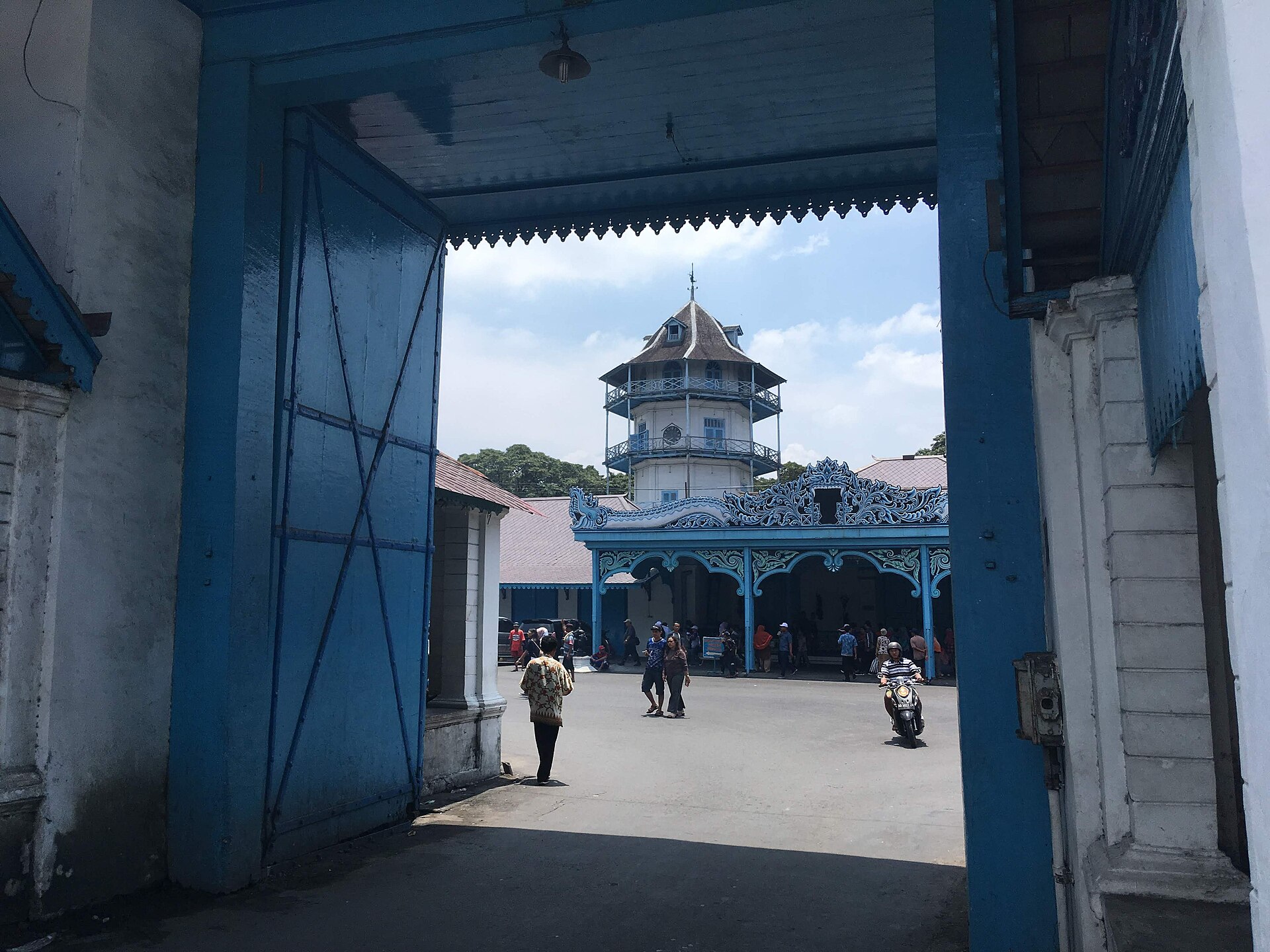
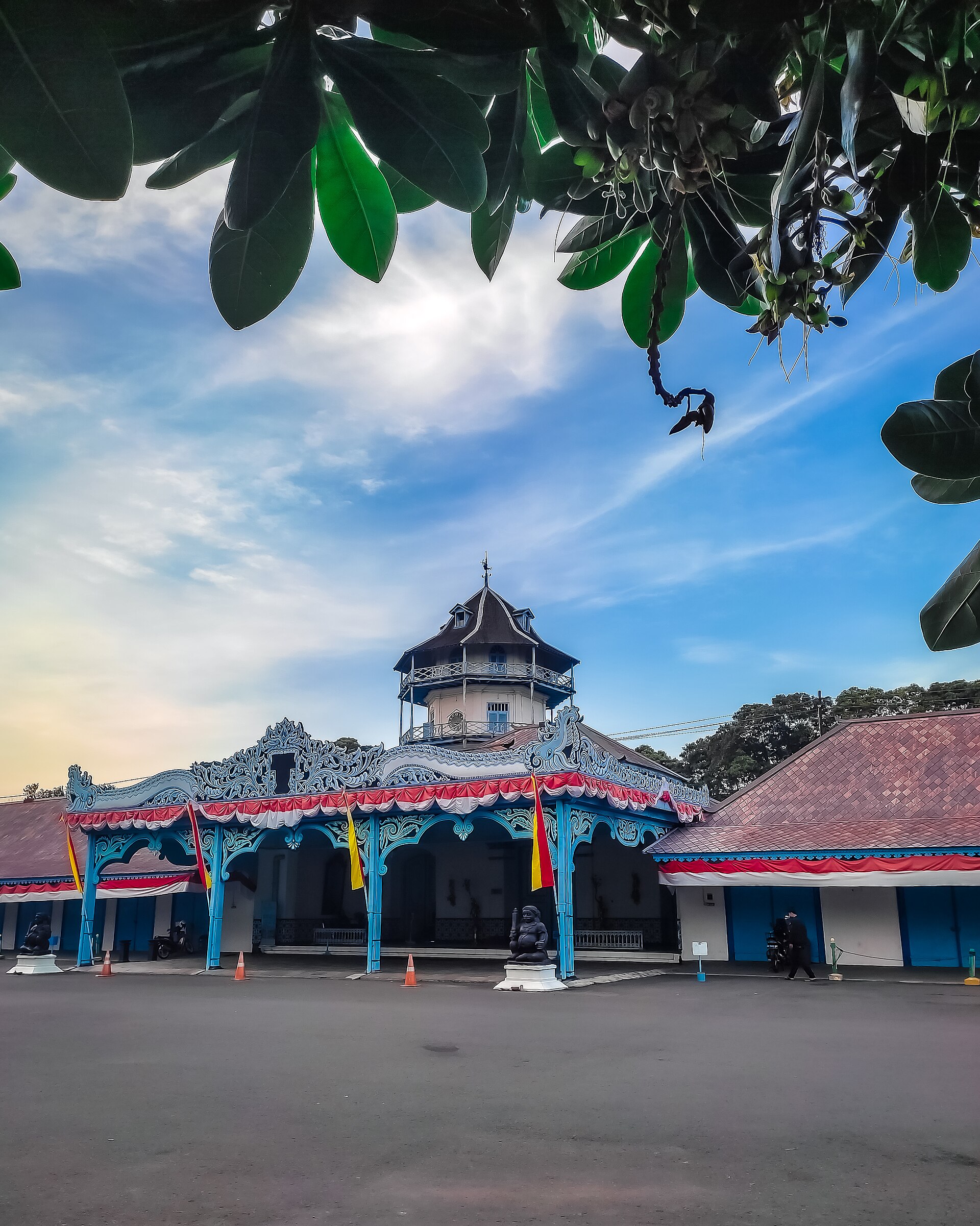
- The Panggung Sangga Buwana
- The Great Audience Pavilion
- Gamelan, Dance, and the Classical Arts
- Heirlooms and Sacred Regalia
- The Rhythm of Court Ceremony
- Inner Courts and Private Precincts
- The Palace Museum
- The Palace and Its City
- Visiting the Kraton Today
A Living Court in the Heart of Solo
Step through the outer gates of the Kraton Surakarta and you leave the traffic of a modern Indonesian city behind almost at once. The compound is a world of its own, ordered around courtyards and pavilions that follow rules older than the buildings themselves. Sand brought from the southern coast covers the ground of the great forecourt, and ancient tamarind and banyan trees stand where court protocol has always placed them. The palace is not a ruin or a preserved relic; it remains the residence of the Susuhunan and the working centre of a court that still keeps its calendar of ceremonies.
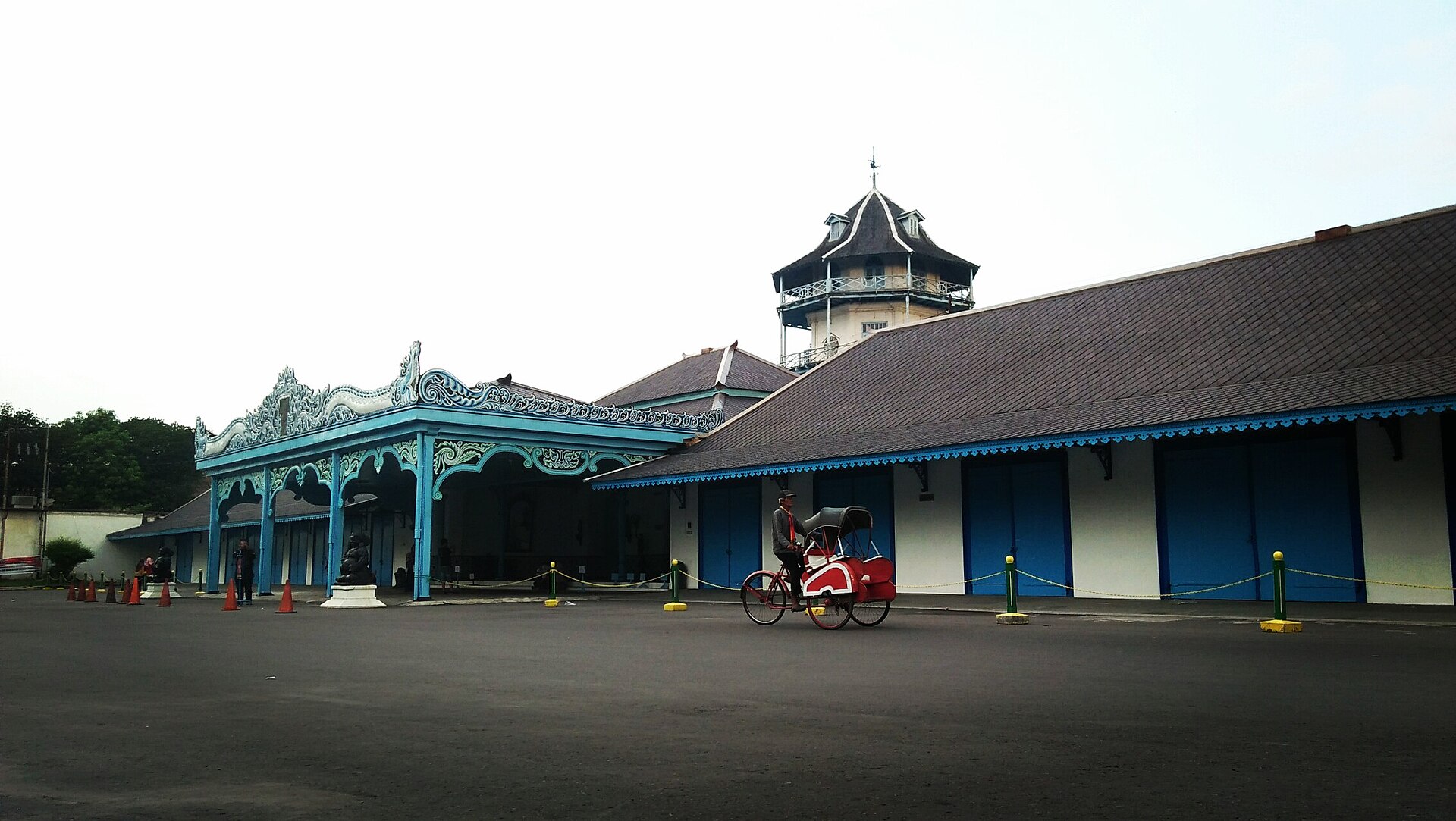
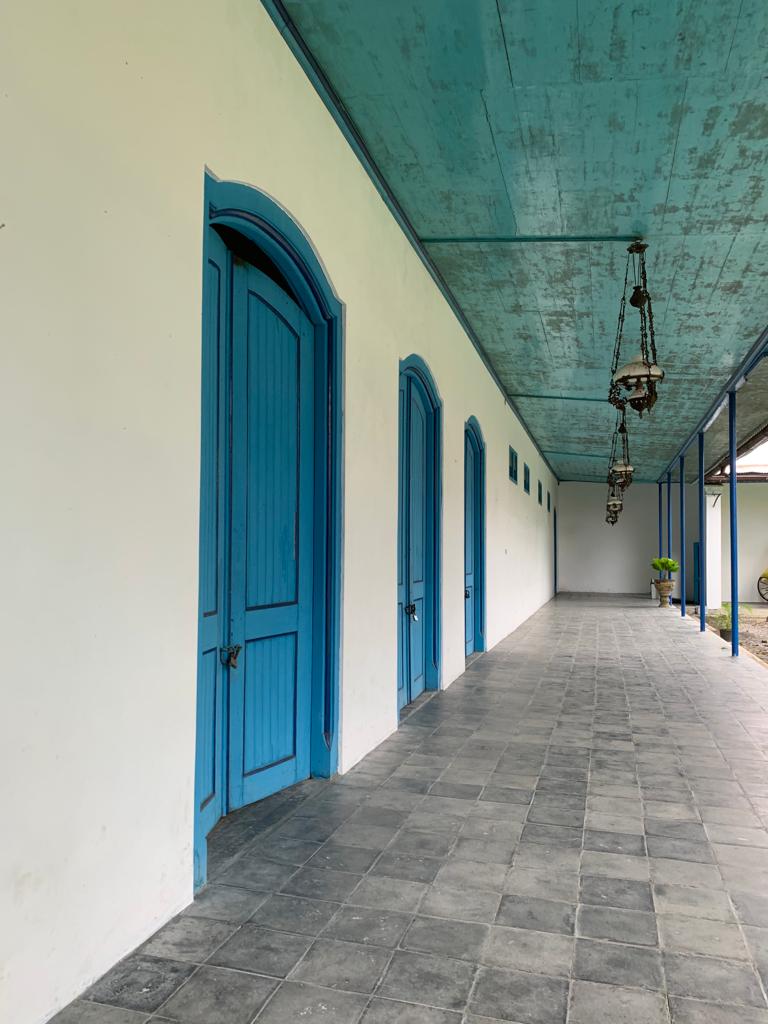
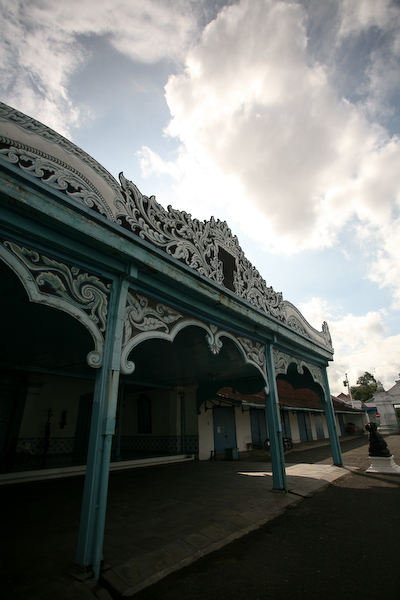
What strikes most visitors first is the colour. The walls and many of the structures are washed in a soft, chalky blue that seems to belong to no other palace in Java, a shade the court adopted as its own and has maintained for generations. Against that blue the deep teak browns of the pavilions and the gold of ceremonial fittings stand out with quiet drama.
To understand Surakarta you have to hold two ideas together at once. It is a museum in the truest sense, guarding regalia, manuscripts, and traditions that reach back centuries, and it is also a household, where a family descended from kings still lives, marries, mourns, and celebrates according to forms that would be recognisable to their eighteenth-century ancestors. That doubleness gives the place its particular atmosphere, at once grand and intimate.
First-time visitors sometimes expect a fortress or a showpiece and find instead something gentler and more human. The scale is grand but the mood is unhurried, and the presence of ordinary court life, attendants crossing a courtyard, the distant clatter of gamelan rehearsal, keeps the grandeur grounded. That is part of what makes the kraton memorable: it wears its history lightly, as a place still lived in rather than merely shown.
The blue of the walls has practical as well as aesthetic meaning. Repainted and renewed over the years, it signals that the compound is cared for, that the household within is active, and that the court still commands the resources and the will to maintain its distinctive face to the world. Colour, here as elsewhere in the kraton, is never merely decorative.
Born from the Division of Mataram
The Kraton Surakarta owes its existence to one of the defining upheavals of Javanese history. In the first half of the eighteenth century the great inland kingdom of Mataram, which had dominated central Java, was worn down by succession disputes, rebellions, and the steady pressure of the Dutch East India Company. The court had already been forced to abandon its earlier capital, and in the 1740s the ruler established a new seat at a village on the Solo River, a place chosen, tradition says, on the advice of spiritual counsellors who read the omens of the land and water.
That new capital was Surakarta. But peace did not follow. Within a few years a further dispute over the throne split the kingdom in two. By the terms of a settlement reached in the middle of the century, the realm of Mataram was divided between two rulers, and a new court was founded at Yogyakarta to the south-west. From that moment there were two royal houses where there had been one, each claiming the mantle of the old kingdom.
Surakarta kept the senior title. Its ruler remained the Susuhunan, the elder of the two sovereigns, while the Yogyakarta prince took the title of Sultan. The rivalry between the two courts, sometimes bitter, sometimes merely ceremonial, has shaped Javanese cultural life ever since, with each palace cultivating its own distinct styles of music, dance, dress, and court etiquette.
The memory of that division still colours how the two courts see themselves. Even now, small differences in the tuning of an instrument or the angle of a dancer’s wrist can be traced back to the moment the kingdom split, each house having refined its own version of a shared inheritance. What might have been a purely political quarrel became, over the generations, a rich cultural rivalry that multiplied rather than diminished the classical arts of Java.
The Susuhunan and His Titles
At the centre of the whole establishment stands the figure of the Susuhunan, a word that carries the sense of one who is revered, a lord to whom homage is due. The full string of royal titles is far longer, layering together claims to be the axis of the realm, the keeper of the faith, and the heir of the Mataram line. In the classical worldview of the Javanese court, the ruler was not simply a political head but a cosmic one, a still point around which the kingdom and even the natural world were meant to turn.
That idea expresses itself everywhere in the palace. The layout of the courtyards, the direction the ruler faces on ceremonial occasions, the placement of trees and gates, all encode a sense of the Susuhunan as the meeting point of visible and invisible powers. Legend binds him in particular to Nyai Roro Kidul, the goddess of the southern sea, whose mystical union with the kings of Mataram is remembered in dances and offerings.
In practical terms the powers of the Susuhunan have shifted enormously over the centuries, curtailed first by the Dutch and later absorbed into the modern Indonesian republic. Today the role is cultural and ceremonial rather than governmental. Yet within the walls of the kraton the old dignity is maintained with care, and the person of the Susuhunan remains the living link to a royal tradition that Indonesians regard as one of the treasures of their heritage.
It is worth remembering how gradually these powers ebbed away. For long stretches the Susuhunan remained a genuine political actor, negotiating, resisting, and manoeuvring within the constraints the Dutch imposed. The retreat into a purely ceremonial role was the work of centuries, not a single stroke, and something of that older gravity still clings to the office as it is performed within the palace walls today.
The bond with the goddess of the southern sea is not treated as quaint folklore within the palace but as a living element of kingship. Offerings are still made, and the great southern beaches remain places of pilgrimage associated with the court. In the Javanese imagination the ruler stands at the junction of land and ocean, mountain and sea, and the Susuhunan’s titles and rituals keep that cosmic geography continually in view.
Reading the Plan of the Palace
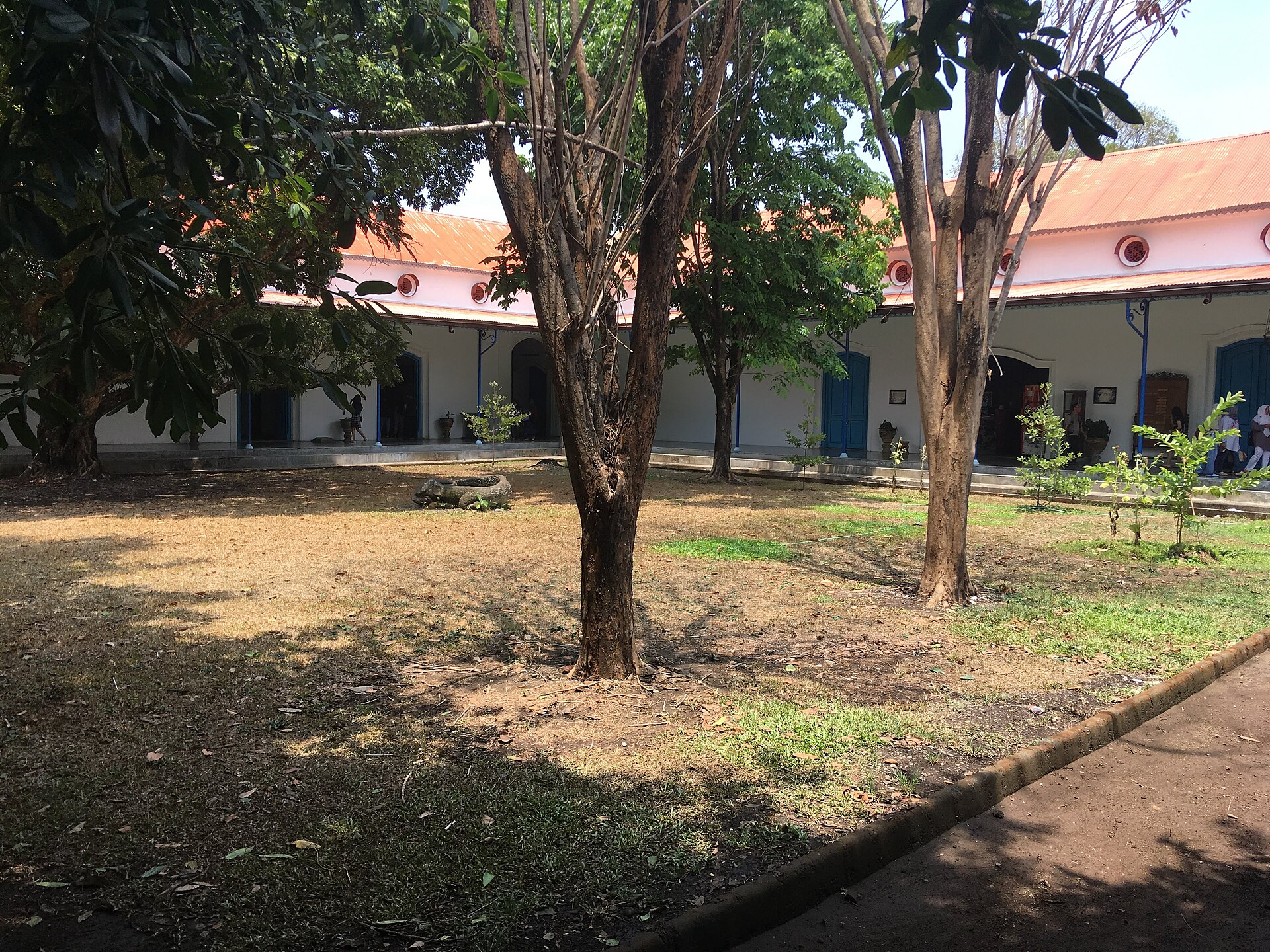
The kraton is best understood as a series of spaces arranged along an axis, each more sacred and more restricted than the last. A visitor moving inward passes from broad public squares, through gateways, into progressively more private courtyards, until reaching the innermost precincts reserved for the ruler and his household. This graded procession is not accidental; it maps the Javanese sense of how the ordinary world gives way to the sacred centre.
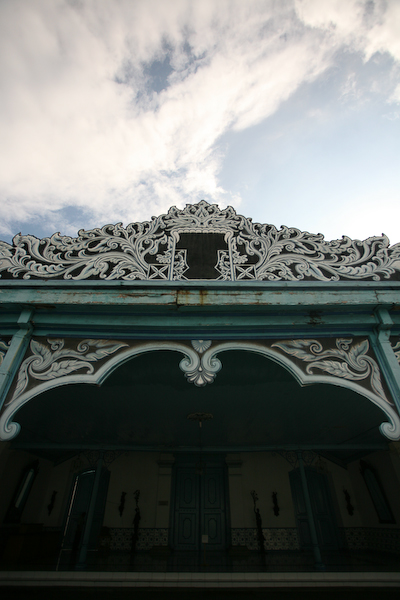
At the northern end lies a great open square, a field of pale sand shaded by sacred banyan trees. Here the public could once gather, petitions could be heard, and the largest ceremonies played out. From there a sequence of gates and walls leads toward the heart of the compound, where the principal audience pavilion stands.
Everything about the arrangement carries meaning. The alignment along a north-south line ties the palace to the mountains inland and the sea to the south, the two poles of the Javanese spiritual landscape. Particular trees are planted in particular spots, colours are assigned to particular walls, and even the sand underfoot is drawn from a place of significance. To walk the axis with an eye for these details is to read a text written in architecture, one that generations of courtiers understood at a glance.
Guides like to point out that nothing in the compound is where it is by chance. Ask why a particular gate is offset, or why a certain tree stands alone in a courtyard, and the answer will reach back to cosmology, protocol, or legend. This density of meaning rewards slow looking; the more you learn to read, the more the apparently simple arrangement of walls and open spaces reveals itself as a carefully composed whole.
The Panggung Sangga Buwana
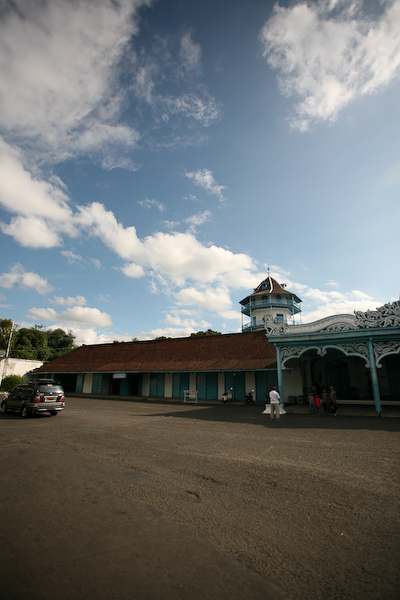
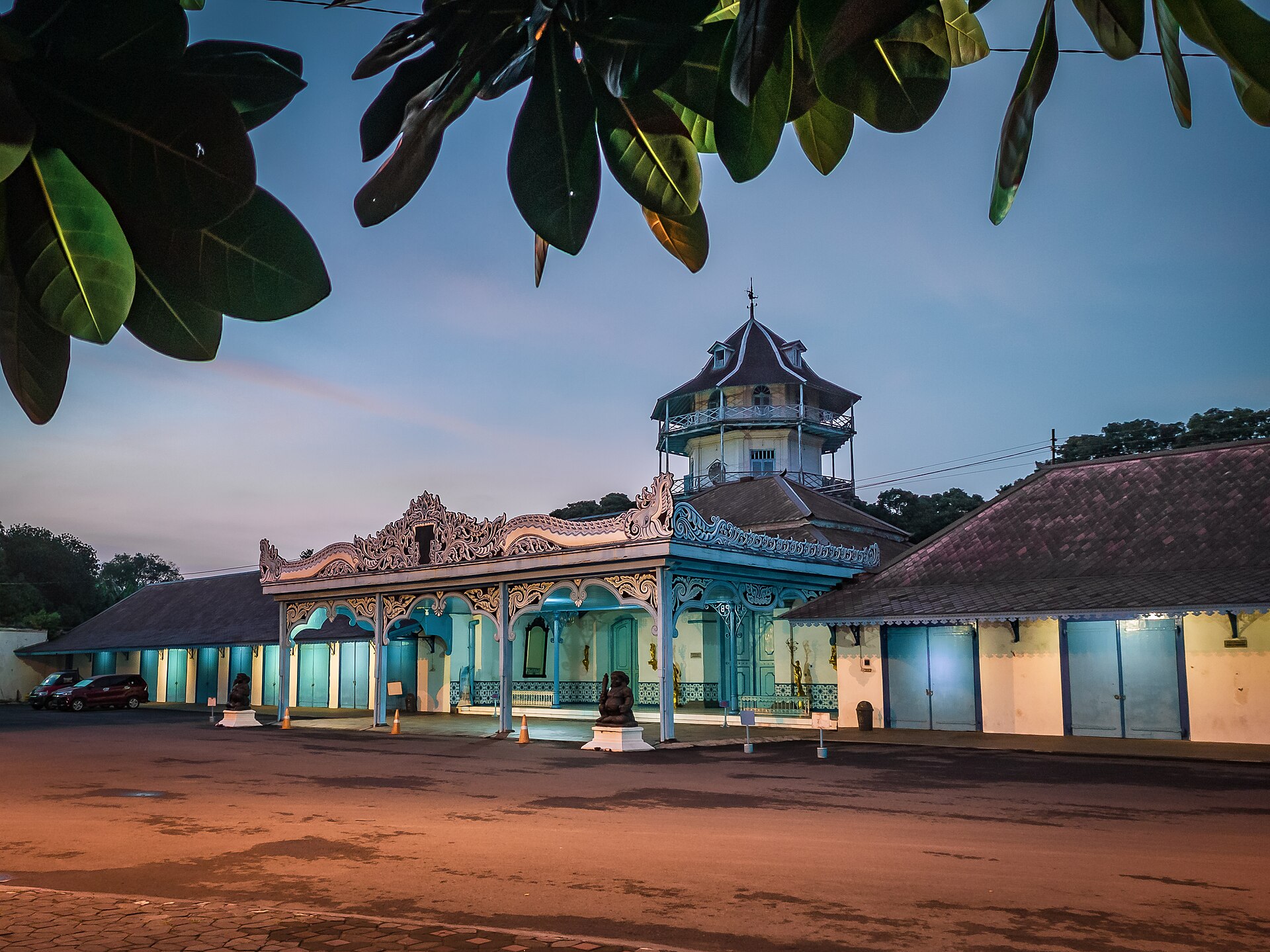
Rising above the roofs of the compound is the feature that most defines the Surakarta skyline, a slender tower of several storeys crowned with a distinctive finial. Known as the Panggung Sangga Buwana, a name that speaks of supporting the world, the tower has stood since the palace’s early decades and carries a heavy load of legend.
Practically, it served as a lookout, a vantage from which the court could watch the surrounding country and, some say, keep an eye on the movements of the Dutch garrison. But its deeper meaning lies elsewhere. Tradition holds that from this tower the Susuhunan communes with Nyai Roro Kidul, the queen of the southern ocean, and the structure is treated as a place of meditation and mystical encounter rather than mere observation.
The tower’s tapering, tiered form, unlike anything else in the compound, has made it the emblem of the palace, the shape that appears on countless photographs and postcards. For the court it is a reminder that the kraton’s authority was always understood to rest on more than earthly power, reaching upward and outward to the unseen forces that Javanese kingship claimed to hold in balance.
Because the tower is bound up with the court’s most private spiritual life, it is not generally open to visitors, and much of what is said about it passes by word of mouth rather than in guidebooks. That air of reticence only deepens its mystique. Seen from the courtyards below, rising pale against the sky, it serves as a constant reminder that the palace’s story is woven from the unseen as much as the visible.
The Great Audience Pavilion
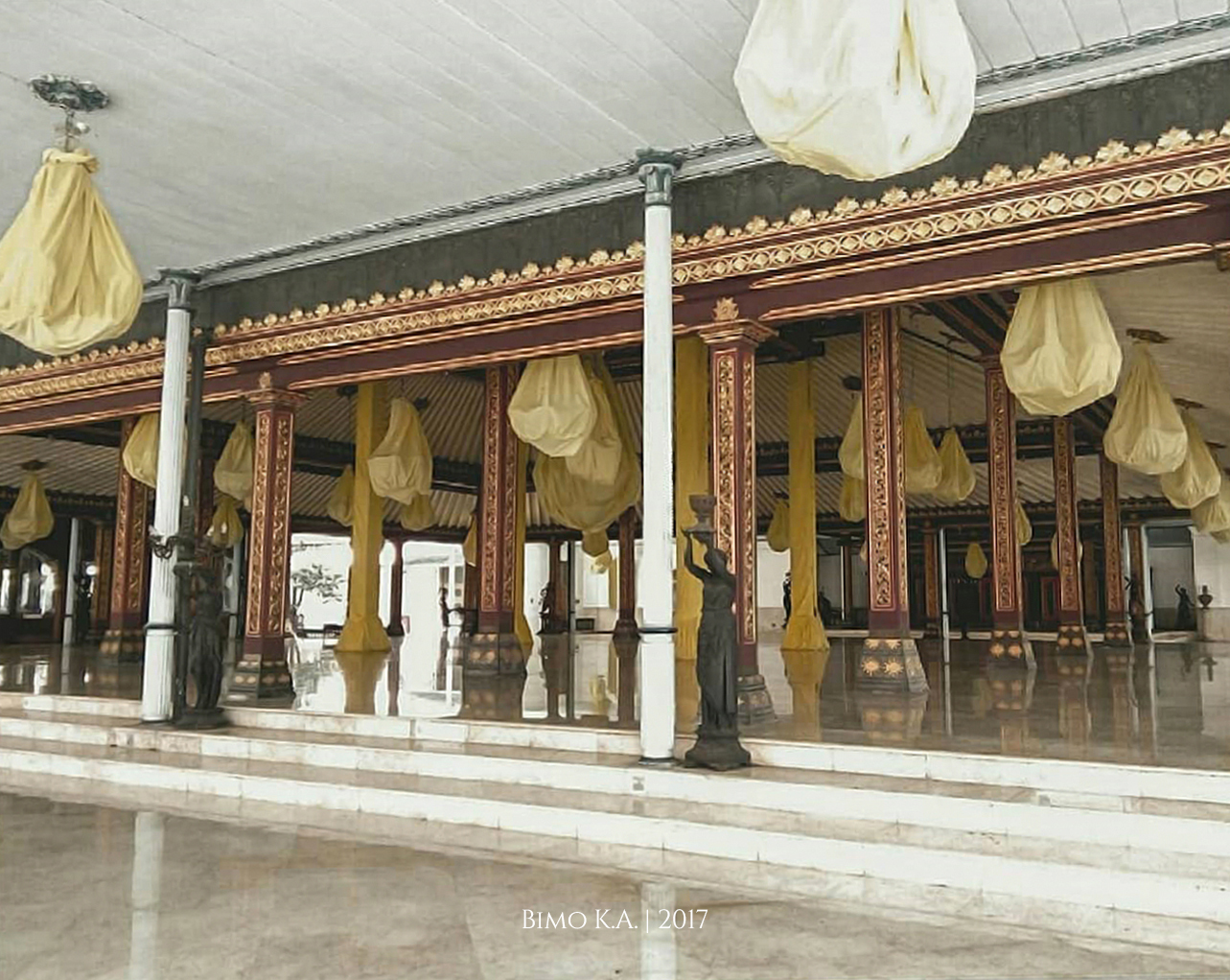
The ceremonial heart of any Javanese palace is its pendopo, a large open-sided pavilion whose roof is carried on rows of massive teak pillars. Surakarta’s principal pendopo is among the grandest in Java, a soaring canopy under which the court gathers for its most important occasions. There are no walls to speak of; the space is defined instead by its columns and by the great tiered roof that seems to float above them.
Look up and the underside of that roof reveals an intricate scheme of painted decoration, geometric and floral patterns in colours that carry symbolic weight. The pillars themselves are carved and gilded, and the whole structure is built to precise proportions that Javanese carpenters regarded as auspicious. To stand beneath it during a ceremony, with gamelan music filling the air, is to feel the full theatrical power of the court.
The pendopo is where the visible business of kingship takes place, the receiving of guests, the staging of dances, the marking of the great days of the court calendar. Its openness is deliberate. Unlike a European throne room sealed behind doors, the Javanese audience hall is a canopy under the sky, a place where the ruler is at once elevated and exposed to the community that gathers at its edges.
The great teak pillars deserve a closer look. Each was chosen and worked according to traditions that treated timber almost as a living collaborator, and the joinery that locks the roof together was designed to flex rather than break. Generations of carpenters have maintained the structure, replacing and repairing without disturbing its proportions, so that the pavilion standing today carries the accumulated craft of the whole life of the court.
On the greatest days the pendopo fills with courtiers seated in ranks according to a precise order of precedence, every position carrying meaning. To the uninitiated it may look simply like a gathering; to those who know the code it is a diagram of the whole social world of the court, rendered in living bodies. The pavilion is thus not only a shelter for ceremony but a stage on which the order of the kingdom is made visible.
Gamelan, Dance, and the Classical Arts
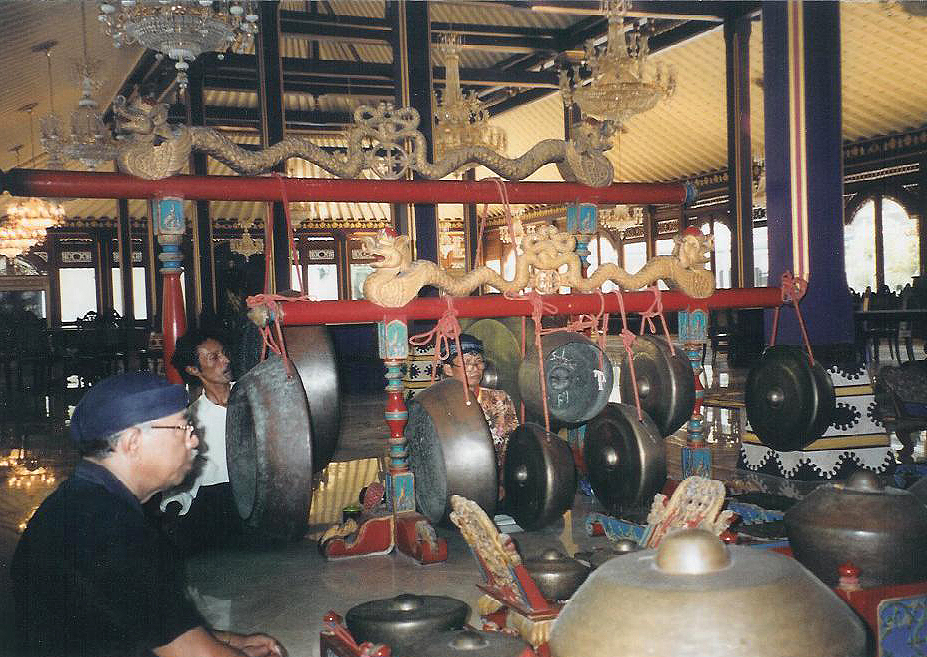
No account of Surakarta can leave out its music. The court is one of the two great centres of the Javanese gamelan, the orchestra of tuned bronze gongs, metallophones, drums, and strings whose shimmering, interlocking sound is among the most distinctive in the world. The palace maintains sets of revered instruments, some regarded as sacred and played only on particular days, and it has been for centuries a nursery of composers and musicians.
The Surakarta style, refined and restrained, is recognised as a school of its own, distinct from the manner cultivated at Yogyakarta. The same is true of dance. The classical dances of the court, performed by trained dancers in elaborate costume, tell stories drawn from the Hindu epics and from Javanese legend, their movements slow, controlled, and charged with meaning.
These arts were never mere entertainment. In the court’s understanding, music and dance were disciplines that ordered the soul and the state alike, and mastery of them was part of what it meant to be cultivated. That ethos survives. The kraton still trains performers and stages its dances, and institutions in the city carry the tradition to new generations, ensuring that the classical culture nurtured here remains a living practice rather than a museum piece.
For anyone lucky enough to hear a full palace gamelan in its proper setting, the experience is hard to forget. The sound does not push forward like a European orchestra but hangs and shimmers, cycles turning within cycles, until time itself seems to loosen. Set beneath the open pendopo roof, with dancers moving through it, the music does exactly what the court intended, drawing listeners into a stillness that feels close to meditation.
The most revered gamelan sets are themselves treated as heirlooms, given names and honoured with offerings, and brought out only on the holiest occasions. To hear one of these sacred ensembles is considered a blessing in itself, quite apart from the beauty of the music. In this the court’s arts circle back to its religion, the boundary between aesthetic pleasure and spiritual devotion deliberately left indistinct.
Heirlooms and Sacred Regalia
Among the most closely guarded treasures of the kraton are its pusaka, the heirlooms in which the court believes its very power to reside. These include krisses, the wavy-bladed daggers that are the most charged of all Javanese objects, along with spears, banners, carriages, and sets of gamelan instruments. Each is regarded as more than an object; the greatest of them are held to possess a spiritual force of their own, capable of protecting the realm and its ruler.
The care of these heirlooms is a serious matter. On appointed days they are ritually cleansed, an act surrounded by offerings and observances, and their wellbeing is thought to be bound up with the wellbeing of the kingdom itself. A famous royal carriage and a number of venerable krisses are counted among the palace’s most precious possessions.
To the outside eye these may look like antiques, but within the world of the court they are living presences, treated with the deference owed to beings rather than things. The reverence surrounding them helps explain why the kraton is understood, even now, less as a collection of historic buildings than as a vessel holding forces that must be tended. The regalia are the concentrated essence of that idea.
The annual cleansing of the heirlooms is among the most intimate of the court’s observances. Carried out by those entrusted with the pusaka, it is less a public display than an act of devotion, surrounded by incense and quiet ritual. To the court, neglecting these rites would be unthinkable, for the health of the realm and the potency of the objects are held to rise and fall together, bound in a single web of care.
The Rhythm of Court Ceremony
The life of the palace runs on a calendar of ceremonies, some tied to the Islamic year, others to the Javanese reckoning of time, still others to the anniversaries of the dynasty. The grandest of them draw crowds from across the city and beyond, transforming the quiet compound into a stage for processions, music, and the display of the court’s treasures.
Among the best known is the great procession held on the eve of the Javanese new year, a solemn night-time march in which sacred heirlooms are carried through the streets and a herd of revered albino buffalo, regarded as guardians of the court, leads the way. The atmosphere is hushed and charged; onlookers seek blessing simply from the passing of the regalia.
Other observances mark the birthday of the Prophet, the accession of the ruler, and the turning points of the agricultural and religious year. Through all of them the court reaffirms its place as the keeper of tradition. For the people of Solo these ceremonies are not spectacle alone but a shared inheritance, moments when the ancient forms of Javanese kingship step out of the palace and into the life of the wider community.
What gives these occasions their power is the sense of continuity they carry. The forms being enacted are, in their essentials, the same ones performed generations ago, and everyone present knows it. In an age of rapid change, that unbroken thread is precisely the point; the ceremonies offer the community a way of touching something older and steadier than the passing concerns of the day, and they are cherished accordingly.
The albino buffalo that lead the new year procession are among the most beloved figures in Solo’s civic life, cared for by the palace and regarded almost as members of the court. Crowds wait long into the night to see them pass, and stories about their behaviour are read as omens for the year ahead. Few images capture the mingling of solemnity and popular affection in the kraton’s ceremonies more vividly.
Inner Courts and Private Precincts
Beyond the great pendopo lie the more private spaces of the palace, the courts where the daily life of the royal household unfolds away from public view. Here the buildings grow more intimate, the courtyards smaller, the atmosphere more domestic, though never without ceremony. Access is restricted, and much of the innermost life of the court remains screened from outsiders.
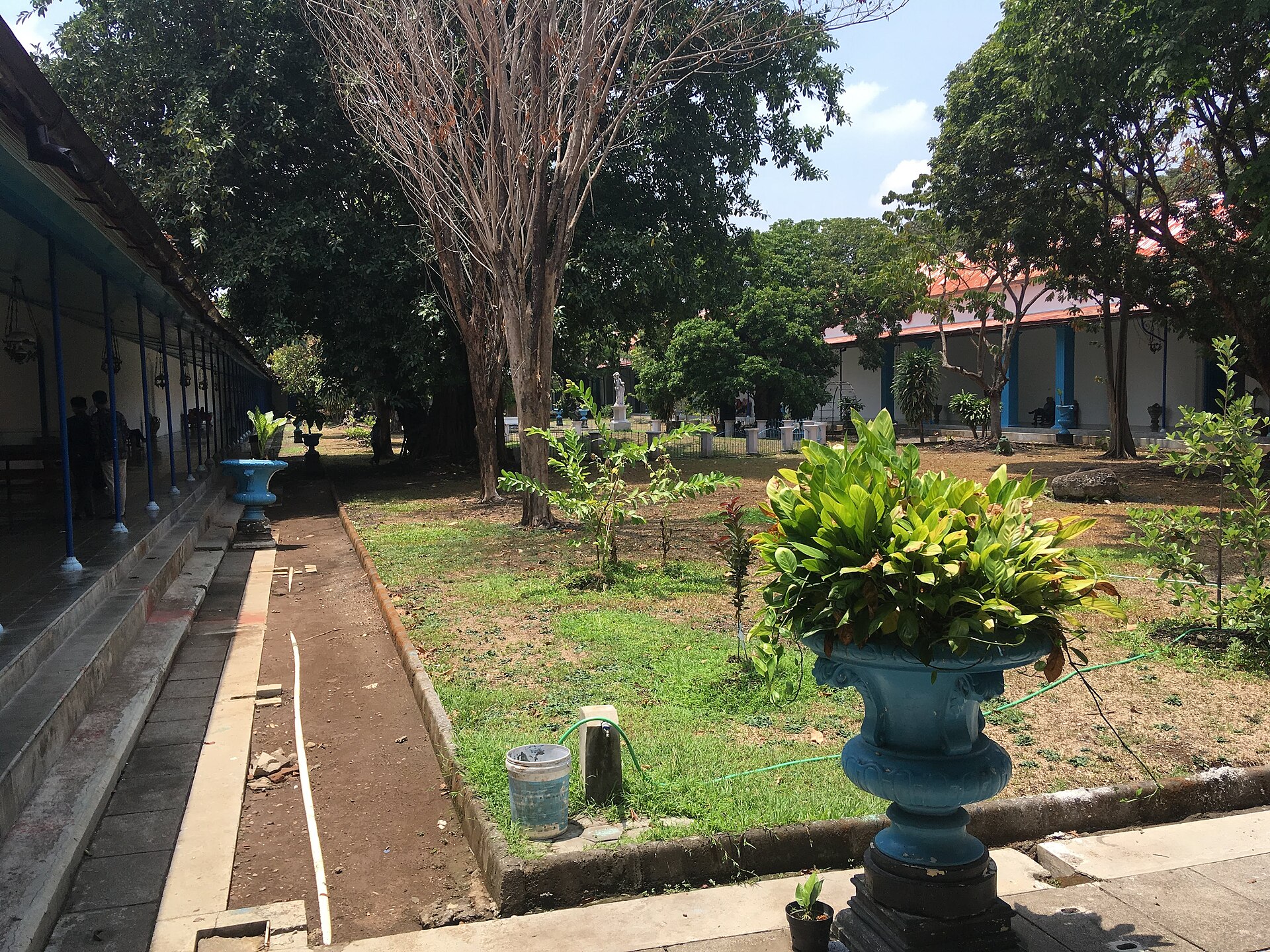
These inner precincts include halls used for the most sacred audiences and rituals, spaces where the presence of the Susuhunan carries its fullest weight. The materials and decoration echo the grandeur of the outer pavilions but on a more concentrated scale, with fine carving, marble floors laid in the colonial era, and fittings that mingle Javanese and European taste.
It is in these quieter courtyards that the palace feels most like a home. Attendants move on soft feet, the sound of gamelan practice drifts from a nearby hall, and the rhythms of a large household continue much as they have for generations. The contrast with the ceremonial splendour of the forecourts is deliberate; the court understood that true authority lived not only in grand display but in the disciplined order of everyday life behind the walls.
The layering of Javanese and European elements in these inner courts tells its own story. Marble floors and colonial fittings sit within a plan that remains wholly Javanese in its logic, a reminder of the centuries during which the court absorbed foreign influences without surrendering its own identity. The result is a distinctive interior world, neither purely traditional nor colonial, but something the court made entirely its own.
The Palace Museum
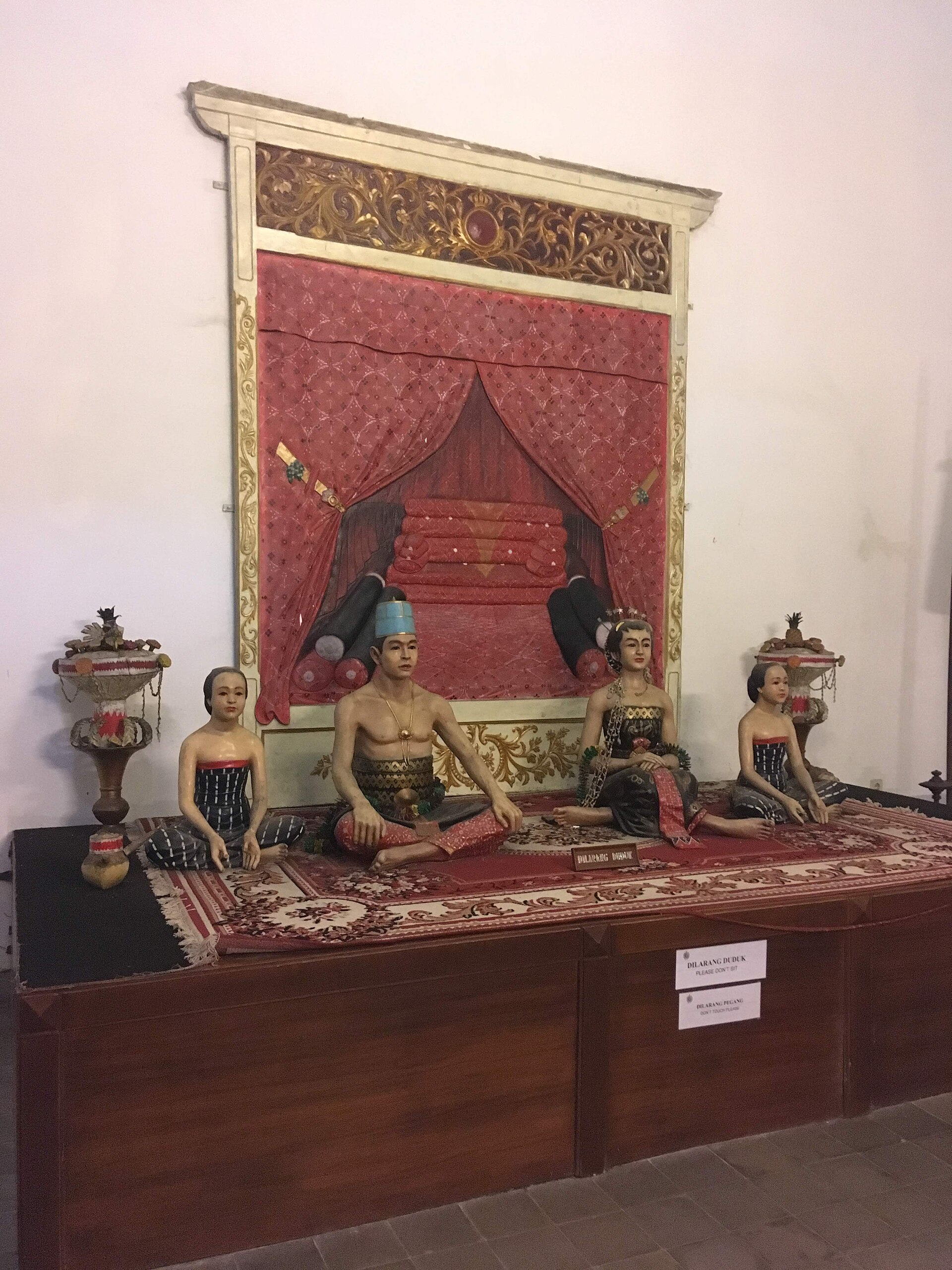
Part of the kraton has long been opened to visitors as a museum, and it offers one of the richest windows onto Javanese court culture to be found anywhere. The galleries hold an extraordinary miscellany: royal carriages, weapons, gamelan instruments, puppets, ceremonial costumes, and a collection of objects that record the court’s contacts with the wider world.
Among the most memorable exhibits are the old carriages, including vehicles used to carry the rulers in state, and a striking array of figureheads and curiosities salvaged over the centuries. Portraits and photographs trace the line of the Susuhunans, while cases of krisses and other heirlooms display the craftsmanship for which the court was famous.
The museum’s charm lies partly in its slightly old-fashioned character. This is not a slick modern display but a collection assembled by the court itself, arranged with an eye to reverence as much as instruction. Walking through it, a visitor gains a vivid sense of how the palace saw itself and what it valued, from the grand carriages of state down to the smallest ritual implement. It is the court telling its own story in objects.
Because the collection was assembled by the court rather than by professional curators, it preserves a particular point of view, one that values reverence and lineage over tidy chronology. For the attentive visitor that is a virtue, not a flaw. The arrangement shows what the palace itself considered important, and reading the galleries in that light turns a simple walk-through into a lesson in how the court understood its own past.
The Palace and Its City
The kraton has never stood apart from the city that grew around it. Solo, or Surakarta, developed as a court town, its life organised around the palace and the second princely house of the Mangkunegaran that shares the city. Markets, craft quarters, and neighbourhoods of court servants clustered near the walls, and the rhythms of the palace set the rhythms of the town.
That relationship endures. Solo is known across Indonesia as a stronghold of Javanese culture, a place where classical arts, refined manners, and traditional crafts remain unusually strong. The city’s famous batik, its cuisine, and its markets all carry the imprint of court taste, and the great ceremonies of the kraton remain civic events in which the whole city takes part.
To visit the palace is therefore also to encounter the city that formed around it. The two cannot really be separated. The blue walls of the kraton are the historic core from which Solo radiates, and the traditions kept alive within them continue to give the city its distinctive character, a modern Indonesian town that still wears the manners of a royal capital.
Solo’s reputation as a cultural heartland is no accident of marketing; it grew directly from centuries of royal patronage. The court drew the finest craftsmen, musicians, and cooks to the city and set the standards they worked to, and those standards outlived the political power of the palace. Today’s thriving batik workshops and dance schools are the descendants of that patronage, carrying court refinement into ordinary civic life.
Visiting the Kraton Today
For the traveller, the Kraton Surakarta is one of the most rewarding stops in central Java. It sits in the middle of Solo, easily reached and open to visitors through its museum and ceremonial courtyards, though the innermost precincts remain private. A local guide, often drawn from the ranks of court servants, can bring the place alive with the stories and protocols that the buildings alone cannot tell.
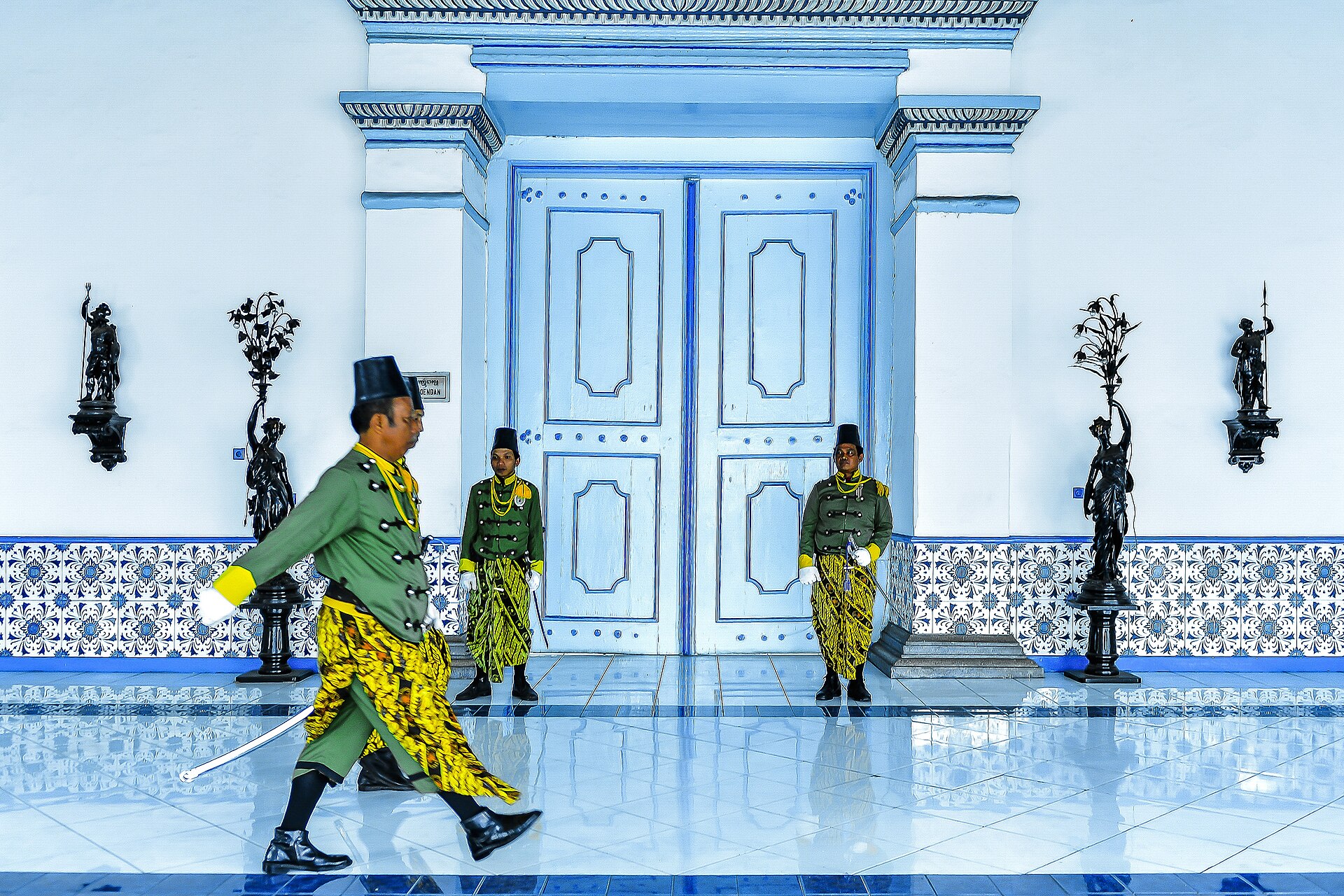
Visitors are asked to observe the court’s sense of decorum, dressing modestly and following the customs of the place, a small courtesy that reflects the palace’s living status. The experience is quieter and more contemplative than a visit to a grand European palace; the pleasures here are in atmosphere, detail, and the sense of stepping into a tradition still being practised.
Timed to coincide with one of the great ceremonies, a visit becomes something more, a chance to witness Javanese court culture in full expression. Whether on an ordinary afternoon or a festival night, the kraton offers a rare thing: not a monument to a vanished world but a court that has kept faith with its past, still turning on the axis its founders laid down beside the Solo River more than two and a half centuries ago.
A little preparation makes the visit far richer. Reading beforehand about the split of Mataram, the meaning of the regalia, or the calendar of ceremonies turns what could be a pleasant stroll into a genuine encounter with a living tradition. The kraton does not shout its significance at visitors; it waits, quietly, for those willing to meet it halfway, and rewards them with one of the most authentic experiences of royal Java still to be had.
Photography is generally welcomed in the public courtyards, and the play of light on the blue walls and golden fittings makes the palace a rewarding subject at almost any hour. Early morning and late afternoon, when the crowds thin and the light softens, are especially fine times to wander, letting the atmosphere of the old court settle over an unhurried visit.
Palaces Nearby
If you are exploring the royal courts of Java, two neighbouring palaces belong on the same journey as Surakarta. Together they round out the island’s courtly world, from the princely house that shares its own city to the oldest royal seat on the north coast.
- Pura Mangkunegaran – the princely court of Surakarta with its grand pendopo and gamelan.
- Keraton Kasepuhan – the oldest royal palace of Cirebon on Java’s north coast.
You May Like
Changgyeonggung: The Gentle Garden Palace of Seoul


2 thoughts on “The Kraton of Surakarta: The Senior Court of Central Java”