Tucked into the green heart of Seoul, next to the grander and more famous Changdeokgung, lies a palace with one of the gentlest and most poignant characters of all the royal residences of Korea. Changgyeonggung does not overwhelm you with scale or ceremony. Instead it draws you in with its intimate halls, its wide ponds and wooded slopes, and a quality of quiet that feels almost rural despite the city pressing in on every side.
For much of its history Changgyeonggung was a palace of the family rather than of the state, a place where dowager queens and royal relatives lived, where the private life of the dynasty unfolded away from the formal business of government. That domestic role gave it a warmth and a human scale that the great audience palaces lack, and it is still felt today in the smaller courtyards and the beautiful gardens.
Yet this gentle palace also witnessed some of the darkest and most dramatic episodes in Korean history, from a king’s terrible act against his own son to the humiliations of the colonial period, when the grounds were turned into a public park and even a zoo. Few places hold together such tenderness and such tragedy, and that mixture gives Changgyeonggung its particular, haunting appeal.
In this article you will come to know Changgyeonggung in depth: its origins as a home for retired royalty, its great throne hall that faces an unusual direction, the queens and consorts who lived within it, the famous tragedy that unfolded in its courtyard, its suffering under foreign rule, and its restoration and life today as one of the most beloved green retreats in the Korean capital.
In This Article
- A Gentler Kind of Palace
- A Home for Retired Royalty
- The Eastern Palace Complex
- Myeongjeongjeon, the Throne Hall
- Queens, Consorts, and Palace Women
- The Tragedy of a Prince
- Ponds, Gardens, and the Botanical Legacy
- Residential Halls and Quiet Courtyards
- Humiliation Under Foreign Rule
- Reclaiming the Palace
- A Palace of the Seasons
- Part of a Royal Landscape
- Changgyeonggung Today
A Gentler Kind of Palace
To step into Changgyeonggung after visiting the larger palaces of Seoul is to feel the mood change. The scale is smaller, the atmosphere softer, and the layout less rigidly formal. Halls are set among trees and lawns, a great pond lies at the heart of the grounds, and wooded hills rise gently beyond, so that the boundary between palace and garden seems to dissolve. It is a place that invites wandering rather than awe.

This gentler character is not an accident. Changgyeonggung was built and used above all as a residence, a place for members of the royal family, especially senior women such as dowager queens, to live in comfort and dignity. Freed from the need to stage the grandest ceremonies of state, its architects could give it a more relaxed, human scale, with buildings arranged for living rather than for overwhelming display.
The result is one of the most likeable of all Korean palaces. Where others impress, Changgyeonggung charms. Its beauty is in its details and its setting, in the way a hall opens onto a garden, in the reflections on its pond, in the sense that real people once lived here, day by day, through joy and sorrow. It is a palace with the intimacy of a home, and that is precisely its enduring gift.
There is a lesson in the way Changgyeonggung was conceived. A great dynasty needed not only spaces to display its power but spaces to live and to care for its own, and this palace answered that need. Recognising that dual requirement helps explain why the royal heart of Seoul was never a single monolithic palace but a family of connected compounds, each with its own purpose, its own mood, and its own place in the life of the court.
First-time visitors often say the palace surprised them by how much it feels like a garden with buildings rather than a fortress of the crown. That impression is exactly right, and it is worth arriving with it in mind. Rather than marching through in search of monuments, the rewarding way to experience Changgyeonggung is to slow down, follow the paths where they lead, and let the interplay of hall and pond and hillside unfold at its own gentle pace.
A Home for Retired Royalty
The origins of Changgyeonggung lie in the practical needs of the royal family. It grew out of an older residence and was developed to house senior members of the dynasty, particularly the widows and elders whose care was a solemn duty of the reigning king. In the Confucian order that governed Korean court life, the proper treatment of one’s parents and elders was among the highest of virtues, and providing them with a fitting home was part of that obligation.

So the palace took shape as a place of retirement and repose for royalty who had stepped back from the centre of power. Here dowager queens could live surrounded by proper ceremony and comfort, close to the reigning king in the neighbouring palace but with an establishment of their own. The arrangement reflected the deep Korean concern with hierarchy, family, and the honouring of age.
This founding purpose shaped everything about the palace. Its more modest scale, its garden setting, its emphasis on comfortable living quarters over grand ceremonial spaces all flow from its role as a royal home rather than a seat of government. To understand Changgyeonggung is to understand that it was built out of duty and affection, to shelter the family of kings.
The care lavished on retired royalty tells us much about the values of the society that built the palace. In a world that prized filial devotion above almost all else, the comfortable provision for dowager queens was not a private courtesy but a public statement of virtue, proof that the king honoured his elders as the moral order demanded. The palace was, in that sense, a monument to duty as much as a residence.
The Eastern Palace Complex
Changgyeonggung does not stand alone. It adjoins Changdeokgung, and together the two were long regarded as a single great complex on the eastern side of the capital, sharing grounds and functioning as complementary parts of one royal world. Where Changdeokgung served more of the formal and governmental role, Changgyeonggung provided the residential space, especially for the senior women of the court.
This pairing made practical sense. A single vast palace could not easily accommodate all the needs of the crown, from grand audiences to the private households of dowager queens and consorts. By developing two connected palaces, the dynasty could separate these functions while keeping them close, the reigning king in one, his elders and family in the other, bound together as a single extended royal home.
The two palaces shared, above all, a magnificent garden that stretched across the wooded hills behind them, a rear garden famed as one of the loveliest in Korea. That green expanse tied the complex together and gave Changgyeonggung its garden character. Even today, understanding the palace means seeing it as part of this larger eastern world of halls and gardens, rather than as an isolated compound.
Because the two palaces shared so much, the line between them could seem almost invisible to those who lived there, a single royal world flowing from formal hall to private garden. Modern administrative boundaries have separated them for visitors, but it is worth holding the older unity in mind, for it explains the layout, the shared garden, and the way each palace assumed and depended upon the presence of the other.
Myeongjeongjeon, the Throne Hall
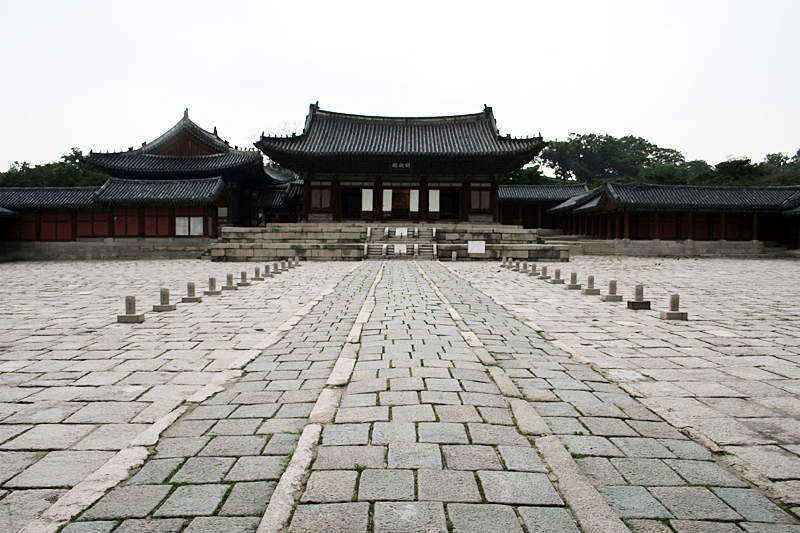
At the ceremonial core of Changgyeonggung stands Myeongjeongjeon, its main throne hall, and it holds a special distinction: it is among the oldest surviving throne halls of any Korean palace, having escaped the destruction that consumed so many royal buildings. To stand before it is to look upon genuinely ancient timbers, a rare survival from centuries of war and fire.
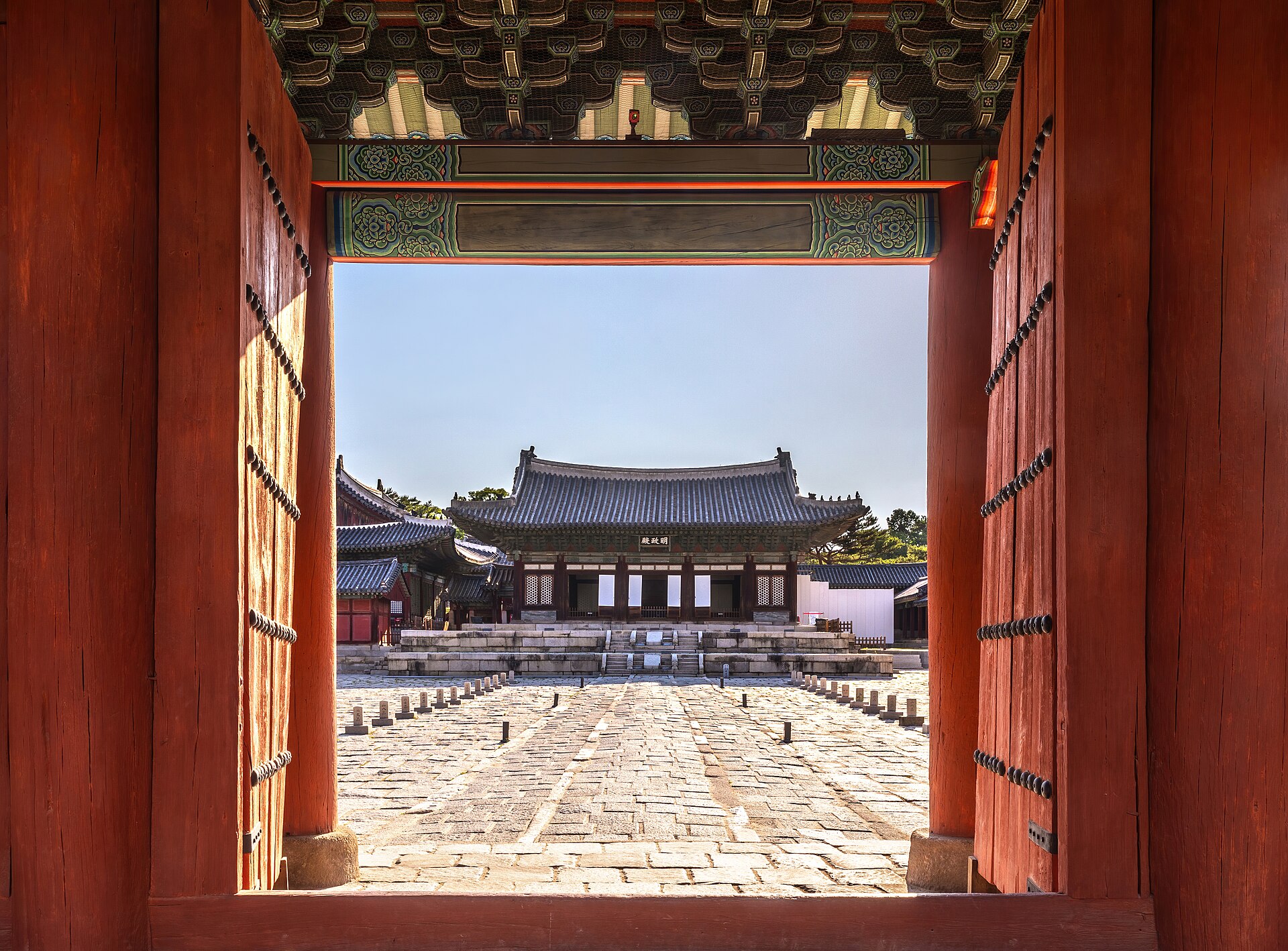
The hall is also unusual in its orientation. Where Korean throne halls conventionally face south, Myeongjeongjeon faces east, a departure dictated by the lie of the land and the older structures around it. This break with convention gives the hall and its courtyard a distinctive feel, and it reminds us that even the most rule-bound royal architecture had to bend to the realities of a particular site.
Modest in scale compared with the great audience halls of the larger palaces, Myeongjeongjeon nonetheless carries all the dignity of a royal throne hall, with its raised platform, its rank stones marching down the courtyard, and its finely painted interior. Its age and its unusual aspect make it one of the most historically precious buildings in all of Seoul, a direct link to the early centuries of the dynasty.
The survival of so old a throne hall is little short of miraculous given how much of Korea’s royal architecture was lost to invasion and fire. Each time you look at its weathered timbers, it is worth remembering the centuries of turmoil they have come through unscathed. In a city where so much has been rebuilt, this hall offers a rare and precious touch of the genuinely ancient, a direct inheritance from the early dynasty.
The eastward orientation repays a moment’s thought as you stand in the courtyard. It is a small reminder that Korean palace architecture, for all its rules, was never mechanical; builders read the land, weighed the existing structures, and adapted the ideal to the real. The result here is a throne hall with a character all its own, subtly different from its south-facing cousins and all the more memorable for it.
Queens, Consorts, and Palace Women
Because it was above all a residential palace, Changgyeonggung was intimately bound up with the lives of the women of the court. Dowager queens presided here in retirement, and the palace hummed with the households that served them, from high-ranking consorts to the many palace women who kept the establishment running. In its halls the private, female world of the court found one of its principal homes.
The lives of these women could be ones of great influence as well as confinement. A dowager queen might wield considerable power behind the scenes, shaping succession and politics through her position at the head of the royal family. Others lived quieter lives bound by strict rules of rank and conduct. The palace was the stage for all of it, ambition and duty, intrigue and devotion.
To walk the residential quarters of Changgyeonggung is to enter this hidden half of court history, so often overlooked in favour of kings and ministers. Here the story is of mothers and grandmothers, consorts and attendants, whose lives were spent within these walls and whose presence gave the palace its warmth. Their world, screened from public view, was as real and as consequential as any council chamber.
History too often reduces palace women to footnotes, but at Changgyeonggung they move to the centre of the story. The dowager queens who presided here could be formidable figures, their influence reaching into the highest matters of state, while the countless attendants who served them formed a whole society of their own. To restore them to the narrative is to see the palace whole, as the living community it truly was.
The residential heart of the palace, where these women lived, is quieter today than the throne-hall courtyard, and easy to hurry past. Yet lingering there is worth the effort, for it is in those modest rooms and enclosed gardens that the true purpose of Changgyeonggung reveals itself, and the long-overlooked lives that filled them come, however faintly, back into view.
The Tragedy of a Prince
Changgyeonggung is forever linked to one of the most harrowing episodes in Korean history. It was in a courtyard of this palace that a king, convinced that his own son and heir had become dangerously unstable and a threat to the throne, ordered the prince confined within a wooden rice chest, where after several days he died. The event has haunted the Korean imagination ever since as a story of madness, cruelty, and unbearable family tragedy.

The causes of the disaster remain debated, tangled in court politics, questions of the prince’s mental health, and the terrible pressures of royal succession. What is certain is the human horror at its heart: a father destroying his son, played out within the walls of a palace built to honour family bonds. The irony of that setting only deepens the tragedy.
The prince’s death cast a long shadow. His son would later become king and would honour his father’s memory with deep devotion, an act of filial piety that shaped his reign. For Changgyeonggung, the episode became its most famous and most sorrowful association, a reminder that behind the beauty of the palace lay the crushing weight and danger of life at the summit of a dynasty.
What makes the tragedy so enduring is that it resists easy explanation. Was the prince truly dangerous, or the victim of court faction and a father’s fear? Generations have wrestled with the question, and the very impossibility of a clean answer keeps the story alive. It endures not as a simple morality tale but as a genuine human catastrophe, played out among people bound by love, duty, and terrible power.
The prince’s son, who came to the throne determined to honour the father he had lost, turned that private grief into one of the defining threads of his celebrated reign. In this way the tragedy of Changgyeonggung reached far beyond its courtyard, shaping the course of Korean history and leaving a legacy of filial devotion that Koreans still remember. Few single events in any palace have echoed so long or so deeply.
Ponds, Gardens, and the Botanical Legacy
The gardens are among the greatest glories of Changgyeonggung. A large ornamental pond lies at the heart of the grounds, its still water reflecting the sky and the surrounding trees, and around it stretch lawns, wooded slopes, and quiet paths that make the palace feel like a great park. In every season the setting is beautiful, from spring blossom to the fiery colours of autumn.

This landscape carries a complicated history. During the colonial period a large greenhouse, a striking structure of glass and iron, was built in the grounds, and it survives as a rare and elegant example of its kind, now cherished despite the painful circumstances of its origin. Botanical collections and ornamental plantings turned parts of the palace into a garden in the fullest sense.
Today the gardens are much of the reason people come. Families stroll by the pond, photographers seek out the reflections and the autumn leaves, and visitors find in this green enclave a rare escape from the density of the surrounding city. The blend of royal history and natural beauty gives Changgyeonggung a restorative quality that few historic sites can match.
The elegant old greenhouse embodies the palace’s tangled history in a single structure. Built during the years of degradation, it might have been resented and removed, yet its grace won it a lasting place, and it now stands protected and admired. That a symbol of the colonial era should become a cherished monument says much about how the palace has learned to carry its whole past, the painful along with the proud.
Photographers have made the pond one of the most recognisable images of the palace, its surface mirroring the halls and the changing sky. But the gardens reward more than the camera; they reward simply sitting a while and watching the light move across the water. In that stillness the palace delivers its quiet promise, a pocket of calm and beauty held safe within the roar of the modern capital.
Residential Halls and Quiet Courtyards
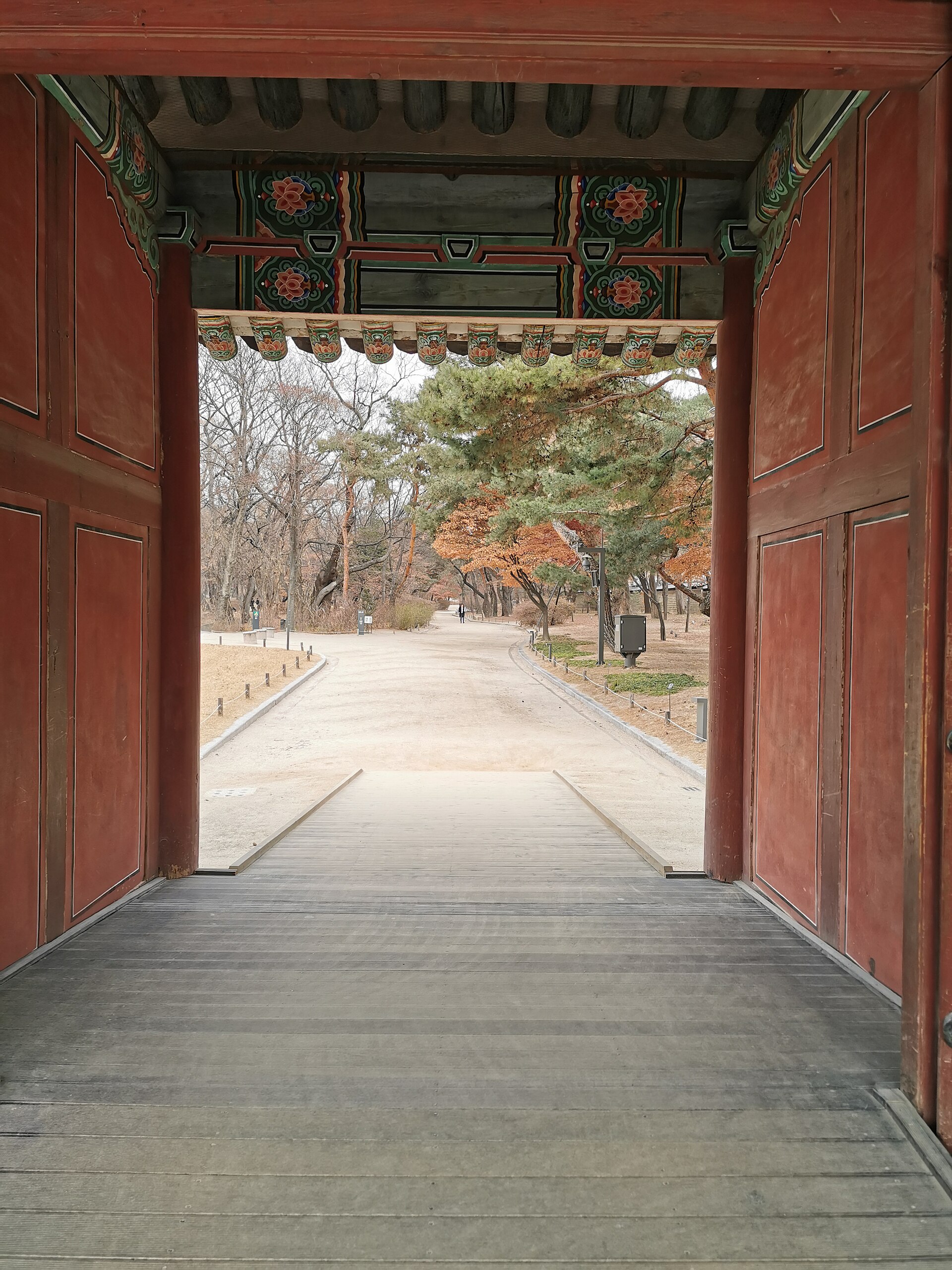
Beyond the throne hall, Changgyeonggung is filled with the residential buildings that were its true purpose. Living quarters, reception rooms, and smaller halls are arranged among the trees and courtyards, each designed for comfort and daily life rather than grand ceremony. Their scale is intimate, their woodwork warm, and their gardens close at hand.

These buildings reveal the domestic character of the palace. Here were the rooms where royal women slept, dined, received visitors, and passed their days, spaces shaped by the rhythms of household life. The heating systems beneath the floors, the sliding paper doors, the verandas open to the gardens all speak of a Korean architecture perfected for living well through the sharp turns of the seasons.
Wandering among these halls, you sense the human presence that once filled them. Unlike the echoing formality of a great audience hall, these courtyards feel like places where life was actually lived. It is this quality, more than any single monument, that makes Changgyeonggung so affecting, a palace that preserves the texture of everyday royal existence.
The genius of these residential halls lies in their responsiveness to the Korean climate. The underfloor heating that warmed them through bitter winters, the open verandas that caught the summer breeze, the paper doors that filtered the light all reflect centuries of refinement in the art of comfortable living. They are not grand, but they are wise, shaped by a deep understanding of how to dwell gracefully through the turning year.
Humiliation Under Foreign Rule
The gentle palace suffered cruelly during the years of colonial occupation. In a deliberate act of degradation, the grounds of Changgyeonggung were converted into a public park, complete with a zoo and a botanical garden, and opened to the crowds. A royal palace, a place of dynastic memory and dignity, was turned into a place of entertainment, its sacred character stripped away.
The transformation was calculated to diminish the symbols of Korean sovereignty. Buildings were demolished or altered, the very name of the palace was changed to mark its new, lowered status, and cherry trees were planted to draw sightseers. For Koreans, the sight of their ancestors’ palace reduced to a zoo was a wound that went far beyond the loss of architecture.
This chapter is essential to understanding what Changgyeonggung means today. Its later restoration was not merely a matter of rebuilding halls but of reclaiming dignity, of undoing a deliberate humiliation and restoring to the palace its rightful character. The memory of those years lends a particular weight to the quiet beauty of the place as it now stands.
The deliberate nature of the humiliation is what still stings. Turning a palace into a zoo was not carelessness but strategy, a calculated attempt to strip the Korean crown of its aura and reduce the symbols of nationhood to objects of amusement. Understanding this intent is essential, for it transforms the later restoration from a simple building project into an act of national healing and defiant remembrance.
It is sobering to imagine visitors of that era strolling past caged animals where dowager queens had once held court, sightseers where there had been solemn ritual. Holding that image in mind makes the present peace of the gardens feel hard-won rather than given. The palace we walk through today exists because later generations refused to accept that degradation as the final word on their heritage.
Reclaiming the Palace
In the decades after liberation, and especially in the later twentieth century, a determined effort was made to restore Changgyeonggung to something like its former self. The zoo and amusement facilities were removed, the ground was cleared of the accretions of the park era, and halls and gates were rebuilt or repaired according to historical records. The palace’s original name was restored, a symbolic act of great importance.

Restoration is always a delicate task, balancing the desire to recover a lost past against the need to respect what has survived. At Changgyeonggung the aim was to bring back the dignity and the essential form of the royal residence while preserving genuine historic structures such as the ancient throne hall and the colonial-era greenhouse, itself now a protected monument.
The work transformed the site from a degraded park back into a palace, allowing visitors once more to experience something of its original character. It stands as an example of how a nation can reclaim and heal a wounded place, turning a symbol of humiliation back into a source of pride and a link to a proud and painful history.
Every decision in the restoration carried symbolic weight, none more than the return of the palace’s original name. To rename it was to reject the diminished identity forced upon it and to reclaim its dignity as a royal residence. In this way the physical work of clearing and rebuilding was matched by an act of memory, a deliberate insistence that the palace’s true history would not be erased.
The greenhouse, spared and restored rather than swept away, has become an unlikely emblem of this balanced approach, proof that a wounded place can hold its whole story without denying any part of it.
A Palace of the Seasons
Few places in Seoul respond so beautifully to the turning year as Changgyeonggung. In spring the grounds fill with blossom, in summer the pond and the wooded slopes offer cool green shade, in autumn the maples and other trees blaze into colour, and in winter a fall of snow settles softly on the tiled roofs and bare branches. Each season reveals a different face of the palace.
This seasonal beauty has made the palace a favourite for evening openings, when the halls and gardens are lit and visitors can wander the grounds after dark, the buildings glowing against the night. Such occasions draw crowds who come as much for the atmosphere as for the history, experiencing the palace as a place of beauty and tranquillity in the heart of the city.
The rhythm of the seasons ties Changgyeonggung to the life of Seoul in an intimate way. People return again and again to see the familiar scenes transformed, marking the year by the changing colours of the palace gardens. In this the old royal residence has found a new role, not as a seat of power but as a shared space of natural beauty woven into the life of the modern city.
The evening openings have given the palace a second life after dark, when lantern light and shadow lend the old halls a dreamlike quality. Visitors move quietly through the illuminated grounds, the daytime crowds gone, the city’s noise fallen away, and the palace becomes something close to enchanted. It is in these hours that Changgyeonggung most fully reveals its gift for beauty and tranquillity.
Part of a Royal Landscape
Changgyeonggung is best appreciated as one part of a larger royal landscape at the heart of Seoul. It sits amid a cluster of palaces and sacred sites, connected historically and physically to its neighbours, and a visit here naturally leads on to the grander Changdeokgung with its famous rear garden, or to the great royal shrine that lies close by.

This concentration of heritage reflects the way the old capital was organised, with the seats of royal power and ritual gathered together at its centre. To move among these sites is to trace the shape of the Korean royal world, from the formal audience palaces to the residential quarters and the shrines where the ancestors were honoured. Changgyeonggung is a vital piece of that whole.
For the visitor, this means that a day spent in the area can encompass several centuries and several moods of Korean history, with Changgyeonggung offering the gentlest and most garden-like of the experiences. Understanding it as part of this greater landscape enriches a visit and reveals the deep coherence of the royal heart of Seoul.
Threading together these neighbouring sites in a single day’s walk is one of the great pleasures of visiting the old capital. From the gentle gardens of Changgyeonggung to the grandeur of Changdeokgung and the solemnity of the royal shrine nearby, the journey traces the full range of the Korean royal world. Each site illuminates the others, and together they tell a story no single palace could.
Changgyeonggung Today
Today Changgyeonggung is one of the most cherished green retreats in Seoul, a place where history and nature meet in perfect balance. Restored to its dignity, opened to the public, and set amid some of the loveliest gardens in the city, it welcomes visitors seeking both a connection to the Korean past and a peaceful escape from the urban rush. Its gentle character makes it a favourite of locals and travellers alike.

The palace rewards a slow, unhurried visit. There is the ancient throne hall to admire, the residential quarters to explore, the great pond to circle, and the historic greenhouse to discover, all within grounds that change beautifully with the seasons. Evening openings and cultural events add further life, making the palace a living part of the city rather than a static monument.
To spend time in Changgyeonggung is to feel the full weight and tenderness of its history, the duty and affection that built it, the tragedies that unfolded within it, the humiliations it endured, and the care with which it has been restored. In its quiet halls and lovely gardens, the long story of the Korean court lives on, gentle, moving, and beautifully preserved at the centre of a great modern city.
For all its sorrows, Changgyeonggung leaves most visitors with a feeling of peace rather than melancholy. Perhaps that is its deepest achievement: to have absorbed so much history, so much beauty and pain, and to offer it back not as a burden but as a quiet, restorative calm. In a restless city it remains a place to slow down, to reflect, and to feel the long continuity of the Korean past.
Whether you come for an hour or a whole afternoon, Changgyeonggung tends to linger in the memory longer than its modest scale might suggest. It is not the grandeur that stays with you but the mood, the sense of a place that has held both great sorrow and great beauty and emerged gentle rather than bitter. Of all the palaces of Seoul, it is often the one to which visitors most long to return.
Palaces Nearby
Changgyeonggung is one of a cluster of royal palaces at the heart of Seoul, and its neighbours reward the traveller who explores further. Two more of the capital’s palaces, each with its own distinct story, lie within easy reach and round out the picture of Korea’s royal past.
- Deoksugung – the palace where old Korea met the modern world, in the city centre.
- Another Seoul palace coming soon
You May Like
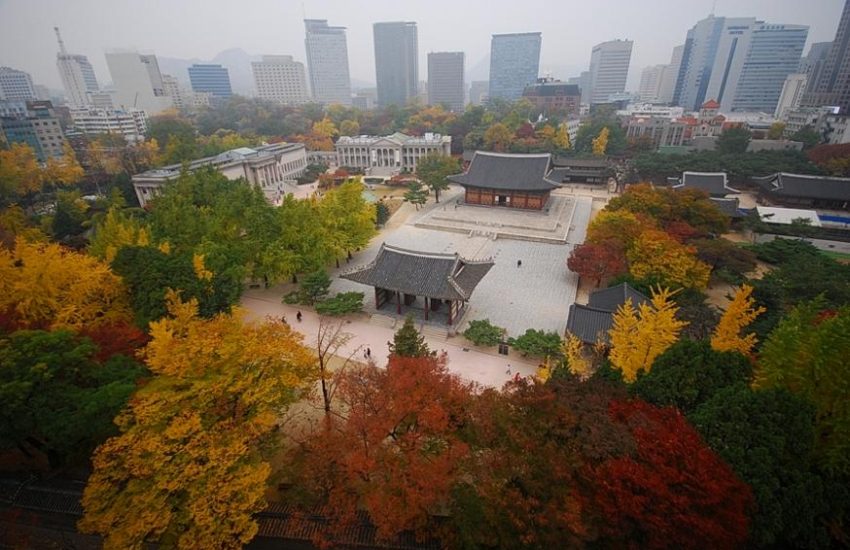
Deoksugung: The Palace Where Old Korea Met the Modern World


