Where the eastern spurs of the Caucasus Mountains plunge toward the Caspian Sea, there is a gap barely three kilometers wide between the peaks and the water, a natural gateway between the steppes of the north and the civilizations of the south. For thousands of years, whoever controlled this narrow passage controlled the movement of peoples, armies, and trade between two worlds. That gateway is guarded by Derbent, one of the oldest continuously inhabited cities in Russia, a place whose very name means the closed gates. Crowned by the great fortress of Naryn-Kala and defended by colossal walls that once marched from the mountains down into the sea, Derbent is a monument to the ancient art of controlling a chokepoint. Its Sasanian fortifications, more than fifteen hundred years old, are among the most impressive defensive works to survive from antiquity, and its long history spans empires, religions, and the endless traffic of the Caspian Gates.

Table of Contents
- The Gate Between Two Worlds
- Walls From the Mountains to the Sea
- The Citadel of Naryn-Kala
- The Persian Shield
- A City of Many Rulers and Faiths
- An Ancient Home of Faith
- Guardian of the Caspian Route
- One of the Oldest Living Cities
- A World Heritage Fortress
- Why Derbent Matters
- The Closed Gates
- The Engineering of a Barrier
- The March of Empires
- Life Within the Walls
- Nearby in Russia’s Ancient Story
- The Sentinel of the Caspian
The Gate Between Two Worlds
Derbent occupies one of the most strategically vital spots in all of Eurasia. Here the Caucasus Mountains come so close to the Caspian Sea that they leave only a narrow coastal corridor, a natural bottleneck through which anyone traveling between the great Eurasian steppe to the north and the lands of Persia, the Middle East, and beyond to the south must pass. This passage has been known since antiquity as the Caspian Gates.
Control of this gateway meant control over migration, invasion, and trade along the western shore of the Caspian. For the empires to the south, it was a vital defensive point against the nomadic peoples of the steppe; for merchants, it was a chokepoint on the trade routes linking distant regions. Derbent grew up precisely to command this passage, and its entire history is bound to the strategic imperative of holding the gate between two worlds.
The importance of such natural chokepoints is a recurring theme in military history, and few are as dramatic as the Caspian Gates. Here, geography itself dictated that a small force holding the passage could bar the way to a much larger one, and this simple strategic fact shaped the destiny of Derbent from its earliest days. The city was, in essence, geography’s answer to the problem of the open frontier.
Standing at the Caspian Gates, one senses how the land itself seems designed to channel and constrain movement, forcing the great flows of history through a single narrow point. It is little wonder that a city arose here to master that flow. Derbent is geography made into architecture, the physical embodiment of a passage that no power in the region could afford to ignore.

Walls From the Mountains to the Sea
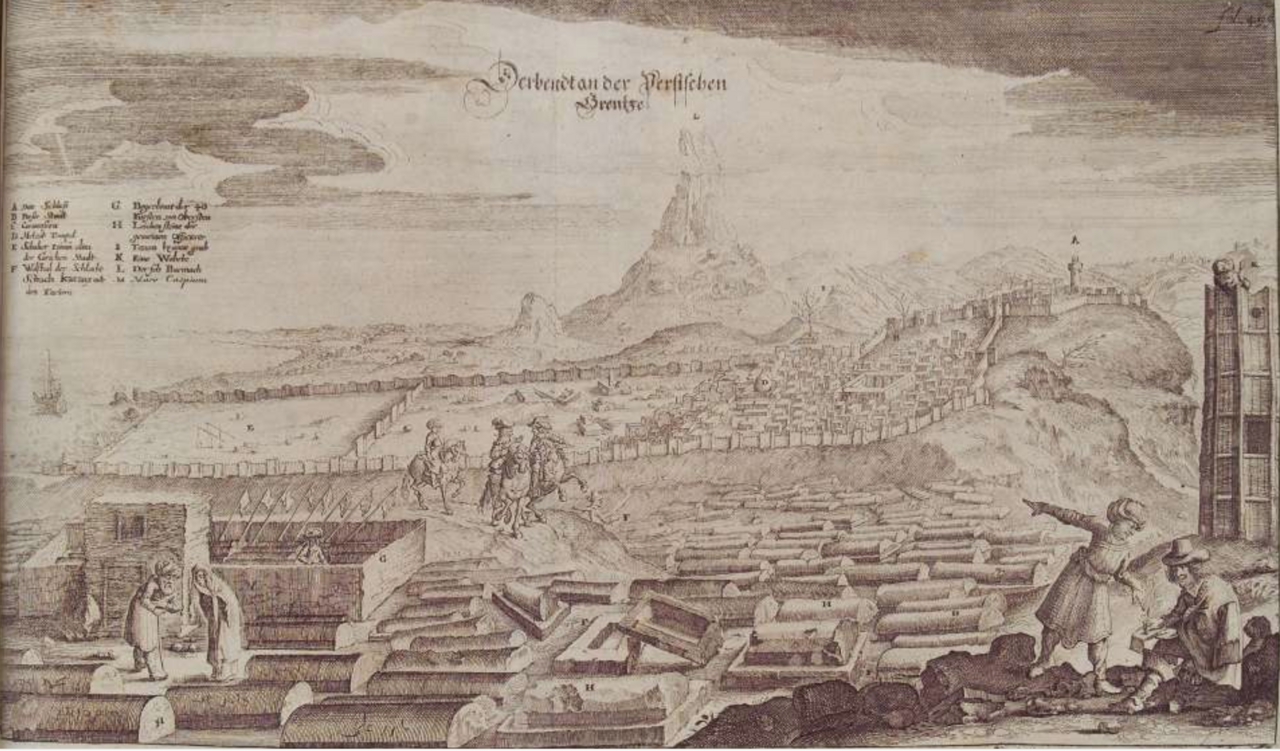
The defining feature of Derbent is its extraordinary fortifications. The city was protected by two long parallel walls running down from the fortress on the mountainside to the Caspian shore, and originally extending out into the sea itself, sealing the coastal corridor completely. Between these walls lay the city, and beyond the landward wall stretched additional defenses reaching far into the mountains to block any passage around the city.
These walls, built largely under the Sasanian Persian Empire around the sixth century CE, are among the most remarkable defensive works surviving from the ancient world. Built of stone and standing many meters high and thick, they turned the natural bottleneck of the Caspian Gates into an impassable barrier. Even in their ruined and diminished state, the walls of Derbent remain an awe-inspiring testament to the engineering and ambition of the empire that raised them.
To imagine the walls in their prime, marching unbroken from the heights down to the water and out into the waves, is to grasp the sheer audacity of the undertaking. Nothing was left to chance; every possible route through the corridor was blocked. The fortifications transformed a vulnerable gap into one of the most formidable barriers of the ancient world, a wall that truly closed the gate between north and south.
There is something profoundly moving about walls built to close a gap between mountains and sea. They embody a very human response to the challenge of the frontier, the determination to impose order and security upon a dangerous passage. Even reduced by time, the walls of Derbent still convey that ancient resolve, standing as one of the great surviving statements of the fortifier’s art.

The Citadel of Naryn-Kala
Crowning a hill above the city stands the citadel of Naryn-Kala, the great fortress that anchored Derbent’s defenses. From this commanding height, the fortress overlooked the walls, the city, the coastal corridor, and the sea, allowing its defenders to control the entire gateway. The citadel enclosed a substantial area and contained the buildings necessary for a garrison and administration, a stronghold at the heart of the fortified system.
Naryn-Kala was the linchpin of Derbent’s power. As long as the citadel held, the walls could not be turned, and the gate remained closed to any hostile force. Over the centuries the fortress was maintained, modified, and fought over by successive rulers, each recognizing its immense strategic value. Today Naryn-Kala remains the crowning monument of Derbent, its ancient walls and structures a powerful symbol of the city’s long role as guardian of the Caspian Gates.
The commanding views from Naryn-Kala were themselves a weapon, allowing the defenders to see any approaching threat long before it arrived. From this vantage the whole strategic situation lay revealed, the corridor, the walls, the sea, and the mountain approaches all visible at a glance. Control of this height meant control of the entire gateway, which is why the citadel was always the key to holding Derbent.
Within its walls, Naryn-Kala held the structures a garrison and administration required, from cisterns that stored precious water to buildings that housed the defenders and their commanders. The citadel was a self-contained stronghold, capable of holding out even if the lower city fell, and its ability to endure sieges was central to Derbent’s remarkable staying power across the centuries.
The Persian Shield
The great fortifications of Derbent were principally the work of the Sasanian Empire of Persia, one of the superpowers of late antiquity. For the Sasanians, the Caspian Gates were a crucial frontier, a point that had to be held against the nomadic peoples of the northern steppe who threatened their realm. Fortifying Derbent was a project of imperial strategy, an investment in the defense of the entire empire.
The scale of the Sasanian effort at Derbent reflects the importance they placed on the passage. Raising massive walls across the corridor and out into the sea, building the citadel, and manning the defenses required enormous resources and organization. The result was one of the great frontier fortifications of the ancient world, a Persian shield against the north that stood as a bulwark of civilization at one of Eurasia’s most contested crossroads.
The Sasanians understood that the security of their empire depended in part on such frontier works, and Derbent was among the greatest of them. In pouring resources into its walls, they were defending not merely a city but the whole civilized south against the perceived dangers of the steppe. The scale of Derbent reflects the scale of that strategic concern, a monument to an empire’s determination to guard its northern flank.
The legacy of the Sasanian builders endures in the very stones of Derbent, more than fifteen centuries after they raised their walls. Their empire is long gone, its glory faded into history, yet the fortifications they created still stand, guarding a gateway that has outlasted the power that once fortified it. In Derbent, the ambition of ancient Persia is preserved in enduring stone.

A City of Many Rulers and Faiths
Because of its strategic value, Derbent passed through the hands of many powers over its long history. Persians, Arabs, Khazars, Mongols, and others contested and controlled the city at various times, each leaving their mark. This turbulent succession of rulers reflects the city’s importance; whoever aspired to dominate the region had to hold the Caspian Gates, and so Derbent was fought over again and again across the centuries.
With its many rulers came many faiths. Derbent became an early center of Islam in the region following the Arab conquests, and it is home to some of the oldest mosques in Russia. Yet it has also been a place of remarkable religious diversity, with Muslim, Christian, and Jewish communities living within its walls over the centuries. This blend of peoples and religions, layered over its ancient defenses, gives Derbent a rich and cosmopolitan character.
The layering of so many rulers and cultures gave Derbent a depth few cities possess. Each conqueror added to the palimpsest of its history, and the city that emerged from this long process was richer and more complex for it. In Derbent, the meeting of civilizations was not an occasional event but the very substance of the city’s long and eventful life.

An Ancient Home of Faith
Derbent holds a special place in the religious history of Russia and the Caucasus. Following the Arab conquest of the region, the city became a stronghold of Islam, and its Juma Mosque is counted among the oldest in the country and the wider region. For centuries Derbent served as a gateway not only for armies and trade but for faith, a point through which Islam entered and spread.
Alongside its Islamic heritage, Derbent has long been home to other religious communities, including an ancient Jewish population and Christian presence. The city’s houses of worship, its old quarters, and its traditions reflect this deep and diverse religious history. In Derbent, the great faiths met and coexisted at the crossroads of Eurasia, adding a profound spiritual dimension to the city’s identity as a meeting place of worlds.
The presence of ancient Islamic, Jewish, and Christian communities within a single city speaks to Derbent’s remarkable role as a meeting place of faiths. In an age when religious difference so often brought conflict, the long coexistence of these communities at the Caspian Gates stands as a notable feature of the city’s heritage, a reflection of its character as a crossroads where many worlds converged.
As a gateway through which faith as well as trade and armies passed, Derbent occupies a distinctive place in the spiritual geography of the region. Its ancient mosque, synagogue traditions, and Christian presence together tell of a city where the great religious currents of Eurasia met and left their lasting mark, adding yet another layer to its extraordinary depth.

Guardian of the Caspian Route
Beyond its military role, Derbent was a hub of trade. The coastal corridor it commanded was a vital artery of commerce, part of the network of routes that carried goods along the Caspian and connected the north with the south. Merchants passing through the Caspian Gates paid for the privilege, and Derbent grew prosperous as the guardian and beneficiary of this lucrative traffic.
The city’s markets and quarters bustled with the exchange of goods from distant lands, and its role as a commercial gateway complemented its military function. To control Derbent was to tax and profit from the trade that flowed through the passage, making the city not only a fortress but a source of wealth. This combination of strategic and commercial value ensured that Derbent remained a prize coveted by every power in the region for well over a thousand years.
The dual role of Derbent as both fortress and marketplace was no coincidence, for strategic passages and trade routes are often one and the same. The very corridor that armies sought to control was also the path that merchants sought to travel, and Derbent stood astride both. This union of military and commercial importance made the city doubly valuable, and doubly contested, across its long history.
Goods from many lands would have passed through Derbent’s markets, mingling with local products in a lively commerce that tied the city into far-reaching networks of exchange. This trade brought not only wealth but also the cultural richness that came with contact between distant peoples, reinforcing Derbent’s character as a cosmopolitan crossroads as well as a mighty fortress.

One of the Oldest Living Cities
Derbent is often cited as one of the oldest continuously inhabited cities in Russia, with a history stretching back into deep antiquity. While its great walls date largely to the Sasanian period, the site itself was significant far earlier, and people have lived here, guarding and profiting from the Caspian Gates, for a very long span of time. This continuity is a large part of what makes Derbent so remarkable.
Few cities can claim such an ancient and unbroken life. Through the rise and fall of empires, the coming of new faiths, and the endless traffic of the gateway it guards, Derbent has endured, always tied to the strategic passage that gave it birth. Its old town, its walls, and its citadel are living monuments to this extraordinary continuity, a city that has held its post at the gate between worlds for well over a millennium.
The sheer antiquity of Derbent invites a kind of awe. Empires that seemed eternal have vanished, faiths have risen and spread, and countless generations have come and gone, yet the city at the Caspian Gates has endured through it all. This continuity connects the present inhabitants of Derbent to a past of extraordinary depth, making the city a living bridge to the ancient world.
For a city to remain continuously inhabited for so many centuries is a rare achievement, and it lends Derbent a special place among the world’s ancient settlements. Its unbroken life means that the past is not merely buried beneath it but woven into its living fabric, present in its old streets, its walls, and the traditions of its people, a continuity that few places on earth can match.
A World Heritage Fortress
The exceptional historical and architectural value of Derbent has earned its ancient fortifications and old city recognition as a UNESCO World Heritage Site. The citadel of Naryn-Kala, the great parallel walls, and the historic urban fabric together form one of the most impressive surviving examples of ancient frontier fortification, and their preservation is a matter of international importance.
This recognition places Derbent among the great heritage sites of the world, alongside the other monuments that document humanity’s shared past. For Russia, Derbent is a treasure of extraordinary antiquity and significance; for the world, it is a rare and magnificent survival of the ancient art of defending a strategic passage. The walls and citadel that once closed the Caspian Gates now stand as a monument open to all who wish to marvel at them.
UNESCO recognition has also helped ensure that Derbent’s monuments are protected and studied for future generations. The great walls and citadel, having survived so many centuries of war and weather, now enjoy a measure of the care their significance demands. In this way the ancient defenses that once guarded the Caspian Gates are themselves guarded, preserved as a treasure of world heritage.
To visit Derbent today is to encounter one of the most impressive ensembles of ancient fortification anywhere in the world, its walls and citadel telling a story that spans empires and millennia. The recognition of its heritage value ensures that this story will continue to be told, and that the closed gates of the Caspian will remain open to all who come to learn from them.
Why Derbent Matters
Derbent matters because it embodies, more completely than almost any other place, the ancient strategy of controlling a chokepoint. Its walls, citadel, and long history reveal how a single narrow passage could shape the movement of peoples and the fate of empires, and how much effort civilizations would pour into commanding such a point. For understanding the geography of power in the ancient world, Derbent is a supreme example.
The city also stands as a monument to endurance and diversity, a place where empires rose and fell, faiths met and mingled, and a continuous human community held its ground for well over a thousand years. In its ancient stones lie the layered stories of Persians and Arabs, merchants and warriors, Muslims, Christians, and Jews, all bound together by the enduring importance of the gate between two worlds.
Derbent’s example also illuminates the broader history of the Caucasus, that great mountainous meeting ground between Europe, the Middle East, and the steppe. As one of the region’s most important and enduring cities, Derbent offers a window onto the complex interplay of empires, peoples, and faiths that has always characterized this crossroads of continents, a history in which the city played a central and lasting role.
The Closed Gates
The legacy of Derbent is written in its very name, the closed gates, and in the mighty walls that still climb from the sea toward the mountains. For fifteen centuries and more, this city has stood guard over one of Eurasia’s most vital passages, a stone sentinel at the meeting point of steppe and civilization, north and south, one world and another.
To stand before the walls of Naryn-Kala, gazing out over the narrow corridor between the Caucasus and the Caspian, is to grasp the timeless importance of geography in human affairs. Derbent reminds us that certain places, by the accident of their position, become the hinges on which history turns. At the closed gates of the Caspian, the ancient city keeps its watch still, a monument to the enduring power of the gateway between worlds.
The Engineering of a Barrier
The construction of Derbent’s defenses was a feat of engineering worthy of the great empires that undertook it. To seal the coastal corridor completely, the builders had to raise walls not only across the level ground but up the slopes of the mountains and out into the waters of the Caspian, adapting their techniques to each demanding environment. The result was a continuous barrier that left no gap for an enemy to exploit.
Building in stone on such a scale, and extending the fortifications into the sea, required careful planning, abundant labor, and sophisticated understanding of construction. The walls had to withstand not only assault but the erosion of wind and water over the centuries. That so much of this ancient system survives today is a tribute to the skill of its builders, who created defenses meant to endure for generations.
The genius of the design lay in its use of the natural landscape. Rather than fighting the geography, the builders of Derbent worked with it, letting the mountains and the sea form the anchors of their barrier and filling only the narrow gap between with their walls. In this marriage of natural and man-made defense, Derbent achieved a security that few fortifications in the ancient world could match.
The March of Empires
The roll call of powers that held Derbent reads like a history of the medieval and ancient Near East and Eurasia. The Sasanian Persians built its great walls; the Arab caliphates seized it and made it a bastion of Islam; the Khazars, a powerful steppe empire, contested it from the north; and later the Mongols, along with various regional dynasties and eventually the Russian Empire, took their turns as its masters.
Each of these powers valued Derbent for the same reason: control of the Caspian Gates. As empires rose and fell across the surrounding regions, the city changed hands, but its strategic significance never diminished. Its walls were repaired, its garrison replaced, its rulers exchanged, yet its fundamental role as the guardian of the passage endured through every transition of power.
This long procession of rulers left Derbent a city of extraordinary historical depth, its stones layered with the legacies of many civilizations. To walk its old streets is to move through the accumulated history of Eurasia, from Persian imperial ambition to Arab conquest to the movements of the great steppe empires. Few cities have witnessed so directly the rise and fall of so many powers.
That a single city could remain so consistently important through such a long succession of ruling powers is itself a mark of its unique strategic value. Empires may have differed in language, religion, and ambition, but all recognized the same truth: that to command the Caspian Gates was to hold one of the keys to the region. Derbent’s history is, in a sense, a history of that unchanging strategic reality.
In the end, the march of empires through Derbent testifies to a truth as old as civilization itself: that control of the vital passages of the earth confers power over the movements of the world. For fifteen centuries and more, that truth drew the mighty to the Caspian Gates, and the city that guards them still bears the marks of all who came to claim it.
Life Within the Walls
Within the shelter of its great walls, Derbent was more than a fortress; it was a living city, home to communities who pursued their trades, worshipped in their houses of prayer, and raised their families in the shadow of the citadel. The old town, packed with narrow streets and ancient buildings, grew up between the two parallel walls, protected by the defenses that made the city famous.
The inhabitants of Derbent made their living from trade, crafts, and the many activities that clustered around a great gateway of commerce and strategy. Their city was cosmopolitan by nature, touched by the many peoples who passed through or settled within its walls, and enriched by the diverse religious and cultural traditions that took root there. Daily life unfolded amid a remarkable blend of influences drawn from across Eurasia.
Over the centuries, this community endured through sieges, conquests, and the changing fortunes of the city, maintaining a continuous human presence at the Caspian Gates. The persistence of ordinary life within Derbent’s walls, across so many upheavals, is part of what makes the city one of the oldest living settlements in the region, a place where the everyday and the epic have always coexisted.
The endurance of Derbent’s communities through siege and conquest is a quiet counterpoint to the grand drama of empires that swirled around the city. Amid the clash of armies and the changing of rulers, ordinary people continued to live, work, and worship at the Caspian Gates, and it is their persistence, as much as the great walls, that has made Derbent one of the oldest living cities of the region.
Nearby in Russia’s Ancient Story
- The Northernmost Greek City, Where Wine Met the Steppe: The Story of Tanais
- The Quiet Town on the Volkhov Where Russia May Have Begun: The Story of Staraya Ladoga
- A Perfect Circle on the Steppe, Burned by Its Own People: The Story of Arkaim
The Sentinel of the Caspian
Derbent endures as one of the great fortress cities of the ancient world, a stone sentinel guarding the narrow gate between the Caucasus and the Caspian Sea. Its towering Sasanian walls, its citadel of Naryn-Kala, and its layered heritage of many empires and faiths make it a monument unlike any other in Russia.
In the closed gates of Derbent, the whole drama of the ancient frontier is preserved, the eternal contest to control the passages between worlds. For over a thousand years the city has kept its watch, and its ancient stones still speak of the peoples, armies, and merchants who once streamed through the gateway it was built to command.
You May Like

Mafra, the Palace a King Built From a Vow


2 thoughts on “Derbent: The Caspian Gates Where a Great Wall Met the Sea”