Rising in great walls of red sandstone along the banks of the Yamuna river in the heart of Old Delhi, the Red Fort is the supreme monument of the Mughal empire at the height of its power and glory. Built by the emperor Shah Jahan, the same ruler who raised the immortal Taj Mahal, it was the palace-fortress of a new imperial capital, a place of marble halls and jewelled thrones, of gardens and fountains, where the Great Mughals ruled over one of the richest and most magnificent empires the world has ever seen. From its ramparts, in our own age, the leaders of independent India address the nation.
In this article you are invited to explore the history and the architecture of this magnificent fortress-palace, from its construction in the golden age of the Mughals, through its plunder and decline, to its role as the stage for the last act of the Mughal empire and the birth of modern India. The Red Fort is a monument of two faces, at once a mighty fortress and a palace of exquisite refinement, and it stands as the great symbol of the Mughal achievement and of the Indian nation that succeeded it.

In This Article
- The Great Palace-Fort of the Mughals
- Shah Jahan and Shahjahanabad
- The Lahori Gate
- The Chatta Chowk Bazaar
- The Hall of Public Audience
- The Hall of Private Audience and the Peacock Throne
- If There Is Paradise on Earth
- The Rang Mahal and the Palaces
- The Gardens and the Stream of Paradise
- The Pearl Mosque
- The Plunder of Nadir Shah
- Bahadur Shah Zafar and 1857
- The Red Fort Today
- Castles Nearby
- The Symbol of a Nation
The Great Palace-Fort of the Mughals
The Red Fort takes its name from the great walls of red sandstone that enclose it, stretching for some two and a half kilometers around the vast palace-city within, and rising to a height of thirty-three meters on the side facing the city. These mighty ramparts, built by the Mughal emperor Shah Jahan, enclose an area of more than two hundred and fifty acres along the banks of the Yamuna river, forming one of the largest and most magnificent palace-fortresses in all of India.
The fort was the heart of Shahjahanabad, the new imperial capital that Shah Jahan founded at Delhi, and it served as the residence of the Mughal emperors and the seat of their government for nearly two hundred years. Within its red walls lay a whole world of marble palaces, halls of audience, mosques, gardens, and bazaars, a self-contained imperial city of surpassing splendor. The Red Fort was at once a fortress, a palace, and a city, the beating heart of the greatest empire of its age.
The octagonal plan of the fortress, with its river frontage and its landward walls, was carefully designed to combine defence with the amenities of a great palace, and the whole was oriented to take advantage of the cooling breezes from the river. Standing before the great red walls today, it is easy to understand the awe they must have inspired in all who approached the imperial capital, a visible symbol of the immense wealth and power of the Mughal empire at the very summit of its glory.
The red sandstone from which the fort takes its name was the favored building material of the earlier Mughals, used at Agra and Fatehpur Sikri, and its warm red color gives the fort a majesty quite different from the pure white marble of the Taj Mahal. Within the red walls, however, the most important buildings were built of white marble, so that the fort combined the strength and warmth of red sandstone with the refinement and delicacy of marble, a contrast that is one of the defining features of its architecture.

Shah Jahan and Shahjahanabad
The Red Fort was the creation of Shah Jahan, the fifth of the Great Mughal emperors, who ruled over the empire at the height of its power and wealth, and who is remembered above all as the greatest builder of the dynasty, the ruler who raised the Taj Mahal in memory of his beloved wife. Around the year 1638, Shah Jahan decided to move his capital from Agra to Delhi, and he founded a new city there, named Shahjahanabad after himself, with the Red Fort as its palace and citadel.
The construction of the fort took some ten years, from 1638 to 1648, and it was designed by the master architect Ustad Ahmad Lahori, the same genius who is credited with the design of the Taj Mahal. Under his direction, the finest craftsmen of the empire created a palace-fortress that combined the strength of a great citadel with the refinement of an imperial palace, blending the architectural traditions of Persia and India into a new and magnificent synthesis. The Red Fort was the crowning achievement of the golden age of Mughal architecture.
The reign of Shah Jahan is remembered as the golden age of Mughal architecture, a period that produced not only the Red Fort and the Taj Mahal but a whole series of magnificent buildings across the empire, marked by their use of white marble, their delicate inlay work, and their perfect proportions. Shah Jahan was a builder of genius and a patron of unrivalled taste, and the Red Fort, as the palace of his new capital, was intended as the supreme expression of his imperial vision. In it, the Mughal style reached a pitch of refinement never surpassed.
The decision of Shah Jahan to build an entirely new capital, Shahjahanabad, with the Red Fort at its heart, was a characteristic act of a great imperial builder, who sought to leave a lasting monument to his reign and his dynasty. The new city, with its great fort, its congregational mosque the Jama Masjid, and its bustling bazaars, became the political and cultural heart of the empire, and it remains, as Old Delhi, the historic core of the modern capital. The Red Fort was the crowning jewel of this magnificent imperial creation.

The Lahori Gate
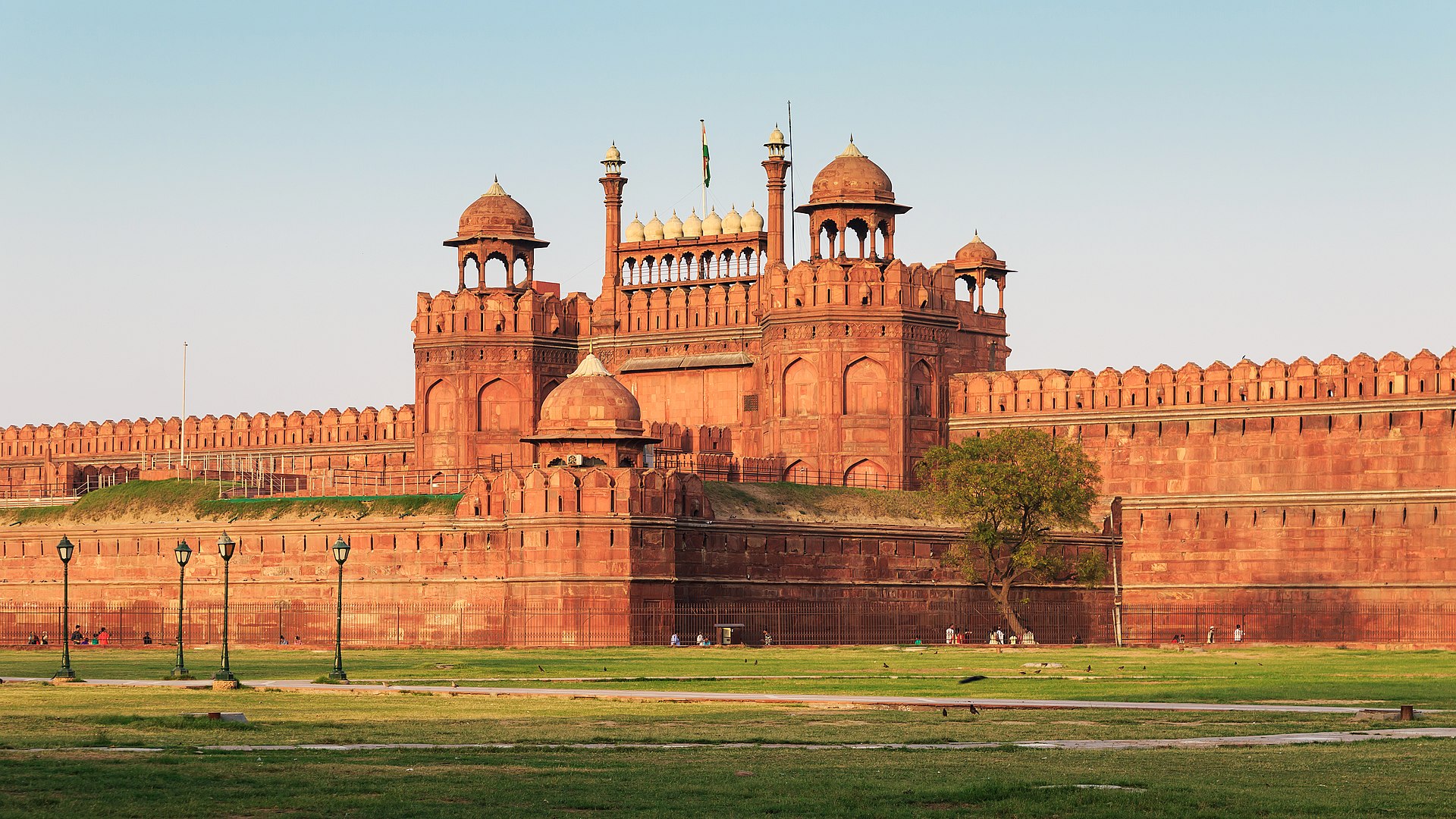
The principal entrance to the Red Fort is the Lahori Gate, so named because it faces toward the great city of Lahore, one of the other capitals of the Mughal empire. This mighty gateway, built of red sandstone and crowned with domed pavilions, is the main public entrance to the fortress, and it is the spot from which, in the modern age, the flag of independent India is raised each year on Independence Day.
In the reign of Shah Jahan’s son, the emperor Aurangzeb, a barbican was added in front of the gate, an additional defensive work that obscured the direct view of the entrance. Shah Jahan, it is said, was displeased by this addition, complaining that it was like a veil drawn across the face of a beautiful woman, hiding the splendor of the gate behind it. The Lahori Gate remains the great ceremonial entrance to the fortress, and its historical and symbolic importance, as the place where modern India celebrates its freedom, is unrivaled.
The Lahori Gate has become, in modern times, the most symbolically charged spot in all of India, for it is here, above this gate, that the destiny of the independent nation is annually reaffirmed. The choice of the Red Fort, the ancient seat of Mughal power, as the place from which the leaders of free India address their people, was a deliberate and powerful assertion of the continuity of Indian sovereignty, linking the new republic to the long and glorious history of the land. The gate is thus a monument to both the imperial past and the democratic present.
The Chatta Chowk Bazaar
Passing through the Lahori Gate, the visitor enters the Chatta Chowk, a long, covered bazaar that runs within the walls of the fortress, its arched arcade lined with shops. This covered market is a rare and distinctive feature of the Red Fort, for it was unusual for a bazaar to be included within the walls of an imperial palace, and it reflects the character of the fort as a complete city in miniature.
In the days of the Mughals, the shops of the Chatta Chowk, also known as the Meena Bazaar, sold the fine goods that the imperial household required, from silks and jewelry to other luxuries, catering to the court and its many attendants. Today the bazaar still functions, selling souvenirs and handicrafts to the visitors who throng the fortress, and it retains something of the atmosphere of the imperial market that it once was. The Chatta Chowk is a fitting introduction to the wonders of the Red Fort, a bustling passage leading into the heart of the palace.
The inclusion of a bazaar within the walls of the palace reflects the Mughal conception of the imperial residence as a complete city, providing for all the needs of the vast household and court that surrounded the emperor. The Chatta Chowk was a place of commerce and of everyday life within the grand setting of the palace, and it must have bustled with activity in the days of the Mughals, as merchants displayed their finest wares to the nobles and attendants of the court. Its survival, still a working market, is a link to this vanished world.
The Hall of Public Audience
Beyond the bazaar lies the Diwan-i-Aam, the Hall of Public Audience, where the Mughal emperor would sit in state to hear the petitions and grievances of his people and to conduct the public business of the empire. This great hall, open on its sides and supported by rows of red sandstone columns, was the setting for the daily audiences at which the emperor made himself accessible to his subjects, hearing cases concerning taxation, inheritance, and other matters.
At the rear of the hall stands a raised marble balcony, or jharokha, where the emperor sat enthroned, elevated above the assembly, framed by a canopy and adorned with exquisite inlaid decoration. From this seat the ruler of the Mughal empire dispensed justice and displayed his majesty before the crowds gathered in the hall below. The Diwan-i-Aam was the public face of imperial power, a place where the awesome authority of the Great Mughal was made visible to all who came before him.
The institution of the public audience was central to the Mughal conception of kingship, for the emperor was expected to make himself accessible to his subjects and to dispense justice personally, and the Diwan-i-Aam was the stage on which this vital function was performed. The daily appearance of the emperor at the jharokha, framed like a living icon of imperial authority, was a ceremony of great importance, binding the ruler to his people and displaying the majesty and the justice of the throne. The hall was thus not merely an architectural showpiece but the setting for a crucial ritual of Mughal government.
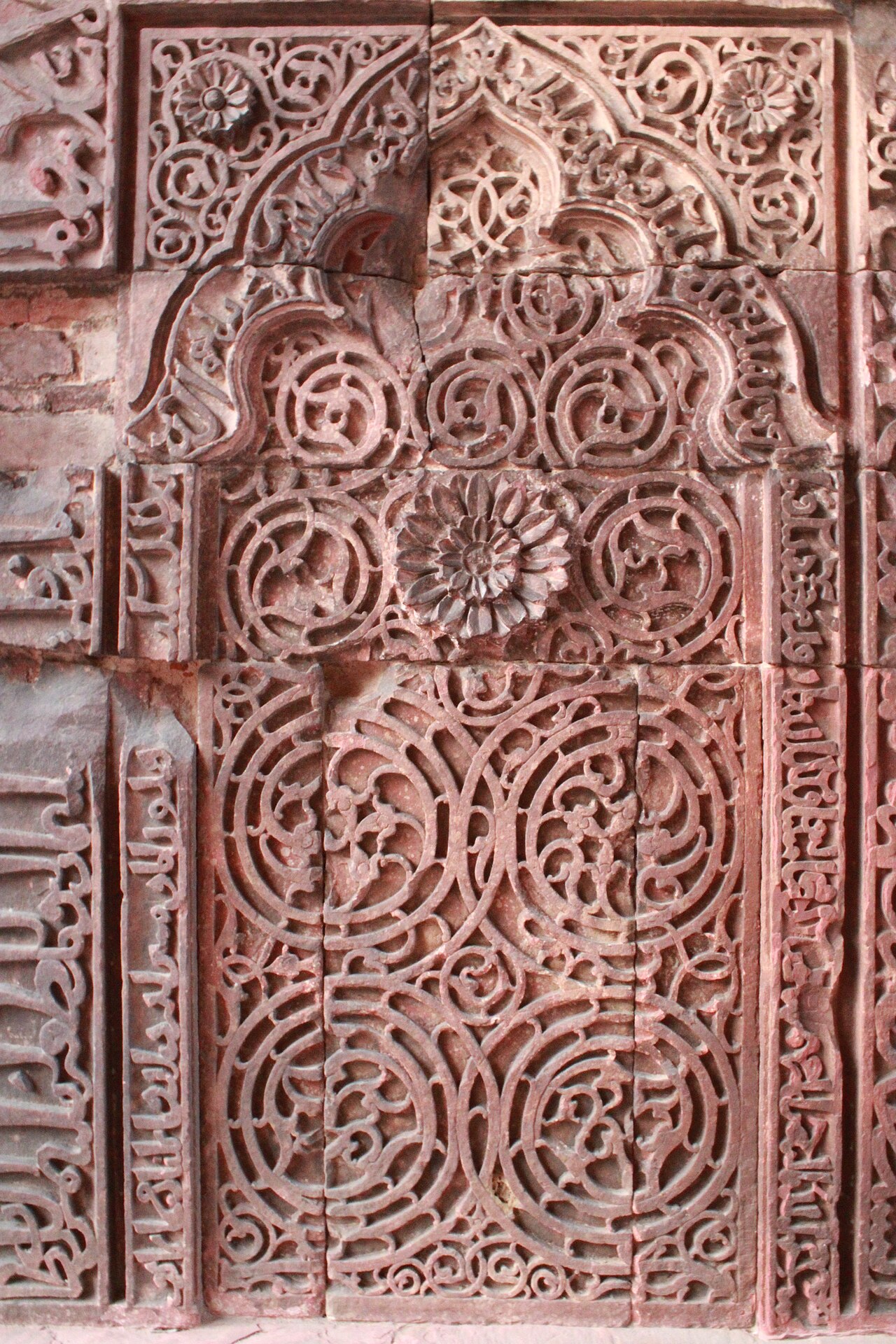
Behind the emperor’s marble balcony in the Diwan-i-Aam is a wall inlaid with panels of pietra dura, some of them, it is said, the work of European craftsmen, depicting birds and flowers and even the Greek figure of Orpheus, a testament to the cosmopolitan reach of the Mughal court, which drew artists and influences from across the world. These exquisite panels, set behind the throne, framed the emperor in a setting of surpassing beauty, and they reflect the openness of the Mughal empire to the arts and cultures of many lands.

The Hall of Private Audience and the Peacock Throne
The most exquisite of all the buildings of the Red Fort is the Diwan-i-Khas, the Hall of Private Audience, a pavilion of pure white marble inlaid with precious and semi-precious stones, where the emperor received his most important guests and conducted the private business of the empire. Once crowned with a ceiling of solid silver, and adorned with the finest decoration, the hall was the innermost sanctum of imperial power, a place of surpassing luxury and refinement.
It was in the Diwan-i-Khas that Shah Jahan placed the fabled Peacock Throne, the most magnificent throne ever created, encrusted with countless jewels, including some of the greatest diamonds in the world, and surmounted by the figures of peacocks in gold and gems. Upon the walls of the hall is inscribed a famous Persian couplet that captures the spirit of the place: if there is a paradise on the face of the earth, it is this, it is this, it is this. Few buildings have ever so richly deserved such praise.
The Peacock Throne, which stood in the Diwan-i-Khas, was perhaps the most fabulous object ever created by human hands, a throne encrusted with an almost incalculable wealth of diamonds, rubies, emeralds, and pearls, and taking its name from the two jewelled peacocks that adorned it. It embodied the immense wealth of the Mughal empire, and its loss to Nadir Shah was a blow from which the prestige of the dynasty never recovered. The empty hall where it once stood is haunted by the memory of this vanished marvel, the supreme symbol of Mughal magnificence.
The white marble of the Diwan-i-Khas, inlaid with flowers and patterns in precious stones in the technique known as pietra dura, represents the very summit of Mughal decorative art, a craft that the empire had brought to a pitch of perfection unequalled anywhere in the world. The delicate floral inlays, glowing against the pure white marble, transformed the hall into a jewel box worthy of the fabulous throne it contained. Even stripped of its silver ceiling and its treasures, the hall remains one of the most beautiful interiors in all of India.

If There Is Paradise on Earth
The famous inscription in the Hall of Private Audience, declaring that if there is a paradise on the face of the earth, it is here, expresses the extraordinary ambition of the Mughal builders, who sought to create in the Red Fort nothing less than a paradise on earth, a vision of the celestial gardens brought down to the world of men. This vision informed every aspect of the design of the fort, from its gardens and fountains to its marble halls and jewelled thrones.
The imagery of paradise runs throughout the palace, from the Stream of Paradise that flowed through its chambers to the gardens named for the seasons and the pavilions that adorned them. The Mughals, drawing upon the traditions of Persian and Islamic art, conceived of the imperial palace as a reflection of the heavenly paradise, and they spared no expense or effort in the attempt to realize this vision. The inscription in the Diwan-i-Khas is the perfect expression of this ambition, and of the confidence and the wealth of the empire that could aspire to it.
The couplet inscribed in the Diwan-i-Khas, composed by the poet Amir Khusrau and applied to the hall, has become one of the most famous inscriptions in the world, and it perfectly captures the aspiration of the Mughal builders to create a heaven on earth. This vision of the palace as an earthly paradise was not mere vanity but a deeply held ideal, rooted in the religious and artistic traditions of the Islamic world, in which the garden and the flowing stream were images of the paradise promised to the faithful. The Red Fort was the supreme realization of this ideal.

The Rang Mahal and the Palaces
Along the eastern edge of the fortress, overlooking the river, stands a row of exquisite marble palaces that formed the private residences of the emperor and his household. Among the most beautiful is the Rang Mahal, the Palace of Colors, which was the residence of the emperor’s wives and the women of the imperial harem, and which took its name from the vivid paintings and decorations that once adorned it. At its center was a marble pool, fed by the Stream of Paradise, in the form of a lotus flower.
Nearby stands the Khas Mahal, the emperor’s own private apartment, and the Mumtaz Mahal, another of the palaces of the women, now housing a museum. These marble palaces, cooled by the flowing waters of the Stream of Paradise and adorned with the finest inlay and carving, were the private world of the imperial family, a realm of luxury and refinement hidden within the great red walls of the fortress. Even in their ruined and diminished state, they convey something of the extraordinary splendor of the Mughal court at its height.
The riverside palaces of the Red Fort were designed to catch the breezes and the light from the Yamuna, and their marble walls, once adorned with paintings, inlay, and gilding, must have glowed with color and richness in the days of the Mughals. The women of the imperial harem, who lived in these secluded palaces, wielded considerable influence behind the scenes, and the harem was a world of its own, with its own hierarchy and its own intricate politics. The surviving palaces, though stripped of much of their former glory, remain among the finest examples of Mughal domestic architecture.
The Gardens and the Stream of Paradise
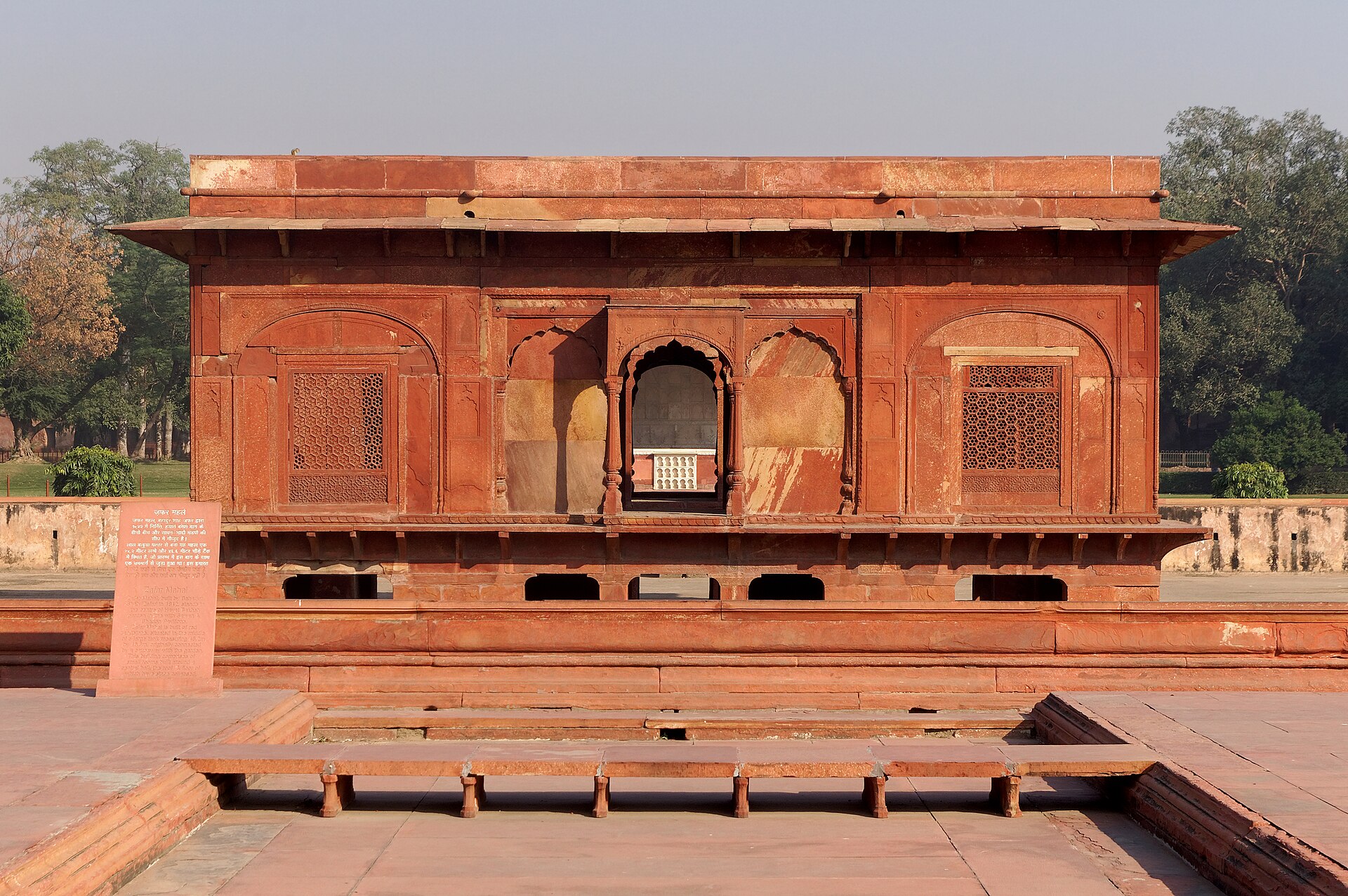
The Mughals were great lovers of gardens, which they regarded as reflections of the paradise promised in their faith, and the Red Fort was adorned with beautiful gardens, the greatest of which was the Hayat Bakhsh Bagh, the Life-Bestowing Garden, laid out in the formal Mughal style with canals, fountains, and pavilions. At each end of its central canal stood a marble pavilion, named for the months of the rainy season, and at its center a red sandstone pavilion added by a later emperor.
Through the palaces and gardens of the fort flowed the Nahr-i-Bihisht, the Stream of Paradise, a channel of running water that carried the cooling waters of the Yamuna through the marble halls and the gardens, feeding the pools and fountains and refreshing the air in the fierce heat of the Delhi summer. This ingenious water system, bringing the life-giving element into the very heart of the palace, was one of the glories of the Red Fort, and it embodied the Mughal vision of the palace as a paradise garden, watered by the streams of heaven.
The Mughal garden, with its geometric layout of canals and beds, its fountains and pavilions, was one of the great artistic achievements of the dynasty, and it was conceived as an image of the paradise garden of the faith, a place of order, beauty, and refreshment amid the harshness of the world. The gardens of the Red Fort, watered by the Stream of Paradise, were among the finest of their kind, and though much was destroyed by the British, enough survives to convey the Mughal genius for the art of the garden, one of their most enduring legacies.
The Sawan and Bhadon pavilions, named for the two months of the Indian rainy season, were designed with ingenious water features, including niches behind the falling water where lamps could be placed by night and flowers by day, so that the water would shimmer with light or color. Such refinements reveal the extraordinary sophistication of the Mughal garden-makers, who sought to delight every sense and to create, in the harsh climate of Delhi, a cool and beautiful paradise of water, greenery, and shade for the pleasure of the imperial family.

The Pearl Mosque
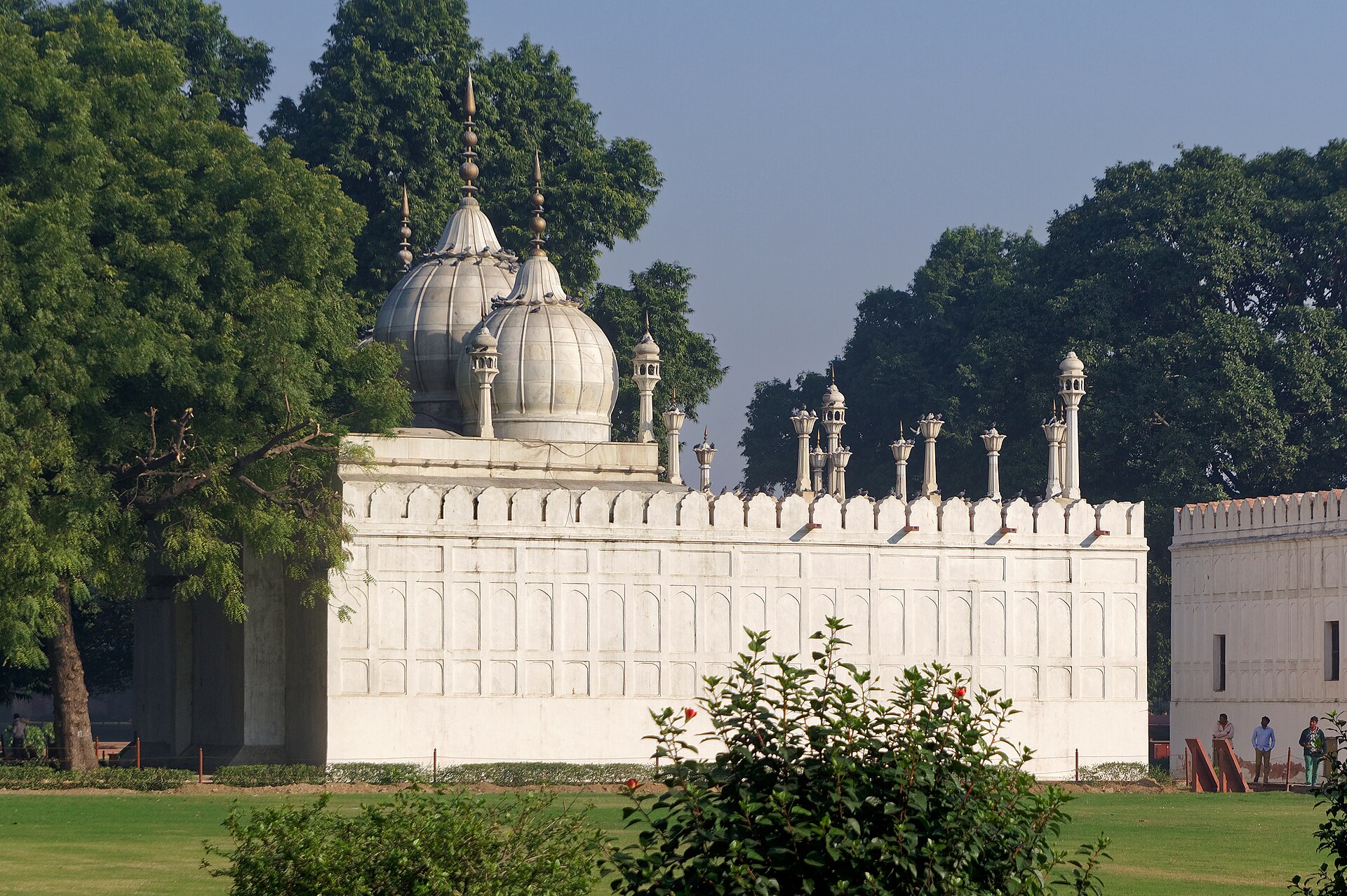
Among the buildings of the Red Fort is the Moti Masjid, the Pearl Mosque, a small and exquisite mosque of white marble built within the fortress by the emperor Aurangzeb, the son and successor of Shah Jahan, for his private worship. Small in scale but perfect in its proportions and its finish, the mosque takes its name from the pearl-like luster of its white marble, and it is one of the loveliest of the buildings of the fort.
The building of a private mosque within the palace reflects the personal piety of Aurangzeb, the most devout and austere of the Great Mughals, who was known for his strict religious observance. The Pearl Mosque, with its three domes and its finely carved marble, provided a place for the emperor to perform his daily prayers without leaving the fortress. It is a jewel of Mughal religious architecture, a small but perfect expression of the faith that lay at the heart of the empire.
The contrast between the austere piety of Aurangzeb, who built the Pearl Mosque, and the luxurious splendor of his father Shah Jahan, who built the rest of the fort, is one of the fascinating themes of Mughal history, for the two emperors represented very different ideals of kingship. Aurangzeb, the last of the great Mughals, was a ruler of stern religious conviction, and his small, private mosque within the palace reflects his personal devotion. The Pearl Mosque is thus a monument not only of architecture but of the character of one of the most important of the Mughal emperors.
The Plunder of Nadir Shah
The glory of the Red Fort suffered a catastrophic blow in the year 1739, when the Persian conqueror Nadir Shah invaded India, defeated the Mughal army, and sacked the imperial capital of Delhi. Nadir Shah plundered the Red Fort of its fabulous treasures, and among the spoils he carried back to Persia was the fabled Peacock Throne itself, the most magnificent throne in the world, together, it is said, with the great Koh-i-Noor diamond.
The loss of the Peacock Throne and the treasures of the fort was a devastating symbol of the decline of the Mughal empire, which had been weakening since the death of Aurangzeb, and which never fully recovered from the humiliation of Nadir Shah’s invasion. In the decades that followed, the fort and the empire suffered further plunder and occupation at the hands of the Marathas, the Sikhs, and others, and the silver ceiling of the Diwan-i-Khas was stripped and melted down. The sack of the Red Fort marked the beginning of the long twilight of the Mughal empire.
The invasion of Nadir Shah in 1739 was one of the great turning points in the history of India, for it shattered the illusion of Mughal invincibility and exposed the weakness of the once-mighty empire to all its enemies. The plunder of the Red Fort, and the massacre of the people of Delhi that accompanied it, was a catastrophe from which the imperial capital took generations to recover, and it opened the way for the long process of Mughal decline and the eventual rise of British power. The empty splendor of the fort after the sack was a symbol of an empire in irreversible decline.
The Koh-i-Noor diamond, which is said to have passed from the Red Fort into the hands of Nadir Shah, went on to have one of the most storied histories of any gem in the world, passing through the treasuries of Persia, Afghanistan, and the Sikhs before finally coming to rest among the British Crown Jewels, where it remains the subject of competing claims to this day. Its journey, beginning with the plunder of the Red Fort, is a vivid illustration of the way the treasures of the Mughals were scattered across the world in the age of the empire’s decline.

Bahadur Shah Zafar and 1857
The last act in the long history of the Mughal empire was played out at the Red Fort in the great uprising of 1857, when the Indian soldiers who rebelled against British rule proclaimed the aged and powerless Mughal emperor, Bahadur Shah Zafar, as the symbol and figurehead of their revolt. For a few months the last of the Great Mughals, a poet and a mystic more than a ruler, presided over the doomed rebellion from his ancestral palace in the Red Fort.
The uprising was crushed by the British, and Bahadur Shah Zafar was captured, tried, and exiled to distant Rangoon, where he died in obscurity, the last of a dynasty that had ruled India for more than three centuries. In their fury and their determination to crush all memory of Mughal power, the British demolished a great part of the fort, tearing down palaces and gardens and replacing them with military barracks. The end of Bahadur Shah Zafar was the end of the Mughal empire, and the Red Fort passed into the hands of the British.
The tragic figure of Bahadur Shah Zafar, the last of the Great Mughals, a gentle poet and mystic thrust unwillingly into the role of a rebel leader, has come to symbolize the melancholy end of a great dynasty and a great age. His trial and exile, and his lonely death in a foreign land, marked the definitive end of the Mughal empire, which had ruled India for more than three centuries. The Red Fort, the scene of this final act, is thus haunted by the memory of the fall of the Mughals, a dynasty that had raised the fort to the summit of earthly splendor.
The demolition of much of the Red Fort by the British after 1857, in which palaces, gardens, and pavilions were torn down to make way for military barracks, was one of the great acts of cultural destruction of the colonial era, and it robbed the fort of much of its former splendor. Yet the greatest of the marble buildings survived, and in recent times efforts have been made to restore and conserve what remains, and even to remove some of the later additions. The scars of the British demolitions are part of the history of the fort, a reminder of the traumas of the colonial age.

The Red Fort Today
Today the Red Fort is one of the most important and most beloved monuments in all of India, and it holds a place of unique significance in the life of the nation. On the fifteenth of August in the year 1947, the first Prime Minister of independent India raised the national flag above the Lahori Gate, and every year since, on Independence Day, the Prime Minister has hoisted the tricolor from the ramparts of the fort and addressed the nation from this historic spot.
In the year 2007 the Red Fort was inscribed upon the list of World Heritage Sites, in recognition of its outstanding importance as the zenith of Mughal creativity and as a monument of profound significance to the history of India. Despite the demolitions of the British era and the ravages of time and pollution, enough of the great fortress survives to convey the splendor of the Mughal empire at its height, and it remains the great symbol of the Indian nation.
The transformation of the Red Fort from the palace of emperors into the symbol of a democratic nation is one of the great stories of the monument, and it reflects the way in which the great buildings of the past can take on new meanings in the service of the present. Each Independence Day, as the Prime Minister addresses the nation from its ramparts, the Red Fort reaffirms its place at the very center of the life of India, linking the glory of the Mughal past to the aspirations of the modern republic. Few monuments anywhere carry so profound a national significance.
The Red Fort has faced new challenges in the modern age, from the air pollution that has darkened its once-bright red walls to the pressures of mass tourism and the occasional intrusion of violence and protest. Yet it endures as the great symbol of the nation, protected as a World Heritage Site and cherished by the people of India as the stage on which their freedom was proclaimed. The continuing care and conservation of the fort is a national priority, ensuring that this supreme monument of the Mughal age will endure for generations to come.
If you would like to see exactly where this magnificent fortress stands upon the map, you can find it here:
View on Google Maps: 28.6562, 77.241
From its red walls along the Yamuna, the Red Fort has stood at the heart of Delhi for nearly four centuries, and it stands there yet, the great symbol of the Mughal empire and of the Indian nation.
Castles Nearby
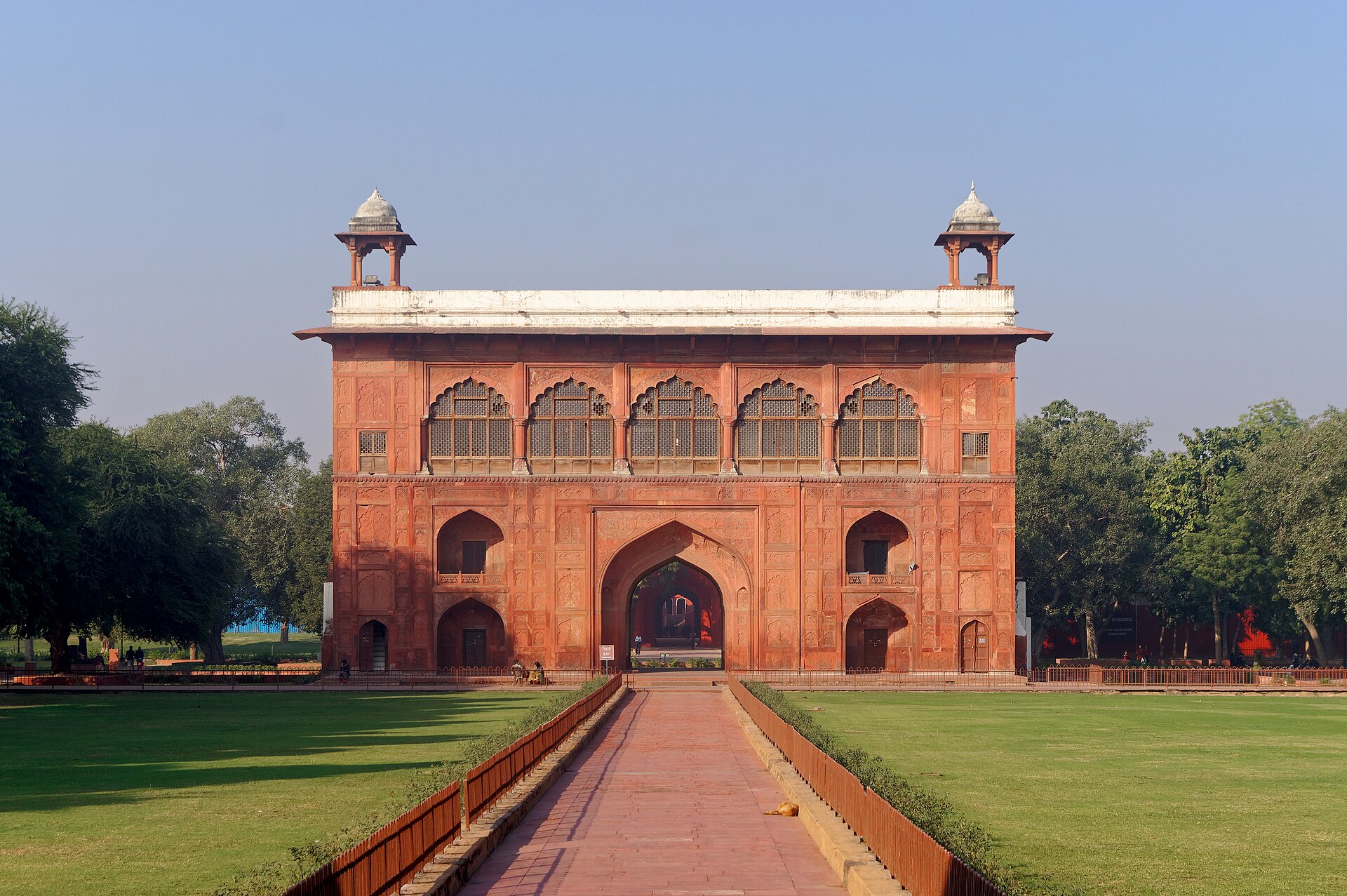
If the splendor of the Red Fort has captured your imagination, you may enjoy these other great forts of India:
The Symbol of a Nation
The Red Fort is one of the great monuments of the world, the supreme expression of the Mughal empire at the zenith of its power and artistry, and the symbol of the Indian nation in the modern age. Its red sandstone walls, its marble halls, and its gardens and fountains combine to make it a masterpiece of the palace architecture of the East, while its role in the history of India, from the glory of the Mughals to the birth of the independent republic, gives it a significance beyond that of almost any other building in the land.
If you should travel to India, the Red Fort is one of the essential sights of Delhi and of the whole country, a monument that embodies the history of the nation in its very stones. To walk through its great gate, to stand in the Hall of Private Audience where the Peacock Throne once glittered, and to imagine the flag of free India first rising above its ramparts is to touch the soul of India, past and present. The Red Fort is a monument to the greatness of the Mughals and to the birth of a nation, and it deserves its place among the most significant buildings on earth.
Whether you come for the splendor of the Mughal marble halls, for the memory of the fabled Peacock Throne, or for the profound national significance of the place where India’s freedom was proclaimed, the Red Fort will move and impress you as few monuments can, and you will carry away the memory of this supreme symbol of the Mughal age and of the Indian nation as one of the great experiences of any journey to India.
You May Like
Mafra, the Palace a King Built From a Vow