In the forested valleys and volcanic landscape of southern Chile and neighboring Argentina live the Mapuche, the largest indigenous nation in the Southern Cone and one of the very few peoples in the Americas who successfully resisted conquest by an outside empire for centuries. Numbering close to two million people today, the Mapuche never fell to Inca expansion and held off Spanish colonial forces for over three hundred years, a record of sustained resistance almost without parallel in the hemisphere.
Mapuche identity has always been closely tied to a fierce, practical independence rather than centralized political structures of the kind seen among the Inca or Aztec. Organized into small, autonomous communities bound by kinship rather than a single unified state, the Mapuche nonetheless proved capable of uniting effectively against outside threats when necessary, a pattern that shaped their relationship first with Spain and later with the independent republics of Chile and Argentina, both of which only completed military conquest of Mapuche territory in the late nineteenth century.
What follows traces Mapuche history from ancient origins through the present, covering where the name Mapuche comes from, the structure of the Mapudungun language, the geography of Mapuche territory, the old way of life before and during colonial contact, the structure of Mapuche society, spiritual belief centered on nature and ancestral spirits, social traditions, craftsmanship in silver and textiles, food, festivals and ceremony, the long Arauco War and later conquest, and the Mapuche nation as it exists today.
What This Article Covers
- Origins: A People Who Were Never Conquered by the Inca
- Name: Mapuche, People of the Land
- Language: Mapudungun, Still Spoken Today
- Homeland: Araucania, Forests, and Volcanoes
- Old Way of Life: Farmers, Horsemen, and Warriors
- Society: The Lof and Life Without a Central State
- Religion: Ngenechen, Nature Spirits, and the Machi
- Traditions: Kinship, Ceremony, and the Palin Game
- Crafts: Silverwork and the Standing Loom
- Food: Wheat, Potatoes, and the Pehuen Pine Nut
- Festivals: We Tripantu and the Ngillatun Ceremony
- History: The Longest War of the Conquest Era
- Today: Land, Language, and an Ongoing Struggle
A People Who Were Never Conquered by the Inca

Archaeological evidence places human settlement in south-central Chile back several thousand years, with communities ancestral to the Mapuche developing settled agriculture, pottery, and metalworking well before European contact, independent of the great Andean civilizations further north. Unlike the Inca or the Maya, Mapuche society never centralized into large cities or a unified state, instead remaining organized as a network of small, self-governing agricultural communities spread across river valleys and coastal forest.
This decentralized structure proved unexpectedly effective against outside conquest. When the Inca Empire expanded southward in the late fifteenth century, it reached the Maule River in central Chile before Mapuche resistance halted its advance, marking the southern limit of Inca territorial expansion anywhere in South America, a boundary the vastly larger and more centralized Inca state could not push past despite repeated attempts.
Spanish forces arrived in the 1540s expecting a similarly swift conquest, having just toppled the Inca and Aztec empires within a matter of years each, but found Mapuche resistance considerably harder to overcome precisely because there was no central capital or king whose capture could end the war. Spanish colonizers established cities south of the Bio Bio River, only to see them destroyed in coordinated Mapuche uprisings, most dramatically the 1598 disaster at Curalaba, which wiped out Spanish settlements south of the river for generations.
This pattern of resistance, retreat, and renewed conflict continued for over three centuries, making the Arauco War the longest sustained conflict of the entire European conquest era in the Americas. Far from a peripheral detail, this extended independence fundamentally shaped Mapuche identity as a people defined significantly by successful, continuous resistance to outside domination, a self-understanding that remains politically significant today.
Mapuche, People of the Land

The word Mapuche combines mapu, meaning land or earth, and che, meaning people, translating literally to people of the land, a name the Mapuche use for themselves rather than one imposed by outside conquerors. This self-chosen identity reflects a worldview in which land is not simply property or territory but an integral part of collective identity and spiritual life, a connection that runs through nearly every aspect of traditional belief and continues to shape contemporary land rights activism.
Spanish colonizers and later Chilean and Argentine authorities commonly used the term Araucanian, derived from the region name Arauco, to describe the Mapuche, a label still found in older scholarship and some place names but increasingly set aside in favor of Mapuche, the name the people use for themselves. This shift mirrors a broader pattern among indigenous peoples of the Americas reclaiming self-chosen names over externally imposed colonial labels.
Several distinct Mapuche subgroups exist, including the Picunche in the north, Huilliche in the south, and Pehuenche in the Andean foothill areas associated with araucaria forests, each carrying a directional or geographic identifier alongside the shared Mapuche identity, roughly translating to people of the north, people of the south, and people of the araucaria respectively. These regional identities remain meaningful locally even as Mapuche functions as the broadly recognized national and political identity.
Contemporary usage of the name Mapuche carries real political weight, actively asserted in land rights disputes, cultural revitalization campaigns, and international indigenous rights forums, functioning simultaneously as an ethnic identity, a political statement, and a claim to historical continuity stretching back well before either the Chilean or Argentine state existed in anything like its current form.
Mapudungun, Still Spoken Today
Mapudungun, sometimes rendered Mapuzugun, is a language isolate, meaning it has no confirmed close relatives among other known language families, a linguistic status shared by only a small number of languages worldwide and one that makes its long-term preservation especially significant, since its loss would mean the disappearance of an entire, irreplaceable branch of human language. Estimates of speakers range widely, from roughly one hundred thousand to several hundred thousand people, concentrated mainly in rural Araucania and in urban Mapuche communities in Santiago and other Chilean cities.
Colonial and republican-era policy in both Chile and Argentina actively discouraged Mapudungun, particularly through boarding schools and public education systems that punished students for speaking it, producing a sharp generational decline in fluency over the twentieth century that revitalization programs are now working to reverse. Many middle-aged and younger Mapuche today understand the language passively, having heard it from grandparents, without necessarily speaking it fluently themselves.
Written Mapudungun uses a Latin-based alphabet, though multiple competing orthographies exist, a source of ongoing debate among linguists, educators, and Mapuche organizations about which system best represents the language’s sounds while remaining accessible for teaching. Chile has introduced limited bilingual intercultural education programs in areas with significant Mapuche population, though coverage and quality vary considerably by region and school.
Mapudungun radio programs, university courses, and a small but growing body of published literature have expanded access to the language in recent decades, and words such as poncho and several Chilean place names, including the country name Chile itself according to some scholars, derive from Mapudungun, evidence of the language’s deep historical imprint on the wider region regardless of current speaker numbers.
Araucania, Forests, and Volcanoes

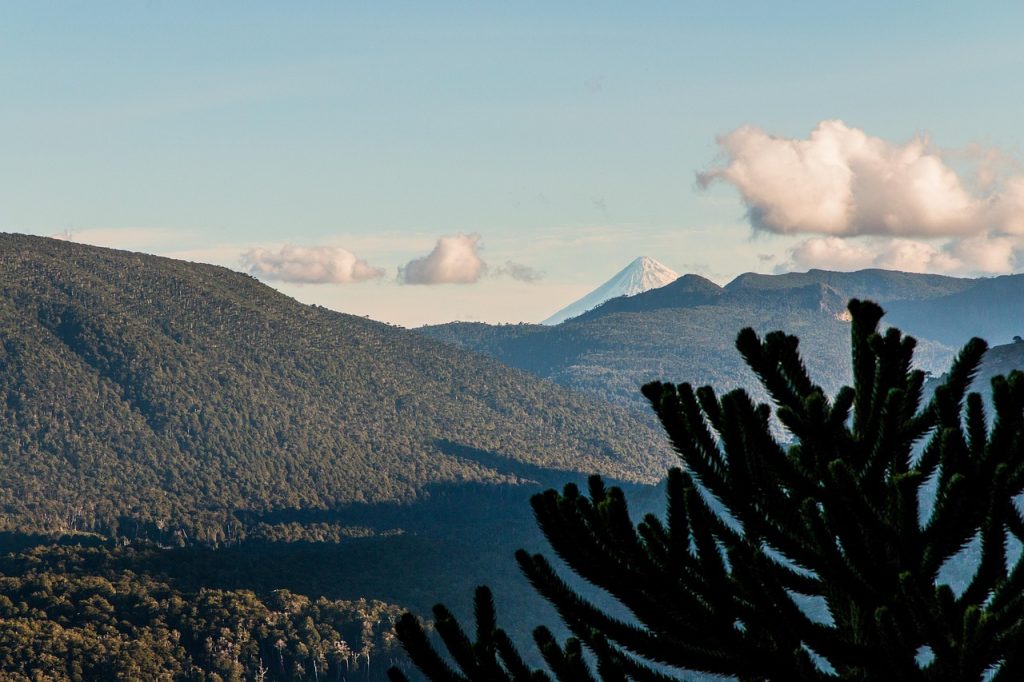
Traditional Mapuche territory, known as Wallmapu, stretched across a substantial portion of south-central Chile and extended east across the Andes into present-day Argentine Patagonia, encompassing temperate rainforest, fertile river valleys, and a chain of active volcanoes running along the mountain spine that divides the two countries. This varied landscape, wetter and more heavily forested than the arid north of Chile, supported mixed agriculture, fishing, and, after Spanish contact, livestock herding across a territory considerably larger than the reduced land base Mapuche communities hold today.
The Araucania region, named for the Spanish term Araucanian, remains the demographic and cultural heart of Mapuche Chile, characterized by native araucaria and southern beech forest, numerous lakes, and volcanic peaks such as Villarrica and Llaima that hold both practical and spiritual significance for surrounding communities. Volcanic soil, while occasionally destructive, also produces some of the most fertile farmland in Chile, a double-edged environmental relationship long recognized in Mapuche oral tradition.
Mapuche communities east of the Andes in Argentine Patagonia developed a somewhat different but related lifestyle after adopting the horse, ranging across the open steppe in a manner that drew comparisons, sometimes exaggerated by outside observers, to Plains nations of North America. Argentine Mapuche, sometimes called Pehuenche or grouped under broader Patagonian indigenous identities, maintain their own distinct communities and land claims separate from, though culturally connected to, Mapuche groups in Chile.
Chilean government land policy following military conquest in the 1880s confined most Mapuche communities to reducciones, small land grants dramatically smaller than the territory they had previously occupied, a compression that continues to drive land rights conflict in the region today. Many Mapuche families migrated to Santiago and other cities across the twentieth century in search of work, meaning a substantial share of the Mapuche population now lives in urban settings far from the Araucania homeland.
Farmers, Horsemen, and Warriors

Pre-contact Mapuche communities practiced settled agriculture, growing potatoes, quinoa, and a native grain called mango or madi, alongside beans and squash, supplemented by fishing along the coast and rivers and gathering wild plants, including the prized seeds of the araucaria tree. This agricultural base supported permanent villages rather than the nomadic hunting lifestyle sometimes assumed of indigenous Chilean peoples, giving Mapuche society a stable food supply that helped sustain centuries of resistance against Spanish forces.
The horse, obtained through raiding and trade with Spanish settlements from the late sixteenth century onward, transformed Mapuche military capability dramatically, allowing mounted warriors to strike Spanish settlements and retreat before reinforcements could respond, a tactical advantage that played a significant role in the long Mapuche success against colonial forces. Cattle and sheep, also introduced through contact with the Spanish, were adopted enthusiastically and became central to the economy east of the Andes in particular.
Toqui, elected war leaders chosen for demonstrated skill and courage rather than hereditary right, coordinated Mapuche military resistance during major conflicts, uniting otherwise independent communities for the duration of a campaign before authority reverted to local leadership once the immediate threat passed. This flexible, situational leadership model proved remarkably effective against a Spanish colonial system built around rigid hierarchy and centralized command.
Daily life for most Mapuche families centered on the ruka, a thatched dwelling housing an extended family, surrounded by cultivated fields and grazing land managed collectively within the local lof, or community. Textile production, metalworking, and pottery supplemented agriculture and herding, with women typically responsible for weaving and food processing while men managed livestock, warfare, and, when necessary, diplomacy with Spanish or later Chilean and Argentine authorities.
The Lof and Life Without a Central State

The lof, a community of extended families sharing land and mutual obligation, formed the basic political and social unit of traditional Mapuche society, with no permanent overarching political structure uniting all Mapuche communities under normal circumstances. Multiple lof might join together temporarily to form larger alliances, called ayllarehue or butalmapu, particularly during wartime, but these confederations dissolved once the immediate need passed, reflecting a deep cultural preference for local autonomy over centralized rule.
Leadership within a lof rested with a lonko, a hereditary or respected community leader responsible for coordinating agricultural work, resolving disputes, and representing the community in dealings with neighboring lof or outside authorities. Unlike the divine kingship found among the Inca or Maya, Mapuche leadership derived its legitimacy from practical wisdom, generosity, and the ongoing consent of community members rather than claimed descent from the gods.
Kinship followed patrilineal lines, with marriage customarily occurring between different lof to build alliances and expand social networks, and it was not unusual historically for a man of sufficient means to have multiple wives, a practice that reinforced kinship ties across communities and, in leadership families, helped cement political alliances. Women held significant responsibility over textile production, food processing, and, in the case of the machi spiritual healers discussed below, considerable religious authority.
This decentralized political structure has persisted in modified form into the present, with modern Mapuche communities organizing through elected leadership, community associations, and increasingly through formal indigenous organizations that coordinate on land rights, education, and cultural preservation while still respecting a strong tradition of local community autonomy inherited from the lof system.
Ngenechen, Nature Spirits, and the Machi

Traditional Mapuche religious belief centers on Ngenechen, sometimes understood as a single creator spirit and sometimes as a set of four related divine forces, alongside a broader cosmology populated by ngen, spirits associated with specific natural features such as forests, rivers, volcanoes, and particular animals or plants, including the sacred araucaria tree, or pehuen. This spiritual framework treats the natural world as inhabited and alive rather than as passive resource, a worldview with direct practical consequences for how land and forest are traditionally used and protected.
The machi, a religious and medical specialist usually though not exclusively a woman, occupies a central role in Mapuche spiritual life, conducting healing ceremonies, interpreting dreams and omens, and leading major community rituals, having trained for years, often after receiving what is understood as a spiritual calling, under the guidance of an established machi. The machi’s authority rests on demonstrated spiritual power and healing success rather than institutional appointment, giving individual machi considerable respect within their communities.
The rewe, a carved wooden ceremonial pole with notched steps, serves as a sacred axis connecting earthly and spiritual realms during major ceremonies, planted outside a machi’s home or at a ceremonial site and understood to represent a cosmic tree linking different levels of Mapuche cosmology. Ceremonies often involve the kultrun, a sacred drum painted with symbolic designs representing the Mapuche understanding of the universe, played by the machi during healing and community ritual.
Catholicism arrived with Spanish missionaries and gained followers over subsequent centuries, and more recently evangelical Protestant churches have made significant inroads in some Mapuche communities, producing a religious landscape in which Christian practice, traditional Mapuche spirituality, and various blends of the two coexist across different families and communities, a pattern common among indigenous peoples throughout the Americas.
Kinship, Ceremony, and the Palin Game

Reciprocal obligation and extended kinship structure much of Mapuche social life, with mingako, a system of cooperative labor exchange similar to reciprocity systems found among other indigenous peoples of the Americas, allowing families to complete demanding agricultural tasks such as harvest or house construction through mutual community assistance rather than hired labor. These obligations reinforce lof cohesion in much the same way similar systems function among the Quechua and other Andean peoples.
Palin, a traditional team sport played with a wooden ball and curved sticks, resembling field hockey, carries deep ceremonial significance beyond simple athletic competition, traditionally used to resolve disputes between communities, celebrate agreements, or mark significant occasions, accompanied by ritual preparation and communal feasting. The game has experienced a notable revival in recent decades as part of broader Mapuche cultural reclamation efforts, now played at cultural festivals and even taught in some schools.
Traditional silver jewelry, including elaborate headpieces called trarilonco and large ornamental pins, historically signaled a woman’s family wealth and status, often passed down through generations as both a financial asset and a marker of identity, worn prominently at ceremonies and important community gatherings. This jewelry tradition remains actively practiced today, with contemporary silversmiths producing both traditional pieces for ceremonial use and adapted designs for wider commercial sale.
Respect for elders, careful attention to dream interpretation, and a strong sense of obligation to deceased ancestors run through Mapuche social custom, with funerary rites in some communities involving elaborate ceremony intended to ensure a peaceful transition for the deceased’s spirit. Naming practices, courtship customs, and the structure of formal community gatherings all reflect this broader emphasis on maintaining right relationship among the living, the dead, and the natural world.
Silverwork and the Standing Loom

Mapuche silverwork ranks among the most technically accomplished indigenous metalworking traditions in South America, developed extensively after silver became available through trade with Spanish colonizers and refined into an art form combining hammering, filigree, and repoussé techniques to create the elaborate jewelry central to traditional women’s dress. Trarilonco headpieces, chain-linked pectorals called trapelacucha, and large decorative pins called tupu remain recognizable symbols of Mapuche identity today.
Textile weaving, carried out on a standing loom rather than the backstrap loom common further north among Andean peoples, produces ponchos, blankets, and belts using wool from sheep introduced during the colonial period, dyed with both natural and, increasingly, commercial pigments in geometric patterns that can carry specific symbolic meaning tied to Mapuche cosmology. Weaving remains primarily women’s work, taught within families and increasingly through community workshops aimed at preserving the craft.
Woodcarving produces both practical items and objects of deep ceremonial significance, including the rewe ceremonial pole, the kultrun drum frame, and chemamull, carved wooden funerary statues traditionally placed at grave sites to represent and honor the deceased, some of which have become recognized as significant works of indigenous art displayed in Chilean museums. Basketry and pottery round out a craft tradition that continues to adapt to both ceremonial need and a growing commercial market for indigenous Chilean art.
Contemporary Mapuche artisans increasingly sell silverwork and textiles through cooperatives and direct online sales, providing meaningful income for many families while also navigating ongoing concerns about cultural appropriation, since Mapuche-inspired jewelry and textile patterns have been copied commercially by non-Mapuche producers without benefit returning to the communities that originated the designs.
Wheat, Potatoes, and the Pehuen Pine Nut

Traditional Mapuche cuisine centers on ingredients cultivated for centuries before Spanish contact, including potatoes, quinoa, beans, and squash, alongside the distinctive pine nuts of the araucaria tree, called pehuen or piñones, gathered in autumn from Andean and coastal mountain forests and either eaten fresh, ground into flour, or fermented into a traditional drink. For Pehuenche communities in particular, these pine nuts historically provided a critical seasonal food source stored for consumption through the winter months.
Wheat, introduced during the colonial period, was adopted enthusiastically and now anchors many staple dishes, including catuto, a bread made from boiled and pounded wheat, and muday, a lightly fermented drink traditionally made from wheat or the pehuen pine nut and served at ceremonies and community gatherings as a mark of hospitality and celebration. Mate, a caffeinated infusion sipped through a metal straw from a shared gourd, is consumed widely across southern Chile and Argentina, including in many Mapuche households, as part of a broader regional drinking culture.
Meat, particularly lamb and, on special occasions, roasted whole animals cooked over an open fire in a method similar to Patagonian asado, plays a central role in celebratory meals, while everyday cooking relies heavily on soups and stews combining vegetables, grains, and whatever meat or seafood is locally available. Coastal Mapuche communities historically relied more heavily on fish and shellfish, including cochayuyo, a type of edible seaweed still gathered and eaten today.
Curanto, a method of cooking meat, shellfish, and vegetables together in a pit lined with hot stones and covered with large leaves, closely related to earth-oven cooking traditions found elsewhere in the Americas such as the Andean pachamanca, remains a significant celebratory cooking method in southern Chile, associated with community gatherings, harvest celebrations, and special family occasions requiring feeding a large group at once.
We Tripantu and the Ngillatun Ceremony

We Tripantu, the Mapuche new year, falls around the June winter solstice in the Southern Hemisphere and marks the symbolic rebirth of the sun and renewal of the natural cycle, celebrated with family gatherings, traditional food including muday, and ceremonies conducted before dawn to welcome the new year’s first light. The celebration has gained increasing public recognition in Chile in recent decades, observed now in some schools and public institutions alongside its continued significance within Mapuche communities themselves.
The ngillatun, a major communal ceremony held periodically, often every one to four years depending on the community, involves days of prayer, ritual dance, and offerings led by a machi and directed toward Ngenechen and various nature spirits, seeking blessings for good harvests, health, and community wellbeing. Participants gather around the rewe ceremonial pole, and the event functions as both religious observance and an important occasion for reinforcing bonds between families and neighboring lof.
Palin matches, described earlier as a traditional ball game with deep ceremonial roots, are frequently held during or alongside major festivals, drawing large community turnout and often extending across an entire day, combining athletic competition with feasting, music, and social visiting between communities that might not otherwise gather so directly. The game’s revival has made it an increasingly visible feature of contemporary Mapuche cultural festivals.
Family and community life-cycle ceremonies, including births, coming-of-age observances, and funerals, punctuate the calendar at a more local level, often incorporating traditional food, music played on instruments such as the trutruca, a long wooden horn, and the kultrun drum, alongside whatever Catholic or evangelical religious elements a given family has also incorporated into its practice.
The Longest War of the Conquest Era

The Arauco War, fought intermittently between Mapuche forces and first Spanish, then Chilean colonial and republican authorities, stretched from the 1540s to the 1880s, making it by a wide margin the longest sustained conflict of the entire European conquest of the Americas, lasting roughly three and a half centuries compared to the years or at most a few decades required to subdue the Aztec and Inca empires. Spanish authorities eventually accepted a rough territorial boundary at the Bio Bio River, formally recognizing Mapuche independence south of that line through a series of parlamentos, negotiated treaties unusual for their genuine bilateral character in the context of Spanish colonial policy elsewhere in the Americas.
This uneasy but real independence persisted for roughly two centuries until the newly independent Chilean and Argentine republics, no longer bound by Spanish colonial treaty obligations, launched coordinated military campaigns in the 1860s through 1880s, known in Chile as the Pacification of Araucania, a term increasingly recognized by historians and Mapuche organizations alike as a euphemism for outright military conquest and displacement.
Argentina’s roughly simultaneous Conquest of the Desert campaign in the 1870s and 1880s pursued similar goals east of the Andes, killing or displacing thousands of Mapuche and other indigenous Patagonian peoples and opening vast territories for European settlement and commercial agriculture. Survivors on both sides of the Andes were confined to small land grants, called reducciones in Chile, a dramatic reduction from the territory Mapuche communities had controlled for centuries.
Twentieth-century land policy in Chile, including subdivision of reducciones among heirs and periods of outright land expropriation for commercial forestry and agriculture, particularly during the military government of the 1970s and 1980s, further reduced Mapuche land holdings, planting the seeds of land rights conflicts between Mapuche communities and forestry companies that remain a significant and sometimes violent political issue in Chile today.
Land, Language, and an Ongoing Struggle

Close to two million people identify as Mapuche today, primarily in Chile, where they make up the largest indigenous group in the country, with significant additional communities across the border in Argentine Patagonia. A substantial share of the Mapuche population now lives in Santiago and other Chilean cities rather than in Araucania itself, a demographic shift produced by decades of land pressure, economic migration, and the ordinary pull of urban opportunity affecting indigenous and non-indigenous Chileans alike.
Land rights conflict between Mapuche communities and large forestry companies operating on ancestral land in Araucania has escalated at times into serious violence over recent decades, drawing international human rights attention and complicating Chile’s broader relationship with its largest indigenous population. Successive Chilean governments have pursued land restitution programs of varying scope and success, while Mapuche organizations continue pressing for greater territorial autonomy and constitutional recognition.
Chile’s recent constitutional reform debates have repeatedly placed indigenous recognition, including possible plurinational status similar to Bolivia’s constitutional framework, at the center of national political discussion, though proposed changes have faced mixed results at the ballot box. Meanwhile, Mapudungun language revitalization, We Tripantu celebrations in public schools, and a growing body of Mapuche literature, visual art, and music have expanded Mapuche cultural visibility well beyond Araucania itself.
Whatever the outcome of ongoing political negotiation, Mapuche identity remains defined by the same resilience that allowed the people to resist the Inca, outlast three centuries of war with Spain, and survive the loss of most of their traditional territory to two modern republics, a persistence shared by other indigenous nations of the hemisphere who continue asserting their place in the present, including the Inuit of the Arctic, whose own homeland and way of life have been reshaped by outside contact without erasing who they are.
Elsewhere in This Look at Indigenous America
The Mapuche take their place alongside other indigenous nations of the Americas explored so far, each still very much part of the present day:
You May Like
The Damara, an Ancient People of Namibia