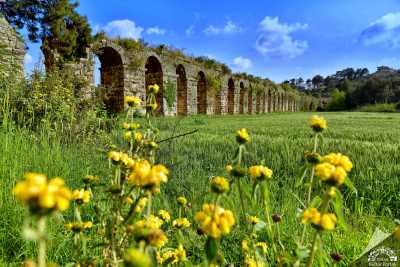
Antiphellos, known as Habesos or Habesa in the Lycian language, is one of the ancient settlements of the Lycian Region. The name of the city means “the place opposite the rocky place”, “the place opposite Phellos (the stony country)”. It is one of the member cities of the Lycian Union, and it is known that it is the port of the city of Phellos in the north and has been inhabited since the 6th century BC. As commercial enterprises gained importance in the Hellenistic period, Antiphellos developed more quickly despite the decline of the main city, Phellos; It continued to be an important port city during the Roman Empire.
Since the mid-2nd century BC, Antiphellos has been known as a commercial city for the coins it minted and the coins it issued in the name of the union, even though it was limited to a single vote in the Lycian League. The ruins of the ancient city in Kaş district continue around the district and along the peninsula extending in the east-west direction. Remains of Hellenistic walls showing rectangular stonemasonry are seen in the part where the peninsula begins and on the side facing Meis Island. Where the walls face the harbour, to the southeast of the church, which has been converted into a mosque today, there are ruins of a temple, designated as a temenos, of which god it is unknown. The original structure dates back to the 1st century BC, and the later additions date to the 3rd century AD.
General Directorate of Promotion Archive
The building in Antiphellos that is better preserved than the temple is the theatre. The theater, at the southern foot of the Acropolis hill, leans on the hillside and overlooks the sea with twenty-six rows of seats. The seating rows are divided into three parts by four vertical stairs and there is no diazoma. The theater, thought to be a Hellenistic period work, does not have a fixed stone skene building. To the north-east of the theater, there is a burial chamber carved into the bedrock, containing twenty-four female reliefs and dating back to the 4th century BC.

General Directorate of Promotion Archive
The mausoleum with Lycian inscription, which is one of the ruins of Antiphellos and located today on Uzun Çarşı Street, is very interesting with its architecture and aesthetics. The well-preserved sarcophagus, which has become the symbol of Kaş, dates back to the 4th century BC with its lion head motifs on the corners of the tomb lid and its inscription in Lycian language. It has a Gothic pediment and consists of a single block. The eight-line Lycian inscription on the work, popularly known as the “king’s tomb”, has not yet been deciphered.
There are many Gothic style or Lycian rock tombs on the hill that borders today’s Kaş from the northeast. The most interesting of these is the tomb with a Lycian inscription on it and whose second floor is made in the form of a Gothic arch. When it was used again centuries later for a woman named Claudia Recepta, a Latin inscription was added to the tomb. Apart from these, Lycian type sarcophagi built in later periods in the water around the port and close to the shore are other monuments of the city that have survived to the present day.

Antiphellos is among the “Ancient Cities of the Lycian Civilization” (2009) recommended to the UNESCO World Heritage List.
Source: “Antiphellos”, Antalya from Past to Today [II. Volume], Antalya Provincial Directorate of Culture and Tourism (2012)
Places to Visit in Antalya
Source: Antalya Provincial Culture and Tourism Directorate