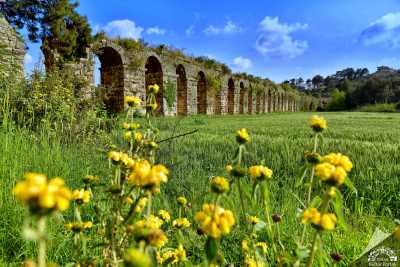
Aperlai (Aperlae) Ancient City is located at the beginning of a long and narrow bay on the Sıçak Peninsula, between today’s Kaş and Kekova. The original name of the city is “Aprillai”, which means “strait of the river” in the Luwian language, and its name is mentioned as “Aprillae” in the Byzantine period episcopal records.
Antalya Provincial Directorate of Culture and Tourism
Aperlai is a small-sized Lycian port city. Silver coins written in Lycian language, minted by the city with the abbreviations “apr” and “prl”, dating back to the 5th and 4th centuries BC, indicate the existence of Aperlai before the Lycian Union. It is possible to encounter the name of the city mostly in the late period writers Pliny, Stadiasmus, Ptolemy and Hierocles. It is also mentioned in Piri Reis’ Kitab-ı Bahriye, as a sheltered harbor where it was completely abandoned in the 16th century and where perhaps three or five fishing families were sheltered.
Antalya Provincial Directorate of Culture and Tourism
According to the coins of the Union period, Aperlai, like other Lycian cities under Roman rule, was only dated to III. It is known that he had the authority to mint coins during the time of Gordianus. During the Lycian Union, Aperlai was the head of the union in which three cities, or according to some sources, four cities had a “single vote”. It is certain that Aperlai signed and formed a sympoliteia with Simena, Apollonia and Isinda.
Most of the archaeological ruins that can be seen in Aperlai date from the Roman period. The earliest known ruins in the settlement are from the Hellenistic period. The ruins of the city are located on the northern side of the bay, at the foot of the hill descending towards the sea. The city is surrounded by walls reinforced with towers, using rectogonal and polygonal techniques, starting from the seaside and extending towards the acropolis. There are three square-planned defense towers on the northern walls. The west wall, which is the best preserved, has three doors, two plain and one arched. The south wall continues perpendicular to the hill slope and is polygonal. Although it is largely destroyed today, there is a gate in the middle with a tower on both sides that provides entrance to the city.
Antalya Provincial Directorate of Culture and Tourism
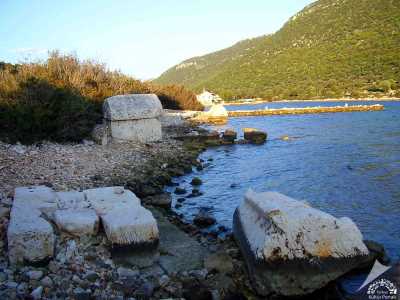
As in all Lycian port cities, two Roman period bath ruins could be found in Aperlai, close to the port. Two small-sized Byzantine church ruins, one in the northwest corner of the acropolis and the other in the southeast corner, also attract attention. Both churches, dating back to the 6th and 7th centuries AD, were built on a basilical plan and reflect Early Byzantine church architecture. There are two narrow corridors on both sides of the middle wide corridor, and a semicircular apse at the end. The necropolis of the city is located to the east of the castle walls and there are many Lycian sarcophagi there. The dock, the buildings belonging to the dock, and the ruins of structures close to the dock are under water today.
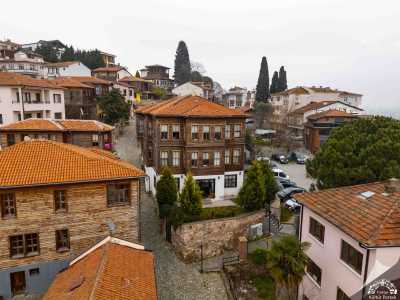
Aperlai is among the “Ancient Cities of the Lycian Civilization” (2009) recommended to the UNESCO World Heritage List.
Source: “Aperlai”, Antalya from Past to Today (Volume II), Antalya Culture and Tourism Directorate (2012)
Places to Visit in Antalya
Source: Antalya Provincial Culture and Tourism Directorate