On the banks of the Rhine at Wiesbaden, facing the broad river and the vineyards of Rheinhessen beyond, stands one of the most elegant baroque palaces in Germany. Biebrich Palace was the residence of the princes and dukes of Nassau, and its striking central rotunda, crowned by statues, seems to greet the ships passing along the river.
Behind the palace lies a large landscape park with old trees, a pond and a romantic mock castle, and every year at Whitsun the park hosts one of the most famous equestrian events in Germany. The house of Nassau that built the palace is the ancestral family of today’s grand dukes of Luxembourg.
In this article we will explore Biebrich from its baroque construction to its role as a ducal residence, through its architecture, its rotunda and its park, and we will finish with practical tips for your visit.
In This Article
- A Palace on the Banks of the Rhine
- The House of Nassau
- Welsch, Stengel and the Building of Biebrich
- The Rotunda and Its Statues
- East and West Wings
- The Park Side of the Palace
- The River Front and the Terrace
- Biebrich in the Evening Light
- Statues and Allegories
- The Landscape Park
- Old Trees and Quiet Corners
- Biebrich Palace on Video
- Visiting Biebrich Palace Today
A Palace on the Banks of the Rhine

The best view of Biebrich Palace is from the river. Its long pale facade stretches along the bank, with a central round pavilion rising above two wings and a terrace leading down toward the water. Ships and barges glide past, as they have for centuries.
On land, the palace stands in the district of Biebrich, a few kilometres south of the centre of Wiesbaden, the elegant spa town and capital of Hesse. A short walk along the riverside promenade brings you to its doors.
The palace is a classic Rhine residence, designed to be admired from the water and to look out over the river landscape. Its terraces and windows frame views of the Rhine and the hills on the opposite bank.
What makes Biebrich special is the combination of baroque elegance, a magnificent riverside setting and a vast park behind it, creating one of the most attractive palace ensembles in the Rhine valley.
The palace is not a museum, as it houses state offices, but its exterior, terraces and park are open to the public and make a lovely destination for a walk.
In summer, the riverside promenade in front of the palace is a favourite place for strolling, cycling and watching the boats.
Wiesbaden itself is one of the most elegant cities in Germany, famous for its hot springs, its nineteenth century villas and its grand Kurhaus, and Biebrich Palace adds a baroque chapter to its story.
The House of Nassau

The palace was built for the princes of Nassau Usingen, one of several branches of the ancient house of Nassau, which had ruled territories in the region since the Middle Ages.
The Nassau family played an important role in European history. One branch became the house of Orange Nassau, which provides the kings of the Netherlands, while the Walram line, to which the Biebrich princes belonged, later inherited the grand duchy of Luxembourg.
In the early eighteenth century, Prince Georg August Samuel of Nassau Idstein began building a summer residence at Biebrich, attracted by the beauty of the Rhine.
Under later princes, especially Karl of Nassau Usingen, Biebrich became the main residence of the family, and the court moved here from Usingen in 1744.
In 1806 the territories of Nassau were united into a duchy, and Biebrich became the residence of the dukes of Nassau until the duchy was annexed by Prussia in 1866.
The Grand Ducal family of Luxembourg still traces its ancestry to the Nassau dukes who lived at Biebrich, and members of the family have visited the palace on several occasions.
The dukes of Nassau were modernisers who introduced reforms in administration, education and agriculture, and their court at Biebrich was a centre of political life in the region.
Duke Adolph, the last duke of Nassau, later became Grand Duke of Luxembourg in 1890, linking the history of Biebrich with that small European nation.
Welsch, Stengel and the Building of Biebrich

Construction of the palace began around 1700, first as a pair of garden pavilions on the riverbank. Over the following decades, the pavilions were linked and expanded into a grand residence.
The architect Maximilian von Welsch, who worked for many courts in the region, designed the central rotunda and gave the palace its distinctive baroque form.
Later, Friedrich Joachim Stengel, the court architect of Nassau Saarbrucken, added further wings and buildings, completing the palace by the middle of the eighteenth century.
The result is a building of great harmony, with the rotunda as its centrepiece and the wings extending along the river in a balanced composition.
Its elegant proportions and refined details make Biebrich one of the finest examples of baroque architecture on the Rhine.
The building history explains the palace’s unusual length along the river, as separate pavilions were gradually joined into a single grand composition.
Stengel also worked on many buildings in Saarbrucken, and his contribution to Biebrich gave the palace its final harmonious appearance.
The Rotunda and Its Statues

The most striking feature of Biebrich Palace is the central rotunda, a round pavilion with a dome rising above the riverside facade. Its roofline is crowned with statues of gods and allegorical figures, silhouetted against the sky.
Inside, the rotunda contains a magnificent domed hall, decorated with stucco and paintings, used for receptions and festivities by the princely court.
The rotunda creates a strong focal point for the palace, drawing the eye from the river and giving the building its unique character.
Seen at sunset, with the light reflecting off the Rhine, the rotunda and its statues make one of the most beautiful sights on the river.
Today the domed hall is used for concerts and official events, preserving its tradition as a place of celebration.
The domed hall inside the rotunda has a remarkable ceiling painting and fine stucco work, and its circular form creates excellent acoustics for music.
The statues on the rotunda were designed to be seen from a distance, and their bold forms stand out clearly when viewed from the river or the opposite bank.
East and West Wings

On either side of the rotunda extend the east and west wings, each ending in a pavilion. Their facades are decorated with pilasters and window frames, creating a rhythm that runs the length of the palace.
The wings once housed the apartments of the princely family, guest rooms and service areas, as well as galleries for art and collections.
From the riverside, the wings appear as a single elegant line, balancing the vertical emphasis of the rotunda.
Walking along the terrace, you can see the details of the facades up close, from carved window surrounds to decorative balustrades.
After 1866, when Nassau became part of Prussia, the palace was used by Prussian officials and occasionally by members of the imperial family visiting the region.
The pavilions at the ends of the wings frame the facade and give it a satisfying sense of completion when seen from the river.
The Park Side of the Palace

The north side of the palace faces the park and has a different character from the river front. Here the facades frame a courtyard and look out over lawns and trees.
This side of the palace was designed for the private life of the court, with entrances and views toward the garden rather than the river.
The contrast between the formal river facade and the quieter park side reflects the dual role of the palace as a public statement and a private home.
From the park, the rotunda can be seen rising above the roofs, linking the two sides of the building visually.
The courtyard on the park side is often used for events, and it offers a peaceful vantage point from which to admire the architecture.
The River Front and the Terrace

The river front of Biebrich Palace is its public face. A broad terrace runs along the facade, with steps leading down toward the Rhine, where boats once landed to bring guests and goods to the court.
From the terrace, the view across the river to the vineyards and towns of Rheinhessen is magnificent, especially in the soft light of evening.
The princes of Nassau used the river as a grand approach, arriving by boat from Mainz and other cities to be greeted by the splendid facade of their residence.
Today the riverside promenade is a public path, and walking along it gives you the same view of the palace that visitors enjoyed three centuries ago.
Passenger ships still stop at Biebrich, so you can arrive by water just as the princes did.
Cyclists on the Rhine cycle path often stop at Biebrich to admire the palace, which lies directly on the route between Wiesbaden and Mainz.
Biebrich in the Evening Light

Biebrich Palace is at its most beautiful in the evening, when the setting sun lights up the pale facades and the statues on the rotunda glow against the darkening sky.
The river reflects the colours of the sunset, and the lights of the opposite bank begin to sparkle, creating a romantic atmosphere.
Many photographers come to capture this moment, and the palace is one of the most photographed sights in Wiesbaden.
An evening stroll along the promenade, followed by dinner in one of the riverside restaurants, is a perfect way to enjoy Biebrich.
On summer evenings, the riverside cafes fill with people enjoying the view of the palace and the river, creating a relaxed and convivial atmosphere.
Statues and Allegories
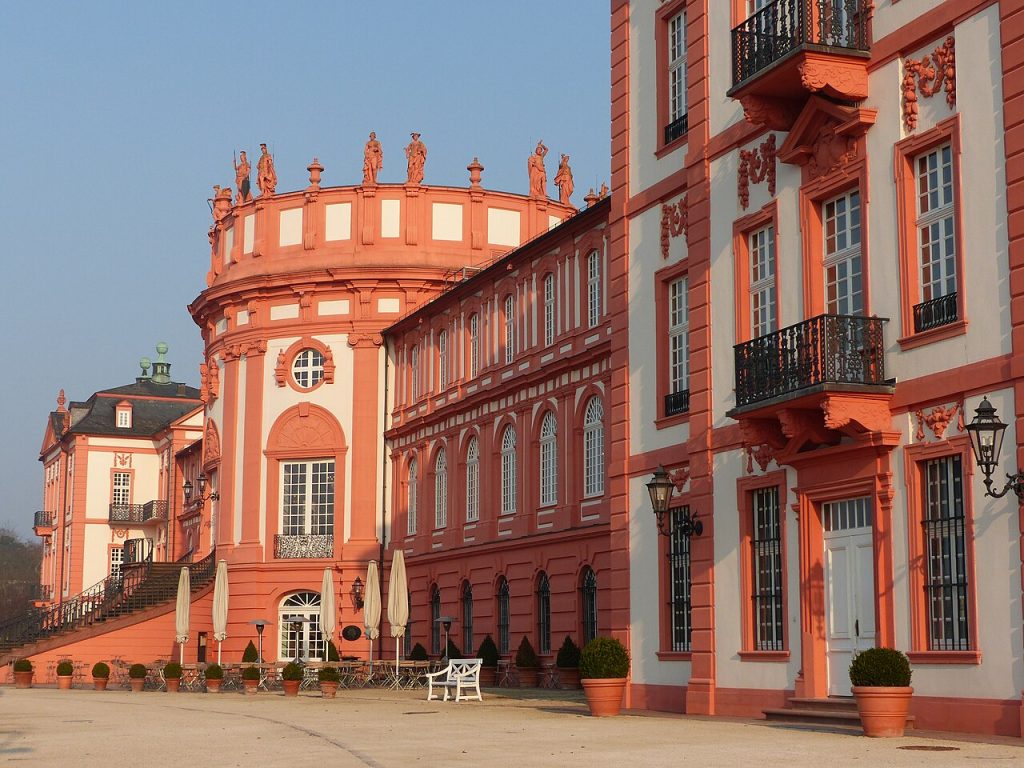
The statues on the roof of the rotunda and along the facades represent gods, goddesses and allegorical figures, including Minerva, the goddess of wisdom.
These sculptures express the ideals of the princely court, celebrating wisdom, strength, prosperity and the arts.
They were carved by skilled sculptors working for the Nassau court, and many have been restored or replaced with copies to protect the originals.
Look up as you walk around the palace, and you will discover figures that add life and meaning to the architecture.
The choice of Minerva reflects the princes’ wish to be seen as wise and enlightened rulers, patrons of learning and the arts.
The Landscape Park

Behind the palace lies the Biebrich Palace Park, one of the most beautiful landscape gardens in Hesse. Originally laid out as a formal baroque garden, it was transformed in the early nineteenth century into an English style park by Friedrich Ludwig von Sckell, the famous garden designer.
The park features wide lawns, groups of old trees, winding paths and a pond, creating a natural landscape that invites relaxation.
At the northern end of the park stands the Mosburg, a romantic mock castle built in the early nineteenth century in the style of a medieval ruin, reflecting the fashion of the age.
The park is a favourite place for walks, jogging and picnics, and its peaceful atmosphere makes it one of the most popular green spaces in Wiesbaden.
Every year at Whitsun, the park hosts the Wiesbaden International Whitsun Tournament, a prestigious equestrian event that attracts riders and spectators from around the world.
The Whitsun tournament is a highlight of the social calendar in Wiesbaden, combining top class show jumping and dressage with a festive atmosphere in the historic park.
Old Trees and Quiet Corners
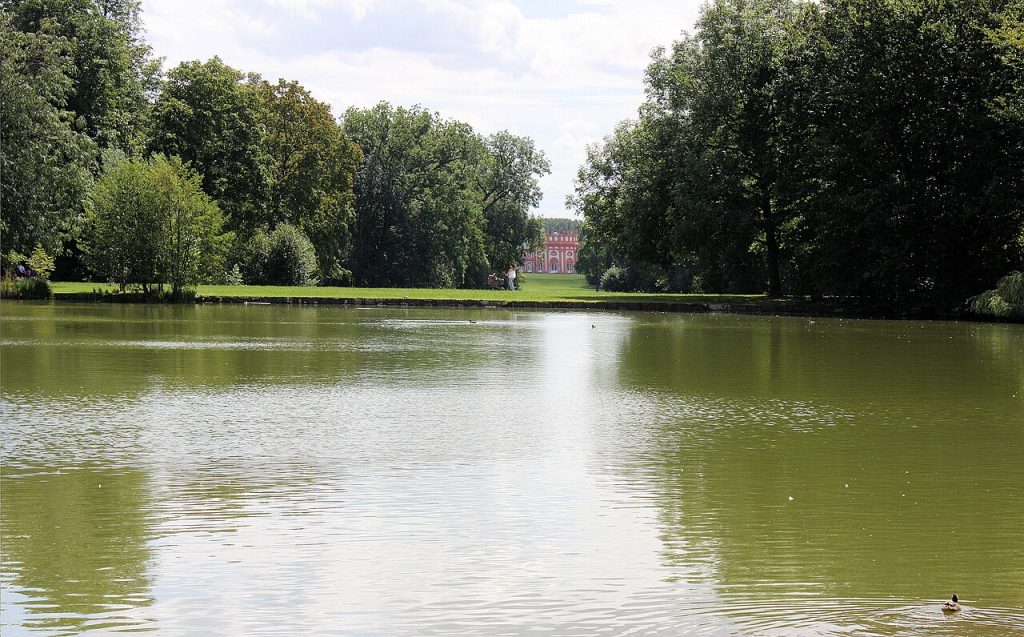
Among the treasures of the park are its old trees, some planted when the landscape garden was created two centuries ago. Their massive trunks and spreading crowns give the park a sense of age and dignity.
Quiet paths lead to secluded corners, where benches invite you to sit and enjoy the birdsong and the shade.
In autumn, the trees turn gold and red, and the park becomes a blaze of colour, framing the palace beautifully.
The park’s trees are carefully looked after, and some are protected as natural monuments.
The pond in the park, with its reflections of trees and sky, is one of the most picturesque spots, especially in the early morning.
Biebrich Palace on Video

For a look at the palace and its riverside setting, the video below presents Biebrich Palace in Wiesbaden.
Watch for the rotunda, the river front and the park.
The video also gives a sense of the palace’s relationship with the Rhine, which defines its character.
If the video inspires you, read on for practical tips.
Visiting Biebrich Palace Today

Biebrich Palace houses state offices and is not regularly open as a museum, but its exterior, terrace and park can be visited freely. Occasional guided tours and events offer access to the rotunda hall.
The palace lies in the Biebrich district of Wiesbaden, easily reached by bus from the city centre or by boat along the Rhine.
Plan to combine your visit with a walk through the park and along the riverside promenade, and perhaps with the spa quarter and the Kurhaus in the centre of Wiesbaden.
Biebrich pairs well with Mainz, just across the river, and with Bad Homburg and other palaces of the Rhine and Main region.
Whenever you visit, Biebrich offers a delightful combination of baroque architecture, river views and parkland, a perfect escape from the bustle of the city.
View the location on Google Maps
Palaces Nearby
If you have enjoyed this palace, the Rhine and Main region holds more remarkable residences. Here are two more well worth adding to your journey:
- Bad Homburg Palace – the residence of the landgraves of Hesse Homburg and summer home of the German emperors.
- The Electoral Palace of Mainz – the red sandstone residence of the archbishop electors on the Rhine.
You May Like


2 thoughts on “Biebrich Palace and the Rhine Residence of the Dukes of Nassau”