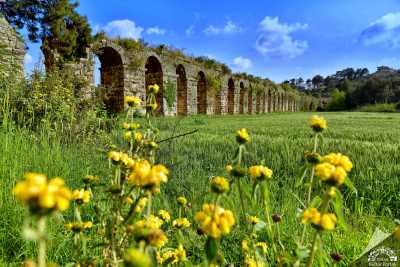
Kyaenai Ancient City is located on a hill plain extending in the east-west direction, north of Yavu village in Antalya’s Demre district. It is a Lycian city that has managed to survive with its impressive structures. This ancient city, located in a dominant position between Antiphellos (Kaş) and Myra (Demre), is approximately 5 kilometers from Üçağız Port. The still used name of the city, whose name is unknown in the Lycian language, is of Greek origin, like Xanthos, and means “dark blue”. Another meaning of the word Kyaenai is “ringing rocks”.
Inscriptions written in Lycian language found in the city reveal that Kyaenai has been inhabited since at least 1000 BC. Not much information can be obtained through inscriptions about the history of the city, whose name is mentioned in Pliny and late period writers. The longest inscription mentioning the name of the city is about a citizen named Jason, son of Nicostratos and a contemporary of Opramoas of Rhodiapolis, who generously donated money to various cities and sixteen Lycian cities gave this person honorary titles at different times.
Kyaenai, whose coins we know with the phrase “Lykion Ku” during the Lycian Union, showed great development, especially under Roman rule. It is understood from the Byzantine ruins on the acropolis that the city, whose name is found in church records as a bishopric center, continued to exist as an important center that had shrunk considerably in this period (5th-6th centuries AD) and was abandoned in the 10th century.
The steep southern side of the city’s acropolis, which extends in the east-west direction and is built on a steep rocky platform to the south, is not surrounded by walls. Of the three gate entrances on the walls surrounding the city from three directions, the ones in the north and west are still visible.
Inside the acropolis, there are probably remains of a library, a bath, a granary, monumental fountains and cisterns, as well as burial chambers, columns and architectural pieces. Dense vegetation makes it difficult to obtain information about these ruins. One of the most striking ruins is the heroon near the western gate, where there is a sarcophagus dating back to the 4th century BC with many reliefs on its sarcophagus and lid.
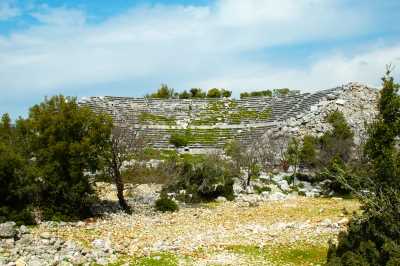
On the southern skirt of the hill in the northern part of the plain leading from the acropolis to the west, there is a theater with double diazomas whose cavea (seating section) is carved into the natural slope. The stage building (skene) of the building, which is in the style of Greek theaters in plan, was not kept high, probably in order not to block the natural view to the south.
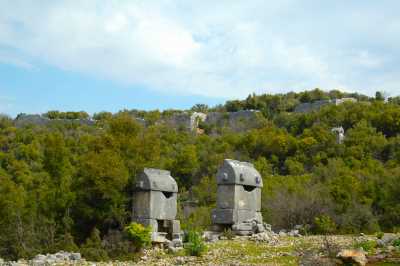
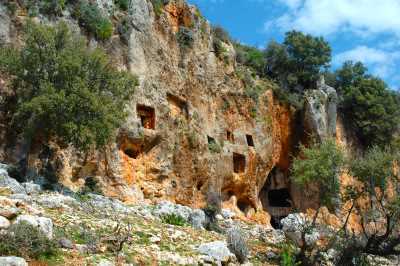
The necropolis area on the east side of the acropolis contains many sarcophagi spread all the way to the steep cliff-shaped southern slope. On the steep rock to the south of the acropolis, there is a rock tomb with a single Ionic column and an in antis temple façade, as well as many rock tombs and sarcophagi with embossed Lycian inscriptions.
Kyaenai, also known as the “City of Sarcophagi” because it is the ruins with the most sarcophagi in the Lycia region, is among the “Ancient Cities of the Lycian Civilization” (2009) recommended to the UNESCO World Heritage List.
Sources:
George E. Bean, Ancient Lycia Region, 1998, p. 112-115
Cevdet Bayburtluoğlu, Lykia, Ankara, Tourism, Antiquities and Museums Lovers Association Publications, p. 43-44
Cevdet Bayburtluoğlu, Lykia, 2004, p. 214- 219; Antalya Cultural Inventory, Kale, 2004, p. 85.
“Kyaenai”, Antalya from Past to Today [II. Volume], Antalya Provincial Directorate of Culture and Tourism (2012)
Places to Visit in Antalya
Source: Antalya Provincial Culture and Tourism Directorate