
Lyrbe Ancient City is located in Manavgat district of Antalya. It has been suggested that the name of the city was Seleukeia, based on the sailors’ handbook Stadiasmus Maris Mayni. However, based on the sacred area mentioned in an inscription written in Side language today, it is determined that this place must be Lyrbe, an ancient Pamphylia city with the identity of a mountain city. It is thought that Seleukeia is located at another point accessible by the Manavgat Stream.
Gulcan Acar
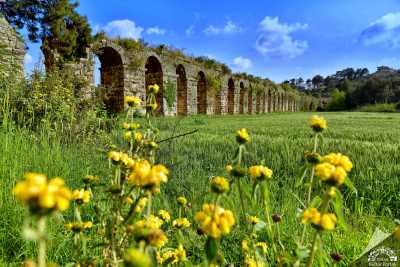
Since the ancient city is surrounded by deep cliffs on three sides, only the southern walls have been well preserved until today. The monumental gate, which provides entrance to the city from the south, is located in the middle of the walls. This gate is bordered by two monumental towers. The walls extending from both sides of the monumental gate to the east and west continue until the cliff. The outer surface of the walls was built from cut sandstone blocks in an irregular rectagonal technique.
Gulcan Acar
The western side of the agora in the center of the city leans on the hillside, and two-storey buildings are placed on the eastern shore. The agora, which generally dates back to the Hellenistic period, is entered through the monumental gate in the southeast.

Photo: Gülcan Acar
This tetropylon was built in the style of a four-legged door and was probably added to the agora later. The structures located to the west of the Agora are defined as Gallery I and II. The northern wing of the agora consists of important buildings. The space containing the Seven Sages Mosaic is defined as a library due to its structural function. (Seven Sages Mosaic is exhibited in Antalya Museum)
Antalya Provincial Directorate of Culture and Tourism
In the southwest of the ancient city, there is a bath complex consisting of three parts and a church, which is a two-storey building. The necropolis is in the southeast and southwest of the city. Although it was a mountain settlement, the existing ruins show that Lyrbe was a highly developed city, especially during the Roman period.

Source: “Lyrbe”, Antalya From Past to Present II. Volume, Antalya Provincial Directorate of Culture and Tourism (2012)
Note: Lyrbe Ancient City is temporarily closed to visitors.
Places to Visit in Antalya
Source: Antalya Provincial Culture and Tourism Directorate


One thought on “Lyrbe Antik Kenti – What to See – Antalya”