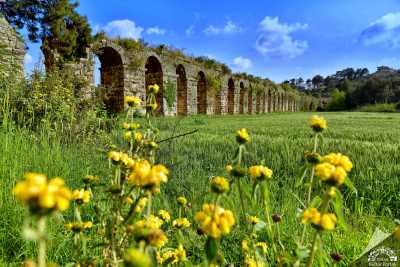
Lyrboton Kome, located northeast of Antalya city center, on top of the mountain backed by the Varsak neighborhood of Kepez district, is an ancient settlement that existed from the Hellenistic period to the Middle Ages. It is also known as “Elaibaris” (olive farm), according to an inscription found in Perge, and is essentially a large ancient olive oil production village. Although it has ruins largely from the Roman and Byzantine periods, it is thought to have been inhabited during the Hellenistic period as well. Although there is not much information about its history and form of government, it can be said that this settlement was a kome (village) status affiliated to Perge, governed by a komorkhos since the 2nd century AD, and was inhabited throughout the Byzantine period.
Olive oil mills, seen everywhere in the region, are mostly found in Lyrboton Kome. Numerous and integrated workshops indicate a high oil production. Via Sebaste (Emperor Road), which comes from Döşemealtı and goes to Perge, also passes here. The income earned in Lyrboton Kome had a large share in the development of the big cities on the coast, especially Perge. The arch erected by the Demetrios brothers in Perge is one of them.
The most important ruin is the olive oil protection and storage tower. In the inscription of the two-storey tower dedicated by Arete, whose name means “virtue”, it is written that “Arete, the Priestess of Demeter, had this tower built with her own money and dedicated it to Emperor Domitian and Artemis of Perge.”
The most impressive inscription, which shows sustainability in production and the contribution of the family foundation, describes the olive groves donated by Mouas, the son of Kille, Arete’s daughter. While the inscription reads, “He transferred the farm that he dedicated to Emperor Hadrian and Apollo of the Lyrbos, 600 cultured olive trees, the olive groves in the Three Olives and the Kallikades Armada to his mother Kille for life; after his mother’s death, the komorkhos (headman) kept the foundation alive, and on the third day of September, a festival was held in honor of Apollo and the people were fed and fed sufficiently”, while at the end of the inscription it reads “above “No one is allowed to sell or dispose of the listed items or use the income obtained for any other purpose. Otherwise, a penalty of 1000 dinars will be paid to Perge Artemisi.” It is said.
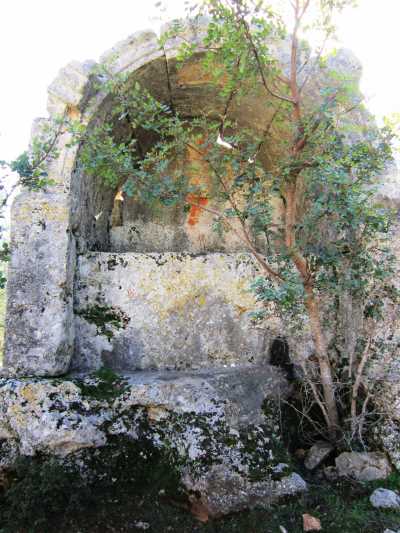
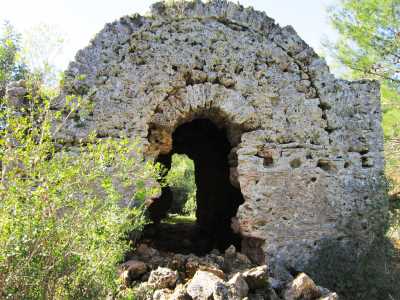
Inscriptions unearthed at Lyrboton Kome reveal that a festival associated with the olive harvest and dedicated to Apollo was celebrated on the third day of the ninth month. This data emphasizes how important olives and olive oil were for the settlement. Other traces of this production and life in the settlement are many cisterns, over eighty tombs, two-storey preserved houses, a small bath, four churches and other structures of unknown function.
Resources
Burak Takmer – Nihal Tüner Önen, Via Sebaste, The Route of Anatolia’s Best Preserved Roman Road Passing through Varsak, Varsak Municipality Cultural Publications 2, 2007, 21-24.
Nevzat Çevik, “My Suggestions for Antalya’s Tokası Varsak (Lyrboton-Kome)”, 2014.
Sencer Şahin, “Ancient Varsak Settlement in Perge Territorium-Lyrboton Kome-Elaibaris”, Housing in Anatolia Throughout the Ages, Istanbul, 1999, 437-445.
Source: Antalya Provincial Culture and Tourism Directorate