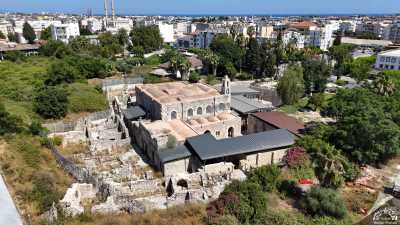
The respected religious personality of St. Nicholas, who was born in Patara in the second half of the 3rd century AD and became a bishop in Myra, enabled him to attain the status of a saint after his death, and he became the most well-known saint of many European countries, especially the former Russian Tsardom. St. Nicholas, who is especially revered in the cities of Freiburg in Germany, Bari and Naples in Italy, and the entire island of Sicily, is known as Santa Klaus in the Dutch and English languages; Thanks to these, he was loved in America and was considered one of the saints who protected New York. In the northern countries of Europe, the tradition of Santa Claus, the protector and joy of children, was integrated with the belief in St. Nicholas, resulting in the creation of a semi-religious and very popular legendary personality. It is understood that the tradition has its origins in the very old beliefs of the northern countries, as Santa Claus travels around in a sleigh pulled by reindeers. However, the places where the real St. Nicholas of Myra lived are the Mediterranean coasts that never see snow. As St. Nicholas, especially Eastern Mediterranean sailors respected him; His picture or icon is hung on all boats, large or small; It has become a tradition to wish “May St. Nicholas hold the helm” when going on a campaign.
TGA
St. (St.) Nicholas Church, as an important monument of Byzantine art history, is considered the most outstanding example of the Middle Byzantine period with its architectural style and decorations. The fact that Myra (Demre) was the capital of the Lycian province in the 5th century AD and the Archbishop of Myra was the second largest religious authority in Anatolia played a major role in increasing the prestige of the city in the years after the death of St. Nicholas. After his death, the people of Myra first built a monument and then a large basilica in his name. The large church built in Istanbul in the name of the saint is also a work of this period. The basilica in Myra was severely damaged in the 8th century as a result of earthquakes and raids on the city, and was rebuilt as a domed church in the 9th century.

General Directorate of Promotion Archive
Later additions took place during the Middle Byzantine period in the 11th century. The most important restoration of this period was carried out by Emperor IX in 1042. It is known that it was built by Konstantin and his wife Zoe. Most of the wall frescoes and floor mosaics date from this period. Another comprehensive restoration of the church, which was destroyed for various reasons over the centuries, was carried out by Russian Tsar Nicholas I in 1862. The bell tower and the new keeled central dome additions belonging to this restoration, which deviated considerably from the original plan, are the product of these works. There are many buildings built at different times on the original foundations of today’s church. Thus, the church looks like a complex built in various periods.
Recommended as a world heritage site, St. Nicholas Church has been on the UNESCO World Heritage Tentative List since 2000.

Source: “Santa Claus Museum”, Antalya From Past to Present II. Volume, Antalya Provincial Directorate of Culture and Tourism (2012)
Places to Visit in Antalya
Source: Antalya Provincial Culture and Tourism Directorate


One thought on “Aziz (st.) Nikolaos Anit Muzesi – Travel Guide – Antalya”