In this article
- The church on the roof of Georgia
- A mountain that was holy before the church
- Stone raised in the fourteenth century
- A strongbox for a nation treasures
- What it means to an Orthodox Georgian
- The faith that defines a people
- How it differs from the Western church
- The climb, and what waits at the top
- Inside the small dark church
- The mountain road that leads here
- A mountain of poets and painters
- A beloved place under pressure
- If you make the climb
Some places fix themselves in the memory the instant you see them, and the Gergeti Trinity Church is one of them. Picture a single stone church, small and severe, standing alone on a green shoulder of mountain more than two thousand metres above the sea. Behind it, filling half the sky, rises the vast snow-crowned cone of Mount Kazbek, one of the highest peaks in the Caucasus, glittering white against the blue. There is nothing else up there, no village clustered around the church, no town, just the building, the grass, the wind, and the enormous mountain looming over it like a presence. It is, without exaggeration, one of the most striking sights in the entire Christian world, and it has become the image that, more than any other, says Georgia to the people of that proud and ancient country.
You will have seen it even if you do not know its name. It appears on book covers and travel posters and a thousand photographs, the lonely church beneath the great peak, and it has come to stand for something deep in the Georgian soul: the meeting of faith and mountain, of a small nation and the wild high country that sheltered it through centuries of invasion. But the postcard hides a richer story, of an ancient holy mountain, of a fourteenth-century church built to guard a nation treasures, and of a Christianity older than almost any in Europe, clinging to its rock at the edge of the world.
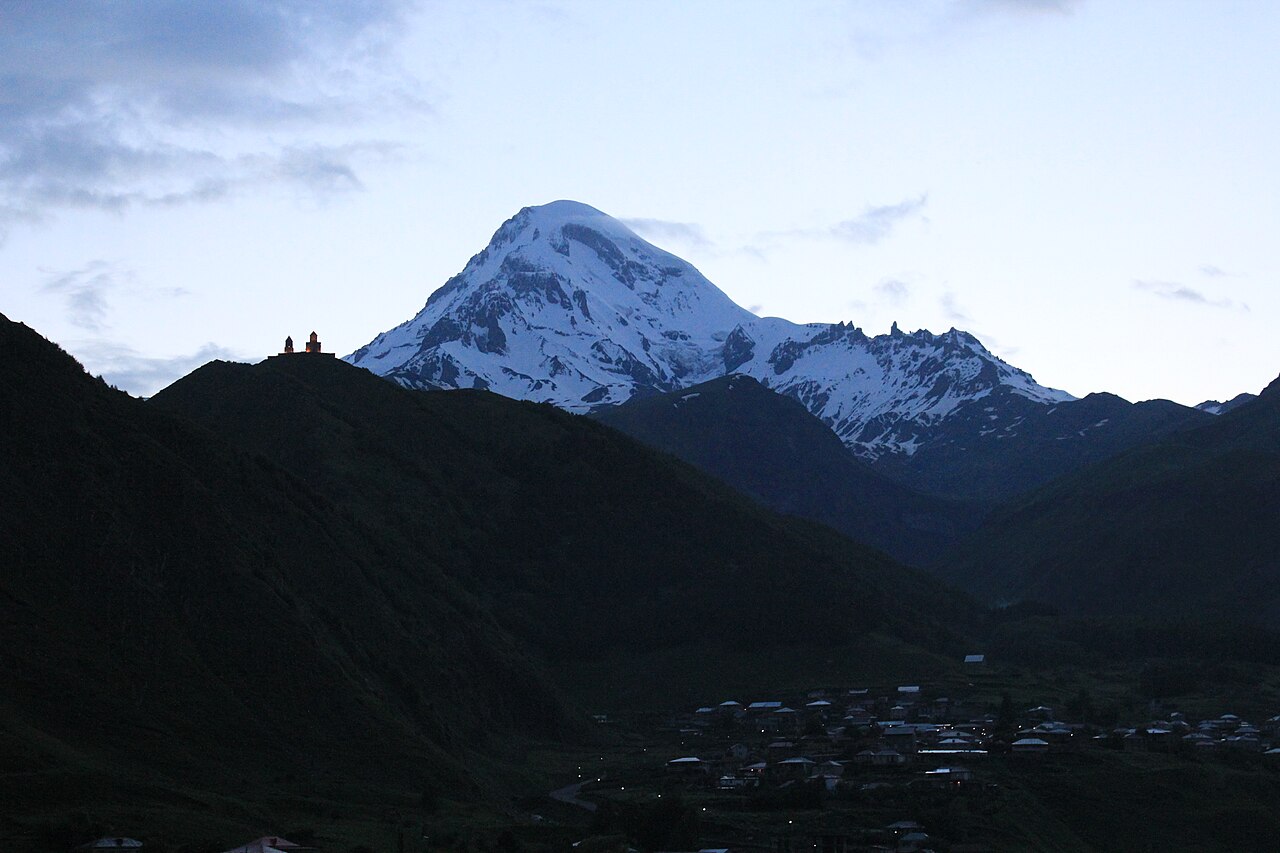
This is the story of that church, of the mountain it stands beneath, of the faith it has kept for seven hundred years, and of what it costs, and what it gives, to climb up to it.
The church on the roof of Georgia
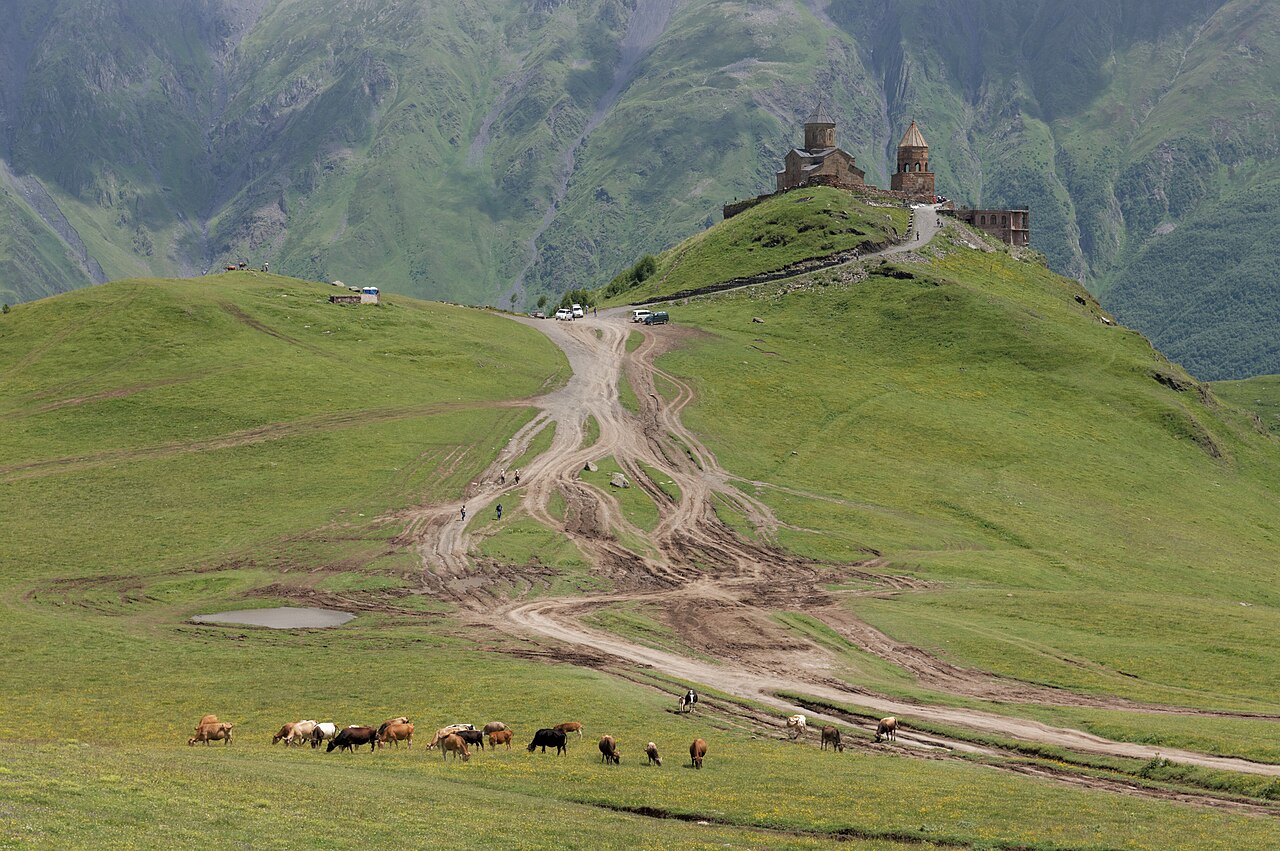
The Gergeti Trinity Church, known in Georgian as Tsminda Sameba, which simply means Holy Trinity, stands above the village of Gergeti in the far north of Georgia, close to the town of Stepantsminda, once called Kazbegi, in the high Caucasus near the border with Russia. It sits at an altitude of around 2,170 metres, perched on a grassy spur beneath the towering bulk of Mount Kazbek, which the Georgians call Mqinvartsveri, the ice-topped peak, rising to over five thousand metres behind it.
Its isolation is total and deliberate. Unlike most old churches, which grew up at the heart of a settlement, Gergeti stands apart and above, with the village of Gergeti and the town below it down in the valley. To reach it you must climb, on foot or by rough vehicle, up out of the valley and onto the mountain shoulder, and the higher you go the more the world falls away beneath you, until at last there is only the church, the peak, and the sky. The Georgians did not put it there by accident. A church in such a place is a statement: that the holy belongs to the heights, that to draw near to God one climbs, leaving the ordinary world behind in the valley below.
A mountain that was holy before the church
Long before any Christian raised a stone here, Mount Kazbek was already a sacred mountain, and the church inherited a holiness older than itself. The peoples of the Caucasus have always looked on these great mountains with awe, and Kazbek in particular gathered legends to itself across the centuries. The most famous is the tale, told in various forms across the region, that this was the mountain to which the Titan Prometheus was chained as punishment for stealing fire from the gods and giving it to humankind, his liver eternally torn by an eagle, a Caucasian echo of the Greek myth that may in fact be older than the Greek version itself.
Georgian Christian tradition layered its own holiness over the older awe. A cave high on the mountain, called Betlemi, the Georgian form of Bethlehem, was said to be a hermitage where monks withdrew to live in extraordinary solitude, and legends told of sacred relics kept there, suspended between heaven and earth. When the Christians built their church on the mountain shoulder, they were not imposing the faith on an empty place. They were claiming and baptising a height that the human imagination had treated as a meeting point of earth and heaven for as long as anyone could remember. That continuity, the holy mountain becoming the Christian holy mountain, is part of what gives Gergeti its peculiar power.
Stone raised in the fourteenth century
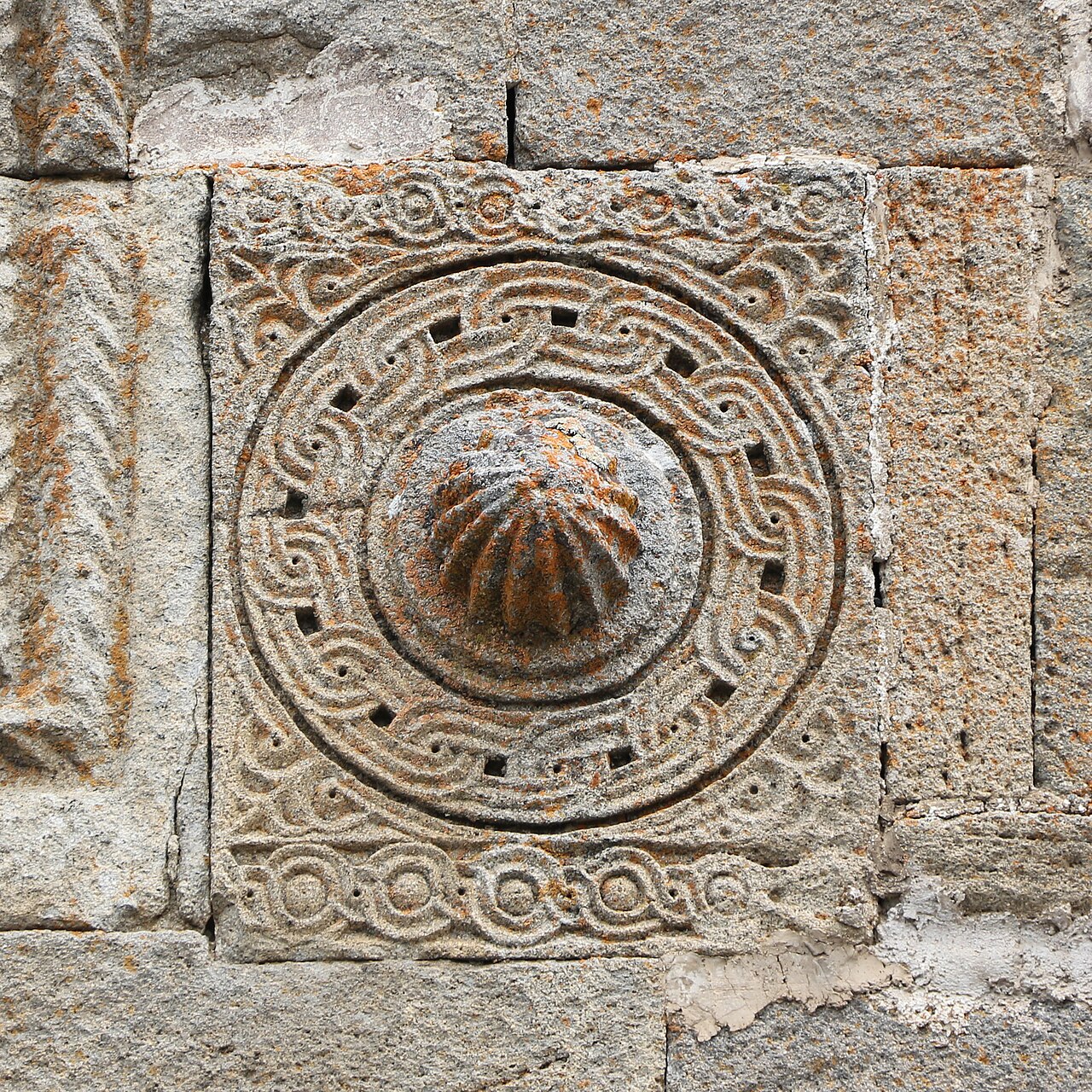
The church itself dates from the fourteenth century, making it roughly seven hundred years old, a single-nave structure of dark stone built in the characteristic style of Georgian medieval architecture: compact, sturdy, crowned with a conical dome on a drum, designed to withstand the brutal winters of the high Caucasus. Beside it stands a separate bell tower of the same period. There is nothing delicate about it. This is mountain architecture, built to endure, its walls thick, its windows small, its whole form hunkered against the wind and the snow.
By the standards of Georgian Christianity, the fourteenth century is actually quite late. Georgia had been a Christian kingdom for a thousand years by the time this church was built, having adopted the faith in the early fourth century, within a generation or so of Armenia and around the same time the Roman Empire itself turned Christian. So Gergeti is not an ancient foundation by Georgian reckoning; it is a relatively young church in a very old Christian land, raised during the late medieval flowering of the Georgian kingdom, in the same broad era that produced so many of the country fortified churches and monasteries in remote and defensible places.
And defensibility was the point. The choice of so remote and lofty a site was not only spiritual but strategic. A church on a mountain shoulder, reachable only by a hard climb, far from the main roads of invasion, was a place where precious things could be kept safe when the lowlands were overrun, and the history of Georgia is a history of being overrun, again and again, by Persians, Mongols, Turks, and others. Gergeti was built, in part, to be a refuge.
A strongbox for a nation treasures
This brings us to the most remarkable chapter in the church story. In times of danger, when enemies threatened the Georgian heartland, the most sacred treasures of the kingdom were carried up to Gergeti for safekeeping, because no invader was likely to fight his way up that mountain to plunder a small stone church. Chief among these treasures was the most precious relic in all of Georgia: the cross of Saint Nino.
Saint Nino is, for Georgians, the founder of their faith, the woman who, according to tradition, brought Christianity to the kingdom of Iberia in the early fourth century and converted the king and queen. Her cross, said to have been made of vine wood and bound with her own hair, is the central relic of Georgian Christianity, the physical link to the very beginning of the nation Christian life. That this supremely precious object was brought to Gergeti in times of peril tells you everything about how the Georgians regarded the place. It was not just a church. It was the nation strongbox, the safest place in the kingdom, the spot where, when all else might be lost, the holiest things could be hidden until the danger passed.
There is something deeply moving in that role. Picture the relics of a thousand-year-old Christian kingdom being carried up the mountain on the backs of priests and monks as enemies advanced in the valleys below, to be kept safe in this small dark church beneath the great white peak, with the whole nation faith and memory entrusted, for a season, to the mountain. The church earned its place in the Georgian heart not only by its beauty but by this service, as the keeper of the things that mattered most.
What it means to an Orthodox Georgian
To understand what Gergeti means today you have to understand the faith it belongs to. The Georgian Orthodox Church is one of the oldest Christian churches in the world, an autocephalous, that is, self-governing, body within the family of Eastern Orthodoxy, with its own ancient liturgy, its own language of worship, its own deep roots reaching back some seventeen centuries. For Georgians, Orthodox Christianity is not one identity among several. It is woven into the very fabric of what it means to be Georgian, inseparable from the language, the alphabet, the history, the survival of the nation itself.

A church like Gergeti, standing alone beneath a sacred mountain, gathers all of that to a point. When a Georgian climbs to it, the climb is not only tourism, though many tourists make it too; for the believer it is a pilgrimage, an ascent toward the holy, a continuation of the immemorial human instinct to seek God on the heights. The dedication to the Holy Trinity, the central mystery of Christian faith, the one God in three persons, raises the church above any single saint or local devotion and points it at the very heart of what Christians believe. And the Orthodox manner of that belief, expressed in icons, in candlelight, in chanted liturgy, in the veneration of the Mother of God and the saints, fills the small interior whenever the priest celebrates the divine service beneath the dome.
The faith that defines a people
It is hard to overstate how central the Orthodox faith is to Georgian identity, and Gergeti is one of its great symbols. Through century after century of foreign domination, when Georgia was partitioned, invaded, and absorbed by larger empires, the Church was the thing that held the nation together, the keeper of the language and the script, the memory of independence, the promise that the Georgian people were a people. To be Georgian was, for most of history, to be Orthodox, and the two identities reinforced each other so completely that they became nearly impossible to separate.
That is why an image of a lonely church beneath a mountain can serve as a national emblem in a way that might puzzle an outsider. Gergeti is not Georgia most important church in terms of size or rank, far from it, but it has become the country visual signature because it captures, in one unforgettable picture, the marriage of faith and homeland that lies at the heart of Georgian self-understanding. The small church, enduring, alone, beneath the immense and beautiful mountain, is Georgia own image of itself: a small nation, ancient in faith, holding its ground at the wild edge of things, dwarfed by the powers around it yet refusing to be moved.
How it differs from the Western church
A visitor from a Western Christian background, Catholic or Protestant, will find both deep familiarity and real strangeness in a place like Gergeti, and the differences are worth understanding. The Georgian Orthodox Church belongs to Eastern Christianity, which separated from the Western, Roman church in the long process that culminated in the schism of 1054, and the two halves of Christendom have developed along different lines ever since.
An Orthodox church does not look or feel like a Western one. There is no great emphasis on statues, as in a Catholic church, but instead the icon, the flat painted image venerated as a window onto the holy, and often a screen of icons, the iconostasis, dividing the congregation from the altar where the most sacred mysteries are performed. The Orthodox do not recognise the authority of the Pope, holding instead to a communion of self-governing national churches united by faith rather than by a single earthly head. They reckon the calendar differently, keep their own ancient forms of worship, and preserve theological emphases, on the transformation of the human person toward union with God, that the Western churches developed differently.
For a Protestant, the gulf is wider still. The veneration of icons and of the Mother of God and the saints, the elaborate liturgy, the monasticism, the sense of holy places and holy objects, all of this belongs to a world the Reformation largely set aside, and a Protestant visitor may find the devotion at a place like Gergeti both beautiful and foreign. Yet the Georgians would point out, gently, that theirs is among the oldest forms of the faith on earth, older than the divisions that produced Catholic and Protestant alike, a Christianity that has come down almost unbroken from the age of the early Church. To stand in that small dark church is to touch a stream of Christian life that has flowed continuously since the fourth century, and that continuity is itself a kind of argument.
The climb, and what waits at the top
You cannot understand Gergeti without climbing to it, and the climb is part of the meaning. From the town of Stepantsminda in the valley, the church is a steep ascent of several hundred metres of elevation, traditionally made on foot up a path through forest and then open mountain pasture, a walk of a couple of hours that leaves most people breathless and grateful for every rest. There is now a rough road that four-wheel-drive vehicles grind up, and many visitors take it, but the walkers will tell you, and they are right, that the church means more when you have earned it with your legs and your lungs.
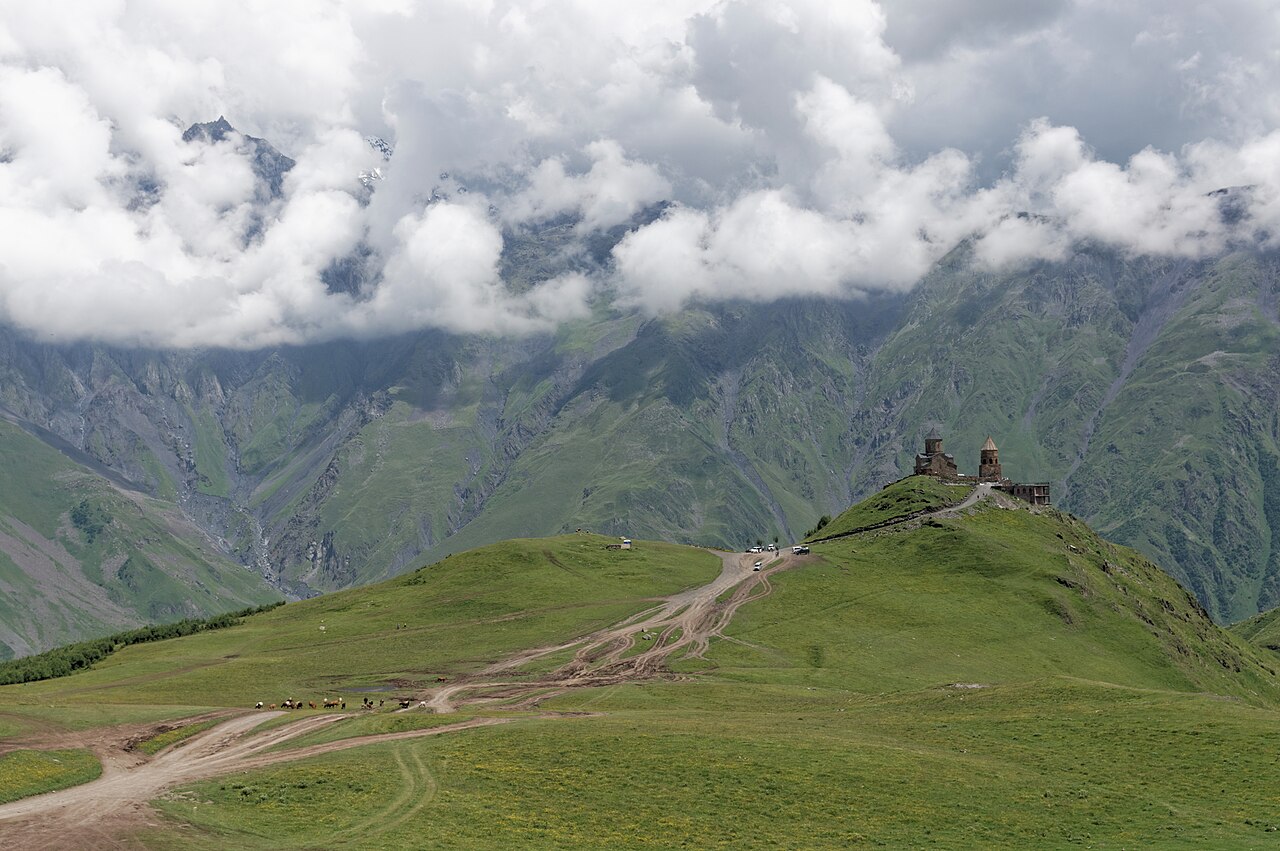
What waits at the top is one of the great rewards in all of travel. As you climb the last stretch of pasture, the church rises ahead of you, and then, if the clouds are kind, the enormous white pyramid of Kazbek reveals itself behind, and the two together, the small dark human church and the vast inhuman mountain, compose a scene that no photograph quite prepares you for. The weather here is wild and changeable; the peak hides itself in cloud for days and then suddenly unveils, and pilgrims and hikers alike have learned to wait, sometimes for hours, for the mountain to show its face. When it does, the effect is overwhelming, and people who climbed for the view often find themselves moved by something more than scenery.
Inside the small dark church
The interior is the opposite of the great basilicas of the West: small, dim, austere, its dark stone walls bare for the most part, lit by a few small windows and by candles. After the immensity of the mountain outside, the smallness within is its own kind of statement. There is no soaring nave, no acres of mosaic, just a low, thick-walled, ancient space, smelling of stone and beeswax and incense, with a few icons glimmering in the gloom and the screen before the altar.
This austerity is not poverty. It is the architecture of a faith that does not need to overwhelm the senses to reach the soul, a mountain Christianity stripped to its essentials. The very plainness of the interior throws the worshipper back on the essentials of prayer, and on the staggering setting outside the walls. In a sense the church does not compete with the mountain; it submits to it, offering a small dark sheltered space from which to contemplate the immensity of God, mirrored in the immensity of Kazbek just outside. When the divine liturgy is sung here, the chant filling that small stone room with the great peak looming beyond the walls, the effect is said to be unforgettable, the human voice raised in worship at the very roof of the Georgian world.
A beloved place under pressure
Fame is a double-edged gift, and Gergeti is learning that the hard way. The same beauty that made it a national symbol has made it one of the most visited spots in Georgia, and in recent years the flood of travellers, the vehicles grinding up the mountain road, the crowds in high season, have raised hard questions about how to protect a fragile holy place from being loved to death. A remote mountain church built for solitude was never designed to receive thousands of visitors, and the pressure on the site, on its surroundings, and on the spirit of the place is real.
There has been genuine tension between those who want to make access ever easier, with better roads and more development, and those, including the Church and many Georgians, who feel that the difficulty of reaching Gergeti is essential to what it is, that a sanctuary you can drive a tour bus to has lost something a sanctuary you must climb to still keeps. It is the same dilemma faced by holy and beautiful places all over the world in an age of mass travel, and there are no easy answers. But it is worth knowing, as a visitor, that the climb you make and the way you behave at the top are not trivial. You are a guest at a working church and a national shrine, not a backdrop for photographs, and the future of the place depends in part on visitors who understand the difference.
The mountain road that leads here
You cannot reach Gergeti without travelling one of the most storied roads in the world, and the journey is part of the pilgrimage. The Georgian Military Highway runs north from Tbilisi up through the heart of the Greater Caucasus to the Russian border, and it has carried armies, merchants, poets, and pilgrims for centuries along a route that nature seems to have designed to inspire awe and dread in equal measure. The Russians gave it its martial name in the nineteenth century when they cut and improved it to move troops through the mountains, but the path it follows is far older, one of the few ways through a range that otherwise forms a near-impassable wall between the worlds to its north and south.
The drive climbs through deepening mountain scenery, past old fortresses and churches clinging to crags, over a high pass where the weather can turn savage even in summer, and down into the high valley where Stepantsminda and the great peak of Kazbek wait. To arrive at Gergeti, then, is to have come a long way through a landscape that grows wilder and more magnificent with every mile, so that the church at the end feels like the goal of a true journey rather than a stop on a tour. Travellers have written for two centuries about the overwhelming grandeur of this road, and the church beneath Kazbek is, in a sense, its spiritual climax, the point at which the raw majesty of the mountains is gathered up and given a human, prayerful meaning.
It is worth dwelling on this because it explains something about why the place affects people so deeply. By the time you stand before the church, you have been steeped for hours in mountains, in their scale and silence and danger, and the small stone building offers the first note of the human and the holy in all that immensity. The road prepares the heart. The mountains humble you, and then, at the top, the little church says that even here, at the wild roof of the world, human beings have come to kneel and to pray, and have done so for seven hundred years.
A mountain of poets and painters
Kazbek and its lonely church have haunted the imagination of writers and artists for as long as outsiders have known of them, and the place carries a weight of cultural memory that adds to its spell. The great Russian poets of the nineteenth century, who travelled the Military Highway and fell under the spell of the Caucasus, wrote of Kazbek in tones of romantic awe, casting it as a symbol of untamed nature, of solitude, of the sublime terror and beauty of the high mountains. To the Romantic mind the peak became a kind of altar of the wild, and the little church beneath it the perfect emblem of human smallness and human faith set against the overwhelming grandeur of creation.
Georgian artists and writers, for their part, saw in Gergeti something closer to home: not an exotic symbol of the sublime but the very heart of their own land, the image that distilled their nation marriage of faith and mountain. Painters returned to it again and again, and it became one of the most depicted scenes in all of Georgian art, the dark church and the white peak rendered in every season and every light. That long artistic devotion is part of why the place feels so charged today. You are not the first to be moved by it; you are joining a procession of poets, painters, pilgrims, and travellers stretching back generations, all of whom stood roughly where you stand and felt the same catch in the throat at the sight of the small church beneath the great mountain.
To know this as you climb is to feel the place grow richer. The church is beautiful in itself, but it is also a vessel of accumulated meaning, layered over centuries by everyone who has loved it, the medieval builders, the priests who carried the relics up to it, the poets who immortalised it, the painters who could not stop returning to it, and the countless ordinary Georgians for whom it is simply the truest picture of who they are. You arrive at a single stone church and find yourself standing at the centre of a whole nation imagination.
If you make the climb
Gergeti is reached from Stepantsminda, a few hours drive north of Tbilisi along the famous Georgian Military Highway, one of the great mountain roads of the world, which winds up through the Caucasus toward the Russian border. Most visitors base themselves in the town and make the ascent to the church from there, either walking the steep path up through the pasture, which is the older and more rewarding way, or taking a four-wheel-drive vehicle up the rough road. Either way, go prepared: the weather at altitude turns fast, the sun is fierce, the air is thin, and what was a warm valley below can be cold and windy at the church.
Dress modestly, as you would for any holy place, with shoulders and knees covered, and remember that this is an active church where services are held and where Georgians come to pray, not merely a viewpoint. Try, if your schedule allows, to be there early in the morning, before the day-trippers arrive, when the light is clean and the church often has the mountain to itself, or to linger into the late afternoon as the crowds thin and the peak catches the last of the sun. And be patient with the weather. Kazbek hides more often than it shows, and many travellers have climbed all that way to find the great mountain swallowed in cloud. If that happens, wait if you can. The mountain has stood there for ages and the church for seven centuries, and sometimes, just when you have given up, the clouds tear open and the white peak blazes out above the little dark church, and you understand, all at once and without anyone having to explain it, why a whole nation chose this lonely spot to stand for everything it loves.


