In this article
- More than a machine that blows cold air
- From ancient tricks to mechanical cool
- The secret: it moves heat, it does not make cold
- Following the refrigerant around the loop
- Why a split system has two boxes
- The different kinds of air conditioner
- The same machine in reverse: heating
- BTUs, efficiency, and what the numbers mean
- Using an air conditioner wisely
- Where cooling is heading
In large parts of the world, the air conditioner has gone from a luxury to a necessity, transforming where people can comfortably live and work. It made the hot regions of the planet habitable for offices, hospitals, and homes; it reshaped the architecture of entire cities; and on the hottest days it is quite literally a lifesaver. For something so consequential, though, it is widely misunderstood, often imagined as a box that somehow generates cold and pumps it into the room.
That is not what happens at all. An air conditioner does not create coldness—it removes heat, gathering up the warmth inside your room and dumping it outdoors, leaving cooler air behind. It is, in fact, almost exactly the same machine as your refrigerator, just pointed at a room instead of a box of food. This article explains how it really works: the heat-moving trick at its core, why a typical home system comes in two separate units, the different types you might encounter, how the very same device can run backwards to heat your home in winter, and how to use it without an alarming electricity bill.

More than a machine that blows cold air
The first thing to understand is that “cold” is not a substance. There is no such thing as a supply of coldness that a machine can manufacture and release. Cold is simply what we feel when heat is absent, so the only way to cool a room is to take the heat out of it and move that heat somewhere else. This is the single idea that unlocks how every air conditioner, refrigerator, and heat pump works, and it is worth holding onto firmly because so much confusion flows from imagining cold as a thing.
An air conditioner, then, is best thought of as a heat-moving machine—a pump for warmth. It reaches into the air of your room, soaks up the heat carried in that air, and carries it outside, releasing it into the world beyond your walls. The air blown back into the room has had its heat stripped away, so it feels cool. As a bonus, the process also pulls moisture out of the air, which is why an air conditioner makes a humid room feel so much more comfortable and why it drips water outside. It is not adding cold; it is subtracting heat and humidity.
From ancient tricks to mechanical cool
People have always sought relief from heat. Ancient civilisations hung wet reeds in windows so that evaporating water would cool the breeze, built thick walls and clever ventilation, and the wealthy had servants fan them or even had snow hauled down from mountains. These methods all worked to some degree, but none could reliably cool a room on demand in the heat of summer.
Mechanical air conditioning grew out of the same nineteenth-century discoveries that gave us refrigeration. The modern electric air conditioner emerged in the early twentieth century, and tellingly, its first purpose was not human comfort at all but industry—controlling the temperature and humidity of a printing plant so that paper and ink behaved predictably. Comfort cooling followed, first in cinemas and department stores that drew crowds with the promise of cool air, then gradually into offices and, after the war, into ordinary homes. As it spread, it changed the world around it, making it possible to build glass towers and to populate hot regions that had previously been thinly settled.

The secret: it moves heat, it does not make cold
The mechanism is the same elegant cycle that drives a refrigerator, relying on a simple fact of physics: when a liquid evaporates into a gas it absorbs heat from its surroundings, and when that gas is compressed and condensed back into a liquid it releases that heat. An air conditioner circulates a special fluid called a refrigerant around a sealed loop, deliberately making it evaporate where you want cooling and condense where you want to dump the heat.
So the refrigerant is a heat-carrying courier. Inside, where it evaporates, it soaks up warmth from the room air blown across its coils. Outside, where it is compressed and condensed, it releases that warmth into the open air. The same fluid loops around endlessly, each pass ferrying another load of heat from indoors to outdoors. The cool air you enjoy and the hot blast from the outdoor unit are two halves of the same process—the heat blowing out the back of the machine is literally the heat that used to be in your living room.
Following the refrigerant around the loop
It is clearest if you trace the refrigerant on its journey. It begins as a cold, low-pressure liquid in the indoor coils, called the evaporator. A fan blows the warm room air across these cold coils; the refrigerant evaporates, greedily absorbing the heat from that air, and the now-cooler air is blown back into the room. This is the moment cooling actually happens, and the moisture in the air also condenses on the cold coils and drains away, drying the air.

Now a warm low-pressure gas, the refrigerant flows to the compressor—the hard-working heart of the system—which squeezes it into a hot, high-pressure gas. It then travels to the outdoor coils, the condenser, where a second fan blows outside air across it. Because the refrigerant is now hotter than the outside air, it sheds its heat into the open and condenses back into a liquid. Finally it passes through an expansion valve, which drops its pressure sharply and makes it cold again, ready to return indoors and repeat the loop. Round and round it goes, continuously pumping heat out of your home.
Why a split system has two boxes
This cycle explains the most common home design: the split system, which comes in two separate units connected by pipes. There is an indoor unit, usually mounted high on a wall, and an outdoor unit, typically bolted to an outside wall or sitting on the ground. People often wonder why it cannot all be in one box, and the answer falls straight out of the physics.

The indoor unit contains the cold evaporator coils and a quiet fan that blows the cooled air into the room. The outdoor unit contains the noisy, heat-producing parts—the compressor and the condenser coils—precisely the components you want outside, because they generate heat and noise that you do not want in your living space. Putting the hot half outside and the cold half inside is the whole point. The two are joined by thin insulated pipes carrying the refrigerant back and forth, which is why installing a split system involves drilling a small hole through the wall for those pipes to pass through.
The different kinds of air conditioner
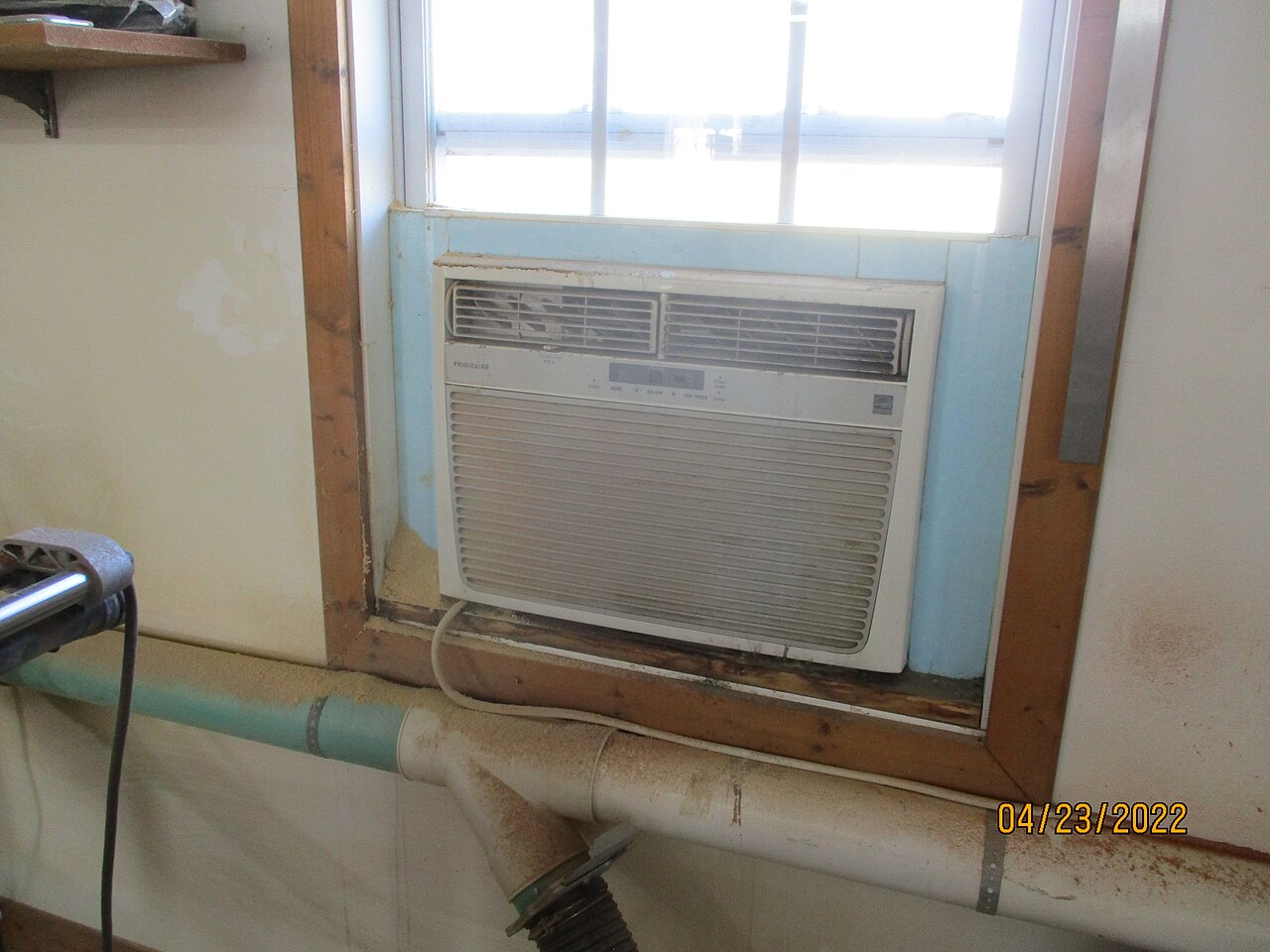
Beyond the wall-mounted split system, there are several variations on the same theme. The window unit packs the entire cycle—evaporator, compressor, condenser, and both fans—into a single box that sits in a window opening, with its cold side facing into the room and its hot side hanging outside. It is cheaper and simpler to install than a split system, at the cost of being noisier, since the compressor is right there in the room with you.
Portable units work similarly but stand on the floor, venting their heat outdoors through a flexible hose run to a window—convenient but generally less efficient. At the larger end, central air conditioning serves a whole building from one big system, distributing cooled air through a network of ducts to vents in each room, which is common in larger homes and commercial buildings. And the ductless “mini-split” extends the split-system idea to serve several rooms from a single outdoor unit feeding multiple indoor units. They differ in scale and convenience, but every one of them runs the identical heat-moving cycle underneath.
The same machine in reverse: heating
Here is one of the most underappreciated facts about air conditioning. Because the machine simply moves heat from one place to another, it can be made to run in reverse—and when it does, it becomes a heater. A unit that can do this is called a heat pump, and many modern air conditioners are exactly that.
Running normally, it pulls heat from inside and dumps it outside, cooling your room. Flip a valve to reverse the refrigerant flow, and it pulls heat from the outdoor air and releases it inside, warming your room. It may seem strange that there is useful heat to extract from cold winter air, but even chilly air contains a great deal of heat energy, and the machine can concentrate it. This makes a heat pump remarkably efficient at heating—rather than burning fuel or using electricity to directly generate warmth, it merely moves existing heat, delivering far more heating energy than the electricity it consumes. It is one of the most promising technologies for heating homes more cleanly, and it is, at heart, just an air conditioner running backwards.
BTUs, efficiency, and what the numbers mean
Air conditioners are rated by their cooling capacity, often given in British Thermal Units, or BTUs, per hour—a measure of how much heat the unit can remove in a given time. The crucial thing is to match the capacity to the room: a unit too small will run constantly and never quite cool a large space, while one too large will cool the air so fast that it shuts off before properly removing humidity, leaving the room cold but clammy and cycling on and off wastefully. Bigger is not better; the right size is.

Efficiency is described by ratings that compare the cooling delivered against the electricity consumed, expressed through measures with names like SEER or EER. A higher rating means more cooling per unit of power and a lower running cost, which matters enormously because air conditioning is one of the most electricity-hungry things in a home. As with refrigerators, a key advance has been the inverter compressor, which can vary its speed to run gently and continuously at just the level needed, rather than blasting at full power and switching off repeatedly—saving energy and holding the temperature far more steadily.
Using an air conditioner wisely
A few simple practices cut both discomfort and cost. Setting the thermostat to a moderate temperature rather than the coldest possible saves a great deal of energy, since every degree cooler demands noticeably more power; aiming for merely comfortable rather than frigid makes a real difference to the bill. Keeping doors and windows shut while cooling is obvious but often neglected, as is closing blinds against direct sun, which can pour a surprising amount of heat into a room.
The unit itself needs basic care to work well. The air filters in the indoor unit clog with dust over time, choking the airflow and forcing the machine to work harder for less cooling; cleaning them regularly is the single most effective bit of maintenance. The outdoor unit needs clear space around it to shed its heat, so keeping it free of leaves and debris helps. A well-maintained air conditioner cools better, costs less to run, and lasts far longer than a neglected one—and a clogged filter is behind a great many complaints of an air conditioner that “just is not cooling like it used to.”
Where cooling is heading
As more of the world warms and grows wealthier, demand for cooling is soaring, which makes the efficiency and environmental impact of air conditioners hugely important. The refrigerants themselves have been a recurring concern: earlier ones damaged the ozone layer and were phased out, and many current ones are potent greenhouse gases, driving an ongoing shift toward more climate-friendly alternatives. Efficiency keeps improving through better inverter compressors, smarter controls, and units that learn your patterns and cool only when needed.
The reversible heat pump is perhaps the most significant trend, since a single efficient machine that both cools in summer and heats in winter, simply by moving heat in one direction or the other, offers a cleaner path away from fuel-burning furnaces. Researchers are also pursuing entirely new cooling methods and passive building designs that reduce the need for air conditioning in the first place. But for the foreseeable future, the quiet box on the wall will keep doing its elegant trick—reaching into the warm air of a room, gathering up its heat, and carrying it away to leave cool comfort behind. It is, in the end, simply a very good pump for moving heat where we want it to go.