In the far north of Japan, a people who never farmed in the usual sense built a village of thousands, raised towering timber pillars, made some of the world’s oldest pottery, and sustained their settlement for fifteen hundred years. This is the story of Sannai-Maruyama, the great village of the Jomon.

Table of Contents
- A great village of the Jomon world
- Complexity without farming
- A managed forest of chestnut trees
- Great timber posts and towering structures
- The cord-marked pottery and Jomon art
- Trade across ancient Japan
- A large and enduring community
- The end of the great village
- Rediscovery and world recognition
- The rich northern environment that fed a village
- Storage, surplus, and the secret of permanence
- A day in the life of the great village
- Honoring the dead of Sannai-Maruyama
- Walking through the reconstructed village
- Sannai-Maruyama and the world’s foraging societies
- The lasting significance of a great village
- Nearby in East Asia’s ancient story
- Closing thoughts
A great village of the Jomon world
In the far north of Japan’s main island of Honshu, near the modern city of Aomori, lie the remains of Sannai-Maruyama, one of the largest and most remarkable settlements of the ancient Jomon culture. Occupied for roughly fifteen hundred years, from around 3900 to 2200 BCE, this was no small camp of wandering foragers but a substantial, long-lived village whose scale and permanence astonished archaeologists when its full extent was revealed. Sannai-Maruyama has become the flagship site of the Jomon, the ancient culture whose name means cord-marked, after the distinctive decoration of its pottery.
What makes Sannai-Maruyama so significant is that it was built and sustained by a people who did not practice agriculture in the conventional sense, relying instead on the extraordinary abundance of their forests, rivers, and seas. The site thus stands as one of the world’s most striking examples of a complex, settled, and long-enduring community built upon foraging rather than farming, challenging the assumption that permanent villages and social complexity require agriculture, and placing the Jomon among the most sophisticated hunter-gatherer societies ever known.

Complexity without farming
The Jomon of Sannai-Maruyama were hunter-gatherers, yet they lived in a large permanent settlement, built substantial structures, engaged in long-distance trade, and produced sophisticated art and craft, achievements once thought impossible without the food surplus of agriculture. They drew their sustenance from an exceptionally rich natural environment, gathering nuts, especially chestnuts, harvesting the bounty of the sea and rivers, and hunting the animals of the forest, a diverse and reliable food base that allowed them to remain in one place for many generations.
This combination of foraging and permanence has made the Jomon a subject of intense interest, for they represent a path to social complexity quite different from the agricultural route taken in Mesopotamia, China, or Mesoamerica. Sannai-Maruyama demonstrates that where nature was abundant enough, hunter-gatherers could build settled villages, develop specialized crafts, and sustain populations over enormous spans of time. In doing so, the Jomon join a select group of complex foraging societies around the world, from the salmon-fishers of the Pacific Northwest to the eel-farmers of Budj Bim, that expanded the range of what settled human life could be.

A managed forest of chestnut trees
One of the most fascinating discoveries at Sannai-Maruyama is the evidence that its inhabitants actively managed the forests around them, in particular cultivating and tending groves of chestnut trees that provided a staple food. Analysis of the abundant chestnut remains and of the genetics of the trees suggests that the Jomon were not simply gathering wild nuts but deliberately encouraging and managing chestnut stands, a form of arboriculture that blurred the line between foraging and cultivation and gave them a dependable and renewable food source close to home.
This management of the chestnut forest was a sophisticated adaptation that helped make the long occupation of Sannai-Maruyama possible, providing a reliable staple that could be stored and that anchored the community to its place. It reflects the deep ecological knowledge of the Jomon and their active shaping of their environment to meet their needs, a practice that, like the wetland engineering at Budj Bim, complicates any simple distinction between hunter-gatherers and farmers. The chestnut groves of Sannai-Maruyama were, in effect, a cultivated resource, tended across generations to sustain one of the ancient world’s great foraging villages.
Great timber posts and towering structures
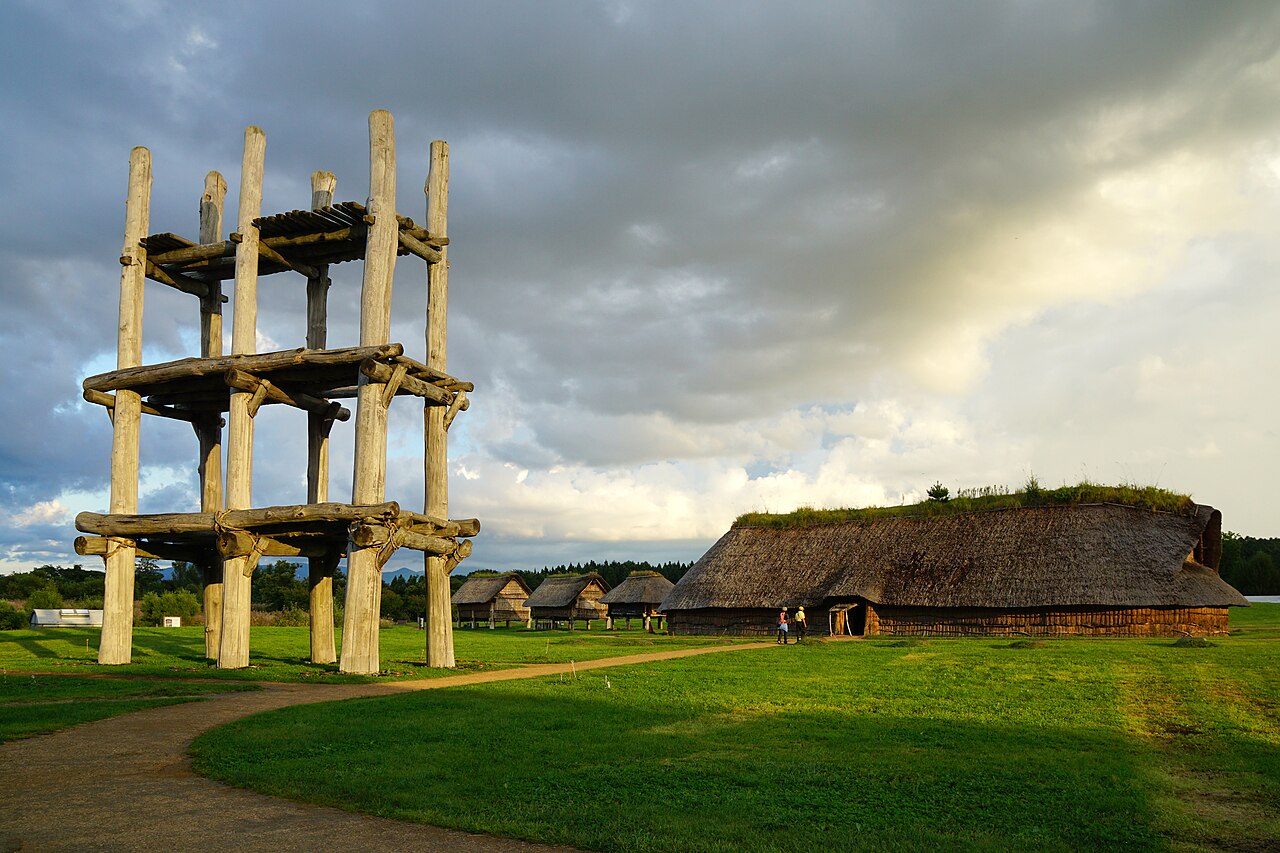
Among the most spectacular features of Sannai-Maruyama are the remains of large timber structures, including the postholes of an enormous building supported by six massive wooden pillars, each set in a deep pit and estimated to have been substantial trees. The scale of this construction, requiring the felling, transport, and erection of huge timbers, has amazed archaeologists and testifies to the ambition and organizational capacity of the Jomon community. A reconstruction of this great post structure now towers over the site, giving visitors a sense of its former grandeur.
The purpose of this monumental timber building remains debated, with suggestions ranging from a watchtower or lighthouse-like structure to a ceremonial monument or communal gathering place, but whatever its function, it demonstrates that the Jomon were capable of large-scale construction rivaling the monuments of contemporary farming societies. Alongside this great structure, the site contained numerous pit dwellings, long communal buildings, storage pits, and other features, forming a complex and permanent village. The architecture of Sannai-Maruyama, above all its towering posts, stands as a monument to the sophistication of a hunter-gatherer people.

The cord-marked pottery and Jomon art
The Jomon are renowned for their pottery, among the oldest in the world, and Sannai-Maruyama has yielded abundant examples of the distinctive cord-marked vessels that give the culture its name, along with clay figurines and other objects that reveal a rich artistic and symbolic tradition. Jomon pottery is celebrated for its elaborate and imaginative forms, and the making of ceramics by these hunter-gatherers, long before the pottery of many farming societies, is itself a remarkable fact that overturns assumptions about the sequence of human technological development.
Beyond utilitarian vessels, the Jomon produced clay figurines known as dogu, mysterious and often highly stylized human forms whose purpose remains uncertain but which clearly held ritual or symbolic significance. These figurines, together with other objects of stone, bone, and lacquer recovered from Sannai-Maruyama, reflect a sophisticated aesthetic sensibility and a complex spiritual world. The art of the Jomon, expressed in their pottery and figurines, ranks among the great artistic traditions of the prehistoric world and testifies to the cultural richness of the people who built and inhabited the great village in the north.

Trade across ancient Japan
Far from being an isolated community, Sannai-Maruyama participated in trade networks that stretched across considerable distances, bringing to the village materials that could not be obtained locally. Obsidian for making sharp tools, jade for ornaments, asphalt used as an adhesive, and other goods reached the site from distant sources, revealing that the Jomon of Sannai-Maruyama were connected to a wider world of exchange spanning much of ancient Japan. These trade connections underscore the sophistication of the society and its integration into networks of contact and commerce.
The presence of jade and other exotic materials also points to the value the Jomon placed on prestige goods and ornaments, and to the social relationships that trade both required and sustained. Through these networks, materials, goods, and very likely ideas and techniques moved between communities, helping to spread the shared Jomon culture across the islands. The trade of Sannai-Maruyama thus reveals a people who, though they lived by foraging, were embedded in a complex web of long-distance connections, another mark of the surprising sophistication of this great ancient village.

A large and enduring community
The scale and longevity of Sannai-Maruyama imply a substantial population living together in a stable community over an immense span of time, raising fascinating questions about how such a society was organized. The village contained many dwellings, communal structures, storage facilities, and a large cemetery, and its inhabitants maintained their settlement across roughly fifteen centuries, an extraordinary continuity that suggests a well-developed social order capable of managing the challenges of long-term communal life.
Burials and other evidence hint at the social world of the community, though much remains uncertain about matters such as leadership and social differentiation among the Jomon. What is clear is that Sannai-Maruyama sustained a large, settled population without the agriculture, kings, or centralized states of other early complex societies, relying instead on the abundance of its environment, the management of its chestnut forests, and whatever social arrangements allowed its people to cooperate across the generations. The very existence of such a large and enduring foraging village stands as testimony to the ingenuity and adaptability of the Jomon.

The end of the great village
After some fifteen hundred years, Sannai-Maruyama was gradually abandoned around 2200 BCE, its long occupation coming to an end for reasons that likely included environmental and climatic changes affecting the resources on which the community depended. A cooling climate may have reduced the productivity of the forests and seas that had sustained the village, undermining the abundant food base that made its permanence possible and eventually leading its people to disperse or relocate.
The abandonment of Sannai-Maruyama did not mark the end of the Jomon culture, which continued for many more centuries across the Japanese islands, but it did bring to a close one of the greatest chapters of Jomon settlement. The long life and eventual decline of the village illustrate how closely the fortunes of even the most sophisticated foraging societies were tied to the natural environment, and how shifts in climate could reshape the human world. The great village in the north fell silent, but the record of its extraordinary achievement lay preserved in the earth, awaiting rediscovery.
Rediscovery and world recognition
Sannai-Maruyama was brought to light in the 1990s during preparations for construction, when excavations revealed the astonishing scale and richness of the ancient village, prompting a decision to preserve the site rather than build over it. The discovery transformed understanding of the Jomon, revealing a level of settlement, construction, and complexity far beyond what had been imagined for a hunter-gatherer culture, and Sannai-Maruyama quickly became the most famous and important Jomon site in Japan.
In recognition of its outstanding significance, Sannai-Maruyama, together with other Jomon sites, has been inscribed as a UNESCO World Heritage Site, celebrating the achievements of this remarkable culture and its distinctive path to settled complexity without agriculture. The site today features reconstructed buildings, including the great timber posts and pit dwellings, along with a museum displaying the wealth of artifacts recovered from the excavations. Sannai-Maruyama has become both a source of national pride in Japan and a place of world importance, its story reshaping the global understanding of what hunter-gatherer societies could achieve.
The rich northern environment that fed a village
The remarkable permanence of Sannai-Maruyama rested on the extraordinary natural abundance of northern Honshu, a landscape where forest, river, and sea came together to provide a diverse and dependable food supply throughout the year. The surrounding forests yielded chestnuts, walnuts, acorns, and other nuts that could be gathered in quantity and stored, while the nearby waters teemed with fish and shellfish and the woodlands sheltered deer, boar, and other game. This mosaic of resources, each available in its own season, allowed the community to meet its needs without ever having to move on in search of food.
It was this environmental richness, carefully exploited and in the case of the chestnut forests actively managed, that underpinned the long life of the great village. The people of Sannai-Maruyama developed an intimate knowledge of their surroundings and a calendar of subsistence activities tuned to the rhythms of the northern year, harvesting the sea in one season and the forest in another. As at so many of the world’s most enduring early settlements, it was the generosity of the local environment, skillfully drawn upon, that made a large and permanent human community possible.
Storage, surplus, and the secret of permanence
A key to the permanence of Sannai-Maruyama was the ability to store food, above all the chestnuts and other nuts that could be preserved and drawn upon through the lean months of winter and early spring. Numerous storage pits and structures at the site testify to the importance of laying up surpluses, a practice that smoothed out the seasonal availability of resources and provided security against times of scarcity. This capacity to store and manage food surpluses is one of the hallmarks of settled life, usually associated with farming, and its presence among the foraging Jomon is deeply significant.
The storage of surplus food did more than ensure survival; it provided the stability and security that allowed the community to invest in permanent buildings, monumental construction, craft production, and the other achievements that mark Sannai-Maruyama as an exceptional settlement. By banking the abundance of good seasons against the scarcity of bad ones, the Jomon of the great village achieved a reliability of subsistence that freed them from the constant movement of many hunter-gatherers and anchored them to their place across the centuries, demonstrating that the foundations of settled complexity could be built on stored wild foods as well as on cultivated crops.
A day in the life of the great village
To imagine daily life at Sannai-Maruyama is to picture a busy community spread across a landscape of pit dwellings and larger communal buildings, where the tasks of gathering, processing, and storing food filled much of the year. In the appropriate seasons, people would set out to harvest chestnuts from the managed groves, to fish the rivers and sea, and to hunt in the forests, returning to the village to process and store their catch. Others would tend the fires, make and repair tools, produce the cord-marked pottery, and fashion the ornaments and figurines that reflected the community’s rich material culture.
The village was also a place of ritual, art, and social life, its large cemetery and ceremonial features pointing to shared beliefs and communal gatherings that bound the population together. Children grew up amid the routines of this settled foraging life, learning the knowledge of the seasons, the forest, and the sea that their survival depended upon. Through the abundant remains preserved at the site, archaeologists have been able to reconstruct this world in unusual detail, giving a vivid human dimension to the story of one of the ancient world’s greatest hunter-gatherer villages.
Honoring the dead of Sannai-Maruyama
The people of Sannai-Maruyama cared for their dead with evident attention, and the site includes both a large cemetery of individual burials and other funerary features that reveal something of Jomon beliefs about death. Adults were buried in the cemetery, while the remains of infants were sometimes placed within ceramic vessels, a practice paralleled at other early settlements around the world and reflecting particular beliefs about the very young. The arrangement of the burials and the accompanying features suggests a community with established customs for honoring the dead and marking their passage.
These funerary practices form an important part of the record of Jomon life at the site, offering insight into the social and spiritual world of the community. The care taken with burial, the distinction between the treatment of adults and infants, and the presence of what may have been ceremonial areas all point to a society with a developed sense of ritual and of the bonds linking the living and the dead. As with the enigmatic dogu figurines, the burials of Sannai-Maruyama open a window, however partial, onto the inner life of the Jomon and their understanding of existence and its end.
Walking through the reconstructed village
Today visitors to Sannai-Maruyama can walk through a partially reconstructed version of the ancient village, where pit dwellings, long communal houses, and above all the great six-pillared timber structure have been rebuilt on the basis of the archaeological evidence. This vivid reconstruction allows the scale and character of the Jomon settlement to be appreciated as no plan or artifact alone could convey, letting people stand beneath the towering posts and enter the homes of a community that flourished five thousand years ago.
The reconstructed village, together with an on-site museum displaying the wealth of pottery, figurines, tools, and other objects recovered from the excavations, has made Sannai-Maruyama one of the most compelling archaeological attractions in Japan. It serves both to educate the public about the achievements of the Jomon and to instill pride in this deep chapter of Japan’s heritage. Through the reconstruction, the great village of the north lives again in the imagination of its visitors, its towering timbers rising once more over the landscape as they did in the age of the Jomon.
Sannai-Maruyama and the world’s foraging societies
Set within the global story of the oldest settlements, Sannai-Maruyama belongs to a small but profoundly important group of complex hunter-gatherer societies that achieved permanence, monumental construction, and social sophistication without agriculture. Alongside the fishing communities of the Iron Gates at Lepenski Vir, the mound-builders of Watson Brake, and the eel-farmers of Budj Bim, the Jomon of Sannai-Maruyama demonstrate that the settled, complex life once thought to depend on farming could arise wherever nature was abundant enough and human ingenuity sufficient.
These parallels across continents, arising entirely independently, reveal something important about human possibility: that the path from foraging to complex settled life could be walked in many ways, and that agriculture, though it would ultimately transform most of the world, was not the only foundation on which lasting human communities could be built. Sannai-Maruyama, with its managed chestnut forests and towering timber posts, is among the most spectacular examples of this alternative path, and its inclusion in the story of the world’s oldest settlements enriches our understanding of the remarkable diversity of the human past.
The lasting significance of a great village
The significance of Sannai-Maruyama reaches far beyond Japan, for the site has reshaped the global understanding of hunter-gatherer societies and of the many roads humanity has taken toward settled, complex life. By revealing a large, permanent, monument-building village sustained for fifteen centuries by a foraging people, it has forced a reconsideration of long-held assumptions and has secured the Jomon a place among the most sophisticated ancient cultures known. Its discovery stands as a landmark in world archaeology and a powerful corrective to narrow views of what foragers could accomplish.
For Japan, Sannai-Maruyama is a treasured link to the deep past and a source of national pride, and its recognition as a World Heritage Site has brought its story to a global audience. In the wider human narrative, it takes its place among the oldest and most remarkable settlements, a village in the north that flourished when much of the world was only beginning to build its first permanent communities. The towering posts of Sannai-Maruyama endure as a monument to the ingenuity of the Jomon and to the enduring truth that the human impulse to gather, to build, and to make a lasting home ran deep across the whole of the inhabited earth.
Nearby in East Asia’s ancient story
To place this site within its wider region, these related articles trace nearby chapters of the ancient story:
- A six-thousand-year-old village: the story of Banpo
- Jiahu and the earliest music of China
- Liangzhu and the jade city of the Yangtze
Closing thoughts
Sannai-Maruyama stands as one of the great surprises of the ancient world, a village of hunter-gatherers that endured longer than most empires. In its towering posts and cord-marked pots, the Jomon speak across five thousand years, insisting that there was never only one road to settled, sophisticated human life, and that abundance, ingenuity, and care for the land could raise a lasting village even without the plow.