On the high right bank of the Don River, in the rolling country south of Voronezh, lies a cluster of sites so old and so rich that some archaeologists have called it the place where Europe’s modern human story begins. Kostenki is not a single settlement but a scatter of more than twenty Stone Age sites packed into a few square kilometers, layered one above another across tens of thousands of years. Here, as early as forty thousand years ago and perhaps more, some of the first anatomically modern humans in Europe hunted mammoths on the frozen steppe, carved delicate figurines, adorned themselves with ornaments, and built shelters from the bones of the great beasts they killed. Frozen into the loess soil of the Don, Kostenki preserves one of the deepest and most detailed records anywhere of how our species first colonized the cold heart of the continent.

Table of Contents
- A Treasure House on the Don
- Among the First Modern Europeans
- Houses Built of Mammoth Bones
- Hunters of the Ice Age Steppe
- Figurines From the Frozen World
- Beads, Ivory, and Distant Stone
- Reading Deep Time in the Loess
- A Century of Excavation
- Surviving the Ice Age
- Why Kostenki Matters
- The Deep Roots on the Don
- Kostenki Today
- Tools, Ivory, and Everyday Ingenuity
- Ancient DNA and the Roots of Europe
- Nearby in Russia’s Ancient Story
- Firelight on the Frozen Steppe
A Treasure House on the Don
The sites of Kostenki are strung along the western bank of the Don and its ravines, where thick deposits of windblown loess have buried and preserved the traces of ancient human life. Over more than a century of excavation, archaeologists have identified a remarkable concentration of Upper Paleolithic sites here, making Kostenki one of the most important Stone Age localities in all of Eurasia.
What sets Kostenki apart is not just the number of sites but their depth in time and richness in finds. Layer upon layer records the presence of hunter-gatherers across tens of thousands of years, capturing changes in tools, art, and way of life through the depths of the last Ice Age. It is a natural archive of the Paleolithic, an extraordinary window onto the lives of the first modern Europeans.
The concentration of so many sites in such a small area is itself extraordinary and speaks to the enduring appeal of this stretch of the Don. Generation after generation of Ice Age hunters returned to these bluffs and ravines, drawn by the game, the shelter, and the resources the location offered. Over the millennia, their repeated presence built up the dense archaeological record that makes Kostenki so precious today.
The loess itself, that fine, wind-deposited soil, is the unsung hero of Kostenki. By gently burying the remains of each occupation, it protected them from the ravages of time, sealing bones, tools, and art into the earth. Without this natural preservative blanketing the Don valley, the extraordinary record of Kostenki would never have survived for us to read.
Among the First Modern Europeans
Some of the deepest layers at Kostenki have yielded dates reaching back around forty thousand years, placing the site among the earliest known presence of anatomically modern humans in Europe. These were people like us, arriving in a cold, demanding landscape at the edge of the habitable world, and finding ways not merely to survive but to thrive along the Don.
The antiquity of Kostenki has made it central to debates about how and when modern humans spread across Europe. The evidence here suggests that our ancestors reached the eastern European plains remarkably early, adapting swiftly to the harsh conditions of the Ice Age steppe. In the ancient soil of Kostenki lies part of the answer to one of the great questions of prehistory: how our species conquered a frozen continent.
The early dates from Kostenki have forced scholars to reconsider the timing and routes of the modern human expansion into Europe. If people were already established on the eastern European plains this early, then the story of our species’ spread across the continent was faster and more complex than once believed, and the Don sites stand as key evidence in that ongoing reconstruction.
These pioneers faced a landscape utterly unlike the temperate Europe of later ages, a cold, open steppe roamed by mammoths and other Ice Age giants. That they chose to settle and thrive here, at what was then the frontier of the human world, speaks to a boldness and adaptability that would carry our species to every corner of the globe. Kostenki marks one of the frontiers they crossed.

Houses Built of Mammoth Bones
Among the most extraordinary discoveries at Kostenki are dwellings constructed from the bones of mammoths. Faced with a treeless, frigid landscape, the inhabitants turned to the most abundant building material available: the massive bones, tusks, and skulls of the mammoths they hunted. These were arranged into the framework of shelters, likely covered with hides, creating sturdy homes against the Ice Age cold.
These mammoth-bone structures are haunting monuments to human ingenuity. Building a dwelling from the remains of such colossal animals required cooperation, planning, and enormous effort, hauling and arranging bones that each weighed a great deal. They testify to a society organized enough to undertake major construction, and to a deep, practical relationship between these people and the mammoths that dominated their world and their imagination.
These bone structures also reveal something about the social world of their builders. Assembling a dwelling from mammoth remains was a communal undertaking, requiring many hands working together toward a shared goal. The houses thus stand as monuments not only to ingenuity but to cooperation, testimony to communities bound together by the demands of survival in a frozen land.
Standing before a reconstructed or preserved mammoth-bone dwelling, one cannot help but feel awe at the world it evokes: a frozen plain, a community huddled within walls of tusk and bone, firelight flickering against the great ivory arches. These structures are among the most evocative images the Ice Age has left us, windows onto a way of life utterly different from our own yet unmistakably human.

Hunters of the Ice Age Steppe
The people of Kostenki were hunters of the mammoth steppe, a vast, cold grassland teeming with large animals now long vanished from the region. Mammoths were central to their existence, providing meat, fat, bone for building and tools, and ivory for carving. But they also hunted horses, reindeer, and other game, drawing on a wide range of the steppe’s resources to sustain their communities through the long Ice Age winters.
Hunting such formidable animals demanded skill, courage, and coordination. It also required intimate knowledge of the land, the seasons, and the behavior of the herds. The material remains at Kostenki, from butchered bones to hunting tools, reveal a society finely tuned to its environment, capable of provisioning itself reliably in one of the harshest habitats humans have ever mastered. These were consummate survivors of the Ice Age world.
The relationship between the people of Kostenki and the mammoth went beyond mere sustenance. The great beasts provided the very framework of their homes, the ivory for their art, and, one imagines, a central place in their stories and beliefs. To live at Kostenki was to live in a world shaped by mammoths, animals whose presence permeated every aspect of existence, from the practical to the spiritual.
The scale of mammoth hunting evident at Kostenki also raises fascinating questions about how these animals were taken. Whether through carefully planned ambushes, the use of natural traps, or the scavenging of naturally dead beasts, procuring mammoths on this scale required deep understanding and coordination. However they managed it, the hunters of Kostenki turned the largest animals of their world into the foundation of their survival.

Figurines From the Frozen World
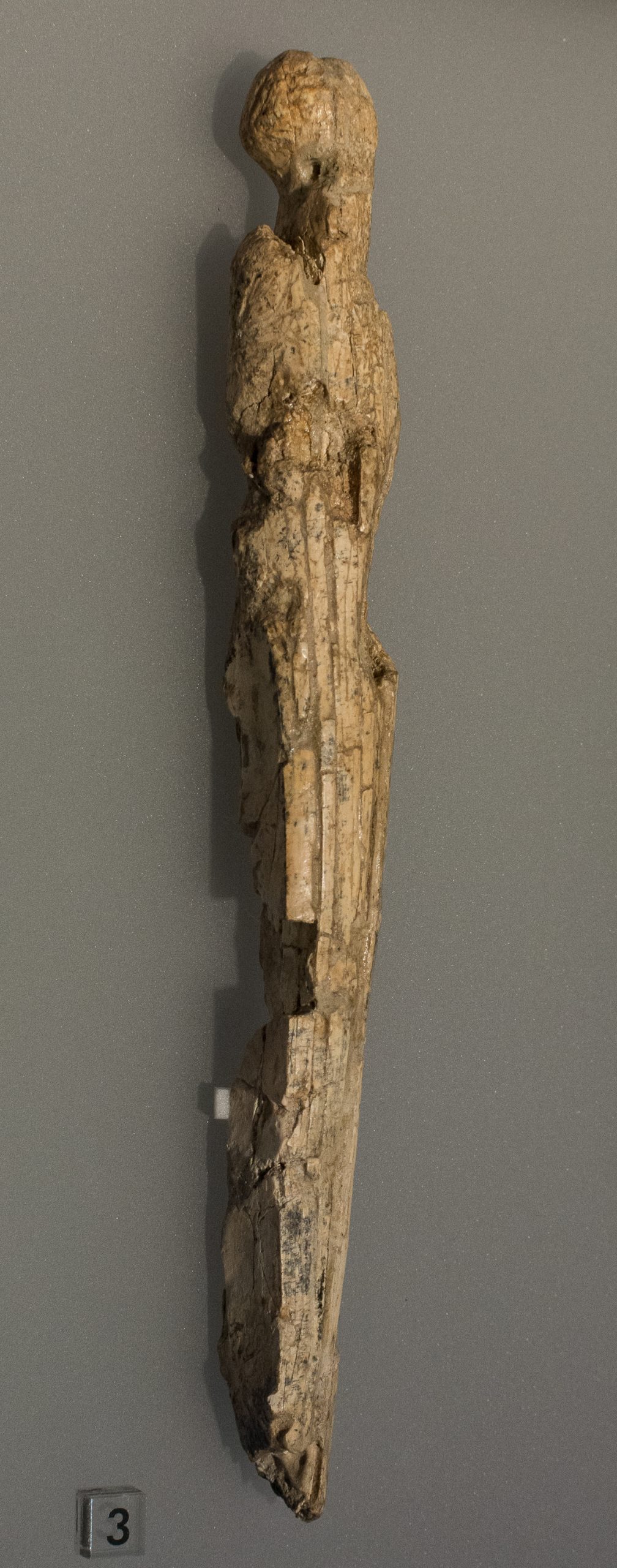
Kostenki is famous not only for survival but for art. The sites have yielded exquisite carved figurines, including the celebrated female figures often called Venuses, small sculptures shaped from ivory, bone, and stone. These figurines, found across Ice Age Europe from France to Siberia, are among the earliest known artistic representations of the human form, and Kostenki has produced some of the finest examples.
Alongside the figurines, the sites have yielded ornaments, decorated objects, and other traces of a rich symbolic life. This art tells us that the people of Kostenki were not merely surviving but living lives full of meaning, belief, and beauty. In the frozen soil of the Don, the human capacity for art and symbolism, one of the defining traits of our species, shines out across forty thousand years.
The care and skill invested in these figurines are remarkable given the harsh circumstances of their makers’ lives. In a world consumed by the daily struggle against cold and hunger, people still found the time, materials, and inspiration to create art. That impulse toward beauty and meaning, persisting even at the edge of survival, is one of the most moving aspects of the Kostenki record.
The figurines of Kostenki also link the site to a vast artistic tradition spanning Ice Age Eurasia, from western Europe deep into Siberia. This shared repertoire of imagery, appearing across thousands of kilometers, suggests common beliefs or traditions uniting scattered peoples. Kostenki thus belongs not only to Russia’s prehistory but to a continent-wide flowering of the earliest human art.

Beads, Ivory, and Distant Stone
The people of Kostenki adorned themselves and their world with ornaments: beads, pendants, and decorative objects made from ivory, bone, shell, and stone. Some of the materials found at the sites came from far away, indicating that these Ice Age communities were connected across long distances, exchanging goods, materials, and perhaps ideas with other groups scattered across the vast Paleolithic landscape.
These distant connections are a revelation. Far from being isolated bands clinging to survival, the hunters of Kostenki were part of wider networks that spanned enormous stretches of Ice Age Europe. Shells from distant seas and stone from faraway sources speak of movement, contact, and relationships reaching across hundreds of kilometers. The frozen Don was a node in a continent-wide web of Paleolithic humanity.
The movement of materials over such distances hints at more than trade; it suggests relationships, alliances, and shared traditions binding scattered groups together. In a sparsely populated Ice Age world, such connections would have been vital, providing access to resources, mates, and knowledge. The beads and pendants of Kostenki are thus tokens of a far-flung human community stretched across the frozen continent.
That such fragile items as beads and pendants survived at all is a gift of the loess, and each one recovered is a tiny act of self-expression reaching across forty millennia. To adorn oneself is a deeply human impulse, bound up with identity, status, and belonging, and in the ornaments of Kostenki we glimpse the individuals behind the archaeology, people who cared how they looked and what they wore.

Reading Deep Time in the Loess
The loess deposits of Kostenki act like the pages of an immensely thick book, preserving layer after layer of human occupation across the Ice Age. By excavating carefully through these layers, archaeologists can trace changes in technology, art, and lifestyle over tens of thousands of years, watching how the people of the Don adapted as the climate shifted and the ages turned.
This stratigraphic depth makes Kostenki uniquely valuable. Few places anywhere offer such a long, continuous record of Upper Paleolithic life in one location. The site allows researchers to study not just a single moment but the sweep of an entire era, from the first arrival of modern humans through the depths of the Ice Age. In the layered loess of Kostenki, deep time becomes legible, chapter by patient chapter.
Comparing the successive layers also lets archaeologists watch human culture itself evolve over vast stretches of time. Tools grow more refined, art appears and develops, ways of life shift with the changing climate. In this sense Kostenki offers not a snapshot but a moving picture of the Upper Paleolithic, a rare chance to observe the long, slow unfolding of human ingenuity across the ages.
For researchers, the challenge and reward of Kostenki lie precisely in this depth. Excavating through such a long sequence demands meticulous care, but it yields a payoff few sites can match: the ability to follow a single region’s human story across the entire span of the Upper Paleolithic, tracing continuity and change through one of the most formative eras in the history of our species.

A Century of Excavation
Kostenki has been studied for a very long time, with excavations reaching back into the nineteenth century and continuing, on and off, ever since. Generations of Russian and Soviet archaeologists have worked here, gradually revealing the extent, antiquity, and importance of the site complex. Each campaign added new finds and refined the understanding of this Paleolithic treasure house on the Don.
The long history of research at Kostenki is itself part of the story. Techniques and interpretations have evolved dramatically over more than a century, and modern methods of dating and analysis have pushed the antiquity of the site ever deeper while revealing new subtleties in the lives of its ancient inhabitants. Kostenki has grown in importance with each passing decade, its full significance still coming into focus.
The dedication of the archaeologists who have worked at Kostenki over so many generations is a story in itself, one of patient labor in difficult conditions to recover the fragile traces of the deep past. Their cumulative efforts have transformed a set of loess bluffs on the Don into one of the cornerstones of Paleolithic archaeology, a place whose finds fill museums and textbooks alike.
Surviving the Ice Age
The world the people of Kostenki inhabited was profoundly cold. During the depths of the last Ice Age, the Don steppe was a frigid, windswept expanse, its winters long and brutal. That humans not only endured but flourished here for tens of thousands of years is a testament to their remarkable adaptability, ingenuity, and resilience in the face of an unforgiving climate.
Survival in such conditions demanded every tool in the human repertoire: fire, tailored clothing, sturdy shelters, cooperative hunting, and deep environmental knowledge. The mammoth-bone houses, the abundant hunting gear, and the evidence of well-organized communities all point to people who had mastered the art of living in the cold. Kostenki is, among other things, a monument to the human genius for adaptation at the very edge of the possible.
It is worth remembering that the people of Kostenki faced not a single, stable environment but a shifting one, as the Ice Age climate advanced and retreated over the millennia. Their long presence on the Don is therefore a story of continual adaptation, of communities repeatedly adjusting their lives to meet the changing demands of a restless and often merciless natural world.
In an age increasingly conscious of climate and its power to reshape human lives, the story of Kostenki carries a certain resonance. Here, people confronted dramatic environmental extremes and, through ingenuity and cooperation, not only survived but built a rich culture. Their example, drawn from the depths of the Ice Age, speaks to the enduring human capacity to adapt and endure in the face of a changing world.
Why Kostenki Matters
Kostenki holds a special place in the study of human origins in Europe. Its great antiquity, its concentration of sites, its extraordinary preservation, and its wealth of art and evidence make it one of the most important Paleolithic localities anywhere. For understanding how modern humans first spread into and adapted to the cold heart of the continent, few places rival the Don sites.
The site also connects to profound questions about who the first modern Europeans were, where they came from, and how they lived. Ancient remains from Kostenki have contributed to genetic and archaeological studies that trace the deep ancestry of European populations. In the frozen soil of the Don lies a crucial chapter in the story of our species, one that continues to reshape our understanding of the Ice Age world.
The importance of Kostenki also lies in how it reshapes the popular image of the Ice Age. Rather than a bleak struggle for bare survival, the site reveals a world of skilled hunters, gifted artists, and connected communities living full and meaningful lives. It restores to our distant ancestors their humanity, showing them not as brutish cavemen but as inventive, creative people much like ourselves.
Kostenki’s contribution to our understanding of the peopling of Europe can hardly be overstated. As one of the earliest and richest windows onto the arrival of modern humans on the continent, it occupies a foundational place in prehistoric research. The questions it helps answer, about origins, migration, and adaptation, lie at the very heart of the human story in Europe.
The Deep Roots on the Don
The legacy of Kostenki is the sheer depth and vividness of the human story it preserves. Here, across an almost unimaginable span of time, generations of Ice Age hunters lived, built, hunted, carved, and adorned themselves, leaving behind a record of astonishing richness. The sites remind us that the roots of humanity in Europe run far deeper than the age of farmers, towns, and writing.
To contemplate Kostenki is to reach back to the very dawn of the modern human presence on the continent, to a world of mammoths and ice and firelit shelters of bone. In these ancient camps along the Don, our distant ancestors met the challenge of the Ice Age and prevailed, and in doing so they laid the deepest foundations of the human story in Europe.
There is a profound humility to be found in contemplating the depth of time at Kostenki. Long before the pyramids, before writing, before the first farmers, people were already here, building, creating, and enduring. The site anchors the human story in Europe in a past so deep it strains the imagination, reminding us how ancient and resilient our presence on this continent truly is.
And so Kostenki endures, a treasure house on the Don whose deep layers continue to yield insight into the dawn of the modern human age in Europe. Each generation of researchers finds new meaning in its ancient soil, and each discovery deepens our appreciation of the ingenuity and resilience of the Ice Age hunters who once made this frozen riverbank their home.
Kostenki Today
Today the significance of Kostenki is marked by a museum built directly over one of the mammoth-bone dwellings, allowing visitors to see this extraordinary structure preserved in place. The surrounding landscape, with its ravines and loess bluffs above the Don, still holds untold archaeological riches, and research continues to add to the story of the site.
For anyone drawn to the deepest reaches of human prehistory, Kostenki offers a rare and moving encounter with the Ice Age past. Standing before a house built of mammoth bones, in a land where the first modern Europeans once hunted the great beasts of the steppe, it is possible to feel the vast depth of time and the enduring resilience of our species. Kostenki is where Europe’s human story begins in earnest.
The decision to build a museum directly over a mammoth-bone dwelling was inspired, allowing visitors to encounter this astonishing structure exactly where it was created. Rather than viewing scattered artifacts behind glass, they can stand before an Ice Age home preserved in its original place, an experience that collapses the distance of forty thousand years into a single, unforgettable moment.
Tools, Ivory, and Everyday Ingenuity
The toolkits recovered from Kostenki reveal a people of remarkable technical sophistication. Their stone tools, made from carefully selected flint and other materials, included blades, points, scrapers, and burins suited to hunting, butchering, working hides, and carving. Bone and ivory were shaped into needles, points, and other implements, showing a mastery of many materials beyond stone alone.
The presence of fine bone needles is especially telling, for it points to the making of tailored, fitted clothing, an absolute necessity for survival in the Ice Age cold. To thrive on the frozen steppe, the people of Kostenki had to sew warm garments from hides, and the delicate needles they left behind are humble but powerful evidence of that essential craft.
Every category of tool tells a story of adaptation. From the blades that butchered mammoths to the needles that stitched winter clothing, the material culture of Kostenki reflects a community with a deep, practical intelligence, endlessly inventive in the face of a hostile world. In these everyday objects we see the ingenuity that made human survival in the Ice Age possible.
The sophistication of this toolkit also underlines the intelligence and foresight of the Kostenki people. Each tool was made for a purpose, its form matched to its function through accumulated knowledge and skill. Behind every blade and needle lay generations of learning, a technological tradition passed down and refined, enabling these communities to meet the many challenges of Ice Age life.
Ancient DNA and the Roots of Europe
In recent decades, the study of ancient DNA has added a startling new dimension to Kostenki. Genetic material recovered from ancient human remains at the site has been analyzed to trace the deep ancestry of the people who lived here, and the results have contributed to a sweeping new understanding of how the populations of Europe came to be.
The genetic evidence from Kostenki suggests deep continuities and connections across Ice Age Eurasia, linking the ancient hunters of the Don to broader populations whose descendants would eventually spread across the continent. These findings place Kostenki not just at the geographic edge of early modern human Europe but near the genetic roots of the European story itself.
This marriage of archaeology and genetics has transformed how we see sites like Kostenki. No longer simply a collection of tools and bones, the site has become a source of profound insight into human ancestry, revealing that the people who once hunted mammoths along the Don are woven, in ways we are only beginning to understand, into the deep lineage of humanity in Europe.
As techniques advance, the genetic story emerging from Kostenki continues to grow richer and more nuanced. Each new analysis adds detail to the picture of how ancient populations moved, mixed, and endured, and the Don sites remain a vital reference point in this rapidly developing field. Few places tie together archaeology and genetics so powerfully in the study of Europe’s deepest past.
Ultimately, the fusion of bones, artifacts, and DNA at Kostenki offers one of the most complete portraits we possess of an Ice Age people, seen at once through their tools, their art, their homes, and their very genes. Few sites allow us to know our distant ancestors so fully, and that completeness is a large part of what makes Kostenki so precious to the study of human origins.
Nearby in Russia’s Ancient Story
- The Ice Age Children Buried With Thirty Thousand Ivory Beads: The Story of Sungir
- The Siberian Child Whose DNA Rewrote the Peopling of the Americas: The Story of Mal’ta
- The Siberian Cave Where a Finger Bone Revealed a Lost Human Species: The Story of Denisova Cave
Firelight on the Frozen Steppe
Kostenki endures as one of the great archives of the Ice Age, a place where the first modern Europeans left a record of unmatched depth and richness. Their mammoth-bone houses, delicate figurines, and distant ornaments reveal a people who met the frozen world with ingenuity, artistry, and resilience.
In the layered loess of the Don, forty thousand years of human striving lie preserved. Kostenki reminds us that long before farms and cities, our ancestors were already building, creating, and connecting across a frozen continent, kindling the first firelight of the human story in Europe on the windswept banks of an ancient river.
You May Like
Mafra, the Palace a King Built From a Vow


4 thoughts on “Kostenki: Where Early Europeans Built Homes From Mammoth Bones”