On a low hill in the plains of Thessaly, in central Greece, the wind moves over the foundations of houses that were old before the first pharaoh ever wore a crown. This is Sesklo, and for a long time archaeologists have argued over a single, provocative claim: that it may be the oldest town in Europe. Whether or not it wins that title outright, the story it tells is remarkable. Nearly nine thousand years ago, people here stopped simply surviving and started building something that looked, felt, and functioned like a community with a plan. They raised stone-footed houses, laid out something close to streets, painted their pottery with a confidence that still catches the eye, and lived in the same spot for two thousand years. To walk the site today is to stand at the exact place where the European village was invented.
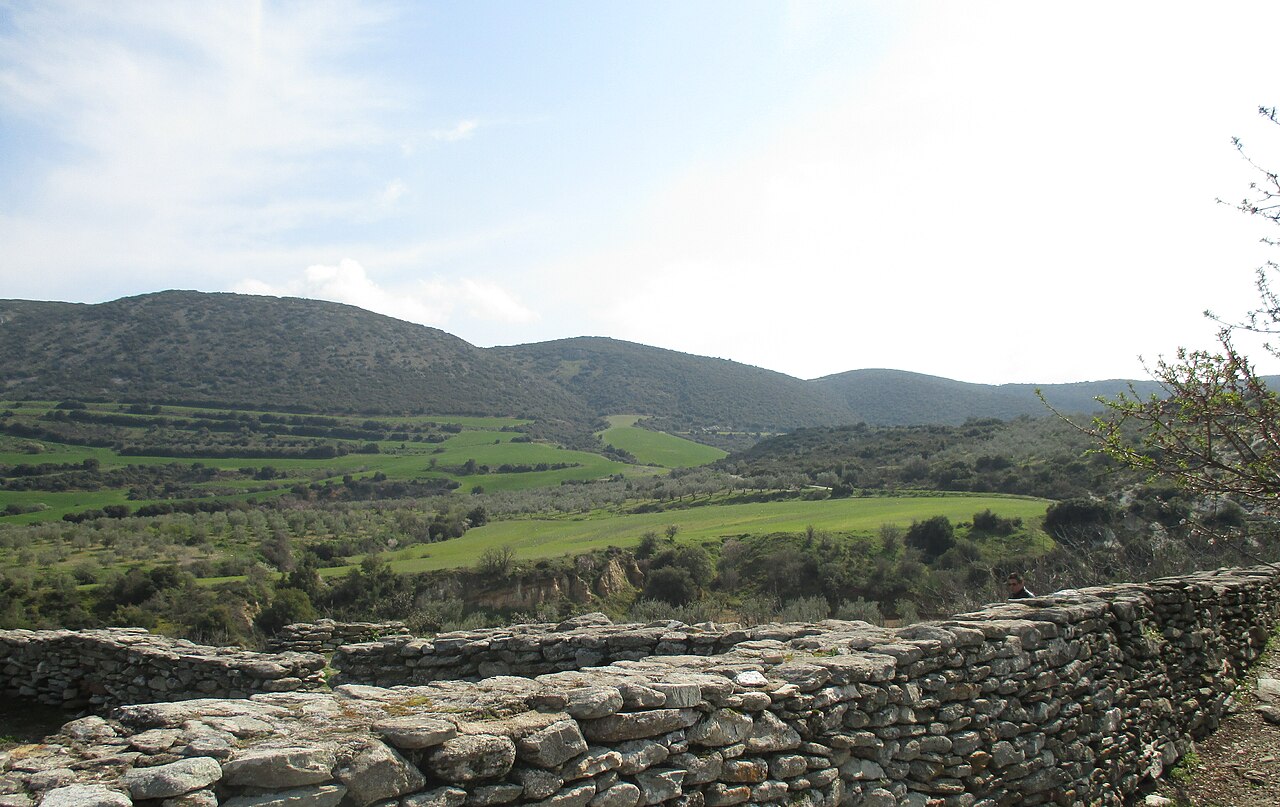
Table of Contents
- A Hill in the Heart of Thessaly
- How a Quiet Mound Became Famous
- Something That Looked Like a Town
- Walls of Stone, Roofs of Mud
- The Hill Within the Hill
- Painted Pots and a Sense of Style
- The Farmers Who Fed a Thousand
- Obsidian, Shells, and Distant Connections
- Clay Figures and the Question of Belief
- A Town That Burned
- Sesklo and Its Rival Neighbor
- Why Sesklo Still Matters
- Standing on the Oldest Ground
- The World the First Farmers Walked Into
- A Day in the Life of the Village
- How Sesklo Treated Its Dead
- Nearby in Europe’s Ancient Story
- The Town That Started It All
A Hill in the Heart of Thessaly
Sesklo sits about fifteen kilometers inland from the modern city of Volos, on a small plateau where two streams meet before running down toward the Pagasetic Gulf. It is not a dramatic landscape of cliffs and canyons; it is gentle, fertile, and generous, the kind of place a farmer notices immediately. The Thessalian plain is one of the great agricultural basins of the Mediterranean, and the earliest settlers who arrived here were among the first in Europe to bring the full toolkit of farming with them: wheat, barley, sheep, goats, cattle, and pigs.
That combination of good soil, fresh water, and a defensible rise is exactly why the hill was chosen and then never really abandoned. Generation after generation rebuilt on the rubble of the houses that came before, so that the ground slowly rose into a tell, an artificial mound made entirely of the debris of daily life. By the time the settlement reached its peak, the hill of Sesklo was not just a place people lived; it was made of them.
The gentleness of the setting is easy to underestimate today, but to a Neolithic farmer it would have read like a promise. Reliable water, workable soil, grazing for animals, and a modest rise that kept homes above the winter mud were the essential ingredients of a good life, and the hill of Sesklo offered all of them at once. Nature had, in effect, laid out an ideal template for settlement, and people accepted the invitation for two millennia.
How a Quiet Mound Became Famous
The site first drew serious attention at the very end of the nineteenth century, when the Greek archaeologist Christos Tsountas began digging here in the 1900s. Tsountas is a towering figure in Greek prehistory, and his excavations at Sesklo and the nearby site of Dimini essentially founded the study of the Greek Neolithic. He recognized that these mounds were not classical or Bronze Age, but something far older, a window into the very first farming societies of the Aegean.
In the decades that followed, especially through the work of Dimitrios Theocharis in the mid-twentieth century, the true depth of the site came into focus. Excavators found layer stacked upon layer, each representing a phase of building and rebuilding. The deepest levels pushed the human presence here back to around 6800 BCE, and possibly earlier, making Sesklo one of the founding chapters of settled life on the European continent.
Modern excavation and radiocarbon dating have since refined and sometimes challenged the early conclusions, but the essential achievement of those first archaeologists stands. They recognized that beneath the surface of an ordinary Thessalian mound lay one of the deepest and most complete Neolithic sequences in Europe, a record thousands of years long that could be read layer by layer like the pages of a book.
Something That Looked Like a Town
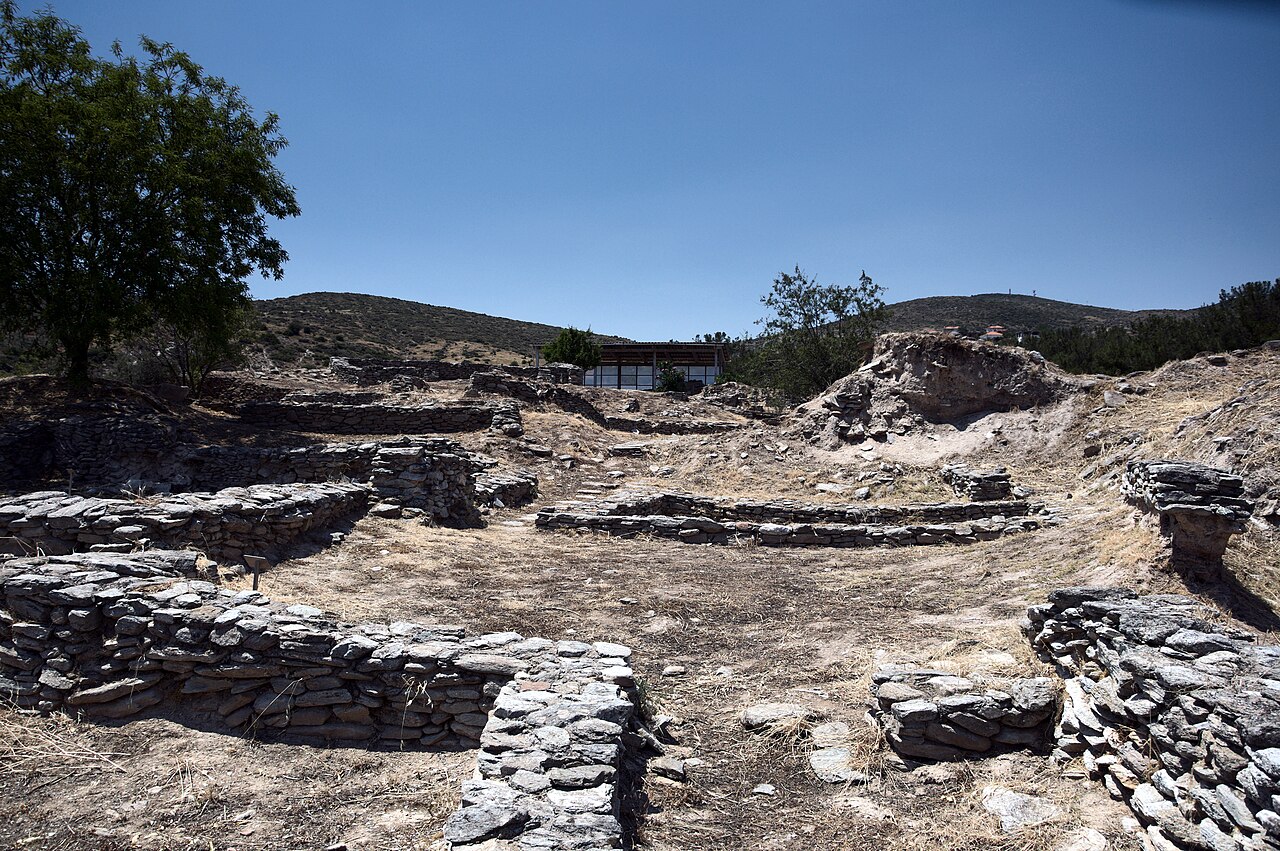
What makes Sesklo special is not simply its age but its organization. At its height, around 5000 BCE, the settlement may have sheltered several thousand people, an enormous number for the period. The houses were not scattered at random. They clustered densely, sharing walls and alignments, separated by narrow lanes and open courtyards that functioned like the arteries of a genuine settlement.
This is why some scholars are willing to call Sesklo a town rather than a village. The distinction matters. A village is a handful of families; a town implies a community large and organized enough to need shared spaces, agreed-upon boundaries, and some form of collective decision-making. Sesklo shows all of these things in embryo, which is why it turns up in almost every serious discussion of how urban life began in Europe.
Scholars sometimes reach for the modern language of urbanism to describe what they see here, and while that can overstate the case, the instinct is understandable. Sesklo has density, permanence, internal differentiation, and a scale of population that demanded some kind of shared order. It is the seed from which the idea of the town would grow, and watching that seed germinate is one of the great privileges of Aegean archaeology.
Walls of Stone, Roofs of Mud
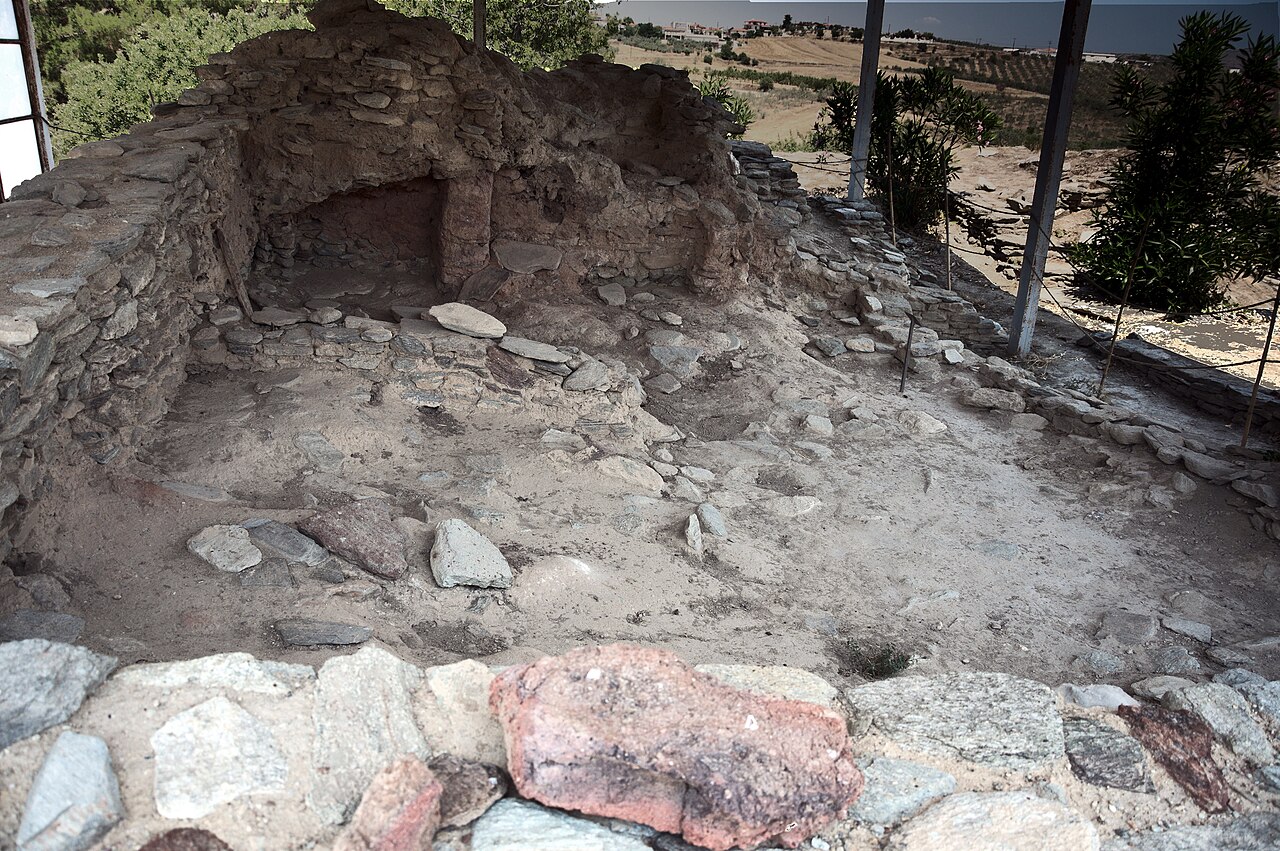
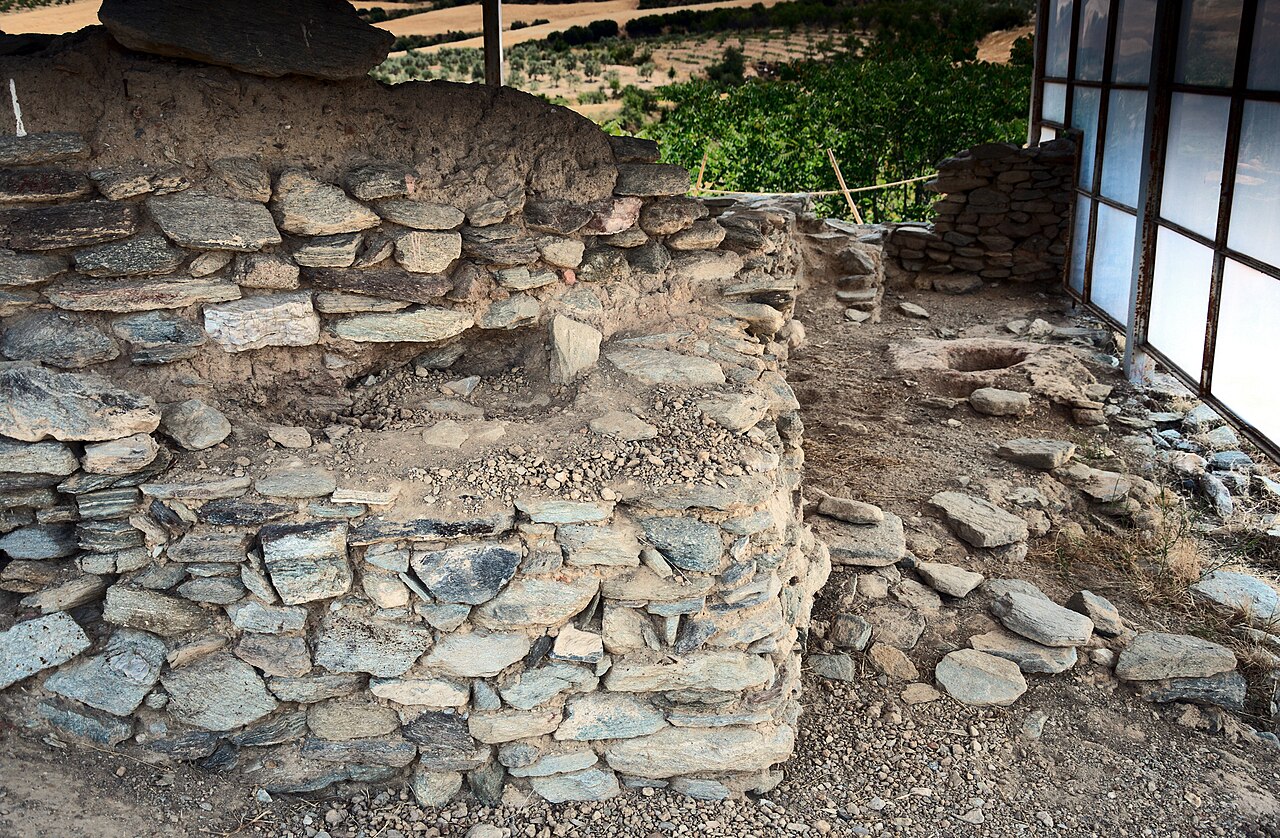
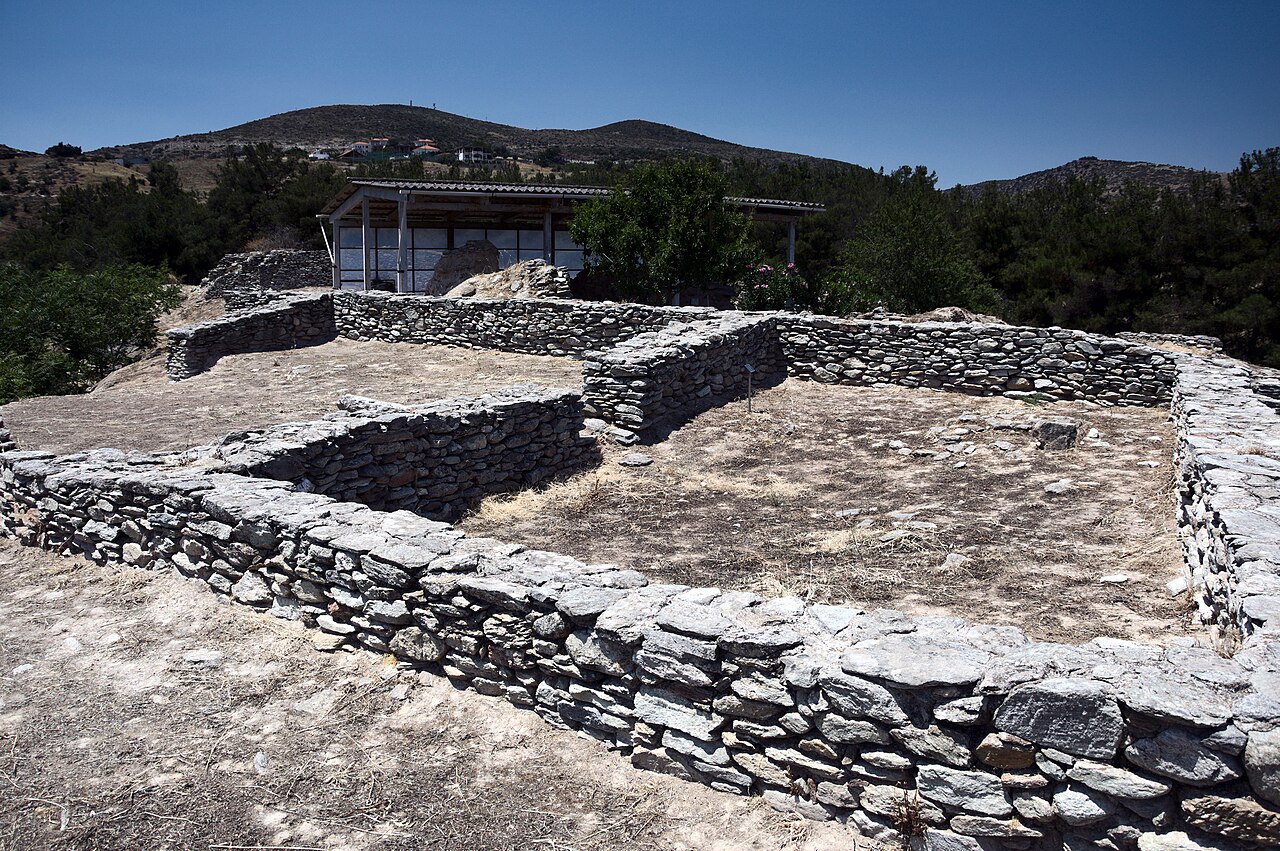
The typical Sesklo house was rectangular, with foundations of unworked stone that lifted the walls off the damp ground. On top of that stone footing rose walls of mudbrick or a timber frame packed with clay, and above it all a flat or gently pitched roof of branches and mud. It was a design perfectly tuned to the Thessalian climate, cool in summer, insulating in the cold months, and easy to repair with materials found within a short walk.
Inside, archaeologists have found the quiet furniture of Neolithic domestic life: clay hearths for cooking and warmth, benches, storage bins for grain, and querns for grinding it into flour. These were not temporary shelters but permanent homes, built to last a lifetime and then rebuilt in the same footprint by the next generation. The continuity is striking, a family staying put not for years but for centuries.
Over the centuries this simple, effective design barely changed, which is itself revealing. When a building method works perfectly for a place, there is little reason to reinvent it, and the people of Sesklo passed their architectural knowledge down through countless generations. Each rebuilt house was both an innovation and an inheritance, a fresh structure raised on the exact plan its grandparents had used.
The Hill Within the Hill
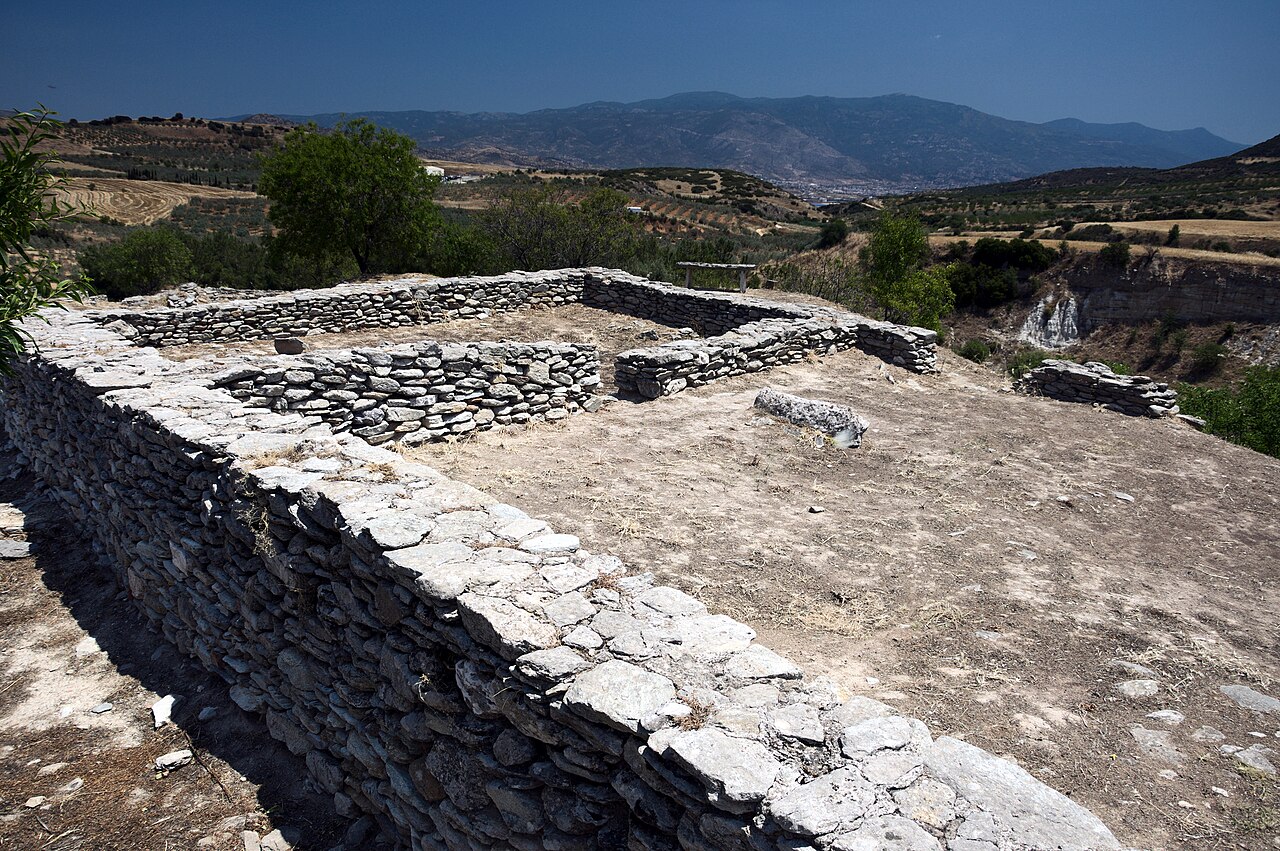
At the highest point of the mound stood a fortified core that archaeologists often call the acropolis of Sesklo. Here the buildings were larger and more carefully made, set apart from the surrounding houses of the lower town. One structure in particular, a substantial building with a porch and a large main room, has been interpreted as a chief’s house or a communal hall, a place where the community’s most important decisions and gatherings may have taken place.
The presence of a distinct upper zone hints at the first stirrings of social difference. Not everyone lived in the same kind of house or in the same part of the settlement. Whether this reflects real hierarchy or simply the practical clustering of important families is still debated, but the physical separation itself is significant. Sesklo was beginning to sort itself into inside and outside, center and edge, a pattern that every later city would repeat.
Whether the great building on the acropolis housed a leader, hosted feasts, or served as a shrine, its very existence marks a turning point. For the first time in European prehistory, a community was investing extra labor and care into a single structure meant to stand apart from and above the ordinary homes around it. That impulse, to build something larger than any single household, runs straight through to the temples and palaces of later ages.
Painted Pots and a Sense of Style
If one artifact defines Sesklo, it is its pottery. The potters here produced fine, well-fired vessels decorated with red designs painted on a pale, cream-colored surface, geometric patterns of flames, zigzags, and stepped triangles that feel almost modern in their crisp confidence. This distinctive ware is so characteristic that archaeologists named an entire cultural phase, the Sesklo culture, after it.
This was not merely functional tableware. The care lavished on these pots suggests they carried meaning, marking status, identity, or ritual occasions. Making them required a mastery of clay selection, shaping, and kiln temperature that took generations to perfect. In the painted pottery of Sesklo we see one of the first moments in European history where ordinary objects became a canvas for shared artistic style.
The evolution of this pottery also gives archaeologists a precise clock. Because styles changed gradually but recognizably over time, the pots found in each layer help date the phases of the settlement with remarkable accuracy. In a world before writing, the painted vessels of Sesklo became an unintentional record, chronicling the passing centuries in slip and pigment.
The Farmers Who Fed a Thousand
Supporting a settlement of thousands required a farming system that worked reliably, year after year. The people of Sesklo grew emmer and einkorn wheat, barley, lentils, peas, and other pulses, and they kept sheep, goats, cattle, and pigs. This mixed strategy spread risk: if the grain failed, the herds endured, and the animals also provided milk, wool, leather, and manure to keep the fields fertile.
The surrounding plain would have been dotted with fields and grazing land, worked with stone-bladed sickles and wooden digging tools. Grain was stored in clay bins and pits inside the houses, a buffer against lean seasons. This quiet mastery of food production is the invisible foundation beneath everything else at Sesklo. Without a dependable surplus, none of the houses, pottery, or communal buildings would have been possible.
The choice of a mixed farming strategy also shaped the very rhythm of the year. Planting and harvest anchored the calendar, while the herds demanded daily care and seasonal movement to fresh pasture. This tight, interlocking schedule of plant and animal husbandry bound the community to the land and to one another, and it produced the dependable surplus that let a few thousand people live shoulder to shoulder on a single hill.
Obsidian, Shells, and Distant Connections
The people of Sesklo were not isolated. Among their tools archaeologists find blades of obsidian, the glassy black volcanic stone prized for its razor edge. The nearest source is the Aegean island of Melos, well over a hundred kilometers away across open water. Its presence at Sesklo proves that these early farmers were plugged into a network of exchange that crossed the sea long before anyone would have called it trade in the modern sense.
Along with obsidian came seashells used as ornaments, fine stone, and no doubt ideas, techniques, and stories. Sesklo was one node in a web of Neolithic communities scattered around the Aegean and the Balkans, all sharing seeds, animals, and know-how. The town on the hill was local in its daily life but surprisingly cosmopolitan in its connections.
These long-distance links remind us not to imagine the Neolithic as a collection of sealed, self-sufficient hamlets. Seeds, animals, techniques, and stones all traveled, and with them traveled people and ideas. The farming revolution itself had reached Thessaly along exactly these kinds of networks, carried westward from Anatolia and the Near East by settlers and by the slow diffusion of knowledge from one valley to the next.
Clay Figures and the Question of Belief
Scattered through the layers of Sesklo are small clay figurines, most of them female, some seated, some standing, their forms simplified into curves and essentials. Similar figures appear across the Neolithic world from the Balkans to Anatolia, and they have fueled endless debate. Are they mother goddesses, symbols of fertility, ancestors, toys, or something we have no word for at all?
The honest answer is that we do not know. What the figurines do tell us is that the people of Sesklo had an inner life expressed in objects, a symbolic world that mattered enough to shape in clay again and again. Belief, ritual, and identity were part of daily existence here, woven quietly into the same houses where grain was ground and pots were painted.
Some scholars see in the sheer number of these figurines evidence of household-level ritual, small acts of devotion performed at the family hearth rather than in any grand temple. If so, the spiritual life of Sesklo was intimate and domestic, practiced in the same rooms where meals were cooked and children were raised, rather than being set apart in monumental sacred spaces.
A Town That Burned
Around 4400 BCE, the flourishing settlement of Sesklo met a violent end. Excavators found a widespread layer of destruction by fire, houses collapsed and burned across the site. What caused it remains uncertain. It may have been warfare between competing communities, internal conflict, or some catastrophe we cannot reconstruct. Whatever the cause, the great Neolithic town was largely abandoned in the aftermath.
This fiery break is one of the most dramatic moments in the site’s long history. For two thousand years Sesklo had grown, rebuilt, and thrived; then, in a relatively short span, that continuity was broken. People did return and live at the site again in later periods, but never again on the same ambitious scale. The town that had helped invent European settlement never fully recovered its former glory.
Later inhabitants built modestly over the ruins, and the site continued to be occupied on and off into the Bronze Age and beyond. But the great Neolithic town, with its thousands of residents and its dense web of painted-pottery households, was gone. What survived was the mound itself, a silent archive of everything that had happened here, waiting patiently for the archaeologists who would one day read it.
Sesklo and Its Rival Neighbor
Just a few kilometers away lies Dimini, another famous Neolithic settlement, and the two are almost always discussed together. In broad terms, Sesklo dominated the earlier phase of the Thessalian Neolithic, while Dimini rose to prominence somewhat later, its concentric ring walls representing a different and in some ways more defensive idea of how a community should be arranged.
Together, Sesklo and Dimini give archaeologists a rare paired view of how Neolithic society in one region changed over time, from the sprawling open town of Sesklo to the walled, ringed layout of Dimini. They are the twin pillars of Greek prehistory, and understanding one means understanding the other. The rivalry, if it existed, has long since faded into the shared story of Thessaly’s first farmers.
The transition from the Sesklo pattern to the Dimini pattern also raises fascinating questions about why communities changed how they organized space. The concentric walls of Dimini suggest a new preoccupation with enclosure, defense, or the marking of an inner sacred or elite core. Something in Thessalian society was shifting, and the two neighboring mounds preserve, side by side, a before and after image of that transformation.
Why Sesklo Still Matters
Sesklo is not a place of towering monuments or golden treasures. Its power lies in what it represents: the moment when Europeans first gathered in large numbers to live a settled, agricultural life, and in doing so began to invent the town. Every alley in a modern city, every neighborhood, every shared public square has a distant ancestor in the crowded lanes of this Thessalian hill.
For archaeologists, the deep, layered mound of Sesklo remains one of the best places on the continent to read the story of the Neolithic in a single vertical slice of earth. Each level is a chapter, and together they trace the arc from the first farmers to a thriving town and finally to its fiery end. Few sites capture the beginning of settled European life so completely in one quiet, unassuming hill.
There is also something humbling in Sesklo’s ordinariness. It produced no writing, no kings we can name, no wonders that draw millions of tourists. And yet it stands at the headwaters of European history, one of the places where the fundamental human decision to settle down and build together was made and remade for two thousand years. Its greatness lies precisely in how normal it came to seem.
Standing on the Oldest Ground
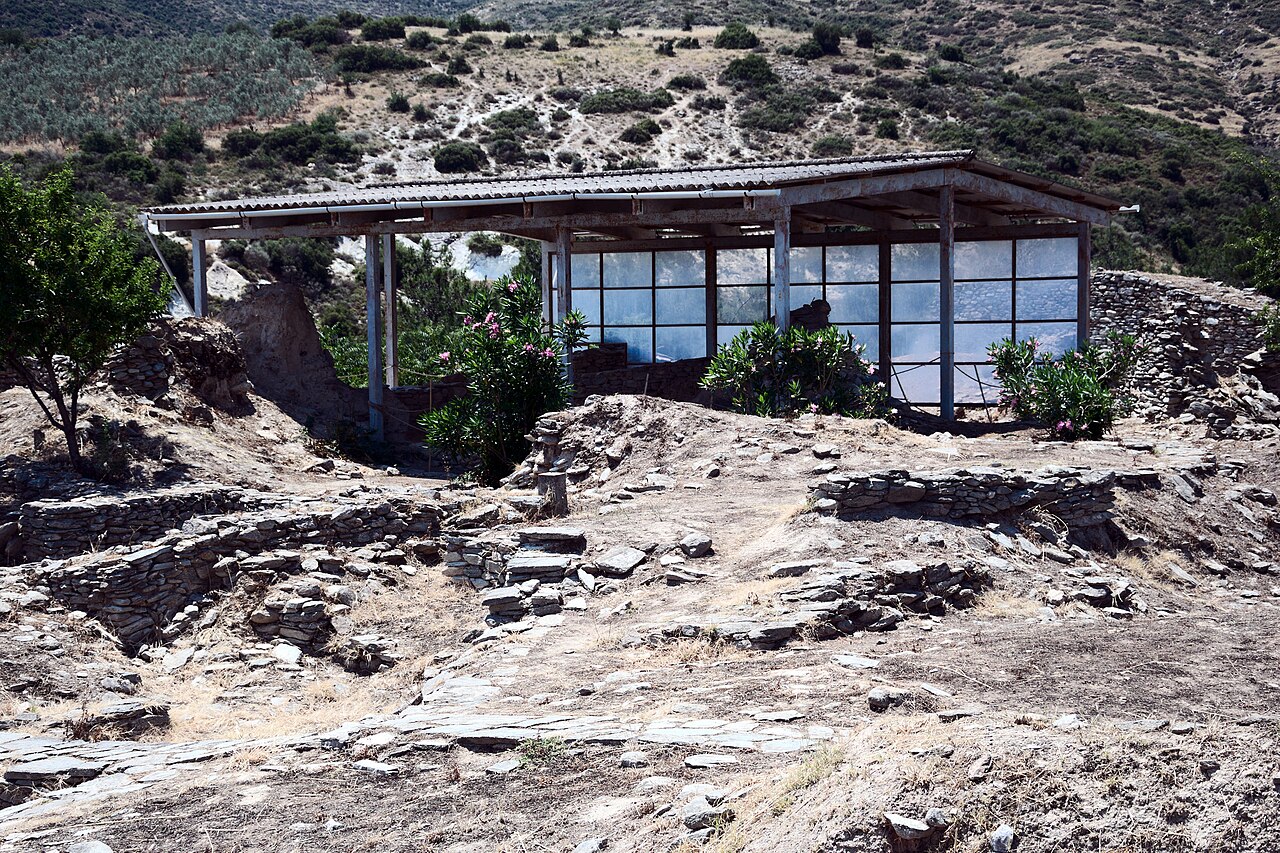
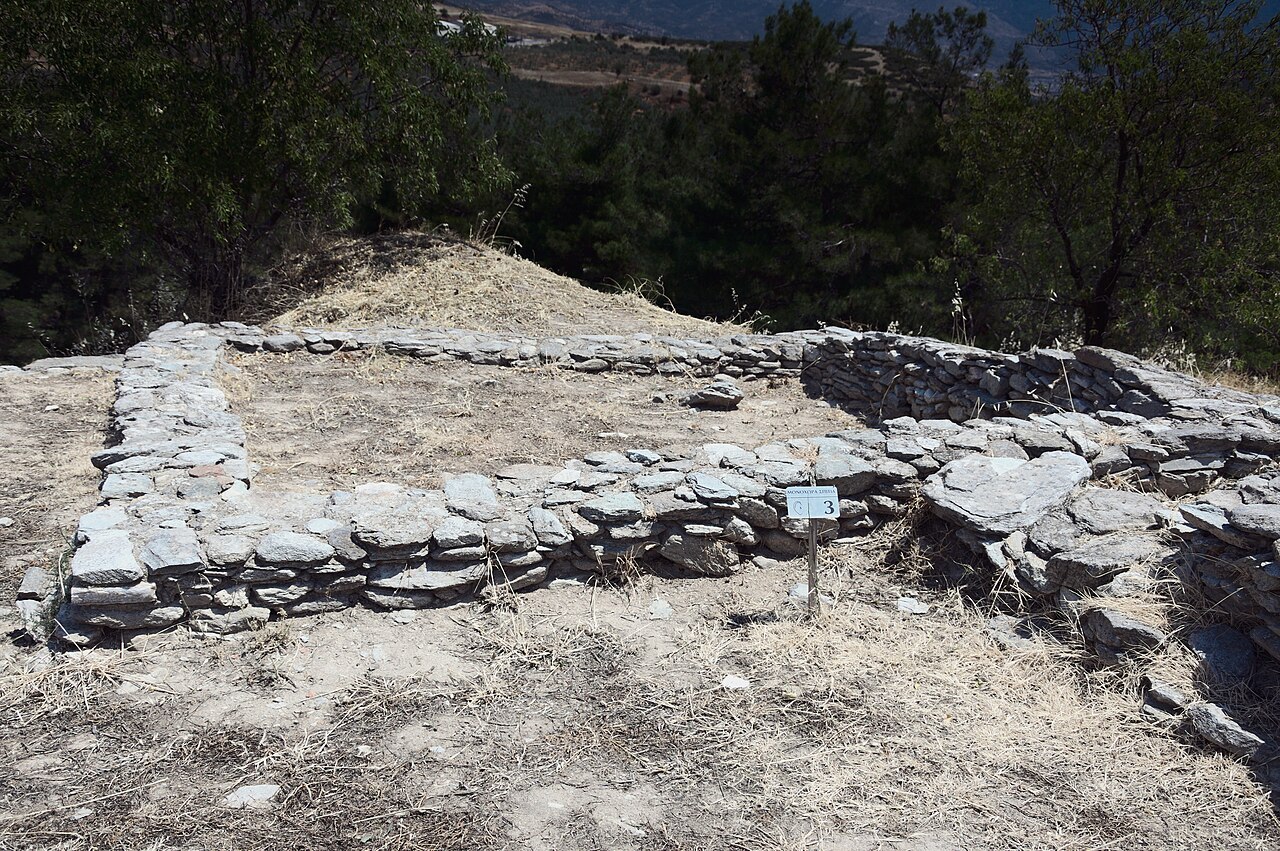
Today the archaeological site of Sesklo is open to visitors, a peaceful expanse of stone foundations traced across the hilltop, with the reconstructed outlines of houses and the great building on the acropolis marking where the community’s heart once beat. It rarely draws the crowds that flock to the Parthenon or Knossos, which is part of its charm. Here the past is quiet, intimate, and unhurried.
To stand among these low walls is to occupy the same ground where, nearly nine thousand years ago, people made the momentous and utterly ordinary decision to stay, to build, and to live together. That decision, repeated across countless hills like this one, is the foundation of everything that came after. Sesklo is where Europe first learned to be neighbors.
For anyone interested in origins, a visit rewards patience and imagination more than spectacle. There are no soaring columns to photograph, only the honest ground plan of a very old town. But that is exactly the point. What Sesklo offers is not grandeur but authenticity, the chance to stand inside the actual outline of one of Europe’s first communities and feel how close together these ancient neighbors truly lived.
The World the First Farmers Walked Into
To understand why Sesklo happened where and when it did, it helps to picture Thessaly in the early Holocene, the warm, stable climatic era that followed the last Ice Age. The retreat of the glaciers had left behind a Europe that was greening rapidly, its river valleys filling with woodland, marsh, and open meadow. Thessaly, ringed by mountains and watered by the Pineios river system, became a natural collecting basin for the fertile soils washing down from the highlands.
Into this landscape came people carrying a revolutionary idea, one that had been slowly maturing for thousands of years in the Near East. Rather than following the herds and the seasons, they would tie themselves to a single patch of ground and coax food from it deliberately. The mild winters and reliable rainfall of the Thessalian plain made it one of the first places in Europe where that gamble could pay off spectacularly, and Sesklo sits at the very center of that agricultural sweet spot.
It is no accident that Thessaly is dotted with dozens of Neolithic mounds, more than almost anywhere else on the continent. The whole region became a kind of laboratory for the new way of living, and Sesklo grew into one of its largest and most enduring experiments. The land itself, generous and forgiving, was a silent partner in the birth of the European village.
That the whole of Thessaly filled with such mounds during this era shows that Sesklo was part of a broader awakening rather than a lone experiment. Communities across the plain were making the same discoveries at roughly the same time, learning together how to store grain, manage herds, and live in permanent villages. Sesklo simply did it on a larger scale and for longer than most, which is why it became the emblem of the entire era.
A Day in the Life of the Village
Imagine waking in a Sesklo house at dawn, the smell of woodsmoke from a clay hearth already thick in the single main room. Outside, the narrow lanes would fill with the sounds of a community stirring: the bleat of goats being driven out to graze, the rhythmic scrape of grinding stones as women turned grain into flour, the sharp knock of a flint blade being resharpened against stone. Everyone had work, and the work was the settlement’s heartbeat.
Much of daily life happened in the open air, in the courtyards and alleys between the houses. Here pots were shaped and set to dry, hides were scraped, and children ran underfoot while elders worked. The rhythm of the day followed the sun and the seasons, and the boundaries between household and community were porous. A neighbor was never more than a few steps away, and the dense packing of the houses meant that Sesklo was, in the truest sense, a society, not just a scatter of families.
By evening, the herds returned, the fires were built up, and the community drew inward for the night. This unremarkable daily cycle, repeated across two thousand years, is precisely what makes Sesklo extraordinary. It is one of the earliest places in Europe where we can reconstruct not just survival, but a settled, textured, thoroughly domestic way of life.
How Sesklo Treated Its Dead
Death at Sesklo was not sequestered far from the living. Excavators have found burials within and among the houses, including the graves of infants and children placed close to the family dwellings. This intimacy with the dead is a recurring feature of the Neolithic across the Aegean and Anatolia, and it speaks to a worldview in which ancestors remained woven into the fabric of the household.
The burials at Sesklo are generally simple, without the lavish grave goods that would later mark the tombs of Bronze Age elites. This relative equality in death mirrors what we see in life: a community of broadly similar households, without the dramatic gulfs of wealth and power that came later. The dead were remembered, honored, and kept near, but they were not yet used to display rank in the way that great burial mounds and gold-filled graves eventually would.
In this quiet treatment of the dead we glimpse the values of an early farming society: continuity, kinship, and belonging to a place. To be buried beneath or beside the family house was to remain part of the settlement forever, a permanent resident of the hill that the living kept slowly building higher.
Nearby in Europe’s Ancient Story
- Fish-Faced Idols on a Roaring River: The Mesolithic Mystery of Lepenski Vir
- A Bulldozer Uncovered the Oldest Gold Ever Found: The Story of the Varna Necropolis
- Sixteen Times Bigger Than Stonehenge and Hiding in Plain Sight: The Story of Avebury
The Town That Started It All
Sesklo endures as a reminder that history’s biggest turning points are not always monumental. Sometimes they look like a cluster of mud-and-stone houses on a low hill, filled with painted pots, grinding stones, and the ordinary business of families choosing to stay put. From that choice grew everything we recognize as settled life.
The next time the word civilization brings to mind marble columns or great pyramids, it is worth remembering the humbler ground where it truly began. On a windswept mound in Thessaly, thousands of years before writing or empire, people built the first European town and, in doing so, quietly changed the future of a continent.
You May Like
Mafra, the Palace a King Built From a Vow


3 thoughts on “The Hill in Thessaly Where Europe First Built a Town: The Story of Sesklo”