High on the slopes of Mount Parnassus, where two great cliffs called the Phaedriades catch the morning light and throw it down across a valley of silver-green olive trees, the ancient Greeks located the center of the world. They believed that Zeus had once released two eagles from opposite ends of the earth and that the birds had met precisely here, at Delphi, marking the spot with a sacred stone called the omphalos, the navel. For more than a thousand years this remote mountain sanctuary was the single most important religious site in the Greek world, home to the oracle of Apollo, whose cryptic pronouncements shaped the decisions of kings, colonists, and ordinary citizens across the Mediterranean.
Delphi was not a city in the ordinary sense. It was a pan-Hellenic sanctuary, a place that belonged to no single state but drew pilgrims and offerings from every corner of the Greek world and beyond. Its priestess, the Pythia, sat in the innermost chamber of the Temple of Apollo and delivered the god’s answers to questions great and small; its treasuries, built by rival cities, overflowed with gold and bronze; its games, second only to the Olympics, gathered athletes every four years. To understand Delphi is to understand how the fractious, competitive, endlessly quarrelling Greek city-states nonetheless recognized a shared spiritual center, and how a single sanctuary on a mountainside could hold a whole civilization’s imagination for a millennium.
Contents
- The Center of the World
- From Earth Goddess to Apollo
- The Pythia and How the Oracle Worked
- Riddles, Warnings, and Famous Prophecies
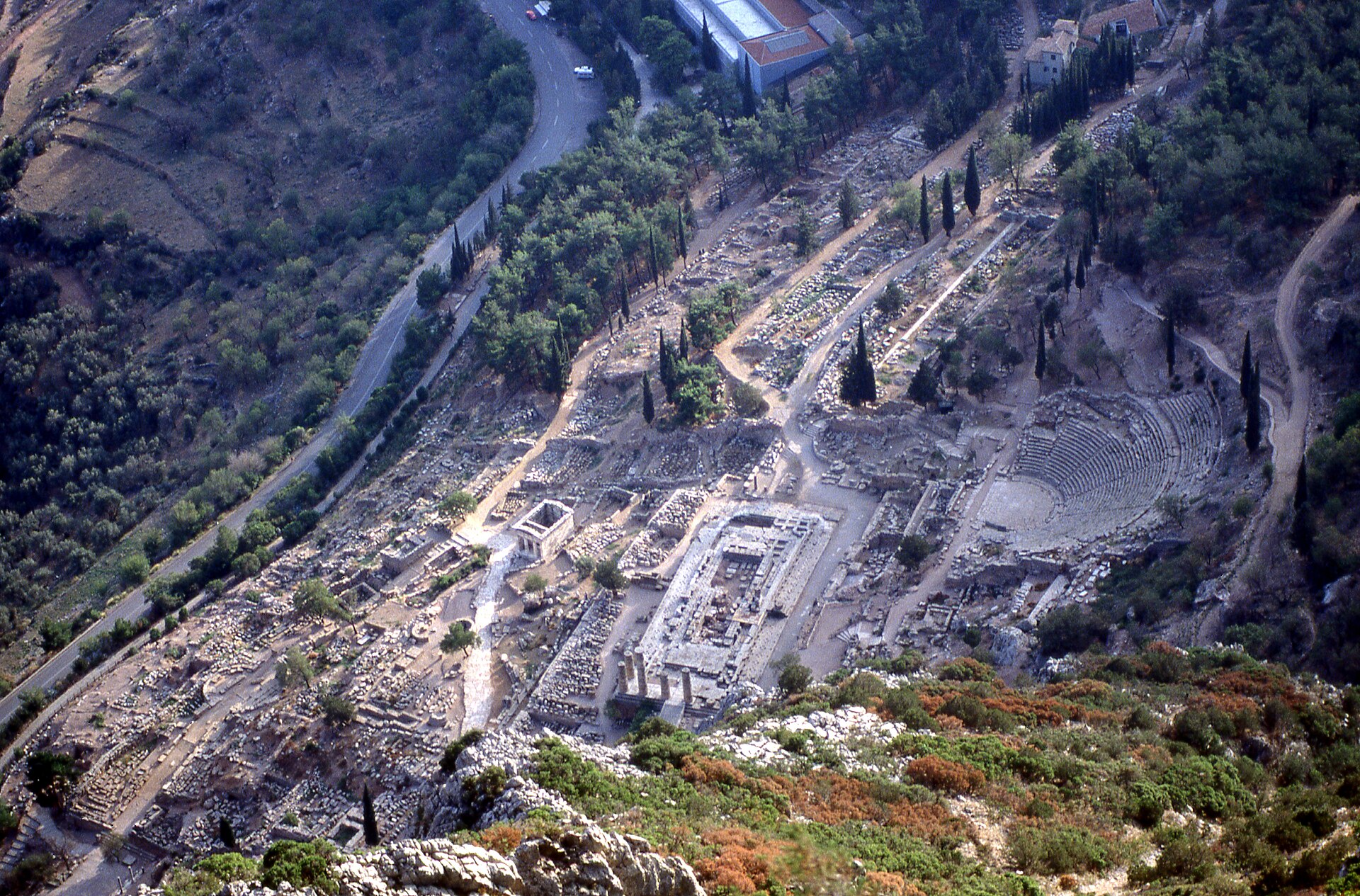
- The Sacred Way and Its Treasuries
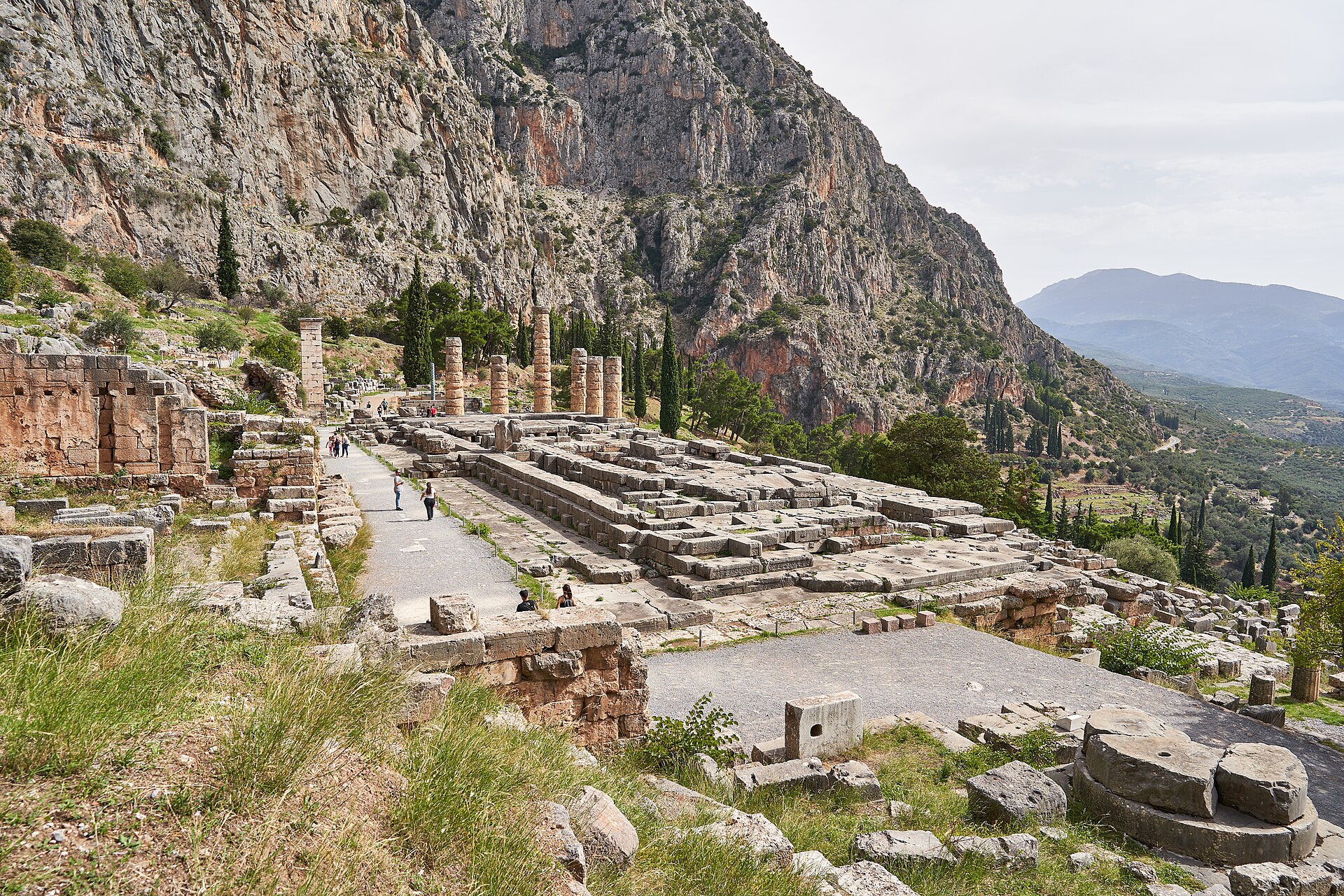
- The Temple of Apollo
- The Pythian Games
- A Museum of the Greek World
- Delphi and the Politics of Greece
- Silence of the Oracle
- Digging Out a Buried Village
- Nearby Places
- Final Word
The Center of the World
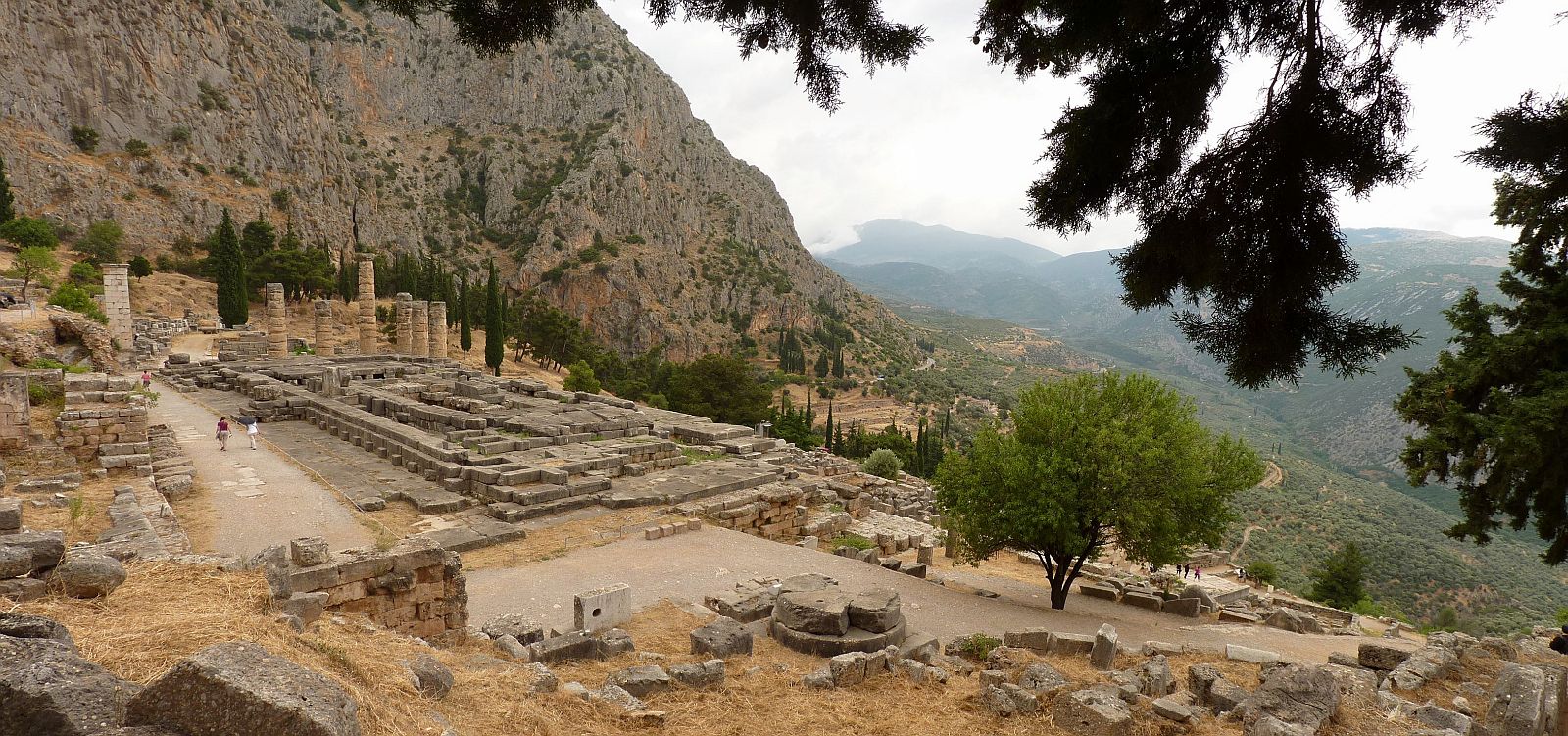
The location of Delphi is inseparable from its meaning. It sits at around six hundred metres above sea level on the southern flank of Parnassus, in a natural amphitheatre of rock that seems built for awe. Behind the sanctuary the twin Phaedriades cliffs rise sheer and pale; below it the ground falls away in terraces toward the deep gorge of the Pleistos and, beyond, to the great olive plain that runs down to the Gulf of Corinth at the little harbor of Kirrha. Springs of cold water emerge from the rock, most famously the Castalian spring, where pilgrims purified themselves before approaching the god.
To the Greek mind this dramatic setting was proof of divine presence. A place so charged with natural power, where cliffs, springs, and mountain met, was naturally where the earth spoke. The omphalos stone that marked the world’s navel stood within the sanctuary, and copies of it survive; it was a rounded, beehive-shaped block, sometimes shown draped with a woven net. Whether or not the eagles of Zeus ever met here, the Greeks needed a center, a fixed point around which their scattered and competitive world could orient itself, and Delphi, neutral, ancient, and breathtaking, was the point they chose.
That neutrality mattered enormously. Because Delphi belonged to no major power, its judgments could be accepted by all. A colony setting out for Sicily, a city debating war, an individual troubled by a private dilemma, all could send to the same oracle and receive an answer that carried authority precisely because it came from nowhere in particular and everywhere at once. The sanctuary was administered by a council of neighboring states, the Amphictyony, and its independence was defended, at least in theory, by the collective interest of the whole Greek world in keeping it free.
From Earth Goddess to Apollo
Delphi was sacred long before Apollo claimed it. The earliest cult here, in the Bronze Age and early Iron Age, seems to have honored earth deities, and Greek myth remembered this older layer even after the sanctuary became Apollo’s. In the traditional story, the site was originally guarded by a monstrous serpent, the Python, offspring of the earth goddess Gaia, who gave oracles from a chasm in the ground. The young god Apollo, arriving from afar, slew the Python and took the sanctuary for himself, and in memory of that combat the games held here were said to have begun, and the priestess herself was called the Pythia.
This myth is doing what myths often do: it records a real historical shift in religious form. An older, chthonic, earth-centered cult was overlaid by the worship of one of the great Olympian gods, and the story of Apollo killing the serpent dramatizes that transition. Apollo was the ideal deity for such a place. God of prophecy, of music and poetry, of healing and of light, of measure and clarity, he embodied exactly the qualities the oracle claimed to offer: knowledge of the future and guidance toward right action. Delphi became his greatest sanctuary, though he was believed to leave it each winter, when the god Dionysus took his place, another echo of the site’s layered, dual religious character.
Archaeology confirms that cult activity at Delphi goes back well into the early Iron Age, with dedications accumulating from around the eighth century BC onward, exactly the period when the Greek world was emerging from its dark age, founding colonies across the Mediterranean, and reaching out for guidance about where to settle. Delphi’s rise as an oracle is bound up with that age of expansion. City after city consulted the god before sending settlers overseas, and the sanctuary grew rich and famous as its advice was sought and, often enough, seen to be vindicated.
The Pythia and How the Oracle Worked
At the heart of Delphi’s fame stood a single woman: the Pythia, the priestess through whom Apollo spoke. She was drawn from the local population, and in the sanctuary’s great days there might be more than one to handle the volume of consultations. On the days when the oracle was open, and it was open only on certain days of the year, a queue of petitioners formed, their order sometimes decided by lot but often by privilege, with cities and important individuals granted the right to jump ahead. Each brought a question and an offering, and preliminary sacrifices were made to determine whether the god was willing to respond at all.
When conditions were right, the Pythia purified herself at the Castalian spring, descended into the innermost chamber of the temple, the adyton, and took her seat on a tripod, the three-legged stool that became the emblem of Delphic prophecy. There, according to ancient accounts, she fell into a trance and uttered the words of the god. Exactly what happened in that chamber has been debated since antiquity. Ancient writers spoke of a vapor rising from a chasm beneath the temple that inspired the priestess, and for a long time modern scholars dismissed this as legend, since early excavations found no chasm. More recent geological study, however, has identified faults beneath the temple and traces of light hydrocarbon gases such as ethylene seeping up through them, offering at least a plausible physical basis for the tradition of intoxicating fumes.
How the Pythia’s utterances reached the petitioner is another old question. In the popular image she raved incoherently and priests translated her babble into polished verse. Many historians now think the reality was less theatrical: the Pythia likely answered questions directly, and the priests helped record and, where necessary, interpret responses. Either way, the answers that entered the historical record are often models of studied ambiguity, capable of being read more than one way, which was itself a kind of insurance. An oracle that could never quite be proven wrong could remain authoritative for a very long time.
Riddles, Warnings, and Famous Prophecies
The most celebrated Delphic prophecies are famous precisely because of their double meanings. When King Croesus of Lydia, fabulously wealthy and contemplating war against the rising power of Persia, asked the oracle what would happen if he attacked, he was told that if he did so he would destroy a great empire. Encouraged, he attacked, and destroyed a great empire, his own. The story, told by Herodotus, became the archetype of the ambiguous oracle, a warning that the god’s words required as much wisdom to interpret as the situation required to resolve.
Before the Persian invasion of 480 BC, the Athenians received an equally famous and frightening response. Told to trust in a wooden wall, they debated fiercely what it meant. Some argued it referred to a thorn hedge around the Acropolis; the statesman Themistocles argued that the wooden wall meant the fleet, and that Athens should stake everything on its ships. His interpretation prevailed, the Athenians evacuated their city and fought at Salamis, and the crushing naval victory that saved Greece seemed to vindicate both Themistocles and the oracle. The episode shows how Delphic ambiguity could function: the god provided a cryptic frame, and human judgment supplied the decisive reading.
Carved on the forecourt of the temple were maxims that distilled the oracle’s deeper message, and two of them became watchwords of Greek thought. Know thyself and Nothing in excess counselled self-knowledge and moderation, the very virtues Apollo embodied. The philosophical tradition seized on these, and Socrates in particular built much of his mission around the Delphic injunction to self-knowledge, prompted, so Plato tells us, by an oracle that had named him the wisest of men, a claim Socrates spent his life trying to understand. Delphi, in this sense, was not only a place of prediction but a place of wisdom, and its influence on Greek ethics ran as deep as its influence on Greek politics.
The Sacred Way and Its Treasuries
A pilgrim approaching the oracle did not walk straight to the temple. Instead they climbed the Sacred Way, a paved path that zigzagged up the steep slope of the sanctuary, and along it they passed a dazzling gauntlet of monuments. Statues, columns, and inscribed dedications crowded the route, gifts from cities and individuals grateful for the god’s favor or eager to display their piety and wealth. And above all there were the treasuries, small but exquisite temple-shaped buildings, each erected by a particular city to house its offerings and to advertise its greatness at the most visited sanctuary in Greece.
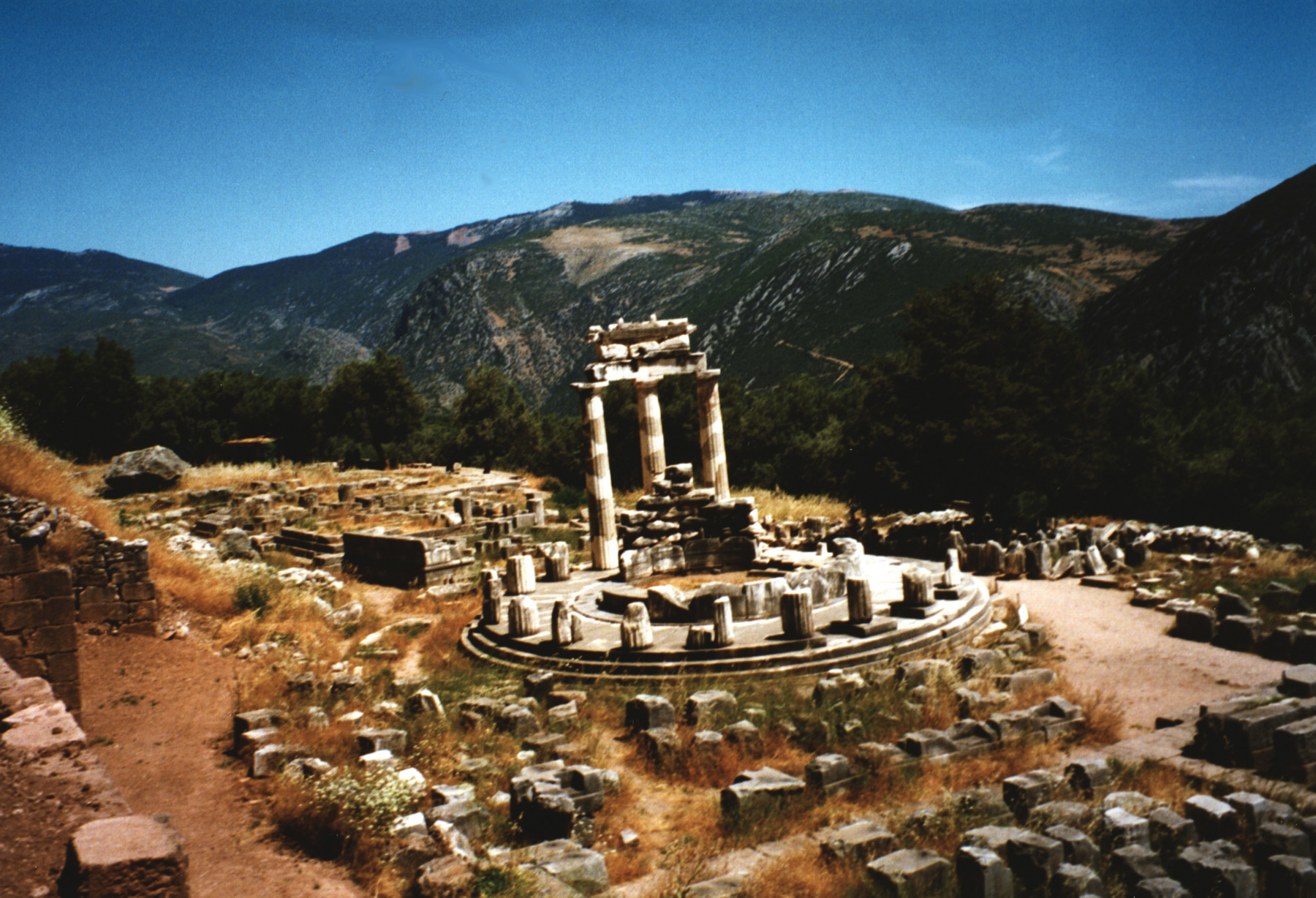
The finest of these to survive is the Treasury of the Athenians, a compact marble building in the Doric style that has been reconstructed from its original blocks. Athens built it in the early fifth century BC, and tradition connected it to the victory at Marathon over the Persians. Its walls were later covered with inscriptions, including hymns to Apollo complete with musical notation, among the earliest surviving examples of written music anywhere. Standing rebuilt on its terrace, it gives a vivid sense of how the treasuries once punctuated the Sacred Way, each a small jewel-box of civic pride competing with its neighbors for the visitor’s admiration.
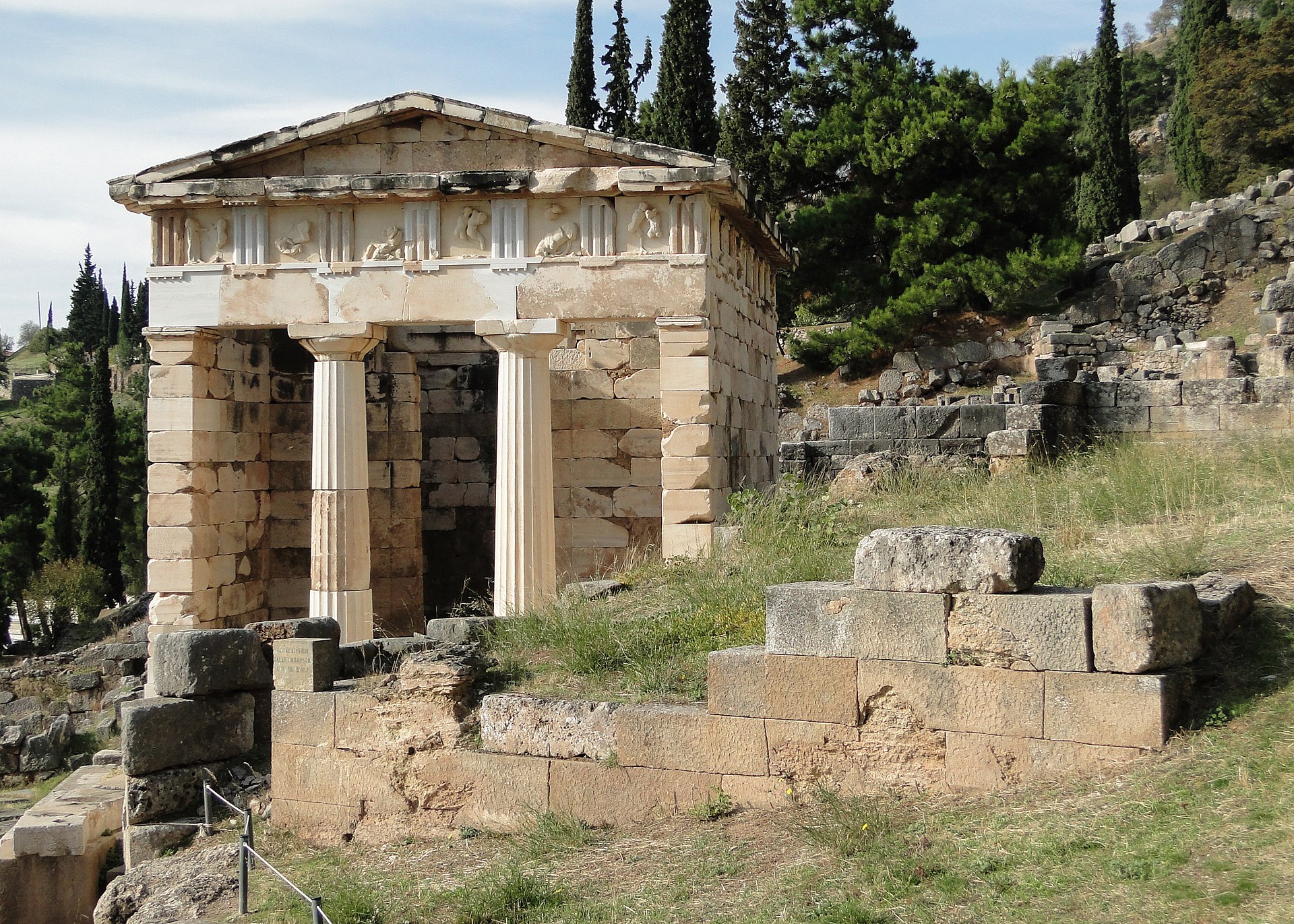
The treasuries turned Delphi into a kind of permanent international exhibition. A visitor moving up the Sacred Way could read the rivalries and alliances of the Greek world in stone: this treasury raised after a victory over that city, this monument dedicated to overshadow a rival’s, this dazzling display of spoils meant to humiliate a defeated enemy. Politics and piety were inseparable here. To give lavishly to Apollo was to honor the god, but it was also to make a statement to every other Greek who would pass by, and cities spent accordingly, filling the sanctuary with the accumulated art and treasure of centuries.
The Temple of Apollo
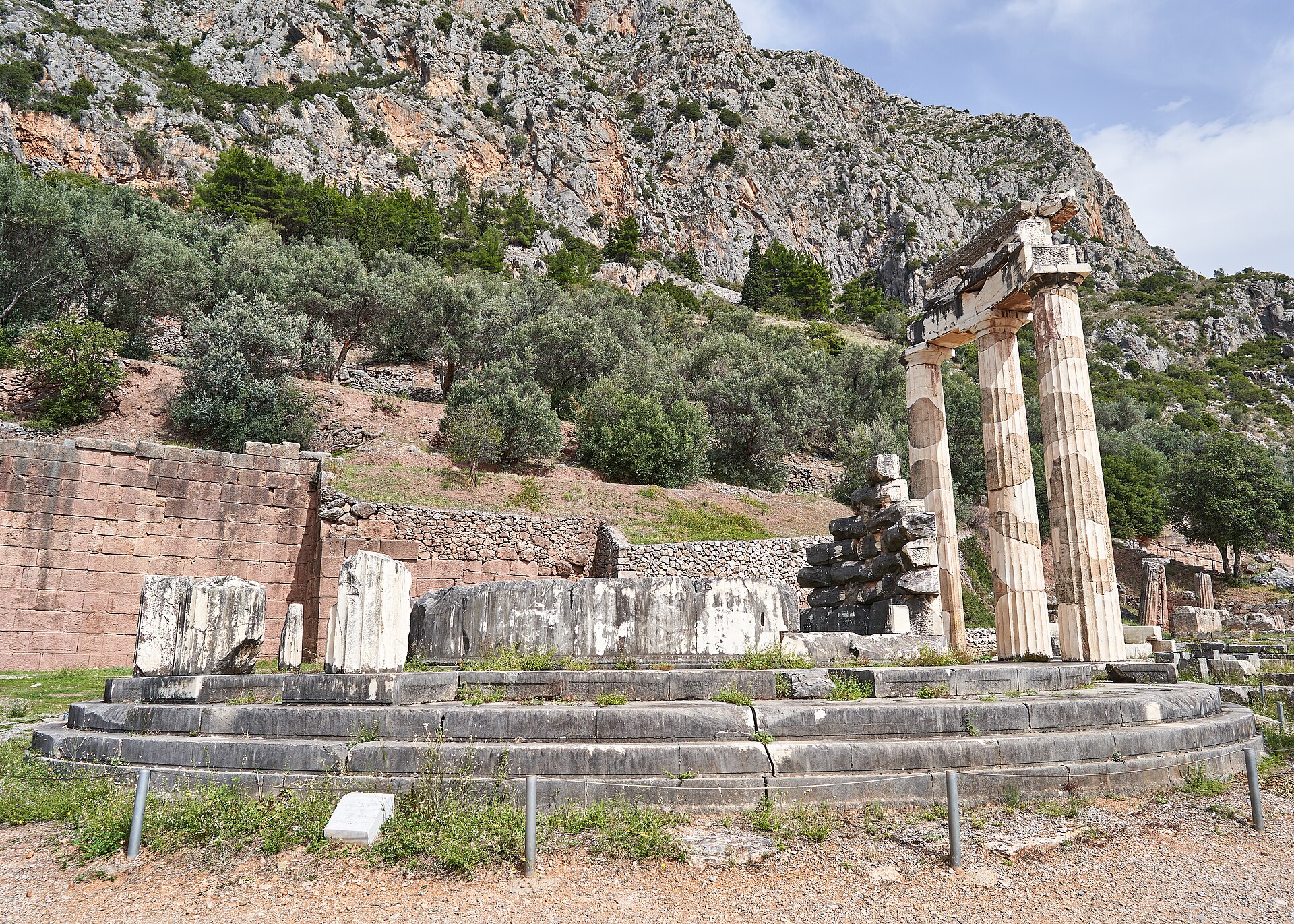
At the top of the Sacred Way stood the goal of every pilgrimage: the Temple of Apollo, the great Doric building that housed the oracle. The temple that visitors see the remains of today, six columns of it re-erected against the mountain backdrop, was the fourth to stand on the spot, rebuilt in the fourth century BC after an earlier temple was destroyed by earthquake. Its predecessors stretched back into the archaic period, each grander than the last, funded by contributions from across the Greek world and, on one famous occasion, by the wealthy Athenian family of the Alcmaeonids, who rebuilt it with a marble facade and won enormous prestige, and Delphic goodwill, in the process.
Inside, the temple held the sacred objects at the core of the cult: the omphalos stone, an image of Apollo, an eternal flame, and, in the adyton below or behind the main chamber, the tripod on which the Pythia sat. The great maxims were inscribed at the entrance, and dedications filled the interior. It was here, in the innermost recess, that the transaction between mortal and god took place, the question posed, the trance entered, the answer given. Everything else at Delphi, the treasuries, the statues, the games, the theatre, radiated outward from this single point where the future was believed to become briefly knowable.
The temple also bore the marks of its own turbulent history. It was damaged by earthquake and by fire more than once, plundered in the fourth century BC during the so-called Sacred Wars, when control of the sanctuary and its treasures became a prize worth fighting for, and its riches were an irresistible temptation to later conquerors. Yet through every disaster it was rebuilt, because the oracle it housed was too important to the Greek world to let fall. Only when the ancient religion itself came to an end did the temple finally fall silent for good.
The Pythian Games
Delphi was not only a place of solemn consultation; every four years it became a place of festival and competition. The Pythian Games, held in honor of Apollo, were one of the four great pan-Hellenic games, ranking just below the Olympics in prestige. Unlike Olympia, which was devoted to athletics, the Pythian Games began as a musical contest, fitting for the sanctuary of the god of music, with competitions in singing to the lyre and playing the aulos, and only later added the athletic and equestrian events that made them a full sporting festival. The prize was a wreath of laurel, sacred to Apollo, worth nothing in itself and everything in honor.
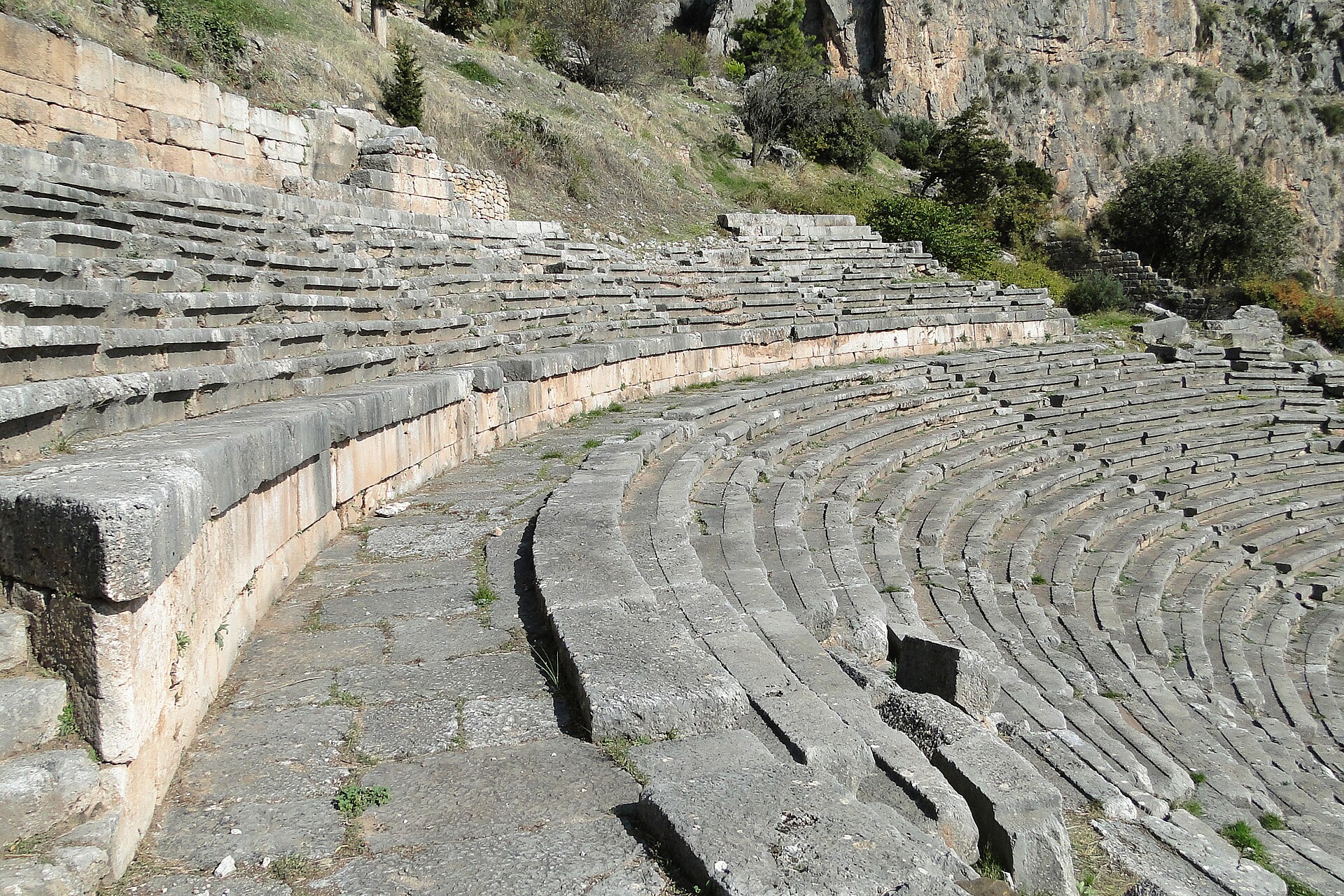
The games drew competitors and spectators from across the Greek world, and during them a sacred truce was proclaimed so that athletes and pilgrims could travel to Delphi in safety even through hostile territory. The athletic events were held in the stadium, cut into the highest terrace of the sanctuary above the temple, where the stone starting line and rows of seating can still be traced. The musical and dramatic contests took place in the theatre, which climbs the slope just above the Temple of Apollo and commands one of the most spectacular views in the ancient world, out over the temple, the treasuries, and the plunging valley beyond.
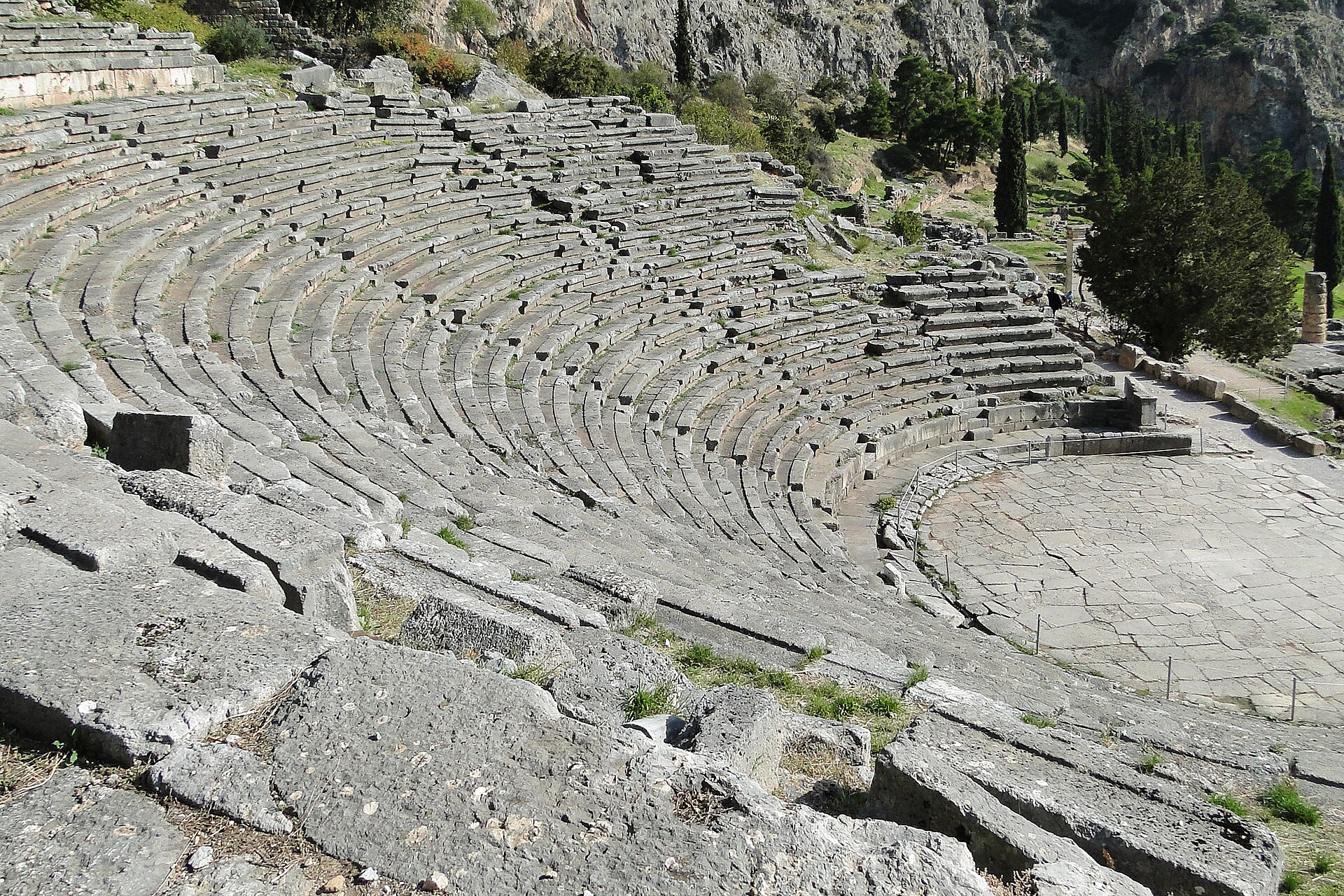
These festivals reveal another dimension of Delphi’s role. Beyond delivering prophecies, the sanctuary was a gathering place, one of the recurring occasions on which the scattered Greeks came together, competed under shared rules, honored the same gods, and were reminded, however briefly, of their common identity. In a world of perpetual inter-city warfare, the pan-Hellenic sanctuaries and their games were among the few institutions that transcended the divisions of the polis, and Delphi, with its oracle, its treasuries, and its games combined, was perhaps the most complete expression of that shared Greek world.
A Museum of the Greek World
Because cities and rulers competed for centuries to dedicate the finest offerings at Delphi, the sanctuary accumulated an unrivalled collection of Greek art, and even after the depredations of antiquity, enough survived in the ground for the site museum to become one of the great treasuries of ancient sculpture. Its most celebrated single object is the Charioteer, a life-size bronze figure cast around 470 BC to commemorate a chariot-racing victory. The rest of the group, the chariot, horses, and grooms, is largely lost, but the charioteer himself survives almost intact, standing calm and upright with the reins in his hand, his inlaid eyes still gazing out with startling presence.
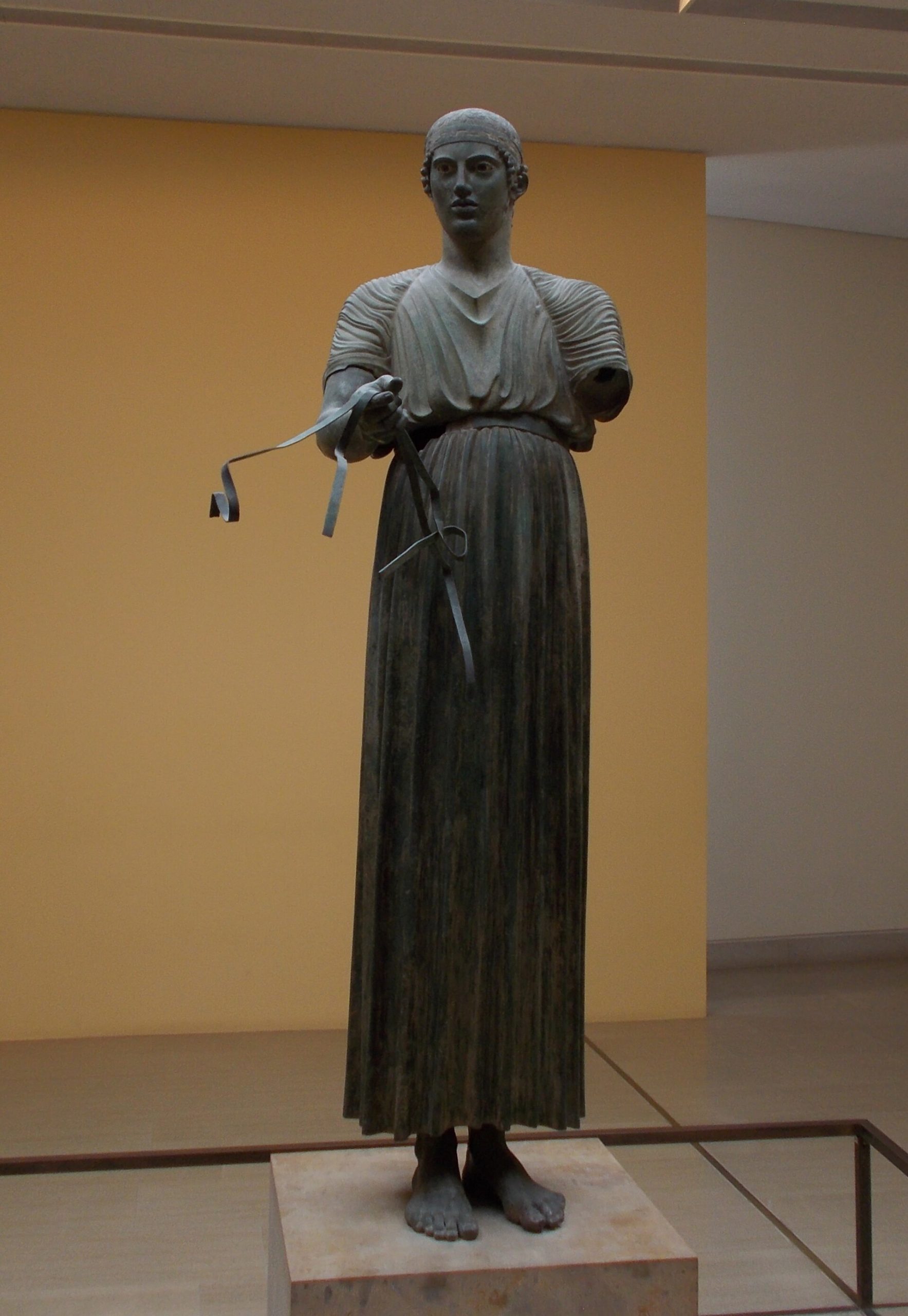
The Charioteer is one of the finest surviving examples of early classical bronze work, a period from which almost no large bronzes survive because most were melted down in later ages for their metal. It escaped that fate only because an earthquake buried it along with much else at Delphi, hiding it until modern excavation. Its serene, disciplined bearing captures exactly the qualities the Greeks associated with Apollo and with Delphi itself: restraint, balance, the mastery of powerful forces held in perfect control.
Around it the museum displays the archaic sculptures that once adorned the treasuries and temples, including the twin statues of two young men long identified with the legendary brothers Kleobis and Biton, whose story of filial devotion Herodotus tells. There are fragments of the sculptural friezes from the treasuries, the strange rounded omphalos stones that symbolized the world’s navel, and countless smaller dedications in bronze and precious metal. Together they make the museum a compressed history of Greek art, drawn from every region and every century of the sanctuary’s long life, all of it once given to Apollo in hope of his favor or thanks for it.
Delphi and the Politics of Greece
For all its aura of otherworldly wisdom, Delphi was a deeply political place, and its history is inseparable from the power struggles of the Greek world. Because the oracle’s word carried such weight, controlling or influencing it was immensely valuable, and cities courted the sanctuary with gifts, sought privileged access, and sometimes accused rivals of manipulating the Pythia. The oracle’s recorded pronouncements often align suspiciously well with the interests of whoever was in favor at the time, and its counsel before the Persian invasion struck many Greeks as defeatist, leading to later suspicions that Delphi had leaned toward accommodation with Persia.
The sanctuary’s wealth and prestige also made it a direct object of conflict. Control of Delphi and its administering council was contested in a series of Sacred Wars over the centuries, conflicts fought ostensibly over sacrilege or the sanctuary’s independence but really over the power and treasure that came with dominating it. In one of these, in the fourth century BC, the Phocians seized the sanctuary and melted down its treasures to pay mercenaries, an act of sacrilege that horrified the Greek world and drew in outside powers. It was through intervention in these Delphic quarrels that Philip II of Macedon first gained a foothold in the affairs of central Greece, a foothold that helped his family toward the eventual domination of the whole peninsula.
So Delphi was never simply a neutral voice from the mountain. It was an institution embedded in the real world of alliances, rivalries, and ambitions, and its influence flowed both ways: it shaped Greek politics through its prophecies, and Greek politics shaped it through gifts, pressure, and force. Understanding this does not diminish the sanctuary; it makes it more human, and more revealing, as a mirror of the civilization that created it and could not do without it.
Silence of the Oracle
Delphi’s decline came slowly, then decisively. Under Roman rule the sanctuary remained honored, and emperors from Augustus onward took an interest in it, but its greatest days were behind it. The Roman general Sulla plundered it to fund his wars; the emperor Nero, according to a much-repeated story, carried off hundreds of statues. The oracle still functioned, and cultivated Romans still consulted it, but the political weight it had carried in the age of the independent city-states could not survive in a world ruled from Rome. By the first and second centuries AD, visitors were already remarking on how much quieter and poorer Delphi had become than in its legendary prime.
The philosopher and priest Plutarch, who served at Delphi in the late first and early second centuries AD, wrote thoughtfully about why the oracles had fallen silent, or grown fainter, weighing explanations from the departure of the inspiring spirits to the simple decline in population and consultation. His essays are among our best sources for how the sanctuary worked, written by a man who loved it and watched its diminishment with melancholy. The oracle was fading, but the questions it had answered, and the wisdom it had counselled, still mattered to a thinker like Plutarch.
The final blow came with the triumph of Christianity. As the new faith became the religion of the empire in the fourth century AD, the old sanctuaries were suppressed. The oracle at Delphi, which had spoken for over a thousand years, was silenced by imperial order, and a tradition, perhaps legendary, holds that its last prophecy announced its own end, telling the emperor that Apollo no longer had a home, no prophetic laurel, no speaking spring. Whether or not those words were ever spoken, they capture the moment well. The center of the world went quiet, and the sanctuary began its long slide into ruin and oblivion.
Digging Out a Buried Village
For centuries the memory of Delphi survived, but the place itself vanished under the ordinary business of life. A village called Kastri grew up directly on top of the ancient sanctuary, its houses built among and over the ruins, its inhabitants ploughing fields where treasuries had stood and reusing ancient blocks in their walls. Early modern travellers who came searching for the famous oracle found a Greek mountain village and had to imagine the sanctuary beneath their feet. To excavate Delphi at all, the entire village would first have to be moved.
That is exactly what happened at the end of the nineteenth century. A French archaeological team, having negotiated the relocation of the villagers to a new settlement nearby, began the great excavation known as the Grande Fouille, the Great Dig, in 1892. Over the following years they cleared away the overburden of centuries and brought the sanctuary back into the light: the Sacred Way, the treasuries, the Temple of Apollo, the theatre and stadium, and, in a thrilling moment in 1896, the buried bronze Charioteer. The French School at Athens has continued to work at Delphi ever since, and the site they revealed is one of the most complete and evocative sanctuaries anywhere in the ancient world.
Today Delphi is a UNESCO World Heritage site, and visiting it remains an experience unlike any other classical ruin. The setting does much of the work: to climb the Sacred Way with the Phaedriades towering overhead and the valley of olives falling away below is to feel, even now, why the Greeks thought a god might speak here. The reconstructed Treasury of the Athenians, the columns of the temple, the theatre and stadium high above, and the serene Charioteer in the museum together let a visitor reassemble, in imagination, the sanctuary that once held the whole Greek world in its spell.
Nearby Places
- Mycenae: The Golden Citadel of Agamemnon
- Knossos: The 4,000-Year-Old Palace Behind the Myth of the Minotaur
- Sesklo: The Hill in Thessaly Where Europe First Built a Town
Final Word
For more than a thousand years, Delphi was where the Greek world went to ask its most important questions. On a mountainside believed to be the navel of the earth, the priestess of Apollo delivered answers that founded colonies, decided wars, and shaped the self-understanding of an entire civilization, while the cities of Greece filled the sanctuary with the finest art they could offer and competed on its slopes for glory in games and treasuries alike. The oracle fell silent long ago, and a village rose over its ruins, but the sanctuary the archaeologists uncovered still commands the same breathtaking setting, and the maxims carved at its temple, to know oneself and to keep to moderation, still speak. Delphi endures as the place where the ancient Greeks came closest to hearing the voice of their gods, and where they left behind, in stone and bronze, a lasting portrait of what they most valued.
You May Like
Mafra, the Palace a King Built From a Vow


2 thoughts on “Delphi: The Mountain Sanctuary of the Ancient Greek Oracle”