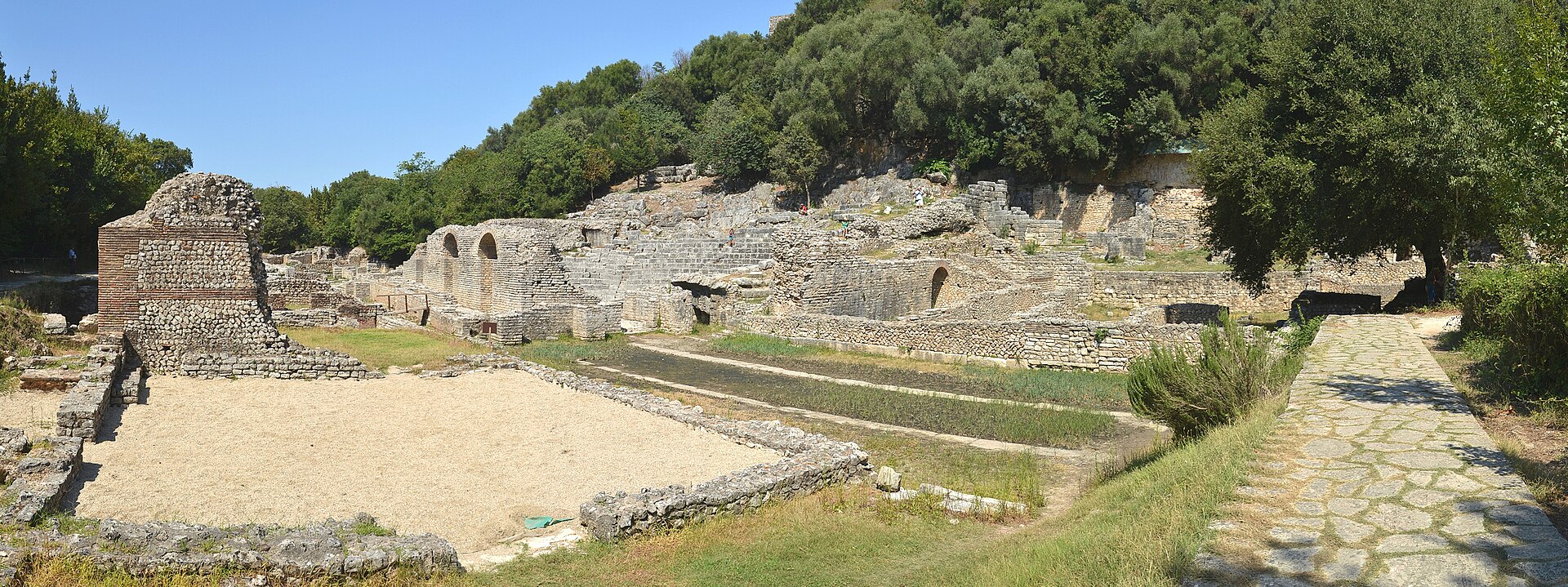
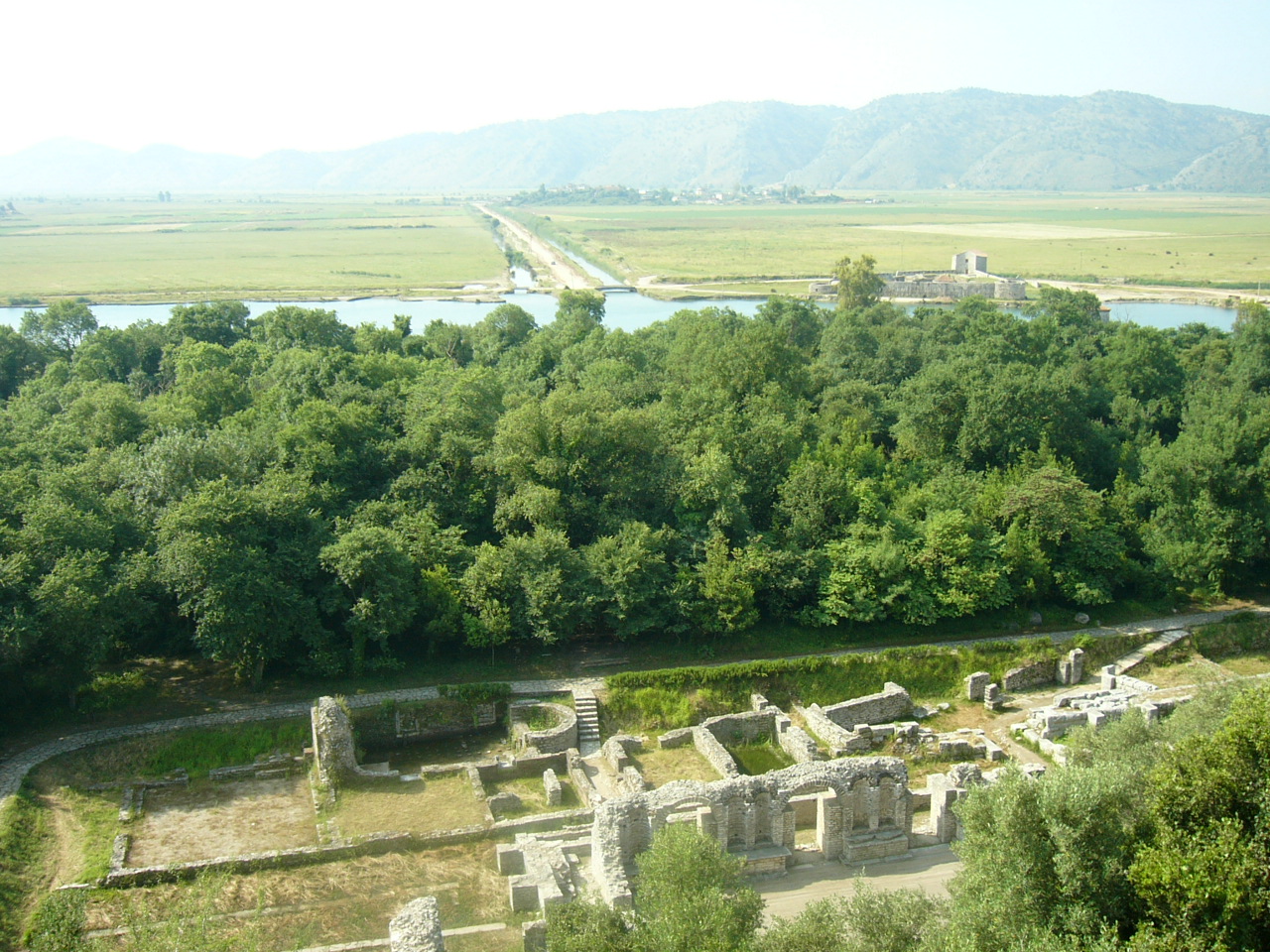
In the far south of Albania, on a wooded peninsula between a shining lagoon and the channel that separates the mainland from the Greek island of Corfu, lie the ruins of a city that lived for more than two thousand years and then, quietly, died. Butrint was a Greek colony, a Roman town, an early Christian bishopric, a Byzantine stronghold, and a Venetian outpost in turn, and each of these worlds left its mark upon the same small hill. Its theatre, its baptistery mosaic, its great gates and walls, and its baths and churches lie layered together in one of the most beautiful archaeological landscapes in Europe, wrapped in forest and mirrored in still water.
Few sites anywhere compress so much history into so small and lovely a space. Butrint is not famous for a single spectacular monument but for the extraordinary depth and continuity of its story, a place where you can walk from a Greek sanctuary to a Roman forum to an early Christian church to a medieval castle within a few minutes, reading in the stones the whole long passage of Mediterranean civilization from the age of Greek colonization to the threshold of the modern world. Abandoned at last to the marsh and the forest, it survived as a hauntingly complete ruin, and today it is Albania’s most celebrated ancient site and a UNESCO World Heritage treasure.
Contents
- A City Between Lagoon and Sea
- A Foundation Legend Out of Troy
- The Greek Town and Its Healing God
- Butrint Under Rome
- The Theatre and the Heart of the City
- Bishops, Basilicas, and the Baptistery
- Byzantine Walls and Shifting Powers
- Venetians on the Frontier
- Marsh, Malaria, and Abandonment
- The Italian Excavations and After
- Butrint Today
- Nearby Places
- Final Word
A City Between Lagoon and Sea
The location of Butrint explains almost everything about its long life. It stands on a low, wooded hill on a peninsula surrounded by water, with the large Lake Butrint, really a coastal lagoon, on one side, and the narrow Vivari Channel, which links the lake to the sea, running past its foot. Just across the water lies the strait separating the mainland from Corfu, one of the most important maritime passages of the region. This was a position of great natural strength and strategic value: defensible, well-watered, rich in fish and fertile land, and commanding a key point on the sea routes between the Adriatic and the Ionian, between Italy and Greece.
For a city dependent on trade and vulnerable to attack, such a site was ideal. The surrounding water gave protection and sustenance; the channel gave access to the sea; and the position astride important routes gave the city commercial and military importance far beyond its modest size. Whoever controlled Butrint controlled a strategic node in the geography of the region, which is why so many powers, Greek, Roman, Byzantine, and Venetian, valued and fought over it across the centuries. The same qualities that made it desirable also made it enduring, allowing the city to recover and adapt through repeated changes of ruler and fortune.
But the watery setting that gave Butrint life would, in the end, also contribute to its death. The lagoons and marshes that fed and protected the city could turn unhealthy, breeding the malaria that plagued so many low-lying Mediterranean coastlands, and over the centuries the environment shifted in ways that undermined the settlement. The relationship between Butrint and its surrounding waters is thus the central thread of its whole history, the source of its long prosperity and, ultimately, of its abandonment. Today that same landscape of water, forest, and ruin is what gives the site its extraordinary beauty.
A Foundation Legend Out of Troy
Like many ancient cities, Butrint claimed a foundation legend that reached back to the heroic age, and its story tied it to the great cycle of myths surrounding the fall of Troy. According to the tradition, preserved most famously in the Roman poet Virgil’s Aeneid, the city was founded by Trojan refugees fleeing the destruction of their homeland. The Trojan seer Helenus, a son of King Priam, and Andromache, the widow of the great Trojan hero Hector, were said to have settled here and built a new city modeled on lost Troy, complete with a miniature version of its features.
In Virgil’s telling, the hero Aeneas, himself a Trojan refugee wandering the Mediterranean on his way to Italy, stops at this city and is amazed to find his fellow exiles recreating their homeland in miniature, a little Troy with its own small version of the river and gates of the original. The episode is one of the memorable moments of the Aeneid, a poignant meditation on exile, memory, and the longing to recreate a lost home. Whether or not it reflects any real tradition about the city’s origins, it gave Butrint a prestigious mythological pedigree, linking it to the Trojan legends that both Greeks and Romans held dear.
This legendary connection to Troy was more than a charming story; it was a claim to status and antiquity that mattered in the ancient world, where cities prized descent from the heroes of myth. It linked Butrint to the same Trojan foundation legend that Rome itself claimed through Aeneas, creating a kind of kinship between the small Adriatic city and the great imperial capital. The archaeological reality of the city’s origins is more prosaic, a Greek colonial foundation, but the myth of the Trojan settlers gave Butrint a place in the grand narrative of the classical world and a romantic aura it has never quite lost.
The Greek Town and Its Healing God
Behind the myth lies the historical reality that Butrint began as a Greek settlement. In the archaic and classical periods, the region was settled by Greeks, and Butrint developed as a Greek town within the sphere of the nearby powers of the area, closely connected to the Greek world of Epirus and to the great island city of Corfu across the water. By the classical and Hellenistic periods it was a walled town with the institutions of a Greek community, and the earliest of its surviving monuments belong to this Greek phase, including stretches of its fortifications and the beginnings of its most important sanctuary.
That sanctuary was dedicated to Asklepios, the Greek god of healing, and it became the religious and economic heart of the Greek town. Like other sanctuaries of Asklepios across the Greek world, it drew people seeking cures, and the offerings and fees they brought enriched the community. The sanctuary was closely associated with the theatre, which was built beside it, for the two often went together in Greek religious life, drama and healing both falling under the patronage of the gods. The wealth generated by the cult of Asklepios helped fund the public buildings of the town, and inscriptions record the sanctuary’s role in the city’s affairs.
The public center of the Greek town included an agora, the open square that was the focus of civic and commercial life, surrounded by public buildings and monuments. The remains of these structures, along with inscriptions recording the freeing of slaves and other public acts, give us a picture of a functioning Greek community managing its affairs in the accustomed way. The Greek Butrint was not a great metropolis but a prosperous provincial town, its life organized around its sanctuary, its theatre, its agora, and its walls, and living by agriculture, fishing, and the trade that flowed past it on the sea routes it commanded.
Butrint Under Rome
As Rome extended its power across the Mediterranean, Butrint, like the rest of the region, came under Roman control, and it entered a new and prosperous chapter. In the first century BC the town became a Roman colony, settled with Roman colonists, and it was favored by powerful Roman patrons. It was drawn into the great events of the late Republic, and later, under the emperors, it flourished as a comfortable provincial town, acquiring the full range of Roman public amenities. Much of what visitors see at Butrint today dates from this Roman era, when the town was rebuilt and expanded in the Roman manner.
The Romans endowed Butrint with baths, an aqueduct to bring water to the town, a forum, temples, fine houses, and other public buildings, transforming the Greek town into a Roman one. The remains of the Roman baths, with their characteristic heated rooms, can still be seen, as can traces of the town’s water supply and civic buildings. Wealthy Romans built villas in and around the town, some of them richly decorated, and the region became a pleasant and prosperous corner of the empire, its mild climate and beautiful setting attractive to the Roman elite much as the Bay of Naples was.
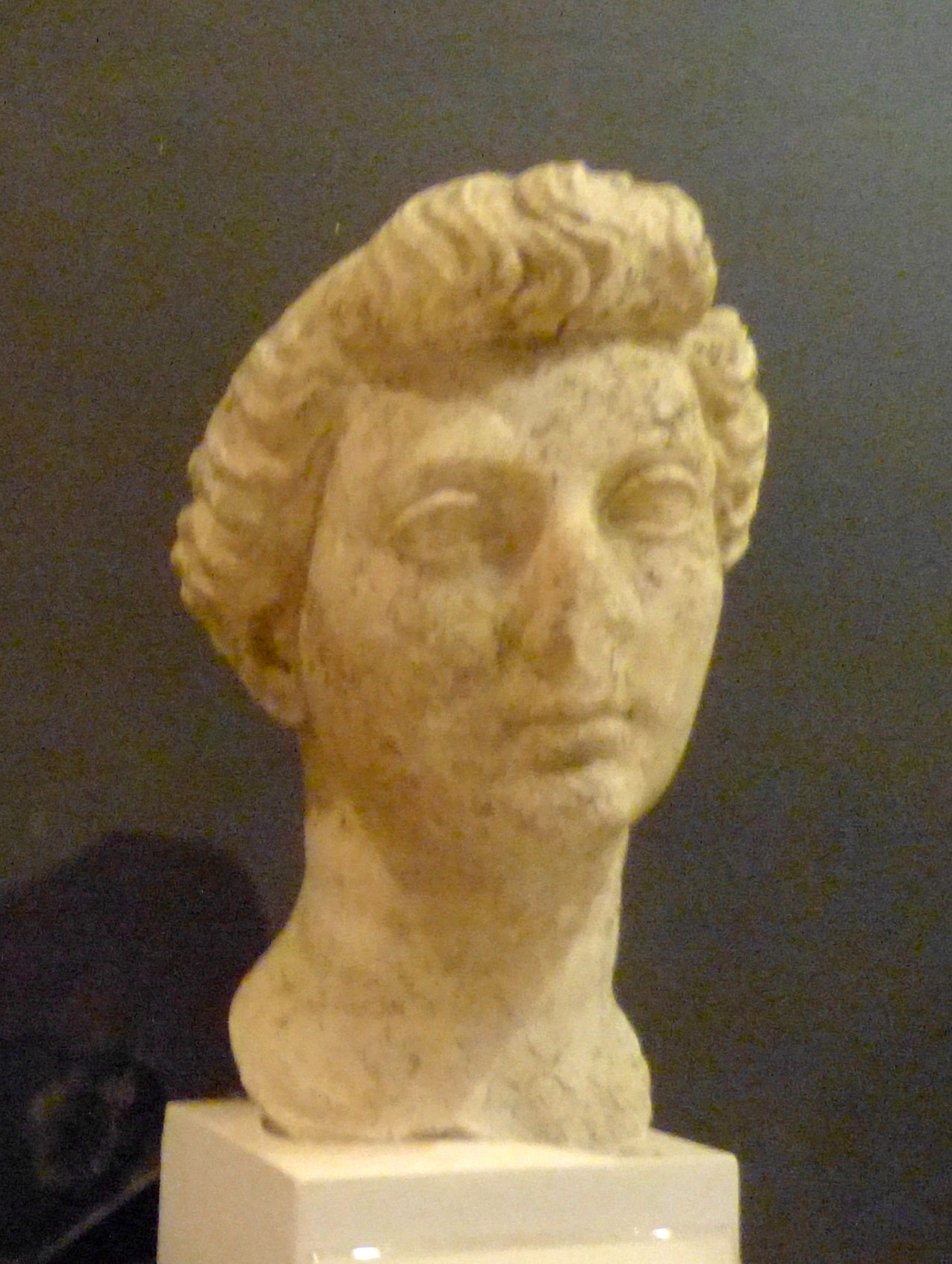
Butrint’s Roman period also produced some of the finest sculpture found at the site, including portraits and statues that testify to the town’s connections and prosperity. Among the notable finds is a fine statue associated with the imperial family, reflecting the town’s loyalty to and favor from the ruling dynasty. These sculptures, now among the treasures of the site’s collections, show that Roman Butrint was a place of some cultural refinement, plugged into the artistic currents of the empire, and not a mere provincial backwater. Under Rome, the small Greek town reached a new height of comfort and prosperity that would carry it into late antiquity.
The Theatre and the Heart of the City
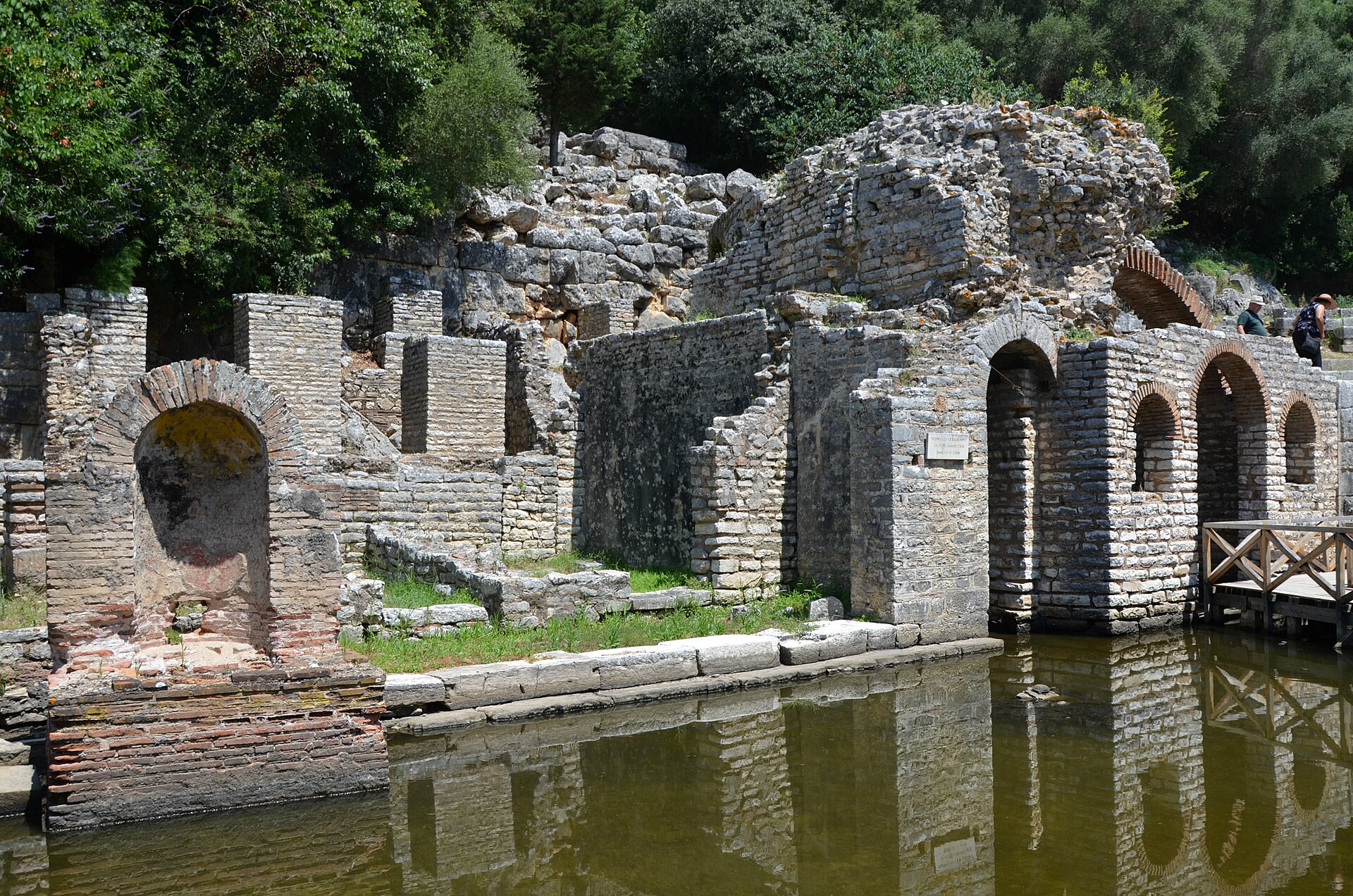
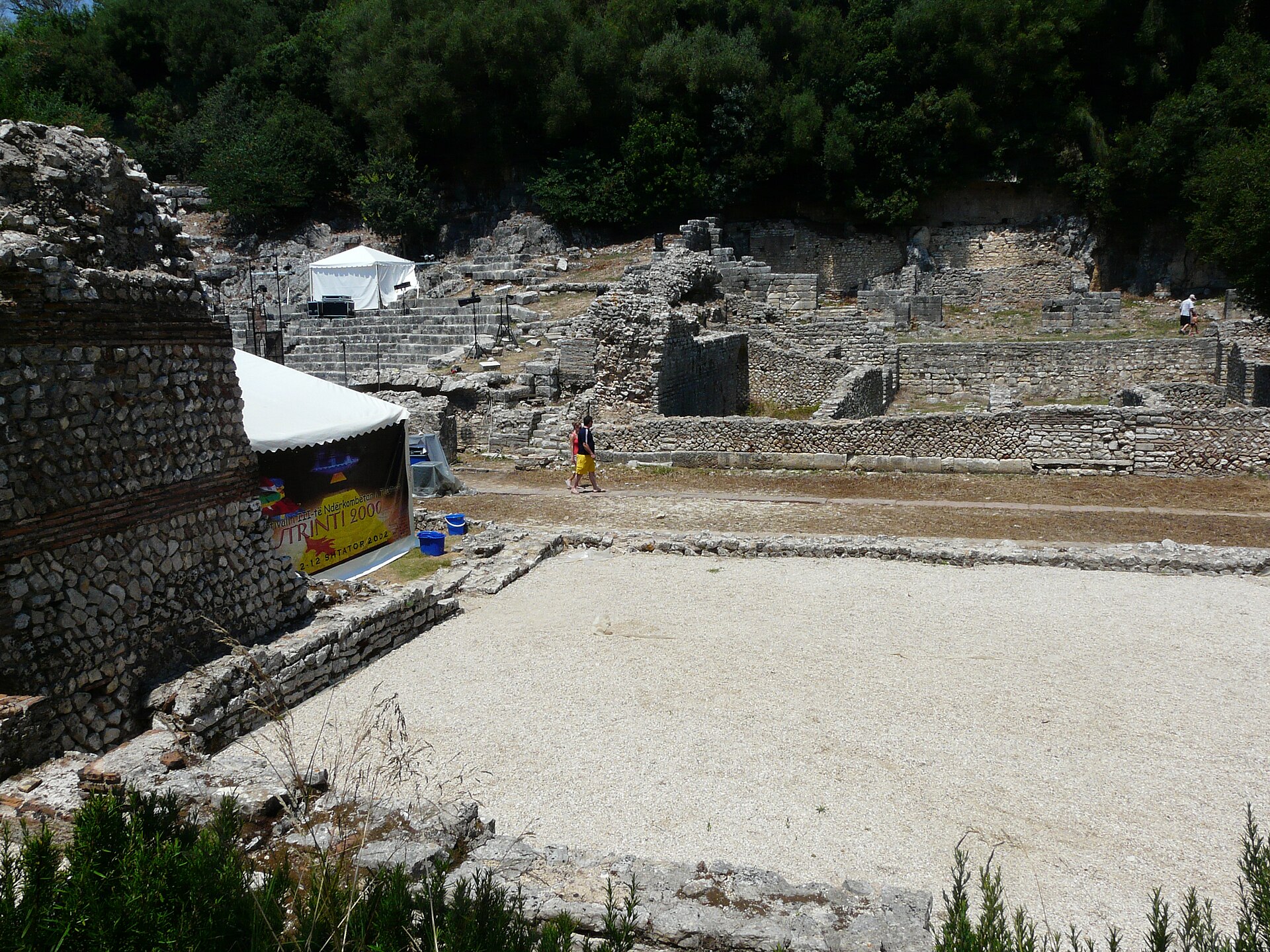
One of the most evocative monuments at Butrint is its theatre, which lies at the foot of the acropolis hill beside the sanctuary of Asklepios. Originally built in the Greek period, it was later modified and enlarged under the Romans, and it survives in a remarkably complete state, its curved rows of stone seating rising in a graceful sweep against the hillside. For much of its later history the theatre lay partly submerged, its lower seats standing in water that collected in the hollow, which gave it a peculiarly romantic aspect and helped preserve it, and it remains one of the enduring images of the site.
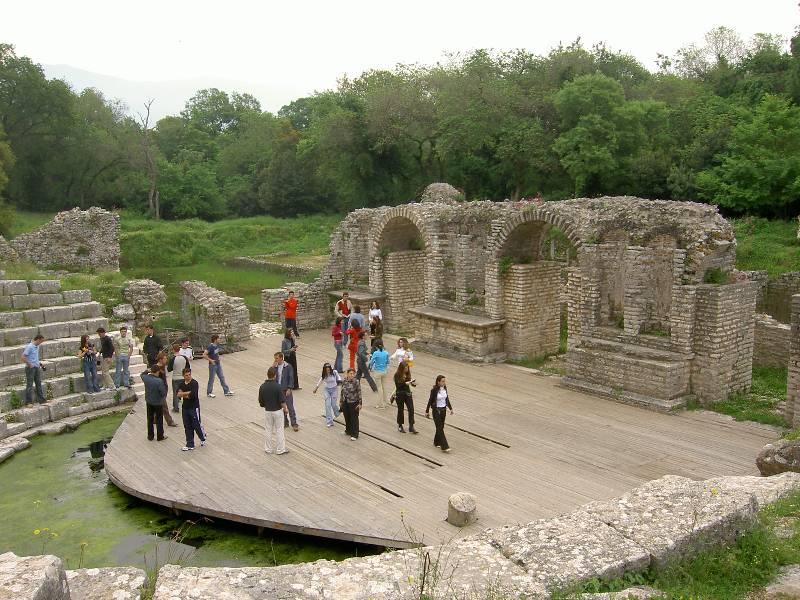
The close association of the theatre with the sanctuary of Asklepios reflects the intertwining of religion and public entertainment in the ancient world. Dramatic performances were part of religious festivals, and the theatre served not only for plays but for public assemblies and civic ceremonies. Inscriptions carved on its walls and nearby, recording public acts such as the manumission, or freeing, of slaves, show that the theatre was a place of civic as well as cultural importance, a focal point where the community gathered for many purposes. These inscriptions are a valuable source for the social history of the ancient town.
Standing in the theatre today, with the wooded acropolis rising behind and the ruins of the sanctuary and later buildings all around, one feels the layered depth of Butrint’s history very directly. Greek and Roman, sacred and civic, the theatre gathers many strands of the city’s story into a single beautiful space. It is the kind of monument that makes the ancient world feel immediate and human: a place where real people once sat, watched, gathered, and took part in the shared life of their city, in a setting whose beauty two thousand years have not diminished.
Bishops, Basilicas, and the Baptistery
As the Roman Empire became Christian in late antiquity, Butrint became an important center of the new religion, the seat of a bishop and a place of considerable ecclesiastical significance. The town was endowed with churches, and the remains of several early Christian basilicas can be seen among its ruins, testifying to its role as a Christian center in the fifth and sixth centuries AD. This late antique and early Byzantine phase was another period of prosperity and building at Butrint, when the town, though the classical world around it was changing profoundly, remained a lively and significant place.
The greatest monument of Christian Butrint is its baptistery, one of the finest early Christian buildings of its kind in the region. Circular in plan, it was built to house the ceremony of baptism, with a font at its center where converts were received into the faith, and its floor is covered with a magnificent mosaic. This mosaic, laid in rings around the central font, is decorated with a rich array of images: birds, animals, plants, and geometric and symbolic designs, arranged in concentric circles of great beauty and skill. It is one of the treasures of Butrint and among the most important early Christian mosaics in the area.
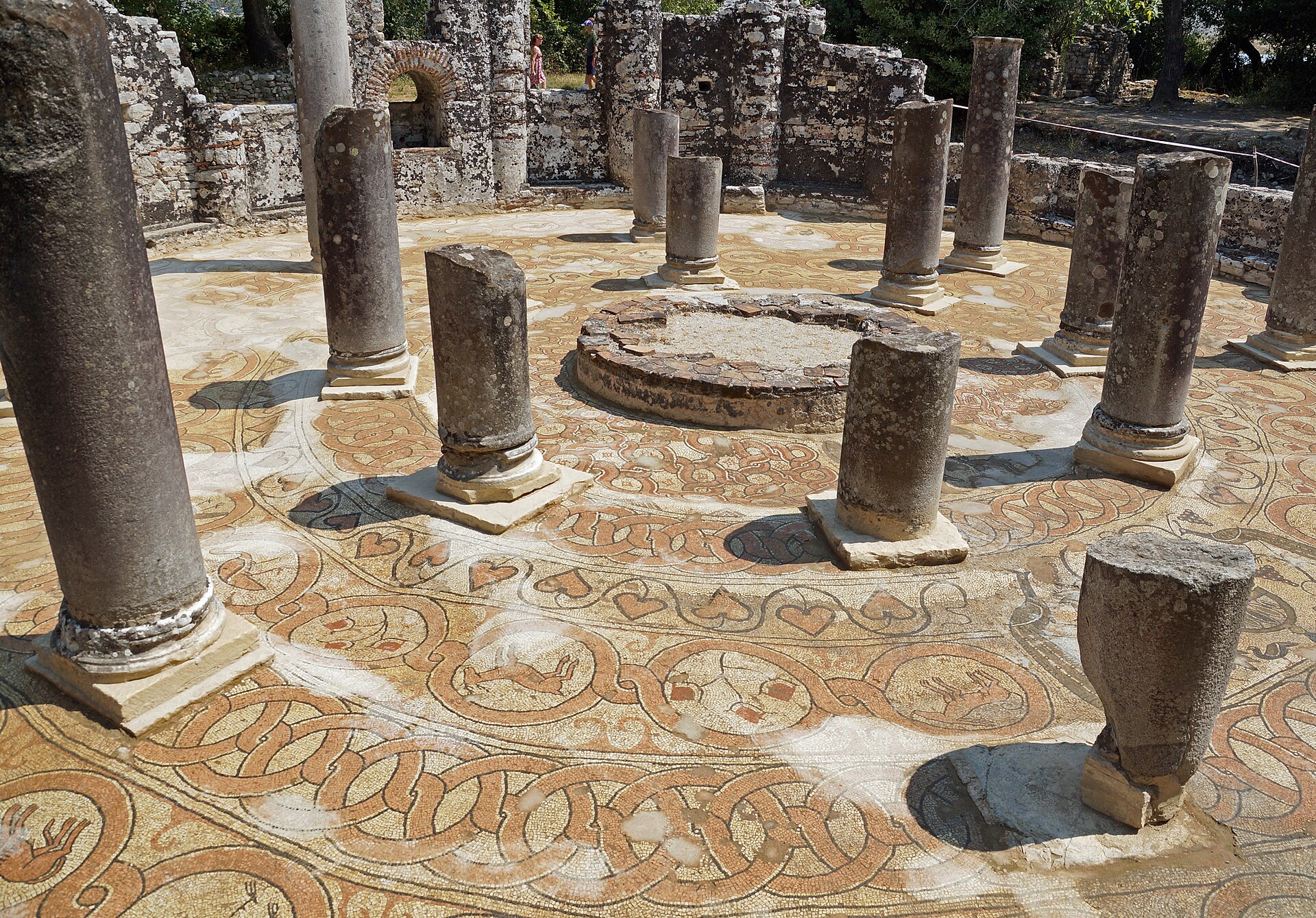
To protect this precious mosaic from damage, it is usually kept covered with a layer of protective sand and revealed only on special occasions, so that most visitors see it not directly but through photographs and reproductions. Its concealment is itself a testament to its fragility and value. The baptistery and the basilicas of Butrint mark the town’s transformation into a Christian city and its continued importance in the early Byzantine world, when the Mediterranean was passing from antiquity into the Middle Ages. Butrint carried its long life across this great divide, adapting once again, as it had so many times before, to a changing world.
Byzantine Walls and Shifting Powers
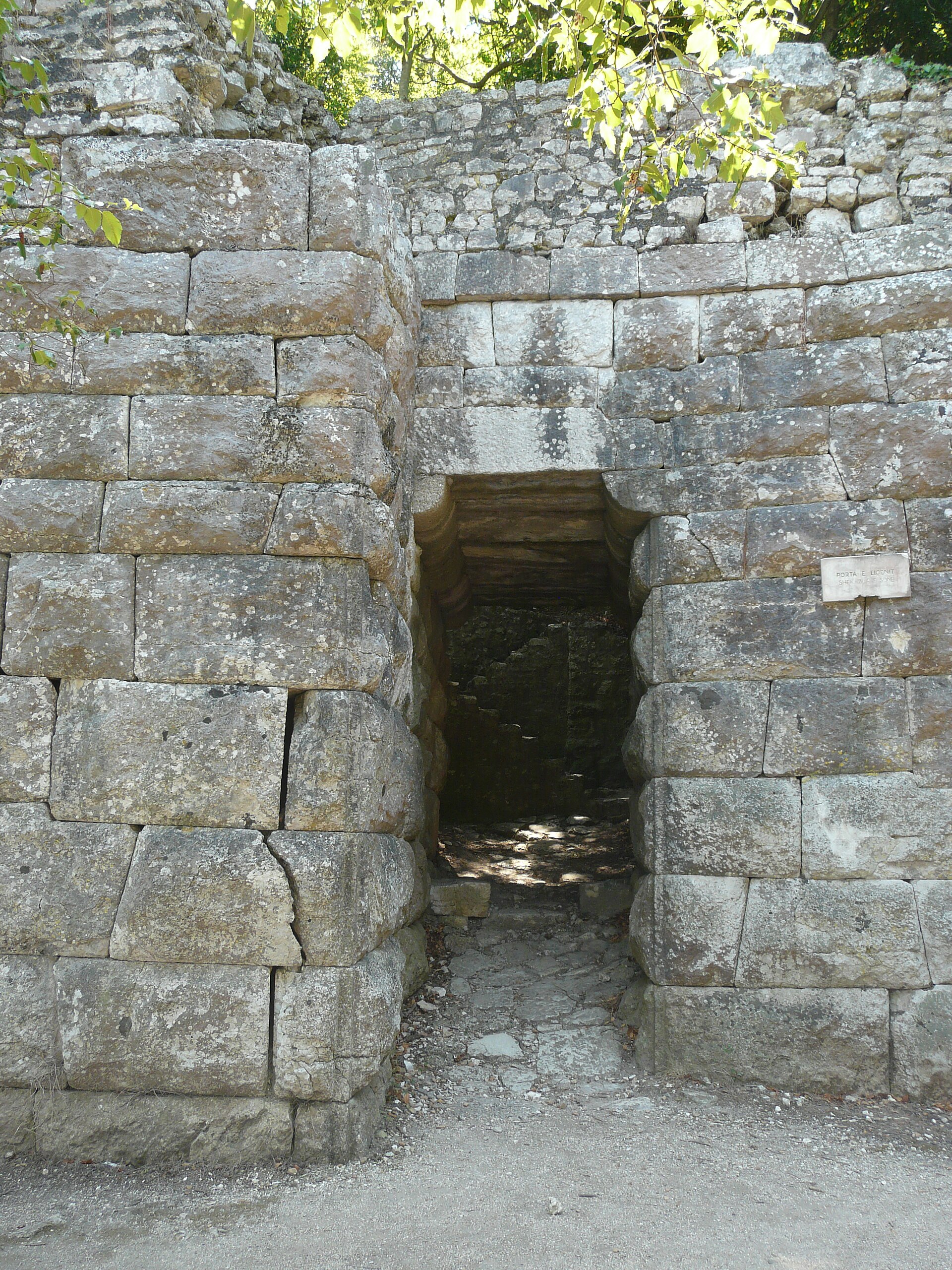
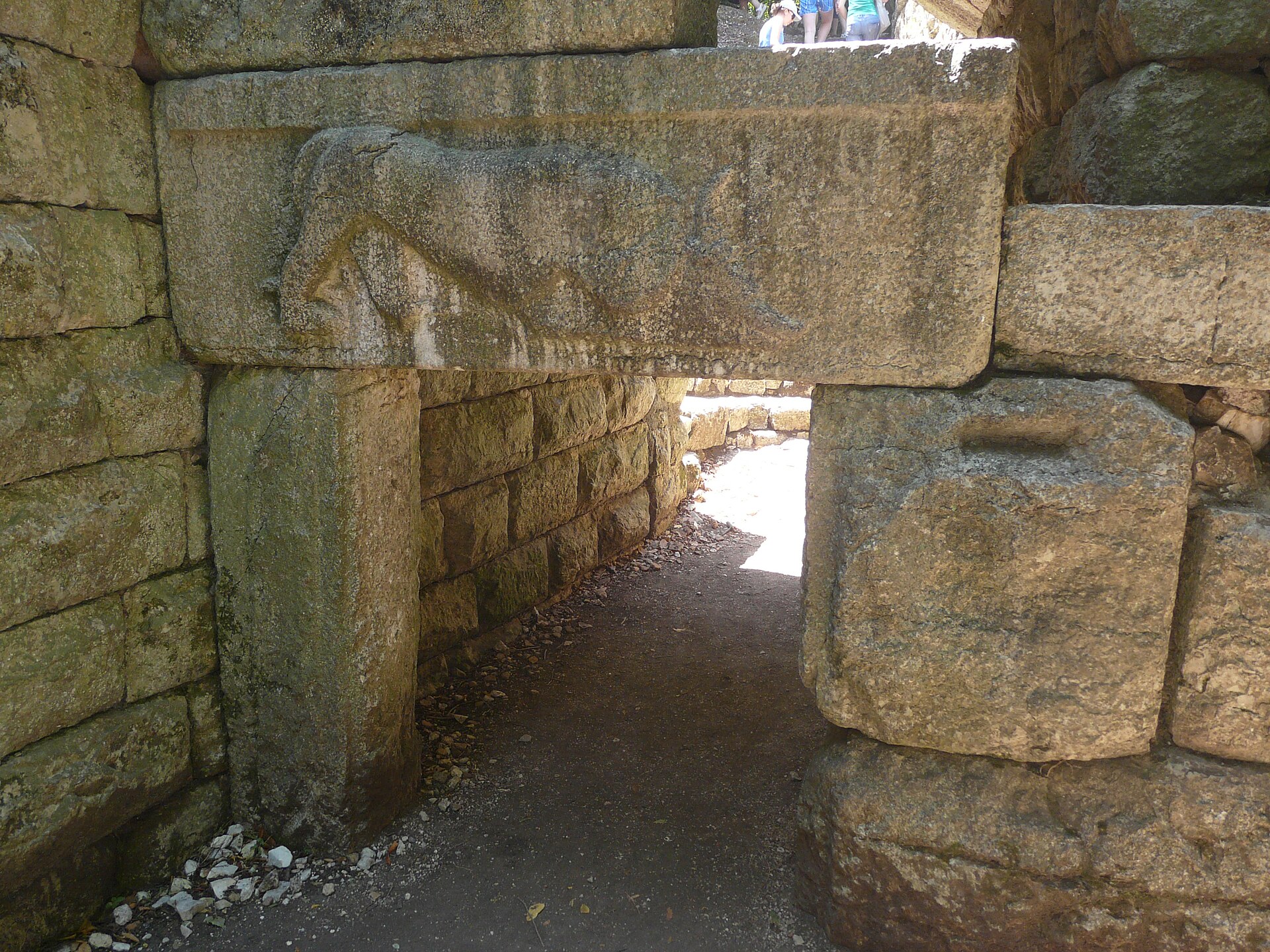
Through the Byzantine centuries Butrint continued to be an inhabited and fortified place, though its fortunes fluctuated with the turbulent history of the region. As part of the Byzantine Empire, it was a frontier town in a contested zone, and it was refortified and adapted to the needs of a more dangerous age. The great gates and walls that are among the most impressive features of the site belong in part to these later phases, when defense was paramount. Among them is the famous Lion Gate, whose lintel is carved with a striking relief of a lion devouring the head of a bull, a powerful image that has become one of the emblems of Butrint.
The medieval history of Butrint was shaped by the shifting struggles of the powers that contested the region: the Byzantine Empire, the various Norman, Angevin, and other western powers who intervened in the area, and the rising maritime republics of Italy. The town changed hands more than once, was fought over, damaged, and rebuilt, and its fortifications were repeatedly strengthened and modified to meet new threats. Through all this it remained a place of strategic importance, its position on the channel opposite Corfu keeping it valuable to whoever sought to control the waters between Italy and Greece.
The layered walls and gates of Butrint, combining Greek, Roman, Byzantine, and later medieval work, are a physical record of this long and contested history. Different phases of construction, using different techniques and styles, can be traced in the fortifications, which grew, shrank, and adapted as the town’s needs and the technology of war changed over more than a thousand years. To trace the walls of Butrint is to trace the whole military and political history of a frontier town that survived, again and again, by adapting to the powers that rose and fell around it.
Venetians on the Frontier
In the later Middle Ages and the early modern period, Butrint fell within the orbit of the Republic of Venice, the great maritime power that dominated much of the Adriatic and Ionian and controlled nearby Corfu. For the Venetians, Butrint was valuable chiefly as an outpost guarding the approaches to their prized island of Corfu and as a source of fish and other resources; the rich fisheries of the lagoon were a particular prize. Under Venetian control the town was more a fortified station than a flourishing city, but it retained a strategic role on the frontier between Venetian and, later, Ottoman power.
The Venetians left their own mark on Butrint in the form of fortifications built to defend their interests. A small triangular castle was raised to guard the Vivari Channel and control the crossing, and a tower and other defensive works were added to secure the site and its valuable fishery. These late medieval and early modern structures form the final layer of building at Butrint, capping the long architectural history of the site with the works of the Venetian republic. By this period, however, the great days of Butrint as a city were long past, and it had dwindled to a garrison and fishing station rather than a true town.
The Venetian phase represents the last chapter of Butrint’s active life. As the balance of power in the region shifted, with the Ottoman Empire dominating the mainland and the old Venetian maritime empire declining, Butrint’s importance faded further. The site that had been a Greek town, a Roman colony, a Christian bishopric, and a Byzantine fortress ended its long history as a minor Venetian outpost, and then, as the surrounding environment deteriorated and the strategic situation changed, it slipped at last into abandonment, its long life finally at an end after more than two millennia.
Marsh, Malaria, and Abandonment
The final decline and abandonment of Butrint, like that of so many ancient coastal cities, was driven in large part by its environment. Over the centuries the surrounding lagoon and marshes, which had once nourished and protected the town, became increasingly a source of danger. The land grew marshier, the drainage worsened, and the low-lying, waterlogged setting bred malaria, which made the area unhealthy and drove people away. The same waters that had given Butrint its long life slowly turned against it, and the town that had survived so many changes of ruler could not survive the deterioration of its own landscape.
By the post-medieval period Butrint had been largely abandoned, left to the marsh and the encroaching forest. Its buildings decayed and were overgrown, the theatre filled with water and silt, and vegetation spread over the ruins of the ancient city. The site that had been continuously inhabited for more than two thousand years fell silent, its stones sinking into the wetland and woodland that reclaimed the peninsula. For a long time Butrint lay forgotten, a ruin hidden in a beautiful but unhealthy landscape, its very existence known to few beyond the local population.
Yet this abandonment, as at so many other ancient sites, helped preserve what remained. Because Butrint was not overbuilt by a later town but left to the forest and marsh, its layered ruins survived largely undisturbed, protected by the very isolation that had killed the city. The theatre, the baptistery with its mosaic, the gates and walls, the baths and churches, all survived beneath the vegetation, waiting. When archaeologists finally came to Butrint in the twentieth century, they found not a fragment beneath a modern town but a whole ancient landscape, its long history preserved in remarkable completeness.
The Italian Excavations and After
The modern rediscovery of Butrint began in the 1920s and 1930s, when an Italian archaeological mission, led by the archaeologist Luigi Maria Ugolini, undertook the first major excavations at the site. Ugolini and his team cleared and revealed much of the ancient city, uncovering the theatre, the sanctuary, the baptistery, and many of the sculptures and inscriptions that are now among the treasures of Butrint. The excavations were conducted in the political context of the time, and they had a nationalistic dimension, but they brought the long-buried city dramatically back to light and laid the foundation for all later study of the site.
After the Second World War, Butrint fell within the isolated communist state of Albania, and excavation continued under Albanian archaeologists, though the site remained little known to the outside world during the decades of the country’s isolation. With the opening of Albania at the end of the twentieth century, Butrint attracted renewed international attention and support, and major conservation and research projects were undertaken to study, protect, and present the site. These efforts have greatly advanced understanding of Butrint’s long history and have helped safeguard its fragile ruins and their beautiful natural setting.
Butrint was inscribed as a UNESCO World Heritage site in 1992, recognized for the exceptional depth and continuity of its history and the beauty of its landscape, and the surrounding area has been protected as a national park to preserve both the archaeology and the rich natural environment of wetland, forest, and lagoon. Today the site is managed with an eye to both conservation and visitors, and ongoing research continues to reveal new aspects of its past. From forgotten marshland ruin to protected World Heritage site, Butrint has been given a new life as one of the most important and evocative archaeological landscapes in the Balkans.
Butrint Today
Today Butrint is Albania’s premier archaeological site and one of the most beautiful ancient places in Europe, set within a national park of exceptional natural richness. Visitors follow a path that winds through the wooded peninsula, passing from monument to monument through the layers of the city’s history: the Greek theatre and sanctuary, the Roman baths and forum, the early Christian baptistery and basilicas, the Byzantine and Venetian fortifications, and the great gates in the ancient walls. The route leads up to the acropolis, crowned by a castle that now houses a museum displaying the finest finds, and offering views over the lagoon and the surrounding landscape.
What makes the experience so memorable is the marriage of history and nature. The ruins are wrapped in forest and reflected in water, alive with birds and rich in wildlife, and the atmosphere is one of tranquil beauty rather than crowded monumentality. Walking among the stones, with the lagoon glinting through the trees and the ancient walls rising from the greenery, the visitor feels the depth of time very directly, and the sense of a great city slowly reclaimed by the landscape gives Butrint a romantic, contemplative character quite different from busier classical sites.
For the traveller interested in the ancient world, Butrint offers an almost unmatched opportunity to trace the whole sweep of Mediterranean civilization in a single place. Greek, Roman, Christian, Byzantine, and Venetian phases lie layered on one small hill, telling the story of more than two thousand years of history in stone and mosaic and wall. To visit Butrint is to walk through that entire story, from the age of Greek colonies to the edge of the modern world, in one of the loveliest settings any ancient city could ask for, and to understand why this small Albanian site has earned its place among the great monuments of Europe.
Nearby Places
- Delphi: The Mountain Sanctuary of the Oracle
- Delos: The Sacred Island of Apollo
- Mycenae: The Golden Citadel of Agamemnon
Final Word
Butrint is a city that lived through the whole of classical history and then vanished into the forest. Founded as a Greek town with a famous sanctuary of the healing god Asklepios, it became a Roman colony, an early Christian bishopric with a magnificent mosaic baptistery, a Byzantine fortress, and a Venetian outpost, each age layering its monuments upon the same small hill between lagoon and sea. Abandoned at last to marsh and malaria, it survived as an astonishingly complete ruin, and rediscovered in the twentieth century it has become Albania’s greatest archaeological treasure and a UNESCO World Heritage site. To walk its wooded peninsula, from Greek theatre to Roman bath to Christian baptistery to medieval gate, is to trace more than two thousand years of Mediterranean civilization in one of the most beautiful ancient landscapes in Europe.
You May Like
Norse Explorers Reached Canada 500 Years Before Columbus