For three thousand years the great stone lions above the gate of Mycenae have kept watch over an empty hill in the northeastern Peloponnese. They were carved when the citadel behind them ruled a network of palaces that stretched across mainland Greece and reached out into the Aegean, and they were still standing, weathered but unbroken, when classical Athenians came to marvel at walls they believed no human hand could have raised. To the Greeks of the fifth century BC, Mycenae was already impossibly old, a place out of legend where Agamemnon had gathered the fleet that sailed for Troy. To us it is something rarer still: the type-site of an entire lost civilization, the Bronze Age culture that archaeologists named Mycenaean after this single windswept acropolis.
The story of Mycenae is the story of how a warrior society on the edge of the prehistoric Mediterranean built palaces, kept written accounts in an early form of Greek, buried its kings under masks of beaten gold, and then vanished so completely that later Greeks could only explain its ruins through myth. It is also the story of Heinrich Schliemann, the German businessman turned excavator whose spade in 1876 pulled that gold out of the earth and, in doing so, dragged the heroic age of Homer halfway into history. What follows is an account of the citadel itself, the empire it commanded, the treasures it hid, and the collapse that turned a capital into a legend.

Contents
- A Gate Guarded by Lions
- Schliemann and the Gold of the Shaft Graves
- How a Hilltop Became a Kingdom
- Inside the Palace of a Mycenaean King
- Tombs Built Like Beehives
- Linear B and the First Greek Words
- An Aegean World of Palaces and Trade
- Warriors, Chariots, and the Question of Troy
- The Catastrophe That Ended an Age
- From Ruin to Legend
- Walking the Citadel Today
- Nearby Places
- Final Word
A Gate Guarded by Lions
The first thing any visitor to Mycenae meets is the Lion Gate, and it is worth pausing over, because almost everything that makes the site remarkable is compressed into this one doorway. It is built of four colossal blocks of limestone: two upright jambs, a threshold, and a single lintel that alone weighs around twenty tonnes. Above the lintel the masons left a triangular gap, a relieving triangle that carried the enormous weight of the wall away from the span below, and into that triangle they set a carved slab showing two lionesses, or perhaps lions or griffins, standing on either side of a central column. Their heads, now lost, were made separately and probably faced outward toward anyone approaching.
The gate was built around 1250 BC, and it is the oldest monumental sculpture in mainland Europe. The column between the two animals is not decorative; it is almost certainly a religious or royal symbol, a sign that whoever passed beneath was entering a place under divine and dynastic protection. The animals flank it the way guardian creatures flank sacred entrances across the ancient Near East, and their presence at Mycenae is a reminder that this was not an isolated culture but one plugged into the wider symbolic language of the Bronze Age Mediterranean.
On either side of the gate rise the walls themselves, and they are the reason later Greeks refused to believe mortals had built them. Constructed from irregular limestone boulders, some weighing several tonnes, fitted together without mortar, they stand in places over seven metres thick. The classical Greeks called this style Cyclopean, convinced that only the one-eyed giants of legend, the Cyclopes, could have moved such stones. The label stuck, and archaeologists still use it today for this kind of massive dry-stone fortification. To stand at the Lion Gate is to understand instantly why myth attached itself so readily to Mycenae: the scale of the place outran the imagination of the people who inherited it.

Schliemann and the Gold of the Shaft Graves
The modern rediscovery of Mycenae belongs to Heinrich Schliemann, a wealthy German who had already caused a sensation by excavating what he believed was Homer’s Troy in the hills of northwestern Anatolia. In 1876, following clues in the ancient traveller Pausanias, Schliemann turned his attention to Mycenae. Pausanias, writing in the second century AD, had recorded a local tradition that the tombs of Agamemnon and his companions lay inside the walls, not outside them as Greek custom would normally demand. Schliemann took the hint literally and dug just inside the Lion Gate.
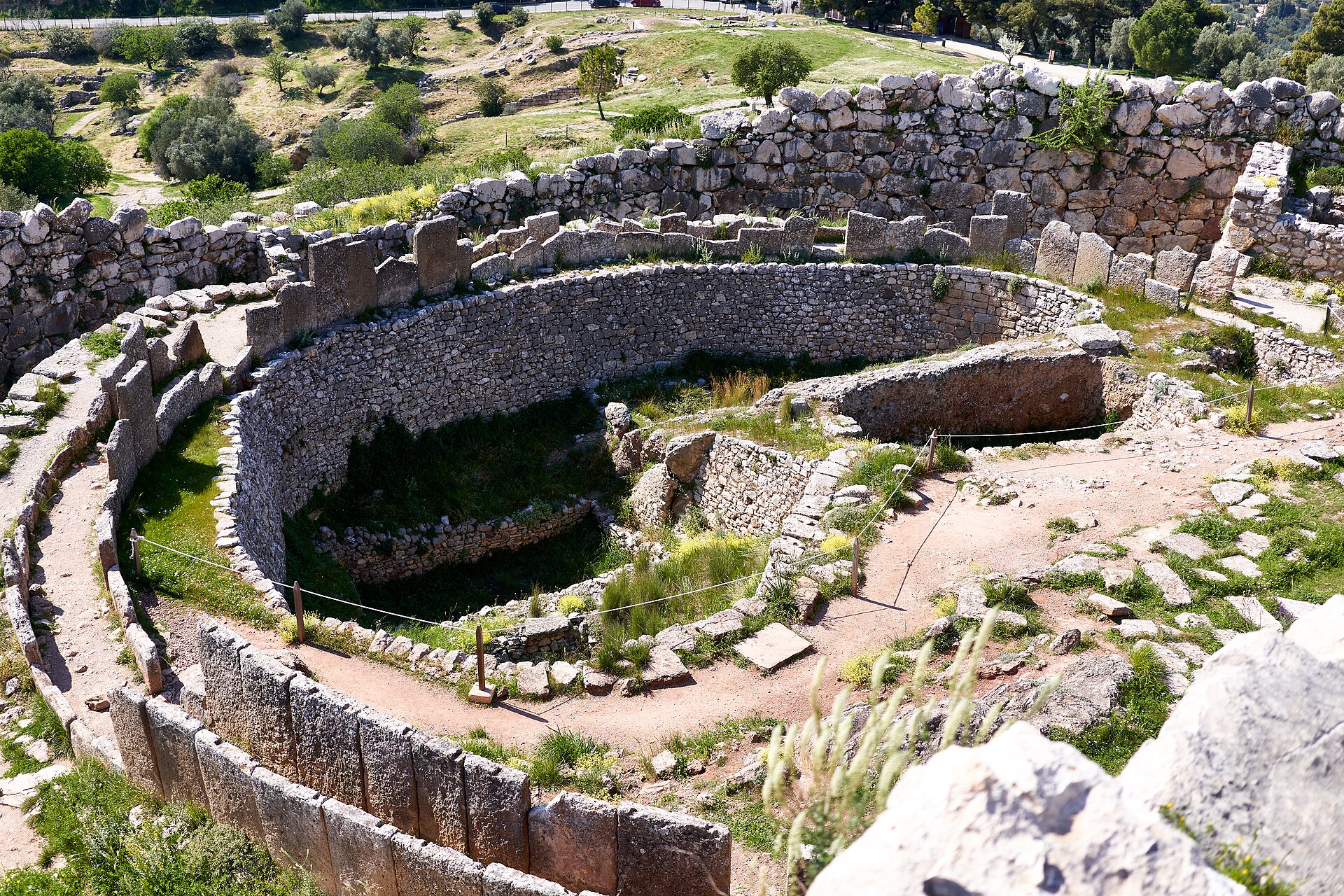
What he found there rewrote the prehistory of Europe. Beneath the ground lay a ring of stone slabs enclosing a cluster of deep rectangular shaft graves, and inside them were the burials of men, women, and children accompanied by an astonishing quantity of gold. There were diadems, cups, ornaments sewn onto clothing, inlaid bronze daggers showing lions hunting and men fighting, and above all a series of thin gold masks that had been laid over the faces of the dead. It was the richest single discovery in the history of Aegean archaeology, and it proved beyond doubt that a wealthy, warlike, artistically sophisticated society had flourished in Greece centuries before the classical age.
Schliemann, never a man for restraint, famously telegraphed that he had gazed upon the face of Agamemnon. He was wrong about that. The shaft graves date to the sixteenth century BC, roughly three hundred years before the traditional date of the Trojan War, so the man behind the most famous mask cannot have been Homer’s king. But the error hardly mattered. Schliemann had found something more important than a single hero: he had found the physical reality of the Mycenaean world, and every study of Bronze Age Greece since has built on the foundation his controversial, destructive, brilliant excavations laid.

How a Hilltop Became a Kingdom
Long before the Lion Gate or the shaft graves, Mycenae was simply a well-chosen hill. It sits on a natural strongpoint between two peaks, Profitis Ilias and Sara, commanding the roads that led from the Argive plain up into the mountains and on toward the Isthmus of Corinth. Whoever held it controlled movement through the northeastern Peloponnese, and control of movement meant control of trade. People had lived on and around the hill since the Neolithic, but it was in the centuries after 1700 BC that the settlement began its dramatic transformation from a prosperous chiefdom into a genuine center of power.
The evidence for that transformation is the gold in the graves. Somewhere in the sixteenth century BC the rulers of Mycenae acquired wealth on a new scale, and they acquired it fast. Where it came from is one of the great questions of Aegean archaeology. Some of it may have come from raiding and mercenary service abroad, perhaps in Egypt, where foreign fighters were in demand. Some came from trade in metals, textiles, and other goods moving across the eastern Mediterranean. And a great deal of the culture’s early sophistication was borrowed wholesale from the Minoans of Crete, the older palace civilization whose art, writing, and administrative techniques the mainlanders absorbed and made their own.
By around 1400 BC the balance had tipped. Minoan Crete, weakened by earthquakes, eruption, and internal upheaval, fell under mainland control, and the great palace at Knossos itself came to be administered in Mycenaean fashion. The pupils had overtaken their teachers. For the next two centuries the Mycenaean palaces, with Mycenae among the greatest of them, dominated the Aegean, and the hill that had begun as a convenient waypoint became the namesake of an age.
Inside the Palace of a Mycenaean King
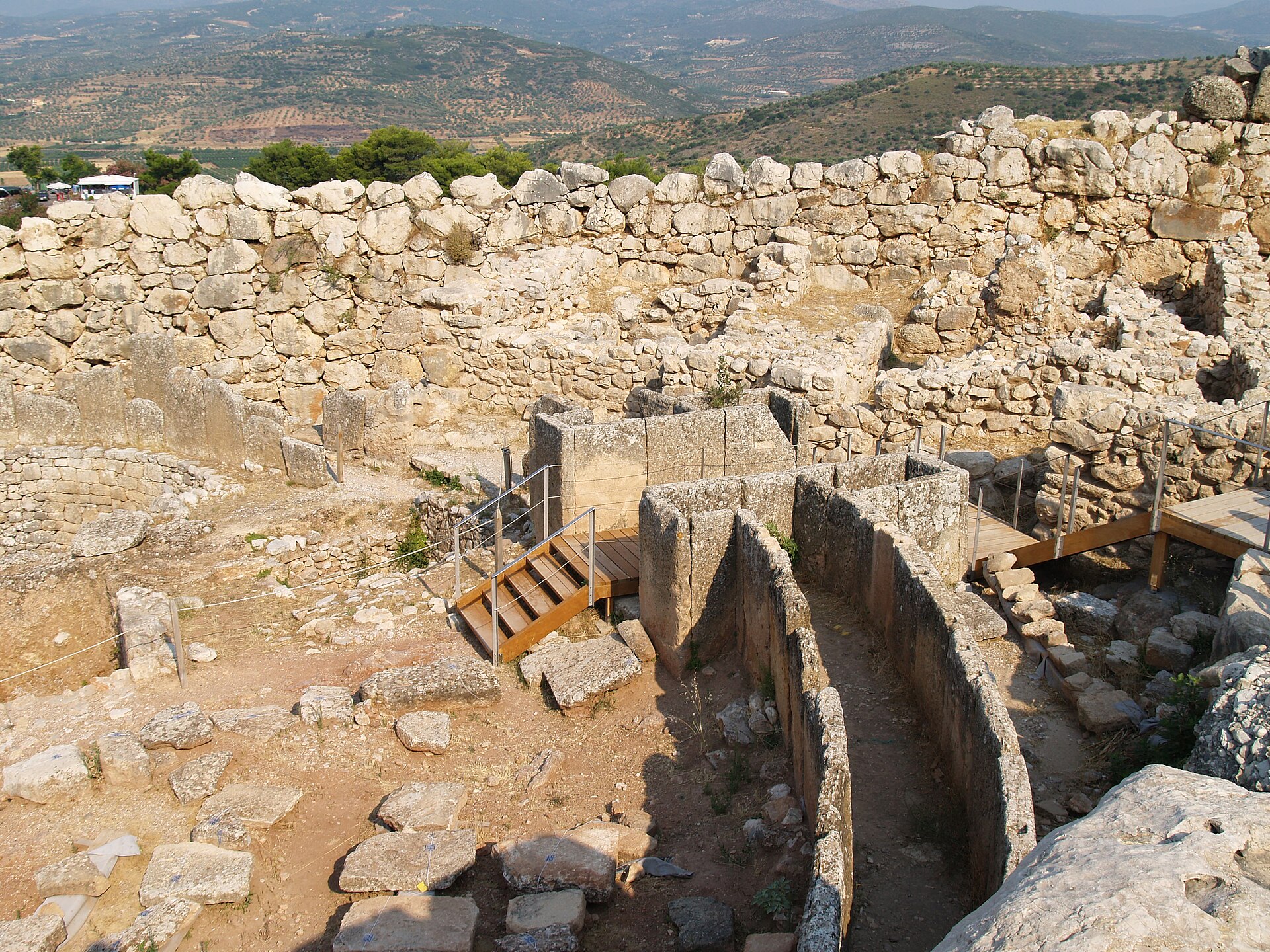
At the summit of the citadel, reached by a ramp that climbs from the Lion Gate past Grave Circle A, stood the palace. Little survives of its upper structure, but the plan can still be read in the foundations, and it follows a pattern repeated at Mycenaean centers across Greece. The heart of the complex was the megaron, a rectangular hall entered through a porch and vestibule, with a great circular hearth at its center ringed by four columns that supported an opening in the roof. Around this core spread courtyards, storerooms, workshops, and living quarters, all laid out to funnel visitors toward the throne room and the figure who ruled from it.
That figure was the wanax, a title preserved in the palace records that means something like lord or sovereign. The wanax sat at the apex of a highly organized society. Below him were military leaders, landholders, priests, and a bureaucracy of scribes who tracked every sheep, every bronze ingot, every ration of grain. The palace was not merely a royal residence; it was the engine of a redistributive economy, gathering the produce of the surrounding countryside and parceling it back out to workers, soldiers, and craftsmen. Fragments of painted plaster show that the walls once blazed with color, decorated with processions, chariots, hunts, and warriors in the frescoed style the Mycenaeans learned from Crete and turned toward their own martial tastes.
What made the palace defensible was the water. Late in the citadel’s life its engineers cut a remarkable underground passage, the so-called secret cistern, descending in stepped tunnels beneath the walls to a spring outside them. In a siege the defenders could still reach fresh water without exposing themselves, and the very existence of such a work tells us that by the thirteenth century BC the rulers of Mycenae were preparing for danger. The confident expansion of earlier centuries was giving way to something more anxious.
Tombs Built Like Beehives
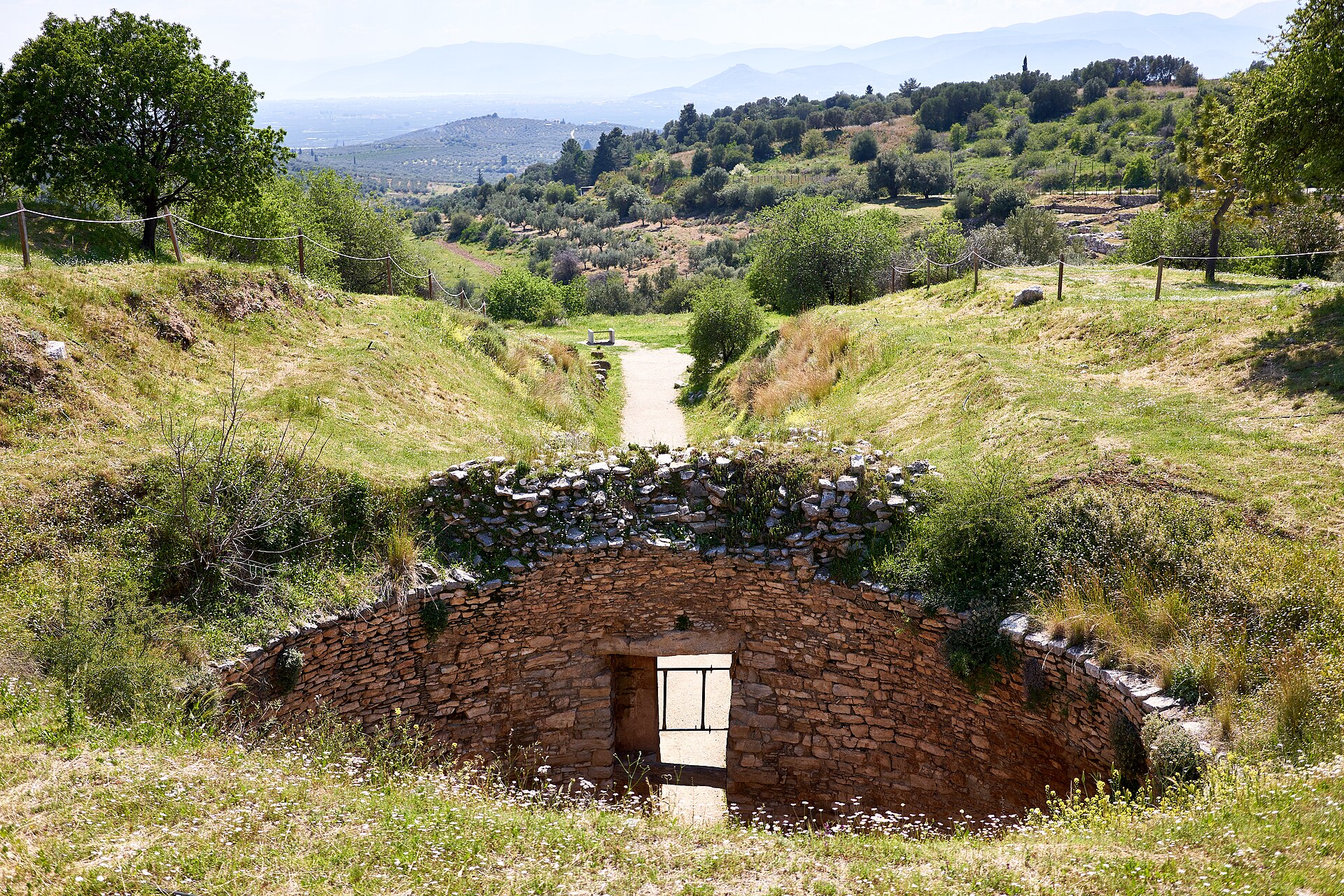
If the shaft graves show the wealth of Mycenae’s early rulers, the tholos tombs show the ambition of its later ones. A tholos, sometimes called a beehive tomb, is a great chamber built by laying successive rings of stone one atop another, each slightly overhanging the one below, until the courses close at the top in a high corbelled dome. The whole structure was then buried under a mound of earth, and it was entered along a long straight passage, the dromos, cut into the hillside and leading to a monumental doorway. Around Mycenae stand nine such tombs, and the finest of them is a masterpiece of Bronze Age engineering.
That masterpiece is the so-called Treasury of Atreus, built around 1250 BC, the same generation as the Lion Gate. Its dome rises nearly fifteen metres and spans almost fifteen metres across, and for more than a thousand years, until the Romans built the Pantheon, it remained the largest dome in the world. The lintel over its doorway is a single stone weighing well over a hundred tonnes, one of the heaviest blocks ever raised in antiquity. The name is a romantic misnomer, attached by early travellers who assumed such grandeur must belong to Atreus, father of Agamemnon; in reality it was a royal tomb, long ago emptied of whatever it once held. But to step through its doorway into the cool, echoing dark of the dome is to feel the reach of Mycenaean ambition more directly than anywhere else on the site.

The shift from shaft grave to tholos was more than a change of fashion. It reflected a change in how power displayed itself. The shaft graves hid their treasure underground, visible only at the moment of burial. The tholos tombs were public monuments, their mounds rising over the landscape, their doorways framed in carved and colored stone, announcing the permanence of a dynasty to everyone who passed. Building one demanded enormous resources and skilled labor, and only the greatest houses could command them. The tholoi are, in effect, the pyramids of the Aegean, and like the pyramids they were emptied by robbers long before any archaeologist arrived.

Linear B and the First Greek Words
For a long time the Mycenaeans seemed a people without a voice. Their art survived, their walls survived, their gold survived, but nothing that could be read. Then came the clay tablets. At Knossos, at Pylos, at Mycenae itself, excavators recovered baked and unbaked clay tablets covered in a script of about ninety signs, which the archaeologist Arthur Evans had labelled Linear B to distinguish it from an earlier Cretan writing system. For half a century no one could read them, and many assumed they recorded some lost pre-Greek language.
The breakthrough came in 1952, when a young English architect named Michael Ventris, working with the classicist John Chadwick, demonstrated that Linear B was in fact an early form of Greek. The decipherment was one of the great intellectual achievements of the twentieth century, and it pushed the recorded history of the Greek language back some five hundred years. Suddenly the Mycenaeans could speak, and what they had to say was, at first glance, almost comically mundane: the tablets are administrative records, inventories of livestock, lists of workers, allocations of grain, wine, oil, and bronze, tallies of chariots and their fittings.
But the mundane is precisely what makes them precious. Through these dry accounts we glimpse a working society: named officials, guilds of craftsmen, women weavers and their children receiving rations, offerings set aside for a pantheon of gods whose names, Zeus, Hera, Poseidon, Athena, Dionysus, would still be worshipped a thousand years later. The tablets survive only because the fires that destroyed the palaces baked the clay hard. In an ordinary year they would have been recycled, temporary records of a single accounting cycle. What we read, in other words, is a snapshot of the last year of each palace’s life, frozen by the catastrophe that ended it.
An Aegean World of Palaces and Trade
Mycenae was the most famous of the Mycenaean centers, but it was never alone. Across the Greek mainland stood a constellation of palaces, each ruling its own territory: Tiryns a short distance away in the Argive plain, Pylos in the southwest, Thebes and Orchomenos in Boeotia, and others whose remains are fainter. Whether these palaces formed a single unified kingdom or a shifting patchwork of rival states is one of the enduring debates of the field. Homer imagined Agamemnon of Mycenae as a high king to whom other rulers owed allegiance, and the sheer wealth of Mycenae lends the idea some support, but the archaeology shows independent centers as easily as a hierarchy.
What is certain is that the Mycenaean world was deeply connected to the wider Bronze Age. Their pottery has been found the length of the Mediterranean, from Sicily and southern Italy in the west to Egypt, Cyprus, and the Levantine coast in the east. Mycenaean stirrup jars, which carried perfumed oil, turn up in Egyptian tombs; the famous Uluburun shipwreck off the Turkish coast, a merchant vessel that sank around 1300 BC, carried Mycenaean goods among a cargo drawn from a dozen cultures. The palaces were nodes in a trading system that moved copper from Cyprus, tin from distant sources, ivory from Africa and Asia, amber from the Baltic, and finished luxury goods in every direction.
There are even hints of the Mycenaeans in the diplomatic correspondence of the great powers. Hittite records from Anatolia mention a kingdom called Ahhiyawa, which most scholars identify with the Mycenaean Greeks, and describe it as a serious player in the politics of the eastern Aegean, alternately trading and quarrelling with the Hittite empire over the coastlands and islands between them. If that identification holds, then the rulers of places like Mycenae were not provincial chieftains but recognized partners in the international order of the Late Bronze Age, corresponding with kings whose names appear in the archives of Hattusa.
Warriors, Chariots, and the Question of Troy
Everything about Mycenaean material culture speaks of war. The dead in the shaft graves were buried with swords and daggers; palace frescoes show helmeted men marching and chariots wheeling; the Linear B tablets count chariots and their parts, coats of scale armor, and stores of weapons. A boar’s-tusk helmet of exactly the type Homer describes, assembled from dozens of curved tusks sewn onto a leather cap, has been recovered from Mycenaean graves, a small but electrifying point of contact between the poems and the archaeology. This was a society that prized martial prowess and organized itself, in part, for fighting.
Which brings us, inevitably, to Troy. The question of whether the Trojan War really happened has hung over Mycenae since Schliemann. The honest answer is that we cannot know whether any single expedition matching Homer’s story took place. What we can say is that the world the poems describe, a world of mainland Greek kingdoms with the resources to launch overseas expeditions, of fortified citadels and bronze-clad warriors and long-distance rivalry across the Aegean, corresponds in its broad outlines to the real Late Bronze Age. Troy itself was a genuine and prosperous city at the mouth of the Dardanelles, and it suffered destruction during this era. Whether a coalition led by a king of Mycenae ever besieged it, no tablet or inscription confirms.
It is best to think of the Homeric epics not as history and not as pure invention, but as memory transformed. The poems were composed centuries after the palaces fell, passed down orally through the intervening dark age, accumulating anachronisms and dramatic shaping along the way. Embedded in them are genuine relics of the Bronze Age, the boar’s-tusk helmet, the great tower shields, the catalogue of places that matches the map of Mycenaean Greece, alongside details that belong to the poet’s own later world. Mycenae is where that memory was anchored, the golden capital at the head of a heroic age that the Greeks never quite let go of.
The Catastrophe That Ended an Age
Around 1200 BC, the Mycenaean world came apart. It did not decline gently over centuries; it collapsed, and it collapsed as part of a wider catastrophe that swept across the entire eastern Mediterranean within a few decades. One after another the great palaces were destroyed by fire, Pylos, Thebes, Tiryns, and Mycenae itself, and the sophisticated system they had anchored, the writing, the redistributive economy, the long-distance trade, the monumental building, simply ceased. The tablets stop. The frescoes end. The population fell, settlements shrank, and Greece entered a dark age that would last some four hundred years, during which even the memory of literacy was lost.
What caused it remains one of the most debated questions in ancient history, and the likeliest answer is that no single cause was responsible. The same period saw the fall of the Hittite empire, the devastation of cities up and down the Levant, and crisis in Egypt, which recorded attacks by mysterious raiders it called the Sea Peoples. Historians now tend to speak of a systems collapse, a cascade in which several stresses reinforced one another: drought and famine suggested by climate data, disruption of the trade networks the palaces depended on, internal revolt against a demanding elite, earthquakes, and warfare, including movements of displaced peoples. The Mycenaean palaces were tightly organized and highly centralized, and that very sophistication may have made them brittle. Once the system was shocked hard enough, there was no simpler structure to fall back on.
At Mycenae the citadel was not immediately abandoned. People continued to live on the hill, and there was even some rebuilding, but the palace as an institution was gone for good. The wanax and his scribes, his workshops and his frescoed halls, belonged to a vanished order. What remained was the great empty shell of walls too big for the diminished world that inherited them, and the slow work of legend beginning to fill the silence the palaces had left behind.

From Ruin to Legend
By the time of classical Greece, Mycenae had become a small and unimportant town living in the shadow of its own colossal past. Its people fought at Thermopylae and Plataea against the Persians, a point of local pride, but the great days were seven centuries gone. In 468 BC the neighboring city of Argos, long jealous of Mycenae’s legendary prestige, attacked and destroyed it, scattering its inhabitants. The site never recovered as a living settlement. What endured was its reputation, and that only grew.
For the Greeks, Mycenae was the capital of the heroic age, the seat of the house of Atreus, cursed and glorious, whose story Aeschylus set on the Athenian stage in the Oresteia. Agamemnon returning victorious from Troy only to be murdered by his wife Clytemnestra; their son Orestes avenging him and then hounded by the Furies; the whole grim cycle of vengeance and justice unfolded, in the imagination of the classical world, behind these very walls. When the traveller Pausanias visited in the second century AD he was shown the tombs of Agamemnon and his companions, and it was his account that eventually guided Schliemann’s spade.
That is the peculiar fate of Mycenae: it has lived far longer as a symbol than it ever did as a city. The historical citadel ruled for perhaps four centuries. The legendary Mycenae has ruled the Western imagination for three thousand years and counting, its name attached to a civilization, its gold masks reproduced in every museum and textbook, its cursed dynasty replayed on stages from Athens to the present. Few places have turned so small a physical footprint into so vast a cultural one.
Modern archaeology has, if anything, deepened rather than dispelled the fascination. Excavation continues, and each generation refines the picture, distinguishing the historical Bronze Age citadel from the heroic overlay the Greeks gave it. The two Mycenaes, the real and the mythic, are now studied together, because the way later people remembered the site is itself part of its history. UNESCO recognized this layered significance in 1999, inscribing Mycenae and neighboring Tiryns on the World Heritage list as the outstanding monuments of a civilization that shaped the very foundations of classical Greek culture.
Walking the Citadel Today
To visit Mycenae now is to climb a hill in the dry, herb-scented landscape of the Argolid, with the mountains rising behind and the plain falling away toward the distant sea. The approach leads first to the Lion Gate, and passing beneath it, the way generations of kings and envoys once did, remains the great moment of any visit. Just inside, on the right, lies Grave Circle A, the ring of shaft graves Schliemann emptied, its slabs still standing in a neat enclosure that the later builders deliberately preserved and honored when they extended the walls to bring it inside the citadel.
From there a ramp climbs toward the palace at the summit, past the foundations of houses and storerooms, to the remains of the megaron with its hearth and throne room, and to the viewpoint from which the whole kingdom once lay spread below. Adventurous visitors can descend the dark, steep steps of the underground cistern, and a short walk outside the walls leads to the Treasury of Atreus, whose vast beehive chamber is the single most impressive structure at the site. A modern museum on the slope displays finds from the excavations, including replicas of the gold masks whose originals are the pride of the National Archaeological Museum in Athens.
What lingers, after the gate and the tombs and the gold, is the silence. Mycenae is not a crowded classical city of temples and colonnades; it is older and starker than that, a Bronze Age fortress on a bare hill, its stones bleached pale by three thousand summers. Standing on the summit, with the lionesses keeping their eyeless watch below and the empty tombs opening into the hillside, it is easy to feel the double weight of the place: the real kingdom that rose and fell here, and the legend that refused to die. Both are what make Mycenae one of the essential sites of the ancient world.
Nearby Places
- Knossos: The 4,000-Year-Old Palace Behind the Myth of the Minotaur
- Dimini: The Neolithic Village Built as a Set of Concentric Rings
- Sesklo: The Hill in Thessaly Where Europe First Built a Town
Final Word
Mycenae is where a lost world became visible again. In its Cyclopean walls we see the ambition of a Bronze Age dynasty; in its gold masks, the wealth of kings who ruled the Aegean; in its clay tablets, the earliest recorded words of the Greek language; and in its ruins, the seedbed of the myths that classical Greece told about itself. The citadel rose, dominated its age, and fell in the great catastrophe that ended the Bronze Age, and then it was reborn as legend, the golden capital of Agamemnon and the house of Atreus. To walk beneath the Lion Gate today is to stand at the meeting point of history and story, on the hill where the Western imagination first learned to remember its heroic past.
You May Like
Mafra, the Palace a King Built From a Vow


2 thoughts on “Mycenae: Agamemnon’s Golden Citadel That Named a Civilization”