Every great city needs a door to the sea, and for a thousand years the door of Rome was Ostia. At the mouth of the river Tiber, where its yellow waters met the Mediterranean a short journey downstream from the capital, stood the port town through which the food, goods, and peoples of an empire flowed into the greatest city the ancient world had ever seen. Grain from Egypt and North Africa, wine and oil, marble, wild beasts for the arena, and merchants and sailors from every shore of the Mediterranean passed through Ostia on their way to Rome. Without it, the vast population of the imperial capital could not have been fed, and the machinery of empire could not have turned.
Ostia is often overshadowed by its glamorous neighbor Pompeii, but in some ways it tells a richer story. Where Pompeii was a modest provincial town preserved by catastrophe, Ostia was a great working port that grew, flourished, and then slowly faded, and its extensive ruins preserve something Pompeii cannot: the ordinary architecture of Roman urban life at its most developed, the multi-storey apartment blocks, warehouses, offices, and shops of a bustling commercial city. Buried not by ash but by the silt of its own river and the sands of centuries, Ostia is one of the best-preserved Roman cities anywhere, an unmatched window onto the commercial and everyday life of the Roman Empire at its height.
Contents
- Rome’s First Colony and Its Guardian at the River Mouth
- Feeding the Capital of the World
- The Great Harbours of the Emperors
- A City of Apartment Blocks
- The Square of the Corporations
- Baths, Theatre, and Public Life
- Temples, Forum, and the Gods of a Port
- A Cosmopolitan Crowd
- Silt, Decline, and Abandonment
- Rediscovering the Port of Rome
- Walking Ostia Antica Today
- Nearby Places
- Final Word
Rome’s First Colony and Its Guardian at the River Mouth
The very name Ostia comes from the Latin word for mouth, ostium, for the town stood at the mouth of the Tiber. Roman tradition held that it was the earliest of all Rome’s colonies, founded, according to legend, by one of the kings of Rome in the distant regal period to guard the river mouth and the vital salt beds nearby. Whether or not the foundation was really so ancient, Ostia’s original purpose was military and strategic: to protect the seaward approach to Rome and to control the mouth of the river that was the capital’s lifeline to the sea.
The earliest securely dated settlement, a small rectangular fortified camp known as the castrum, dates to around the fourth century BC, and its regular military plan can still be traced within the later city. From this fort Ostia grew as Rome’s power expanded. During the wars in which Rome fought for control of the western Mediterranean, the town served as a naval base and a point of supply, and as Rome’s overseas conquests brought ever more trade and tribute flowing toward the capital, Ostia’s role shifted from guarding the river mouth to handling the immense commerce that passed through it.
By the last centuries of the Republic and into the imperial age, Ostia had become above all a commercial town, its fortunes bound to the insatiable needs of Rome. The capital’s population swelled toward a million people, more than any pre-modern city, and feeding and supplying that multitude required a flow of goods on a scale unprecedented in history. Ostia stood at the crucial junction where seagoing ships met the river route to Rome, and its whole existence came to revolve around the transfer of goods from the Mediterranean to the capital. It grew from a frontier fort into the throbbing commercial gateway of an empire.
Feeding the Capital of the World
The single most important task of Ostia was to keep Rome fed, and above all to handle the grain supply on which the peace and stability of the capital depended. Rome’s enormous population could not be sustained by the produce of Italy alone, and the city relied on vast imports of grain, chiefly from Egypt and the provinces of North Africa, distributed to the populace partly as a free or subsidized dole. This grain supply, the annona, was a matter of the highest political importance; a failure of it could bring riots and endanger emperors, and its smooth running was one of the central concerns of the imperial government.
Ostia was the linchpin of this system. Great fleets of merchant ships brought the grain across the Mediterranean, and at or near Ostia it was unloaded, checked, measured, stored, and transferred to smaller river craft that could be towed up the Tiber to the warehouses of Rome. The town was accordingly filled with the infrastructure of this trade: enormous warehouses, or horrea, for storing grain and other goods; the offices of the officials and guilds who managed the traffic; and the quarters of the many workers, from dockhands to boatmen to clerks, whose labor kept the supply flowing. The remains of these warehouses, with their rows of storage rooms, are among the most characteristic features of the site.
Around this central business of grain grew up a whole world of commerce. Ostia handled not just food but the immense range of goods an empire’s capital demanded: wine and olive oil in their countless amphorae, building materials including the marble that faced Rome’s monuments, luxury goods from the eastern provinces, and the exotic animals shipped in for the spectacles of the arena. The town was a place where the products of three continents changed hands, a commercial hub whose reach extended across the entire Mediterranean world and whose prosperity rose and fell with the trade of the empire.
The Great Harbours of the Emperors
Ostia had one great weakness as a port: it lacked a good natural harbor. The mouth of the Tiber was shallow and prone to silting, and large seagoing ships could not easily dock there, often being forced to anchor offshore and unload into smaller vessels, a slow and risky business, especially in bad weather. As the demands on the port grew, this deficiency became a serious problem, and the emperors undertook enormous engineering works to solve it, building artificial harbors on a scale that testifies to the vital importance of the supply of Rome.
The emperor Claudius, in the first century AD, began the construction of a great new harbor a little to the north of Ostia, an immense artificial basin protected by curving moles, or breakwaters, reaching out into the sea, with a lighthouse guiding ships to its entrance. This harbor, known simply as Portus, meaning the Port, was a colossal undertaking. Yet even it proved not entirely adequate, being exposed to storms, and so the emperor Trajan, early in the second century, added a second, inner harbor: a remarkable hexagonal basin, its precise geometric shape still clearly visible from the air today, providing a sheltered inner haven where ships could safely dock and unload.
These imperial harbors transformed the port of Rome and gradually shifted the center of gravity of the shipping trade away from the old town of Ostia toward the new complex at Portus. Ostia itself remained the administrative and residential heart of the port zone, the town where the officials, guilds, workers, and merchants lived, while the actual handling of the largest ships increasingly took place at the great harbors nearby. Together, Ostia and Portus formed a vast port complex, one of the greatest engineering and logistical achievements of the ancient world, dedicated entirely to the feeding and supplying of the imperial capital.
A City of Apartment Blocks
The most valuable thing Ostia preserves is something Pompeii largely lacks: the ordinary urban architecture of the developed Roman Empire, and above all the multi-storey apartment building. In the crowded imperial city, land was scarce and the population dense, and Romans responded by building upward. The characteristic dwelling of the imperial-era city was not the sprawling single-storey house of the wealthy but the insula, a block of flats several storeys high, and Ostia is the best place in the world to study it, because so many of its insulae survive to a substantial height.
These buildings, constructed of brick-faced concrete, could rise to four or five storeys and contained numerous apartments of varying size and quality, from spacious flats for the reasonably well-off to cramped rooms for the poor. They had large windows, balconies, staircases serving the upper floors, and often shops built into the ground floor facing the street. Some were arranged around internal courtyards to bring in light and air. The famous House of Diana at Ostia is a fine surviving example, its brick facade and tall structure giving a vivid impression of what the streets of imperial Rome itself must have looked like, for the capital was full of such buildings, almost none of which survive there.
This is why Ostia is so precious to historians of Roman life. The great city of Rome has largely been buried, rebuilt, and overbuilt across two thousand years, and its everyday residential architecture is almost entirely gone. Ostia, abandoned and then buried in silt, preserved its brick apartment blocks, its shops, its streets, and its warehouses in a way the capital never could. To walk through Ostia is to walk through the kind of city most Romans actually inhabited, a dense, vertical, commercial world of flats and shops and businesses, quite different from the marble monuments that usually stand in for Rome in the popular imagination.
The Square of the Corporations
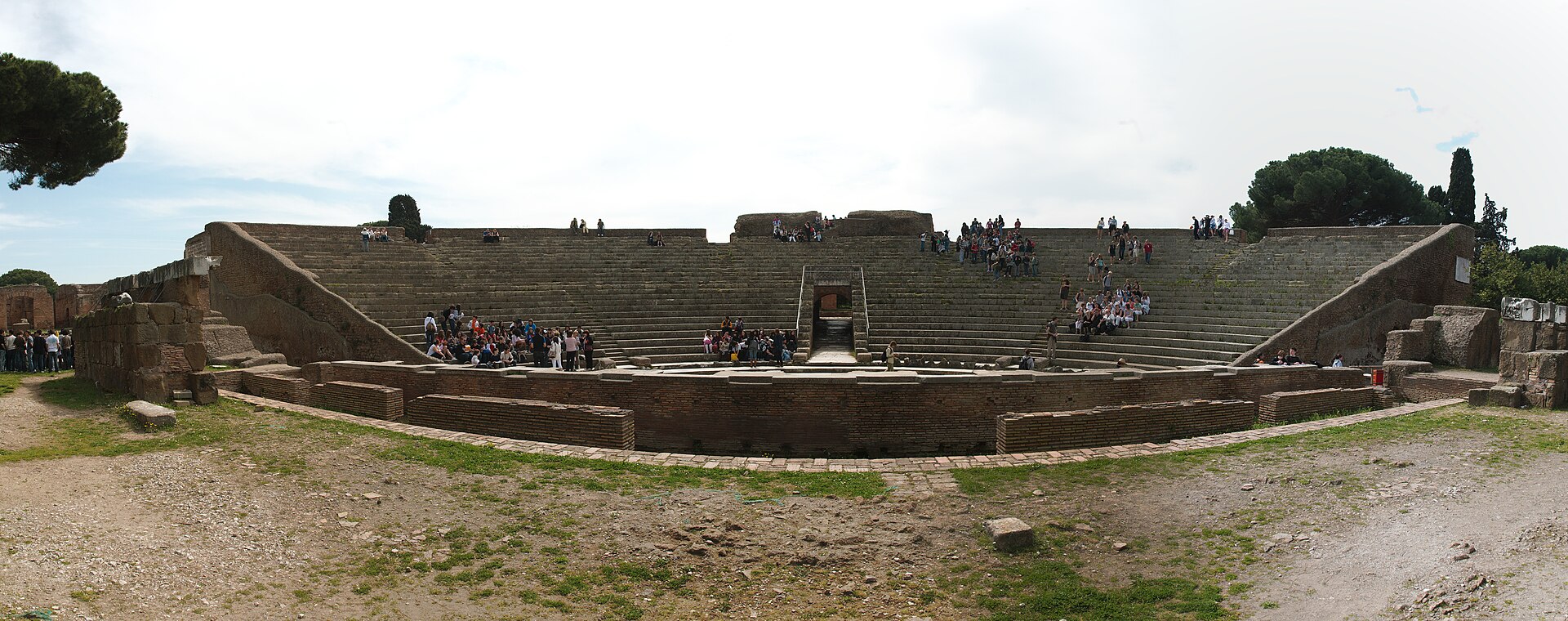
One of the most fascinating places in all of Ostia is the Square of the Corporations, a large porticoed plaza behind the theatre that served as a kind of commercial and shipping exchange. Around its colonnade ran a long series of small offices, each belonging to a different trading company, guild, or group of merchants, many of them representing shippers and traders from particular cities and provinces around the Mediterranean. It was here, in effect, that much of the business of the port was transacted, where the various commercial interests that made Ostia work had their premises.
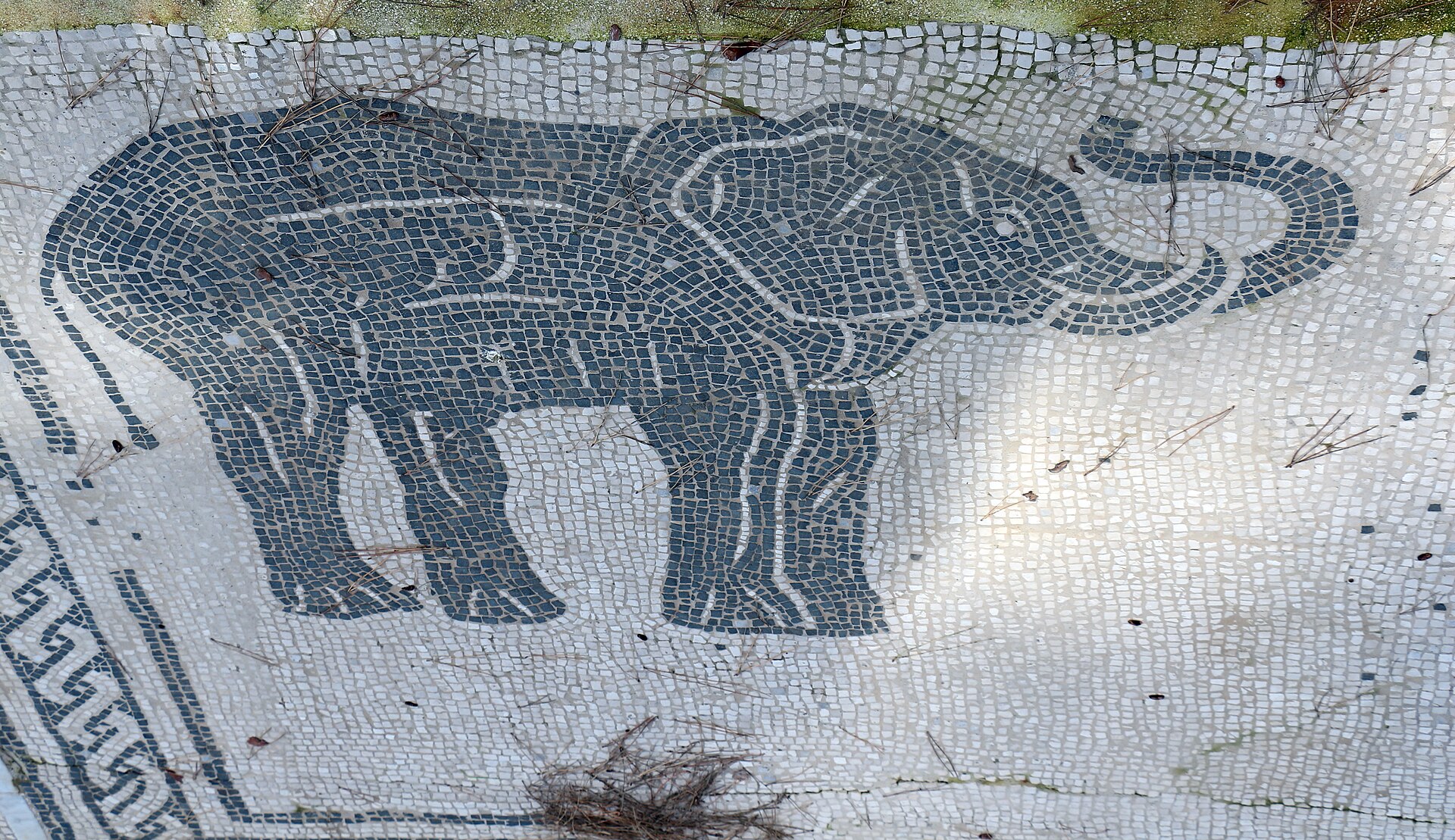
What makes the square extraordinary is that the floors in front of these offices are paved with black-and-white mosaics that advertise, in pictures and inscriptions, the business of each occupant. There are mosaics showing ships, lighthouses, and marine creatures; images of grain measures for the corn merchants; and, most famously, depictions of exotic animals such as an elephant, marking the office of traders connected with a particular African port. These mosaics form a unique visual directory of the ancient shipping trade, a picture-map of who did business at Ostia and where they came from, from the ports of North Africa to Gaul, Sardinia, and beyond.
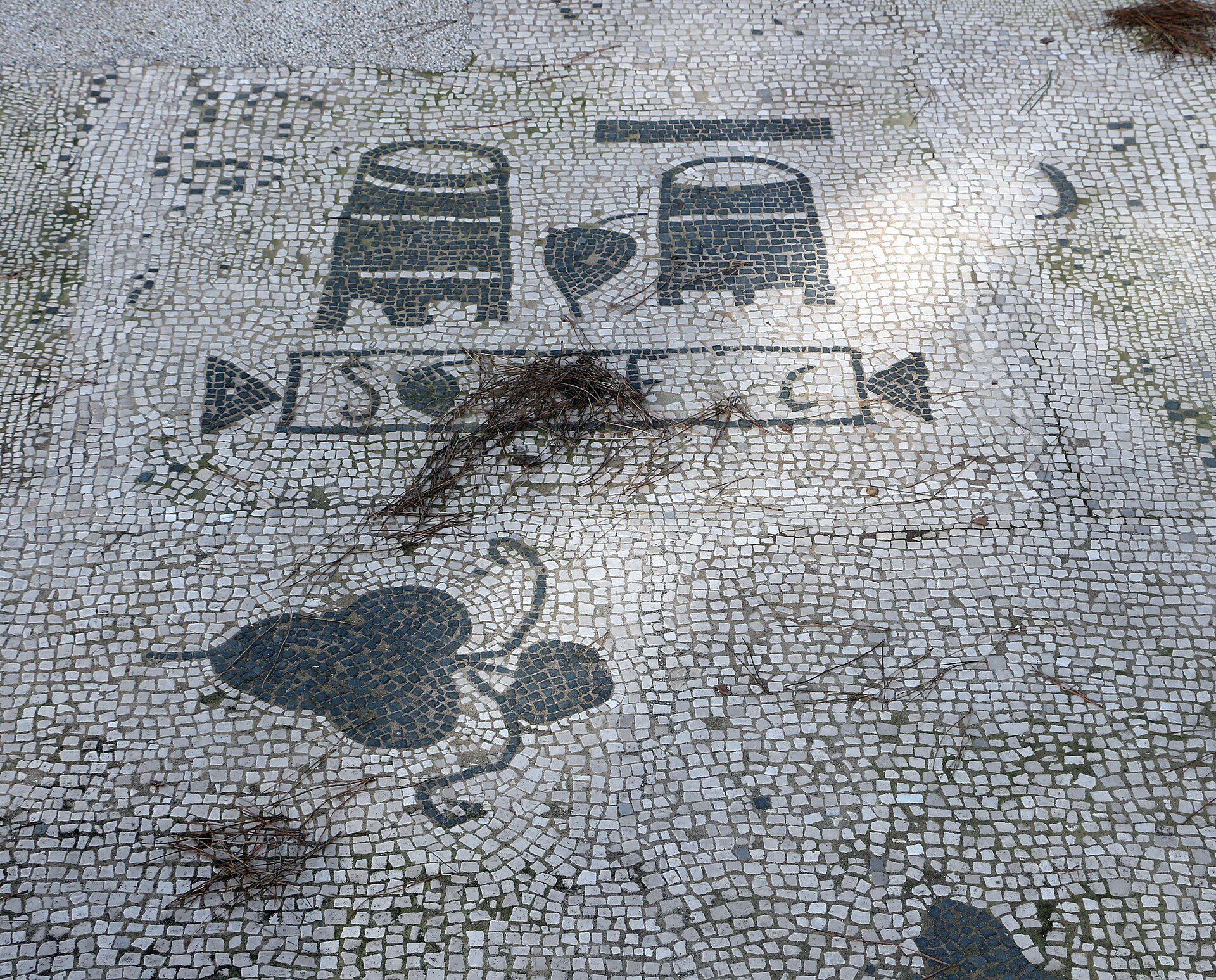
The Square of the Corporations captures, better than almost anything else at the site, what Ostia was really about. This was a town built on commerce, on the movement of goods and the organization of trade, and here the guilds and companies that ran that commerce left their mark literally underfoot. To stand in the square and read the mosaics is to grasp the astonishing reach and organization of the Roman commercial world, a Mediterranean-wide network of trade centered on the endless appetite of the imperial capital and coordinated, in part, from these modest offices around a porticoed plaza.
Baths, Theatre, and Public Life
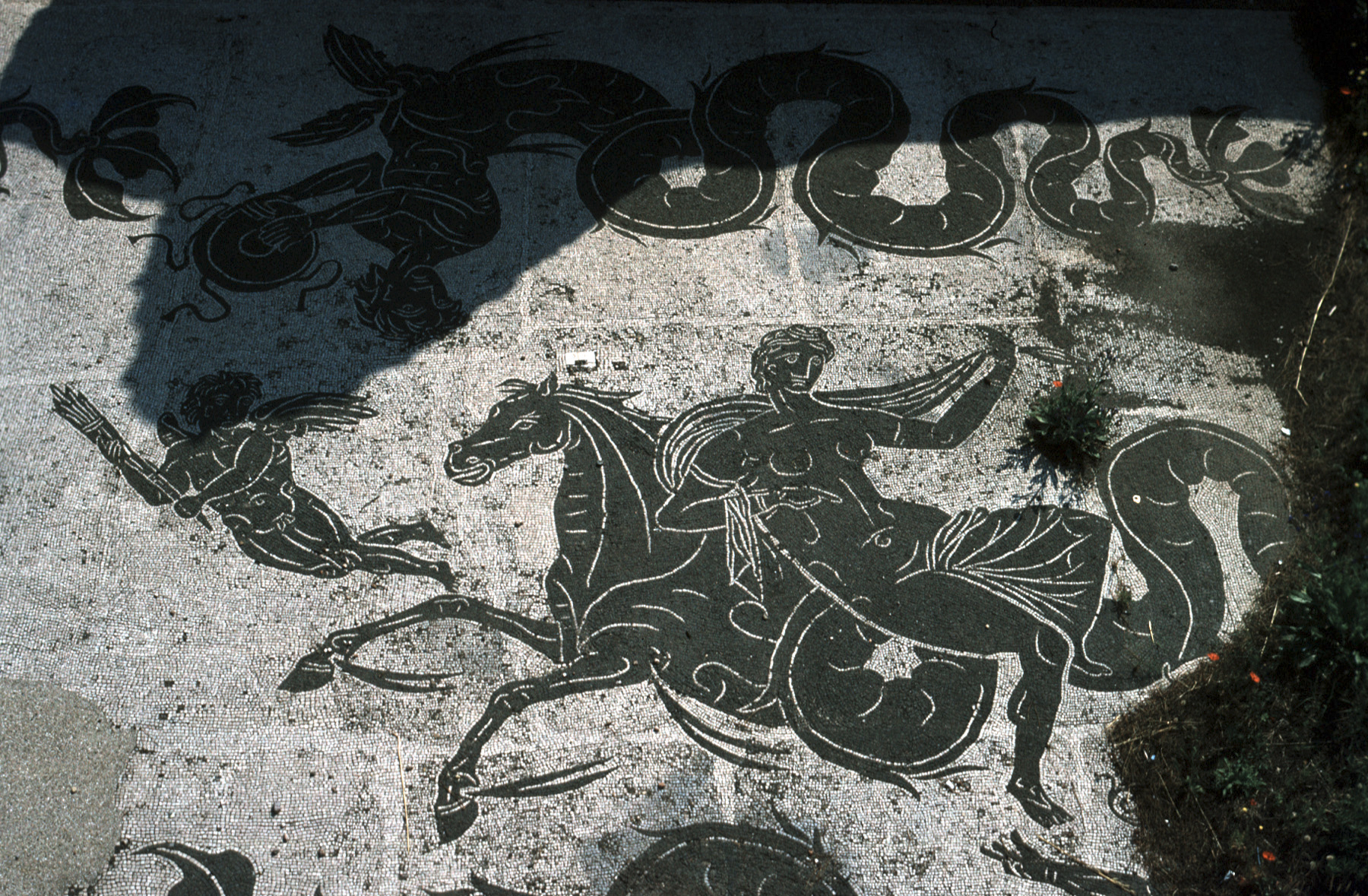
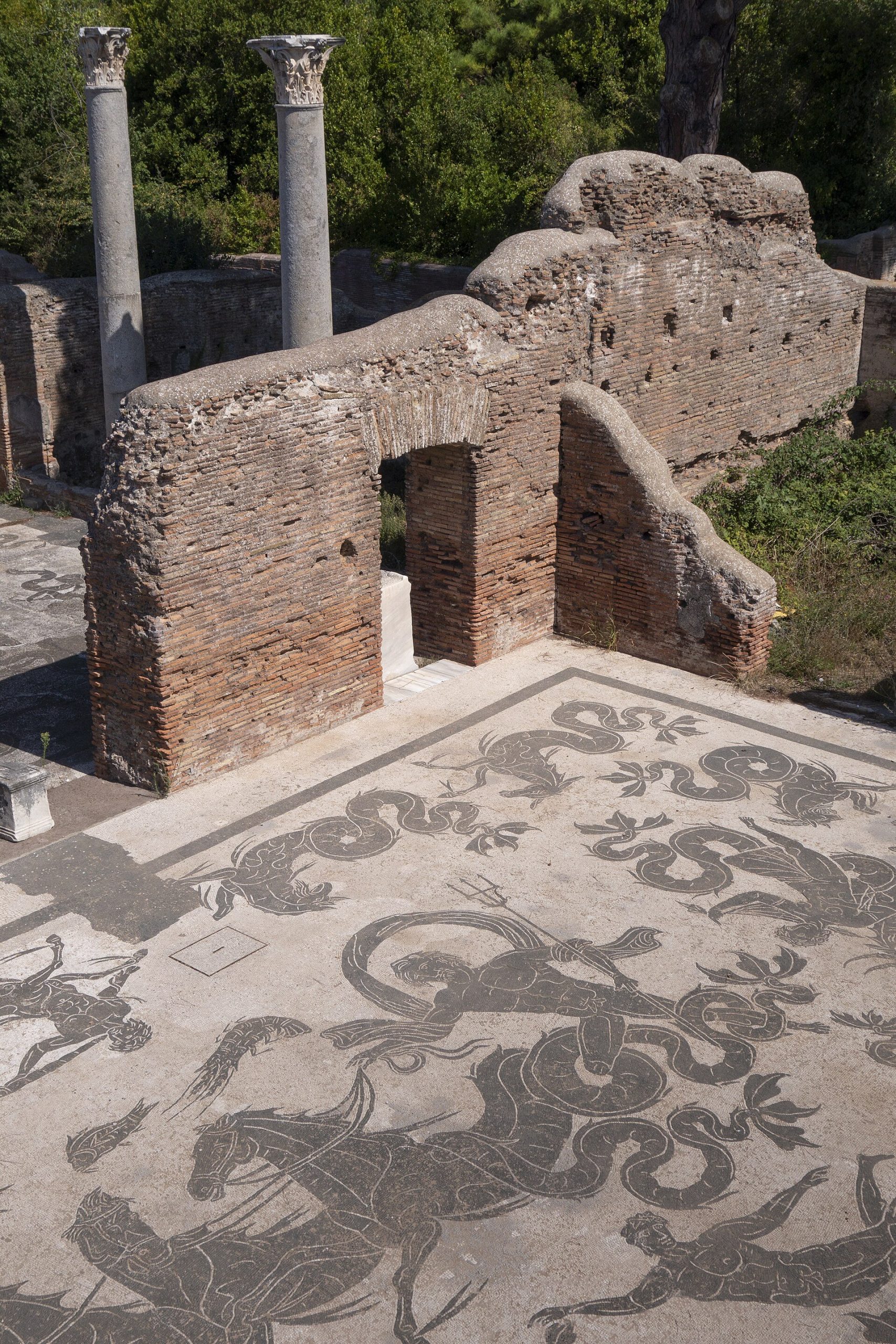
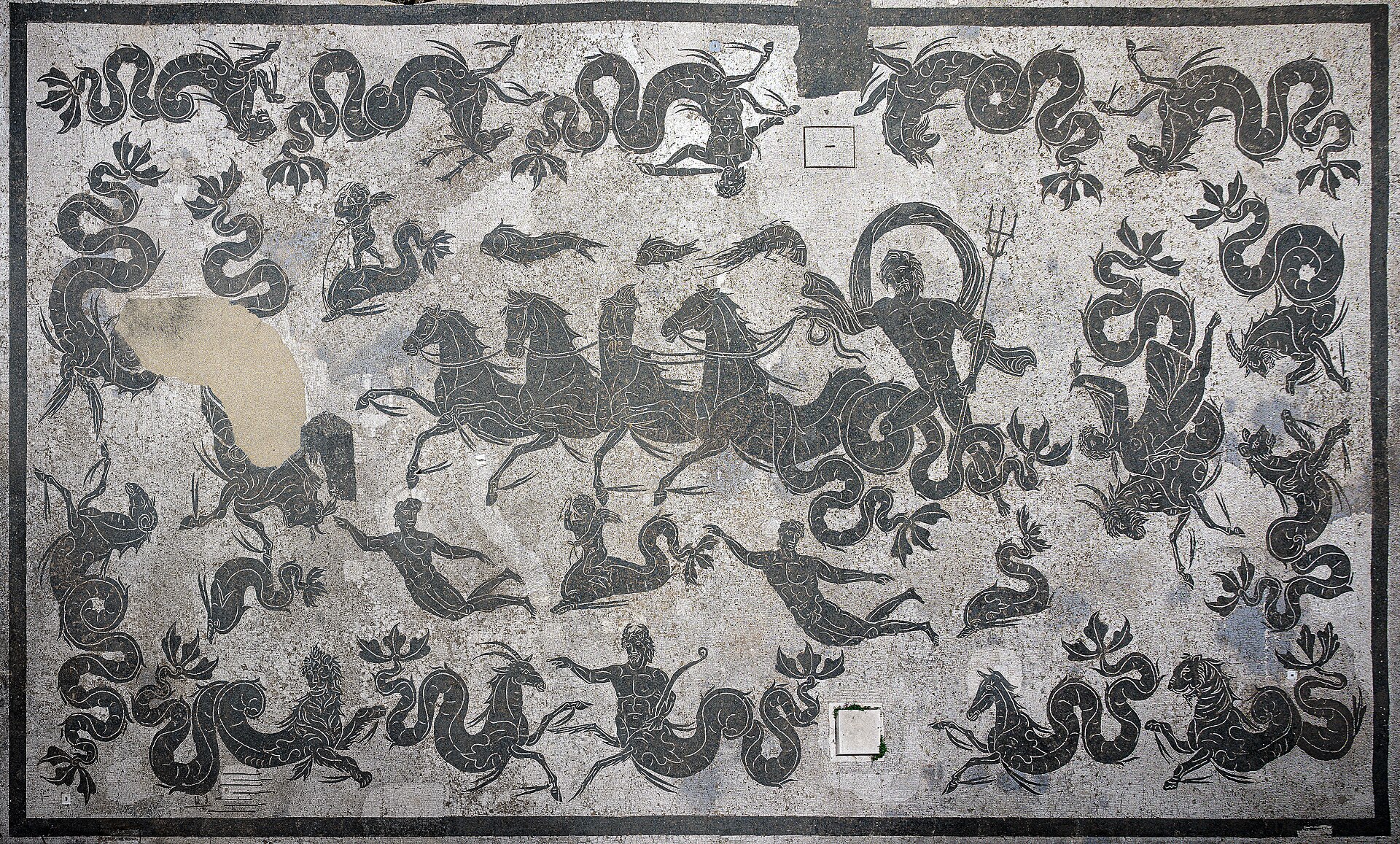
For all that it was a working commercial town, Ostia enjoyed the full range of Roman civic amenities, and their remains are among the site’s chief attractions. The town had numerous public baths, the great social institution of Roman life, and several of them are well preserved. The finest is the Baths of Neptune, whose great halls are floored with magnificent black-and-white mosaics, the largest and most celebrated showing the sea god Neptune driving a team of sea-horses across the water, surrounded by tritons, nymphs, and marine creatures. It is one of the masterpieces of Roman mosaic art and a fitting decoration for a bath in a sea-port.
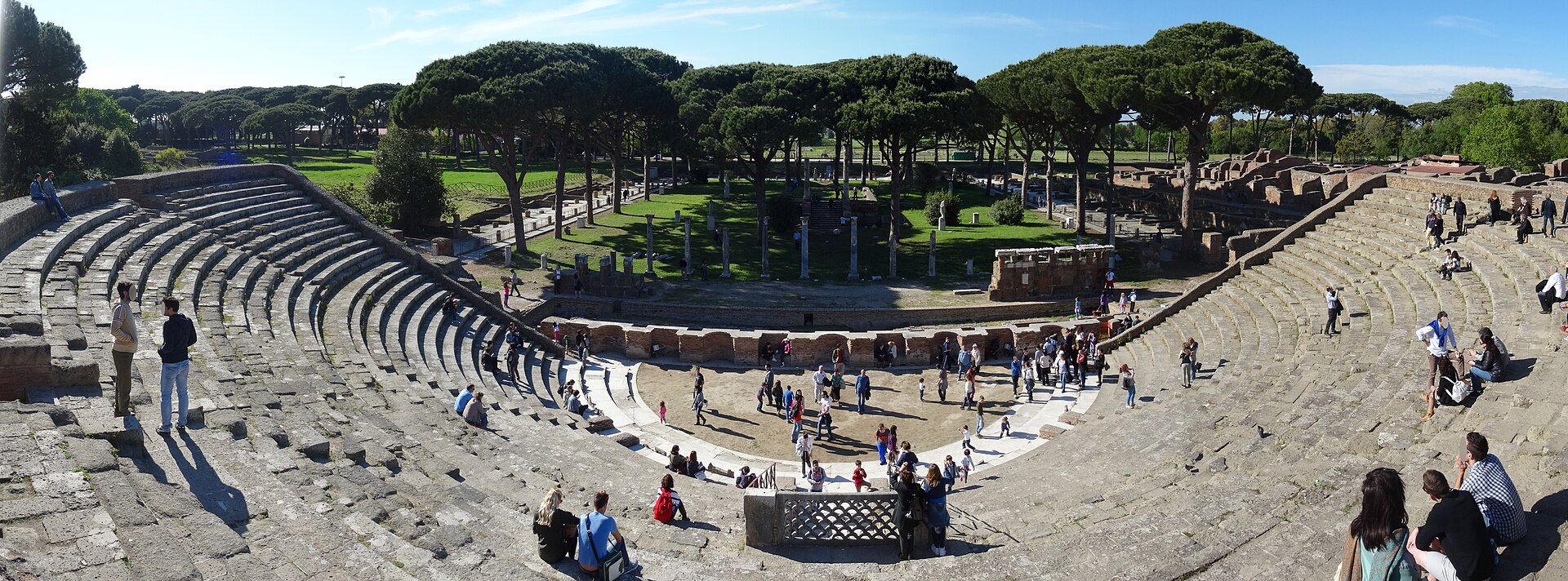
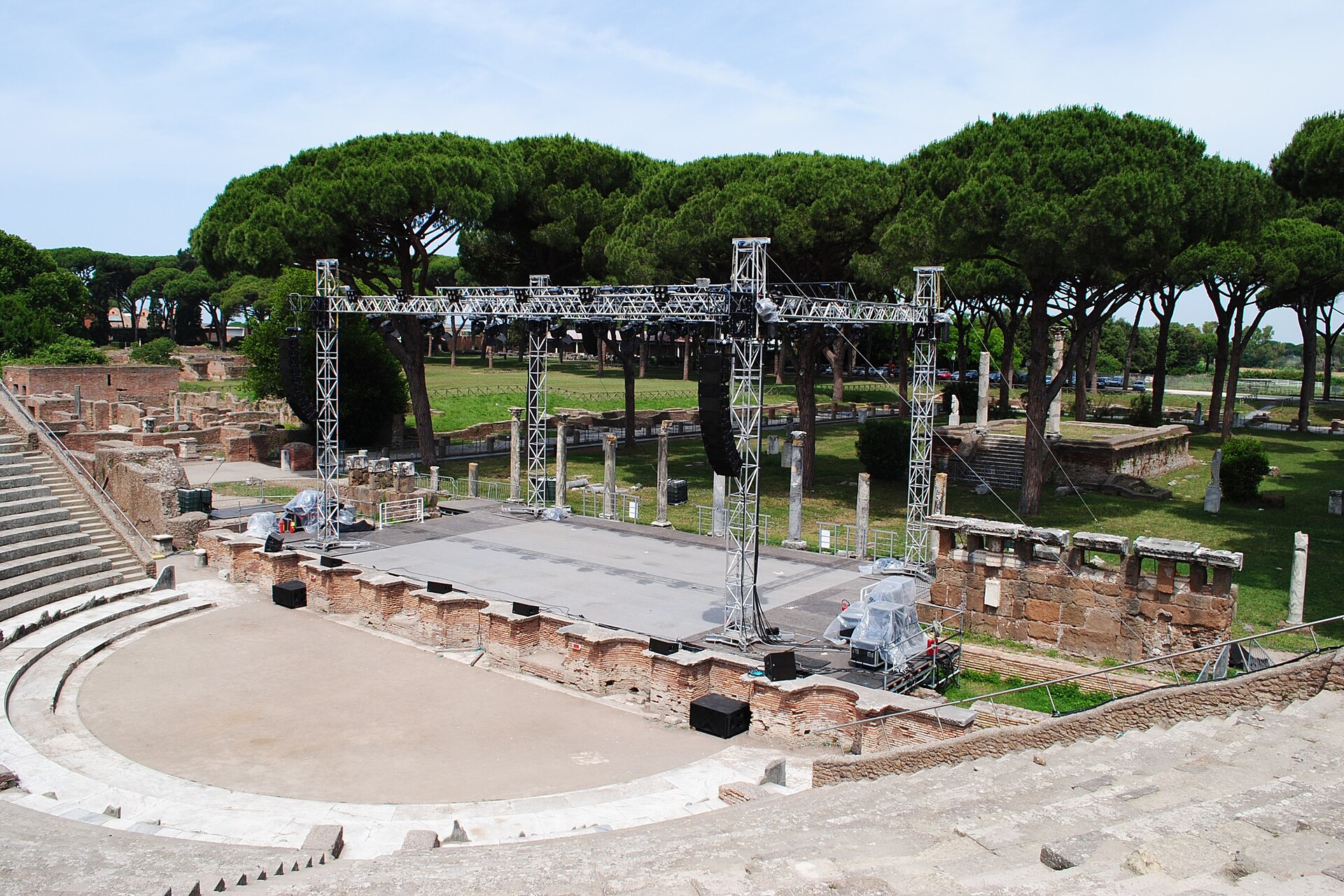
Ostia also had a fine theatre, originally built in the reign of Augustus and later enlarged, which has been restored and can seat a substantial audience; it is still used for performances today, and behind it lies the Square of the Corporations. There were temples, a forum, meeting halls, and all the apparatus of a self-governing Roman town. There were also more humble but revealing amenities: the town preserves examples of Roman public latrines, with their rows of stone seats, and of the thermopolia, the ancient equivalent of bars or snack counters, where workers and travellers could buy food and drink, complete in one case with a painted menu-board and a marble counter.
These public buildings show that Ostia was not merely a soulless industrial zone but a real community with a full civic and social life. Its inhabitants, however busy with the business of the port, bathed, attended the theatre, worshipped their gods, ate and drank in its bars, and gathered in its forum like the citizens of any Roman town. The combination of intense commercial activity with the ordinary amenities of Roman urban living is exactly what makes Ostia so complete and so illuminating a picture of imperial society.
Temples, Forum, and the Gods of a Port
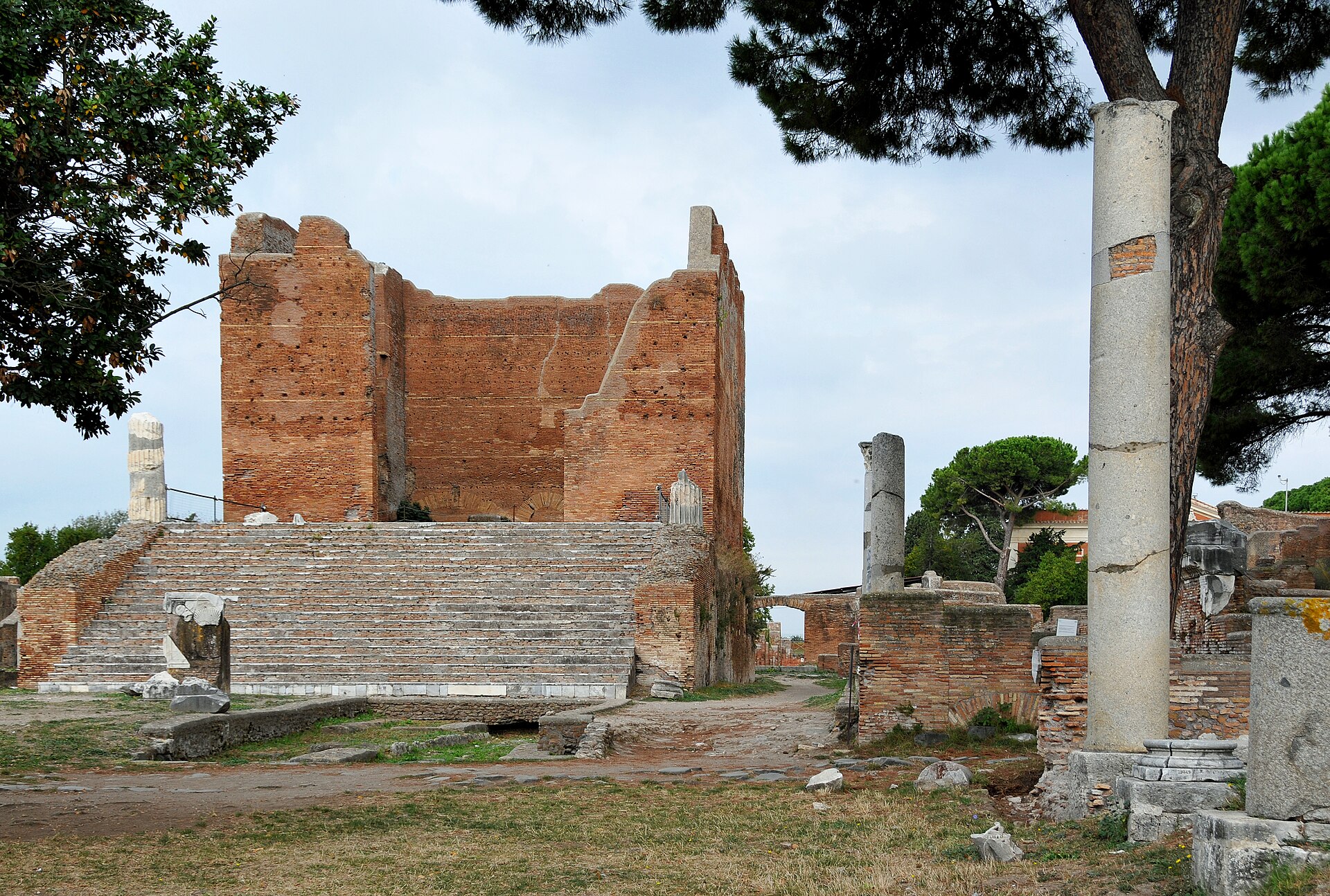
At the center of Ostia, where the two main streets crossed, lay the forum, the civic and religious heart of the town. Dominating it stood the Capitolium, a large temple raised on a high podium and approached by a broad flight of steps, dedicated to the great triad of Roman state gods, Jupiter, Juno, and Minerva. Its towering brick core still rises above the surrounding ruins, one of the most imposing structures on the site and a reminder that even a commercial port placed the official gods of Rome at its symbolic center. Facing it across the forum stood a temple to the deified emperors, expressing loyalty to the imperial power on which the town’s whole existence depended.
But the gods of the Capitoline triad were far from the only deities worshipped at Ostia. As a cosmopolitan port drawing people from across the Mediterranean, the town was home to an extraordinary religious diversity, and its ruins are dotted with sanctuaries to a wide range of gods. There were numerous shrines to Mithras, the mysterious eastern deity whose secretive, male-dominated cult was especially popular among soldiers, merchants, and the kind of mobile, practical men who thronged a trading port; Ostia has yielded a remarkable number of these mithraea, underground sanctuaries with their characteristic imagery of the god slaying a bull.
Alongside these were temples and shrines to the Egyptian goddess Isis, to the Anatolian mother goddess Cybele, and to other deities from the eastern provinces, as well as evidence for a Jewish community, including the remains of one of the oldest synagogues known in the western Mediterranean. This religious variety is a direct reflection of the human variety of the port. The gods worshipped at Ostia were the gods of the whole Roman world, brought there by the sailors, merchants, and immigrants who passed through or settled in the great gateway of the capital, making the town a microcosm of the empire’s spiritual as well as commercial life.
A Cosmopolitan Crowd
The population of Ostia was as mixed and mobile as one would expect of a great international port. At its height in the second century AD the town may have held tens of thousands of people, a diverse crowd of merchants, ship-owners, sailors, dockworkers, warehousemen, craftsmen, officials, slaves, and freed slaves, drawn from all over the Mediterranean world. Many were immigrants or the descendants of immigrants; many were of servile origin, for the Roman economy ran heavily on slave labor, and the port was full of both slaves and the freedmen who, having gained their liberty, often prospered in trade and formed an important part of the town’s commercial class.
Ostian society was organized to a striking degree around the guilds, the collegia, associations of people in the same trade or profession. There were guilds of shippers, of grain measurers, of boatmen, of builders, and of many other occupations, and these bodies played a central role in the economic and social life of the town, both organizing their trades and providing their members with a sense of community, mutual support, and collective identity. The prominence of these guilds, attested in countless inscriptions, reflects the intensely commercial and occupational character of Ostian life, a town where what you did was who you were.
The inscriptions, tombs, and other remains of Ostia give us an unusually rich picture of this working urban population, one that includes the middling and humble ranks of Roman society that are so often invisible in the literary sources. We meet freedmen who rose to wealth and civic honor, guild officials proud of their positions, families commemorating their dead, and the ordinary tradespeople who kept the port running. Ostia, in this sense, is a rare portrait of the Roman world seen not from the top down but from the middle, the town of the merchants and workers who made the empire’s economy function.
Silt, Decline, and Abandonment
Ostia’s fortunes were tied inseparably to those of Rome, and as the empire entered its long troubles in the later centuries, the port declined with the capital it served. The crises of the third century AD, with their wars, instability, and economic strain, hit Ostia hard, and although there was some revival and the town saw the building of fine private houses in the fourth century, its role as the great commercial gateway was fading. The shift of shipping to the harbors at Portus drew activity away from the old town, and as Rome’s population shrank and the western empire weakened, the volume of trade that had sustained Ostia dwindled.
Nature compounded the decline. The Tiber carried a heavy load of silt, and over the centuries this silt steadily built up around the river mouth, extending the coastline seaward and leaving Ostia gradually stranded further and further from the sea that had been its whole reason for existing. The harbors silted, the river shifted, and the geography that had made the town a great port slowly unmade it. What had once been a bustling waterfront became landlocked, and the sea that Ostia had faced for a thousand years retreated beyond reach.
By the early medieval period Ostia was largely abandoned. Its stone and marble were quarried away for building elsewhere, a common fate for ancient cities, and malaria made the marshy, silted-up coastal zone unhealthy and unattractive for resettlement. The great port of imperial Rome sank into ruin and was gradually buried under the silt and sand, its streets and buildings covered over, its very existence fading from memory except as a name. The forces that had built Ostia, the river and the sea, had in the end conspired with the decline of the empire to bury it.
Rediscovering the Port of Rome
The rediscovery of Ostia came slowly and then, in the twentieth century, dramatically. Interest in the ruins revived from the Renaissance onward, and sporadic digging over the following centuries, often in search of statues and marble, brought some of the ancient town to light. But it was in the modern era that Ostia was properly excavated, and much of what visitors see today was uncovered in a great campaign of the 1930s and 1940s, when large areas of the city were cleared in a relatively short time. This was, in part, a project of the Fascist regime, which was eager to display the grandeur of ancient Rome, and the speed of the work reflected that political impulse.
The scale of what emerged was remarkable. Whole districts of the ancient town were revealed, with their streets, apartment blocks, warehouses, baths, temples, and shops, making Ostia one of the largest and most complete excavated Roman cities anywhere. Later archaeology, more careful and scientific, has refined our understanding, and modern techniques including geophysical survey have mapped the buried remains of the town and the harbors beyond the excavated zone, showing that a great deal still lies underground. Even today, only a portion of the full extent of Ostia and Portus has been dug.
The result of all this work is an archaeological treasure of the first rank. Ostia offers what few other sites can: the everyday fabric of a great Roman city preserved on a vast scale, from the towering brick apartment blocks to the mosaic-floored bath halls to the offices of the shipping guilds. For the study of Roman architecture, urbanism, commerce, and daily life, it is indispensable, complementing the picture given by Pompeii and, in the matter of the developed imperial city, surpassing it. The port that fed Rome has become, in its ruins, one of our richest sources for understanding how the Roman world actually worked.
Walking Ostia Antica Today
Today Ostia Antica is one of the most rewarding archaeological sites in Italy, and yet, lying just outside the sprawl of modern Rome and easily reached from the city, it remains far less crowded than Pompeii or the monuments of the capital. Visitors enter along the ancient main street, the Decumanus Maximus, and can wander for hours through a genuine Roman townscape: past the tombs that line the road out of town, through the theatre and the Square of the Corporations, along streets flanked by the tall brick facades of apartment blocks and shops, into the great bath complexes with their gleaming mosaics, and up to the forum with its towering Capitolium.
The pleasure of Ostia lies in its completeness and its atmosphere. Because so much survives and because the site is spacious and green, shaded by umbrella pines and dotted with wildflowers, exploring it feels less like visiting a monument than like walking through a real, if ruined, city. One can climb the stairs of an ancient apartment block, sit in a Roman bar, stand in the middle of a warehouse, and read the shipping mosaics of the Square of the Corporations, all while getting a powerful sense of the ordinary, workaday Roman world. A museum on the site displays sculpture and other finds recovered from the excavations.
For anyone who wants to understand not the Rome of emperors and triumphs but the Rome of merchants, workers, and everyday life, Ostia is the essential place. It shows the city as most Romans knew it: crowded, commercial, cosmopolitan, built upward in brick, alive with trade and the movement of goods and people from across the Mediterranean. To walk its streets is to grasp the astonishing scale and sophistication of the Roman economy, and to stand in the great gateway through which the wealth of an empire once flowed toward its capital.
Nearby Places
- Pompeii: The Roman City That Vesuvius Buried
- The Pyramid of Cestius: An Egyptian Pyramid in Rome
- Filitosa: Corsica’s Ancient Stone Warriors
Final Word
Ostia was the door through which an empire fed its capital. Founded to guard the mouth of the Tiber and grown into the great commercial gateway of Rome, it handled the grain, goods, and peoples of the whole Mediterranean on their way to the largest city of the ancient world, sustained by the vast imperial harbors built to serve it. When Rome declined and the river silted, Ostia was stranded, abandoned, and buried, and in that burial it preserved something uniquely valuable: the everyday architecture of the developed Roman city, its apartment blocks, warehouses, baths, and shops, that the capital itself has lost. Rediscovered and extensively excavated, it stands today as one of the most complete Roman cities anywhere, and the finest place in the world to understand the ordinary, commercial, cosmopolitan life of the Roman Empire at its height.
You May Like
Mafra, the Palace a King Built From a Vow


One thought on “Ostia: Rome’s Great Port, Swallowed by Its Own River”