On an August day in the year 79, or possibly a little later in the autumn, the mountain that had loomed peacefully over the Bay of Naples for as long as anyone could remember tore itself open. Mount Vesuvius sent a column of ash and pumice tens of kilometres into the sky, and over the next two days it rained destruction down on the prosperous Roman towns clustered at its foot. Chief among them was Pompeii, a busy provincial city of perhaps twelve thousand people, which was buried under metres of volcanic debris and erased from the map. The catastrophe was total, but it was also, from the point of view of history, a strange kind of preservation, for the ash that killed Pompeii also sealed it, freezing an entire Roman city at a single moment in time.
No other site in the world offers what Pompeii offers. Most ancient cities were rebuilt, robbed, decayed, and overbuilt across the centuries, leaving archaeologists to piece together fragments. Pompeii was stopped dead and locked away, and when it was rediscovered and excavated it came back not as ruins but as a living city caught in the act of everyday life: shops with their counters, houses with their frescoes and gardens, streets rutted by cart wheels, election slogans painted on the walls, loaves of bread left in ovens, and, most hauntingly, the shapes of the people themselves, preserved in the voids their bodies left in the hardened ash. To walk through Pompeii is to walk through the Roman world as it actually was, on an ordinary day that happened to be its last.
Contents
- A Roman City on the Bay of Naples
- Streets, Shops, and Daily Life
- Houses, Gardens, and Frescoes
- The Forum and Public Life
- Baths, Theatres, and the Amphitheatre
- The Day Vesuvius Erupted
- The Casts of the Dead
- An Eyewitness to Catastrophe
- Digging a City Out of the Ash
- What Pompeii Taught the World
- Pompeii Today
- Nearby Places
- Final Word
A Roman City on the Bay of Naples
Long before it became Roman, Pompeii was already old. Founded by the local Oscan people and shaped over the centuries by Greek and Etruscan influence, it grew up on a low plateau of ancient lava near the mouth of the river Sarno, a few kilometres from the sea on the fertile Bay of Naples. The bay was one of the most desirable stretches of coast in the whole Roman world, its mild climate, rich volcanic soil, and beautiful setting drawing wealthy Romans to build seaside villas all along its shores. Pompeii, standing among them, prospered as a regional market town and port, trading in wine, oil, and the produce of the fertile Campanian countryside.
The town came fully under Roman control in the first century BC, becoming a Roman colony after it backed the losing side in a war against Rome. From then on it was thoroughly Roman in its institutions and increasingly in its culture, though its older Oscan and Greek roots never entirely vanished. By the first century AD it was a thriving, comfortable provincial city, home to merchants, craftsmen, farmers, freed slaves, and a prosperous local elite who competed to fund public buildings and display their wealth in fine houses. It was not a great capital or a famous center of art or power, and that ordinariness is precisely what makes it so valuable: Pompeii shows us not the exceptional Rome of emperors and monuments, but the everyday Roman world in which most people actually lived.
The city had already had a warning of the danger it lived beside. In the year 62, a severe earthquake, now understood as a sign of Vesuvius stirring, struck the region and did great damage to Pompeii. When the eruption came seventeen years later, the town was still repairing and rebuilding from that earlier disaster, with scaffolding up and work unfinished in many places. The Pompeians, like their neighbors, did not recognize Vesuvius as a volcano at all; to them it was simply a fertile green mountain, its slopes covered in vineyards, its deadly nature entirely unsuspected until the day it destroyed them.
Streets, Shops, and Daily Life
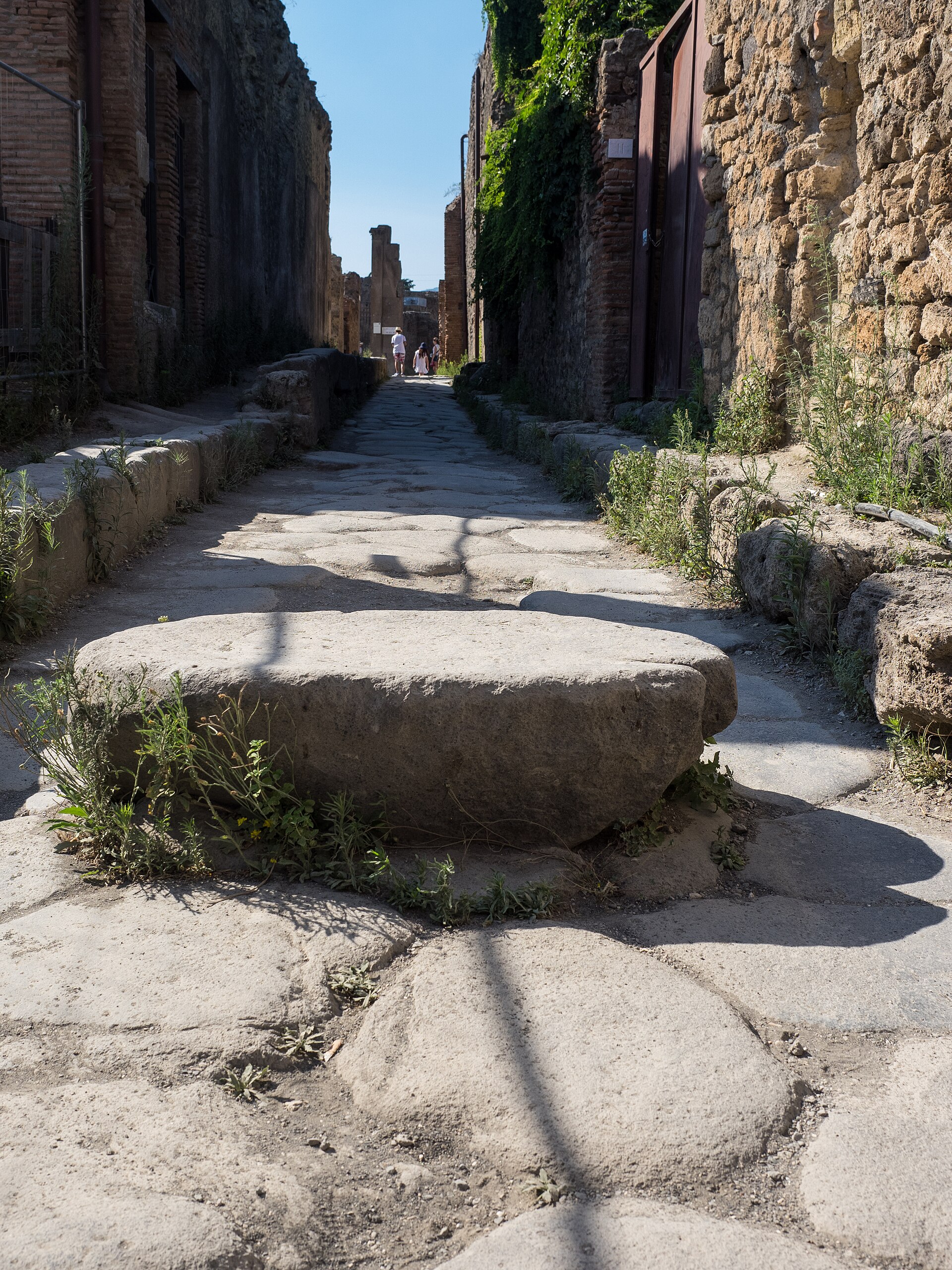
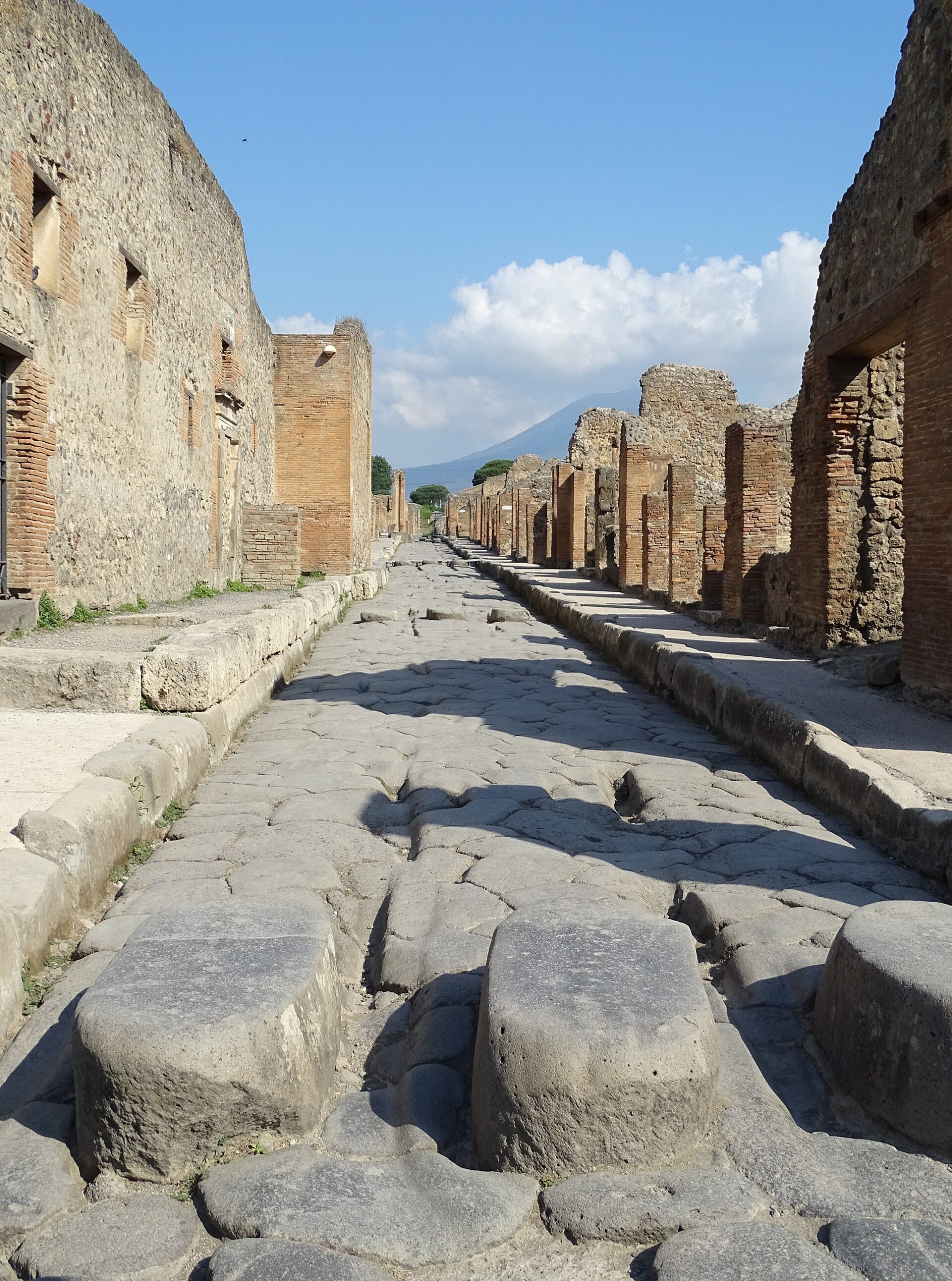
The streets of Pompeii are among the most evocative sights in the whole ancient world, because they survive almost exactly as they were. Paved with large polygonal stones, they were laid out in a grid modified by the older organic growth of the town, and they still bear the ruts worn by centuries of cart traffic. Most striking are the raised stepping stones set across many streets at intervals, allowing pedestrians to cross without stepping into the roadway, which doubled as a drain and could run with water and waste. The gaps between the stones were spaced to let cart wheels pass through, a small but vivid piece of Roman traffic engineering.
Lining the streets were shops and workshops of every kind, their fronts open to the pavement. There were bakeries, complete with their grinding mills and ovens, in one of which carbonized loaves of bread were famously found still inside; there were fulleries where cloth was cleaned, wine shops and food counters, or thermopolia, with their distinctive masonry counters set with jars from which hot food and drink were served to passers-by. Pompeii was a city of small businesses, and the density of commercial premises shows a bustling, busy urban economy where a large part of daily life was lived in public, in the street and the shop rather than behind closed doors.
The walls of Pompeii talk. Scratched and painted graffiti cover them in astonishing quantity, and they are one of the site’s greatest treasures, for they record the unfiltered voices of ordinary people. There are election notices urging support for candidates, advertisements for gladiatorial games, prices, insults, jokes, declarations of love, and the idle scribbles of passers-by. Nowhere else has the casual written life of an ancient city survived on this scale. Through these graffiti, and through the objects found in the shops and houses, Pompeii gives us the everyday texture of Roman urban life more directly than any text ever could.
Houses, Gardens, and Frescoes
Behind the shop fronts lay the houses of Pompeii, and they range from cramped dwellings to grand mansions, all preserved in extraordinary detail. The classic Roman town house, or domus, turned inward, away from the noisy street, and organized itself around open spaces: an atrium near the front, with a central pool to catch rainwater from an opening in the roof, and often a colonnaded garden, or peristyle, toward the back. This inward-looking plan gave the wealthy privacy, light, and air, and the finest Pompeian houses, such as the House of the Faun or the House of the Vettii, are spacious and luxurious, with multiple courtyards, elegant gardens, and richly decorated rooms.
The glory of these houses is their wall painting. Pompeii and its neighbors have preserved the richest collection of Roman frescoes in existence, and from them scholars have reconstructed the whole development of Roman interior decoration. The walls of Pompeian rooms were painted with imitation marble, with architectural fantasies that seemed to open the wall into imaginary vistas, with mythological scenes, landscapes, still lifes, and portraits. The colors, deep reds, blacks, and golds, remain astonishingly vivid, and the quality of the best work is very high. Alongside the frescoes, floors were often laid with intricate mosaics, some of them, like the great mosaic of Alexander battling the Persian king, masterpieces of ancient art.
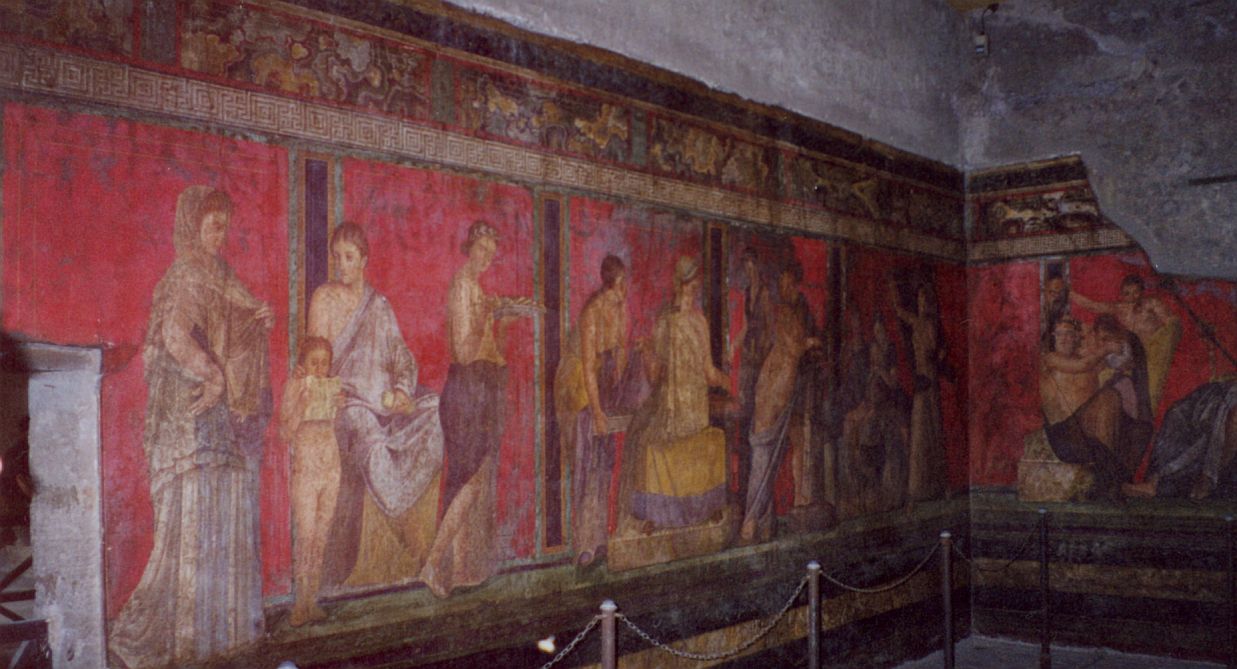
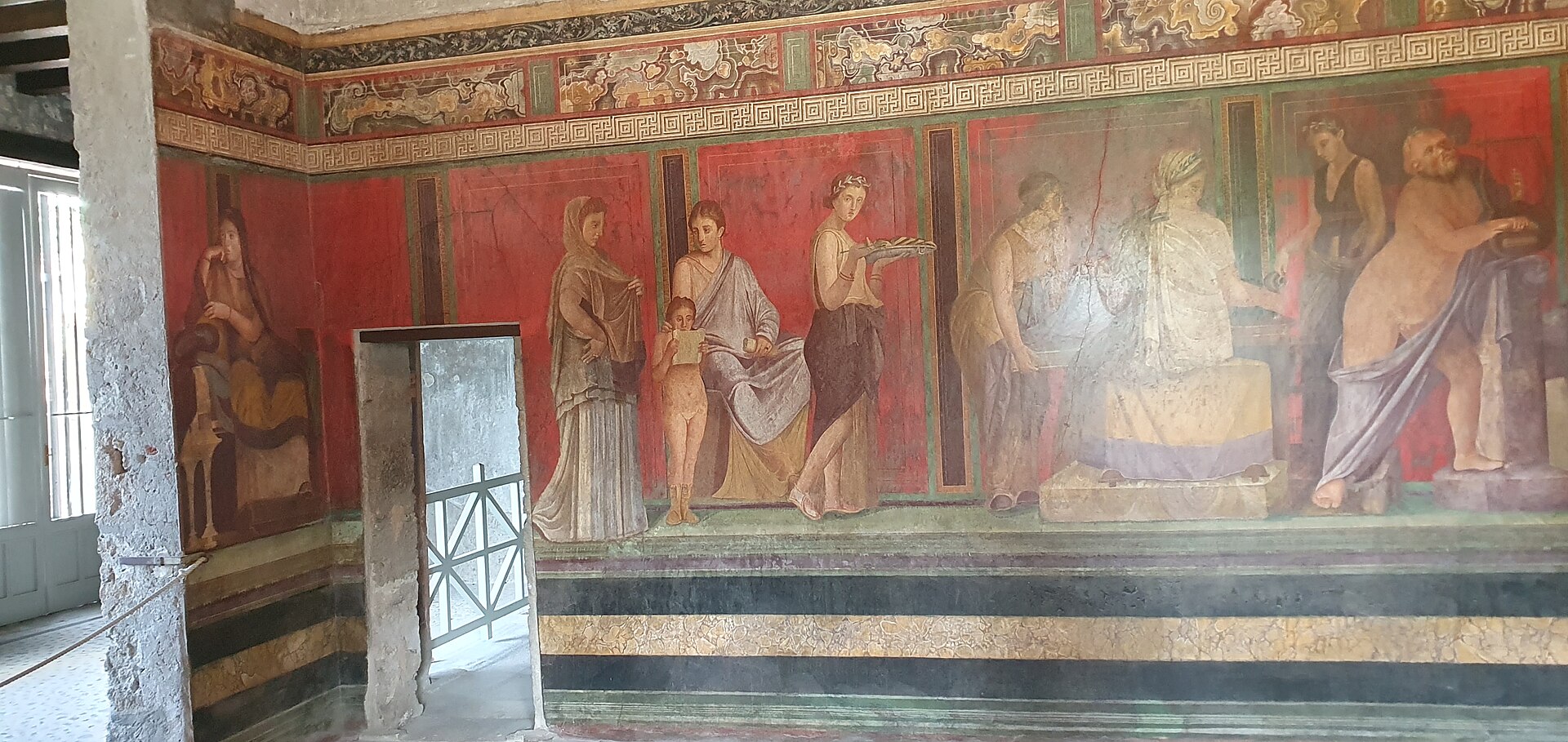
The gardens deserve special mention, because Pompeii has allowed archaeologists to reconstruct Roman gardens in remarkable detail. By studying the cavities left by roots in the hardened ash, researchers have identified the very plants the Pompeians grew, and some gardens have been replanted with the same species. Adorned with fountains, sculptures, and painted garden scenes on their walls that made them seem larger and more lush, these green courtyards were the heart of the domestic ideal, bringing nature, beauty, and tranquillity into the middle of the busy town. The Pompeian house, with its frescoed rooms opening onto a planted peristyle, is one of the most complete pictures we have of how the Roman elite actually lived.
The Forum and Public Life
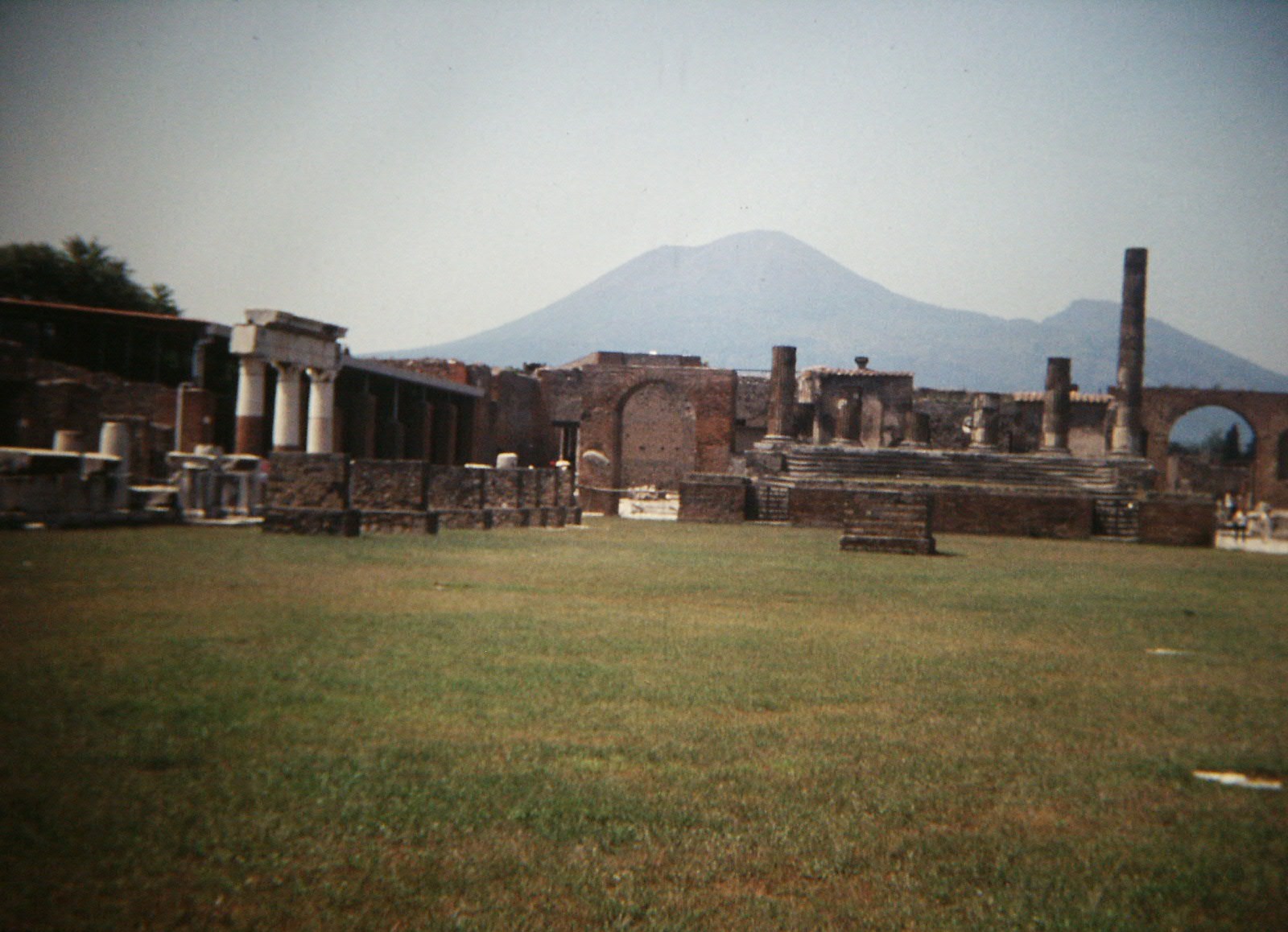
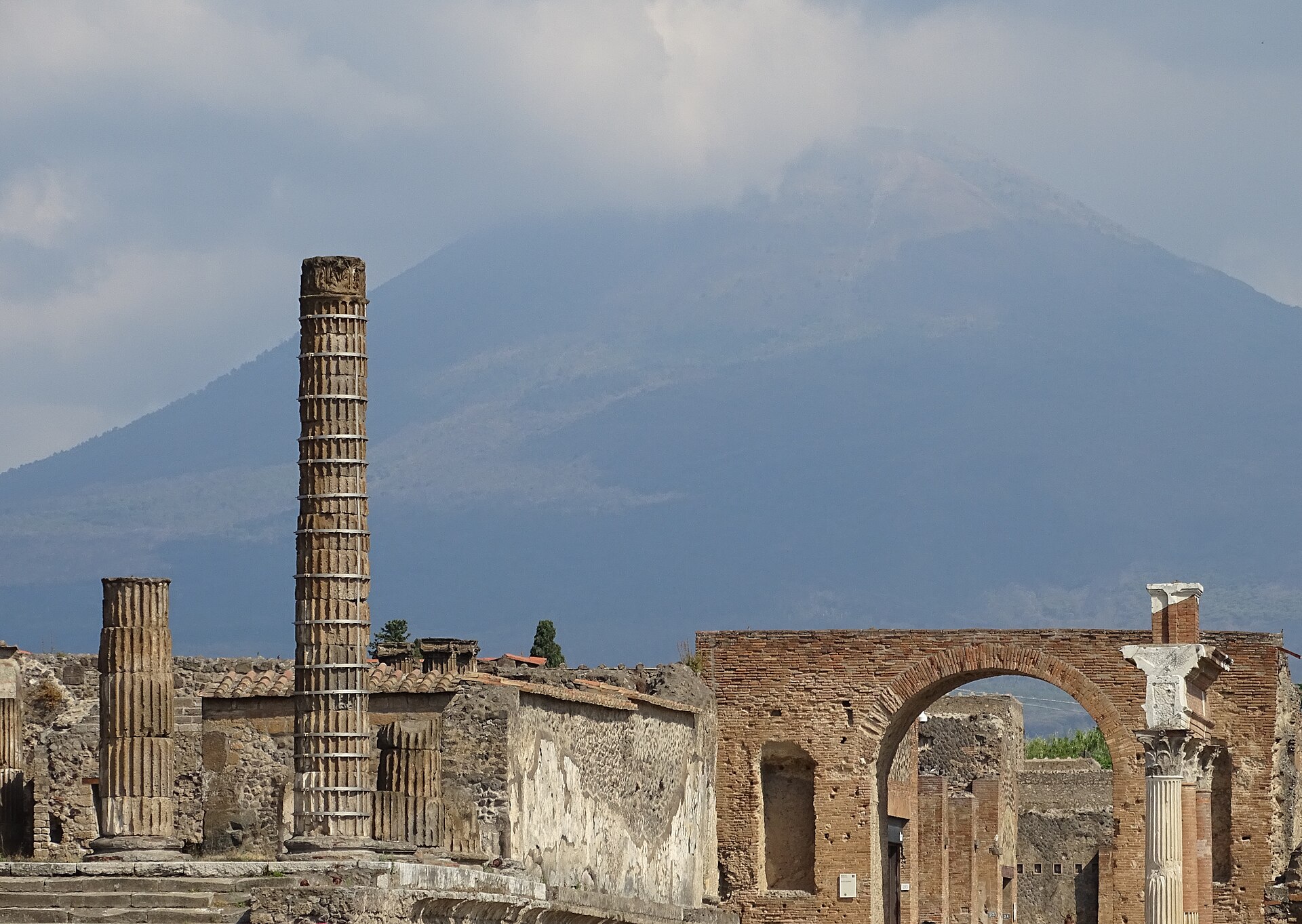
The civic heart of Pompeii was its forum, a large rectangular open space at the western end of the town, surrounded by the most important public buildings and framed, in the view that has become the city’s iconic image, by the brooding cone of Vesuvius beyond. Here was the center of the city’s political, religious, and commercial life. The forum was a pedestrian plaza, closed to carts, ringed by colonnades and lined with statues of local worthies and imperial figures, a place where citizens gathered to do business, hear news, attend to legal and civic matters, and take part in public ceremonies.
Around the forum stood the buildings that expressed the town’s identity. There was the basilica, the great hall that served as a law court and center of business; temples to Jupiter, to Apollo, and to the imperial cult; the macellum, a covered market for meat and fish; and the offices of the town’s magistrates and council. There was also the building associated with a priestess named Eumachia, a wealthy patroness whose funding of it advertised both her piety and her family’s standing. Together these structures show how a Roman town governed itself and expressed its collective life, with religion, law, commerce, and civic pride all gathered into a single monumental space.
The forum also reveals the disaster that preceded the eruption. Much of it was still under repair in 79, damaged by the earthquake of 62 and not yet fully restored. This unfinished state, visible in the archaeology, is a poignant reminder that Pompeii met its end while still recovering from an earlier warning it had failed to understand. The mountain that dominates every view of the forum was already at work beneath the surface, and the Pompeians, rebuilding their civic center, had no idea that their labor would soon be buried along with everything else.
Baths, Theatres, and the Amphitheatre
The Pompeians knew how to enjoy themselves, and the city was well supplied with the amenities of Roman leisure. Several public bath complexes served the population, and they are beautifully preserved, allowing us to trace the whole ritual of the Roman bath: the changing rooms, the cold room or frigidarium, the warm tepidarium, and the hot caldarium, heated by an ingenious system of hollow floors and walls through which hot air from furnaces circulated. The baths were not merely for cleanliness; they were social centers where people met, talked, exercised, and relaxed, and their sophistication shows the comfort and conviviality of Roman urban life.
For entertainment the city had two theatres, a larger open-air one for plays and a smaller roofed odeon for music and recitations, both preserved well enough to be used for performances even today. But the most famous of Pompeii’s places of public spectacle is its amphitheatre, at the eastern edge of the town. Built in the first century BC, it is the oldest surviving permanent stone amphitheatre in the Roman world, predating the great Colosseum of Rome by more than a century, and it could hold much of the town’s population. Here the Pompeians gathered to watch the gladiatorial games that were among the most popular entertainments of the age.
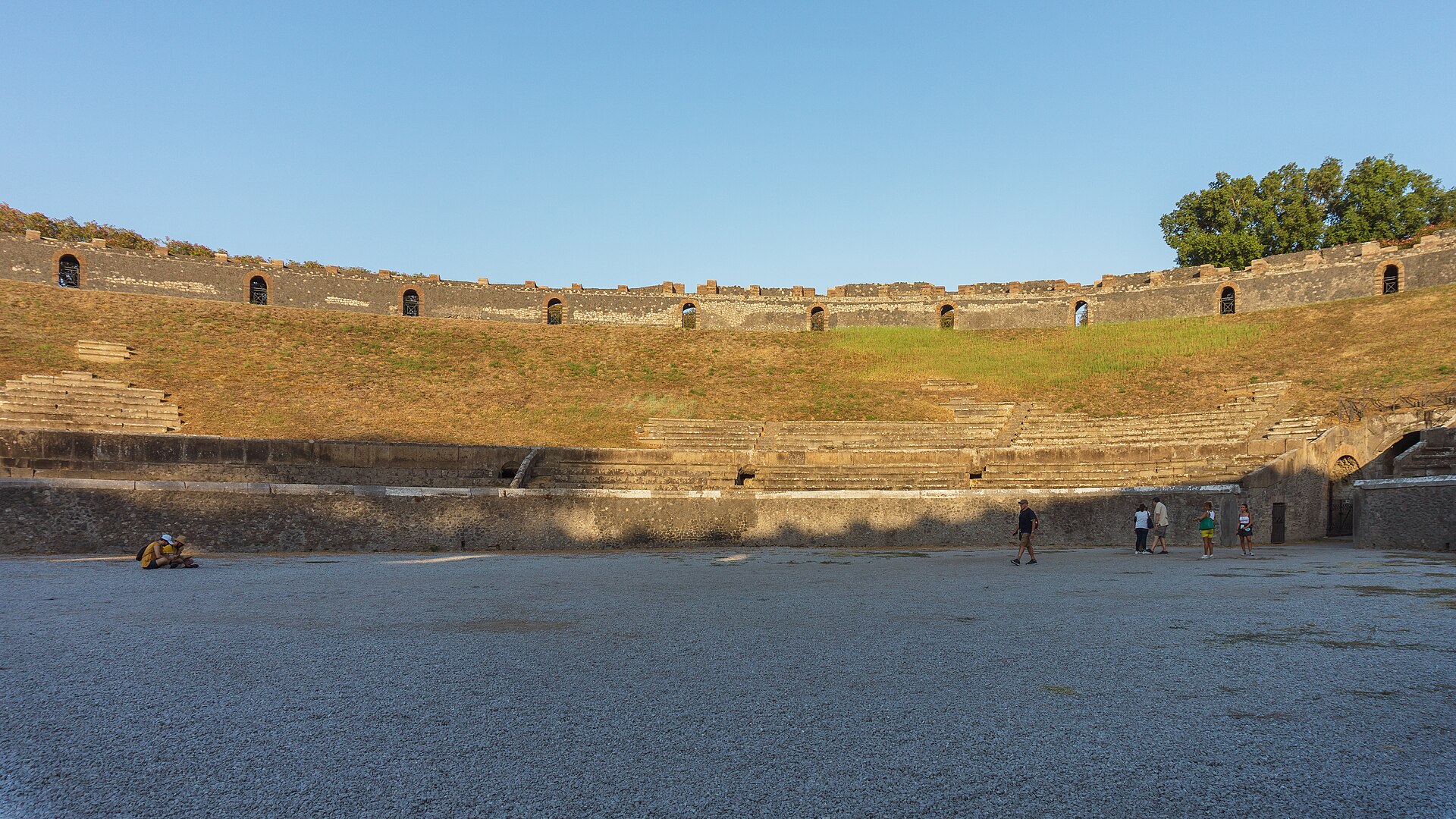
The amphitheatre was also the scene of one of the best-documented episodes of Pompeian daily life, and one of its ugliest. In the year 59, a riot broke out during the games between the people of Pompeii and visitors from the neighboring town of Nuceria, ending in bloodshed. The affair was serious enough to reach the emperor Nero and the Roman senate, which banned games at Pompeii’s amphitheatre for a period as punishment, and a fresco found in the town actually depicts the brawl. It is a vivid reminder that the Pompeians were not idealized ancients but real people, capable of passion, rivalry, and violence, whose ordinary and sometimes disorderly lives the ash preserved along with their buildings.
The Day Vesuvius Erupted
The eruption of Vesuvius in AD 79 unfolded over roughly two days, and volcanologists studying the deposits have been able to reconstruct its terrible sequence in detail. It began with a colossal explosion that drove a towering column of ash, pumice, and gas high into the stratosphere, a type of eruption now named Plinian after the eyewitness who described it. For hours this column rained pumice and ash down on Pompeii, which lay downwind, piling up on roofs and streets. Many Pompeians fled during this phase; others sheltered indoors, hoping to wait out the fall, some taking refuge in cellars and rooms that would become their tombs as the weight of accumulating debris collapsed roofs across the city.
The deadliest phase came later, when the eruption column collapsed and sent pyroclastic surges racing down the mountain: fast-moving avalanches of superheated gas and ash that swept across the landscape at great speed and killed almost instantly. It was these surges, rather than the earlier pumice fall, that killed most of those who had remained in and around Pompeii and the neighboring towns, overwhelming them with heat and choking ash. The nearby town of Herculaneum, closer to the mountain, was engulfed by these surges and buried even more deeply than Pompeii, under a thick, hardened flow that sealed and carbonized organic materials, preserving wood, food, and other perishable things that rarely survive.
By the time the mountain fell quiet, the towns at its foot had vanished. Pompeii lay under some four to six metres of ash and pumice, Herculaneum under far more, and the entire fertile, densely settled landscape of the mountain’s southern slopes had been transformed into a grey wasteland. The very shape of the coastline had changed, and the map of the Bay of Naples was permanently redrawn. The disaster passed into legend, but the towns themselves were, in a real sense, forgotten, their exact locations eventually lost, sleeping under the ash for centuries until the modern age brought them back to light.
The Casts of the Dead
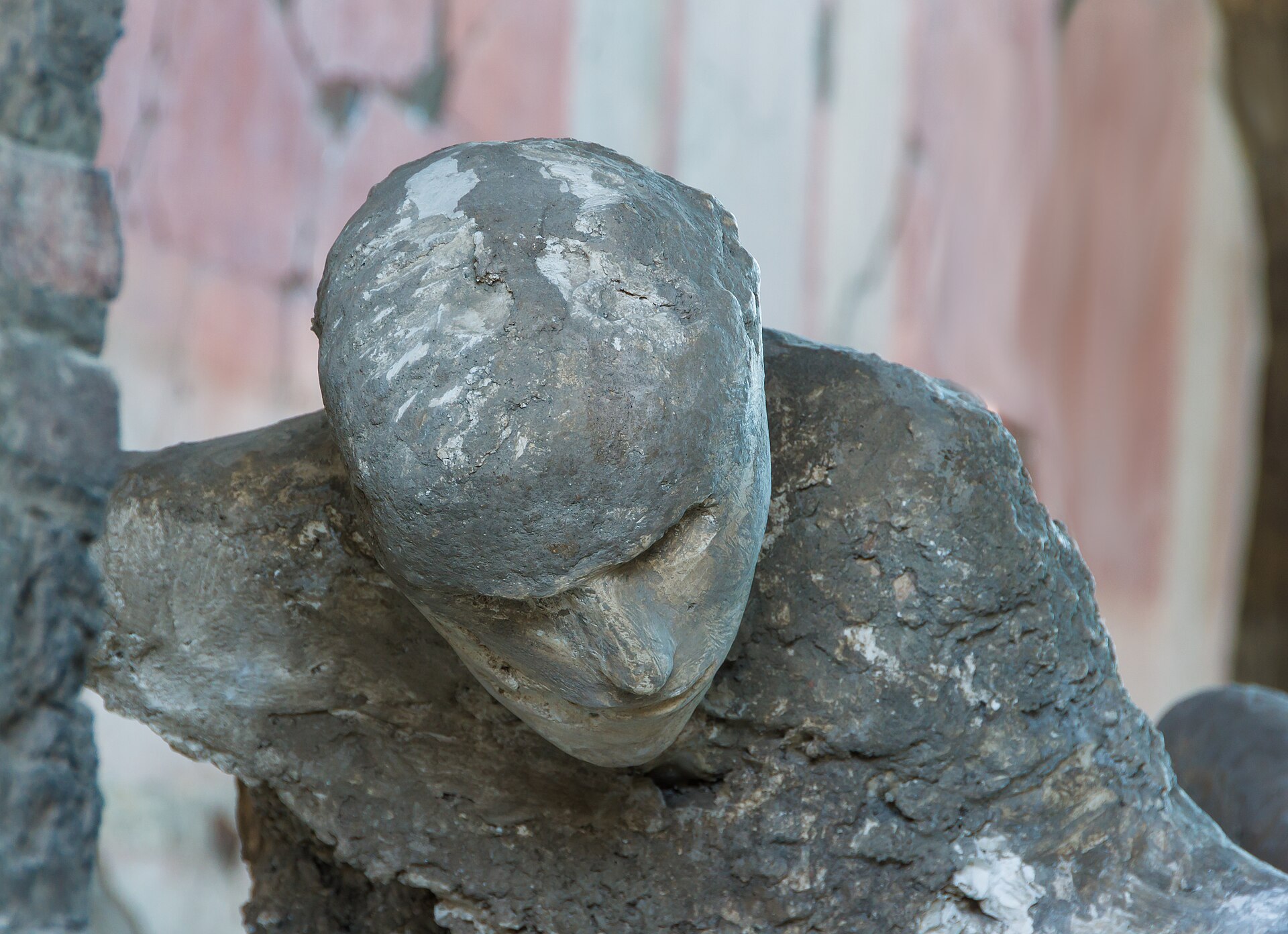
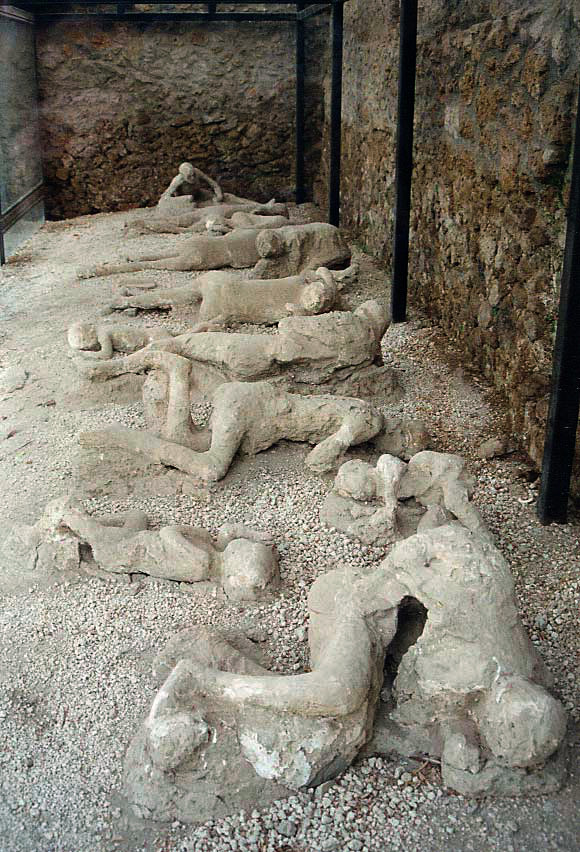
The most famous and most moving discovery at Pompeii is also one of the most ingenious. As the fine ash that buried the victims hardened around their bodies, it took the exact shape of them, and then, as the soft tissue decayed, it left behind hollow voids in the solidified ash, cavities in the precise form of the dying person. For a long time excavators simply broke through these voids without understanding them. Then, in the nineteenth century, the archaeologist Giuseppe Fiorelli realized what they were and devised a technique to recover them: by pouring liquid plaster into the void and letting it set, then digging away the surrounding ash, he could produce a cast of the victim exactly as they had been at the moment of death.
The results are among the most powerful objects in all of archaeology. The casts show the people of Pompeii in their final moments: figures curled up, covering their faces, embracing one another, a family together, a person shielding a child, even the shapes of clothing and, in some cases, expressions of anguish. They confront the modern visitor not with the abstract idea of an ancient disaster but with individual human beings caught in the act of dying, and they collapse the distance of nineteen centuries in an instant. No other ancient site preserves its dead in this way, and the casts have become the enduring image of Pompeii’s tragedy.
They are also, increasingly, a source of scientific knowledge. Modern study of the casts and of the skeletal remains within some of them, using techniques from CT scanning to DNA analysis, has begun to reveal details about the health, diet, age, and even the family relationships of the victims. The casts, first made simply to recover the shapes of the dead, have become windows into the biology of the Pompeian population. But their deepest power remains emotional: they are the reason Pompeii is not experienced as a ruin but as a place where real people lived, and died, and were, in their last moments, preserved.
An Eyewitness to Catastrophe
Uniquely among the great disasters of antiquity, the destruction of Pompeii has a genuine eyewitness account, written by someone who watched it happen. The young Pliny, known to history as Pliny the Younger, was staying across the bay at Misenum with his uncle, the famous naturalist and admiral Pliny the Elder. Years later, at the request of the historian Tacitus, the younger Pliny wrote two letters describing what he had seen, and they remain our most precious literary source for the event, so important that the very type of eruption is named after them.
Pliny described the strange cloud that rose from the mountain, shaped, he wrote, like a great tree, an umbrella pine, with a tall trunk spreading into branches at the top, one of the most accurate descriptions of a volcanic eruption column ever written. He recounted the darkness that fell, the ash and pumice, the earth tremors, the panic of the population, and the eerie experience of a day turned to night. His account is vivid, humane, and remarkably observant, capturing both the physical phenomena and the human terror of the disaster with the clarity of a real witness rather than the embellishment of a later legend.
The letters also record a personal tragedy. Pliny the Elder, driven by both duty and scientific curiosity, took ships across the bay to rescue people trapped by the eruption and to observe the phenomenon at close range. He landed at Stabiae, near the mountain, and there, overcome by the fumes and ash, he died, one of the most famous victims of Vesuvius and, in a sense, a martyr to his own inquiring mind. His nephew’s account of his death, calm and dignified even as disaster closed in, has fixed the elder Pliny in memory as the very image of the natural philosopher who paid with his life for his desire to understand the natural world.
Digging a City Out of the Ash
For nearly seventeen centuries Pompeii lay forgotten, its very location lost, until the eighteenth century brought it back to light. The rediscovery began nearby at Herculaneum, where well-digging in the early 1700s struck ancient remains, and then extended to Pompeii, where digging began in earnest in 1748 under the patronage of the Bourbon kings of Naples. These early excavations were as much treasure hunting as archaeology, tunneling in search of statues, frescoes, and precious objects to adorn royal collections, often with little record of where things were found. But they revealed to an astonished Europe that a whole Roman city lay preserved beneath the ground.
The discovery had an enormous cultural impact. As word and images of Pompeii and Herculaneum spread, they fueled a wave of fascination with the classical past that helped shape the Neoclassical movement in art, architecture, and design across Europe. The wall paintings, furniture, and everyday objects gave artists and designers a direct, detailed picture of Roman taste, and Pompeian motifs began to appear in the decoration of grand houses far from Italy. The buried city became one of the great inspirations of the age, a real window into the antiquity that Europe so admired.
Over the following centuries, excavation gradually became more scientific. Giuseppe Fiorelli, who took charge in the nineteenth century, introduced more systematic methods, dividing the city into regions and blocks for recording, insisting on careful documentation, and inventing the technique of casting the victims. Later directors continued to refine the work, and the emphasis shifted from extracting objects to understanding the city as a whole and, crucially, to conserving what was uncovered. Even today, much of Pompeii remains unexcavated, deliberately left in the ground both as a reserve for future archaeologists with better techniques and because so much of what has already been exposed demands constant care.
What Pompeii Taught the World
The importance of Pompeii to our knowledge of the ancient world is almost impossible to overstate. Because it was preserved whole and at a single moment, it is the closest thing we have to a photograph of Roman daily life. Nearly everything we know in concrete detail about how ordinary Romans lived, their houses and furniture, their food and cooking, their shops and trades, their gardens and gods, their graffiti and their games, is illuminated by Pompeii and its neighbors. Where literary sources tell us about emperors, wars, and the doings of the great, Pompeii tells us about the bakery on the corner and the family in the house next door.
The site has also been fundamental to the development of archaeology itself. Techniques pioneered or refined at Pompeii, from Fiorelli’s casting method to modern approaches in conservation, environmental archaeology, and the study of ancient diet and health, have influenced the discipline far beyond Italy. The challenges of the site, above all the problem of conserving a huge, fragile, exposed ancient city, have driven advances in how archaeological heritage is protected and managed. Pompeii has been, in effect, a vast laboratory in which the science of studying the past has been continually tested and improved.
And Pompeii endures in the imagination as few ancient places do. It has inspired novels, paintings, operas, films, and endless retellings, drawn by the potent combination of a vivid, relatable ancient life and a sudden, dramatic death. The image of the doomed city going about its ordinary business beneath a mountain about to destroy it has a permanent hold on the human mind, a memento mori on the scale of a whole city. Pompeii is at once the most ordinary and the most extraordinary of ancient sites: ordinary in what it shows, extraordinary in that it shows it at all.
Pompeii Today
Today Pompeii is one of the most visited archaeological sites in the world, drawing millions of people each year to walk its ancient streets in the shadow of Vesuvius, which still smokes gently on the horizon and remains an active and closely monitored volcano. The excavated area is vast, an entire city that takes many hours to explore, and visitors can wander through its streets, enter its houses, stand in its forum and amphitheatre, and see the plaster casts of its victims. Alongside it, the smaller but even more deeply buried Herculaneum offers a complementary experience, with its remarkable preservation of wood and other organic materials.
The scale and fragility of Pompeii make its preservation an enormous and ongoing challenge. Exposed to weather, vegetation, and the sheer pressure of mass tourism, the ancient city requires constant conservation, and there have been periods of neglect and dramatic collapses that drew international concern. In recent years major conservation projects have worked to stabilize and restore the site, combining traditional methods with new technologies, and continuing excavation in previously undug areas has produced spectacular fresh discoveries, showing that Pompeii still has much to reveal. The site is inscribed, together with Herculaneum and the nearby villas, as a UNESCO World Heritage site.
For the visitor, the experience is unlike any other ruin. Because so much survives, and survives so vividly, Pompeii does not feel like a place long dead but like a city its inhabitants have only just left. The ruts in the streets, the counters of the shops, the frescoes on the walls, the gardens, and above all the casts of the dead combine to collapse the centuries and bring the Roman world startlingly close. To spend a day in Pompeii is to understand the ancient past not as an abstraction but as a lived reality, and to carry away an image of it that no book or museum can quite match.
Nearby Places
- The Pyramid of Cestius: Why There Is an Egyptian Pyramid in Rome
- Filitosa: Corsica’s Ancient Stone Warriors
- Ħaġar Qim: Malta’s Cliff-Top Temple Older Than the Pyramids
Final Word
Pompeii is the city that died so completely that it survived. When Vesuvius buried it in AD 79, the ash that ended a Roman town at the height of its ordinary life also sealed it away, preserving its streets and shops, its houses and gardens, its frescoes and graffiti, and the very shapes of its people, in a way no other ancient place can match. Rediscovered after seventeen centuries, it gave the modern world an unparalleled window into how the Romans actually lived, reshaped the science of archaeology, and fixed itself permanently in the human imagination as the image of a vivid life cut short by sudden catastrophe. To walk through Pompeii, beneath the mountain that destroyed it, is to meet the ancient world not as history but as a place, and to feel, across nineteen centuries, the nearness of the people who once called it home.
You May Like
Norse Explorers Reached Canada 500 Years Before Columbus


One thought on “Pompeii: The Roman City Vesuvius Buried on an Ordinary Day”