The Ashaninka are the largest Indigenous people of the Peruvian Amazon, an Arawak-speaking nation whose river-based homeland stretches across the forested foothills of central Peru. Their history includes one of the most successful sustained Indigenous uprisings against Spanish colonial rule anywhere in the Americas, centuries of resilience through the rubber boom, and a more recent, painful chapter of displacement during Peru’s internal armed conflict. This article traces Ashaninka origins, language, and way of life through to the challenges and organizing efforts shaping their communities today.
Contents
- Origins
- Name
- Language
- Homeland
- Old way of life
- Society
- Religion
- Traditions
- Crafts
- Food
- Festivals
- History
- Today
Origins
The Ashaninka are the largest Indigenous people of the Peruvian Amazon, with a homeland stretching across the forested foothills and lowlands of central Peru, in a region where the Andes give way to the great river basin below. They belong to the Arawak language family, one of the most widely dispersed Indigenous language families in the Americas, whose speakers are found from the Caribbean to the southern reaches of the Amazon basin, a distribution that points to a long and complex history of migration across the continent over many centuries.

Archaeological and linguistic evidence suggests Arawak-speaking peoples began spreading through lowland South America several thousand years ago, likely originating somewhere in the northwestern Amazon basin before fanning out along river systems that served as natural highways through otherwise difficult terrain. The ancestors of the Ashaninka are thought to have settled in the montane and lowland forests along the Apurimac, Ene, Tambo, Perene, and Ucayali rivers at some point in this long process, establishing a homeland whose river geography would shape their society for centuries afterward.
Unlike the great Andean civilizations to their west, the Ashaninka and neighboring Amazonian peoples did not build large stone cities or centralized states, instead developing a social and political organization suited to the dispersed, resource-patchy environment of the tropical forest. This has sometimes led outside observers to underestimate the sophistication of Ashaninka society, when in fact their patterns of settlement, trade, and resource management reflect a long-refined adaptation to one of the most ecologically complex environments on earth.
The Ashaninka also maintained contact and exchange with Andean peoples to the west, including the Inca state, whose expansion into the eastern forest margins in the fifteenth century brought Inca influence to the edges of Ashaninka territory without ever fully incorporating it. This position, at the boundary between the Andean highlands and the Amazon lowlands, placed the Ashaninka in a strategic middle ground that shaped centuries of subsequent history, from Inca contact through Spanish colonization and into the present day.
Name
The name most commonly used today, Ashaninka, derives from a term in their own language that is generally translated as “our kin,” “our people,” or “our relatives,” reflecting a self-designation built around kinship rather than a geographic or political label. Closely related groups, sometimes considered dialectal variants and sometimes classified as distinct but closely linked peoples, include the Asheninka, Nomatsiguenga, and Kakinte, all speaking mutually intelligible or closely related Arawakan languages and sharing significant cultural overlap with the Ashaninka proper.
For much of the colonial and early republican period, Spanish-language sources referred to the Ashaninka and related peoples using the term “Campa,” a label of disputed and likely external origin that came to carry pejorative connotations over time. This term appears throughout colonial missionary records, nineteenth-century travel accounts, and even some twentieth-century anthropological literature, but has been increasingly abandoned in favor of Ashaninka and related self-designations as scholars and the Peruvian state have moved toward using the names Indigenous peoples use for themselves.
The shift away from “Campa” toward “Ashaninka” mirrors a broader pattern seen across Indigenous naming conventions throughout the Americas, in which colonial-era exonyms, often based on incomplete understanding or outright insult, are gradually replaced by the terms communities use internally. Peruvian law and government agencies now generally use Ashaninka in official contexts, and the term has become the standard reference in international human rights reporting and academic literature concerning this population.
It is worth noting that Ashaninka identity, like many Amazonian ethnic categories, has never been a single rigid box but rather a flexible and evolving sense of belonging built on language, kinship, shared territory, and shared historical experience, particularly experience of external threat, whether from Inca expansion, rubber-boom exploitation, or modern land encroachment. This flexibility has allowed Ashaninka identity to persist and adapt across centuries of dramatic change while remaining recognizably continuous with earlier generations.
Language
Ashaninka belongs to the southern branch of the Maipurean, or Arawakan, language family, one of the largest and most geographically dispersed Indigenous language families in the Americas, with member languages historically spoken from the Caribbean islands to as far south as Bolivia and Paraguay. Within this large family, Ashaninka is most closely related to Asheninka, Nomatsiguenga, Matsigenka, and several other languages of the Peruvian and Brazilian Amazon, together forming what linguists sometimes call the Kampan subgroup, referencing the older, now largely retired “Campa” label.
With an estimated speaker population in the tens of thousands, Ashaninka remains one of the more vigorously spoken Indigenous languages of the Peruvian Amazon, though it faces the familiar pressures confronting Indigenous languages worldwide, including the dominance of Spanish in schooling, media, and government administration. Intergenerational transmission remains reasonably strong in more remote Ashaninka communities along the upper tributaries of the Ene and Tambo rivers, while communities closer to towns and colonist settlements show greater rates of language shift toward Spanish, particularly among younger generations.
Bilingual intercultural education programs, developed in Peru since the late twentieth century with input from Ashaninka educators and linguists, have sought to support Ashaninka-language literacy and formal schooling in the language, though implementation and resourcing remain uneven across different regions and school districts. Missionary linguists, particularly evangelical Protestant groups working from the mid-twentieth century onward, produced some of the earliest systematic grammars, dictionaries, and Bible translations in Ashaninka, work that, whatever one thinks of its religious motivations, has left a substantial body of linguistic documentation still used by scholars today.
Ashaninka grammar reflects broader Arawakan patterns, including a complex system of verbal prefixes and suffixes that encode person, tense, aspect, and evidentiality, meaning the grammar itself often signals how a speaker knows what they are reporting, whether through direct observation, inference, or hearsay. This grammatical feature, common across many Amazonian languages but unfamiliar to speakers of European languages, reflects a cultural emphasis on the source and reliability of knowledge that runs through many aspects of Ashaninka social and spiritual life.
Homeland
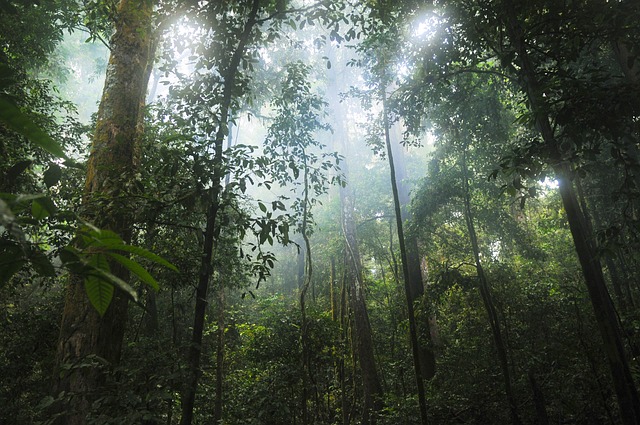
Ashaninka territory spans a broad swath of central Peru’s Amazonian foothills and lowlands, covering parts of the regions of Junin, Pasco, Huanuco, Ucayali, and Cusco, along the watersheds of the Apurimac, Ene, Tambo, Perene, Pichis, and Ucayali rivers. This territory sits at the ecological transition zone often called the ceja de selva, or “eyebrow of the jungle,” where Andean cloud forest gives way to lowland Amazonian rainforest, producing an unusually rich diversity of plant and animal life that has shaped Ashaninka subsistence for centuries.

Rivers rather than roads have traditionally structured Ashaninka geography, serving as the primary routes for travel, trade, and communication between dispersed family settlements scattered along the banks and tributaries. This river-centered geography meant that Ashaninka communities, even when relatively distant from one another in a straight line, could remain connected through canoe travel along interlocking waterways, a pattern of mobility well suited to a rainforest environment where overland travel is often slow and difficult.
The remoteness and difficult terrain of much of this territory historically provided the Ashaninka a degree of protection from full incorporation into the Inca state, and later, from complete Spanish colonial control, allowing them to maintain greater autonomy over a longer period than many Andean Indigenous peoples experienced under colonial rule. This same remoteness, however, has also made Ashaninka territory attractive to loggers, coca growers, and other outside economic interests in more recent decades, creating persistent land pressure despite legal protections.
Today, Ashaninka communities are organized into hundreds of recognized native communities, a legal category under Peruvian law that grants collective land titles, though the boundaries and enforcement of these titles remain a source of ongoing conflict with logging concessions, coca cultivation, and infrastructure projects that continue to press into the forest from multiple directions across the region.
Old way of life
Traditional Ashaninka subsistence combined shifting horticulture, hunting, fishing, and gathering in a flexible system well adapted to the poor, easily depleted soils typical of much of the Amazon basin. Families cleared small forest plots, called chacras, for cultivation of cassava, maize, plantains, and a range of other crops, farming a given plot intensively for a few years before allowing it to return to forest fallow and clearing a new area, a rotational pattern that prevented long-term soil exhaustion while requiring relatively large territories to support even modest populations.

Hunting supplied crucial protein, with men using bows, arrows, and blowguns, sometimes tipped with plant-derived poisons, to take game including peccary, tapir, monkeys, and a wide range of birds, while fishing along the numerous rivers and streams provided another major protein source, using techniques ranging from hook and line to woven traps and, in some contexts, plant-derived fish poisons that temporarily stunned fish for easy collection.
Settlement patterns traditionally favored dispersed extended-family households rather than large centralized villages, a pattern that reflected both the practical logistics of shifting cultivation, which requires access to fresh forest land, and a cultural preference for household autonomy under the authority of a senior man, sometimes with several wives in polygynous households, whose leadership extended to organizing labor, defense, and ceremonial life within his extended kin group.
This dispersed settlement pattern also served defensive purposes historically, making it more difficult for slave raiders, rival groups, or later rubber-boom overseers to locate and control entire communities at once, though it also meant that Ashaninka resistance to external threats often took the form of localized, kin-based responses rather than large-scale centralized military campaigns, a pattern that shaped the specific character of Ashaninka resistance movements discussed later in their history.
Society
Ashaninka social organization traditionally centered on the extended household, typically comprising a senior man, his wife or wives, married sons and their families, and unmarried children, functioning as the basic unit of production, consumption, and decision-making in daily life. Beyond the household, broader kinship networks connected multiple households through marriage alliances, shared ceremonial obligations, and cooperative labor arrangements, particularly for larger tasks such as clearing new garden plots or constructing houses.

Leadership traditionally rested with respected senior men known as curacas or, in more recent usage influenced by Spanish colonial administrative terms, jefes, whose authority derived from personal reputation, oratory skill, ritual knowledge, and demonstrated ability to organize collective action rather than from any fixed hereditary office. This leadership model proved adaptable under colonial and later national pressure, allowing Ashaninka communities to designate representatives for external negotiation while maintaining internal decision-making processes rooted in consensus and kinship obligation.
Gender roles divided labor along fairly clear lines, with men typically responsible for hunting, fishing, house construction, and forest clearing, while women managed most agricultural cultivation and processing, cooking, child-rearing, and the important craft of weaving cotton cloth, though these roles were never absolute and considerable flexibility existed depending on household needs and individual circumstance.
The twentieth century brought significant organizational innovation to Ashaninka society, as communities began forming formal federations and associations to negotiate more effectively with the Peruvian state, missionary organizations, and outside economic interests, a process that accelerated dramatically after the internal armed conflict of the 1980s and 1990s, discussed further in the history section, forced many Ashaninka communities into new forms of political organization for collective self-defense and advocacy.
Religion
Traditional Ashaninka cosmology understands the universe as populated by a wide range of spirits inhabiting rivers, forests, mountains, and the sky, some benevolent and some dangerous, all requiring careful ritual attention and respect to maintain a stable relationship between human communities and the surrounding natural and supernatural world. Central to this system is the belief in multiple cosmic levels or worlds, often described as layered realms above and below the visible earth, connected through specific ritual practices and altered states of consciousness accessible primarily to trained specialists.

The sheripiari, a shamanic specialist role found among the Ashaninka and related peoples, mediates between the human and spirit worlds, using tobacco, and in some contexts the psychoactive brew ayahuasca, to enter altered states in which diagnosis of illness, communication with spirits, and resolution of community conflicts can take place. This role carries significant social authority alongside its spiritual function, since a respected sheripiari’s diagnosis of the spiritual cause behind an illness or misfortune could carry real weight in community decision-making.
Catholic and, more significantly in Ashaninka territory, evangelical Protestant missionary activity has been present since the colonial period, with periods of intense Franciscan missionary effort in the eighteenth century followed by renewed evangelical Protestant missionary activity beginning in the mid-twentieth century, particularly through Bible translation and literacy projects conducted by organizations such as the Summer Institute of Linguistics. These missionary efforts produced significant conversion in many communities, though often blended with rather than fully replacing older cosmological beliefs and healing practices.
Contemporary Ashaninka religious life reflects this layered history, with many communities identifying as evangelical Christian or Catholic while simultaneously maintaining respect for traditional spiritual specialists, particularly around illness and healing, where sheripiari and other traditional healers continue to be consulted alongside or instead of Western medical care, especially in more remote communities with limited access to formal healthcare infrastructure.
Traditions
Music and oral narrative occupy an important place in Ashaninka cultural life, with traditional songs accompanying activities ranging from farming and hunting to healing ceremonies, often performed with simple instruments such as panpipes, flutes, and drums crafted from locally available materials. Oral tradition preserves an extensive body of narrative concerning the origin of the world, the behavior of animals, and the proper relationship between humans and the spirit-inhabited forest, transmitted primarily through storytelling by elders during evening gatherings within the extended household.

Body painting using natural pigments, particularly the red dye derived from the achiote or annatto plant and dark pigments from the huito fruit, has long served both decorative and protective functions among the Ashaninka, applied in patterns that can signal occasion, status, or spiritual protection depending on context and community convention. Feathered ornaments, crowns, and jewelry made from seeds, bones, and animal teeth similarly carry social and ceremonial meaning beyond simple decoration.
Life-cycle ceremonies, particularly those marking a girl’s first menstruation, have traditionally held significant importance in Ashaninka communities, involving a period of seclusion, instruction from older female relatives, and community ceremony marking the transition to adult status, a practice that, though its specific form varies and has diminished in some communities under missionary and modernizing pressure, remains documented and in some cases still practiced in more traditional Ashaninka settlements.
Hospitality and reciprocal exchange between households and communities remain deeply embedded cultural values, expressed through shared meals, cooperative labor arrangements for major tasks, and the expectation that visitors, particularly kin, will be received with food and lodging without direct payment, an ethic of mutual obligation that continues to underpin much of everyday Ashaninka social life even as market relationships have become more prominent in recent decades.
Crafts
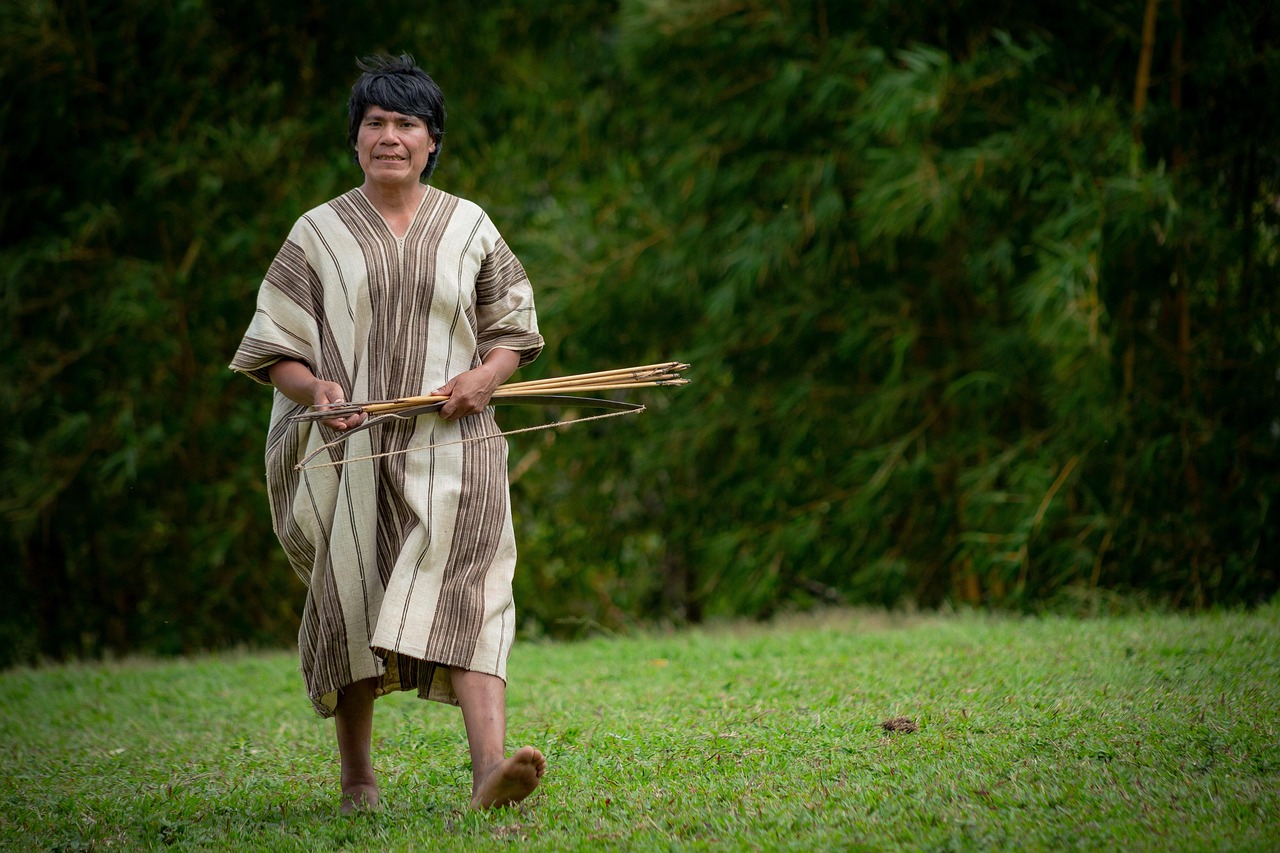
Textile weaving stands as one of the most recognizable Ashaninka crafts, centered on the cushma, a long, sleeveless cotton robe worn by both men and women that serves as the traditional garment of daily and ceremonial life alike. Cushmas are woven on simple backstrap looms from hand-spun cotton thread, often dyed with natural pigments in bands of brown, cream, and other earth tones, with pattern and quality of weave sometimes signaling the skill and status of the weaver within her community.

Basketry and cordage production draw on the wide range of fibrous plants available in the rainforest environment, producing carrying baskets, mats, and rope used in construction, transport, and hunting, with specific techniques and plant sources varying somewhat between different Ashaninka regional groups depending on locally available materials. Pottery, though less elaborately decorated than ceramic traditions found in some other parts of South America, has historically served practical cooking and storage functions in many Ashaninka households.
Beadwork using seeds, animal teeth, and increasingly purchased glass beads produces necklaces, bracelets, and other ornaments worn for both everyday and ceremonial purposes, with specific combinations and arrangements sometimes carrying meaning related to age, marital status, or spiritual protection. Wood carving produces tools, ceremonial objects, and, in more recent decades, artisan items intended for sale to tourists and collectors outside Ashaninka communities.
Contemporary Ashaninka artisans increasingly participate in regional and national craft markets, selling cushmas, jewelry, and carved items to tourists and collectors as a source of cash income supplementing subsistence agriculture, a shift that has brought both economic opportunity and pressure to standardize or simplify traditional designs to meet external market expectations, a tension familiar to many Indigenous artisan communities navigating the balance between cultural preservation and economic survival.
Food
Cassava, known locally as yuca, forms the dietary foundation of Ashaninka cuisine, prepared in numerous ways including boiling, roasting, and fermentation into masato, a traditional beverage made by chewing and spitting cooked cassava to introduce enzymes from saliva that kickstart fermentation, a labor-intensive process traditionally performed by women and central to hospitality and communal gatherings across many Amazonian peoples, not only the Ashaninka.

Maize, plantains, sweet potatoes, and a range of other cultivated crops supplement cassava in the traditional diet, grown in the rotational chacra plots described earlier and supplemented by numerous wild and semi-cultivated fruits available seasonally throughout the forest, including varieties of palm fruit that require specialized knowledge of forest ecology to identify and harvest safely and efficiently.
Fish and game provide essential protein, prepared through roasting over open fires, smoking for preservation, or boiling in simple stews, often seasoned with chili peppers, salt when available through trade, and a range of aromatic herbs gathered from the surrounding forest. Insects, including certain grubs and larvae considered delicacies, along with wild honey gathered from forest hives, round out a diet that draws on an intimate, generations-deep knowledge of the surrounding ecosystem’s edible resources.
Contemporary Ashaninka diets increasingly incorporate purchased goods such as rice, sugar, cooking oil, and canned foods, particularly in communities closer to towns and roads, reflecting broader patterns of market integration affecting Indigenous Amazonian communities throughout Peru. Even so, cassava, plantains, and river fish remain dietary staples in most Ashaninka households, and masato continues to hold important social and ceremonial significance well beyond its nutritional role.
Festivals
Traditional Ashaninka ceremonial life historically centered less on a fixed annual calendar of public festivals, as might be found in more centralized societies, and more on life-cycle events and periodic communal gatherings tied to harvest timing, seasonal river conditions, and specific ritual needs such as healing ceremonies or conflict resolution led by a sheripiari. These gatherings typically involved the preparation and communal consumption of masato in large quantities, accompanied by music, storytelling, and sometimes days of continuous celebration among assembled extended family and allied households.

Missionary influence, both Catholic and evangelical Protestant, introduced Christian holidays such as Christmas and Easter into many Ashaninka communities over the past century, often blended with existing communal gathering traditions to create hybrid celebrations that combine Christian religious observance with older patterns of extended family reunion and shared feasting.
In recent decades, Ashaninka federations and community organizations have also begun organizing more formalized cultural festivals aimed at celebrating and publicly asserting Ashaninka identity, sometimes coordinated with regional Peruvian cultural tourism initiatives or Indigenous rights advocacy events, featuring traditional dress, music, craft displays, and sometimes public ceremonies intended to educate both community members and outside visitors about Ashaninka heritage.
These newer, more public-facing cultural events reflect a broader pattern seen among many Indigenous Amazonian peoples in recent decades, in which traditions once practiced primarily within and between kin networks have been adapted into forms suitable for wider public presentation, serving both as a means of cultural pride and continuity and as a practical tool for asserting visibility and legal recognition in negotiations with the Peruvian state and outside economic interests.
History
Ashaninka contact with outside powers began well before European arrival, as Inca expansion into the eastern forest margins during the fifteenth century brought Andean state influence to the fringes of Ashaninka territory, though the difficult terrain and Ashaninka resistance appear to have prevented full incorporation into Inca administrative control. Spanish colonization brought renewed missionary and military pressure beginning in the sixteenth and seventeenth centuries, with Franciscan missions established along the Perene and other rivers attempting to congregate and convert Ashaninka communities into settled mission towns.

The most dramatic episode of colonial-era resistance came in 1742, when an Ashaninka-allied uprising led by a charismatic figure known as Juan Santos Atahualpa, who claimed Inca royal descent, drove out Spanish missionaries and colonial forces from a large swath of the central Peruvian forest region and maintained effective independence from colonial control for decades afterward, an achievement almost unmatched elsewhere in the Spanish American colonial period and still commemorated as a foundational moment of Ashaninka and broader Peruvian Amazonian resistance.
The late nineteenth and early twentieth century Amazon rubber boom brought catastrophic violence to many Amazonian peoples, and the Ashaninka were not spared, as rubber tappers and labor recruiters used debt bondage, kidnapping, and outright violence to compel Indigenous labor in rubber extraction, a period whose brutality left deep and lasting scars on collective memory across the region even after global rubber prices collapsed and reduced the immediate pressure.
The most recent major trauma in Ashaninka history came during Peru’s internal armed conflict of the 1980s and 1990s, when the Maoist insurgent group Sendero Luminoso, and later state counterinsurgency forces, both directly affected Ashaninka territory, with thousands of Ashaninka displaced, killed, or forced into slave-labor camps by Sendero fighters seeking to control the strategically located forest region. This period, still within living memory for many Ashaninka adults today, prompted the formation of Ashaninka self-defense organizations known as rondas, which played a documented role in eventually helping push Sendero forces out of much of the region.
Today
The Ashaninka today number somewhere between one hundred thousand and one hundred fifty thousand people by most estimates, spread across hundreds of legally recognized native communities in central Peru, making them the largest Indigenous group in the Peruvian Amazon by population. Despite this significant population and a long history of organized self-defense and political mobilization, Ashaninka communities continue to face serious pressure from illegal logging, coca cultivation linked to drug trafficking, and infrastructure and extraction projects that encroach on titled community lands.

Ashaninka political organization has grown considerably more sophisticated since the trauma of the internal armed conflict, with federations such as CARE, the Central Ashaninka del Rio Ene, gaining recognition both domestically and internationally for advocacy work around land rights, environmental protection, and cultural preservation, including notable involvement in United Nations climate and Indigenous rights forums highlighting the connection between Ashaninka territorial rights and rainforest conservation.
Access to education, healthcare, and economic opportunity remains uneven across Ashaninka territory, with communities closer to towns and roads generally having greater access to formal schooling and medical services, while more remote riverine communities continue to rely more heavily on traditional subsistence practices and face greater barriers to state services, a disparity that mirrors patterns seen across much of the Peruvian Amazon and that Ashaninka leaders continue to raise in negotiations with regional and national government bodies.
Younger generations of Ashaninka increasingly move between traditional community life and wage labor, education, or migration to regional towns and cities, creating a lived experience that blends ancestral practices such as cassava farming, cushma weaving, and masato preparation with smartphones, Spanish-language schooling, and participation in national and even international Indigenous rights networks, a combination that reflects not contradiction but the ongoing, adaptive continuity that has always characterized Ashaninka life across centuries of profound external pressure.
Nearby Peoples of the Amazon
The Ashaninka share the vast Amazon rainforest with other peoples covered on this site, each adapted to a different corner of the same immense forest system.
You May Like
The Damara, an Ancient People of Namibia