In the mountains of southern Colombia’s Huila department, where the Magdalena River begins its long journey to the Caribbean, hundreds of carved stone figures stand watch over burial mounds scattered across a landscape of grassy hilltops. This is San Agustin, home to the largest collection of pre-Columbian religious monuments and megalithic sculpture anywhere in South America.
Unlike Ciudad Perdida further north, where living Kogi and Wiwa communities still trace their heritage back to the original builders, San Agustin offers no such thread. The people who carved these statues left behind no name for themselves, no deciphered language, and no confirmed descendants, making this one of the more genuinely mysterious archaeological landscapes covered anywhere in this series.
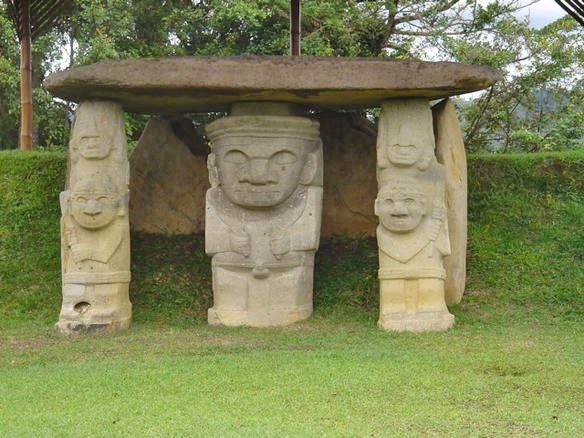
Table of Contents
- South America’s Largest Field of Stone Guardians
- A Culture Known Only by Its Statues
- Jaguars, Eagles, and Guardians of the Dead
- Mesitas and the Burial Mounds Beneath the Statues
- What Language Did the Builders Speak?
- The Carved Riverbed at Fuente de Lavapatas
- Alto de los Idolos and Across the River
- Carving Volcanic Stone Without Metal Tools
- Rediscovery by Colonial Travelers and Archaeologists
- Visiting the San Agustin Archaeological Park Today
- Nearby Places to Explore
South America’s Largest Field of Stone Guardians
Archaeologists have documented more than five hundred monumental stone statues across the wider San Agustin archaeological zone, spread across numerous sites in the upper Magdalena valley rather than concentrated in one single location. That scale earned the area UNESCO World Heritage status in 1995, recognizing it as an unmatched concentration of megalithic religious art in the Americas.

The statues range from small, simply carved figures to towering monoliths several meters tall, most fashioned from volcanic tuff and andesite quarried from the surrounding mountains, a testament to both the region’s geology and the builders’ evident willingness to move and carve heavy stone across considerable distances.
The upper Magdalena valley’s fertile volcanic soil, enriched by nearby active volcanoes including the Puracé volcanic complex, likely supported the agricultural surplus needed to sustain the labor investment required for carving and transporting such an enormous quantity of monumental stone across the region’s hilly terrain.
The sheer geographic spread of documented statues, extending well beyond the boundaries of the formally protected archaeological park, has led some researchers to suspect that additional undiscovered examples likely remain scattered across private farmland throughout the wider Huila region, awaiting future survey work.
UNESCO’s 1995 World Heritage designation specifically recognized both the archaeological park and the surrounding cultural landscape, an acknowledgment that San Agustin’s significance extends beyond any single fenced site to encompass the broader pattern of settlement, burial, and monument construction spread across the upper Magdalena valley.
A Culture Known Only by Its Statues
Archaeologists generally date the main period of statue construction to somewhere between the first century BCE and the eighth century CE, though the culture responsible left no writing, no oral tradition confirmed to survive into the present, and no artifacts that clearly identify how its people referred to themselves.
By the time Spanish colonizers arrived in the region centuries later, the statue-carving tradition had already ended, and local indigenous groups encountered by the Spanish had no clear, continuous account of who had built the monuments scattered across their territory, leaving ‘San Agustin culture’ as essentially a modern label of convenience rather than a historically attested name.
Some researchers propose that San Agustin was never a single unified political entity but rather a shared religious and funerary tradition practiced across multiple related communities scattered through the upper Magdalena valley, each contributing statues and burial mounds to what became, collectively, an enormous sacred landscape over several centuries.
Ceramic styles recovered from excavated contexts at San Agustin show both distinct local characteristics and some broader similarities to pottery traditions documented elsewhere in the northern Andes, hinting at regional trade or cultural exchange even in the absence of any deciphered written record confirming the nature of those connections.
Some archaeologists have proposed loose cultural connections between San Agustin and the nearby Tierradentro culture, known for its own distinct underground painted shaft tombs a short distance away, though the two traditions differ enough in style and burial practice that most researchers treat them as related but ultimately separate archaeological cultures rather than a single unified civilization.
Jaguars, Eagles, and Guardians of the Dead
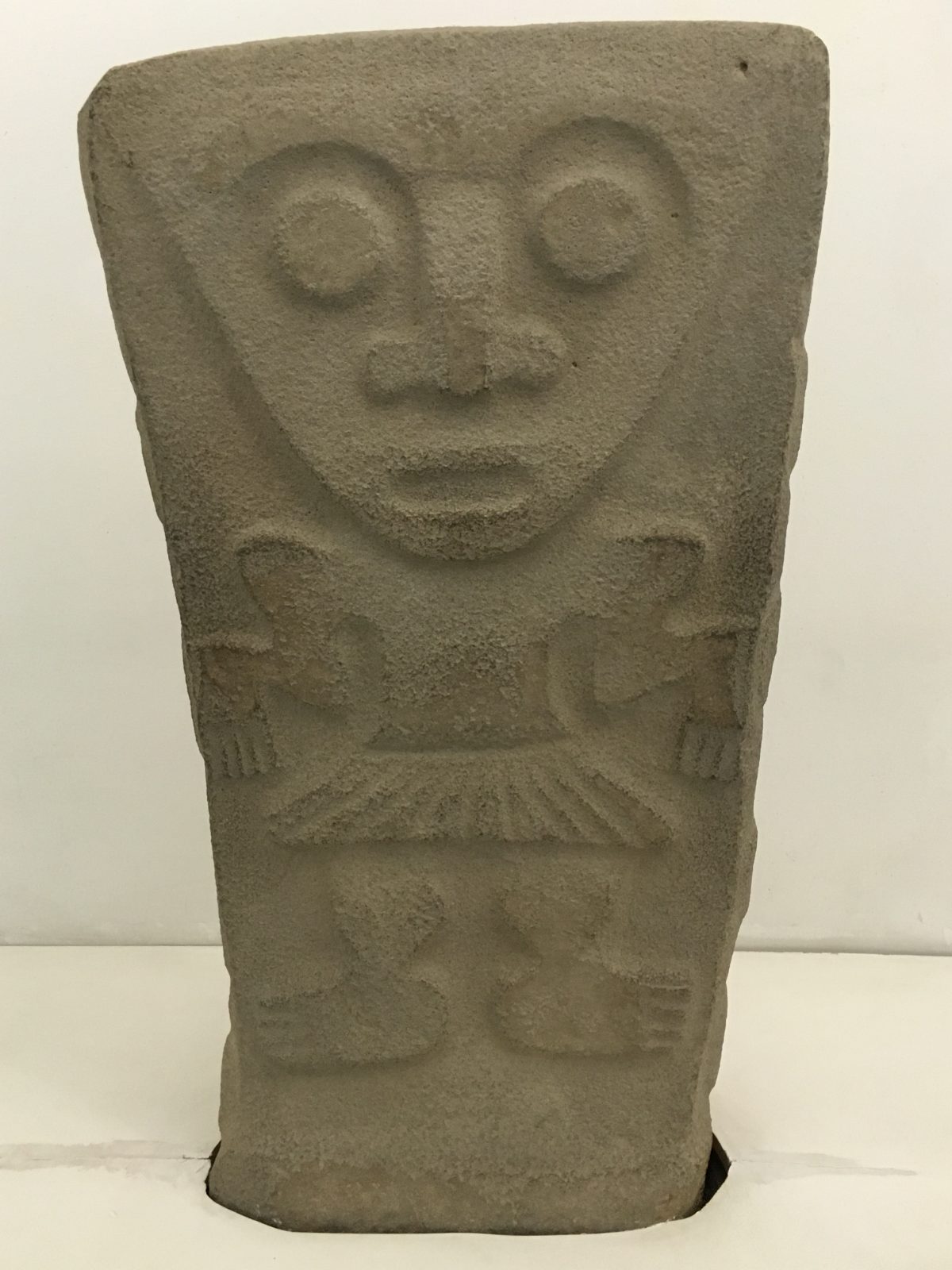
The statues depict an extensive visual vocabulary of human figures, animals, and hybrid supernatural beings, with jaguars, eagles, monkeys, and frogs appearing repeatedly alongside more abstract composite creatures blending human and animal features in ways that suggest a rich, now largely undocumented mythology.
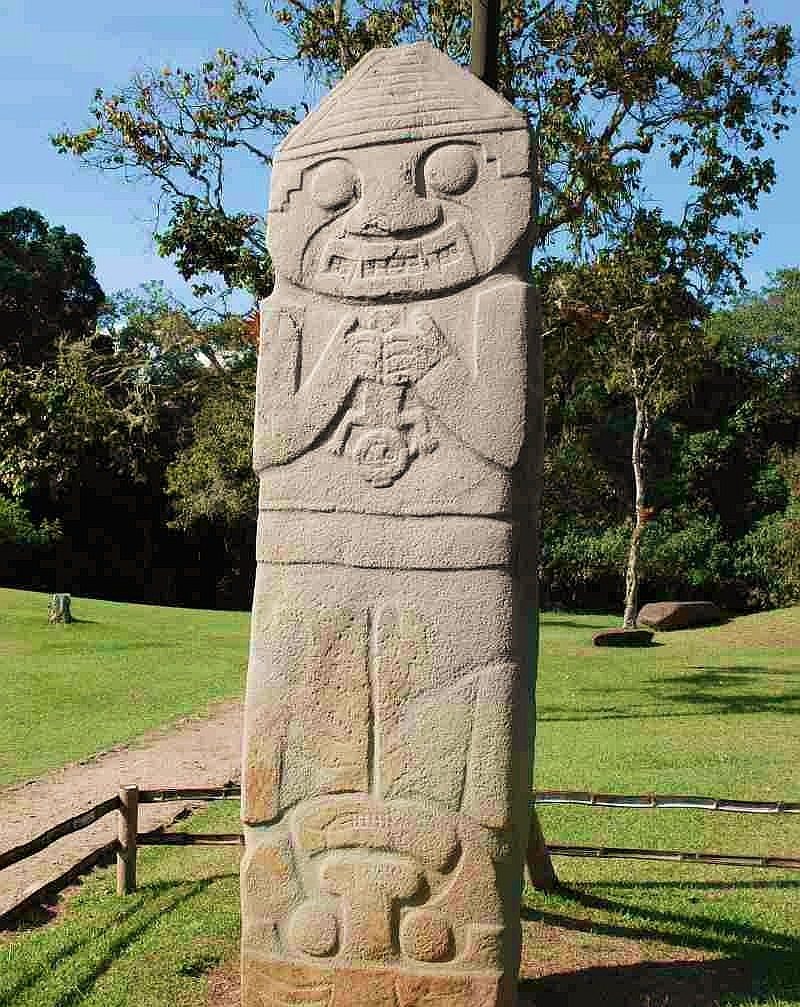
Many statues appear to have functioned specifically as guardians, positioned at the entrances to burial mounds and tombs, their fierce or watchful expressions likely intended to protect the dead and, perhaps, to intimidate the living against disturbing sacred burial ground.
Some statues combine multiple animal features into a single figure, a stylistic choice paralleled at other pre-Columbian sites across the Americas where composite creatures often represented shamanic transformation or the blurring of boundaries between the human and spirit worlds during religious ritual.
Facial expressions carved into many statues range from serene to genuinely fearsome, with some figures baring prominent fangs, an artistic choice that has led some scholars to draw loose comparisons with jaguar-deity imagery documented at other pre-Columbian sites across Mesoamerica and the Andes, though direct cultural contact between these distant regions remains unconfirmed.
Some statues also incorporate what appear to be depictions of childbirth or fertility, carved figures showing a larger adult form holding or associated with a smaller one, adding another layer to the range of human experience the culture apparently chose to memorialize in stone alongside its more overtly militaristic or supernatural guardian imagery.
Mesitas and the Burial Mounds Beneath the Statues
Several key excavated areas within the park, known as Mesita A, B, and C, combine statues with underlying burial mounds and stone-lined tomb chambers, giving archaeologists their clearest evidence connecting the monumental sculpture directly to funerary practice rather than purely decorative or unrelated religious display.

Excavation at these mesitas has revealed stone slab tombs, sometimes capped with additional carved figures, arranged beneath or alongside standing statues in a manner that suggests careful, deliberate design linking the monuments above ground to the burials interred beneath them.
Grave goods recovered from these tombs, including ceramics and occasional gold ornaments, suggest the individuals buried beneath San Agustin’s statues held elevated social status, reinforcing interpretations of the site as an elite mortuary landscape rather than a burial ground accessible to the culture’s entire population.
Excavation methodology at the mesitas has evolved considerably since the earliest twentieth-century digs, with modern archaeologists placing far greater emphasis on careful stratigraphic recording and non-invasive survey techniques than the sometimes more disruptive excavation practices used by pioneering researchers decades earlier.
The scale of labor represented by these mounds, requiring the movement of substantial quantities of earth and stone using only human effort and simple tools, suggests a level of social organization capable of mobilizing significant communal labor for funerary and religious purposes, even without any surviving evidence of centralized political authority comparable to contemporary state-level societies elsewhere in the Americas.
Similar burial mound and statue combinations have been documented at smaller, less-visited sites scattered throughout the wider Huila countryside, suggesting the practice extended well beyond the handful of mesitas most heavily studied by early archaeologists, with many likely remaining only partially documented even today.
What Language Did the Builders Speak?
Unlike several other sites in this series where a plausible candidate language can be proposed through descendant communities or colonial documentation, San Agustin offers no such lead. No language has been confidently associated with the statue-carving culture, and no modern indigenous group in the region claims direct linguistic descent from its builders.
This is one of the more honestly uncertain cases in the entire history of pre-Columbian archaeology in the Americas: the builders of one of the continent’s largest concentrations of monumental stone art remain, linguistically and culturally, essentially anonymous, known only through what they carved rather than anything they are recorded as having said.
This absence of any confirmed linguistic descendant sets San Agustin apart even from other sites in this series where the original language is merely uncertain rather than entirely disconnected from any living population, since here there is no community claiming ancestral or spiritual continuity with the statue builders the way the Kogi and Wiwa do at Ciudad Perdida.
Some place names in the surrounding Huila region show possible traces of pre-Spanish indigenous vocabulary, but as with several other genuinely uncertain cases in this series, these fragments are too sparse and too disconnected from any confirmed language family to support meaningful reconstruction of what the San Agustin culture’s builders actually spoke.
The Carved Riverbed at Fuente de Lavapatas
A short distance from the main statue groups, the streambed known as Fuente de Lavapatas features an extensive series of channels, pools, and carved figures, including serpents and human or animal forms, cut directly into the natural rock over which flowing water still passes today.
Researchers generally interpret this site as having served ritual bathing or water ceremony functions, possibly tied to fertility rites, though as with much of San Agustin’s iconography, the precise meaning intended by its builders remains an informed inference rather than a confirmed fact.
Water continues to flow through many of these carved channels today much as it likely did when the site was in active ritual use, giving visitors a rare opportunity to see a pre-Columbian religious monument still functioning, in a literal physical sense, largely as its builders originally designed it.
Some researchers have proposed that the carved serpent motifs at Fuente de Lavapatas may relate symbolically to water, fertility, and the underworld in ways broadly consistent with serpent imagery found across many unrelated pre-Columbian cultures throughout the Americas, though whether this reflects direct cultural connection or simply a common human tendency to associate serpents with water remains an open question.
Conservation work at this carved streambed has had to balance protecting the fragile stone carvings from erosion caused by the very water flow that likely gave the site its original ritual significance, a delicate preservation challenge shared with several other water-integrated archaeological sites around the world.
Alto de los Idolos and Across the River
Beyond the main park, additional statue groups at Alto de los Idolos and Alto de las Piedras sit across the Magdalena River, expanding the total footprint of the San Agustin culture’s monumental landscape well beyond the boundaries of the most heavily visited central archaeological park.
These outlying sites include some of the tallest statues associated with the culture, along with additional burial mounds, reinforcing the picture of a dispersed sacred landscape spread across numerous hilltops rather than a single centralized city or ceremonial capital.
Travel between these outlying sites and the main archaeological park typically requires a river crossing and additional walking or driving time, meaning many visitors on shorter itineraries see only the central park’s statues without exploring the full geographic extent of the broader San Agustin cultural landscape.
The name Alto de los Idolos, meaning roughly ‘hill of the idols,’ reflects the same Spanish colonial naming pattern seen throughout the region, where descriptive Spanish labels replaced whatever names, if any, the original builders might have used, further compounding the difficulty of recovering any authentic indigenous terminology for these sites.
Visitors willing to make the additional trip to these outlying sites are often rewarded with a quieter, less crowded experience than the main park, along with some of the tallest and most visually striking individual statues associated with the entire San Agustin cultural tradition.
Carving Volcanic Stone Without Metal Tools
San Agustin’s sculptors worked primarily in volcanic tuff, a comparatively soft stone that hardens somewhat upon prolonged exposure to air, making it workable with harder stone tools while still allowing for the detailed features visible on many of the surviving statues.

No metal tools have been confidently associated with the statue-carving tradition, meaning the entire body of monumental sculpture at San Agustin was almost certainly produced using stone hammers, chisels, and abrasives, a labor-intensive process that underscores the significant investment of time and skill this culture placed in memorializing its dead.
Comparative studies of tool marks preserved on statue surfaces have allowed researchers to reconstruct likely carving sequences and techniques, offering indirect insight into the organization of labor and craft specialization within a culture that otherwise left no direct account of its own working methods.
Some statues show evidence of having been left unfinished, their carving interrupted partway through, offering archaeologists rare direct insight into the step-by-step process by which a rough quarried block was gradually transformed into a detailed figure, information that would otherwise have to be inferred entirely from completed works alone.
Weathering patterns visible on many exposed statues, caused by centuries of rain, sun, and temperature fluctuation in the Andean highland climate, have gradually softened fine surface detail on some pieces, a natural process that conservation efforts today aim to slow rather than fully reverse, given how much original surface information has already been lost over the centuries.
Rediscovery by Colonial Travelers and Archaeologists
Spanish colonial accounts mention the San Agustin statues as early as the eighteenth century, when a traveling Jesuit priest recorded encountering the carved figures, though systematic archaeological study did not begin until German ethnologist Konrad Theodor Preuss led an influential expedition to the site in 1913.

Subsequent decades of Colombian and international archaeological work have steadily expanded the documented statue count and refined understanding of the site’s burial practices, even as the fundamental question of who exactly built San Agustin and what language they spoke remains unresolved.
Preuss’s 1913 expedition produced some of the earliest systematic photographic and descriptive documentation of the statues, work that remains a valuable historical record given how many pieces have since been damaged, moved, or lost to erosion and, in some cases, looting during the decades before more rigorous site protection was established.
Later twentieth-century Colombian archaeologists, including researchers affiliated with the country’s national anthropology institute, expanded significantly on Preuss’s early work, formally cataloguing hundreds of statues across the wider region and establishing the protective park boundaries that exist today.
Comparing Preuss’s early twentieth-century photographs to the statues’ current condition has allowed conservators to track the rate of natural weathering over roughly a century, providing valuable baseline data for planning future protective measures at a site where the stone itself, not any written record, remains the primary source of historical information.
Visiting the San Agustin Archaeological Park Today
The San Agustin Archaeological Park near the modern town of the same name offers visitors relatively accessible walking paths connecting many of the major statue groups and mesitas, a considerably gentler visitor experience than the demanding multi-day trek required to reach Ciudad Perdida further north.

An on-site museum displays additional artifacts and provides context for the statues visible throughout the park grounds, while nearby Alto de los Idolos and Alto de las Piedras offer additional stops for visitors interested in the fuller extent of this dispersed monumental landscape.
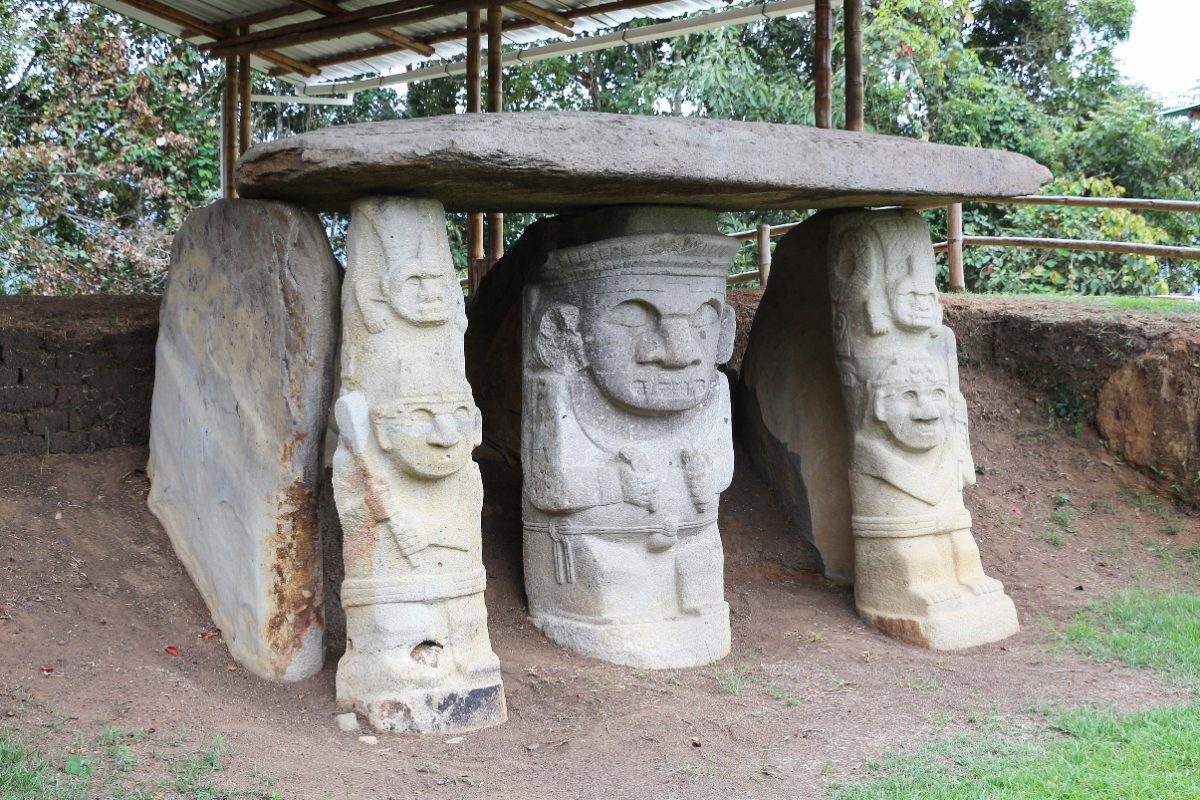
Colombian heritage authorities have invested significantly in protective shelters over some of the more exposed statues in recent decades, aiming to slow weathering caused by rain and temperature fluctuation while still allowing visitors reasonably close access to appreciate the carved detail on the monuments.
Local guides available at the park often draw on decades of accumulated archaeological interpretation to walk visitors through the likely symbolic meaning of specific statues, while consistently acknowledging, as most serious researchers do, that much of this interpretation remains informed speculation rather than settled fact given the absence of any direct written or oral testimony from the culture that built the site.
The nearby town of San Agustin has grown into a modest regional tourism hub supporting the archaeological park, offering visitor accommodations and transportation to outlying sites, though it remains considerably smaller and less internationally known than tourism centers built around more famous South American ruins.
Nearby Places to Explore
San Agustin’s history connects to other South American sites covered elsewhere in this series.
- Ciudad Perdida Predates Machu Picchu by 650 Years
- Sipan’s Looted Royal Tomb Rewrote Moche History
- Kuelap, the Andean Fortress the Inca Struggled to Conquer
Closing Thoughts
San Agustin stands as a reminder that not every ancient culture leaves behind a name, a language, or even a confirmed connection to any people living today. What survives instead is purely the work itself, hundreds of carved guardians spread across a mountain landscape, still watching over burials whose exact meaning their makers never wrote down.
That silence has not stopped archaeologists from steadily piecing together burial patterns, iconographic themes, and construction techniques over more than a century of study, even as the core mystery, who exactly these builders were and what they called themselves, remains one of the more open questions in all of South American archaeology.
You May Like
Mafra, the Palace a King Built From a Vow