Kedrai, (Kedreai, Kedreiai, Sedir Island) is on Sedir (Sedre) Island on the east coast of Keramos Bay (sinus ceramicus) (now Gökova). It should be noted that the most important feature of Kedrai is its sands. These are not actually sand, but were formed after a chemical reaction of precipitated seashells, and they are found in 1-2 other places in the world.
They develop on the shallow bottom of warm seas, in waters saturated with Calcium Carbonate, and in the turbulent zone near the coast. They are in the form of shells wrapped in layers like a hailstone. Each membrane-thin shell is formed by the arrangement of many needle-like calcite (aragonite) crystals side by side.
Carbonate precipitation occurs at the bottom when carbon dioxide, which is dissolved in calcium bicarbonate fresh groundwater and plays a role in dissolving limestone, turns into gas during wave turbulence and leaves the environment. Aragonite crystals, which develop in the form of needles in water, are wrapped around the sand grain. Frictions turn these substances into a polished state.
This is how these wonderfully beautiful tiny marbles, which do not resemble sand, which is the greatest feature of Sedir Island, are formed. This exquisite formation, which until ten years ago reached the entire coast and even the ancient settlement inside, can only be seen in the sea today. Unfortunately, that white foamy beach has turned into soil today.
It is thought that the word Kedrai comes from the Luwian language. Most likely, it changed to Kedrai or Kadrai in the Hellenic language, meaning “the city of the people of Kadra”. Information about the history and foundation of this city, whose people were described by Xenephon as “half Greek and half Barbarian”, is limited.
Hekataios of Miletos mentions the settlement here in the 6th century BC. The city joined the Carian Union in 404-428 BC, then Attica joined the Delian League and paid annual dues of 3000 drachmas. In 439, this dues decreased to 2000. In the Athens-Sparta war in 405-406 BC, Xenophon besieged the Spartan commander Lysandros Kedrai and captured the city, which sided with the Athenians. He sold his people in the slave market to punish them.
After this incident, Kedrai could never regain its former glory.
During the time of Xenephon, there were also some Carians among the old inhabitants of the city. The city came under the rule of Rhodes in the 2nd century BC, which caused a change in religious belief. In the II-I century BC, two important cults, Apollo Pythios and Apollo Kedrieus, were led by the same priest. After 170 BC, an important person from the Rhodes peraia administered two cults at the same time.
Kedrai, under Roman rule, also gave a rank of honor to Emperor Vespasian as an expression of their gratitude.
The city walls, Temple of Apollo, Theater, Agora and necropolis area have survived from Kedrai to the present day. Among these, the city walls surround almost the entire coast, starting from the east of the island. The rectangular prism-shaped city walls are in very good condition. The walls were reinforced with square planned bastions.
Among these, a monumental bastion reflecting the most beautiful workmanship of the Hellenistic period, sitting on a four-tiered base on the south side of the island, stands out from the others with its careful workmanship. Not all of the walls were built in the same period.
The temple of Apollo, on a platform supported by terrace walls in the east of the city, is in the Doric style. It is understood from the foundation ruins that have survived to the present day in good condition and the architectural pieces scattered around. This temple is located in the middle of a sacred area surrounded by a perimeter wall. A number of pedestals can be seen next to the thresholds and corners of the entrance doors of this sacred area. The inscriptions have been so damaged that they cannot be read.
Traces of three cylindrical altars can be seen, two of which have garlands on them and one of which has a snake relief. According to mythology, the snake is an animal related to Apollo. Based on this, it can be said that this temple was dedicated to Apollo Kadrieus (Apollon Pythos). During the early Byzantine period, a church on the basilica plan was built over the temple.
We see pieces containing the Jesus monogram and a cross from this period.
There is a theater on the slope in the east of the island, which has survived to the present day. Limestone was used in this building, as in the others. The cavea section and seating levels are in very good condition. Its plan is shaped like a horseshoe, which is considerably larger than a semicircle. What is striking here is that it is quite large for a small city. From this we can assume that a large number of spectators from the surrounding area come to the plays held here from time to time.
The non-symmetrical parados walls were made with very careful workmanship. Skene, on the other hand, remained completely underground.
It is possible that the Agora was on the beach; Because here you can find pieces such as stiles and Ionic style column bases processed with good stone workmanship. There is also a B.C. monument built here with careful workmanship. There is also a wall fragment that may date back to the 4th century.
The city’s necropolis is on the mainland opposite the island. The vast majority of these are sarcophagi. In addition, pits and burial chambers are also seen.
You May Like
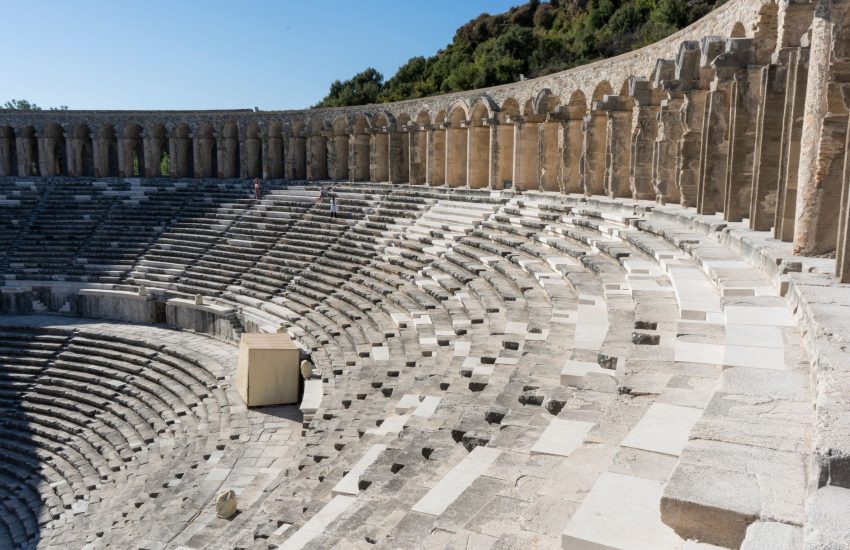
Aspendos Ancient Theater Travel Guide