A historic and ornate building at the exit of the underpass, on the corner where Vojvoda Street intersects the Square. According to the documents, there was a Jewish shop and five shops there in 1813. In1862, a single-door inn and three shops belonging to Yosef were built in place of this later demolished building. According to the article of Master Architect and restorer Tülin Taşçıoğlu in the Istanbul Encyclopedia, the present building was built as Dilber Han in1889.
This three-storey building, whose architect is unknown, is said to have been built by Rafael Salamon, the son of Italian Count Avram Commando. And since it resembles the former Italian Embassy used as the Maçka Technician School and the Saint Antoine Church in Beyoğlu, it is thought that it may have been the first building of the famous Italian Architect Guilio Mongeri in Istanbul.
The building has a foreign architectural style that gained the appreciation of the Levantines in the 19th century and is called “animation”. The double-window pointed arches on its facades, the decorated windows, the pilasters between the windows and the column capitals fit the neogothic style with their inter-storey decorated wipes.
When the building was built today, the door numbers were 1, 3, and 5. There were two shops in Numbers 1 and 3 and Dilber Han in Number 5. In1928, two shops under the building were rented to Banco Di Roma and one shop was rented to Baylan Patisserie; while the basement was the safe apartment of Banco Di Roma, it later became Baylan’s factory.
The historical building, which was rented out over time and many sections and mezzanines were added, was radically renovated in 1994 by its next owner, Nordstern Public Insurance Company. Now the second group is registered as the structure that needs to be protected. In another article, Tülay Taşçıoğlu, who carried out the restoration project, says that the additions were extracted during the renovation and the building was tried to be adapted to the original.
The building is now owned by Axa Oyak Insurance Company. But Nordstern Han, as it’s known, isn’t just an insurance company building. Axa Oyak decided to create a new environment where artists will meet with art lovers, as he thought that the building was located on the “Cultural Axis” that will be formed in the near future according to the Istanbul Master Plan. The emergence of a space suitable for a gallery on the ground floor also supported this decision.
You May Like
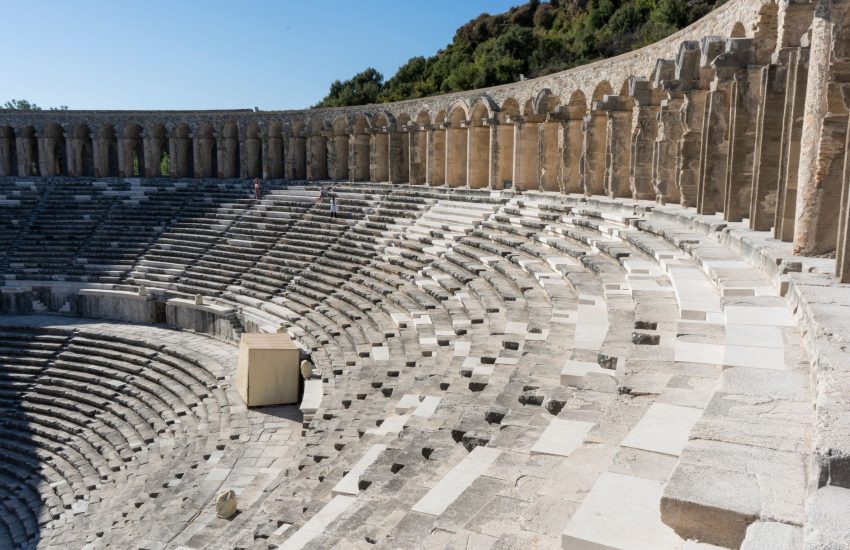
Aspendos Ancient Theater Travel Guide