Most castles were built to keep enemies out. Caernarfon was built to keep a whole nation down. When Edward I of England finally crushed the independent princes of Wales in the 1280s, he did not just want to defend his conquest, he wanted to make it permanent and unmistakable, to stamp English royal power onto the Welsh landscape in stone so overwhelming that no one could ever doubt who was master. Caernarfon Castle, rising in bands of coloured stone above the Menai Strait, was the supreme expression of that ambition, and it remains one of the most magnificent and intimidating fortresses in Europe.
But Caernarfon is more than raw power in masonry. Look closely and you will see that its towers are not round like most castles of the age but many-sided, and that its walls are laid in stripes of different-coloured stone. This was no accident. Edward was making a deliberate visual statement, echoing the walls of ancient imperial cities and weaving in old Welsh and Roman legends, casting himself not just as a conqueror but as a kind of new emperor. Caernarfon is a castle that was designed, quite consciously, to look imperial.
It is also the castle where the tradition of the Prince of Wales was born, and where, in living memory, princes have been formally invested before the eyes of the world. So this is a story about conquest, about propaganda in stone, and about a title that still stirs strong feelings in Wales today. Let’s walk into Edward’s great fortress and unpick what he was really building.
We will keep two questions in view as we go: how this astonishing fortress actually worked as a machine of war, and what it was really trying to say. Because at Caernarfon the two are inseparable, and the more closely you look at the banded walls and angular towers, the more clearly you hear the message a conquering king wanted to send.

Table of Contents
- Edward I and the Conquest of Wales
- A Castle Dressed as an Empire
- The Grandest of Edward’s Fortresses
- The Master Behind the Masterpiece
- The First English Prince of Wales
- Tested by Welsh Revolt
- A Castle Never Quite Finished
- Decline, Neglect, and Survival
- Investitures and a Contested Symbol
- The Iron Ring of Castles
- Visiting Caernarfon
- Nearby Castles
- Before You Go
Edward I and the Conquest of Wales
To understand Caernarfon you have to start with a war. For centuries Wales had kept its independence under its own native princes, most powerfully the princes of Gwynedd in the mountainous north. But in the thirteenth century Edward I, one of the most formidable and ruthless kings England ever produced, was determined to bring Wales fully under English control, and he launched a series of brutal campaigns to do it.
The decisive blow came in the early 1280s. The last independent prince of Wales, Llywelyn ap Gruffudd, was killed, Welsh resistance was crushed, and Edward set about making sure that Wales would never rise as an independent power again. His method was as much psychological as military: he would ring the conquered land with a series of gigantic new castles, symbols of English domination that could never be ignored or overthrown.
This great programme of castle-building is one of the most remarkable in European history. Across North Wales, Edward’s architect, the brilliant Master James of St George, raised a chain of enormous fortresses, sometimes called the iron ring, to hold the country down. Of all of them, Caernarfon was to be the greatest, the crown jewel of the whole enterprise, part fortress, part palace, and part deliberate monument to conquest.
The scale of Edward’s building programme is hard to overstate. Thousands of labourers, diggers, carpenters, and masons were brought from all over England and set to work across North Wales at once, in one of the largest construction efforts of the entire Middle Ages. The cost nearly bankrupted the crown, but Edward judged it worth every penny, because these castles were not just military bases but the physical machinery of a permanent conquest.
A Castle Dressed as an Empire
What makes Caernarfon unique among Edward’s castles, and indeed among British castles generally, is the way it looks. Where the others have round towers and plain grey walls, Caernarfon has striking many-sided, polygonal towers and walls built in horizontal bands of different-coloured stone. This was a conscious and expensive choice, and it carried a powerful message.
Edward and his builders were deliberately imitating the great land walls of Constantinople, the capital of the old Roman and Byzantine empire, with their banded masonry and angular towers. By echoing those imperial walls, Edward was casting himself as heir to the emperors of Rome, dressing his conquest of Wales in the borrowed grandeur of ancient empire. Caernarfon was not just strong; it was propaganda, a piece of political theatre in stone.
There was a local dimension too. Welsh legend told of Macsen Wledig, a figure based on a real Roman emperor, who was said to have dreamed of a magnificent fortified city at the mouth of a river in Wales, and the site of Caernarfon was associated with Roman remains. By building here, in this style, Edward was tapping into these old imperial and legendary associations, appropriating them for the English crown and rooting his new power in a deep and prestigious past.
It is worth pausing on how unusual this makes Caernarfon. Medieval castles were overwhelmingly practical buildings, and decoration on this scale, chosen to carry a political and imperial message, is genuinely rare. Edward was thinking like a Roman emperor as much as a medieval king, and the result is a fortress that speaks a visual language of power quite unlike anything else in Britain. Once you know what those stripes and angular towers are saying, you can never look at the castle the same way again.

The Grandest of Edward’s Fortresses
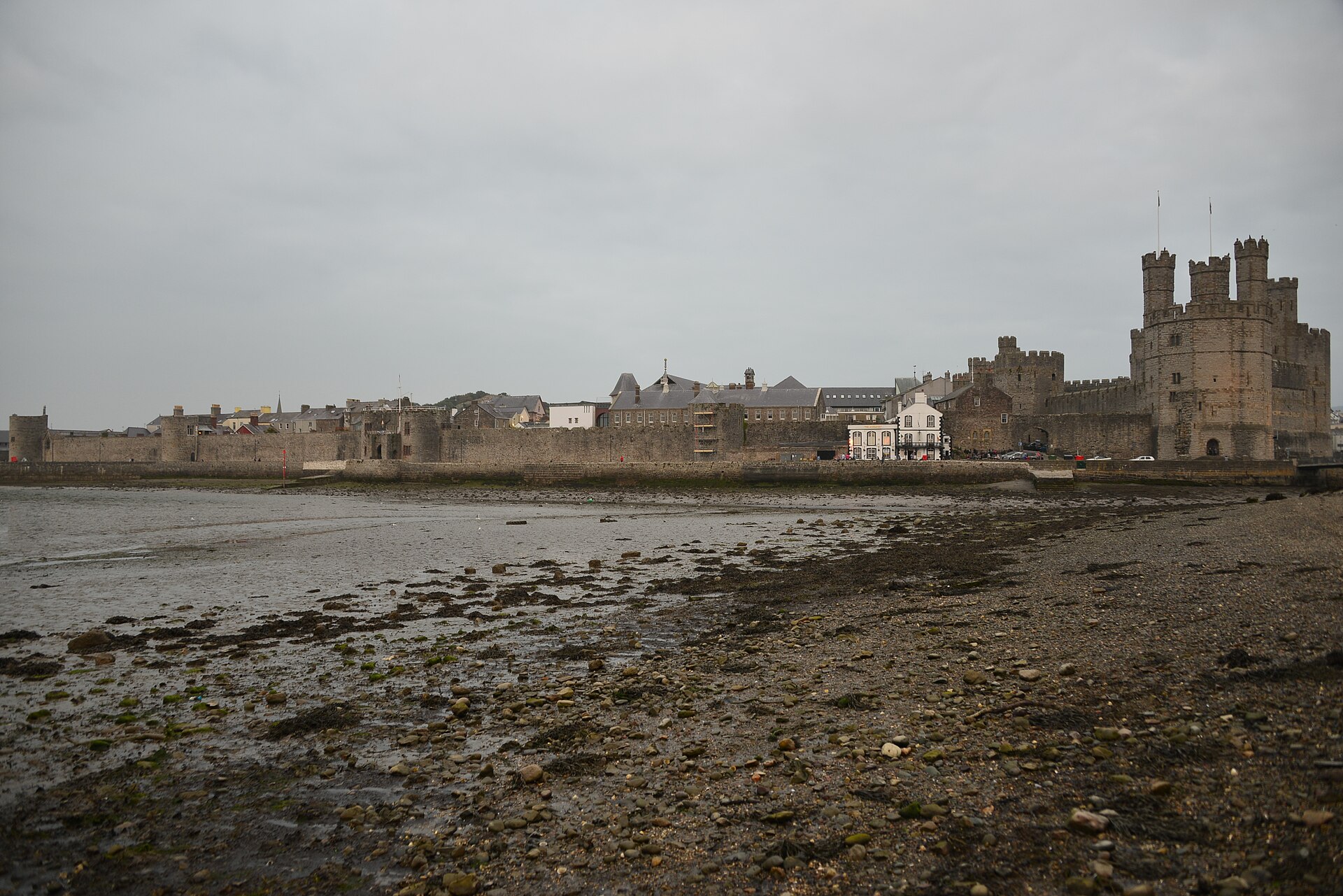
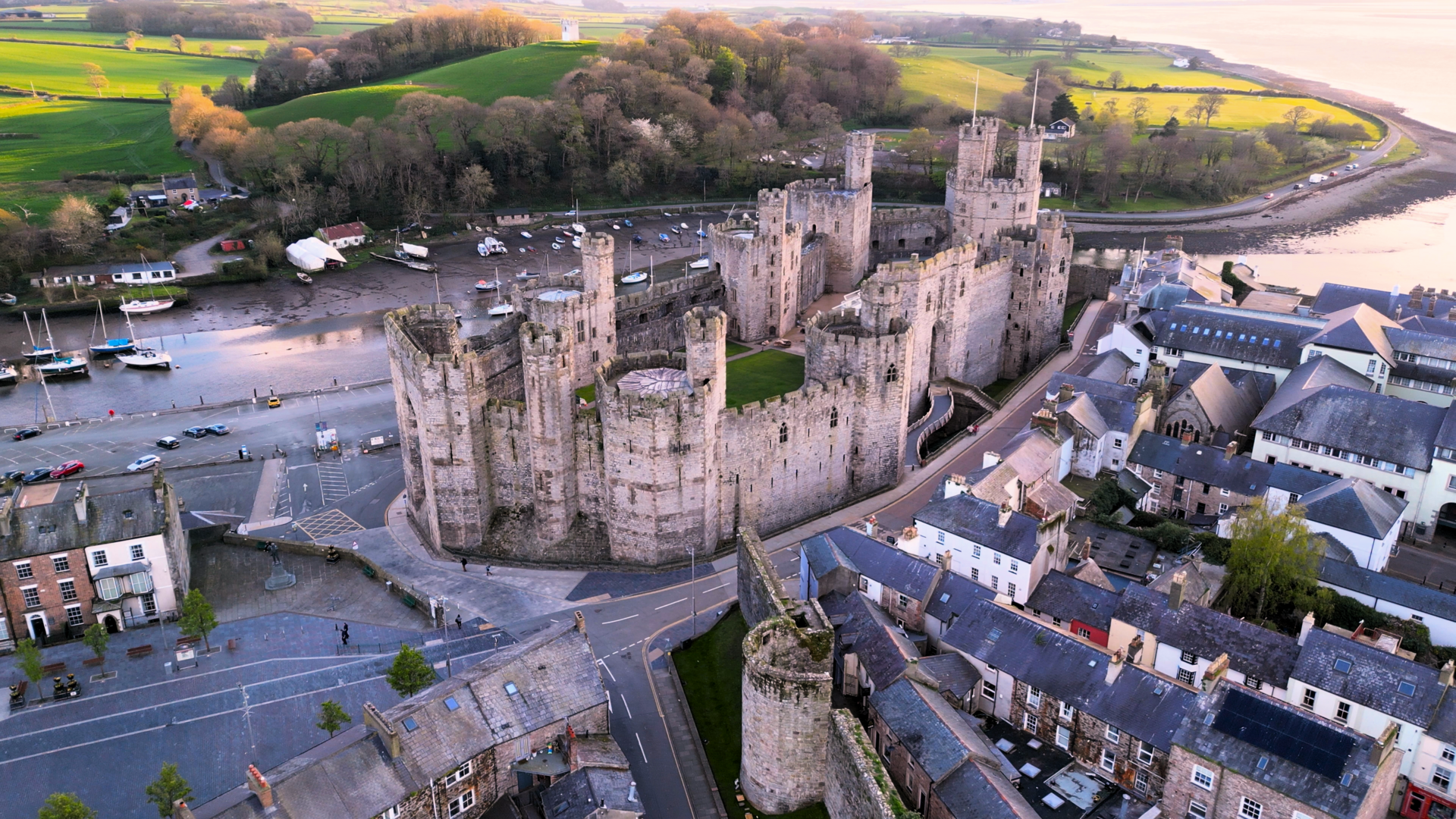
Even setting aside its symbolism, Caernarfon is a masterpiece of military engineering. Its enormous curtain walls, immensely thick and studded with those great polygonal towers, enclose a long ward beside the river, and they are honeycombed with a maze of passages, stairs, and firing galleries built into the thickness of the stone, allowing defenders to rain missiles on attackers from several levels at once.
The main entrance, the King’s Gate, was designed to be all but impregnable, a killing zone of multiple doors, portcullises, murder-holes, and turns, through which any attacker would have to fight step by bloody step. The grandest of the towers, the Eagle Tower, is a fortress in itself, crowned with turrets and topped, once, with carved stone eagles that gave it its name and reinforced the imperial theme.
Caernarfon was intended to be far more than a barracks. It was to be a royal palace and the centre of English government in North Wales, a seat of power fit for a king. Its scale and splendour were meant to dwarf anything the Welsh princes had ever built, announcing that a new and greater order had arrived and was here to stay.
The wall passages are one of the great pleasures, and terrors, of a visit. Narrow and dark, they burrow through the immense thickness of the stone, linking towers and firing positions so that defenders could move unseen and appear at arrow loops on several levels. To an attacker in the ward below, the walls themselves would have seemed alive with hidden marksmen, and even today, edging along them, you feel the cold, clever menace built into every metre of the design.

The Master Behind the Masterpiece
A castle like Caernarfon did not design itself, and much of the credit belongs to one remarkable man: Master James of St George, the greatest military architect of his age. Brought from the Alpine region of Savoy, where he had built castles for its counts, James was placed in charge of Edward’s vast Welsh building programme, and he brought to it a genius for both engineering and grand design.
Under his direction rose not only Caernarfon but the whole chain of Edwardian castles, each a masterpiece in its own right, and together forming one of the supreme achievements of medieval architecture. James was rewarded and honoured by the king, and unusually for a craftsman of his time his name is remembered, a rare case of a medieval architect stepping out of anonymity into history.
It is worth remembering him as you explore Caernarfon. The clever killing-zone of the King’s Gate, the honeycomb of wall passages, the soaring Eagle Tower, and the whole imperial conception of the place owe much to his skill. Behind Edward’s political vision stood a builder capable of turning that vision into some of the mightiest stone the Middle Ages ever raised.
The First English Prince of Wales
Caernarfon is bound up with one of the most famous, and most politically loaded, traditions in British history: the title of Prince of Wales. In 1284, very soon after the conquest, Edward I’s son, the future Edward II, was born at Caernarfon Castle. According to a well-known legend, Edward presented his infant son to the conquered Welsh as their new prince, a prince born in Wales who, as a newborn, spoke not a word of English, cleverly satisfying, so the story goes, a Welsh demand for a native-born prince.
The tale is almost certainly a later invention, but the underlying fact is real and momentous: from around this time the heir to the English throne came to be given the title Prince of Wales, a title that had once belonged to the independent native rulers Edward had destroyed. In taking it for his own son, the English crown absorbed and neutralised the very idea of Welsh princely leadership, turning a symbol of Welsh independence into an English royal title.
To this day the eldest son of the British monarch is styled Prince of Wales, and the title remains, for many in Wales, a sensitive reminder of conquest as much as an honour. Caernarfon, as its birthplace, stands at the very heart of that long and complicated story.
The genius of the move, whether or not the cradle-side legend is true, was in how completely it hollowed out Welsh identity at the top. The title that had rallied Welshmen behind their own leaders was quietly transferred to the conqueror’s heir, so that thereafter every Prince of Wales was an Englishman in waiting for the English throne. It was conquest by symbolism as much as by sword, and Caernarfon was its stage.

Tested by Welsh Revolt
Edward’s castles were meant to make Welsh rebellion impossible, but they did not entirely succeed, and Caernarfon was soon put to the test. In 1294, only a few years after building began, a major Welsh uprising broke out under Madog ap Llywelyn, and the rebels fell upon the half-finished castle and its new town. The town walls were stormed, the settlement sacked, and much of the recent building work damaged.
It was a serious blow and a reminder that the conquest was not as secure as Edward liked to pretend. But the revolt was eventually crushed, English control was reimposed, and work on the castle resumed, with the defences strengthened in the light of hard experience. Caernarfon had survived its first real crisis, and it would remain firmly in English hands.
That the great symbol of conquest could be attacked and its town sacked so soon after its founding is a telling detail. It shows that behind the imperial swagger of the banded towers lay a genuinely contested and dangerous land, and that Edward’s magnificent castles were built not in a subdued country but in one that still had the will, if not always the means, to resist.
Caernarfon was more than a castle, too; it was a fortified town. Edward laid out a brand-new walled settlement beside the castle, planted with English settlers and ringed by a complete circuit of town walls with their own towers and gates, much of which survives today. The castle and the walled town were designed as a single system, an English colony implanted in the heart of conquered Wales, and the sack of 1294 fell on the whole of it.
A Castle Never Quite Finished
For all its grandeur, Caernarfon was never actually completed to its full intended design. The costs of Edward’s Welsh castles were astronomical, straining even the resources of the English crown, and as royal attention and money were drawn away to other wars, especially against Scotland, the work at Caernarfon slowed and eventually stopped with parts of the plan unrealised.
If you look carefully, you can see the evidence. Some of the intended buildings within the walls were never built, and in places the stonework shows where construction simply halted, leaving the castle a magnificent but partly unfinished shell of what Edward had envisaged. Even so, what was built is so vast and so impressive that most visitors never notice the gaps.
This unfinished quality is a reminder of just how ambitious, and how expensive, the whole project was. Edward set out to build not merely a castle but a statement of imperial power, and even the wealth of a great medieval kingdom could not quite stretch to complete the dream. What remains is still one of the mightiest fortresses in Europe.

Decline, Neglect, and Survival
After the great age of conquest, Caernarfon’s importance gradually faded. As Wales settled, uneasily, into English rule, the castle was less needed as an active fortress, and over the centuries it fell into a long decline, its buildings decaying and its defences neglected. During the English Civil War it saw some action and changed hands, but it escaped the deliberate destruction that ruined so many other castles.
For a long period Caernarfon stood as a magnificent but crumbling ruin, admired by travellers and artists drawn to its romantic grandeur but otherwise largely forgotten as a working building. Its sheer size and strength, however, meant that even neglected it remained one of the most imposing sights in Wales, its banded towers looming over the little town at its feet.
In time its importance was recognised and it was taken into public care and conserved. Today Caernarfon is remarkably well preserved for a castle of its age, its walls and towers standing to their full height, allowing visitors to explore the passages, climb the towers, and grasp something of the overwhelming scale that Edward intended. It is now, fittingly, a UNESCO World Heritage Site.

Investitures and a Contested Symbol
In the twentieth century Caernarfon found a dramatic new role, tied once again to the title of Prince of Wales. Twice in modern times the castle has been the setting for the formal investiture of a Prince of Wales, staged as a grand ceremony before the world’s press and cameras. The first, in 1911, invested the future Edward VIII, and the second, in 1969, invested Charles, the future king, in a spectacular televised event.
These ceremonies were deliberate revivals, using Caernarfon’s medieval majesty as a backdrop to reinforce the modern monarchy’s link to Wales. But they were, and remain, controversial. For many Welsh people the investiture of an English royal as Prince of Wales at the very castle built to symbolise the conquest of Wales is a painful reminder of subjugation, and the ceremonies have attracted real protest and deep feeling.
That tension is part of what makes Caernarfon so fascinating. It is at once a magnificent work of medieval architecture, a proud symbol drawn on by the British state, and, for many, a monument to the loss of Welsh independence. Few castles carry such a heavy and contested weight of meaning, and to visit Caernarfon is to walk straight into the long, unresolved story of Wales and England.
The Iron Ring of Castles
Caernarfon should never be seen entirely on its own, because it was one piece of a much larger scheme. To hold down conquered Wales, Edward built or rebuilt a whole ring of great castles around the mountainous heartland of Gwynedd, including the mighty fortresses of Conwy, Harlech, and, later, Beaumaris, along with others. Together they formed an interlocking system of control, each within reach of the sea so it could be supplied and reinforced by ship even if the land around it rose in revolt.
This network is often called the iron ring, and it represents one of the most ambitious and expensive military projects of the entire Middle Ages. No other medieval ruler concentrated so much castle-building genius and treasure into so small an area in so short a time. The castles were, in effect, a machine for holding a country, and they worked: after their completion, Wales never again regained its independence.
Several of these castles, Caernarfon among them, are now jointly recognised as a World Heritage Site for their outstanding importance in the history of military architecture. To tour them is to follow the footsteps of a conquest, and to see how a determined king used stone, sea power, and sheer scale to bind a nation to his will.
Visiting Caernarfon
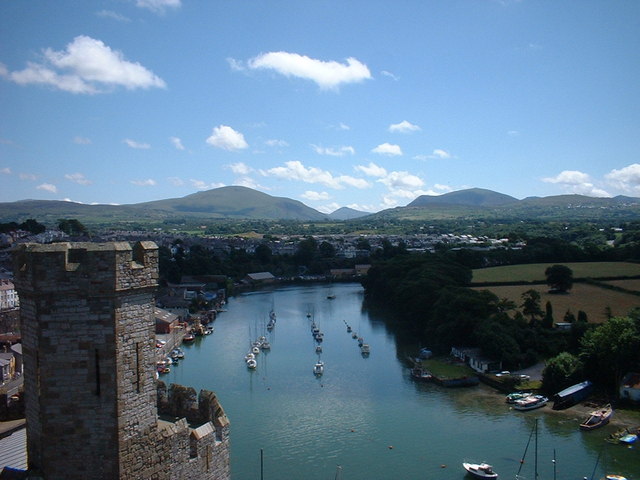
Caernarfon sits on the coast of North Wales, at the western end of the beautiful region of Snowdonia, or Eryri, guarding the Menai Strait that separates the mainland from the Isle of Anglesey. It is reached by road through some of the finest scenery in Wales, and the walled town at the castle’s feet is a lively and characterful place, still strongly Welsh-speaking, well worth exploring in its own right.
Allow a good couple of hours for the castle, and be ready for plenty of climbing, as much of the fun lies in exploring the towers, the wall passages, and the spiral stairs that riddle the walls, emerging onto high battlements with sweeping views over the town, the strait, and the mountains beyond. Combine a visit with the other great Edwardian castles nearby, Conwy, Harlech, and Beaumaris, to see the full sweep of the most ambitious castle-building project in medieval Britain.
The castle sits at roughly 53.1394, -4.2767. Punch that into Google Maps and it will take you straight to Caernarfon Castle in North Wales.
Nearby Castles
A Fortress Built to Send a Message
Caernarfon is a castle that argues with you. On one level it is simply breathtaking, one of the grandest and best-preserved medieval fortresses anywhere in Europe, a marvel of engineering and a joy to explore. On another, it is a monument to conquest, built to crush a nation’s independence and dressed up in the borrowed clothes of empire to rub the point in. Both things are true at once, and that is exactly what makes it so compelling.
Stand beneath the banded walls of the Eagle Tower and look up, and you are looking at raw political power turned into architecture, a message from a medieval king that still echoes seven centuries later every time the words Prince of Wales are spoken. Magnificent and menacing in equal measure, Caernarfon remains the greatest, and the most eloquent, of all the castles Edward I built to hold down Wales.
You May Like
Mafra, the Palace a King Built From a Vow


4 thoughts on “Caernarfon Castle: Edward I’s Imperial Fortress and the Conquest of Wales”