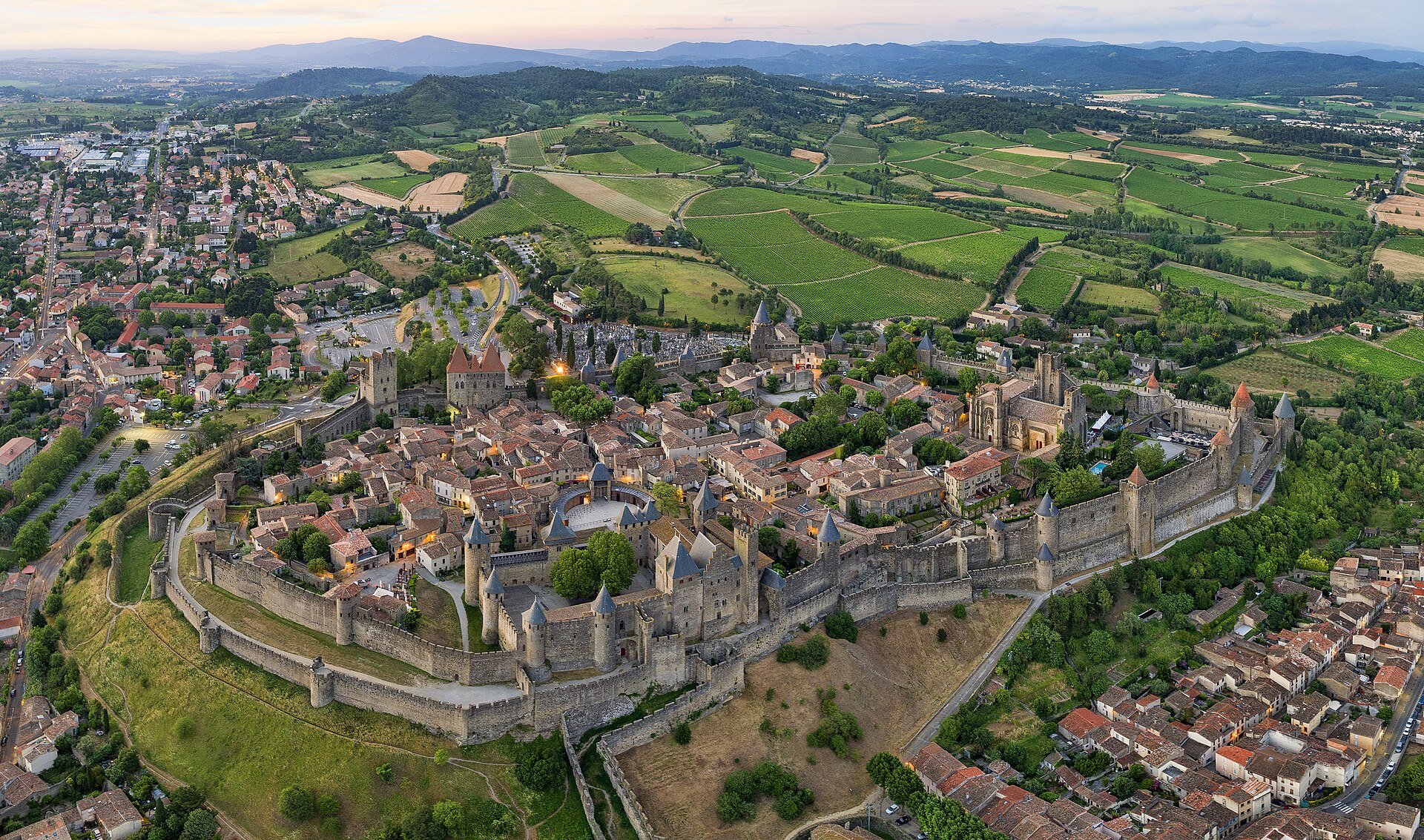
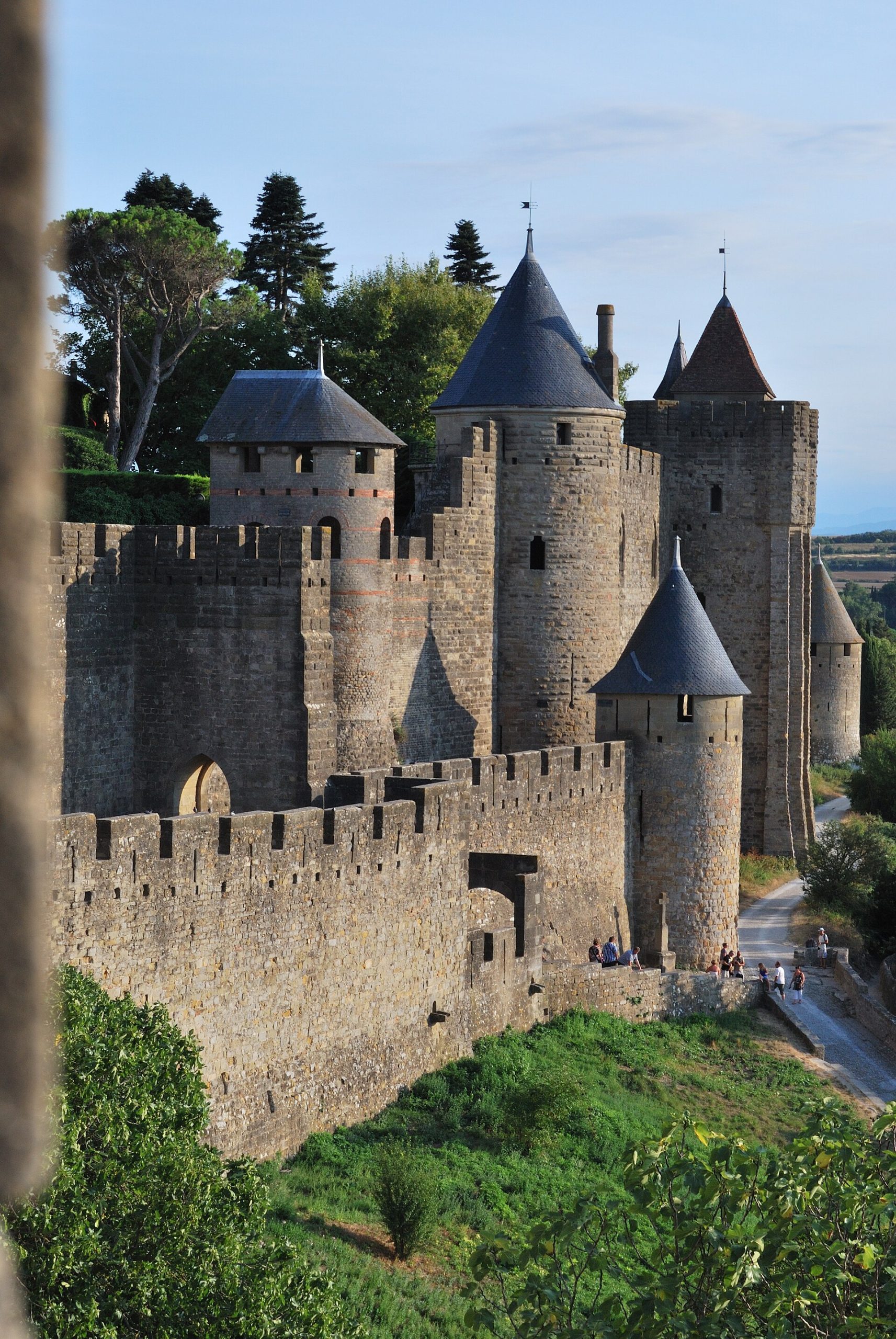
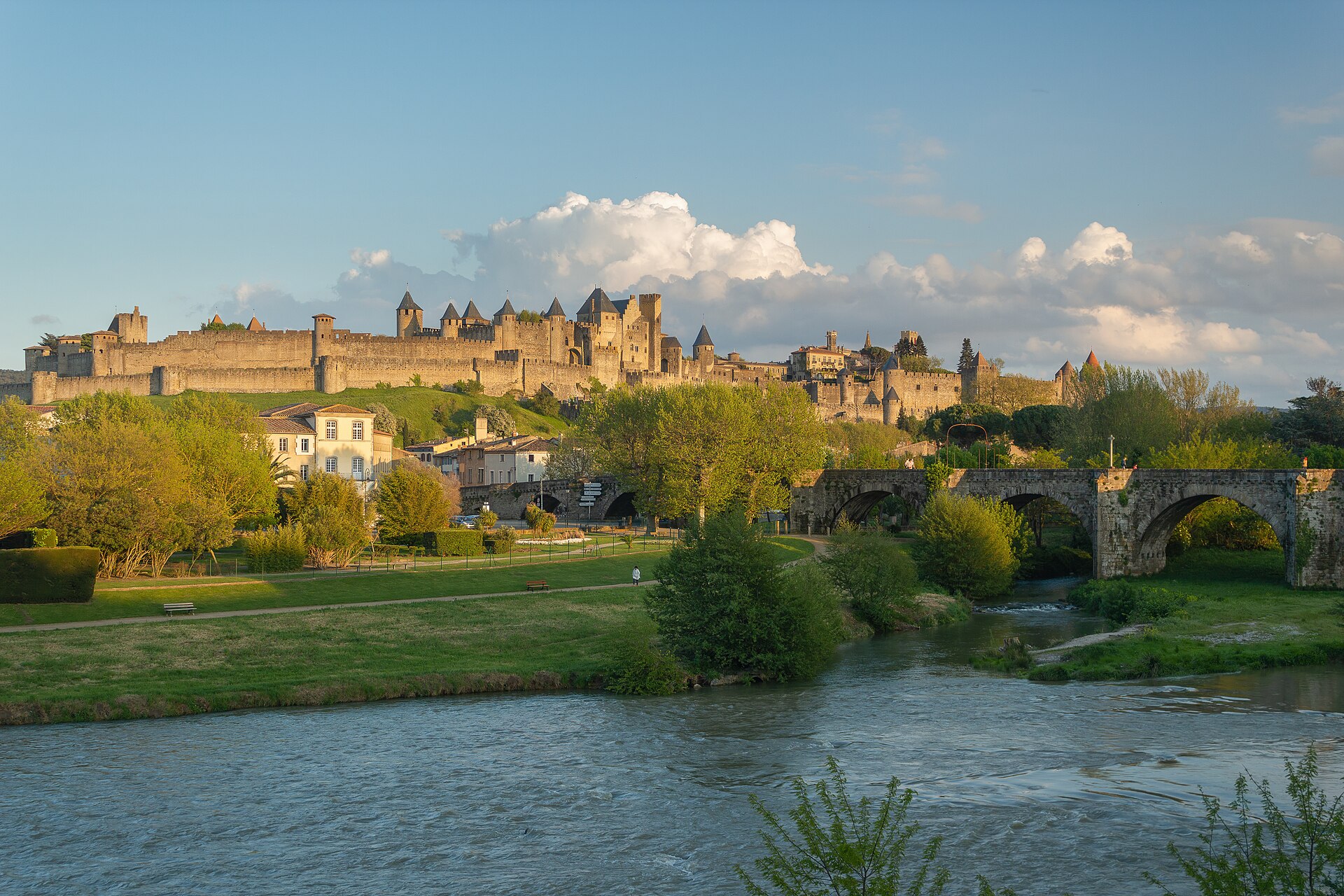
Come over the hill toward Carcassonne, and you may think you have fallen asleep and woken inside a storybook. There, rising above the vineyards of southern France, stands an entire medieval city, ringed by a double crown of golden walls studded with more than fifty round towers, each capped with a pointed grey roof. It is the largest and most complete fortified city in Europe, and to see it for the first time is to feel that the Middle Ages have somehow survived intact into the modern world.
This is the Cité de Carcassonne, a walled town so perfect that it seems almost too good to be true, and in a way it is: much of what we see was restored in the nineteenth century, rescuing a crumbling ruin and giving it back its pointed towers and battlements. But beneath that restoration lies the real thing, a fortress with two thousand years of history, Roman, Visigothic and medieval, and a story that includes one of the darkest episodes of the entire Middle Ages.
For Carcassonne was at the heart of a terrible religious war, the crusade against the Cathars, and its mighty walls witnessed a siege that helped to destroy a whole civilisation of the south. Grand, beautiful and haunted by history, it is one of the most extraordinary sights in France. Let’s cross the drawbridge and enter the double walls of Carcassonne.
In This Article
- A City Within Two Walls
- Two Thousand Years of Defence
- The Land of the Cathars
- The Siege of 1209
- The Fall of the South
- A Royal Fortress on the Frontier
- The Château Comtal
- The Basilica of Saint-Nazaire
- Light Through Ancient Glass
- The Gates of the City
- A Second Gate and a Steep Descent
- Decline and a Great Rescue
- Visiting the Cité de Carcassonne
A City Within Two Walls
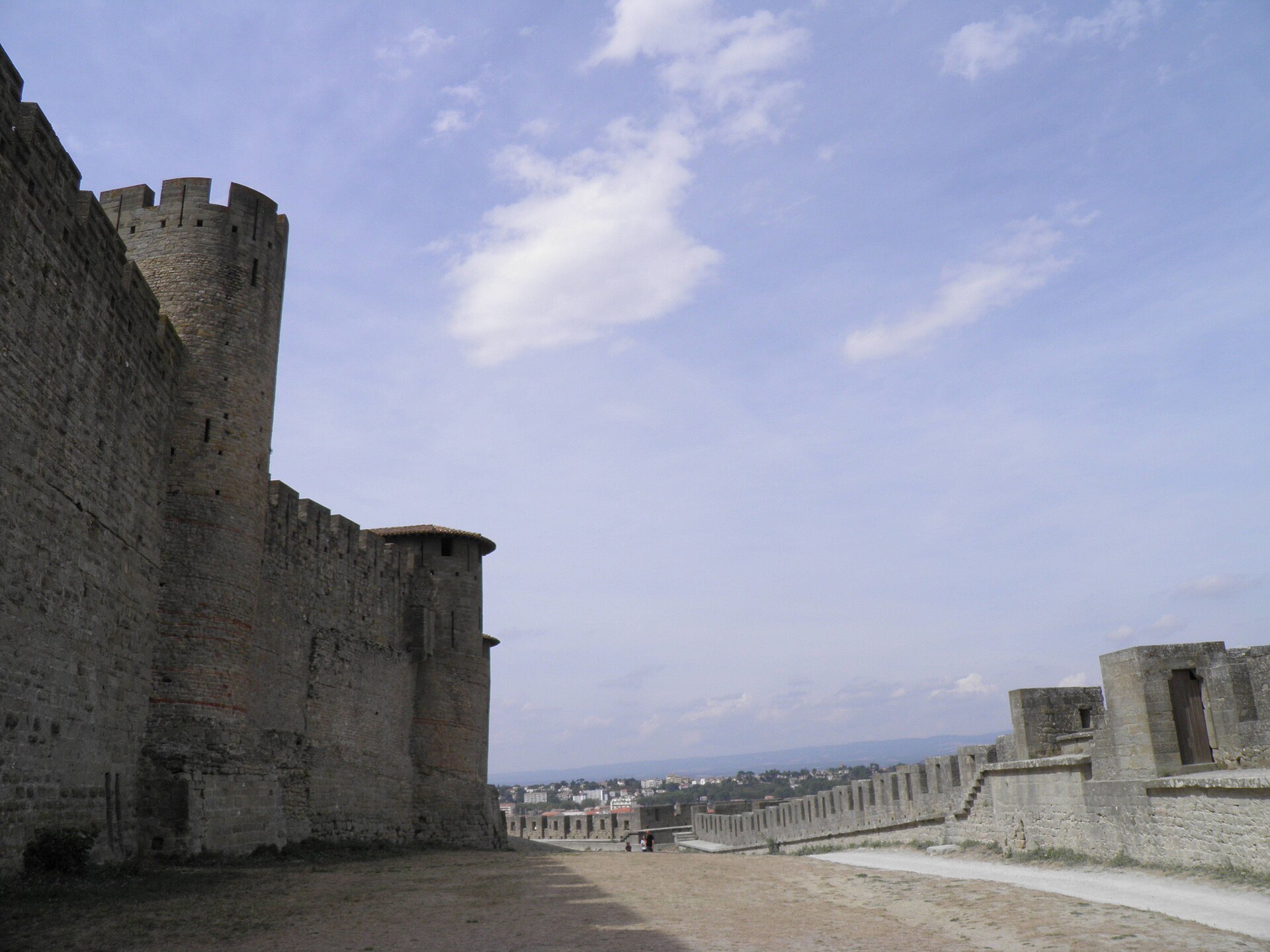
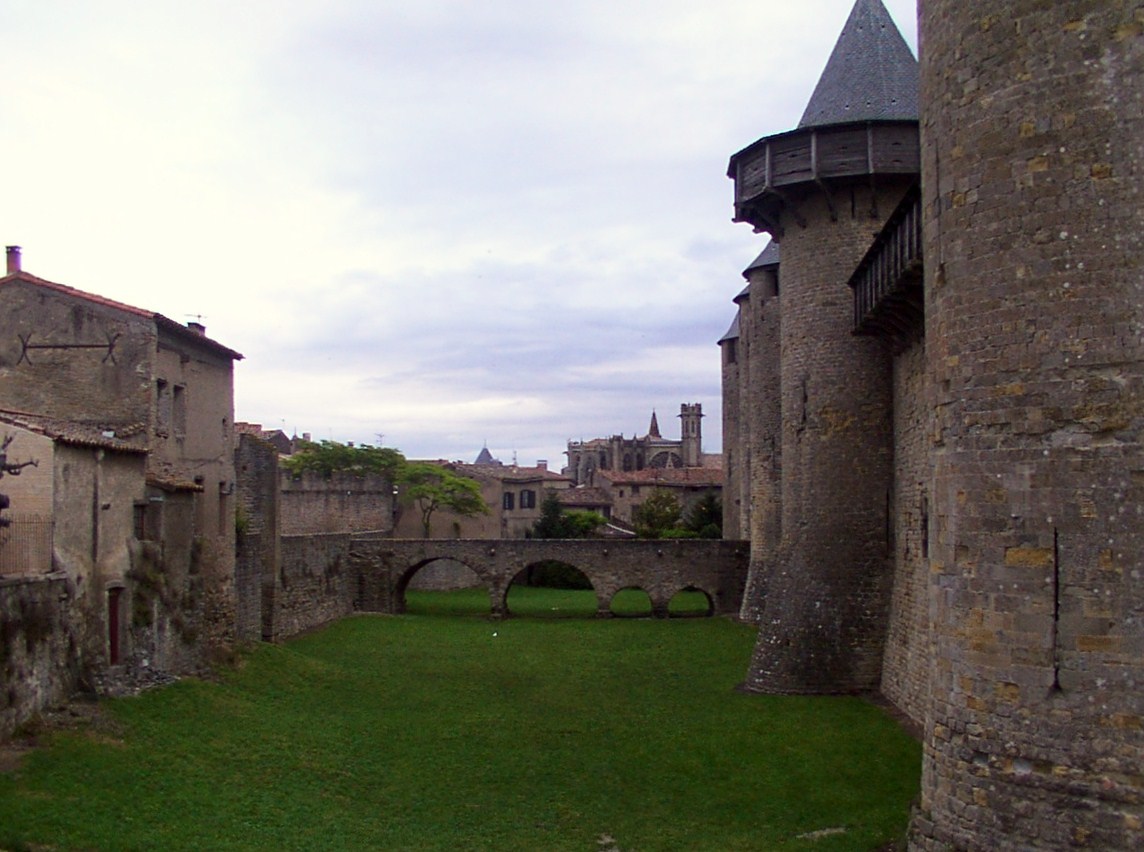
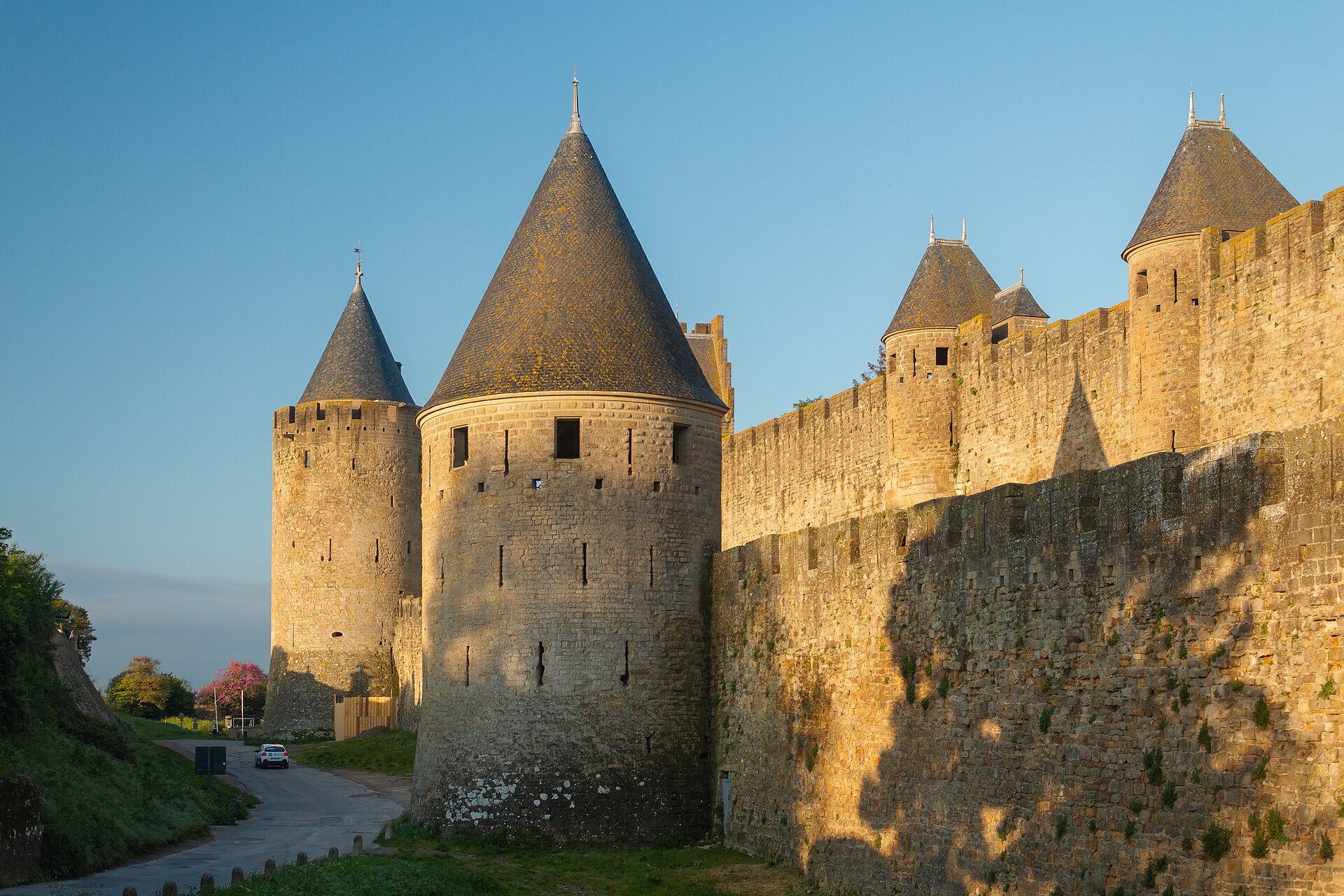
The defining feature of Carcassonne is its double ring of walls. Around the medieval city run not one but two complete circuits of fortification, an inner wall and an outer wall, separated by a broad open space known as the lices. Any attacker who somehow breached the outer wall would find himself trapped in this killing ground, exposed to fire from the higher inner wall, with a whole second line of defence still to overcome.
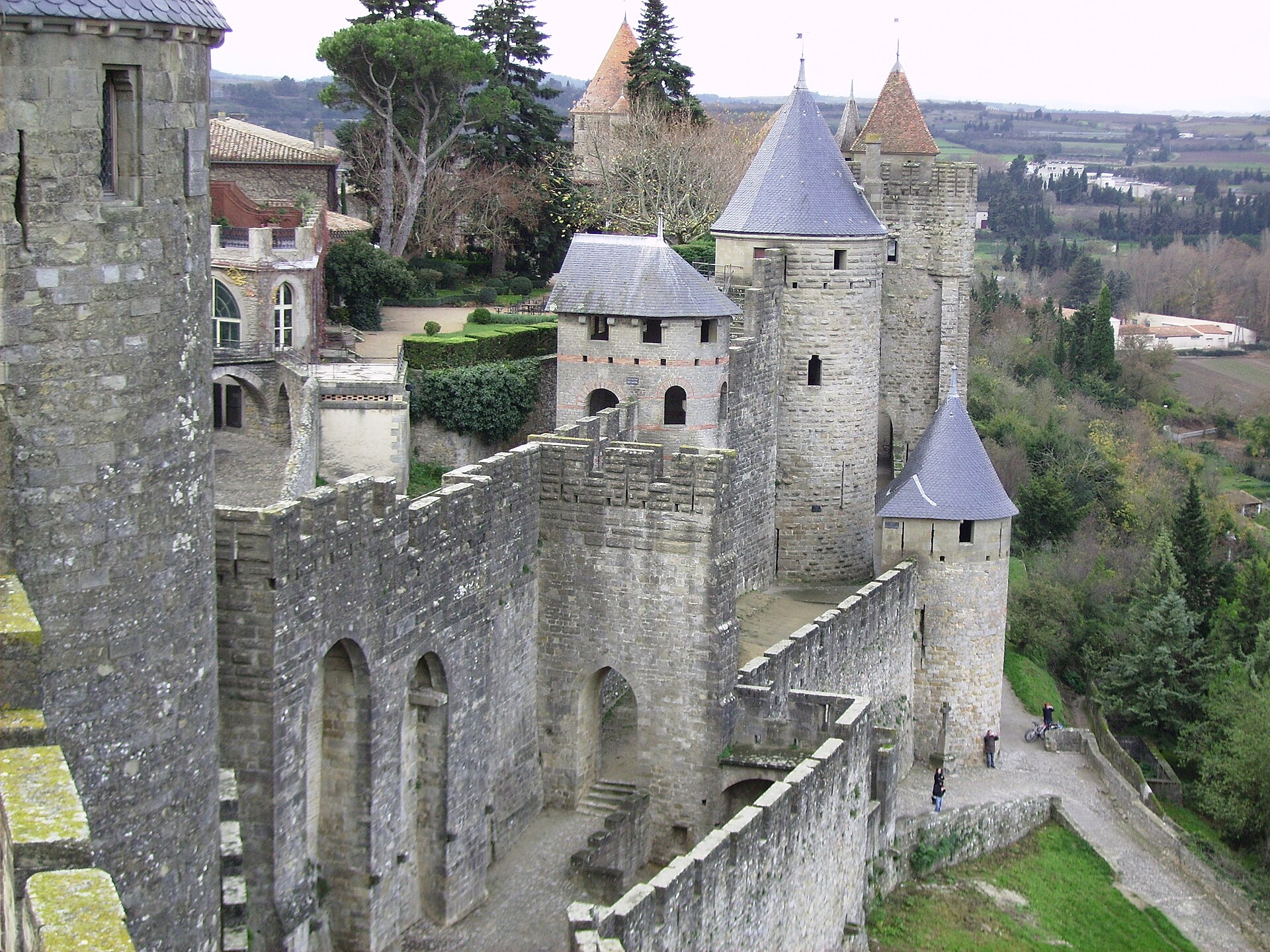
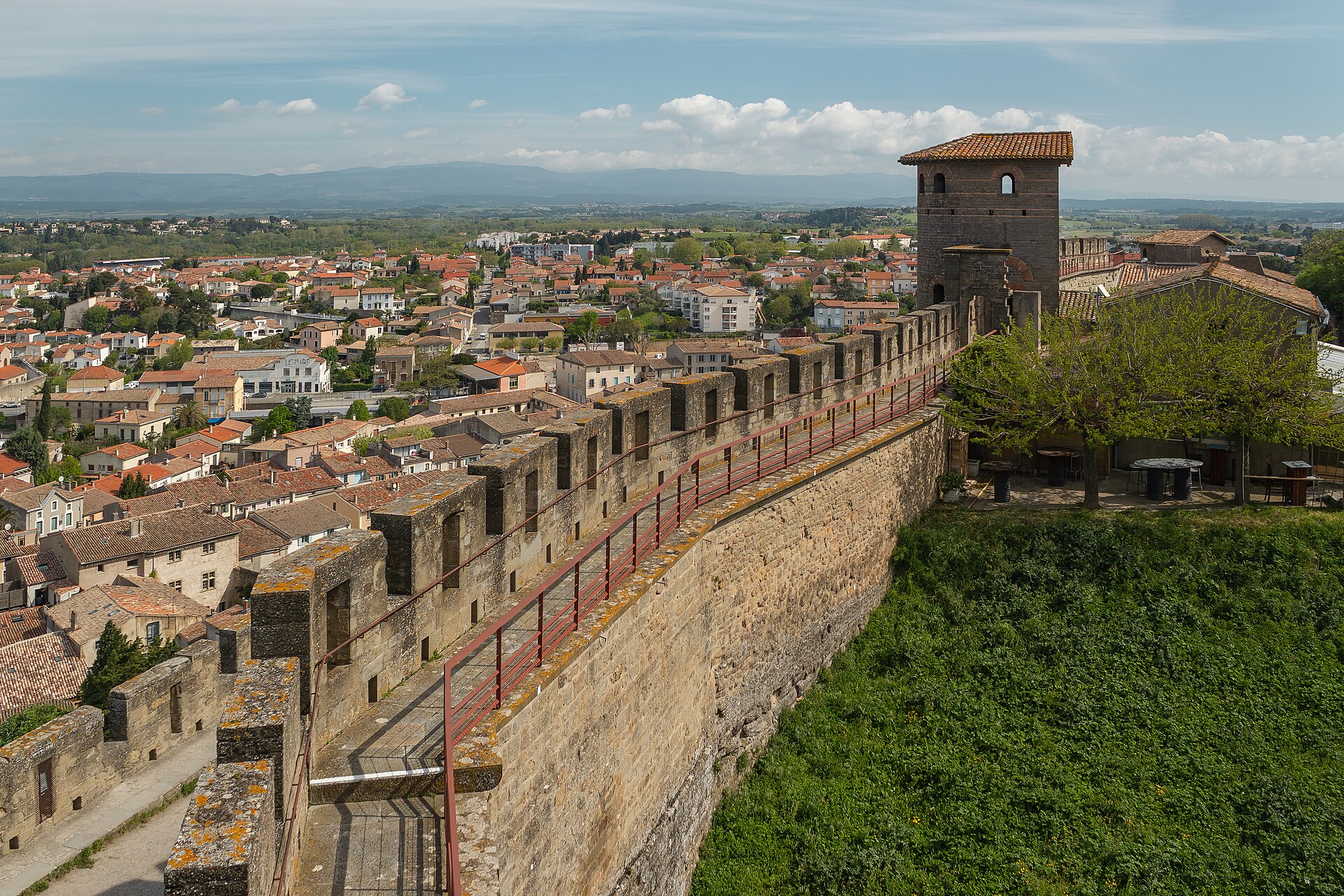
Between them, the two walls stretch for around three kilometres and are studded with more than fifty towers, each one a strong point in its own right. The towers are set close enough together that defenders could cover every stretch of wall with arrows and crossbow bolts, leaving no blind spots for an enemy to exploit. It was one of the most sophisticated defensive systems of the entire Middle Ages.
To walk the lices, the corridor between the walls, is to appreciate just how formidable Carcassonne was. On one side rises the towering inner rampart, on the other the outer wall, and above you loom the great round towers with their pointed roofs. An attacker caught here would have faced almost certain death. It is easy to see why Carcassonne earned its reputation as an impregnable fortress, a place that could defy the greatest armies of its day.
The lices themselves were more than just an empty killing ground; they served practical purposes in peacetime too, providing space for the movement of troops around the defences and, at times, for markets and other activities. But their primary function was always military, and their very existence transformed the mathematics of any siege, forcing an attacker to mount not one assault but two, against successive lines of ever-stronger fortification.
Standing anywhere along the double walls, you are struck by the sheer ambition of the whole conception. To build one complete ring of fortification around a city was a huge undertaking; to build two, with all their towers and gates, and to maintain them for centuries, required resources and determination on a scale that only the greatest powers could command. Carcassonne is, above all, a monument to the seriousness with which the Middle Ages took the business of defence.
Two Thousand Years of Defence
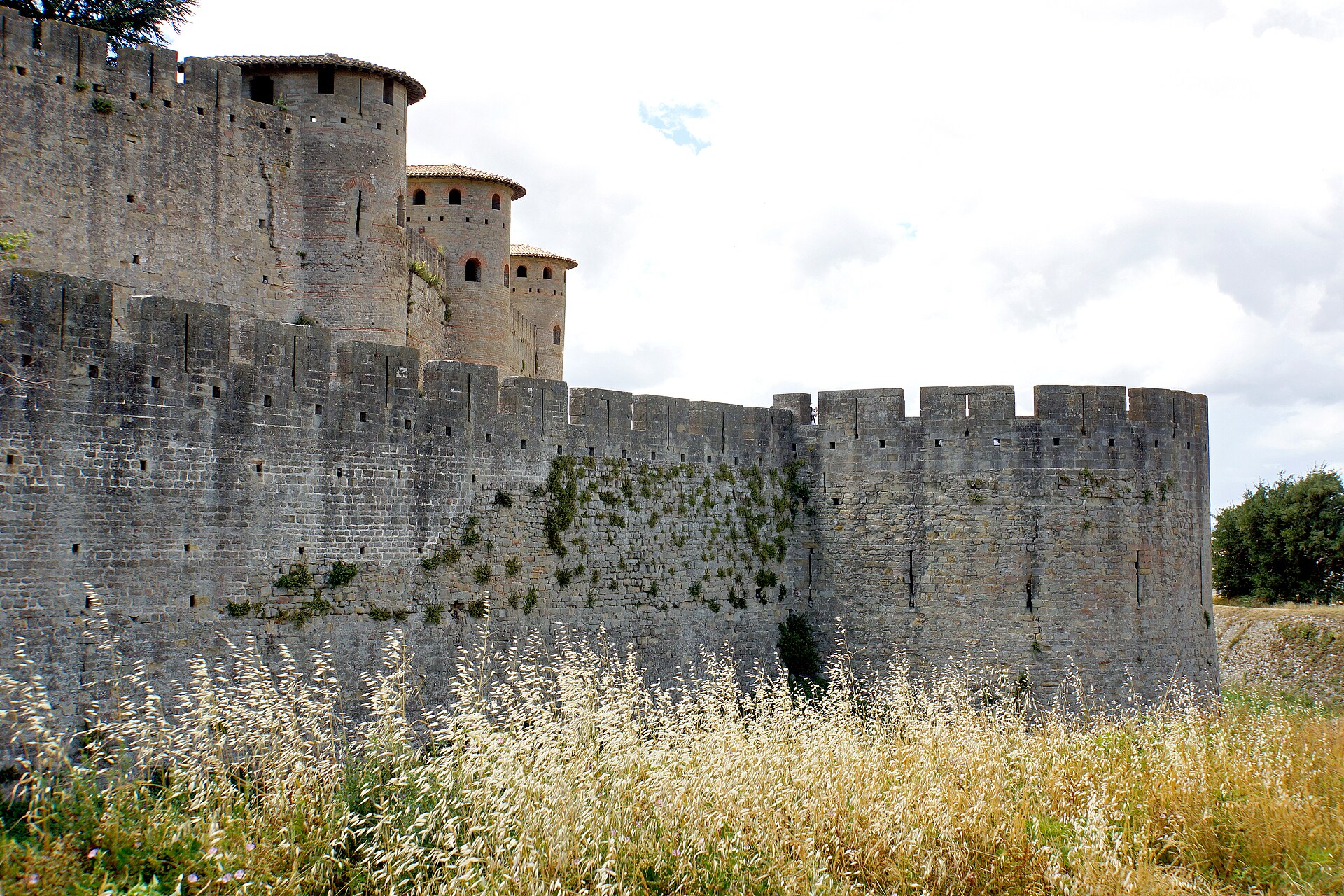
The hill on which Carcassonne stands has been fortified for well over two thousand years, and its walls are a layered record of that immense span of history. The earliest defences were raised in ancient times, and it was the Romans who first surrounded the hilltop town with proper walls, sections of which still survive, incorporated into the later fortifications like fossils embedded in rock.
After the fall of Rome, the Visigoths took the city and strengthened its defences, adding towers and repairing the walls to hold off Frankish and other attackers. For a period the town was even held by Muslim forces, before being retaken, and each successive ruler left their mark on its fortifications. By the Middle Ages, Carcassonne was already an ancient stronghold with a long history of resisting sieges.
Look closely at the walls today and you can read this history in the stone itself. Roman work, with its distinctive brickwork and rounded towers, gives way to medieval masonry above, the different ages of building clearly visible where they meet. Few places allow you to trace the evolution of fortification across so many centuries in a single set of walls, from the ancient world through to the height of the Middle Ages.
The survival of so much Roman and early medieval work within the walls makes Carcassonne a place of exceptional interest to historians and archaeologists. Elsewhere, later rebuilding has usually swept away the earliest fortifications, but here, because each age built upon rather than replacing what had gone before, the whole long story of the site’s defence can still be read in the fabric of the walls, a rare and precious survival from the deep past.
The Land of the Cathars
To understand the most dramatic chapter of Carcassonne’s history, we have to understand the world of the medieval south of France, a rich, sophisticated and independent-minded region with its own language and culture, quite distinct from the north. In the twelfth and early thirteenth centuries, this land became the heartland of a religious movement that the Church condemned as heresy: the Cathars.
The Cathars held beliefs very different from those of the Catholic Church, seeing the material world as evil and rejecting much of the wealth and hierarchy of the established religion. Their faith spread widely through the towns and castles of the south, tolerated and even protected by many of the local lords, including the powerful Trencavel viscounts who ruled Carcassonne. To the Church in Rome, this was an intolerable challenge that had to be crushed.
The result was one of the most brutal episodes of the Middle Ages: the Albigensian Crusade, a holy war launched not against distant infidels but against fellow Christians in the south of France, aimed at wiping out the Cathar heresy by fire and sword. And one of the first and greatest targets of this crusade was the mighty fortress-city of Carcassonne.
The medieval south of France, often called Occitania after its language, the langue d’oc, was one of the most brilliant civilisations of its age, home to the troubadours whose poetry shaped the whole European idea of courtly love. The tolerance and sophistication of this culture, so different from the harsher north, was part of what allowed the Cathar faith to flourish there, and part of what made its destruction in the crusade so great a loss.
The Siege of 1209
In 1209 a great crusading army, tens of thousands strong, swept into the south of France to crush the Cathars. Under the ruthless leadership of Simon de Montfort, the crusaders sacked town after town, most notoriously at Béziers, where the population was massacred wholesale. Then they turned toward Carcassonne, the greatest stronghold of the region, held by the young viscount Raymond-Roger Trencavel.
Carcassonne was crowded with refugees who had fled the crusaders, and its defences were formidable, but the siege that followed was ferocious. In the summer heat, the crusaders cut the city off from the river and its water supply, and within the walls conditions quickly became desperate. Thirst and disease began to do the work that the crusaders’ assaults could not, and the position of the defenders grew hopeless.
Seeking to save his people, the young Trencavel went out to negotiate with the crusaders under a promise of safe conduct. It was a fatal mistake. He was seized and thrown into the dungeons of his own castle, and shortly afterwards he died there, at the age of only twenty-four, in circumstances that have never been fully explained. Leaderless and dying of thirst, the city surrendered, and its people were driven out, allowed to leave with nothing but the clothes they wore.
The massacre at Béziers, which preceded the siege of Carcassonne, had sent a wave of terror through the south. It was there that a papal representative is said to have uttered the infamous words, when asked how to tell Catholic from Cathar among the townspeople, to kill them all and let God sort them out. Whether or not the phrase was really spoken, the wholesale slaughter that followed was real enough, and it left the defenders of Carcassonne in no doubt about the mercilessness of the enemy at their gates.
The death of the young Trencavel in the dungeons of his own castle shocked even contemporaries and cast a long shadow over the crusade. To many in the south he became a martyr, a symbol of the destruction of their world by the armies of the north, and his fate has haunted the memory of Carcassonne ever since. That so young a lord, who had gone out in good faith to save his people, should die a prisoner in his own fortress seemed to sum up the whole tragedy of the crusade.
The cutting of the water supply proved decisive, as it so often did in medieval sieges. In the fierce heat of a southern summer, with the wells failing and the city packed far beyond its normal population by refugees, thirst and disease spread rapidly. No walls, however strong, could hold out against such an enemy, and it was this, rather than any breach in the defences, that finally forced the proud city to its knees.
The Fall of the South
The fall of Carcassonne was a turning point in the Albigensian Crusade and in the history of the whole south of France. With the greatest fortress of the region in his hands, Simon de Montfort took the Trencavel lands for himself and used Carcassonne as a base for the continuing war against the Cathars and their protectors, a war that would drag on with terrible cruelty for decades.
The crusade eventually broke the independence of the south and destroyed the Cathar faith almost entirely, hunting down its believers and burning them in their hundreds. It also opened the way for the kings of France to extend their power over the region, absorbing the once-independent lands of the south into the growing French kingdom. The rich and distinctive civilisation of the medieval south never fully recovered.
Carcassonne thus stands as a monument not only to medieval military engineering but to one of the great tragedies of European history, the crushing of a whole culture in the name of religious conformity. Behind the beauty of its walls lies the memory of the siege, the imprisonment and death of the young Trencavel, and the expulsion of a whole city’s population, a dark story that gives the fortress a poignancy beyond its architecture.
The absorption of the south into the kingdom of France, which the crusade did so much to bring about, was one of the decisive developments in the making of the French nation. The distinctive language and culture of Occitania were gradually overshadowed by those of the north, and a region that had once looked toward the Mediterranean world was drawn firmly into the orbit of Paris. Carcassonne, passing from Trencavel to king, stands as a monument to that momentous shift.
A Royal Fortress on the Frontier
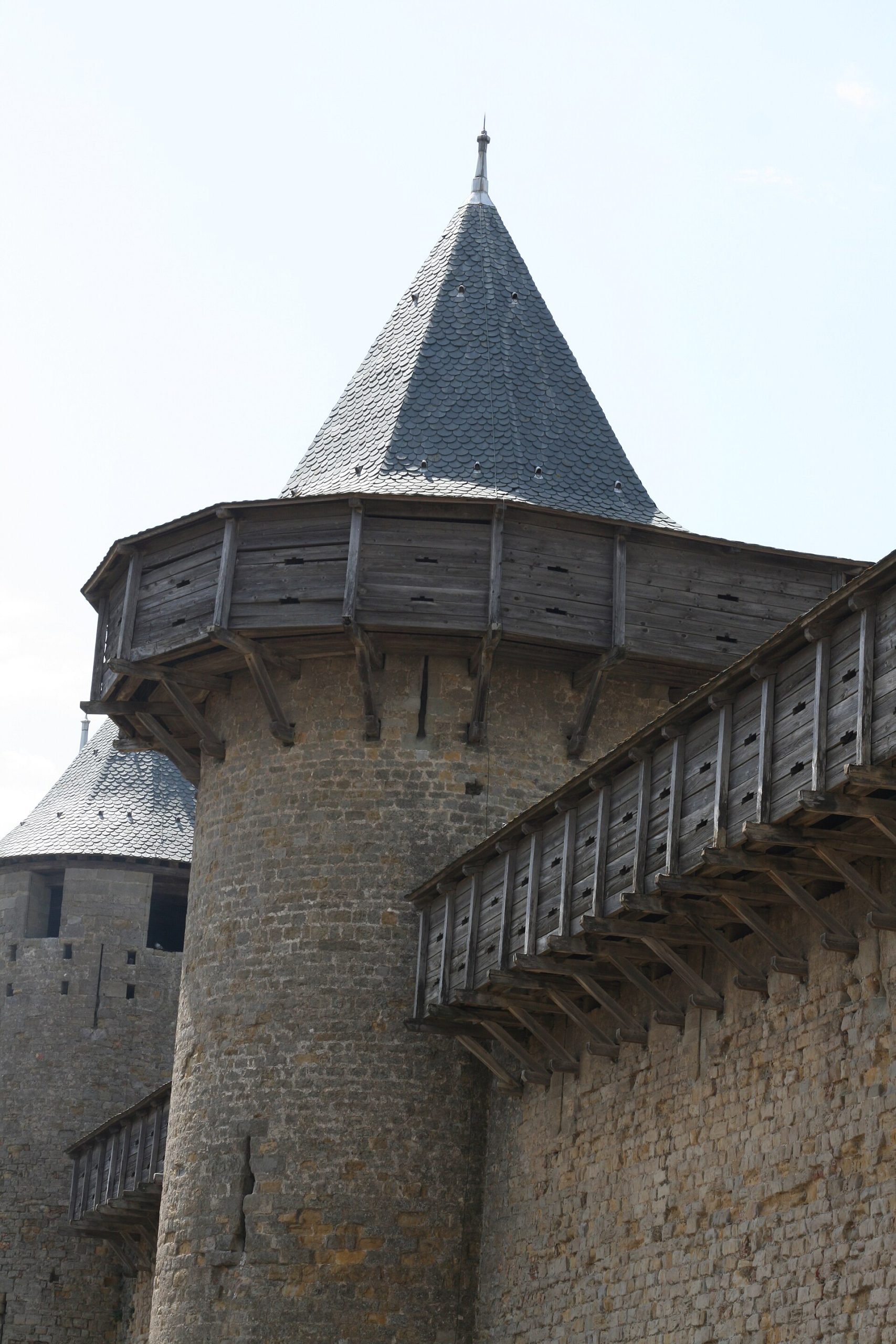
After the crusade, Carcassonne passed into the hands of the kings of France, who recognised its enormous strategic value. The city now stood close to the frontier with the kingdom of Aragon, in what is now Spain, and the French crown was determined to make it an impregnable bastion guarding the southern border of the realm. Over the following decades, the fortifications were massively strengthened and expanded.
It was under the French kings, above all Louis IX and his son, that Carcassonne took on much of the form we see today. They added the second, outer ring of walls, creating the famous double line of defence, and reinforced the towers and gates, turning the city into one of the strongest fortresses in all of Europe. The scale of the work reflected the importance the crown attached to holding this vital frontier stronghold.
For centuries Carcassonne fulfilled this role, a great royal fortress guarding the road to Spain, so strong that no enemy dared to attack it. Its very impregnability, however, would eventually be the cause of its decline, for a fortress that is never besieged can come to seem unnecessary, and when the frontier itself finally moved, Carcassonne’s reason for existence would begin to fade.
The royal engineers who remade Carcassonne in the thirteenth century were masters of their craft, and the double walls they created were a textbook of the most advanced military thinking of the age. Every element, the spacing of the towers, the angle of the walls, the design of the gates, was calculated to maximise the defenders’ advantage and to make any assault as costly as possible. The result was a fortress considered virtually impregnable by the standards of the day.
The expulsion of the original population after the crusade had also changed the character of the city. A new town, the bastide, was founded on the plain below by the river, and much of the population moved there, so that the fortified city on the hill became increasingly a purely military and administrative centre. This division between the upper fortified city and the lower town persists to this day, and it shaped the whole later history of Carcassonne.
For four centuries after the crusade, Carcassonne guarded the southern approaches to France so effectively that no enemy ever seriously attempted to take it. Its reputation for impregnability was itself a form of defence, deterring attack before it could begin. In an age of near-constant warfare, this long peace behind its walls is a testament to just how formidable the fortress had become in the hands of the French crown.
The Château Comtal
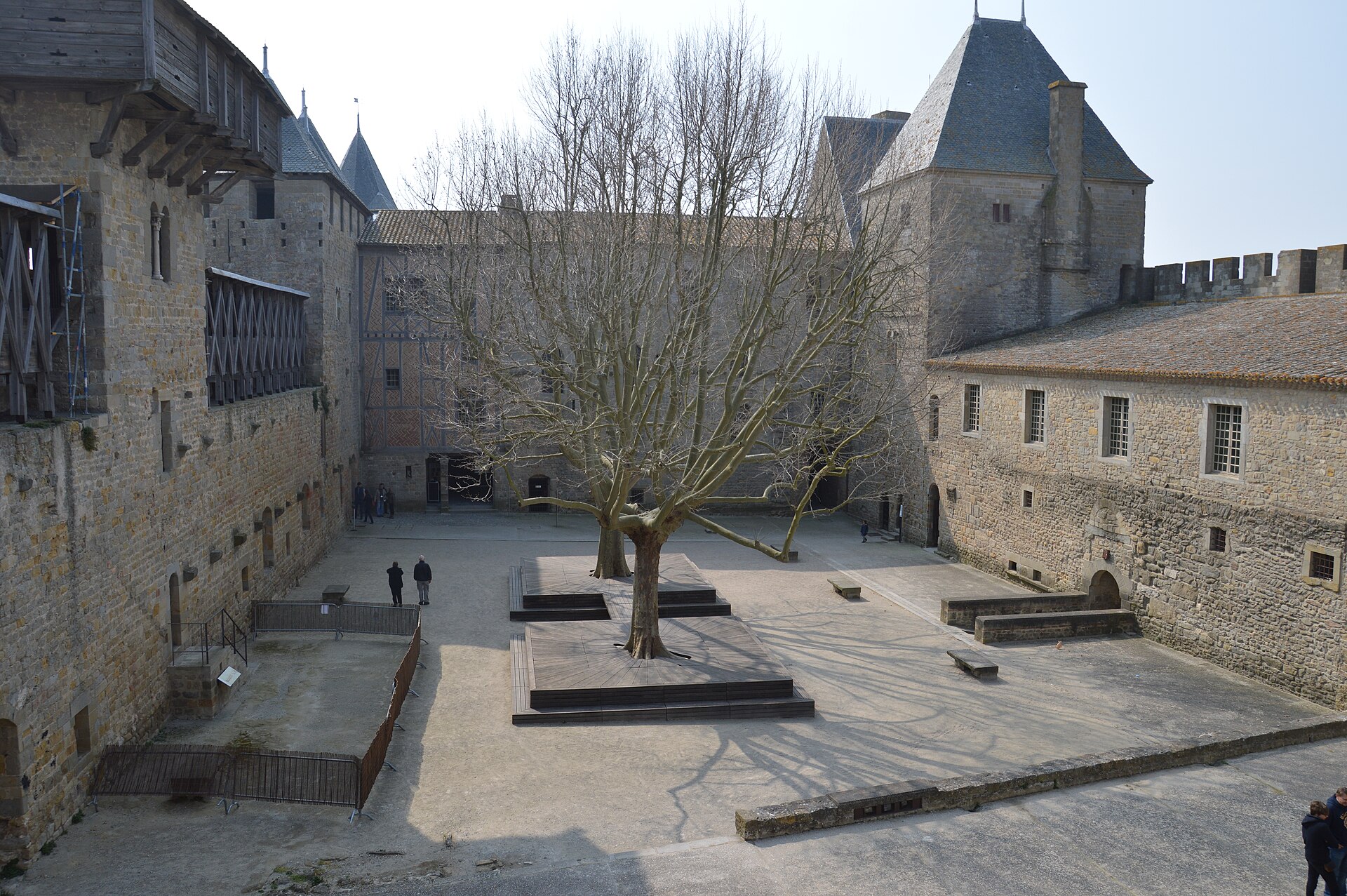
Within the walls of the city stands a castle within the castle: the Château Comtal, the fortified residence of the viscounts and later of the royal officials who governed Carcassonne. Guarded by its own walls, towers and moat, and reachable only across a bridge, it formed a last stronghold within the city, a place of refuge if the outer defences should ever fall.
The Château Comtal was the seat of power in Carcassonne, first of the Trencavel viscounts and then, after the crusade, of the representatives of the French crown. It was here that the young Raymond-Roger Trencavel was imprisoned and died, and here that the business of ruling the city and its region was carried on for centuries. Its strong towers and courtyards give a vivid sense of the concentrated power that once resided within the walls.
Today the Château Comtal is at the heart of the visitor’s experience of Carcassonne, housing displays on the history and restoration of the city and giving access to sections of the ramparts. To explore it is to reach the inner core of the fortress, the strongest point of one of the strongest fortified cities ever built, and to feel the layers of history, from Trencavel to king, that are gathered within its walls.
The placement of a strong castle inside an already formidable walled city was a common feature of the greatest medieval fortresses, providing a final refuge and a secure seat for the lord even if the town itself were taken. At Carcassonne the Château Comtal fulfilled this role perfectly, its own walls and moat setting it apart from the surrounding city, a fortress within a fortress at the very heart of the defences.
The Basilica of Saint-Nazaire
Amid the towers and ramparts of the fortified city stands one of its greatest treasures: the Basilica of Saint-Nazaire. This beautiful church, begun in the Romanesque style and completed in the Gothic, served the people of the medieval city, and it survives as a reminder that Carcassonne was not merely a fortress but a living town, with all the religious and communal life that implied.
The basilica is famous above all for its stained glass, some of the finest and oldest in the south of France, which fills the Gothic eastern end of the church with jewel-like colour. The contrast between the sturdy Romanesque nave and the soaring, light-filled Gothic choir tells its own story of changing styles, much as the walls outside record the changing art of fortification.
For the inhabitants of Carcassonne across the centuries, the basilica was the spiritual heart of their walled world, a place of worship, ceremony and burial. Its survival, alongside the great defences, helps to make Carcassonne feel like a complete medieval city rather than merely a set of walls, a place where people lived and prayed as well as fought, and its beauty offers a moment of calm amid the military might all around.
The building of the basilica over several centuries, beginning in the solid, rounded Romanesque style and continuing in the soaring, pointed Gothic, mirrors the wider development of medieval architecture across Europe. Within a single building, the visitor can trace this great transition, from the massive simplicity of the earlier age to the light and height of the later, a shift in taste and technology as profound in its way as any change in the art of war recorded by the walls outside.
Light Through Ancient Glass
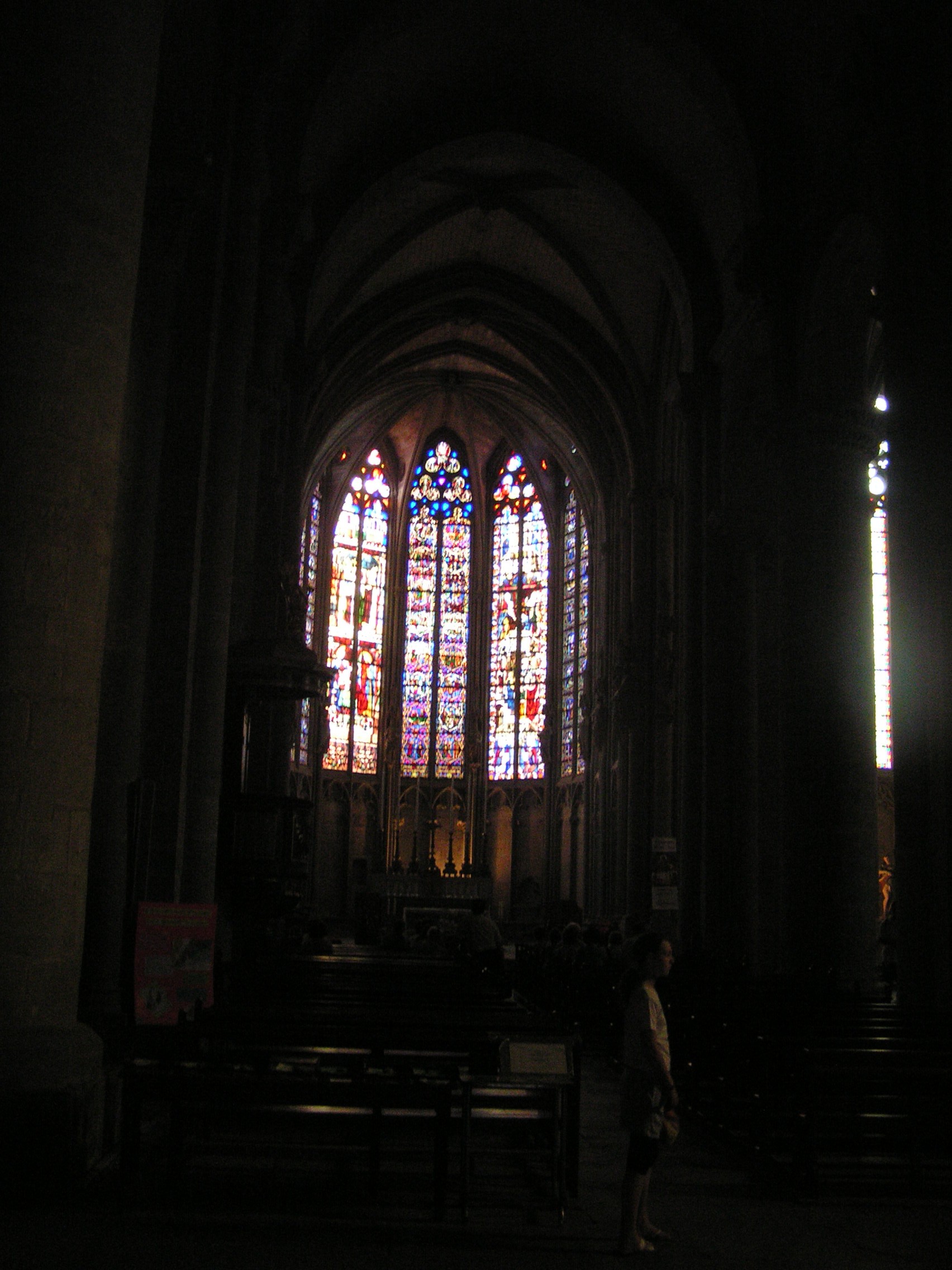
Step inside the Basilica of Saint-Nazaire and the mood changes completely. After the martial grandeur of the walls and towers, here is a space of quiet beauty, its Gothic choir glowing with the colours of medieval stained glass. The great windows, some among the oldest in this part of France, cast pools of red, blue and gold across the ancient stone, a display of craftsmanship as impressive in its way as the fortifications outside.
The stained glass of Saint-Nazaire tells stories from the Bible and the lives of the saints, as medieval church windows did everywhere, serving as a kind of illustrated scripture for a largely unlettered congregation. To gaze up at them is to see the world as medieval worshippers saw it, filtered through coloured light, a glimpse of heaven brought down into the heart of the fortress city.
The basilica is a reminder that the people who built and defended Carcassonne were not only soldiers and engineers but also artists and craftsmen, capable of creating great beauty as well as great strength. The same civilisation that raised the mighty double walls also filled this church with light and colour, and the two together, the fortress and the basilica, give a fuller picture of the medieval world than either could alone.
The preservation of such fragile treasures as medieval stained glass through centuries of war, neglect and restoration is little short of miraculous, and the windows of Saint-Nazaire are among the finest to survive in the whole of southern France. They remind us that Carcassonne was a centre of art and faith as well as of war, and that the people who lived behind its mighty walls sought beauty and meaning as earnestly as they sought safety.
The Gates of the City
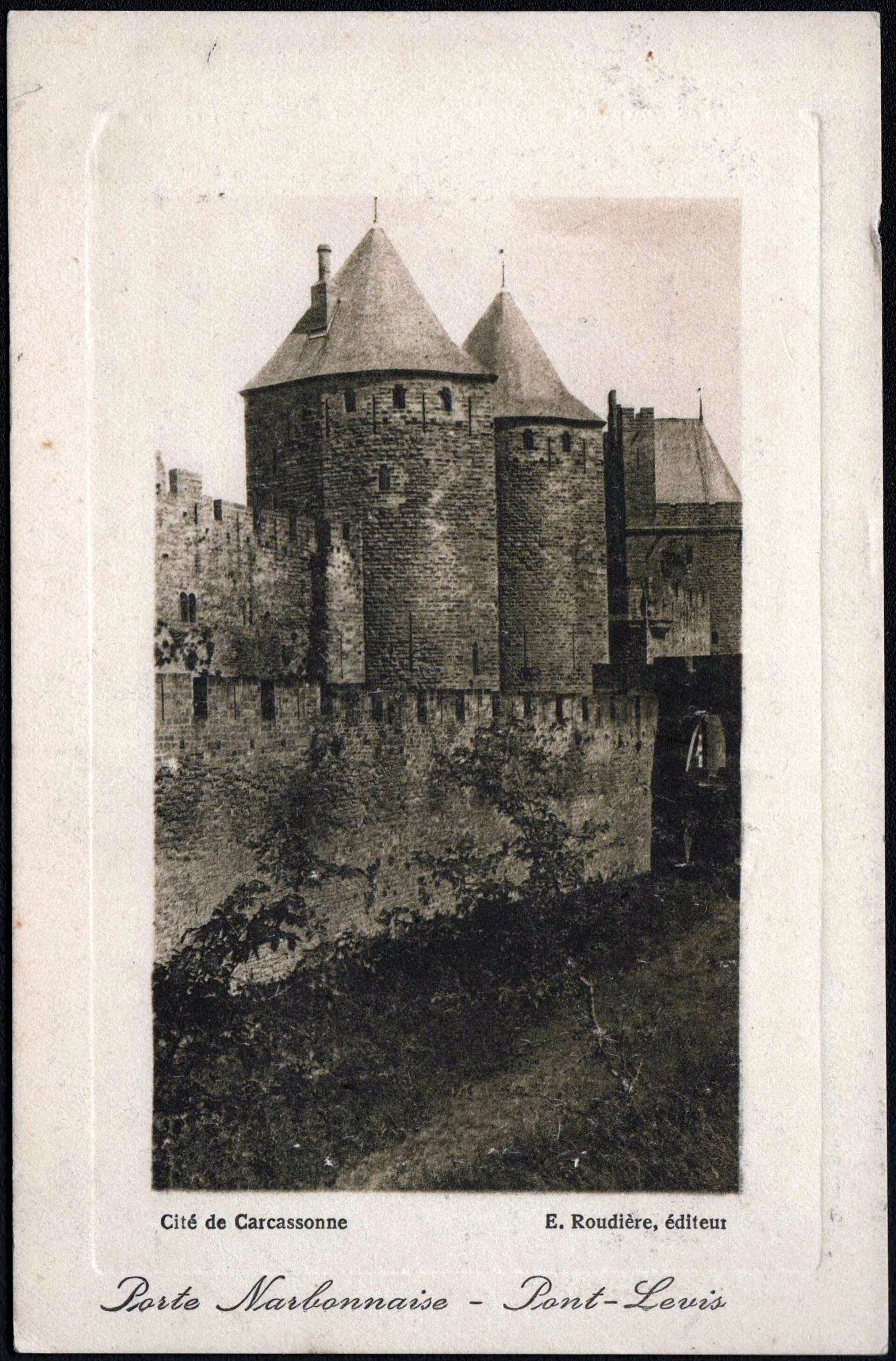
A fortress is only as strong as its gates, and Carcassonne’s were designed with enormous care. The main entrance, the Narbonne Gate, is a mighty structure flanked by two great towers, defended by a drawbridge, portcullises, murder-holes and heavy doors, a whole sequence of obstacles that any attacker would have to overcome in turn. To pass through it is to feel the full weight of medieval defensive ingenuity.
On the opposite side of the city, the Aude Gate guards the steep approach from the river below, its defences cleverly adapted to the difficult terrain. Between them, these gates controlled all access to the city, funnelling visitors and would-be attackers alike through carefully defended passages where they could be watched, challenged and, if necessary, destroyed. No one entered Carcassonne except on the defenders’ terms.
The gates were also the points of contact between the fortress and the world outside, where merchants, travellers and officials passed in and out, where tolls were collected and news exchanged. For all their defensive purpose, they were the busy thresholds of a living city, and today they remain the dramatic entry points through which visitors step from the modern world into the medieval one.
The elaborate defences of the Narbonne Gate show how much thought medieval engineers gave to protecting the vulnerable points of a fortress. An attacker who forced the outer defences would find himself in a confined space, overlooked from all sides and blocked by a further series of barriers, so that the gate became not a way in but a trap. The layering of drawbridge, portcullis and gate, each covered by the next, made a direct assault almost suicidal.
A Second Gate and a Steep Descent
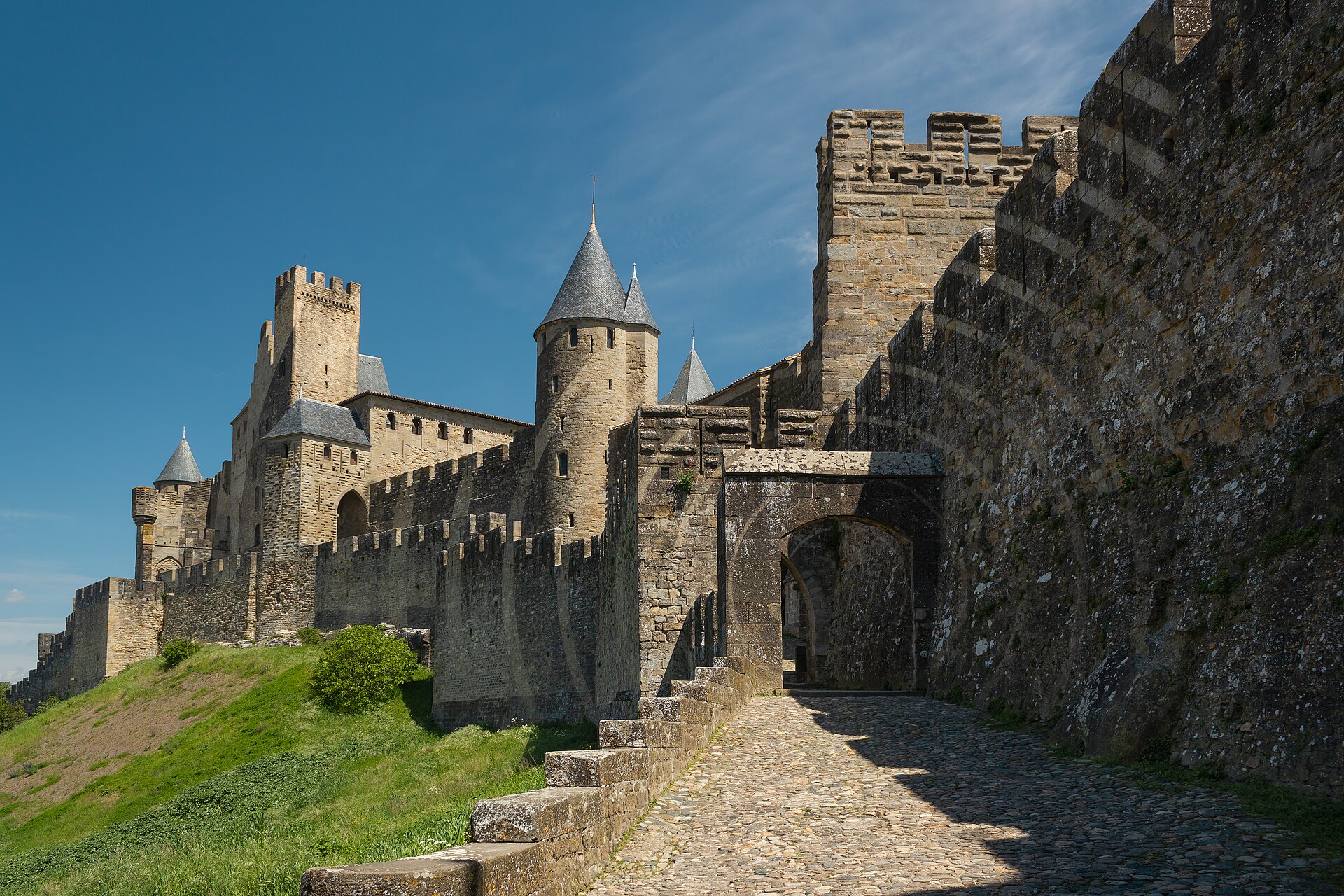
The Aude Gate, on the western side of the city, offers one of the most dramatic approaches to Carcassonne. Here the ground falls away steeply toward the River Aude and the lower town beyond, and the path up to the gate winds beneath the walls, overlooked at every turn by towers and battlements. An attacker approaching from this side would have faced a long, exposed and deadly climb.
This gate connected the fortified city on its hill to the settlement that grew up below, by the river, and it was through here that much of the everyday traffic of the town would have passed. The steepness of the approach, which made it so easy to defend, also makes it a spectacular route for the modern visitor, climbing up beneath the golden walls with the whole fortress rising overhead.
Together, the two great gates and the double walls between them made Carcassonne a fortress of extraordinary strength, a place that could be entered only through carefully controlled and heavily defended points. It is this completeness, the sense of a whole fortified city with all its defences intact, that makes Carcassonne so uniquely impressive among the surviving castles and strongholds of Europe.
The relationship between the fortified city on its hill and the lower town by the river is central to understanding Carcassonne. For much of its history the two were distinct communities, the one military and administrative, the other commercial and residential, connected by the steep road through the Aude Gate. This division, born of the upheavals of the crusade, still shapes the way the city is experienced today, with the great fortress crowning the height above the modern town below.
Decline and a Great Rescue
Carcassonne’s long career as a frontier fortress came to an end in the seventeenth century, when a treaty moved the border between France and Spain far to the south. Overnight, the great stronghold found itself deep inside French territory, no longer guarding any frontier, its military purpose gone. Neglected and unneeded, the fortifications began to decay, and over the following century the once-mighty city fell into serious disrepair.
By the nineteenth century, the walls were crumbling, towers had lost their roofs, and there were even proposals to demolish the fortifications altogether. Carcassonne, one of the greatest medieval fortresses in the world, seemed doomed to disappear. That it survives at all is due to a change in attitudes, as a new generation came to value the medieval past and to campaign for the preservation of its monuments.
The rescue of Carcassonne became one of the great restoration projects of the age, and it saved the fortress from destruction. But it also raised questions that are still debated today, for the restorer who saved Carcassonne did not simply repair it but reimagined it, giving it back an appearance that was partly historical fact and partly romantic vision. The result is the fairy-tale city we see, magnificent and controversial in equal measure.
The architect who led the restoration of Carcassonne was Eugène Viollet-le-Duc, the most famous restorer of medieval buildings in nineteenth-century France, a man of enormous energy and strong opinions who worked on many of the country’s greatest monuments. At Carcassonne he not only repaired the crumbling walls but sought to return the fortress to what he believed was its ideal medieval form, rebuilding towers and adding the pointed conical roofs that give the city its distinctive fairy-tale silhouette today.
It is these roofs, above all, that have provoked debate. Critics have pointed out that the steeply pointed slate roofs are more typical of northern France than of the sun-baked south, and that the original towers of Carcassonne may have had flatter, tiled tops. Viollet-le-Duc, they argue, gave the southern fortress a northern face. Yet whatever the historical accuracy of the details, there is no doubt that his work saved Carcassonne from ruin and created one of the most beloved and recognisable images in all of France.
The debate over Viollet-le-Duc’s work at Carcassonne touches on one of the deepest questions in the whole field of conservation: whether a monument should be preserved exactly as it survives, ruins and all, or restored to some imagined original completeness. There is no easy answer, and reasonable people still disagree. What is beyond dispute is that without his intervention, one of Europe’s greatest medieval monuments would almost certainly have been lost, and for that alone his controversial achievement deserves gratitude.
Visiting the Cité de Carcassonne
Today the Cité de Carcassonne is one of the most visited monuments in France, drawing well over a million people a year, and it is easy to see why. To walk its double walls, explore the Château Comtal, wander the narrow streets of the still-inhabited old town within, and gaze up at the fifty-two towers is to step as completely into the Middle Ages as any place in Europe allows. It is recognised by UNESCO as a World Heritage Site, and it belongs firmly on any list of the great castles of the world.
A visit rewards both the historian and the dreamer. You can trace the layers of Roman, Visigothic and medieval building in the walls, follow the grim story of the Cathar siege in the Château Comtal, admire the stained glass of the basilica, and simply enjoy the extraordinary spectacle of a complete walled city. The view of the whole fortress from across the old bridge over the Aude, especially when it is floodlit at night, is one of the most magical sights in France.
You will find Carcassonne in the Aude department of the Occitanie region, in the far south of France, easily reached by road and rail and a natural base for exploring the wider land of the Cathars. For exact directions, here is a map link to guide you there: 43.2064, 2.3644. Cross the bridge, climb to the gates, and step inside the greatest walled city in Europe.
The old town within the walls is not a museum but a living quarter, with houses, shops, restaurants and even a hotel, so that Carcassonne remains an inhabited medieval city rather than an empty monument. Wandering its narrow streets, away from the busiest routes, you can still find quiet corners where the centuries seem to fall away and the true character of the medieval city makes itself felt, beyond the crowds and the souvenir stalls.
The Greatest Walled City in Europe
The Cité de Carcassonne is a place where the Middle Ages seem to live on. Its double crown of golden walls, its fifty-two towers, its castle within the castle and its living streets make it the most complete fortified city in Europe, a fortress so perfect that it hardly seems real. Behind that beauty lies two thousand years of history, from Roman colony to Visigothic stronghold to royal bastion on the frontier of France.
But Carcassonne is more than a marvel of engineering. Its walls witnessed one of the great tragedies of the Middle Ages, the crusade that destroyed the Cathars and crushed the civilisation of the south, and the memory of that dark time lingers still among the towers. Magnificent and haunted, saved from ruin by a bold and controversial restoration, Carcassonne stands today as one of the wonders of France, a whole medieval world preserved within its double walls.
You May Like
Castello di Miramare: The White Castle of a Doomed Prince


One thought on “The Cité de Carcassonne: Europe’s Greatest Walled City”