Rising beside the harbour of Naples, its five great towers dominating the waterfront of one of the most vibrant cities in Italy, stands the mighty fortress known as Castel Nuovo, or the New Castle, and to Neapolitans simply as the Maschio Angioino, the Angevin Keep. For more than seven centuries this castle has stood guard over the bay, a stronghold of kings and a symbol of the city, and it remains one of the great landmarks of Naples.
The castle was built in the thirteenth century as the royal residence of a new dynasty of kings who ruled Naples, and over the following centuries it was fought over, rebuilt, and adorned by the various rulers who held the city. Its history is the history of Naples itself, a tale of French and Spanish kings, of sieges and conspiracies, of splendour and violence, all played out within and around its powerful walls.
Among its many treasures, one stands out above all: a magnificent white marble triumphal arch, squeezed between two of the dark stone towers, a masterpiece of Renaissance art that commemorates the triumphant entry of a conquering king. This dazzling arch, set against the grim fortress, captures perfectly the double nature of the castle, at once a stronghold of war and a monument of art. Come with me to the bay of Naples and we will explore this great fortress of kings, following its long story from the Angevin keep to the Aragonese arch and beyond.

In This Article
- A Castle by the Bay
- Five Great Towers
- The New Castle
- A Fortress of Kings
- The Arch of Triumph
- Marble Between Dark Towers
- Into the Courtyard
- The Hall of the Barons
- The Palatine Chapel
- Dungeons and a Legend
- Through the Centuries
- A Museum in a Fortress
- Visiting Castel Nuovo
A Castle by the Bay
The position of Castel Nuovo, right beside the harbour of Naples, is central to its character and its history. Naples has always been a great port and a coveted prize, its bay one of the most beautiful and strategic in the Mediterranean, and a fortress guarding the waterfront controlled the very heart of the city. From its walls the castle commanded the harbour and the sea approaches, and it stood as the visible symbol of whoever ruled the city and its bay.
This waterfront setting gave the castle enormous importance in the endless struggles for control of Naples. Whoever held the fortress held the key to the city and its port, and so the castle was the focus of sieges, conspiracies, and changes of dynasty over the centuries. Its command of the harbour made it not merely a residence but a strategic strongpoint, essential to the mastery of one of the richest cities in Italy.
For the visitor today, the castle by the bay is one of the great sights of Naples, its powerful towers rising above the busy waterfront with the sea beyond and, in the distance, the great cone of Vesuvius. The combination of the medieval fortress, the harbour, and the famous bay makes an unforgettable scene, and it places the castle firmly at the heart of the city it has guarded for so long. Castel Nuovo is, above all, a castle of Naples and its bay.
Naples has been one of the great cities of the Mediterranean for well over two thousand years, and its bay, watched over by Vesuvius, is among the most famous and beautiful in the world. A fortress on such a shore was heir to a very long history of power and trade, and Castel Nuovo took its place in that story as the medieval and Renaissance stronghold of a city that had been coveted since ancient times.

Five Great Towers
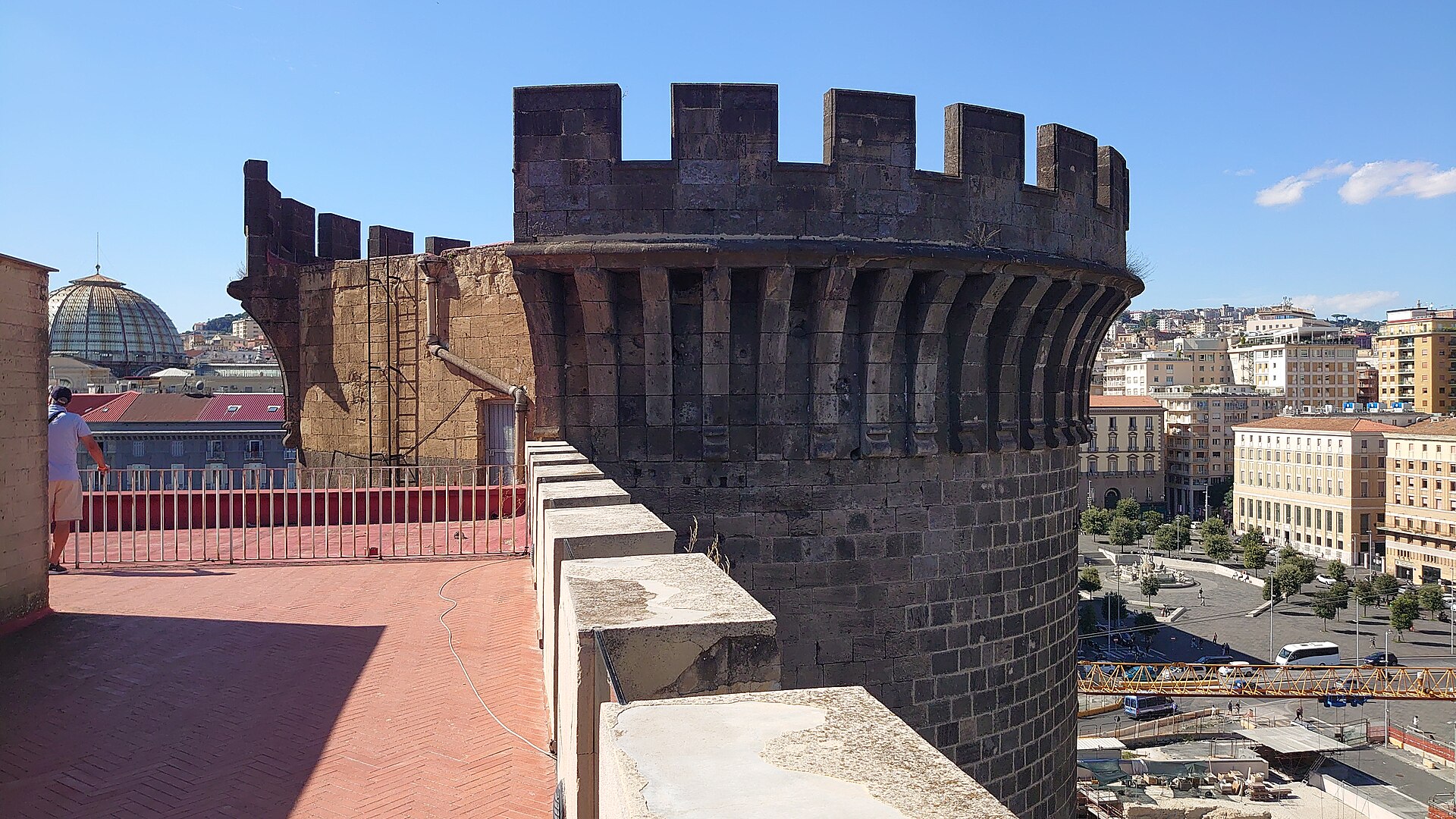
The most striking feature of Castel Nuovo is its towers, five great cylindrical bastions of dark stone that rise above the walls and dominate the fortress. Massive and powerful, they give the castle its formidable silhouette, and they were the key to its defence, allowing the garrison to command the walls and the approaches from every angle. Their sheer bulk speaks of the serious military purpose behind the whole building.
Each of the towers has its own name and its own history, and together they form the backbone of the castle’s defences. Built and rebuilt over the centuries, they were designed to withstand the weapons of successive ages, and their thick walls of dark volcanic stone gave the castle its reputation for strength. Rising above the harbour, they announced the power of the fortress and of the kings who held it.
The contrast between the dark, grim towers and the white marble arch set between two of them is one of the most memorable features of the castle, and it captures the whole character of the building. The towers are the fortress, powerful and warlike; the arch is the palace, refined and triumphant. Together they make Castel Nuovo a place where war and art, strength and beauty, stand side by side in a single unforgettable composition.
The towers were built largely of a dark local stone, giving the castle its characteristic sombre colour and setting off all the more dramatically the white marble of the arch between them. This use of the region volcanic stone ties the castle to the very ground of Naples, and it gives the fortress a distinctive character quite different from the brick and pale stone of castles further north.
Climbing to the upper levels of the castle rewards the visitor with fine views over the harbour and the city, the same commanding prospect from which the garrison once watched the sea and the streets. From here the strategic value of the fortress becomes plain, for the castle dominates both the waterfront and the heart of Naples, exactly as its builders intended.

The New Castle
The name of the castle tells the story of its origins. It is called the New Castle because, when it was built in the late thirteenth century, it was indeed new, a fresh royal residence raised to replace the older castles that had until then served the rulers of Naples. Its builder was a French prince who had won the kingdom of Naples, and who wished for a grand new fortress and palace worthy of his rule.
This new dynasty, the Angevins, took their name from their French homeland, and it is from them that the castle gets its popular name, the Angevin Keep. Under their rule Naples became the capital of a great kingdom, and the New Castle was its royal heart, the seat of the court and the symbol of the dynasty. The castle was designed to be both a mighty fortress and a splendid residence, fit for the kings of one of the most important realms in Italy.
So from its very beginning Castel Nuovo was a royal castle, built to house a king and to dominate a capital. The name it still bears, seven centuries later, recalls that moment of foundation, when a new dynasty raised a new fortress to proclaim its rule over Naples. Everything that followed, the wars and the conquests, the arch and the conspiracies, would unfold within the walls of this great new castle by the bay.
The building of a grand new royal castle was a statement of the ambitions of the Angevin dynasty, who intended Naples to be the capital of a powerful Mediterranean kingdom. The New Castle was to be the centrepiece of that vision, a fortress and palace worthy of a great crown, and its construction announced the arrival of a new order in the city and the determination of its rulers to hold Naples for good.
The original medieval castle raised by the Angevins was later much altered, above all by the Aragonese, so that the fortress we see today is largely their reworking of the earlier building. Yet the name and the essential role of the New Castle endured through all these changes, a thread of continuity linking the fortress of today to the royal seat first founded more than seven centuries ago.

A Fortress of Kings
For centuries Castel Nuovo was the seat of the kings of Naples, and it passed through the hands of successive dynasties as the fortunes of the city changed. The Angevin kings who built it were followed, after a period of war and conquest, by a new line of rulers from Spain, the Aragonese, and each dynasty left its mark on the castle, rebuilding and adorning it according to its own tastes and needs.
The castle was thus the stage on which the royal history of Naples was played out, the place where kings held court, received ambassadors, and governed their realm. Its halls saw feasts and ceremonies, its towers held prisoners and treasure, and its walls witnessed the great events, triumphant and tragic, that shaped the history of the kingdom. To hold the castle was to hold Naples, and its story is inseparable from that of the crown.
This long role as the seat of kings gives Castel Nuovo a depth of history matched by few castles in Italy. Angevin and Aragonese, French and Spanish, the rulers came and went, but the castle endured, adapting to each new dynasty while remaining always the royal heart of Naples. The entrance through which kings and ambassadors once passed still admits the visitor today into a fortress steeped in the royal history of one of the great cities of the Mediterranean.
The change of dynasty from the Angevins to the Aragonese came through war and conquest, as the kingdom of Naples was fought over by rival claimants and their armies. The castle stood at the centre of these struggles, besieged and captured as control of the city changed hands, and its walls bore the marks of the conflicts that decided the fate of the crown. Each new ruler who won the castle won with it the mastery of Naples.

The Arch of Triumph
The greatest treasure of Castel Nuovo, and one of the masterpieces of the Italian Renaissance, is the magnificent triumphal arch that rises at its entrance, squeezed dramatically between two of the dark stone towers. This dazzling structure of white marble was raised in the fifteenth century to commemorate the triumphant entry into Naples of the Aragonese king who had conquered the city, and it stands as one of the finest works of Renaissance sculpture in all of southern Italy.
The arch was inspired by the triumphal arches of ancient Rome, through which victorious emperors had once paraded, and it was designed to celebrate the king’s victory and to assert his glory in the same grand classical manner. Rising through two storeys between the towers, it is covered with sculpture depicting the king’s triumph and adorned with classical detail, a deliberate evocation of the grandeur of antiquity applied to the glory of a Renaissance monarch.
The effect of this brilliant white arch, set against the grim dark towers of the medieval fortress, is unforgettable, and it is the defining image of Castel Nuovo. The contrast between the warlike stronghold and the refined triumphal arch captures the meeting of the medieval and the Renaissance, of the fortress and the palace, that runs through the whole history of the castle. The Arch of Triumph is the jewel of Castel Nuovo, a masterpiece that draws visitors from around the world.
The idea of a permanent triumphal arch, built of marble to endure for the ages, was a bold revival of an ancient Roman practice, and it made a powerful statement about the king who commissioned it. By linking himself to the triumphant emperors of antiquity, the king proclaimed his own glory and legitimacy, and the arch served as a piece of royal propaganda as much as a work of art, celebrating his conquest of Naples for all time.
Over the centuries the arch has suffered from the weather and from the damp air of the harbour, and it has needed careful conservation to preserve its delicate carving for the future. The ongoing care of this masterpiece is a reminder of the constant effort required to protect the treasures of the past, and of the value that Naples places on this jewel of its greatest fortress.

Marble Between Dark Towers
Seen close up, the triumphal arch reveals the extraordinary quality of its carving and design. The finest sculptors of the age were employed to create it, and their work covers the arch with reliefs, statues, and classical ornament of the highest quality. The central relief depicting the king’s triumphal procession is a masterpiece of Renaissance sculpture, and the whole arch is a showcase of the new art that was transforming Italy in the fifteenth century.
The arch was a bold and innovative work in its time, one of the first great expressions of Renaissance classicism in southern Italy, and it drew artists and ideas from across the peninsula. Its creation marked the arrival of the new Renaissance style in Naples, and it helped make the city a centre of the movement, connecting it to the great artistic currents flowing from Florence, Rome, and the north.
To stand before the arch and study its sculpture is to appreciate one of the great achievements of Renaissance art, made all the more striking by its setting within the medieval fortress. The white marble, glowing between the dark towers, seems to belong to a different world from the grim stronghold around it, and yet the two are one, the arch of art rising from the castle of war. It is this union that makes the arch, and the castle, so endlessly fascinating.
The sculptors who worked on the arch came from various parts of Italy, bringing with them the latest ideas and techniques of Renaissance art, and their collaboration made the arch a meeting point of the finest talents of the age. The result was a work that not only celebrated a king but advanced the art of sculpture itself, a landmark in the spread of the Renaissance to the south of Italy.
The precise details of who designed and carved the arch have been much debated by scholars, a sign of how important and admired the work has always been. What is not in doubt is its quality and its influence, for the arch stands as one of the defining monuments of the early Renaissance in southern Italy, studied and celebrated ever since its creation.

Into the Courtyard
Passing through the arch and the gate, the visitor enters the courtyard at the heart of the castle, an enclosed space surrounded by the walls and buildings of the fortress. This inner court was the centre of life within the castle, the point from which the royal apartments, the halls, the chapel, and the towers could be reached, and it retains the atmosphere of the sheltered heart of a great stronghold.
The courtyard reflects the various ages of the castle’s building, with work from different periods meeting around the same enclosed space. Over the centuries the successive rulers of Naples remodelled and adorned the castle, and their changes can be read in the walls around the courtyard, a record of the long and layered history of the fortress written in stone.
Standing in the courtyard, surrounded by the great mass of the castle, the visitor is at the very heart of the royal fortress of Naples, the still centre around which so much history has turned. From here the various parts of the castle can be explored, and it is the natural place to pause and take in the long story of the fortress, from the Angevin kings who founded it to the Aragonese who adorned it and the many rulers who came after.
From the courtyard one can appreciate how the castle grew and changed over the centuries, its buildings raised and altered by the successive dynasties who held Naples. This layering of history gives the courtyard a particular richness, and it is the ideal vantage point from which to begin to understand the complex and much-rebuilt fabric of the great fortress.

The Hall of the Barons
Among the grandest rooms of the castle is the great hall known as the Hall of the Barons, a vast chamber that was the setting for the ceremonies and gatherings of the royal court. With its lofty vaulted ceiling and its imposing scale, it was designed to impress, a fitting space for the great occasions of state in the kingdom of Naples, and it remains one of the most striking interiors of the castle.
The hall is famous, or rather infamous, for a dark event in the history of the kingdom. In the late fifteenth century a group of powerful nobles rose in revolt against the king of Naples, and in a notorious act of treachery the king invited the rebellious barons to a banquet in this very hall, only to have them seized and arrested once they were within his power. The episode gave the hall its name and its grim fame, a reminder of the ruthlessness of Renaissance politics.
This tale of a treacherous banquet, played out in the great hall of the castle, is one of the most famous stories of Castel Nuovo, and it captures the darker side of the fortress’s history. Behind the splendour of the court and the beauty of the arch lay a world of intrigue, violence, and betrayal, and the Hall of the Barons stands as a monument to that harsher reality. To enter it is to step into the scene of one of the most dramatic episodes in the history of Naples.
The great vaulted ceiling of the hall was an architectural achievement in its own right, a bold span of stone that crowned the vast chamber and demonstrated the skill of the builders. Rooms on this scale were rare and expensive, and the Hall of the Barons was designed to overawe those who entered it, a fitting stage for the power and ceremony of the Neapolitan court at the height of its splendour.
For many years in modern times the hall served as the meeting place of the city council of Naples, so that the chamber once used by kings continued to house the government of the city into our own age. This remarkable continuity, from royal hall to civic assembly, is a fitting emblem of the castle enduring role at the heart of Neapolitan public life.

The Palatine Chapel
One of the most precious survivals within the castle is its chapel, the Palatine Chapel, which dates back to the earliest, Angevin phase of the building. As the private chapel of the royal household, it was the place where the kings and their court worshipped, and it is among the oldest and most historically important parts of the whole fortress, a direct link to the medieval origins of the castle.
The chapel once held magnificent decoration, including frescoes by some of the finest artists of the medieval period, though much has been lost over the long and turbulent history of the castle. What survives, together with the fine architecture of the chapel itself, gives a sense of the beauty and devotion of the royal court, and the chapel remains one of the highlights of a visit, a quiet and sacred space within the mighty fortress.
A private chapel was an essential part of any royal residence, a place for the sovereign and the court to worship and to mark the great religious occasions of the year. At Castel Nuovo the Palatine Chapel fulfilled this role for the kings of Naples, and its survival, amid all the changes and destruction the castle has seen, makes it a precious witness to the medieval world of the Angevin monarchy that first raised the New Castle by the bay.
The chapel doorway and windows, with their fine carving, are among the best-preserved medieval features of the castle, and they reward close attention as rare survivals from the Angevin age. Amid a fortress so often rebuilt and altered, these medieval details are precious links to the earliest days of the New Castle, when the Angevin kings first made it their royal seat.

Dungeons and a Legend
Beneath the splendour of the castle lay its dungeons, dark chambers where prisoners were held, and these grim spaces have gathered their share of legend over the centuries. Like many great fortresses, Castel Nuovo served not only as a palace but as a prison, and the memory of those confined within its walls adds a darker note to its history, a reminder of the harsher purposes the castle also served.
The most famous legend of the castle’s dungeons is a gruesome tale of a crocodile, said to have lurked in a pit beneath the fortress, into which prisoners were supposedly cast to meet a terrible end. Whether or not there is any truth in the story, it has become one of the most enduring legends of Castel Nuovo, a piece of dark folklore that captures the sinister reputation of the castle’s depths and has been told and retold for generations.
Such legends are the natural response of the imagination to a place so old, so powerful, and so bound up with the dramas of royal history. Behind the beauty of the arch and the grandeur of the halls, the castle held its secrets and its horrors, and the tale of the crocodile in the dungeons is a reminder that a great fortress was a place of fear as well as of splendour. The dungeons of Castel Nuovo, real and legendary, are part of its enduring fascination.
Recent explorations beneath the castle have revealed hidden chambers and passages, adding new discoveries to the old legends and reminding us how much of the fortress long history still lies beneath the surface. Each such find deepens the mystery of the castle depths, and shows that even after seven centuries Castel Nuovo has not yet given up all its secrets.
Through the Centuries
The long history of Castel Nuovo did not end with the age of the Angevin and Aragonese kings. As the centuries passed and Naples came under the rule of successive powers, the castle continued to serve as a fortress and a seat of authority, adapting to the changing demands of war and government. It withstood sieges, endured occupations, and was repaired and altered many times, a survivor of the turbulent history of one of the most fought-over cities in Europe.
Through all these changes the castle remained a powerful presence in the life of Naples, a symbol of authority and a landmark of the city. Its towers and walls, its arch and its halls, endured while dynasties rose and fell around them, and the castle accumulated the memories of centuries of Neapolitan history. Few buildings have witnessed so much of the story of a great city, or borne it so enduringly.
By the modern age the castle had passed through many hands and many uses, and like so many ancient fortresses it required careful restoration to preserve it for the future. That work has secured the great castle for our own time, allowing it to continue its long life as a monument and a museum. Standing today beside the harbour, beneath the changing skies of Naples, Castel Nuovo remains what it has always been, the enduring symbol of the city and its royal past.
The endurance of the castle through so many wars and changes of rule is a testament to the strength of its construction and the importance of its position, for a fortress this vital to the control of Naples could never be allowed to fall into ruin. Successive rulers, whatever their origin, maintained and valued the castle, and it is to their continuing care, as much as to its original builders, that we owe its survival.

A Museum in a Fortress
Today Castel Nuovo is no longer a royal residence or a working fortress but a treasure house of the history and art of Naples, home to a civic museum that fills its rooms with paintings, sculpture, and objects from the long history of the city. The fortress that was once the seat of kings now serves the people of Naples as a cultural centre, its halls open to all who wish to explore the history of the castle and the city.
The museum allows the visitor to explore the interiors of the castle, from the great Hall of the Barons to the Palatine Chapel, and to see collections of art that tell the story of Naples through the centuries. To wander these rooms is to move through the history of the castle and the city at once, the art and the architecture together bringing the past vividly to life within the ancient walls.
That the fortress should end its long story as a museum and a civic space is a fitting conclusion to its history. The castle built to house kings and to dominate a city now belongs, in a sense, to the citizens of Naples, open to all as a place of history, art, and memory. In this new role Castel Nuovo continues to serve the city it has watched over for so long, no longer as a stronghold of power but as a treasure house of its past.
The setting of the collections within the historic rooms of the castle gives them an added power, for the art and the architecture illuminate one another, and the visitor experiences the history of Naples not in a neutral gallery but within the very walls where much of it was made. Few museums enjoy so evocative a home, and the union of collection and castle is one of the pleasures of a visit.

Visiting Castel Nuovo
Castel Nuovo stands in the very heart of Naples, beside the harbour and close to the main squares and sights of the city, and it is one of the most accessible and rewarding of all Neapolitan landmarks. It is easily reached on foot from the centre of the city, and its powerful towers and famous arch make it impossible to miss, rising above the busy waterfront in the middle of one of Italy’s most vibrant cities.
A visit allows you to admire the great triumphal arch, explore the courtyard, and enter the museum housed within the castle, seeing the Hall of the Barons, the Palatine Chapel, and the collections of art and history that fill its rooms. The combination of the mighty fortress, the Renaissance arch, and the treasures within makes for a rich and rewarding visit, and the castle is a perfect introduction to the long and dramatic history of Naples.
If you would like to find it and plan your visit, here is the castle’s position beside the harbour: 40.8384, 14.2527. Take time to admire the arch from the square in front, to explore the interior, and if you can, to see the castle floodlit at night, when its towers and arch glow above the city. Castel Nuovo is one of the great castles of Italy and the enduring symbol of Naples, and it belongs on the itinerary of everyone who comes to this remarkable city by the bay.
A visit to the castle pairs naturally with the many other wonders of Naples, from its great churches and museums to its famous waterfront and its incomparable views of the bay and Vesuvius. Seen against this backdrop, Castel Nuovo takes its place as one of the crowning sights of a city extraordinarily rich in history and beauty, and a natural starting point for exploring one of the great cities of the Mediterranean.

Castles Nearby
- Castel Sant’Angelo, from emperor’s tomb to papal fortress
- Castel del Monte, the octagonal riddle of Frederick II
The Fortress of Naples
Of all the castles of Italy, few carry so much history, or wear it so grandly, as Castel Nuovo. For more than seven centuries it has stood beside the bay of Naples, the seat of kings and the symbol of the city, and its walls have witnessed the whole dramatic story of the Neapolitan crown, from the Angevin kings who built it to the Aragonese who adorned it and the many rulers who came after.
What makes the castle so unforgettable is the union within it of the warlike and the beautiful. Its five dark towers speak of war and power, while the dazzling white arch set between them speaks of art and triumph, and the two together capture the whole character of the fortress. Behind them lie the grand halls where kings held court and barons were betrayed, the chapel where the household worshipped, and the dungeons of dark legend, a world of splendour and shadow bound within a single great building.
So when you come to Naples, do not pass by the great fortress on the harbour. Stand before the marble arch, explore the halls and the chapel, and let the long history of the castle unfold around you. Castel Nuovo is the fortress of Naples, a stronghold of kings crowned by a masterpiece of the Renaissance, and it remains, after seven centuries beside the bay, one of the grandest and most storied castles in all of Italy.
You May Like

Mafra, the Palace a King Built From a Vow



One thought on “Castel Nuovo: The Fortress of Kings on the Bay of Naples”