In the heart of Milan, one of Italy’s greatest and most modern cities, stands a vast red-brick fortress that seems to belong to another age entirely. The Castello Sforzesco is one of the largest citadels in Europe, a mighty square of walls and towers that was once the stronghold and the palace of the dukes who ruled Milan, and that today stands at the very centre of the busy modern city, a survivor from the age of the Renaissance princes.
This is a castle with two faces. It was built as a fortress, grim and powerful, designed to dominate the city and to withstand siege, and its massive walls and towers still speak of that martial purpose. But it was also a ducal residence, and in its golden age it became one of the most brilliant courts in Italy, a place of art and learning where the greatest minds of the Renaissance, including Leonardo da Vinci himself, were employed to adorn and beautify the home of the dukes.
Today the Castello Sforzesco is no longer a fortress or a palace but a treasure house, home to a remarkable group of museums and to some of the greatest works of Italian art, including the last, unfinished masterpiece of Michelangelo. Come with me to Milan and we will explore this great citadel, following its story from the warlike Visconti and Sforza dukes to the age of Leonardo and beyond, and discovering why the Castello Sforzesco is one of the proudest monuments of northern Italy.

In This Article
- A Fortress in the City
- The Tower at the Gate
- One of Europe’s Great Citadels
- From Visconti to Sforza
- The Duke Who Built It
- The Courtyard of Arms
- The Ducal Court
- Leonardo and the Painted Room
- A Golden Age of Milan
- Fall and Foreign Rule
- Explosion and Rebirth
- A Treasure House of Art
- Visiting the Sforza Castle
A Fortress in the City
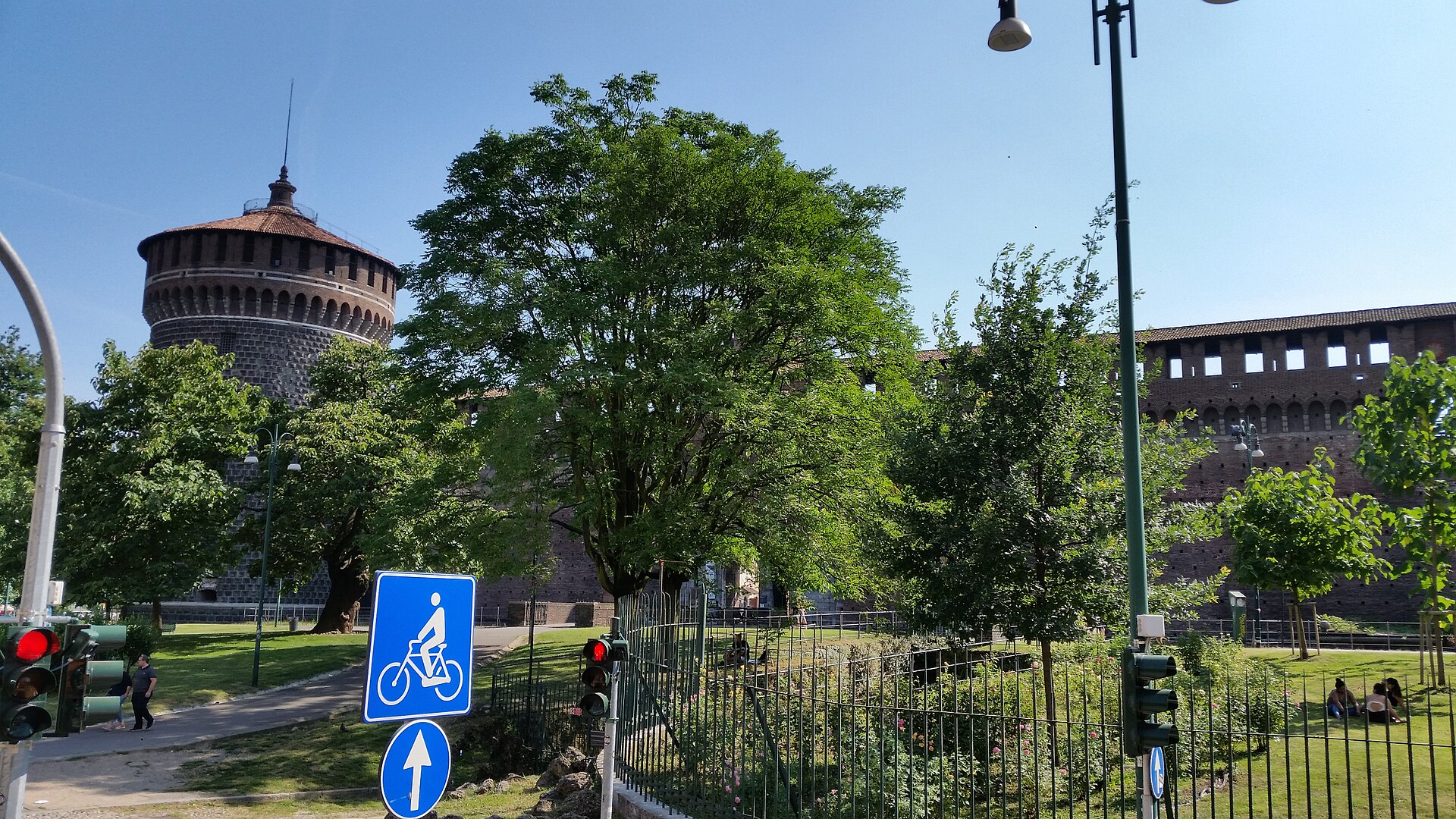
The first thing that strikes you about the Castello Sforzesco is its situation, for unlike the castles that crown lonely hills or guard remote valleys, this great fortress stands right in the middle of a bustling modern city. Milan has grown up around it, and today the castle sits at the meeting point of busy streets and squares, its ancient walls rising incongruously and magnificently amid the traffic and life of one of Italy’s most dynamic cities.
This urban setting is a reminder of what the castle was built to do. It was not a rural stronghold but a citadel, a fortress designed to dominate and control a great city, standing guard over Milan and asserting the power of the dukes who ruled it. A castle in the heart of a city was as much about controlling the citizens as about defending against outside enemies, and the Castello Sforzesco was, for centuries, the visible symbol of ducal authority over Milan.
For the visitor today, the contrast between the medieval fortress and the modern city that surrounds it is one of the castle’s great pleasures. To pass from the noise and movement of the streets into the vast, calm courtyards of the castle is to step back several centuries in a single moment, and the great red-brick walls, rising above the city, offer a powerful reminder of the long and turbulent history that lies beneath Milan’s modern surface.
The survival of so vast a fortress in the centre of a modern metropolis is itself remarkable, for in many cities such structures were demolished to make way for growth. That Milan chose to keep and cherish its great castle reflects a deep pride in the city’s history, and the fortress now serves as a link between the modern city and its long and storied past.
There is a particular pleasure in the way the castle anchors the surrounding neighbourhood, its towers rising at the end of long avenues and its walls forming a backdrop to the daily life of the city. For the people of Milan it is not a remote monument but a familiar presence, woven into the fabric of the city and cherished as one of the great symbols of their home.
The Tower at the Gate
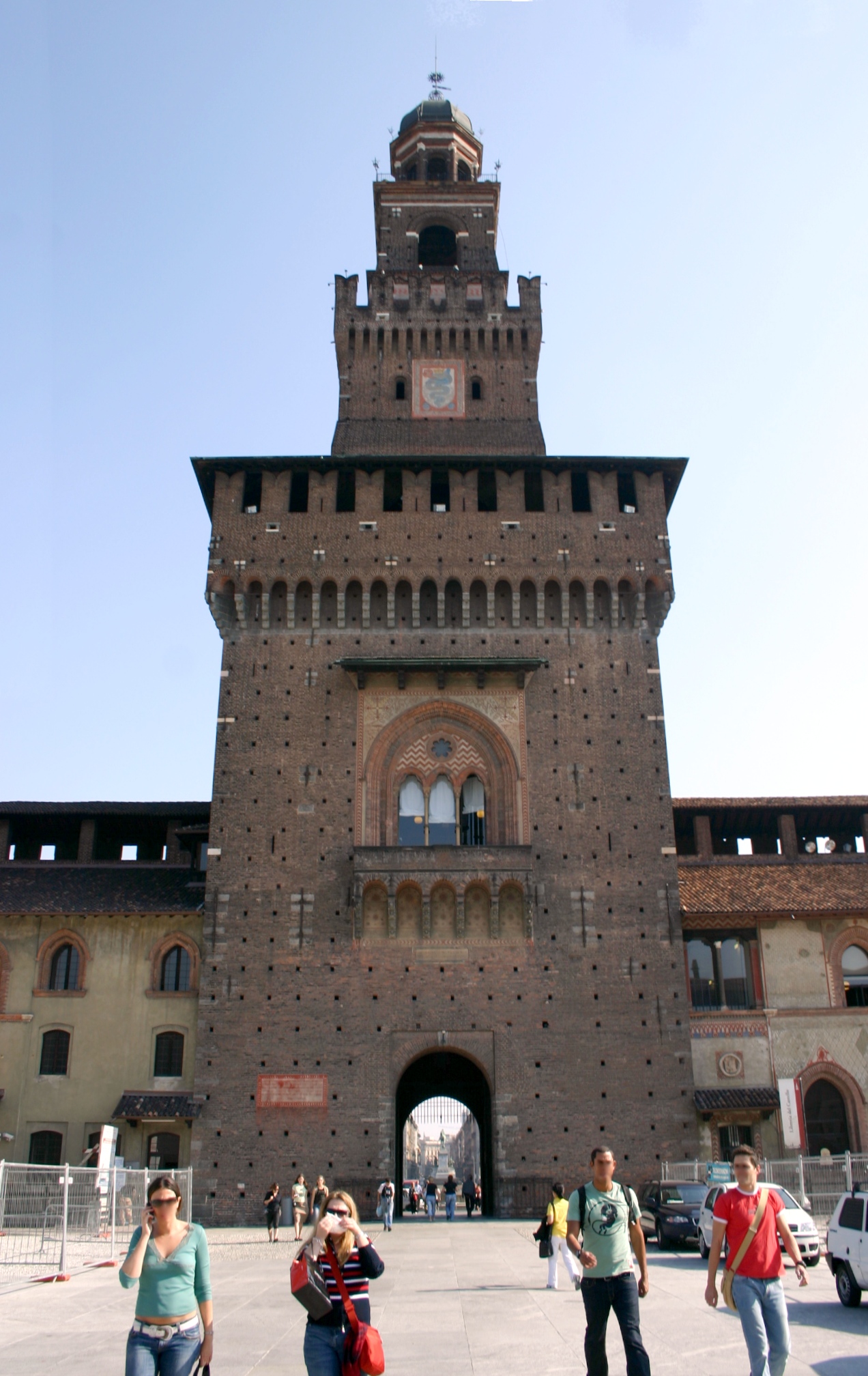
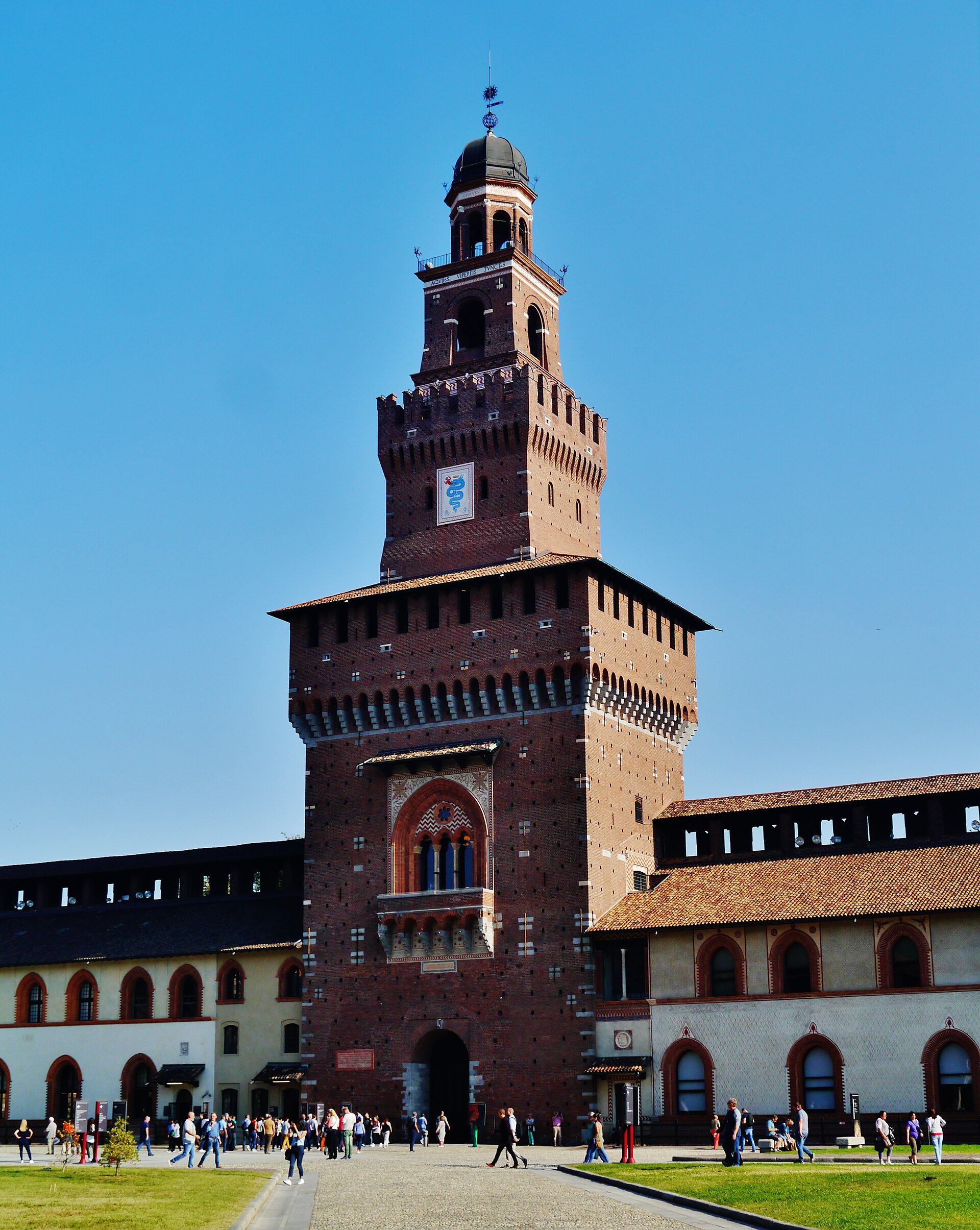
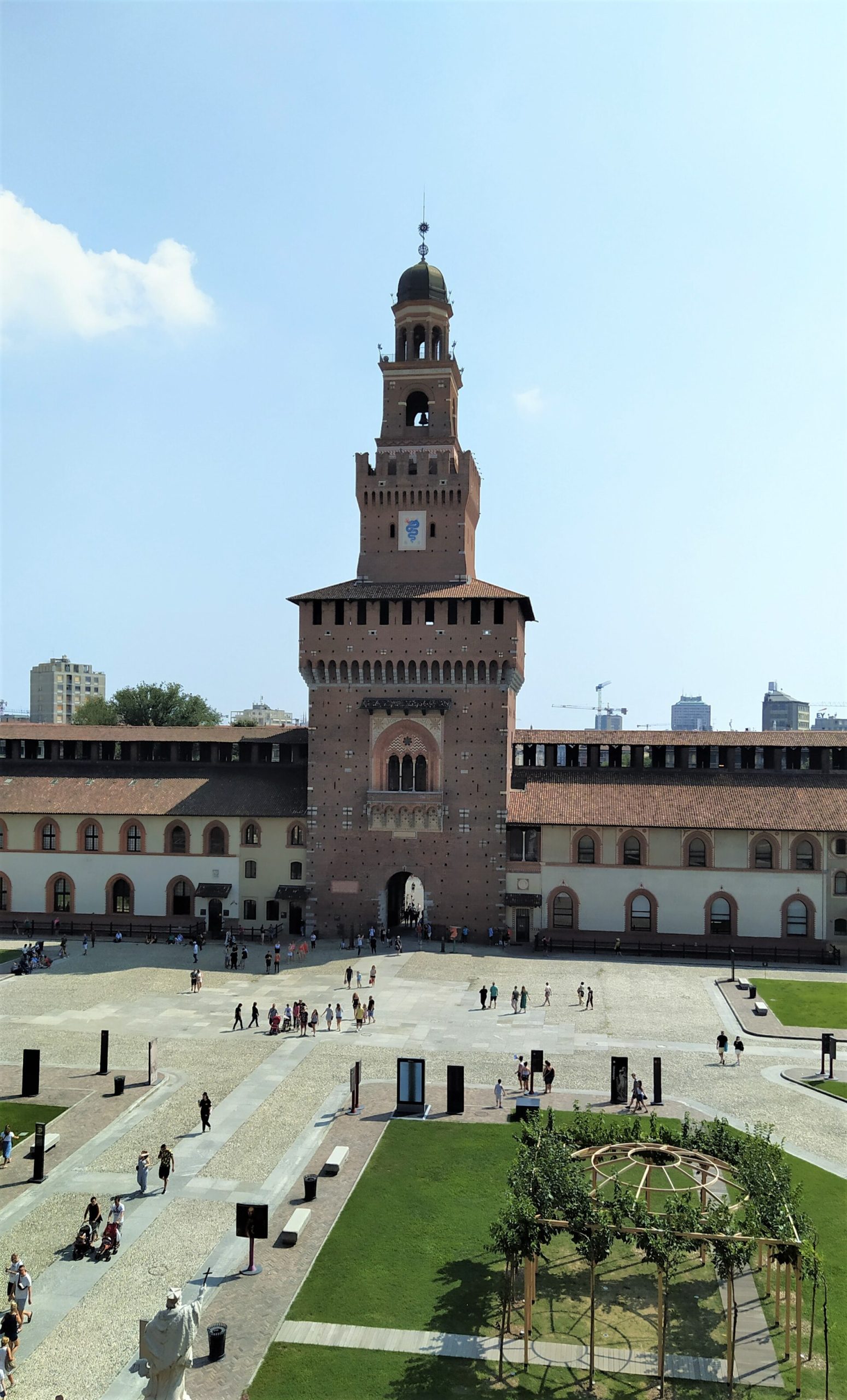
The main entrance to the Castello Sforzesco is dominated by its most famous feature, a tall and elegant tower rising above the gateway, known as the Filarete Tower after the architect associated with its design. Slender and graceful compared to the massive bulk of the walls, the tower is the visual focus of the whole facade, and it has become one of the great landmarks of Milan, a symbol of the city almost as recognisable as its cathedral.
The tower has a dramatic history. The original structure was destroyed in a catastrophic explosion in the sixteenth century, when gunpowder stored within it was somehow ignited, and for centuries the gateway stood without its crowning tower. The elegant tower you see today is in fact a careful reconstruction from around the year nineteen hundred, raised as part of a great restoration of the castle and designed to recall the lost original.
Despite being a reconstruction, the Filarete Tower is a beloved and essential part of the castle, and it beautifully expresses the double nature of the whole building, at once a fortress and a work of art. Rising above the entrance, it welcomes the visitor into the great citadel and sets the tone for all that lies within, a fitting introduction to a castle that was both a stronghold of war and a palace of Renaissance splendour.
The rebuilding of the tower around the year nineteen hundred was itself an act of civic devotion, an attempt to restore to Milan a landmark lost for centuries. The architects worked from old images and records to recreate the vanished tower, and the Filarete Tower is now inseparable from the identity of the castle, its elegant silhouette instantly recognisable as a symbol of the city.
One of Europe’s Great Citadels
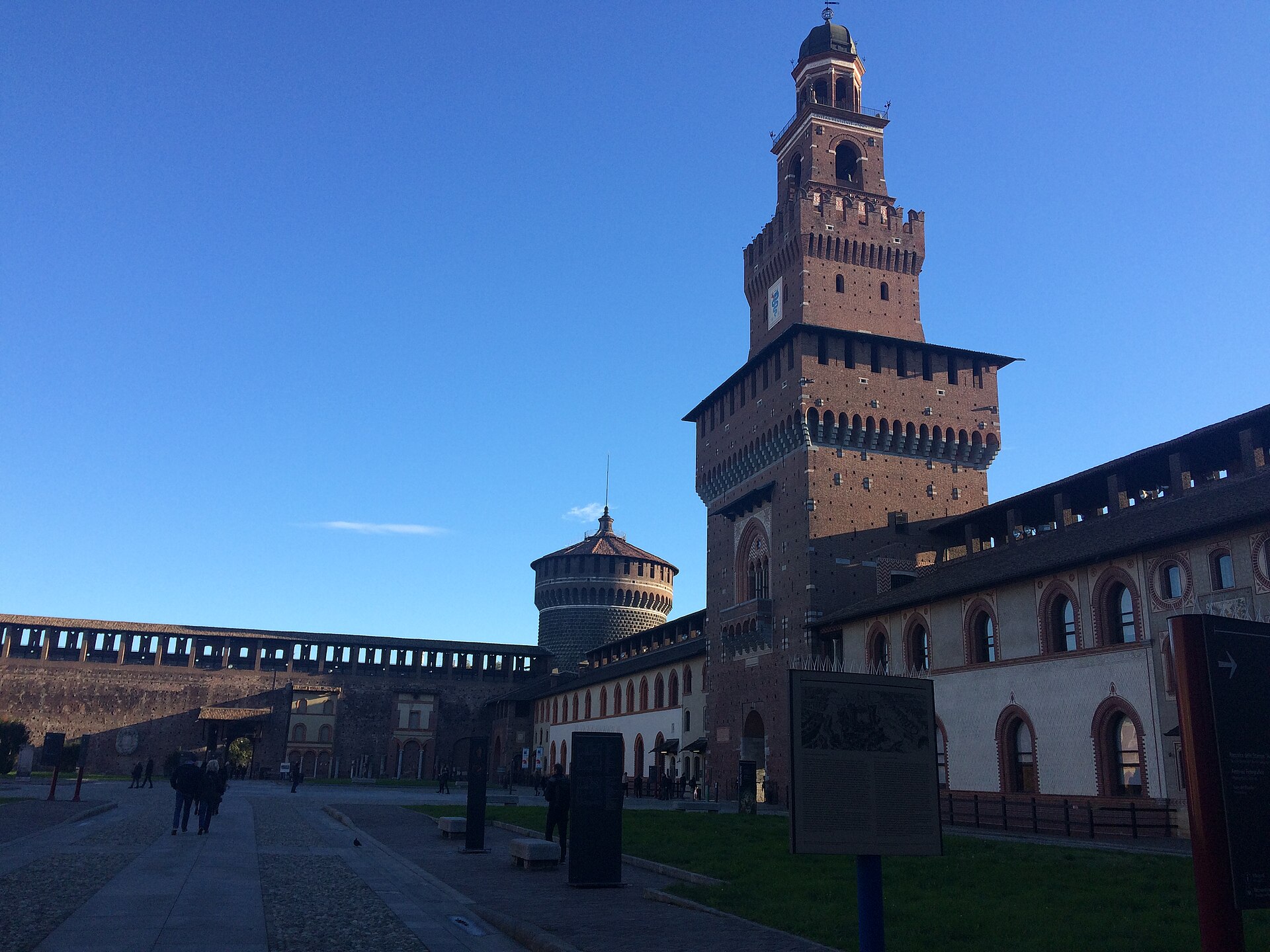
Seen from above, the sheer scale of the Castello Sforzesco becomes apparent. It is one of the largest citadels in Europe, a great square fortress enclosing a series of vast courtyards, with mighty towers at its corners and along its walls. The size of the complex reflects the wealth and ambition of the dukes who built it, and it was designed to be not merely a castle but a self-contained centre of power, big enough to house a court, a garrison, and all the machinery of a great state.
The plan of the castle divides it into distinct parts, reflecting its double function. There are the great outer courtyards, associated with the military and defensive life of the fortress, and there are the more private and elegant inner areas, where the dukes had their residence and their court. This division between the martial and the domestic, the fortress and the palace, is written into the very layout of the building.
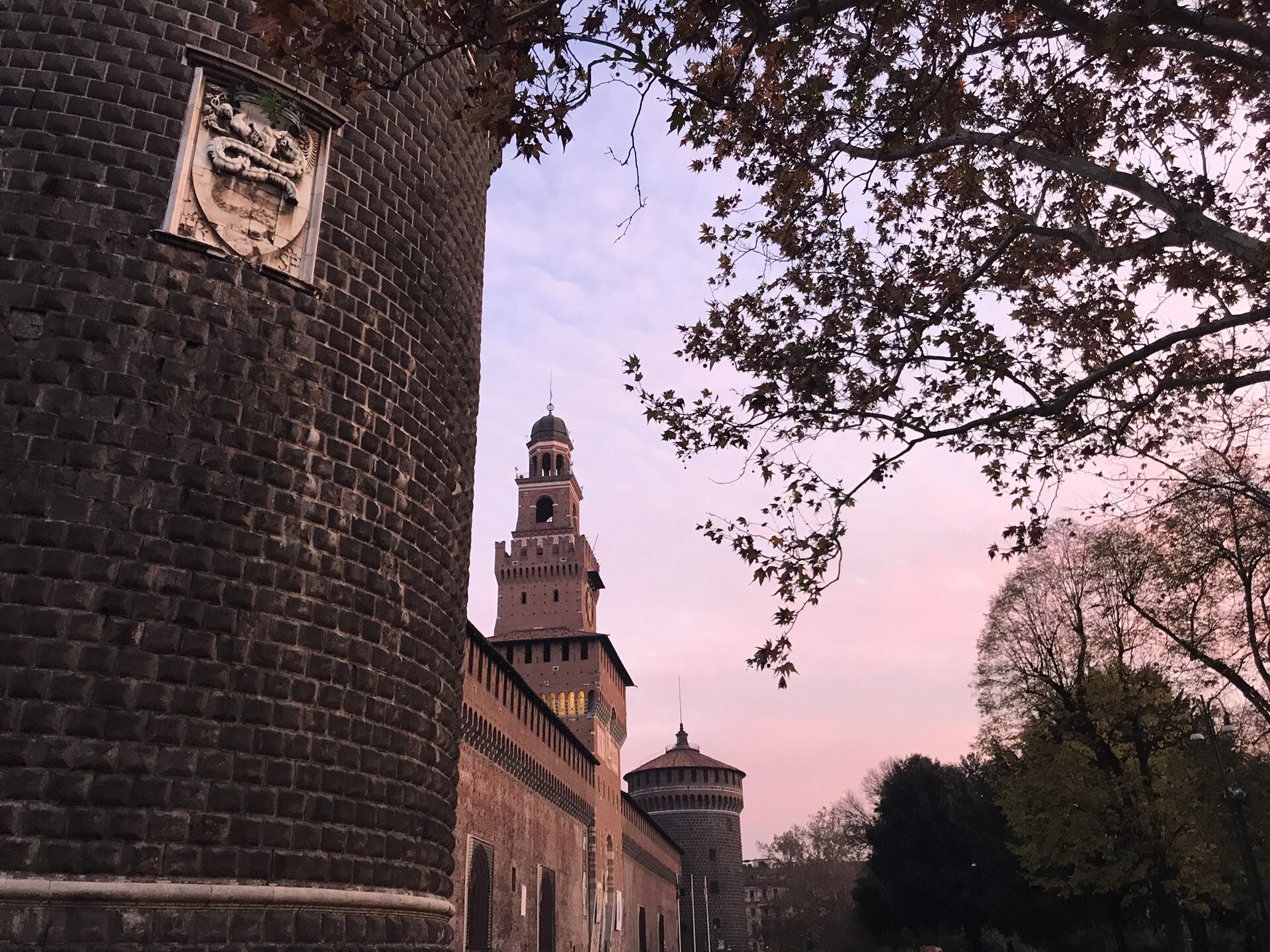
The great corner towers were key to the castle’s defences, and two massive round towers still stand at the outer corners, their sheer bulk a reminder of the serious military purpose behind the whole design. From the air, the combination of these powerful defences with the spacious courtyards within captures perfectly the nature of the Castello Sforzesco, a building that was at once a formidable fortress and a princely residence on the grandest scale.
The great size of the castle also reflects the changing nature of warfare in the age when it was built, for as gunpowder artillery transformed siege warfare, fortresses had to grow larger and stronger to survive. The Castello Sforzesco was designed with these new realities in mind, its massive walls and powerful towers built to withstand the cannon of the age.

From Visconti to Sforza
The story of the Castello Sforzesco begins before the Sforza, with the earlier rulers of Milan, the Visconti, who built a fortress on this site in the fourteenth century as their stronghold and residence. Under the Visconti, Milan became one of the most powerful states in Italy, and their castle was the seat of that power, a symbol of their dominance over the city and the surrounding region.
But the Visconti castle did not survive unbroken. In a period of turmoil following the end of the Visconti line, when the people of Milan briefly threw off ducal rule, the hated fortress was attacked and largely destroyed as a symbol of the tyranny they wished to escape. For a time it seemed that the great castle might vanish altogether, torn down by the very citizens it had been built to control.
It was the rise of a new dynasty that gave the castle its present name and its lasting form. Francesco Sforza, a brilliant soldier who seized power in Milan and made himself duke, rebuilt the fortress from the mid fifteenth century as his own stronghold and residence, and it is from him that the Castello Sforzesco takes its name. Under the Sforza the castle was not only rebuilt but transformed, becoming in time one of the most magnificent princely residences in all of Italy.
The transition from the Visconti to the Sforza is one of the great stories of Renaissance Italy, a tale of the fall of one dynasty and the rise of another through the turmoil of war and politics. That the castle passed from one to the other, destroyed and then rebuilt, mirrors the fortunes of Milan itself in those turbulent years.
The Duke Who Built It
The man who gave the castle its name was one of the most remarkable figures of Renaissance Italy. Francesco Sforza began life not as a prince but as a condottiere, a professional soldier and commander of mercenaries, who rose through skill, ambition, and good fortune to seize the duchy of Milan for himself. His life was a classic tale of the age, when a man of talent and daring could carve out a principality by the sword.
Having won Milan, Francesco set about securing and adorning his new state, and the rebuilding of the castle was central to that project. He needed a fortress to hold the city and a residence worthy of a duke, and the Castello Sforzesco provided both. Under his direction the destroyed Visconti fortress rose again, larger and stronger than before, the visible foundation of the new Sforza dynasty and its rule over Milan.
Francesco Sforza’s achievement was to found not just a castle but a dynasty and a golden age. Under him and his successors, Milan flourished as one of the great states of Italy, and the castle became the heart of a brilliant court. The soldier who had won a duchy by force proved also a capable and far-sighted ruler, and the great fortress that bears his name stands as the enduring monument to his extraordinary rise from mercenary captain to Duke of Milan.
Francesco’s success rested not only on force but on shrewd statecraft, and he proved as capable in peace as in war, strengthening Milan’s institutions and its economy as well as its defences. The castle he rebuilt was part of this larger project of consolidation, a stronghold that anchored the new dynasty and gave it a fitting seat from which to govern one of the richest states in Italy.
His descendants would carry the Sforza name to further heights of splendour and, in time, to ruin, but the foundation Francesco laid endured, and the castle remained the seat of the dynasty through all its fortunes. In this sense the fortress is the truest monument to the whole Sforza story, the stage on which their rise, their golden age, and their fall were all played out.
The Courtyard of Arms
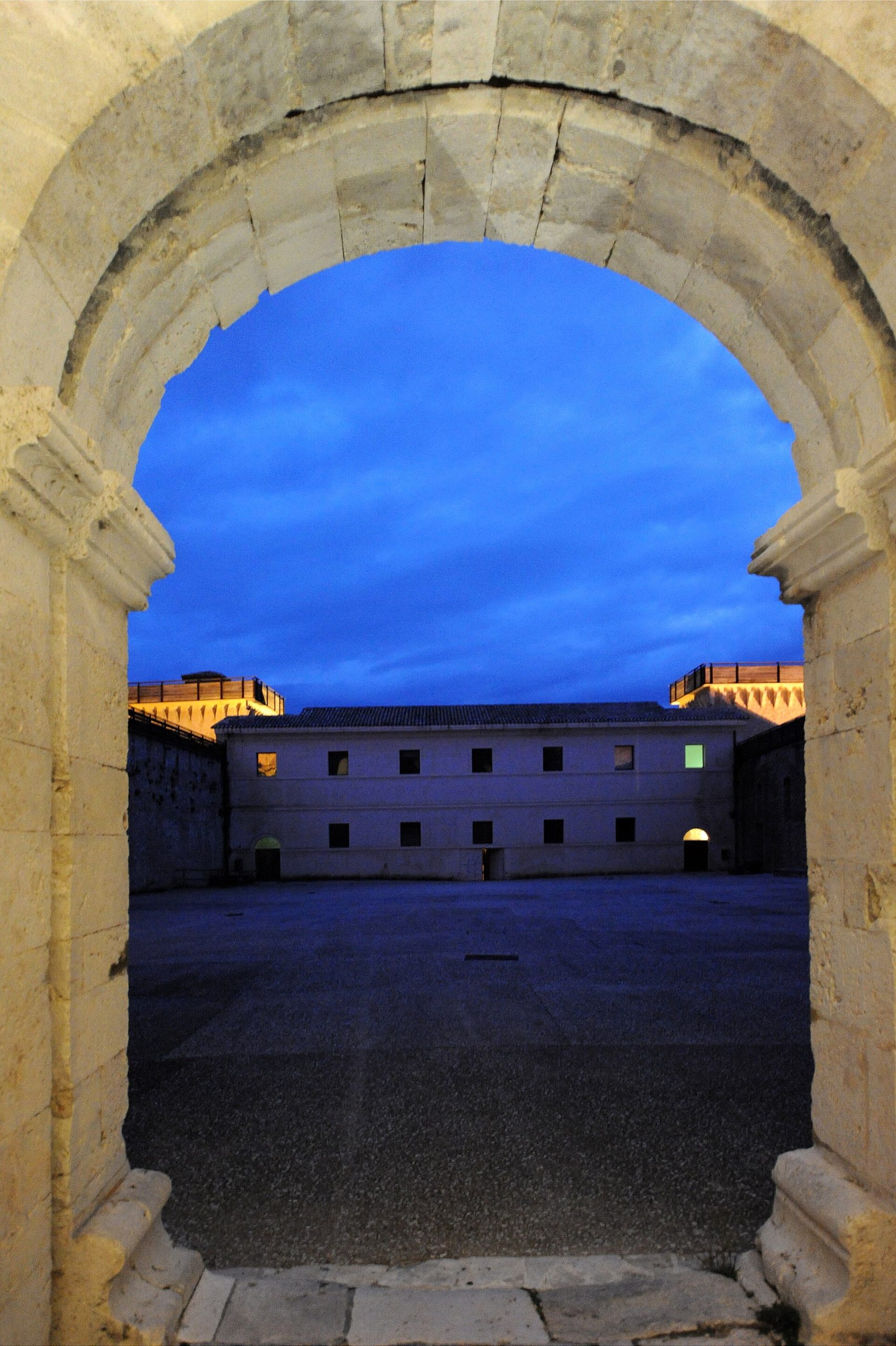
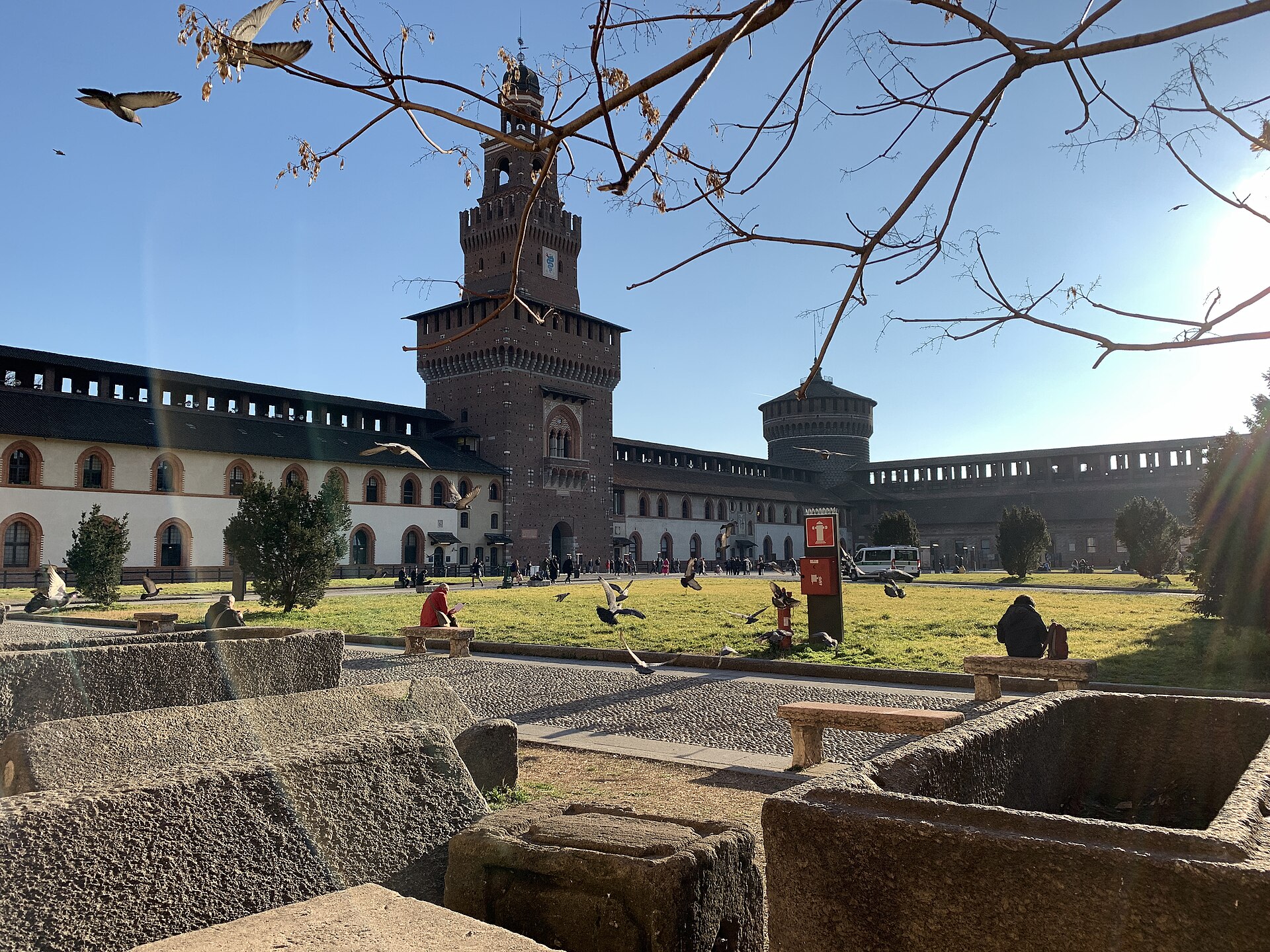
Passing through the Filarete Tower, the visitor enters the first and largest of the castle’s courtyards, the great Courtyard of Arms. This vast open space, enclosed by the mighty walls of the fortress, was the military heart of the castle, the place where troops could gather and drill, where the garrison lived and worked, and where the serious business of defence was conducted. Its sheer size gives an immediate sense of the scale of the whole citadel.
The Courtyard of Arms speaks of the castle’s original purpose as a fortress. Here everything was arranged for war and defence, the great open space allowing the movement and assembly of soldiers, the surrounding walls bristling with the means of defence. To stand in this courtyard is to feel the martial character of the castle at its strongest, and to understand that, for all its later splendour, the Castello Sforzesco was first and foremost a military stronghold.
Today the great courtyard is a place of calm and space in the heart of the busy city, crossed by visitors making their way to the museums and the inner courts beyond. But its scale and its severity still recall the days when it echoed to the tramp of soldiers and the clash of arms, and it remains one of the most impressive spaces in the castle, a vast reminder of the fortress that lies at the core of this great treasure house of art.
In times of danger this great space could fill with armed men, horses, and the apparatus of war, a self-contained military world within the walls of the city. The sheer capacity of the courtyard meant that the castle could hold a substantial force, ready to sally out into the city or to withstand a siege, and it made the fortress a decisive factor in any struggle for control of Milan.
The Ducal Court
Beyond the great Courtyard of Arms lie the more private and elegant courtyards where the dukes had their residence, and here the character of the castle changes entirely. In place of the martial severity of the outer courtyard, these inner courts have the refinement of a princely palace, their proportions graceful, their architecture more delicate, designed for the comfort and splendour of the ducal household rather than for war.
It was in these inner areas that the true magnificence of the Sforza court unfolded. The dukes and their families lived here surrounded by beauty and luxury, and the rooms around these courtyards were richly decorated and furnished, fit settings for the entertainments, ceremonies, and daily life of one of the greatest courts in Italy. The contrast with the fortress-like exterior could hardly be greater, and it captures the double nature of the whole building.
These quieter courtyards are among the most pleasant parts of the castle to explore, offering a sense of the elegant private world of the dukes behind the mighty defences. Walking through them, you move from the world of war to the world of the Renaissance court, from the fortress to the palace, and you begin to understand how the Castello Sforzesco could be both a grim stronghold and one of the most brilliant centres of art and culture in fifteenth-century Italy.
The refinement of these inner courts extended to every detail, from the carved stonework to the proportions of the arcades, all designed to create an atmosphere of cultivated elegance. Here the harsh logic of the fortress gave way to the harmonious ideals of Renaissance architecture, and the visitor passing from the outer courtyard to the inner senses at once the shift from a world of war to a world of art and courtly life.
Leonardo and the Painted Room
The Sforza dukes were great patrons of art, and under them the castle became a magnet for the finest talents of the age. Among the artists and thinkers employed at the Sforza court was none other than Leonardo da Vinci, who spent many years in Milan in the service of the duke, and who left his mark on the castle itself. That the greatest genius of the Renaissance worked within these walls is one of the castle’s proudest boasts.
Leonardo’s most famous contribution to the castle is a remarkable painted room, whose ceiling he decorated with an intricate design of interwoven trees and branches, transforming the vaulted chamber into a kind of leafy bower, a room that seems to become a living grove. It is a work of extraordinary imagination and beauty, and though damaged and much restored over the centuries, it remains a precious survival, a direct link to the hand and mind of Leonardo.
Leonardo was not the only great artist to work at the Sforza court, which drew architects, painters, and scholars from across Italy and beyond. Under the patronage of the dukes, the castle and the city became one of the leading centres of the Italian Renaissance, and the presence of such talents transformed the fortress into a place of art and learning as much as of power. The painted room of Leonardo is the most famous fruit of that golden age, a masterpiece hidden within a fortress.
The years Leonardo spent in Milan were among the most productive of his life, and the city and its court provided him with patronage, stimulation, and the freedom to pursue his boundless range of interests. That the fortress at the heart of the city should preserve a work from his hand is a source of great pride to Milan, a tangible link between the ancient stronghold and one of the supreme geniuses of human history.
Efforts to study and conserve the painted room have continued over many years, as experts work to recover as much as possible of Leonardo’s original vision beneath the damage and later overpainting of the centuries. Each new investigation reveals a little more of the master’s intentions, and the room remains a focus of scholarly fascination as well as a treasure for the visitor.
A Golden Age of Milan
The height of the castle’s splendour came in the late fifteenth century, under one of the most famous of the Sforza dukes, a great patron of the arts whose court was among the most brilliant in all of Europe. Under his rule Milan became a dazzling centre of Renaissance culture, and the castle at its heart was filled with beauty, learning, and magnificence, a fitting stage for one of the golden ages of Italian civilisation.
This was the Milan of Leonardo, of great architects and painters, of scholars and musicians, a city that rivalled Florence and Rome as a home of the Renaissance. The duke gathered around him the finest talents of the age and spent lavishly on art and building, and the castle shared fully in that flowering, its rooms adorned and its court renowned throughout Europe for its splendour and its sophistication.
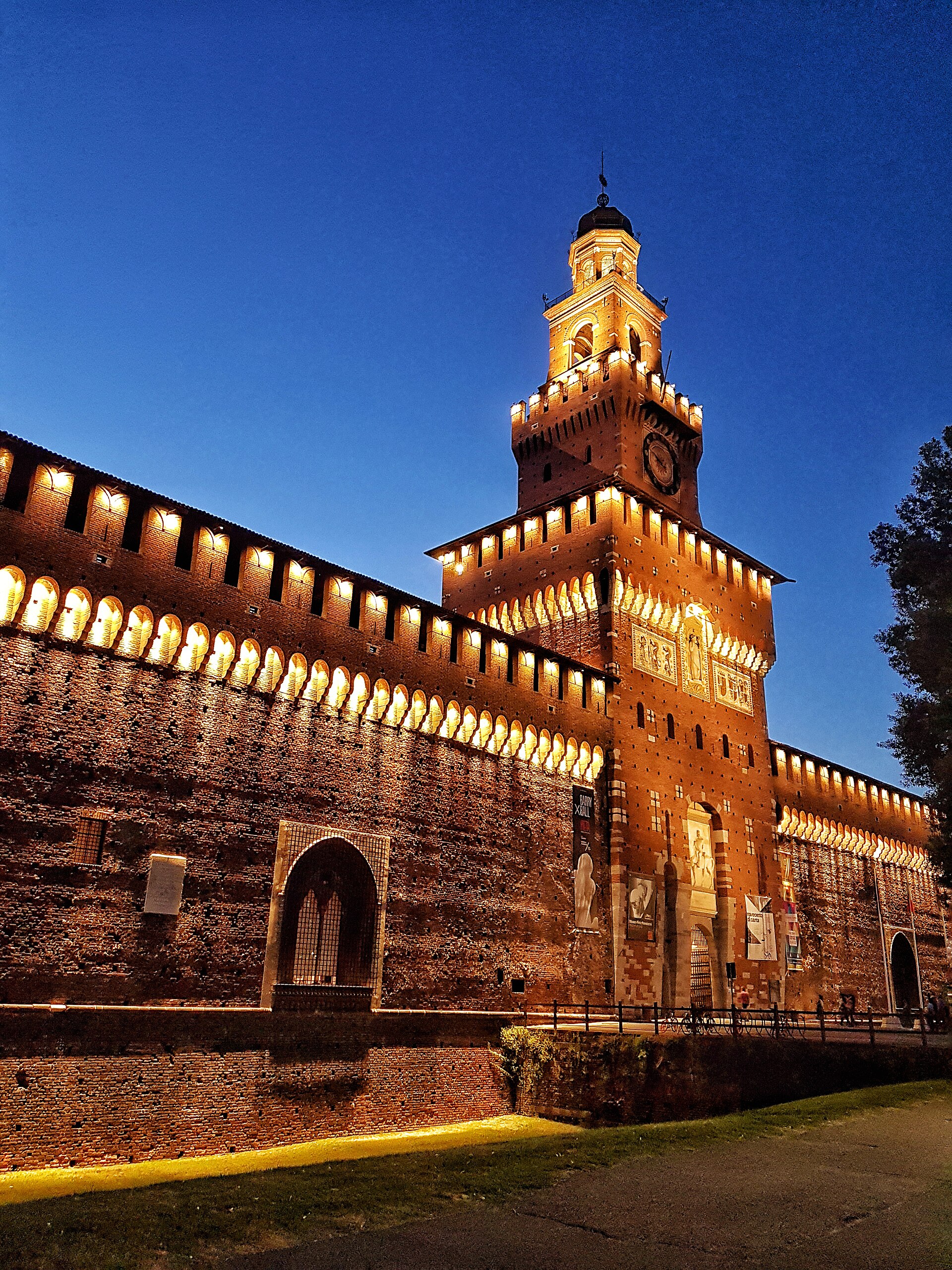
Like so many golden ages, this one did not last. The wealth and brilliance of Sforza Milan made it a tempting prize, and the wars that swept Italy at the turn of the sixteenth century brought the golden age to an end, as foreign armies invaded and the Sforza were driven from their duchy. But the memory of that brilliant time clings to the castle still, and at sunset, when the great walls glow golden above the city, it is easy to imagine the vanished splendour of the Sforza court.
The wars that ended the golden age also scattered its artists and treasures across Italy and Europe, so that the brilliance of Sforza Milan lived on in the work of those who had known it, carried far beyond the city. In this way the influence of the castle and its court reached well beyond the moment of their splendour, helping to shape the art of the wider Renaissance long after the dukes themselves had fallen.
It is one of the poignant lessons of history that the very brilliance of a court can hasten its downfall, by making it a prize worth seizing, and Sforza Milan is a classic example. The splendour that Leonardo helped to create was, in the end, part of what drew the armies of France and others to covet and conquer the duchy, bringing the golden age to its abrupt and violent close.
Fall and Foreign Rule
With the fall of the Sforza, the castle entered a long and often inglorious period as a fortress in the hands of foreign rulers. For centuries Milan was governed by outside powers, first one great European monarchy and then another, and throughout this time the castle served primarily as a military stronghold and barracks, garrisoned by foreign troops and used to hold the city in subjection rather than to adorn it.
During these centuries the castle suffered much. Its role as a working fortress meant that its splendid interiors were neglected or adapted for military use, and much of the Renaissance decoration that had made it so magnificent was lost or damaged. The great citadel that had been the heart of a brilliant court became a grim symbol of foreign domination, its beauty faded and its purpose reduced to the crude business of military control.
This long decline is an important part of the castle’s story, for it explains why so much of the original Renaissance splendour has been lost, and why the building had to be so extensively restored in later times. The castle that we admire today came through centuries of hard use and neglect, and its survival, battered but standing, through the long era of foreign rule is itself a testament to the strength and importance of this great fortress at the heart of Milan.
Yet even in these centuries of decline the castle never lost its strategic importance, and it remained the key military strongpoint of Milan, coveted and contested by the great powers who fought for control of northern Italy. Its very endurance as a fortress through this long era, however inglorious, ensured that the great structure survived to be rescued and celebrated in a later and happier age.
Explosion and Rebirth
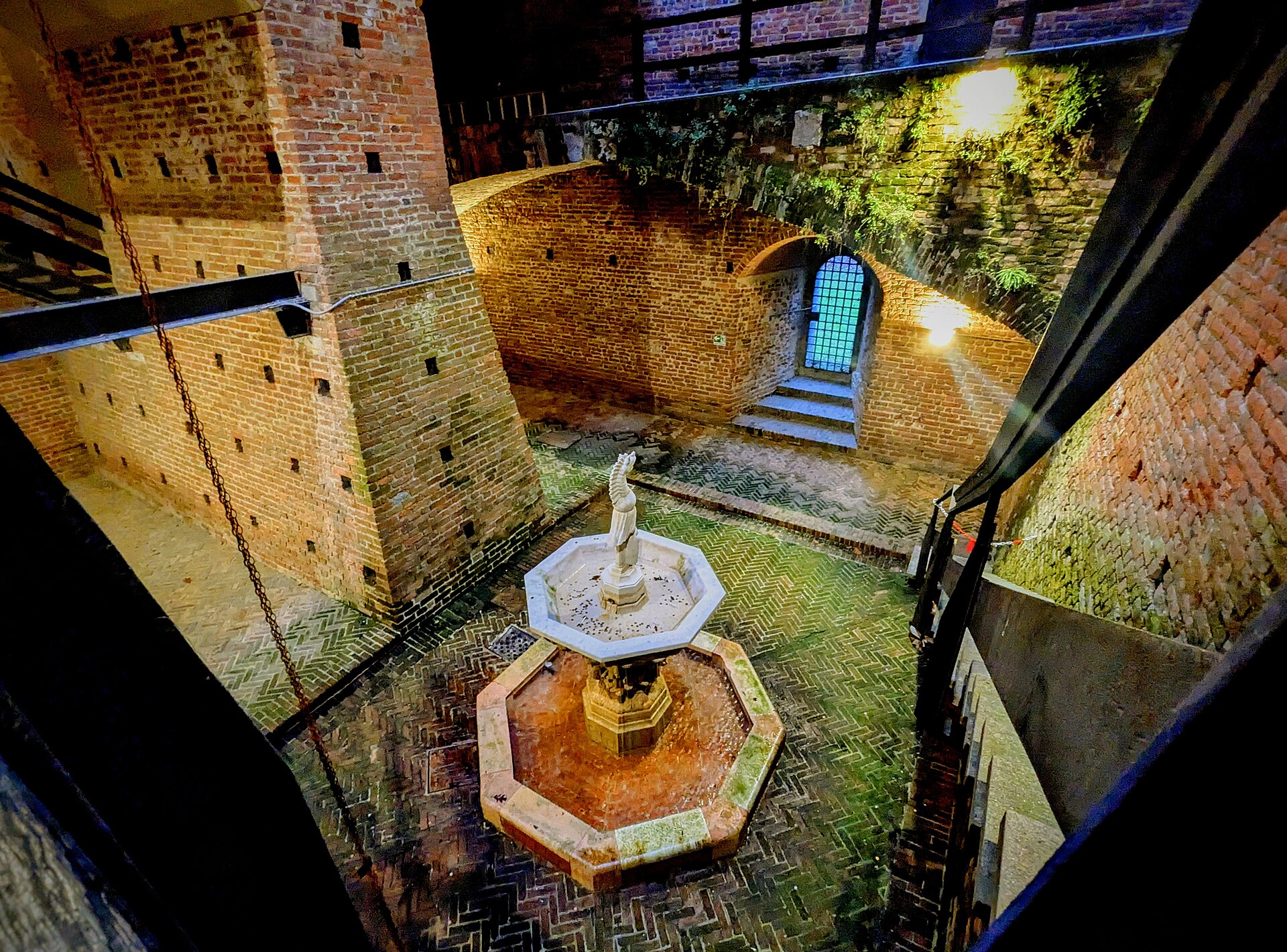
By the later nineteenth century the castle was in a sorry state, worn down by centuries of military use and neglect, and there was even talk of demolishing it altogether. But as Italy became a unified nation and Milan a proud modern city, opinion shifted, and there arose a determination to save the great fortress and restore it to something of its former glory as a monument to the city’s history.
The great restoration that followed, carried out around the turn of the twentieth century under the direction of a dedicated architect and scholar, rescued the castle from ruin. The walls and towers were repaired, the elegant Filarete Tower, lost centuries before in the great explosion, was rebuilt to crown the entrance once more, and the whole fortress was given new life as a symbol of Milan and a home for its treasures.
This rebirth transformed the castle from a decaying barracks into the proud monument we know today. The restorers worked to recover the spirit of the Renaissance fortress while adapting it to a new role as a museum and a public treasure, and their work was so successful that it is hard now to imagine Milan without the great red-brick castle at its heart. The Castello Sforzesco owes its survival, and much of its present appearance, to this determined act of rescue and renewal.
The restoration was carried out in a spirit of deep respect for the castle’s history, seeking not to invent a fantasy but to recover and honour the real fortress of the dukes. Where the evidence was clear, the restorers rebuilt faithfully; where it was uncertain, they worked to a plausible and harmonious design, and the result is a castle that feels authentically of its age while standing sound and whole for the modern visitor.
A Treasure House of Art
Today the Castello Sforzesco is no longer a fortress or a palace but a great treasure house, home to a remarkable group of museums that fill its many rooms with the art and history of Milan and of Italy. Sculpture, painting, decorative arts, musical instruments, and much else are gathered here, making the castle one of the richest cultural destinations in the city and a place where the visitor can spend many happy hours among masterpieces.
The greatest treasure of all is a work of profound and moving beauty, the last, unfinished sculpture of Michelangelo, on which the great artist was working in the final days of his life. This deeply affecting piece, left incomplete at the master’s death, is one of the supreme works of Western art, and to stand before it within the walls of the castle is one of the great experiences that Milan has to offer.
That such treasures should be housed within the ancient fortress of the dukes is deeply fitting, for it continues the castle’s long association with the finest art of Italy. From the days when Leonardo worked at the Sforza court to the present, the Castello Sforzesco has been a home for beauty and genius, and in its new life as a museum it fulfils that role more completely than ever, a fortress of war transformed into a stronghold of art.
The range of the collections is remarkable, spanning many centuries and many forms of art, so that a visit offers not a single experience but many, from ancient sculpture to Renaissance painting to the decorative arts of later ages. Together they make the castle a microcosm of the artistic history of Milan and of Italy, gathered fittingly within the walls of the city’s greatest secular monument.
That the fortress should end its long story as a home for beauty rather than a machine of war is a fitting and hopeful conclusion. The building raised to dominate and defend has become a place of contemplation and delight, open to all, and in this transformation the Castello Sforzesco offers a quiet emblem of how the monuments of power can be turned, in time, to the service of art and the enrichment of ordinary life.
Visiting the Sforza Castle
The Castello Sforzesco stands at the very heart of Milan, easily reached on foot from the city’s central sights and well served by public transport, and it is one of the essential stops on any visit to the city. Its great courtyards are open to all, free to enter and wander, so that even those with little time can enjoy the grandeur of the fortress and cross from the busy streets into its calm and historic spaces.
For those with more time, the museums housed within the castle offer a rich reward, from the moving masterpiece of Michelangelo to the painted room of Leonardo and a wealth of other art and history. Behind the castle stretches a large and beautiful park, laid out where the dukes once had their hunting grounds, which makes a lovely place to walk and completes the pleasures of a visit. The combination of fortress, museums, and park makes the castle a destination in itself.
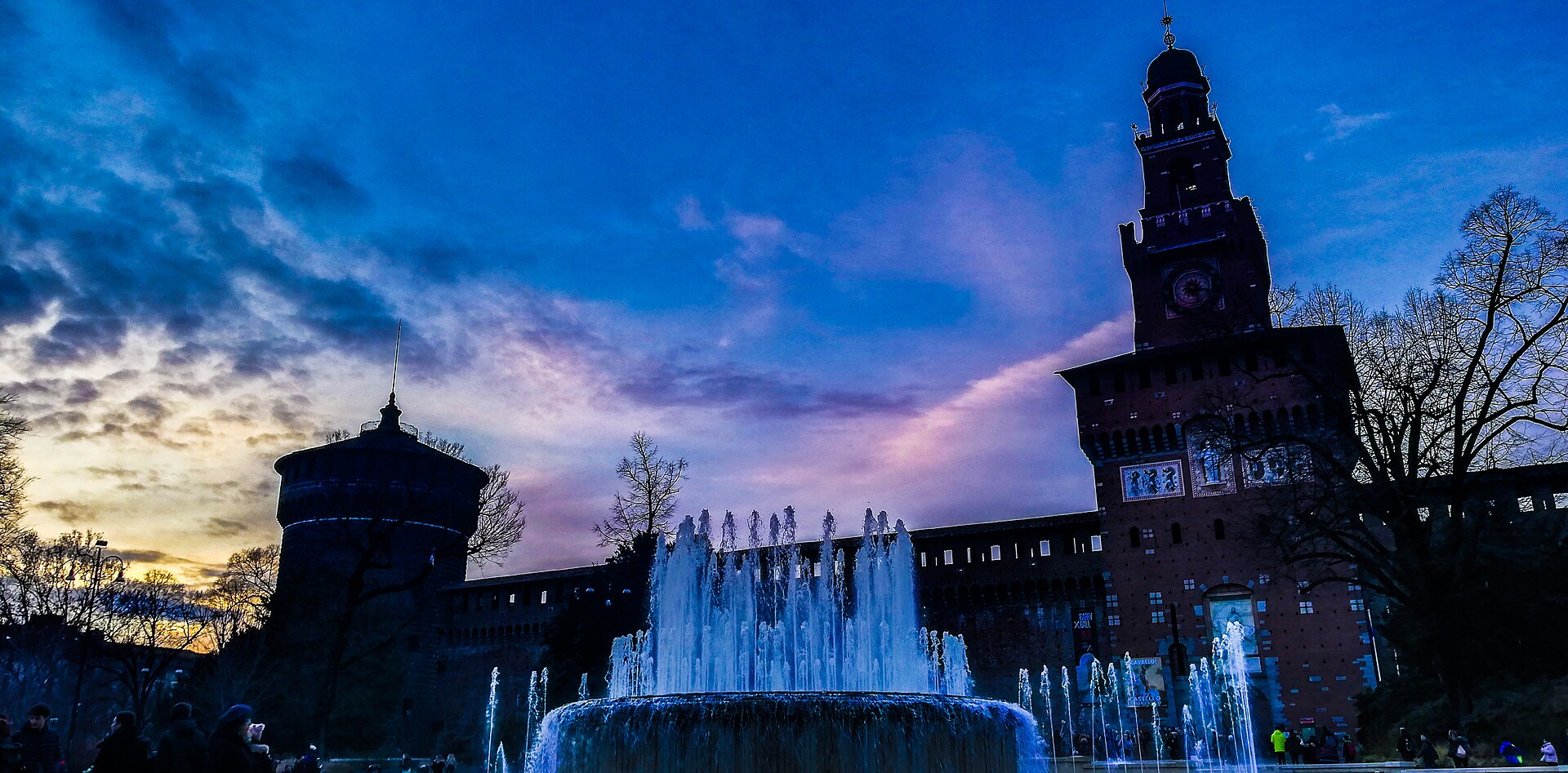
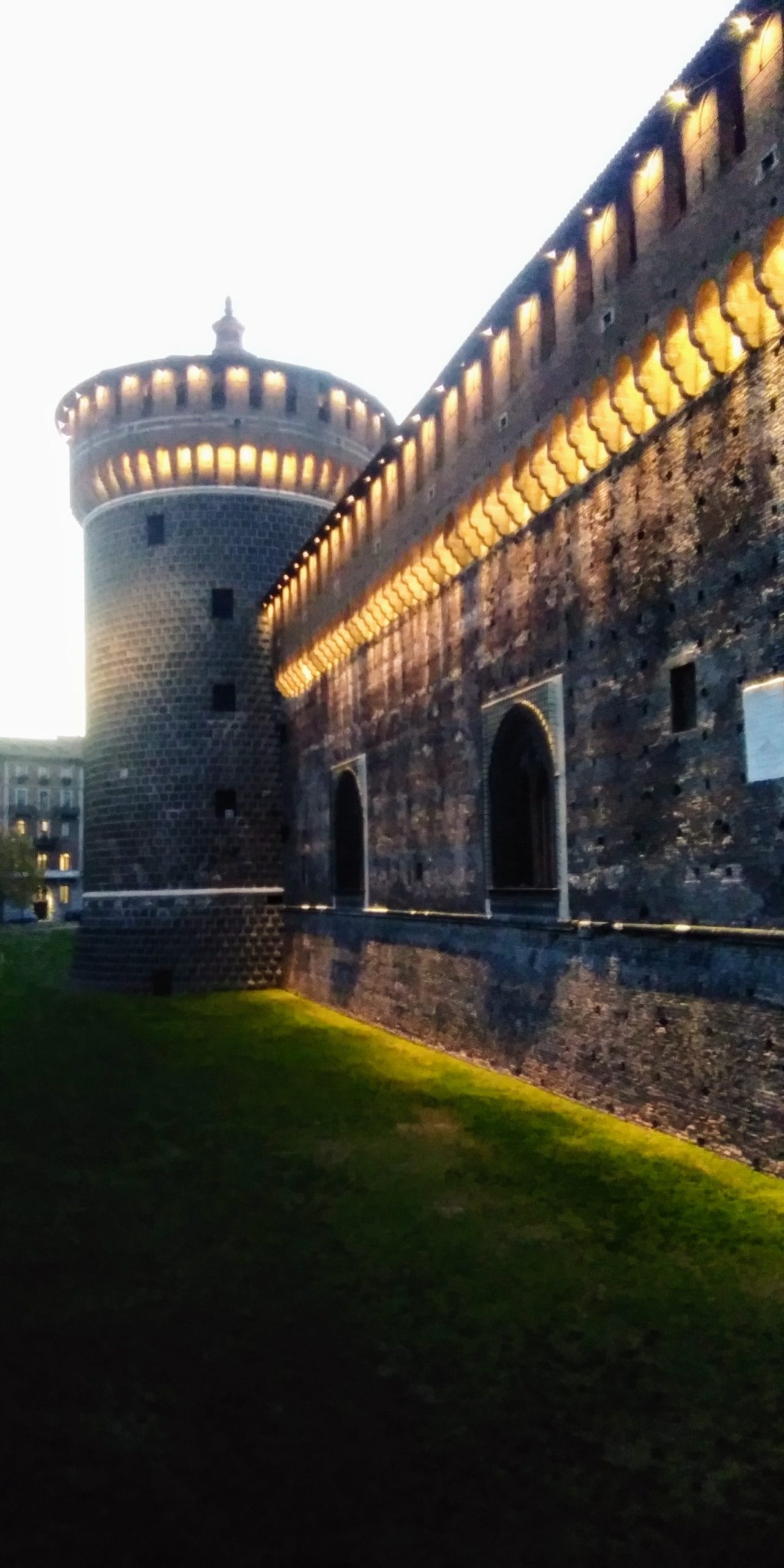
If you would like to find it and plan your visit, here is the castle’s position in the centre of Milan: 45.4705, 9.1795. Try to see the great courtyards, take in at least the greatest of the museum treasures, and if you can, view the castle floodlit at night, when its red-brick walls and elegant tower glow above the city. The Castello Sforzesco is one of the proudest monuments of Milan, a fortress of the Renaissance dukes turned treasure house of art, and it belongs on the itinerary of everyone who visits this great city.
A visit rewards both the hurried traveller and the leisurely one: those with only an hour can enjoy the grand courtyards and the exterior for free, while those with more time can lose themselves in the museums and the park behind. This flexibility, along with its central position, makes the castle one of the most accessible of all Milan’s great sights.
Castles Nearby
- Castel Sant’Angelo, from emperor’s tomb to papal fortress
- Castel del Monte, the octagonal riddle of Frederick II
Fortress of Art
The Castello Sforzesco is a building of many lives and many faces. It was a fortress, built to dominate a great city; a palace, home to one of the most brilliant courts of the Renaissance; a barracks, held for centuries by foreign armies; a ruin, nearly lost to neglect; and finally a treasure house, guarding some of the greatest works of Italian art. Few buildings so completely embody the long and turbulent history of their city.
What makes it so remarkable is the way it unites the martial and the beautiful. Behind its grim walls and mighty towers lie the elegant courtyards of the dukes, the painted room of Leonardo, and the last masterpiece of Michelangelo, so that the same building that was raised for war has become one of the great homes of art. In the Castello Sforzesco, the fortress and the museum, the sword and the paintbrush, are joined in a single unforgettable whole.
So when you come to Milan, do not pass by the great red-brick castle at its heart. Cross from the busy streets into its vast courtyards, seek out the treasures within, and let the long history of the fortress unfold around you. The Castello Sforzesco is proof that a stronghold of war can become a stronghold of beauty, and it stands, proud and battered and magnificent, as one of the great monuments of northern Italy and one of the treasures of Milan.
You May Like
Mafra, the Palace a King Built From a Vow


3 thoughts on “Castello Sforzesco: The Renaissance Fortress of Milan”