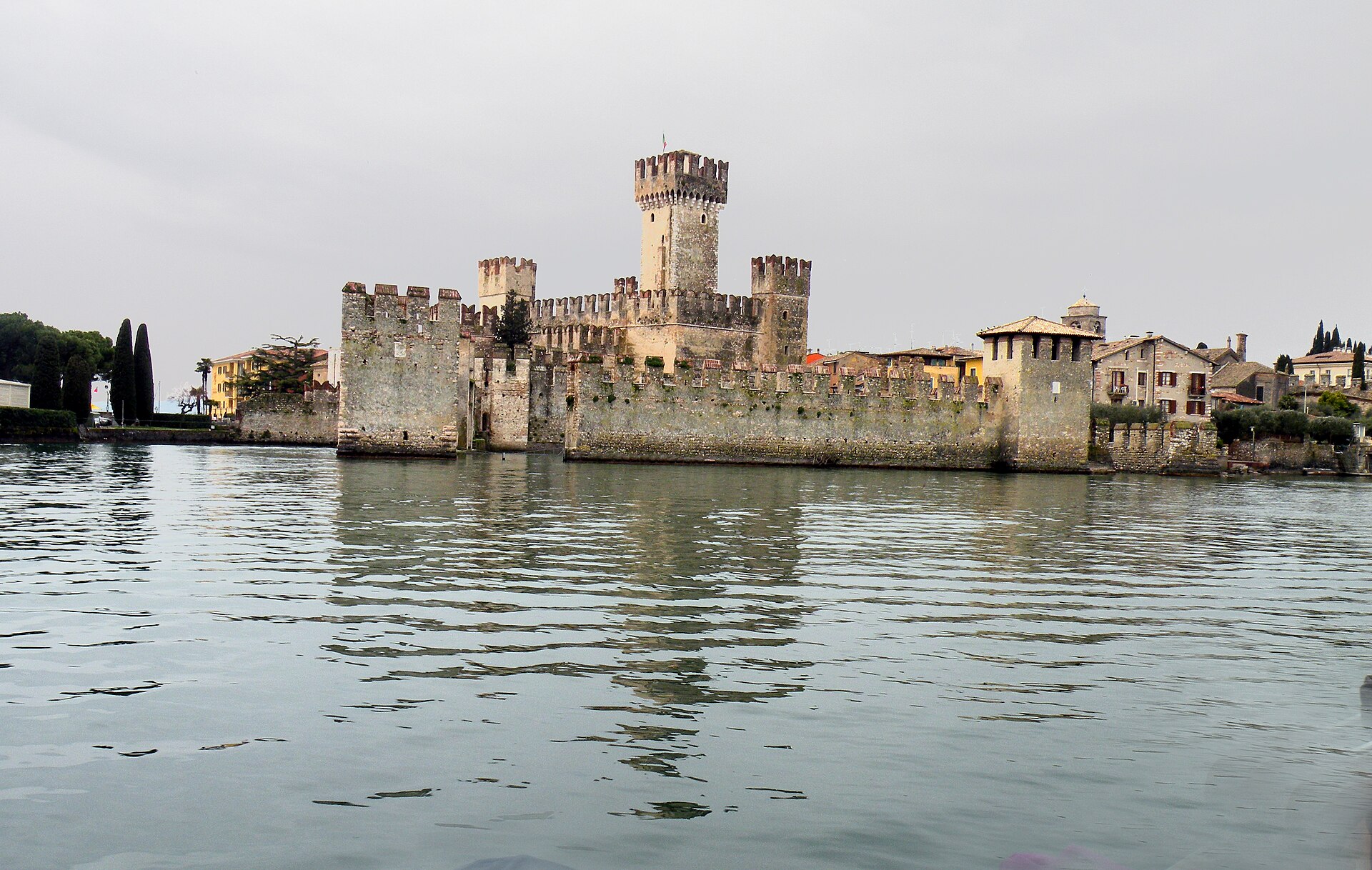
At the very tip of a long, narrow peninsula reaching out into the blue waters of Lake Garda, the largest and one of the most beautiful lakes in Italy, stands one of the most picturesque castles in the whole country. The Castello Scaligero of Sirmione is a fairy-tale fortress of pale stone, surrounded by water, guarding the entrance to a charming lakeside town, its towers and swallowtail battlements reflected in the lake. It is, quite simply, one of the loveliest castles in Italy.
The castle was built in the Middle Ages by the powerful family that ruled the great city of Verona, as a stronghold to guard their lands and their fleet on the lake. It is one of the best-preserved castles of its kind anywhere, its walls, towers, and battlements almost complete, and it possesses a rare and remarkable feature: a fortified harbour, enclosed within its walls, that once sheltered the warships of its lords. Few castles anywhere combine so completely the roles of fortress and naval base.
Set at the gateway to the beautiful town of Sirmione, a place of Roman ruins and healing waters loved since antiquity, the castle is the crowning jewel of one of the most enchanting spots on Lake Garda. Come with me to the shores of the lake and we will explore this water-girt fortress of the Scaligeri, following the story of the great family who built it and discovering why the Castello Scaligero of Sirmione is one of the most beautiful and best-loved castles in all of Italy.
In This Article
- A Castle Guarding a Peninsula
- Rising From the Waters of Garda
- A Fortress Almost Surrounded by Water
- Across the Drawbridge
- The Fortress of the Scaligeri
- Into the Courtyard
- Along the Battlements
- A Harbour Within the Walls
- The Scaliger Fleet
- Master of the Lake
- The View From the Keep
- Sirmione and the Poet’s Peninsula
- Visiting the Castello Scaligero
A Castle Guarding a Peninsula
The setting of the Castello Scaligero is one of the most beautiful of any castle in Italy. It stands at the neck of the long, narrow peninsula of Sirmione, which reaches out into the southern end of Lake Garda, guarding the single approach to the town beyond. The castle controls the only way onto the peninsula, so that to enter Sirmione one must pass beneath its walls, and this position made it the perfect guardian of the town and its approaches.
Lake Garda, on whose shores the castle stands, is the largest lake in Italy and one of the most beautiful, a great sheet of blue water ringed by mountains and dotted with lovely towns. In the Middle Ages the lake was an important route and a valuable prize, and the castles that guarded its shores, above all this one at Sirmione, were key to the control of the region. The beauty of the setting should not disguise the strategic importance that first raised a fortress here.
For the visitor today, the sight of the castle guarding the entrance to Sirmione is unforgettable. The pale fortress, surrounded by water and crowned with its distinctive battlements, rises at the gateway to the town, its towers reflected in the lake. To pass beneath its walls into the beautiful town beyond is one of the great pleasures of a visit to Lake Garda, and it places the castle firmly at the heart of one of the loveliest spots in all of Italy.
The peninsula of Sirmione is itself a place of great natural beauty, a long finger of land clothed in olive groves and cypresses reaching far out into the lake. The castle stands at its base like a gatekeeper, so that the whole peninsula seems to lie under its protection, and the sense of passing through a guarded threshold into a special and secluded place is one of the great charms of arriving at Sirmione.

Rising From the Waters of Garda
The most striking feature of the Castello Scaligero is its intimate relationship with the water, for the castle rises directly from the lake, surrounded on its seaward sides by the blue waters of Garda. This water setting gives the fortress much of its beauty and much of its strength, for the lake served as a natural defence, a barrier that could not easily be crossed and that protected the castle on the sides facing the water.
The use of water for defence is one of the oldest and most effective of all military strategies, and at Sirmione the builders made the fullest use of the lake that surrounded their fortress. A castle rising from the water could be reached only by its guarded approaches, and the lake gave it a security that walls alone could not provide. The water that makes the castle so beautiful today was, in its origins, a vital part of its defences.
Seen from a boat on the lake, the castle is at its most beautiful, its pale walls and towers rising from the blue water and reflected in its surface. This view of the fortress from the lake, the way its builders and their enemies would often have seen it, captures the essence of the Castello Scaligero as a water castle, a fortress wedded to the lake that surrounds it. Few castles anywhere rise so beautifully from the water, and it is this, above all, that makes Sirmione unforgettable.
The colour of the lake plays a great part in the beauty of the scene, for the waters of Garda can shift from deep blue to brilliant turquoise with the changing light and weather, and the pale stone of the castle is set off beautifully against them. On a bright day the contrast of the white walls and the blue water is dazzling, and it is this interplay of stone and water that photographers return to again and again.

A Fortress Almost Surrounded by Water
So closely is the Castello Scaligero bound to the water that it is almost entirely surrounded by it, the lake reaching around its walls on nearly every side. This makes it one of the finest examples in Italy of a water castle, a fortress that relied on water rather than height for its defence, and it gives the building its unique character and its extraordinary beauty. The castle seems to belong as much to the lake as to the land.
The channels and stretches of water around the castle acted as moats, protecting the walls and making any assault extremely difficult. An attacker would have had to cross the water under fire before even reaching the base of the walls, and the defenders, secure behind their ring of water, held every advantage. The lake was, in effect, the castle’s greatest weapon, and the builders shaped their fortress to make the fullest use of it.
To walk around the castle today, with the water lapping at its walls and the lake stretching away on every side, is to understand at once how completely it was designed as a fortress of the water. The pale stone rising from the blue lake, the towers reflected in the still surface, the sense of a castle poised between the water and the sky, all combine to make the Castello Scaligero one of the most beautiful and distinctive fortresses in all of Italy.
The reliance on water rather than height marks Sirmione out from the many hill castles of Italy, and it reflects the particular conditions of its site on the flat peninsula in the lake. Where there was no hill to build upon, the builders turned the surrounding water to their advantage, creating a fortress whose defences were as effective as any on a mountain crag, and far more beautiful.
Across the Drawbridge
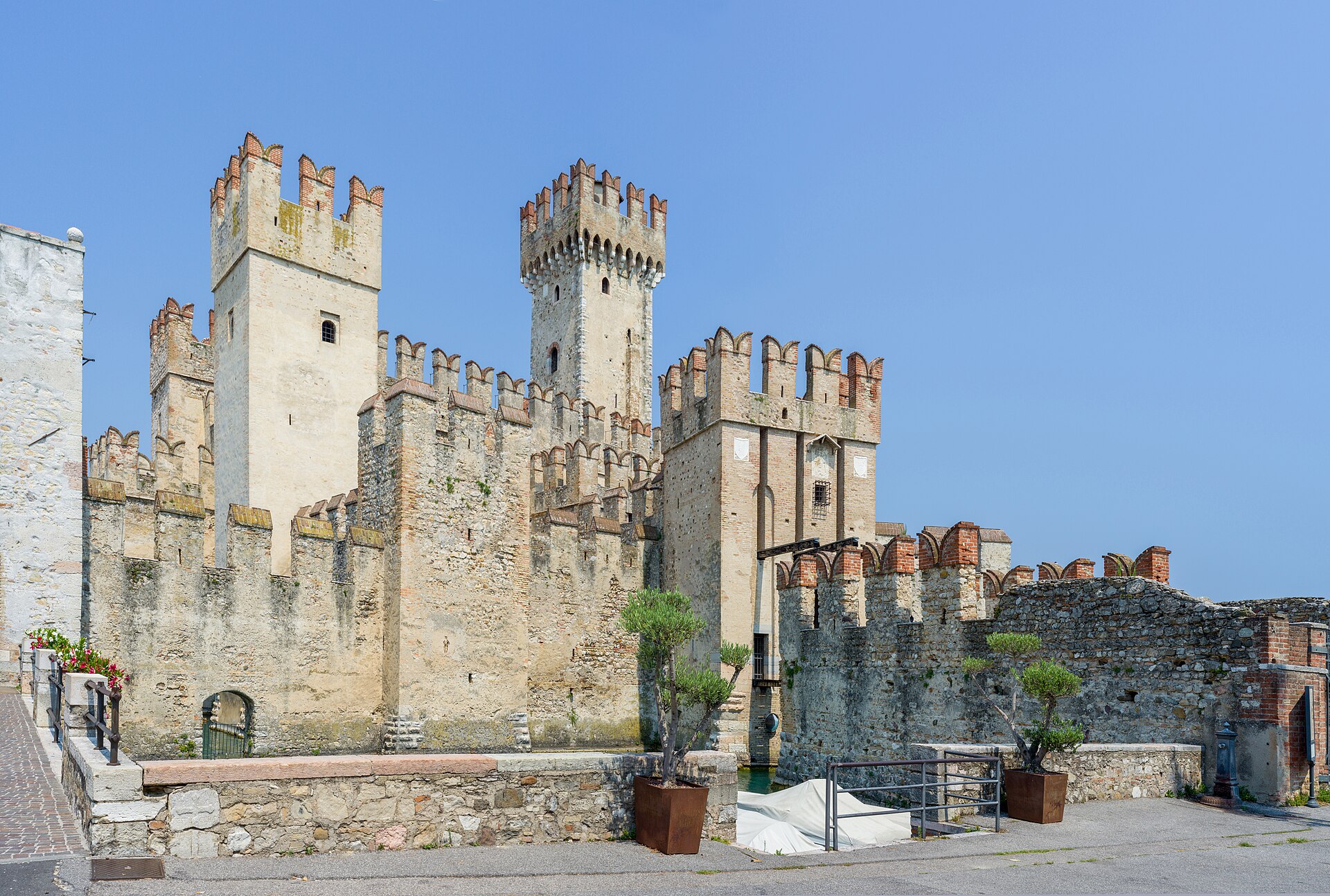
To enter the Castello Scaligero one must cross the water, and the castle was reached, in earlier times, by drawbridges that could be raised to seal the fortress off completely. The drawbridge was an essential part of the defences of a water castle, the single controllable point of access that turned the surrounding water into a true barrier, and at Sirmione the entrance was designed to make the approach a formidable obstacle to any attacker.
The whole approach to the castle was arranged for defence, so that anyone wishing to enter had to pass through a series of gates and across the water, all under the eyes of the garrison. The raised drawbridges denied easy access, and the combination of water, bridges, and gates made the Castello Scaligero exceptionally difficult to storm. It was a fortress designed to keep its owners safe and its enemies out, and its defences were as thorough as they were elegant.
Crossing into the castle today, over the water and beneath the gate, the visitor follows the same path by which the lords of the castle and their guests once entered their fortress. The experience of crossing the water, with the lake below and the great walls rising ahead, is one of the most memorable moments of a visit, a vivid reminder that this beautiful castle was, first and foremost, a serious work of military engineering built to command the water and the town.
The gate and its defences were the point where the whole strength of the water castle was concentrated, for here alone could an enemy hope to force an entry. The builders accordingly lavished care on the entrance, layering its defences so that even if one obstacle were overcome another lay beyond, and the crossing of the water remained, to the very end, the castle great point of strength.
The Fortress of the Scaligeri
The castle takes its name from the Scaligeri, the family known also as the della Scala, who ruled the great city of Verona and its territories in the Middle Ages. Powerful, ambitious, and often ruthless, the Scaligeri built up a strong state in this part of northern Italy, and they raised a network of castles to guard and control their lands. The fortress at Sirmione was one of the finest of these, built to hold this vital point on Lake Garda.
The Scaligeri were among the most notable of the many families who ruled the cities of medieval Italy, and under them Verona flourished. They are remembered, among other things, as patrons of the poet Dante during his exile, and their court was one of the more brilliant of its age. The castles they built, marked by the distinctive swallowtail battlements that were a sign of their allegiance, were the physical expression of their power, and Sirmione is one of the best-preserved of them all.
To stand before the walls and towers of the Castello Scaligero is to encounter the power of this great medieval family made solid in stone. The fortress was designed both to defend and to dominate, to hold the lake and to overawe the region, and it did its work well. That it survives so complete, its walls and towers almost as the Scaligeri built them, makes it a precious witness to the age of the great city-lords of medieval Italy, and to the family whose name it still bears.
The rise and fall of the Scaligeri is one of the great stories of medieval northern Italy, a tale of a family that climbed to power, ruled brilliantly for a time, and was eventually overtaken by mightier rivals. The castles they left behind, and Sirmione above all, are the enduring monuments of their age, standing long after the family itself passed from the scene, a reminder of the vivid and turbulent world of the medieval Italian city-states.
The distinctive style of the Scaliger castles, with their tall towers, their crenellated walls, and their swallowtail battlements, became one of the defining images of the medieval castle in the popular imagination, and Sirmione is among the finest and most complete surviving examples. To see it is to see the medieval Italian fortress at its most picturesque and most perfectly preserved.

Into the Courtyard
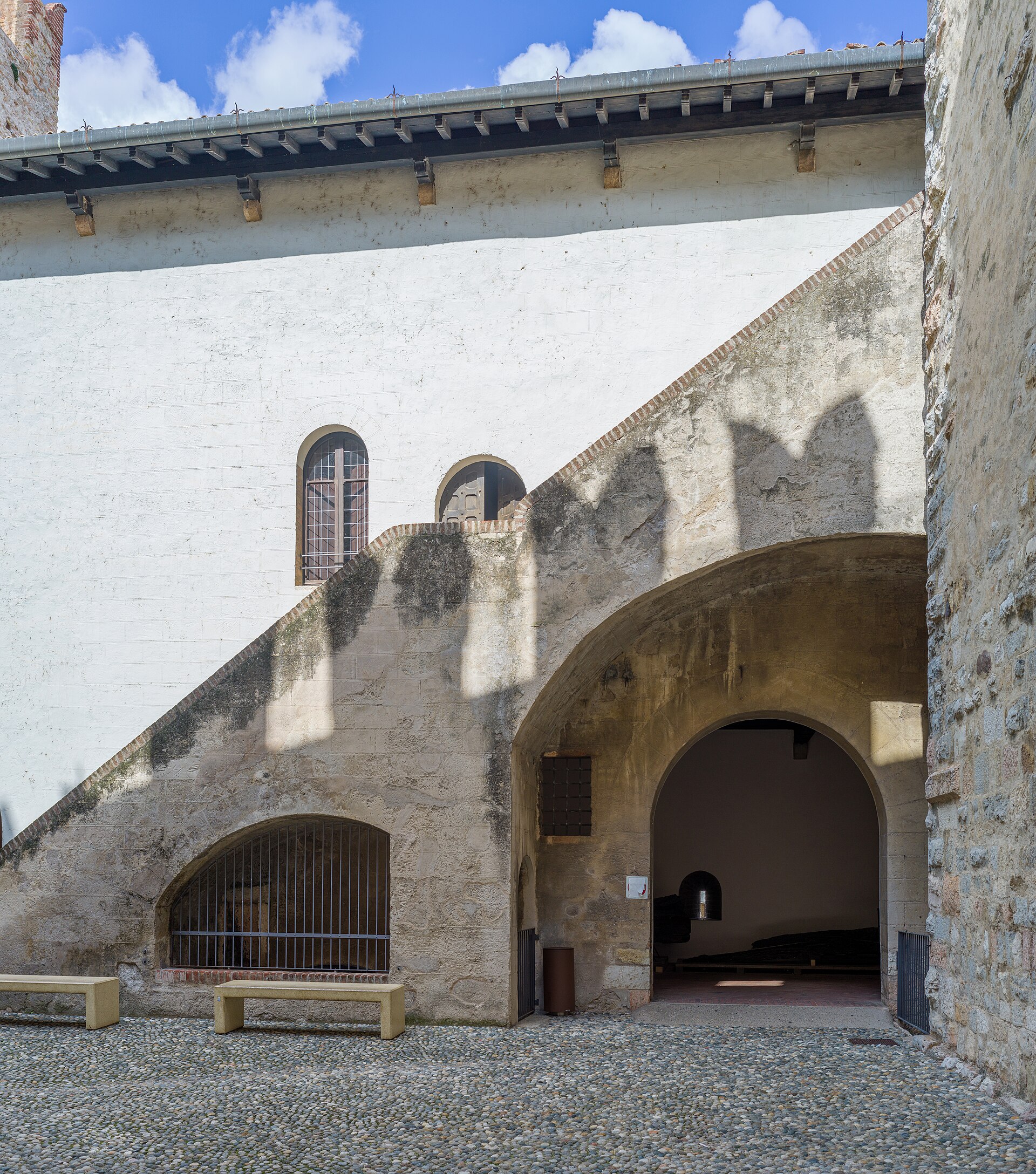
Passing through the gate, the visitor enters the courtyard at the heart of the castle, an enclosed space surrounded by the walls and towers of the fortress. This inner court was the centre of life within the castle, the point from which the towers, the walls, and the harbour could be reached, and it retains the calm and sheltered atmosphere of the protected heart of a stronghold, safe within its ring of water and stone.
The courtyard is a place of surprising peace, enclosed and quiet after the openness of the lake outside. Here the garrison lived and worked, and the daily life of the fortress went on, sheltered behind the walls. Standing in the courtyard, the visitor is at the very heart of the castle, able to appreciate the completeness of its design and the strength of the walls that rise on every side.
From the courtyard the various parts of the castle can be explored, from the towers with their views over the lake to the wall-walks along the battlements and the remarkable enclosed harbour beyond. It is the natural starting point for a visit, the still centre of the fortress from which its many features open out, and a place to pause and take in the beauty and the strength of one of the finest water castles in all of Italy.
The relative simplicity of the courtyard, compared with the grand painted courts of the great Renaissance palaces, reflects the castle character as a working fortress rather than a princely residence. Sirmione was built for war and for the control of the lake, not for courtly display, and its plain, strong architecture has a beauty of its own, the beauty of a building perfectly fitted to its purpose.

Along the Battlements
One of the great pleasures of a visit to the Castello Scaligero is to walk the wall-walks along the top of its battlements, following the path the sentries once trod as they kept watch over the lake and the town. From these walkways, high on the walls, the views over the water and the surrounding country are magnificent, and one gains a real sense of the castle as a working fortress, alert and watchful over its domain.
The battlements are crowned with the distinctive swallowtail merlons that were the mark of the Scaligeri and their allegiance in the great political struggles of medieval Italy. These forked battlements, shaped like the tail of a swallow, are a characteristic feature of the castles of northern Italy, and they give the Castello Scaligero its unmistakable silhouette, a fringe of pointed stone against the sky above the lake.
To walk the battlements is to experience the castle as its defenders knew it, to feel the wind off the lake and to command the same wide views that once allowed the garrison to watch for any threat. It is one of the highlights of a visit, combining the drama of the fortifications with the beauty of the setting, and it brings home, as nothing else can, the double character of the Castello Scaligero as both a formidable stronghold and a place of extraordinary beauty above the waters of Garda.
The swallowtail shape of the merlons was more than decoration, for in the fierce factional politics of medieval Italy the form of a castle battlements could signal its lord allegiance in the great division that split the country. To build with swallowtail merlons was to make a statement, and at Sirmione these distinctive battlements proclaim the loyalties of the Scaligeri to all who see them, a piece of political symbolism written into the very stone of the walls.

A Harbour Within the Walls
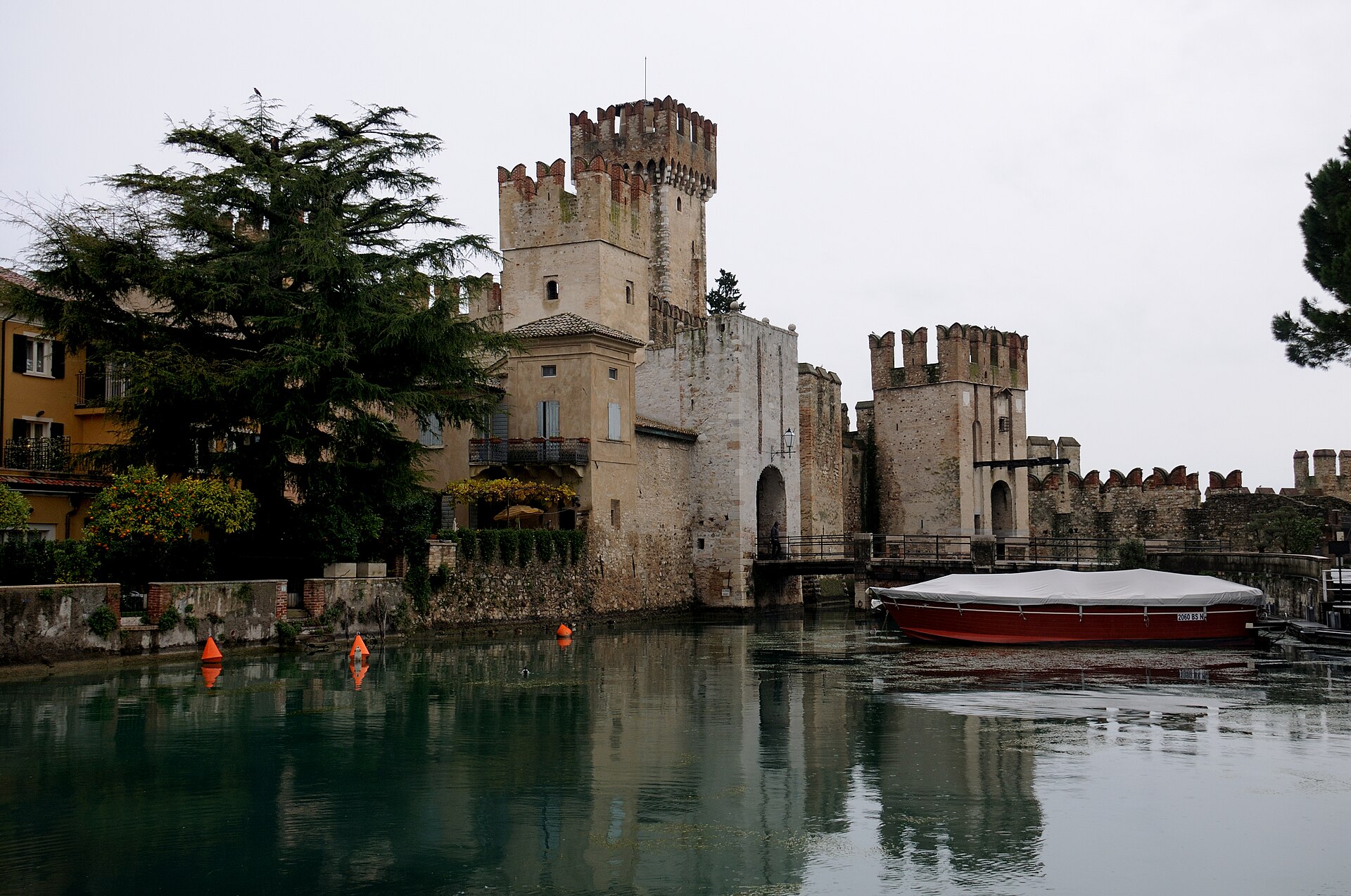
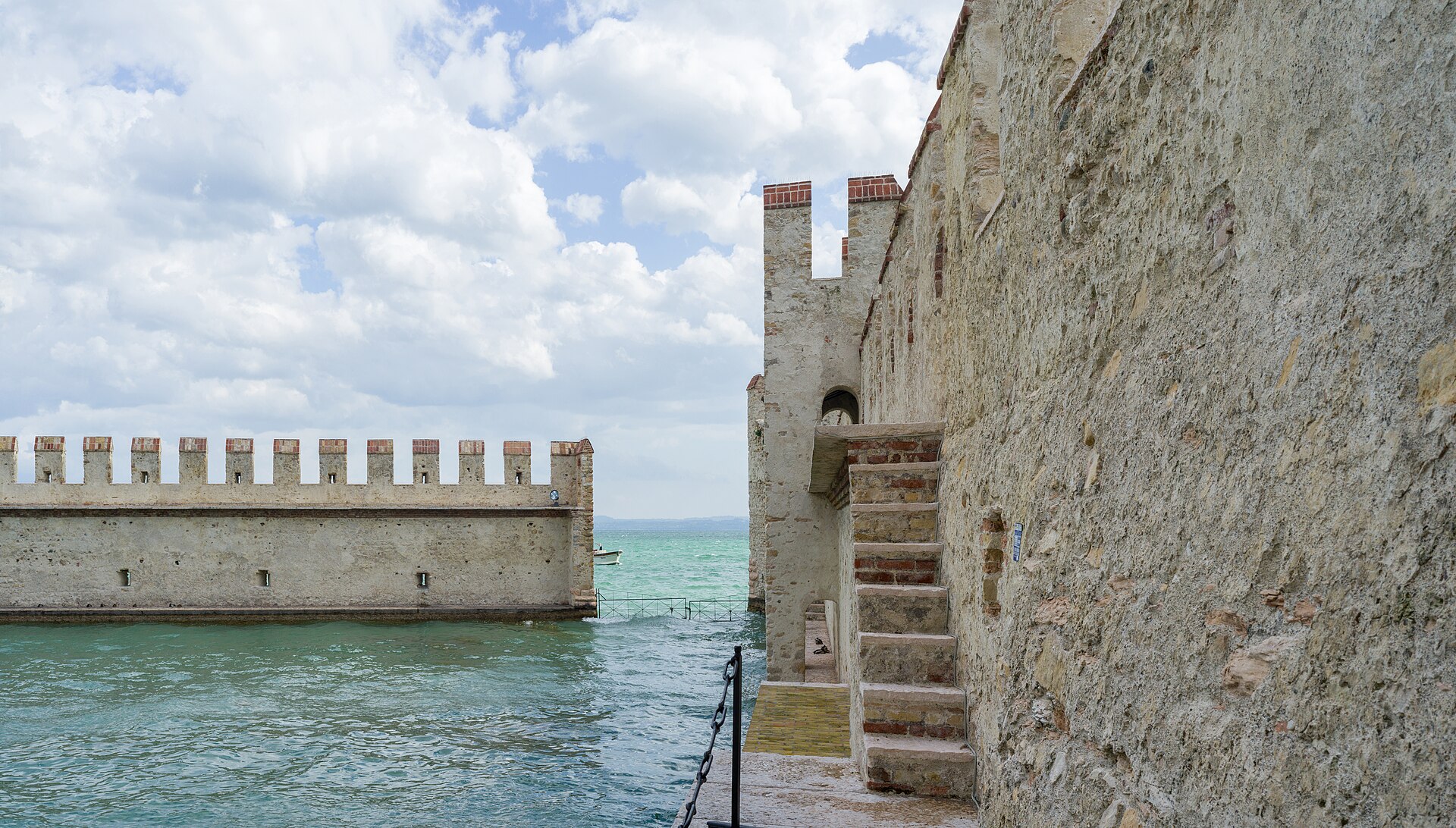
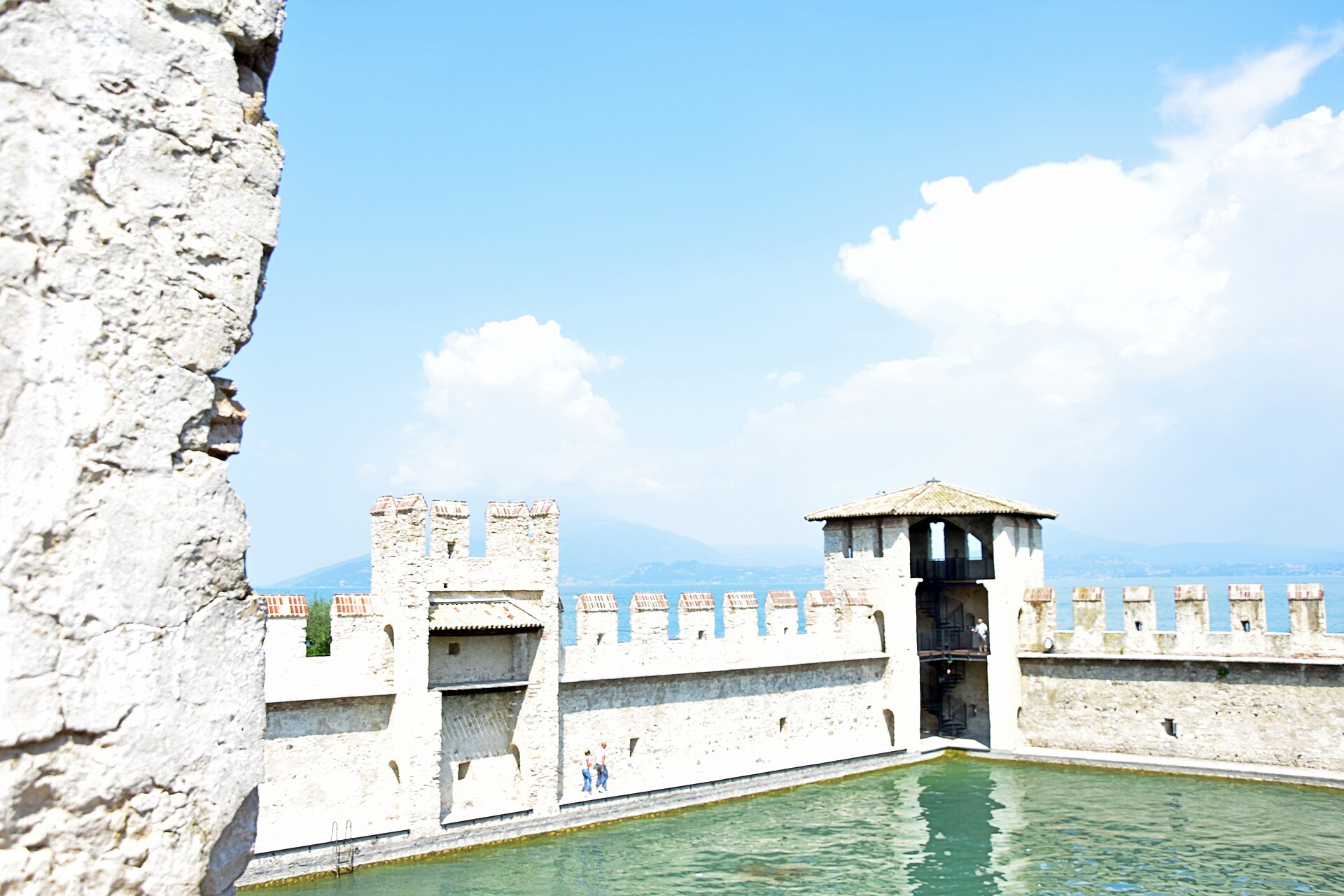
The most remarkable and unusual feature of the Castello Scaligero is its fortified harbour, a rare and precious survival that sets it apart from almost every other castle in Italy. Enclosed within the walls of the fortress, this protected basin of water served as a safe haven for ships, allowing the lords of the castle to shelter and maintain a fleet of vessels within the very defences of their stronghold. Few castles anywhere possess so complete a fortified harbour.
The harbour was essential to the castle’s role as a naval base on Lake Garda. The Scaligeri needed to control the lake as well as the land, and a fleet of warships was the means to do it, giving them command of the water and the routes across it. The fortified harbour allowed them to keep their ships safe from storms and from enemies, protected behind the walls of the castle, ready to sail out to assert their power over the lake.
To stand within the enclosed harbour, surrounded by the walls of the fortress with the water lapping below, is to grasp at once the unique character of the Castello Scaligero. This was not merely a castle but a naval fortress, a stronghold that reached out onto the water and controlled the lake as well as the shore. The fortified harbour is the castle’s greatest treasure, a rare witness to the age when fleets contended for the mastery of Lake Garda, and it makes Sirmione one of the most fascinating fortresses in all of Italy.
The survival of the fortified harbour is all the more precious because such features were rare even in their own day and rarer still today, most having been lost or filled in over the centuries. That Sirmione preserves its enclosed harbour so completely makes the castle a place of exceptional interest to anyone who cares about the history of fortification, and a rare window into the world of medieval naval warfare on the lakes of Italy.
Seen from within, the enclosed harbour has a serene and almost magical quality, the water within the walls lying still and sheltered while the open lake stretches beyond. It is easy to linger here, imagining the ships that once filled it, and it is this rare and evocative space, more than any other feature, that makes a visit to the Castello Scaligero so memorable.
The Scaliger Fleet
The enclosed dock of the castle, protected within its walls, once sheltered the fleet of the Scaligeri, the ships with which they controlled Lake Garda. In an age when the lake was a vital route and a contested prize, a fleet of armed vessels was as important as any army, and the castle’s harbour allowed the lords of Sirmione to keep their ships safe and ready. The fortress and the fleet together gave them the mastery of the water.
The ships based here would have patrolled the lake, protected the trade and the shores under Scaliger control, and given battle to rival fleets when the mastery of Garda was in dispute. The lake, for all its beauty, was a place of conflict as well as commerce, and the fortified harbour of Sirmione was a key base in the struggles for its control. The quiet water within the walls was once busy with the coming and going of warships.
Today the enclosed harbour is a place of great beauty and calm, its still water reflecting the walls that surround it, but its origins lay in the hard realities of medieval warfare on the lake. To picture it filled with the ships of the Scaligeri, ready to sail out to contest the mastery of Garda, is to understand the castle in its full character as a naval fortress, and to appreciate the rare and remarkable survival of a fortified harbour within its walls.
The vessels of the medieval lake fleets were small compared with the great ships of the sea, but on the enclosed waters of Garda they were mighty enough, and the mastery of the lake could turn on their success or failure. The fortified harbour of Sirmione was the base from which such power was exercised, and its quiet water once echoed to the business of building, arming, and manning the ships on which the fortunes of the Scaligeri in part depended.
Master of the Lake
The whole purpose of the Castello Scaligero was to command Lake Garda, and its combination of fortress and harbour made it uniquely fitted to do so. From this stronghold, with its walls, its towers, and its sheltered fleet, the Scaligeri could control the southern end of the lake and the routes that crossed it, dominating both the water and the shore. To hold Sirmione was to hold the key to the lake.
Control of Lake Garda mattered greatly in the medieval struggles of northern Italy, for the lake was a highway for trade and a barrier and a route for armies alike. The powers that contended for mastery of the region, the Scaligeri of Verona and their many rivals, understood that whoever controlled the lake held a great advantage, and the castles and fleets that guarded its waters were central to their wars. Sirmione was one of the most important of these strongholds.
Looking out from the castle over the wide waters of Garda, one can appreciate the strategic vision that raised so complete a fortress on this spot. The Castello Scaligero was designed to project power across the lake, to shelter a fleet and to command the water, and it did so for as long as the Scaligeri held sway. Its walls and harbour are the enduring monument to that ambition, a fortress built not only to defend a peninsula but to master an entire lake.
After the decline of the Scaligeri, Lake Garda and its castles passed to other powers, above all to the great republic of Venice, which came to dominate this part of Italy. Sirmione continued to serve as a fortress under its new masters, guarding the lake as it had always done, and its long service under successive rulers is a testament to the enduring importance of its position at the gateway to the peninsula.

The View From the Keep
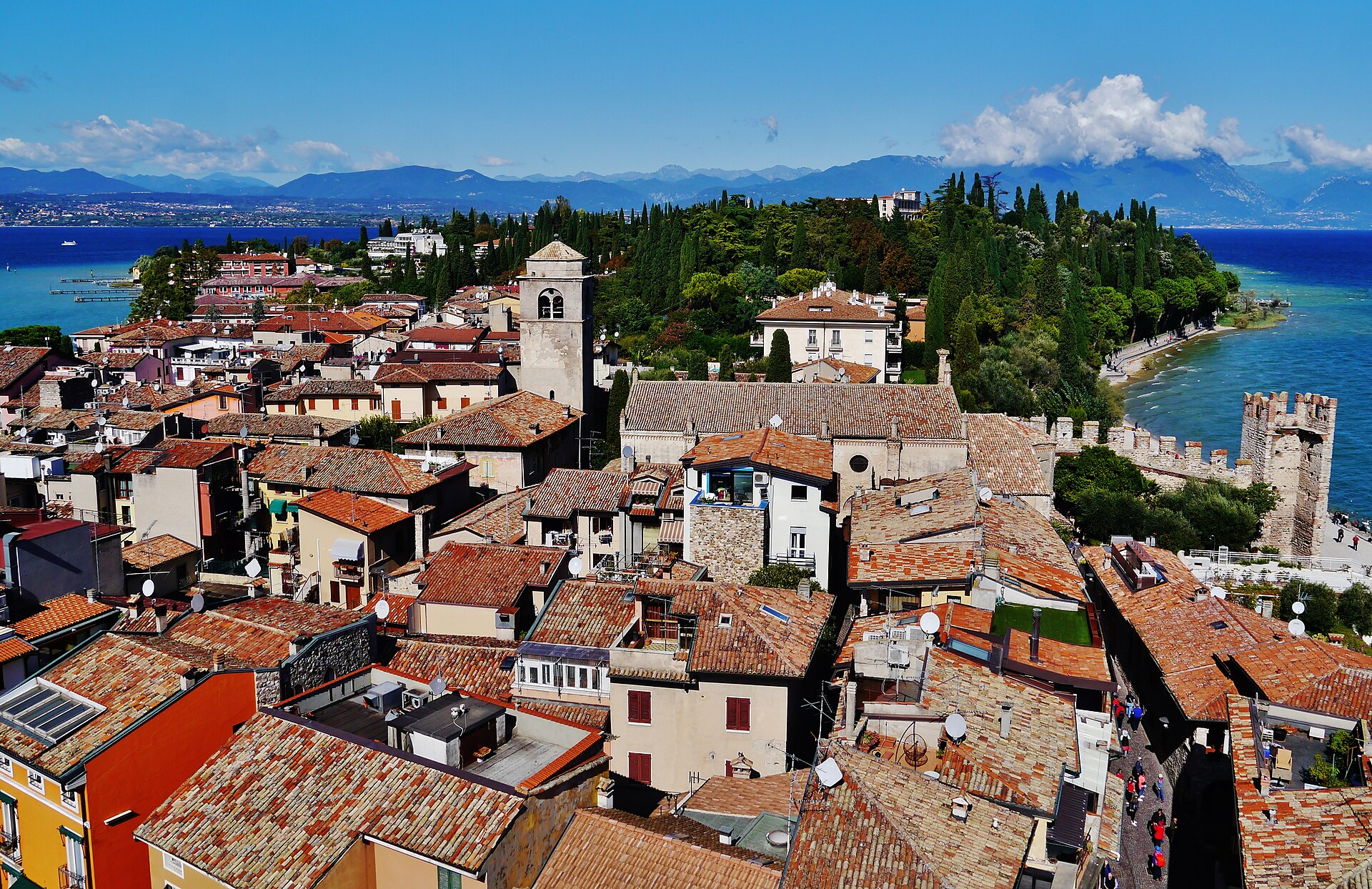
Rising above the rest of the fortress is its keep, the tall tower that was the strongpoint and the lookout of the castle, and climbing it rewards the visitor with one of the finest views on all of Lake Garda. From the top the whole scene spreads out below, the town of Sirmione on its peninsula, the wide blue lake stretching away to the mountains, and the castle itself with its walls and harbour, laid out like a map beneath your feet.
The keep was the heart of the castle’s defences, the tower into which the garrison could withdraw as a last resort and from which they kept watch over the lake and the approaches. Its height gave the defenders command of the surrounding country and early warning of any threat, and it was the visible symbol of the power of the castle and its lords, rising above the walls and the water for all to see.
For the visitor, the climb to the top of the keep is the crowning moment of a visit, offering a panorama that combines the beauty of the lake, the charm of the town, and the drama of the fortress in a single unforgettable view. From this height one grasps the whole design of the castle and its setting, and understands at a glance why the Scaligeri chose this spot, and why the Castello Scaligero remains one of the most beautifully placed castles in all of Italy.
The changing moods of the lake are nowhere better appreciated than from the top of the keep, whether under the bright sun of a summer day, in the soft light of evening, or amid the mists that sometimes rise from the water. Each brings its own beauty to the scene, and the view from the keep is never quite the same twice, rewarding those who climb it in any season or weather.
The ascent of the keep by its stairs is part of the adventure, leading the visitor up through the heart of the tower to emerge at the top into the light and the wind, with the whole panorama suddenly spread out below. It is a moment of revelation that crowns any visit, and it fixes the image of Sirmione, its castle, its peninsula, and its shining lake, forever in the memory.
Sirmione and the Poet’s Peninsula
The castle guards the entrance not only to a beautiful town but to a peninsula loved and celebrated since the days of ancient Rome. Sirmione, on its long spit of land reaching into the lake, was a favoured retreat of the Romans, drawn by its beauty and by the healing thermal waters that still rise here, and the ruins of a great Roman villa survive at the very tip of the peninsula, a reminder of its long history as a place of pleasure and repose.
Above all, Sirmione is associated with one of the greatest poets of ancient Rome, who loved the place and celebrated it in his verse, calling it the jewel of all peninsulas and islands. His connection has given Sirmione a special place in the history of literature, and the Roman ruins at the end of the peninsula are traditionally linked to his name. To visit Sirmione is thus to walk in the footsteps of poets and emperors as well as of medieval lords.
This long history, stretching from the Romans through the Middle Ages to the present, gives Sirmione a depth of association matched by few places on the lake. The medieval castle guards the gateway to a peninsula that has been loved for two thousand years, a place of beauty, poetry, and healing waters. The Castello Scaligero is the crowning monument of this enchanting spot, standing guard, as it has for centuries, over one of the loveliest and most storied places on Lake Garda.
Visiting the Castello Scaligero
The Castello Scaligero stands at the entrance to the town of Sirmione, on the southern shore of Lake Garda in northern Italy, and it is easily reached by road or by the boats that ply the lake. Sirmione is one of the most popular and beautiful destinations on Garda, and a visit to the castle combines naturally with exploring the charming town, its Roman ruins, its thermal waters, and its lovely lakeside setting.
A visit to the castle allows you to cross the water into the fortress, explore the courtyard, walk the battlements with their swallowtail merlons, climb the keep for its magnificent view, and see the rare fortified harbour that makes Sirmione so remarkable. The combination of the water setting, the well-preserved fortifications, and the beauty of the lake makes for a memorable visit, and the castle is a perfect introduction to the medieval history of the region.
If you would like to find it and plan your visit, here is the castle’s position at the gateway to Sirmione: 45.4936, 10.6069. Try to see the castle both by day, when its pale walls rise against the blue lake, and by night, when it is floodlit above the water, and take time to explore the beautiful town beyond. The Castello Scaligero of Sirmione is one of the loveliest and best-preserved castles in Italy, a water fortress of rare beauty, and it rewards everyone who comes to its enchanting corner of Lake Garda.
Sirmione can grow very busy in the height of summer, when its beauty draws great crowds, so those who wish to enjoy the castle and the town in relative peace often find the quieter months of spring and autumn the most rewarding. Whenever you come, the sight of the water fortress at the gateway to the peninsula, rising from the blue lake, is one that stays in the memory long after the visit is over.

Castles Nearby
- Castello di Miramare, the white castle of a doomed prince
- Castello Sforzesco, the Renaissance fortress of Milan
- Castello Estense, the moated fortress of the Este dukes
The Water Fortress of the Scaligeri
Of all the castles of Italy, few are as beautiful, or as complete, as the Castello Scaligero of Sirmione. Rising from the blue waters of Lake Garda, its pale walls and swallowtail battlements almost as they were in the Middle Ages, it is a fortress of rare charm and rare preservation, guarding the gateway to one of the loveliest towns on the lake. It is a castle that seems to belong to a fairy tale, yet it is entirely real, and its beauty is matched by its history.
What makes it so remarkable is its intimate bond with the water, and above all its rare fortified harbour, that enclosed haven within the walls where the fleet of the Scaligeri once sheltered. Few castles anywhere combine so completely the roles of fortress and naval base, and it is this, together with its beauty and its state of preservation, that makes the Castello Scaligero one of the most fascinating water castles in all of Italy.
So when you come to Lake Garda, cross the water into the fortress of the Scaligeri and give yourself to its beauty and its history. Walk the battlements, climb the keep, and stand within the enclosed harbour where warships once lay at anchor, and let the long story of the castle and its lake unfold around you. The Castello Scaligero of Sirmione is the water fortress of the Scaligeri, and it remains one of the most beautiful and best-loved castles in all of Italy.
You May Like

Mafra, the Palace a King Built From a Vow



One thought on “Castello Scaligero di Sirmione: The Water Fortress of Lake Garda”