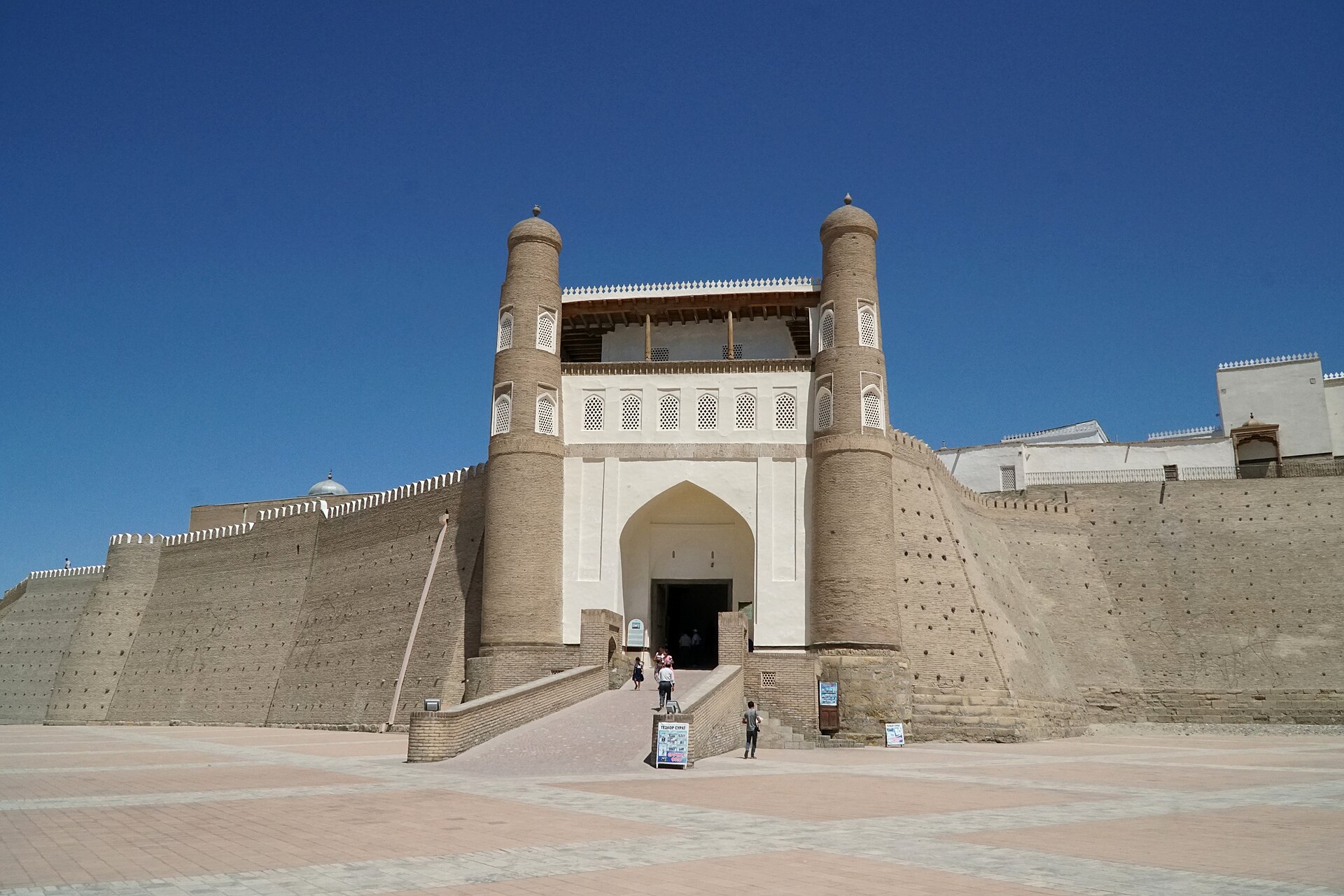
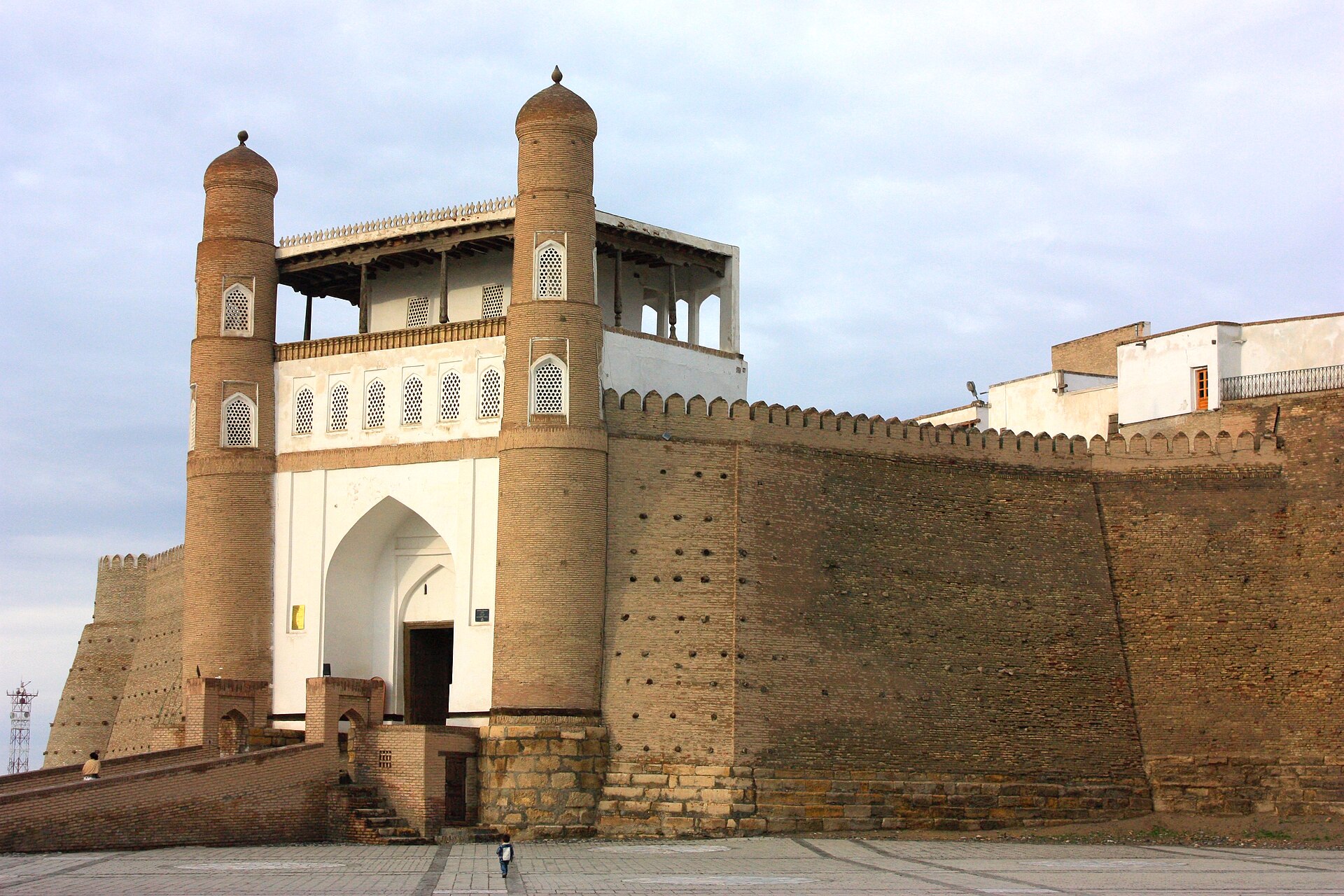
Come at Bukhara from the west, and the first thing you see is the Ark, a vast mound of a fortress rising abruptly out of the flat Central Asian plain. Its sloping walls, streaked and weathered the color of the desert itself, climb some twenty meters above the square below, and the great gate between two round towers looks less like a doorway than the mouth of a cave. This is the oldest structure in Bukhara, a fortified city-within-a-city that served as the seat of the region’s rulers for well over a thousand years.
The Ark is not a delicate pleasure palace like so many of the courts of Europe or East Asia. It is a stronghold, a royal citadel where power, faith, and fear were concentrated behind massive earthen ramparts. Inside its walls once lived not only the emir and his family but a whole town of officials, soldiers, craftsmen, servants, and prisoners, a self-contained world that could seal itself off from the city at the first sign of trouble. To walk into it is to enter the hard heart of an old and often ruthless kind of kingship.
Bukhara itself is one of the great cities of the Silk Road, a place whose name once stood for learning, trade, and Islamic scholarship across half the world. For centuries the Ark was the political anchor of that city, the fortress from which dynasty after dynasty ruled the oasis and the caravan routes that made it rich. Emirs held audience here, tax was gathered here, and the fate of the region was decided within these walls while the domes and minarets of the holy city spread out below.
What you visit today is partly ruin and partly restoration, for the citadel was heavily damaged in the twentieth century and much of what once stood inside is gone. But enough remains, the towering gate, the ramps and courtyards, the coronation court and the old mosque, to conjure the world of the emirs of Bukhara, a world that survived almost untouched into the modern age before it was swept away. This is the story of that fortress and the rulers who made it the center of their realm.

In This Article
- A Fortress City Above the Oasis
- Legends and Ancient Foundations
- The Emirs of Bukhara
- The Great Ramparts
- The Gate and Its Towers
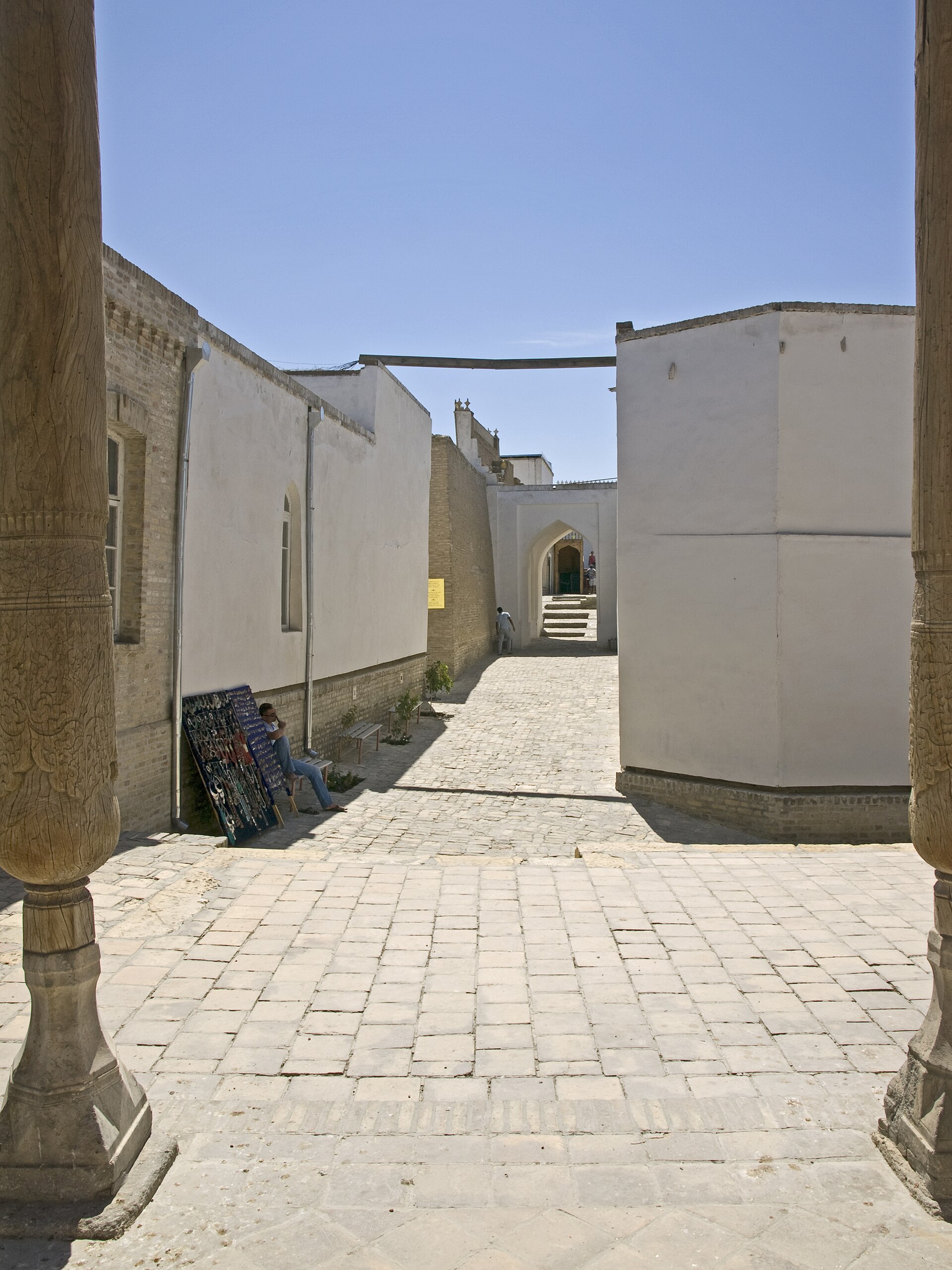
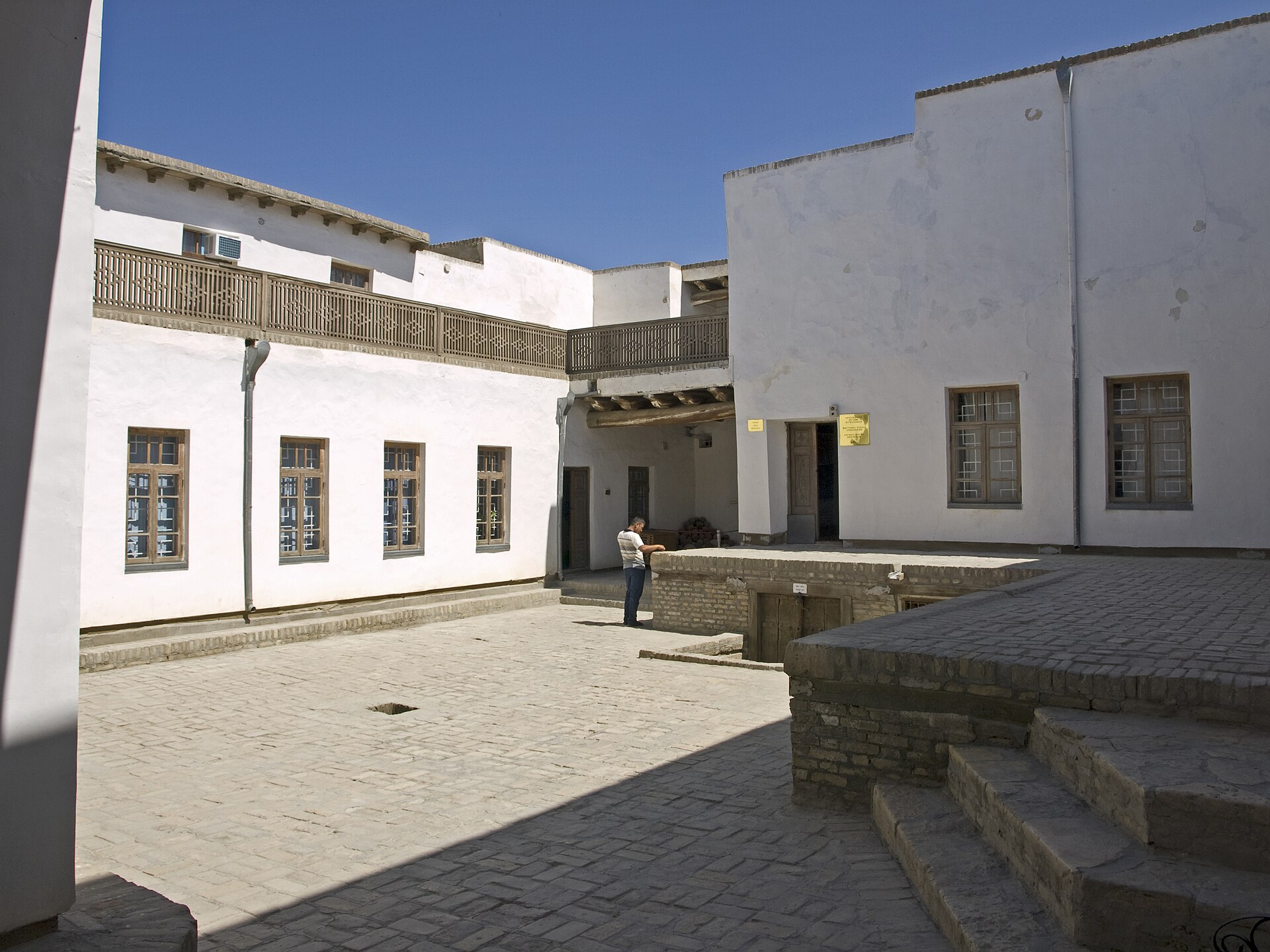
- Courtyards, Ramps, and Quarters
- The Coronation Court
- The Court Mosque
- Halls of Audience and Rule
- The Zindan and the Fortress Jail
- Household, Treasury, and Daily Life
- A Citadel of Museums
- The Ark Today: Bukhara’s Enduring Symbol
A Fortress City Above the Oasis
The Ark is best understood not as a single building but as a fortified quarter, an artificial hill crowned by walls and packed with structures. Its footprint is roughly rectangular, covering several hectares, and at its height it held everything a ruler needed to govern and to withstand a siege, from throne rooms and mosques to mints, treasuries, barracks, workshops, stables, and dungeons.
The whole mass sits on top of accumulated centuries of earlier building. Bukhara is an ancient city, and the Ark has been destroyed and rebuilt so many times that the ground beneath it is a deep layer cake of older fortresses, each new citadel raised on the rubble of the last. Archaeologists have traced occupation here back well over two thousand years, which makes the mound itself a kind of monument.
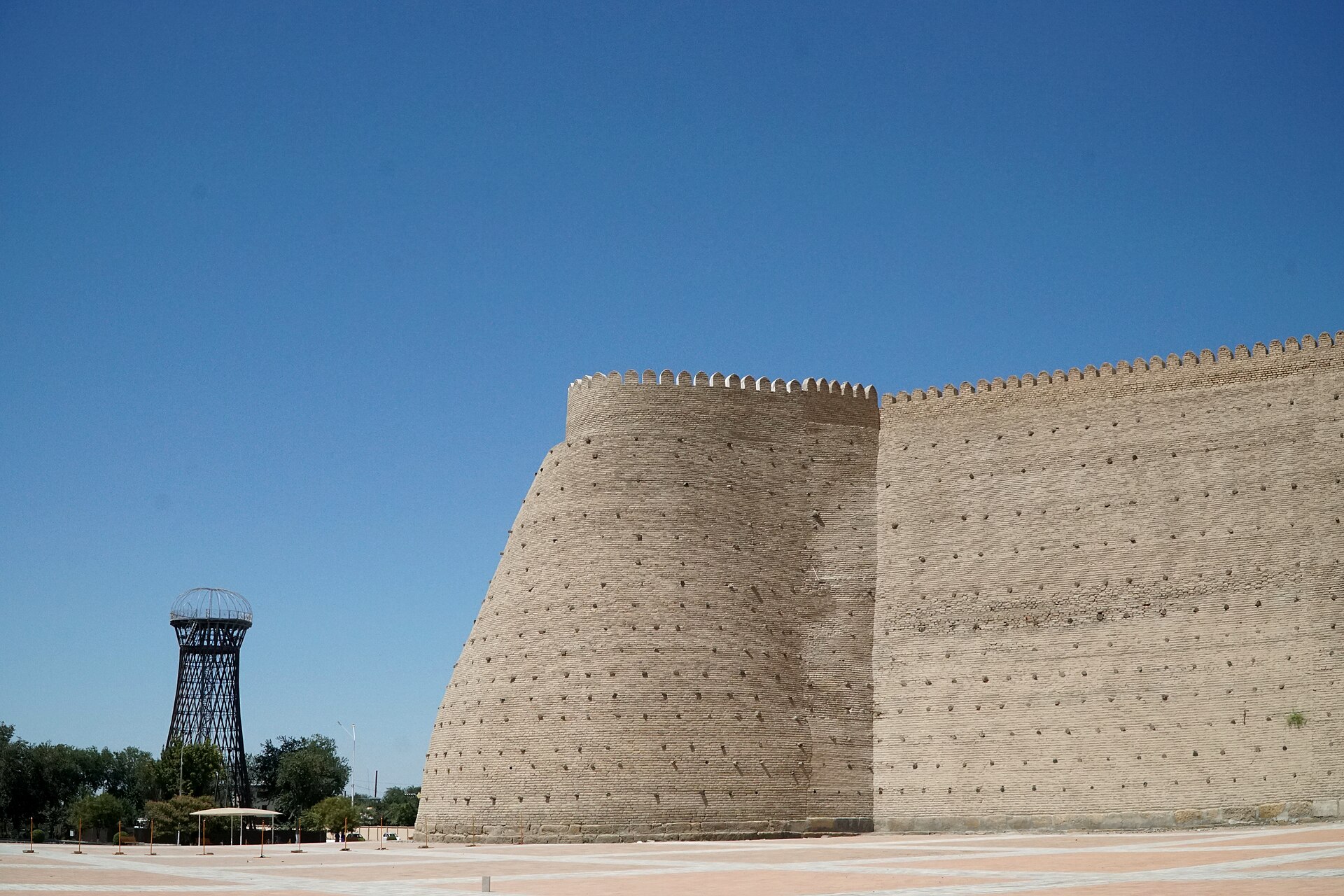
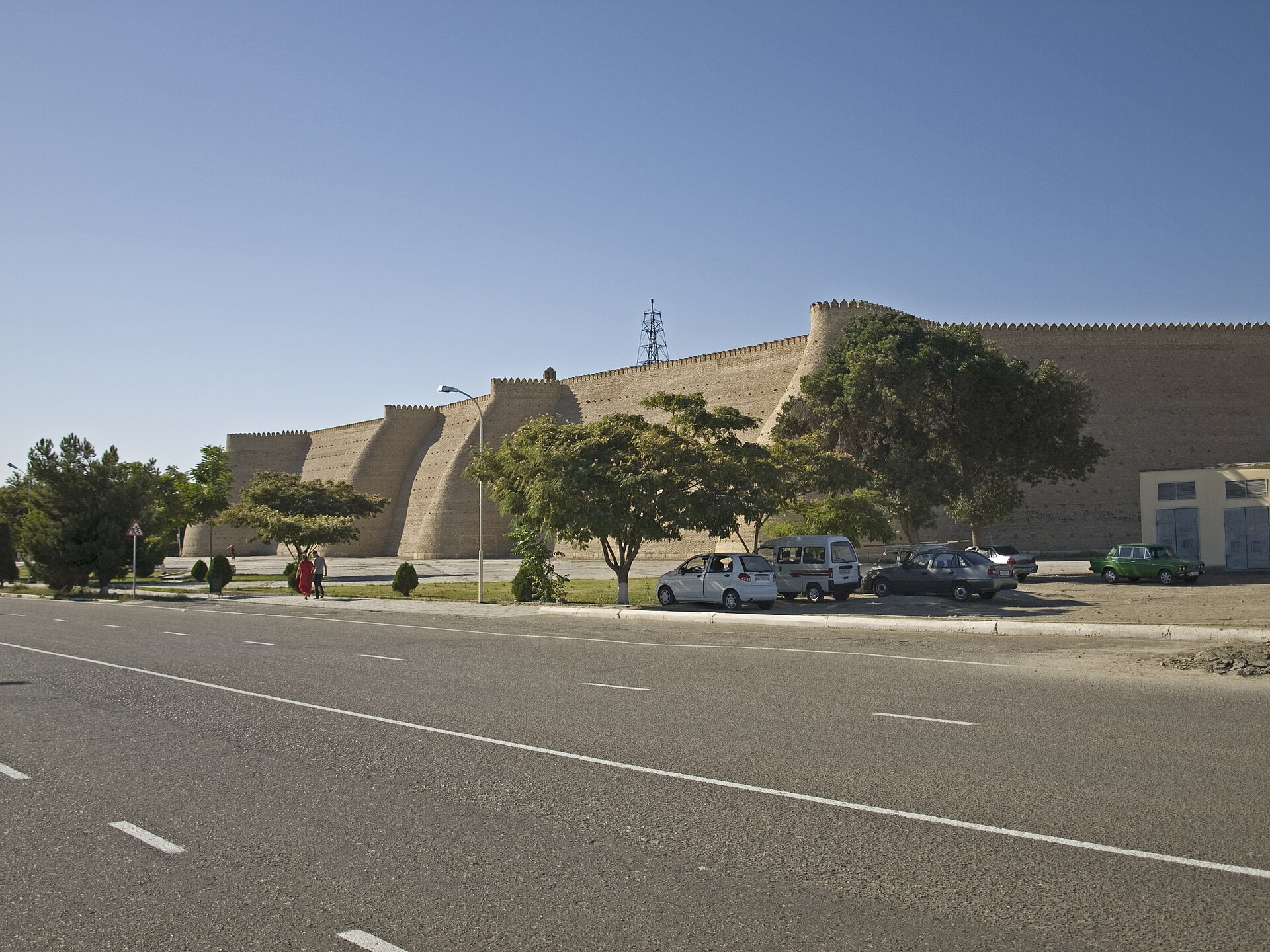
From the great square below, called the Registan, the citadel presents a single overwhelming face of sloping wall. That slope is deliberate, an engineering choice that made the ramparts harder to undermine and helped them shrug off the weight of their own great height. Buttressed and battered, the walls read as a solid cliff of fortification rather than a decorated palace facade.
Only one gate breaks the wall, and everything and everyone passed through it. That single controlled entrance is the key to the Ark’s whole logic. Power here was about the ability to shut the world out and to control who came in, and the fortress was designed so that a handful of guards at one gate could hold the entire complex against the city outside.
Standing in front of it, you feel the difference between this and the open, garden-facing palaces of gentler climates and safer politics. The Ark was built by rulers who expected to be attacked, by rivals, by nomad armies, by their own restless subjects, and its architecture is a frank admission that in this world a throne was something you defended with walls.
There is a useful comparison to be made with the other great citadels of the Islamic world, the Alhambra above Granada, the fortresses of the Mughals, the castles of the Levant. All share this instinct to place the ruler on high ground behind strong walls, but the Ark is starker than most, less softened by garden and ornament, more frankly a fortress. It belongs to a harder frontier, where the steppe met the sown land and where a ruler could never quite forget that his throne stood within bowshot of the wilderness.
Legends and Ancient Foundations
Like many very old places, the Ark has gathered legends about its founding. The most famous connects it to Siyavush, a hero of Persian myth, who is said to have built the first citadel here in the distant past. Such stories are less history than an expression of how ancient the site felt even to medieval people, who reached for legend to explain a fortress older than memory.
What the archaeology suggests is that a fortified settlement stood on this spot from at least the early centuries of the first millennium, guarding the young oasis city that was growing up around it. Bukhara sat at a crossroads of trade and was worth defending, and its rulers naturally raised their stronghold on the highest and most defensible ground available.
Over the centuries the citadel was repeatedly ruined and rebuilt. Conquests, fires, and the simple decay of mud-brick architecture meant that no version of the Ark lasted forever. Each destruction was followed by reconstruction on the same spot, the new walls rising on the leveled remains of the old, which is why the mound grew steadily taller with the passing generations.
The most catastrophic early blow came with the Mongol conquest in the thirteenth century, when Bukhara was stormed and much of the city, the Ark included, was devastated. Yet even the Mongols could not erase the strategic logic of the place, and in time the fortress was raised again, because whoever ruled Bukhara needed a citadel, and this was where a citadel belonged.
By the time the last dynasty of emirs took power in the eighteenth century, the Ark had been the seat of Bukharan rulers for so long that its authority felt almost natural, as though the right to govern the oasis lived in the walls themselves. To hold the Ark was to hold Bukhara, and to hold Bukhara was to be a power in Central Asia.
The Emirs of Bukhara
The rulers most closely associated with the Ark in its final centuries were the emirs of the Manghit dynasty, who governed the Emirate of Bukhara from the mid-eighteenth century until the twentieth. Under them the citadel reached its last great flowering as a working seat of government, a court both splendid and severe.
The emirate they ruled was a Muslim state of a conservative and traditional cast, where religious law and scholarship carried enormous weight and where Bukhara prided itself on being one of the holiest cities of the Islamic world. The emir was both a temporal ruler and a defender of the faith, and the Ark served as the stage on which that double authority was displayed.
Life at this court could be brutal. The emirs held absolute power over their subjects, and the Ark was a place of both magnificence and terror, where lavish ceremony coexisted with harsh justice and notorious prisons. Foreign visitors who reached Bukhara in the nineteenth century left accounts that mixed wonder at its splendor with horror at its cruelty.
In the nineteenth century the emirate was caught in the great rivalry between the Russian and British empires, the contest that history remembers as the Great Game. Bukhara’s rulers tried to hold their independence between the two, but the pressure was relentless, and by the 1860s the emirate had been forced into submission to Russia, becoming a protectorate that kept its emir but lost its freedom of action.
Even under Russian overlordship the emirs continued to rule from the Ark, maintaining their court, their ceremonies, and their fortress-capital almost as before. It was one of the last places on earth where a medieval-style Islamic monarchy carried on into the modern century, a living survival that would not outlast the upheavals of the age.
It is worth remembering how recent all this was. The last emir did not lose his throne in some distant medieval century but in 1920, within living memory of people whose grandchildren are alive today. That nearness is part of what makes the Ark so affecting. This is not a fairy-tale castle from a vanished age but the fortress of a monarchy that persisted almost defiantly into the era of the telegraph and the railway, and then fell very suddenly.
The Great Ramparts
The walls are the Ark’s defining feature and its first line of defense. Built of mud brick and packed earth and faced against the weather, they rise in a long sloping mass that encircles the entire citadel. Their height and thickness were meant to defeat both the siege engines of settled armies and the sudden raids of steppe horsemen.

The battered, inward-leaning profile of the walls was sound military engineering. A sloping face is far harder to scale and to undermine than a vertical one, and it helps distribute the enormous weight of a tall earthen rampart so that it does not simply slump under its own mass in a land of baking summers and occasional heavy rain.
Along the top ran a walkway from which defenders could watch the city and the plain and rain down missiles on any attacker. The great gate was flanked and protected by towers, and the whole circuit was designed so that the defenders always held the high ground, looking down on anyone who approached from the square below.
These ramparts needed constant care. Mud-brick architecture is forgiving to build but demanding to maintain, and every generation had to repair and re-face the walls to keep them from dissolving. The survival of the Ark’s outline into our own time is a testament to centuries of that patient, repeated labor.
Seen at sunset, when the low light rakes across their surface and turns the earthen walls to gold, the ramparts are unexpectedly beautiful, their rough texture and long shadows giving them the quality of a natural landform. They are among the most photographed sights in Uzbekistan, and it is easy to see why.
The Gate and Its Towers
The single monumental gate is the Ark’s most striking piece of architecture. Set between two massive round towers and reached by a ramp, it is crowned by a gallery and framed to impress and intimidate everyone who approached. Passing through it, a visitor left the ordinary world of the city and entered the guarded precinct of the ruler.

Above the gate was a chamber from which, by tradition, great drums and horns announced the hours and the comings and goings of the court. The sound of that music rolling out over the Registan told the whole city that the emir’s fortress was awake and watchful, a daily audible reminder of where power lay.
The gateway itself is not a simple opening but a long vaulted passage that climbs upward into the citadel, lined with chambers that once served as guardrooms and, in darker use, as cells. To enter the Ark was to walk uphill through a controlled, enclosed corridor entirely overlooked by the ruler’s men, defensible at every step.
That passage set the tone for everything within. There was no sweeping garden approach, no open forecourt inviting the visitor in. Instead there was a climb through shadow and stone into the heart of the fortress, an experience engineered to remind anyone who made it that they entered at the ruler’s pleasure and on his terms.
Today the gate is the point where visitors still enter, and it remains the most photographed part of the citadel. Restored and cared for, it frames the approach exactly as it always did, and stepping under it you feel a small echo of the awe and unease that generations of petitioners must have carried up that ramp before you.
Look closely at the towers and you will notice how the whole composition is designed to funnel the eye and the body toward that one dark opening. There is no other way in and no other way out, and the psychological effect on an arriving petitioner must have been considerable. You did not stroll into the emir’s presence; you were channeled toward it, watched from above at every moment, and delivered at last into the heart of a fortress from which there was no easy retreat.
Courtyards, Ramps, and Quarters
Once through the gate and up the passage, the interior of the Ark opens into a series of courtyards and lanes rather than a single grand hall. The citadel was a dense little town, and its spaces were organized for function, with the ruler’s ceremonial and religious buildings clustered around courtyards and the working quarters filling the rest.

Lanes wound between the structures, connecting the mosque, the audience courts, the offices, and the residential and service areas. This was a place where thousands of people might live and work at once, and its layout reflects the practical needs of a fortress that had to be self-sufficient during a siege, with its own water, food stores, and workshops.
The various courtyards each had their purpose. Some were ceremonial, staged for the display of the emir’s authority; others were administrative, where the business of taxing and governing the oasis was carried out; still others were domestic, the more private preserve of the ruler’s household hidden away from public eyes.
Because so much of the interior was lost in the twentieth century, walking these spaces today requires imagination. Open ground and low ruins stand where dense buildings once crowded together, and signboards and a few restored structures hint at the vanished density. The Ark you see is a fraction of the Ark that was.
Yet even in its reduced state the internal geography still reads. You can trace the climb from the gate, find the ceremonial courts, stand in the coronation space, and enter the old mosque, and from these surviving fixed points the shape of the lost citadel begins to reassemble itself in the mind’s eye.
The Coronation Court
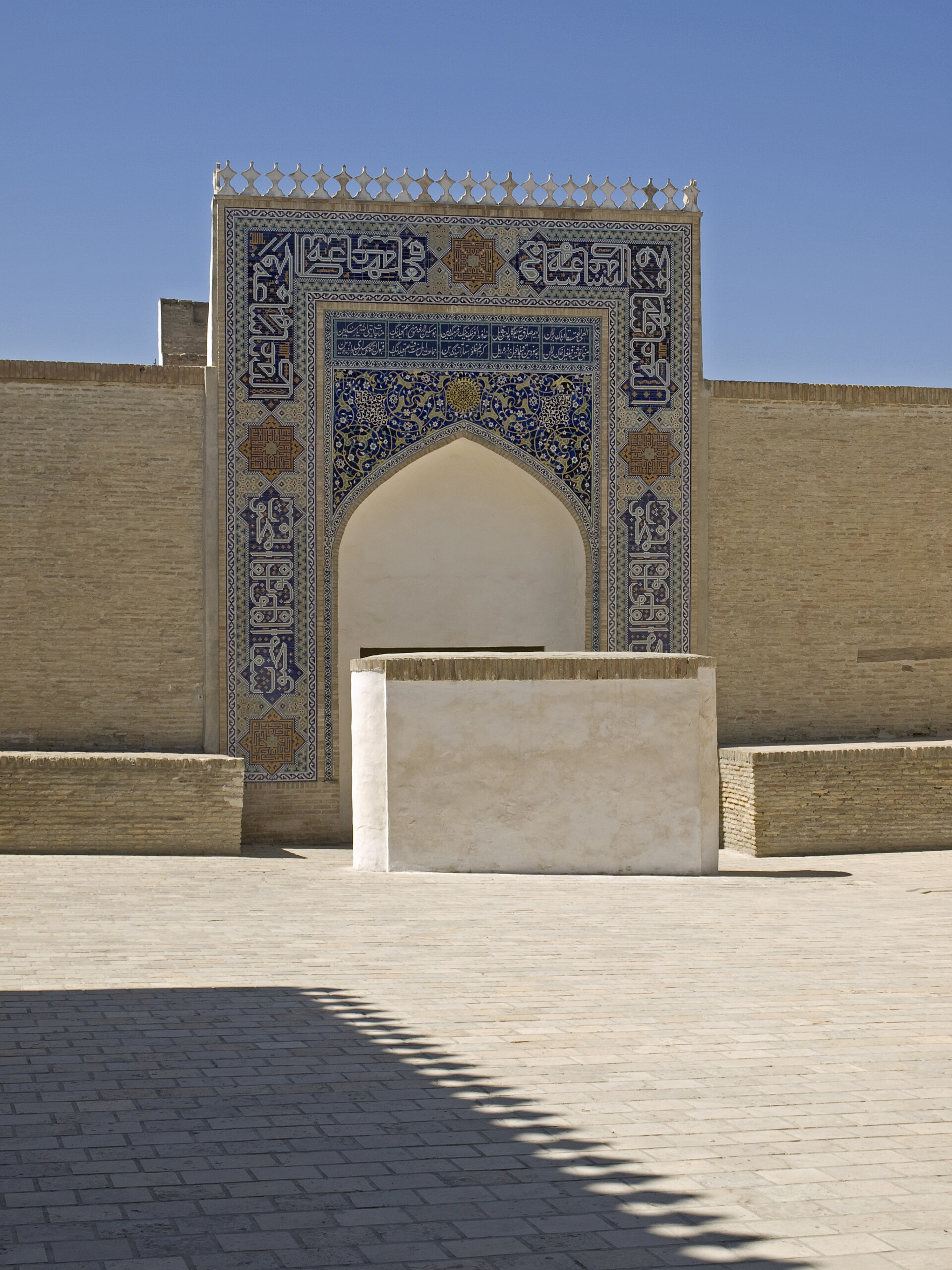
At the heart of the ceremonial Ark lies the coronation court, the open space where the emirs of Bukhara were formally enthroned. Surrounded by a gallery of carved wooden columns, this courtyard was the setting for the single most important ritual of the realm, the moment when a new ruler was raised to power in the sight of his court and clergy.
The enthronement followed old custom. The new emir was seated upon a stone throne, and the great men of the state, the officials, the military commanders, and above all the religious scholars, gathered to acknowledge him. Legitimacy in Bukhara flowed from the endorsement of the learned and the pious as much as from birth or force, and the ceremony bound the two together.
The carved and painted wooden columns that ring the court are fine examples of the Central Asian craft tradition, their capitals worked into stalactite forms and their surfaces once brightly colored. They give the space a lighter, more decorative character than the grim ramparts outside, a reminder that the fortress held beauty as well as strength.
From this court the emir presided as the supreme authority of a state that fused mosque and throne. There was no separation here between the religious and the political; the ruler was the guardian of a holy city, and his coronation in this space was as much a religious act as a civil one, sealing his role as protector of the faith.
Standing in the coronation court today, with the columns casting their shadows across the paving, you are in one of the few parts of the Ark where the ceremonial life of the emirate can still be clearly felt. This was the stage on which power was legitimized, and it remains the symbolic center of the whole citadel.
The stone throne itself deserves attention. Simple and solid, it makes no attempt at the gilded flamboyance of some other courts, and that restraint is telling. Power in Bukhara did not need to shout through gold leaf; it rested on the fortress walls, the loyalty of the clergy, and the fear of the prisons. A plain stone seat within a strong citadel could carry more authority than a jeweled throne in a defenseless hall, and the emirs seem to have understood this well.
The Court Mosque
Within the walls stands the Ark’s own mosque, a place of worship for the ruler and his court that spared them the need to leave the safety of the citadel for their daily prayers. Its presence underlines how completely the fortress was a world unto itself, providing for every need, spiritual as well as material, behind its ramparts.

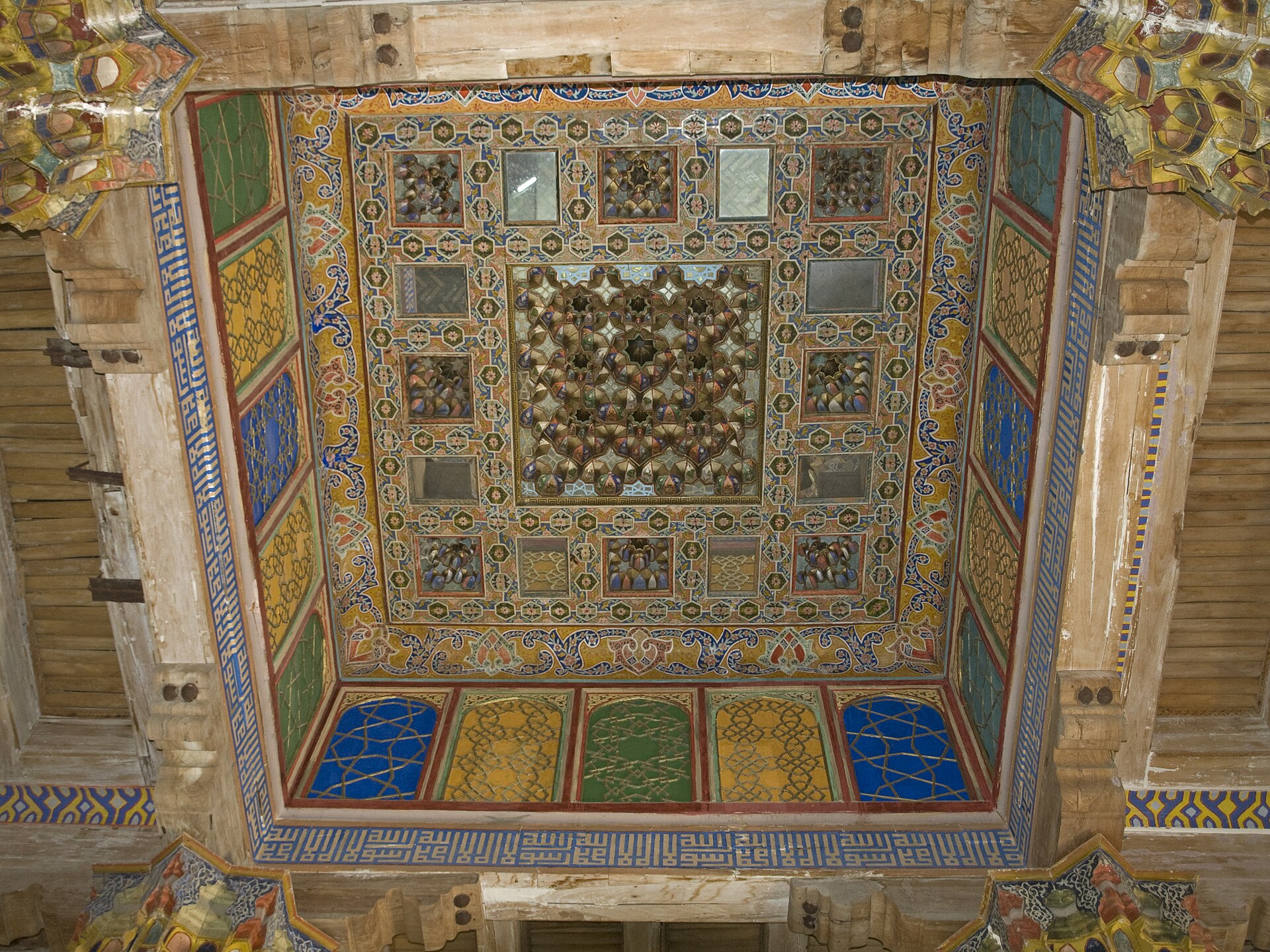
The mosque is a graceful building with a columned portico and a richly worked ceiling, its wooden elements carved and painted in the local manner. After the severity of the walls, the refinement of its craftsmanship comes as a pleasant surprise, the work of artisans who brought the decorative traditions of Bukhara into the ruler’s stronghold.
For a city that regarded itself as one of the holiest in Islam, a fitting court mosque was essential. Bukhara was famous throughout the Muslim world for its scholars, its madrasas, and its piety, and the emir, as the city’s protector, needed a place of prayer that reflected the seriousness with which his realm took its faith.
The ceiling in particular repays a long look upward. Its painted geometric and floral patterns, layered in fine detail, represent the kind of decorative art that Central Asian craftsmen perfected over centuries, turning a flat wooden surface into a shimmering field of ornament without a single depicted living figure, in keeping with tradition.
Today the mosque is among the better-preserved interiors in the Ark and often houses displays drawn from the citadel’s collections. It offers a quiet, shaded contrast to the sunbaked courts outside and a glimpse of the devotional life that ran alongside the hard politics of the fortress.
Halls of Audience and Rule
Beyond the coronation court the emir conducted the business of ruling in halls of audience and reception, where he received officials, heard petitions, and dispensed the justice that was his to give. These were the working spaces of an autocratic state, where a word from the ruler could raise a man up or destroy him.
The emir of Bukhara held near-absolute authority. There was no assembly to check him and little law that stood above his will, and the reception halls were where that concentrated power met the people it governed. Envoys, tax collectors, judges, and supplicants all came before the throne to have their affairs decided.
The court that filled these halls was elaborately ranked and robed. Central Asian court dress was famously splendid, heavy silk and cotton robes in brilliant patterns, and the officials who served the emir wore their status openly. Ceremony and display were tools of rule, meant to impress subjects and foreign visitors alike with the majesty of the throne.
Justice here could be swift and severe. The emirate was notorious among nineteenth-century travelers for the harshness of its punishments, and the same fortress that staged glittering audiences also held grim prisons, a combination that shocked European visitors accustomed to thinking of palaces and dungeons as separate worlds.
The reception halls, then, are where the true nature of the emirate comes into focus. This was a state in which magnificence and menace were two faces of the same power, both radiating from the ruler enthroned within these walls, and the audience chambers were where subjects came to feel the full weight of that power.
The Zindan and the Fortress Jail
No account of the Ark is complete without its prisons, for the citadel was as famous, or infamous, for its jails as for its throne rooms. Cells lay within the gate passage and elsewhere in the fortress, and the emirate’s justice filled them with debtors, criminals, and political prisoners alike.
The most notorious of Bukhara’s prisons in the popular imagination is the so-called bug pit, a deep underground cell where prisoners were held in appalling conditions. Nineteenth-century accounts of it, especially those tied to the fate of British envoys during the Great Game, gave the emirate a fearsome reputation in the West.
Those famous episodes belong to the wider story of Bukhara rather than only to the Ark, but they colored how the whole citadel was seen abroad. To European readers the fortress became a symbol of oriental despotism, a place of cruelty and caprice where a foreign visitor might vanish into a pit on the ruler’s whim.
The reality was that the emirate, like many states of its time and kind, used fear as an instrument of rule, and its prisons were part of that machinery. The Ark concentrated in one fortress the full apparatus of power, ceremonial, religious, administrative, and punitive, so that the same walls that housed the mosque also housed the jail.
For the visitor today, the prison areas and their displays provide a sobering counterweight to the beauty of the coronation court and the mosque. They insist that you see the citadel whole, as a seat of power in every sense, and not merely as a picturesque ruin softened by the passage of time.
The traveler’s tales that spread Bukhara’s fearsome name were not always fair or accurate, shaped as they were by the rivalries of empire and the appetites of a reading public hungry for the exotic and the cruel. Yet they were not pure invention either, and the honest visitor holds both truths at once, recognizing the genuine harshness of the emirate while resisting the temptation to reduce a complex civilization to a single lurid image of the pit.
Household, Treasury, and Daily Life
Behind the public and ceremonial spaces lay the private world of the emir’s household, together with the treasuries, stores, and workshops that kept the fortress running. This was the domestic and economic engine of the citadel, largely hidden from outsiders and reserved for the ruler, his family, and their servants.
The household was large and complex, with the ruler’s family, attendants, guards, and a substantial staff all housed within the walls. Water storage, food stores, kitchens, and stables made the Ark capable of sustaining this population through a siege, a self-reliance that was the whole point of concentrating the court inside a fortress.
The treasury held the wealth of the emirate, the gold, silver, and precious goods gathered through taxation and the caravan trade that flowed through Bukhara. Control of that treasure was control of the state, and it was guarded within the most secure part of the most secure building in the realm.
Workshops within the citadel produced and repaired the goods the court needed, from weapons and horse tackle to textiles and metalwork. The Ark thus contained not only rulers and soldiers but also skilled artisans, whose crafts sustained both the practical life and the visual splendor of the emir’s establishment.
Little of this working world survives intact, but its former presence explains the sheer scale of the citadel. The Ark had to be large because it was not merely a palace but a fortified town, and the vanished quarters that once filled it were as essential to its life as the throne room and the mosque.
A Citadel of Museums
Today much of the surviving Ark has been given over to museums, and the fortress serves as a showcase for the history of Bukhara and its region. The mosque, the reception rooms, and other restored spaces hold collections that trace the long story of the oasis, its rulers, and its crafts.
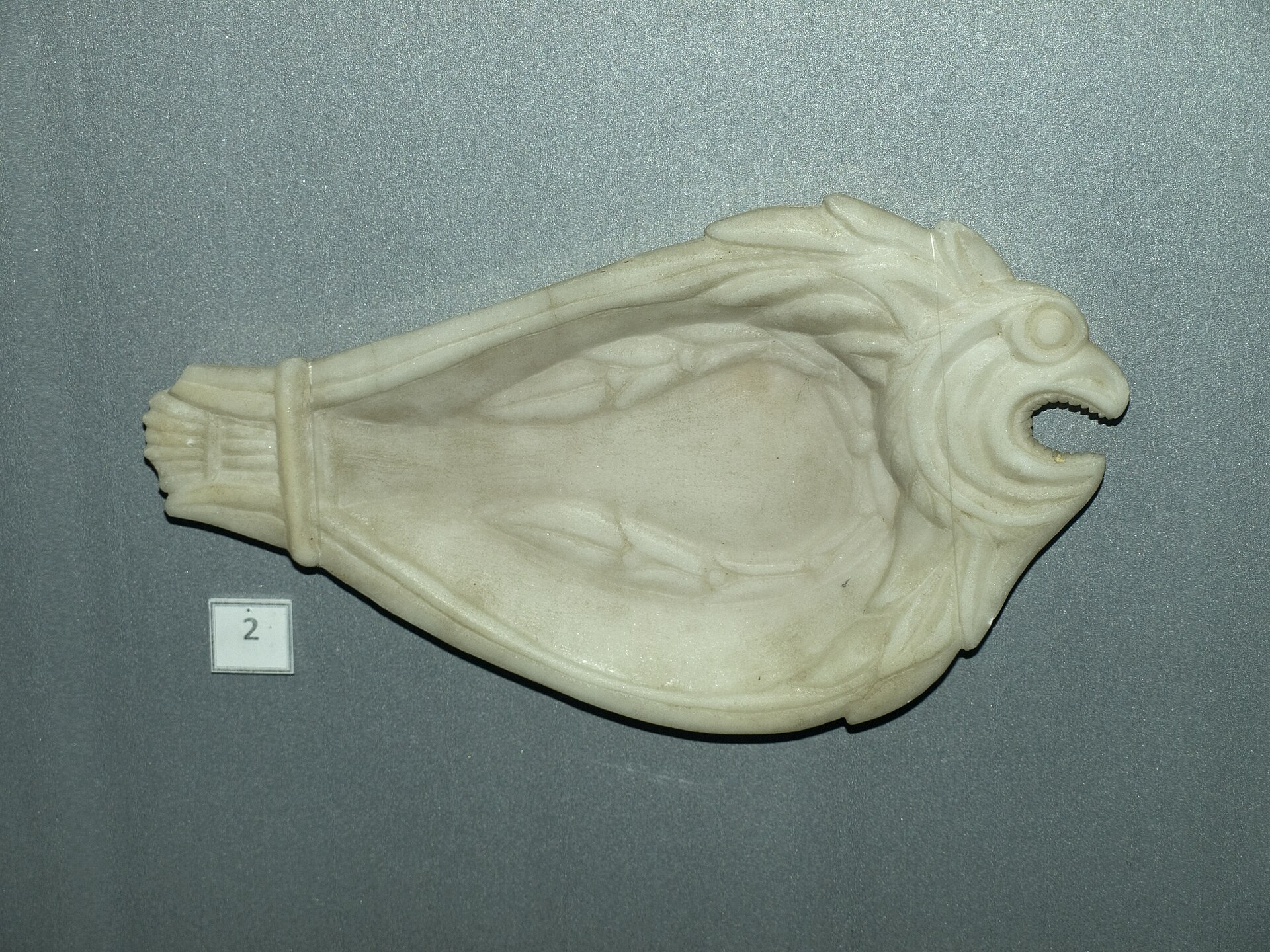
The displays cover a broad sweep, from the archaeology of the ancient city and the deep layers beneath the citadel to the coins, manuscripts, weapons, and robes of the emirate. Together they let a visitor assemble a fuller picture of the world that the Ark once governed than the bare walls alone could give.
Among the more memorable exhibits are those devoted to the daily and ceremonial life of the court, the splendid silk robes, the calligraphy and books that reflect Bukhara’s scholarly fame, and the objects of governance and war. Each helps to flesh out the human reality behind the fortress’s grim exterior.
The archaeological collections are especially valuable because the Ark itself is an archaeological site of the first rank, its mound recording thousands of years of continuous occupation. The finds displayed here connect the visitor to the many vanished citadels that preceded the one now standing.
Turning the fortress into a museum has given it a new purpose in an age with no emirs. The walls that once concentrated power now concentrate memory, and the citadel that ruled the oasis for a thousand years now teaches its history to travelers who climb the same ramp that petitioners once climbed in fear.
The Ark Today: Bukhara’s Enduring Symbol
The Ark’s survival into our time is a story with a violent turn. In 1920, during the upheavals that followed the Russian Revolution, the citadel was bombarded as Soviet forces took Bukhara and overthrew the last emir, who fled into exile. Much of the interior was destroyed in the assault and the fires that followed, which is why so little of the old fortress-town remains inside the walls.
View the exact location on Google Maps
With the fall of the emir, the thousand-year role of the Ark as a seat of rulers came abruptly to an end. The medieval Islamic monarchy that had held on into the twentieth century was gone, and the fortress passed into a new era as a monument, a ruin, and eventually a protected heritage site rather than a living center of power.
Bukhara as a whole is now inscribed on the UNESCO World Heritage List, its historic center recognized as one of the best-preserved medieval cities of Central Asia, and the Ark stands as the great fortress-anchor of that ensemble. Restoration and conservation work continue to stabilize the walls and the surviving buildings.
For modern Uzbekistan the Ark is a powerful national symbol, an emblem of Bukhara’s long importance and of the deep history of the region. Its silhouette appears on countless images of the country, and for many visitors the sight of its ramparts rising over the Registan is the defining image of a journey along the Silk Road.
To climb its ramp today, among travelers from around the world, is to trace the last steps of a very old story. The emirs are gone and their court is dust, but their fortress endures, and standing on its walls with the domes of the holy city spread out below, you understand why whoever wished to rule Bukhara first had to hold the Ark.
Come early, before the tour groups thicken, and you can have stretches of the walls almost to yourself. In that quiet the citadel gives up its atmosphere most freely, the smell of warm earth, the wind moving over the ramparts, the long views across the flat roofs of the old town to the minarets beyond. It is in such moments, rather than in front of any single exhibit, that the Ark most fully becomes what it is, the ancient stone heart of one of the world’s great cities.
Palaces Nearby
The Ark is the first of several great citadels and palaces of Central Asia and its neighbors that we will gather here. More strongholds of the Silk Road and the wider region will join it soon, to trace the varied splendor of the courts that ruled these ancient crossroads.
You May Like
The Palaces of Orchha: A Bundela Capital on the Betwa


2 thoughts on “The Ark of Bukhara: The Fortress Heart of a Silk Road Emirate”