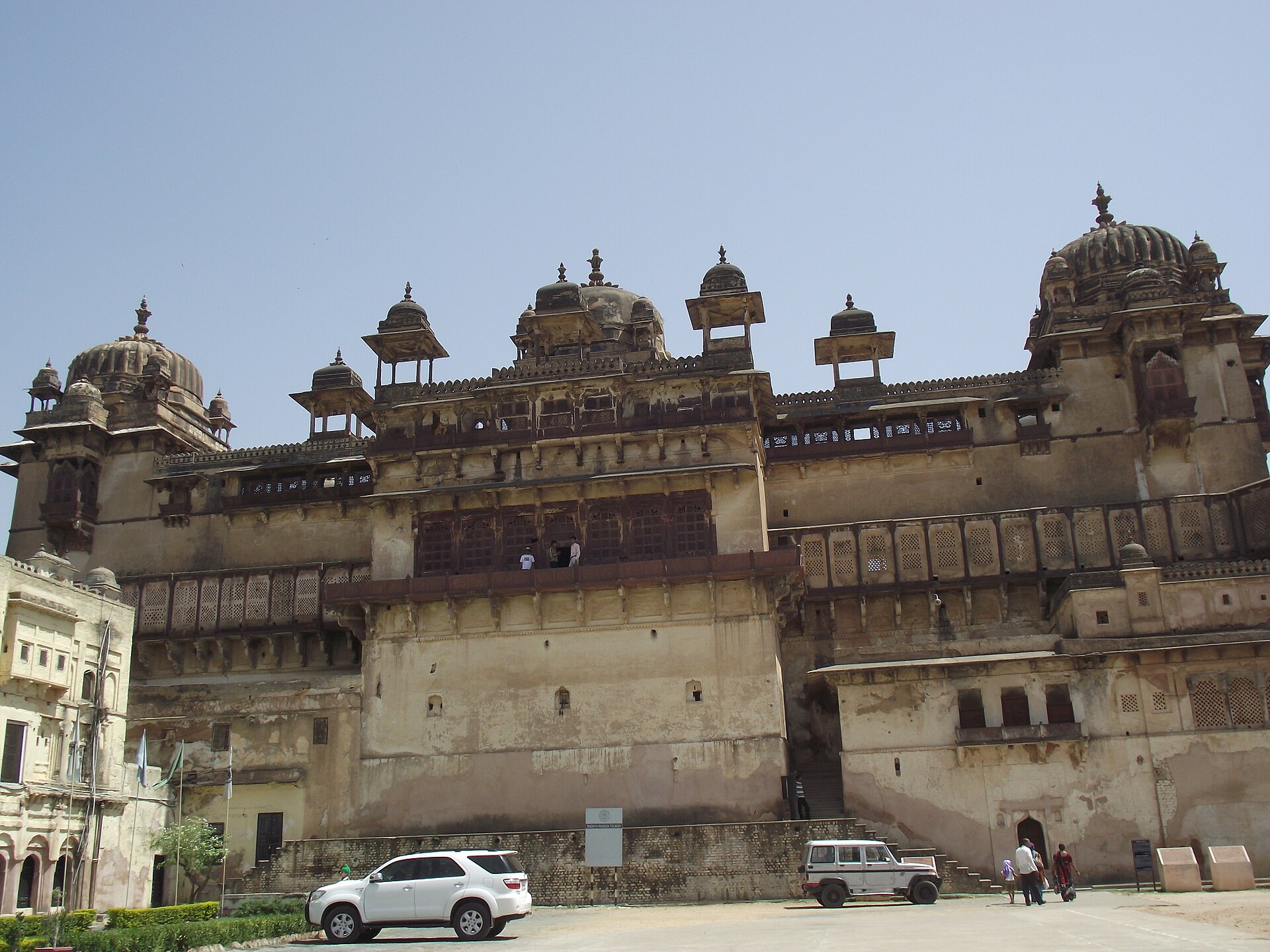
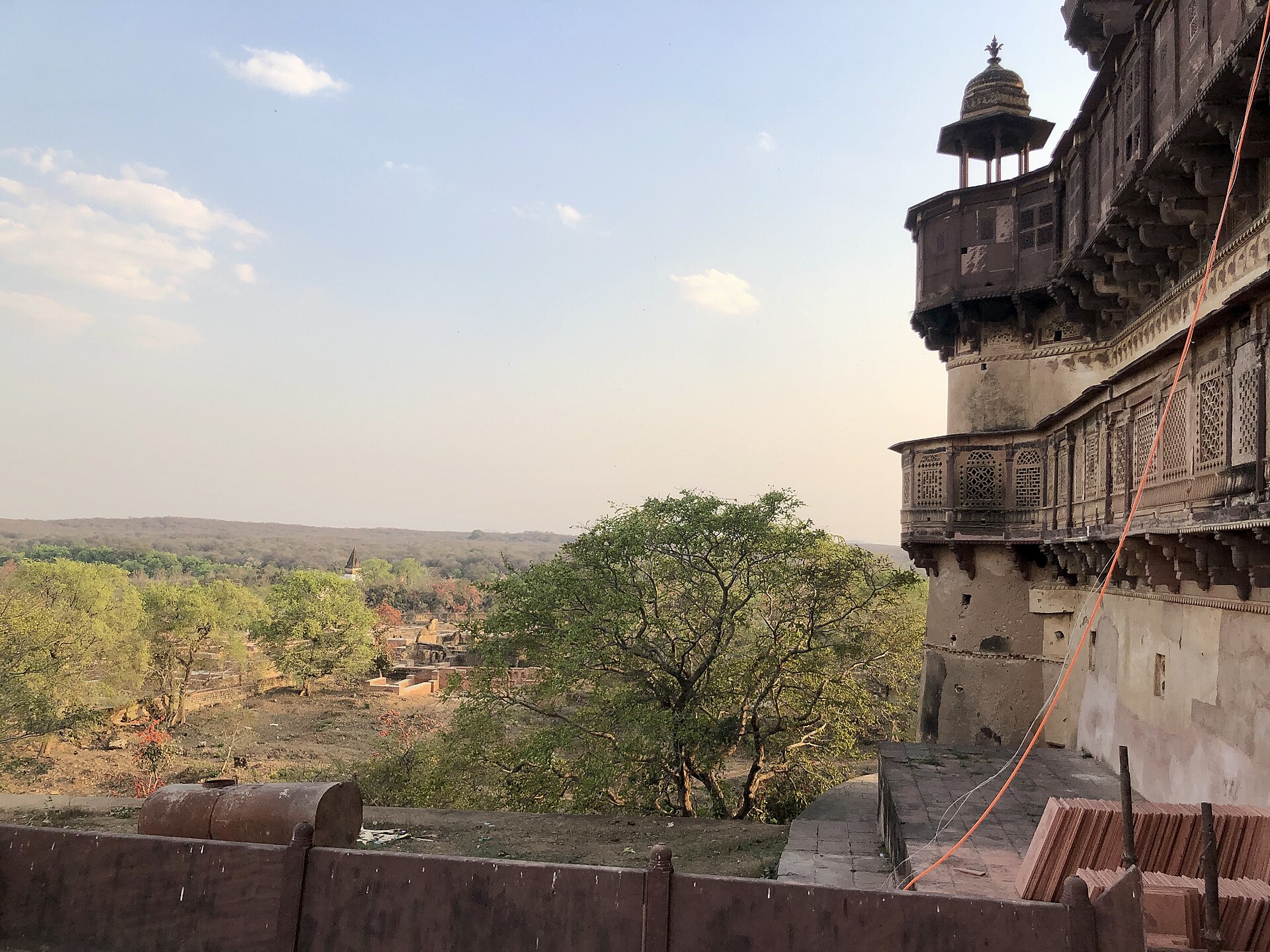
On a rocky island in the Betwa River, in a quiet corner of central India, stands one of the country’s most atmospheric palace complexes, the fort of Orchha. Cross the arched bridge onto the island and you come upon a cluster of great honey-colored buildings, domed and turreted, rising above the river and the plain, their walls once painted with brilliant murals and their courtyards echoing now only with birdsong. Chief among them is the Jahangir Mahal, a palace built for an emperor’s visit, its many-domed silhouette one of the defining images of the region.
Orchha was the capital of the Bundela Rajputs, a warrior dynasty that carved out a kingdom in the region known as Bundelkhand and ruled it for centuries from this river island. In the sixteenth and seventeenth centuries, in the shadow of the mighty Mughal empire, the Bundela kings built here a whole townscape of palaces, temples, and gardens, much of which survives, remarkably intact, as one of the least spoiled medieval capitals in India.
The palaces of Orchha tell a particular story, that of a proud Rajput house navigating its relationship with the Mughal emperors, sometimes in alliance and sometimes in bitter rebellion. The greatest of the palaces, the Jahangir Mahal, was built to honor a Mughal emperor as an honored guest, and it fuses Rajput and Mughal architecture into a harmonious whole that embodies that complex bond in stone.
This is the third of a group of great Indian palaces in this series, joining the hilltop fort of Amer and the painted Man Mandir of Gwalior, and it completes a portrait of the courtly world of central and northern India before the modern age. To wander the palaces of Orchha, half-empty and washed in the golden light of the Betwa valley, is to step into a beautifully preserved fragment of that vanished world.
In This Article
- A Fortress Island on the Betwa
- The Town and the River
- The Bundela Rajputs
- Bir Singh Deo, the Builder King
- Gates, Bridge, and the Citadel
- The Jahangir Mahal
- The Raj Mahal and Its Murals
- Courtyards, Galleries, and Screens
- The Painted World of Bundela Art
- The Rai Praveen Mahal
- Temples of the Devout Kingdom
- The Cenotaphs on the River
- Orchha Today: A Preserved Capital
A Fortress Island on the Betwa
The heart of Orchha is a fortified complex set on an island in the Betwa River, reached by an old arched bridge that carries the visitor across the water to the palaces. This island setting gave the capital natural protection and a striking beauty, the great buildings rising directly from the rock above the flowing river.
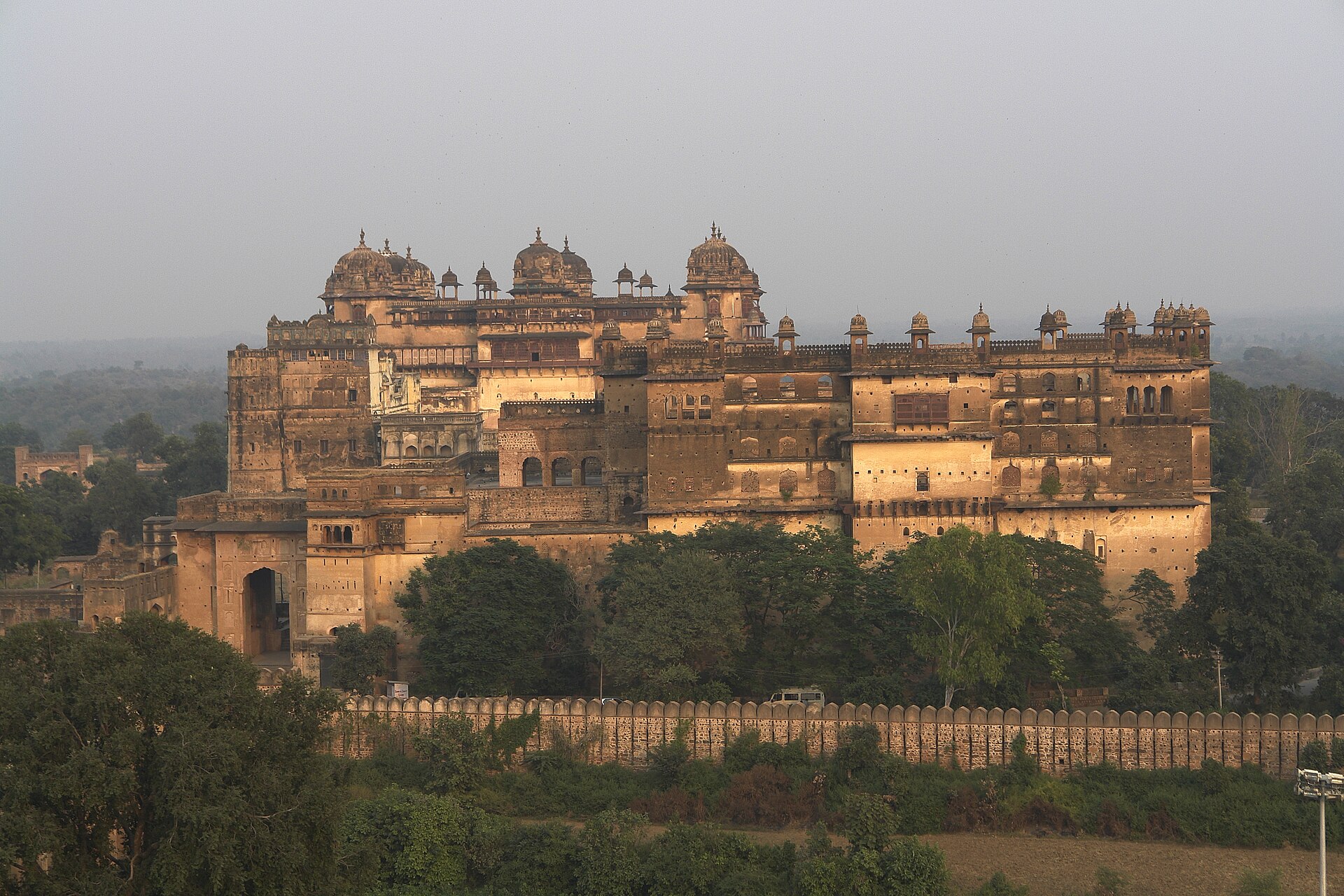
Within the walled complex stand several palaces built over successive reigns, chief among them the Raj Mahal and the Jahangir Mahal, along with gardens, gateways, and lesser structures. Together they form not a single palace but a royal citadel, the accumulated seat of a dynasty, spread across the island in a loose and picturesque grouping.
The buildings are constructed of the warm local sandstone, and their architecture blends the muscular strength of a fortress with the refinement of a palace. Domes, chhatris, or pillared kiosks, turrets, and screened balconies crowd their skylines, giving Orchha a romantic, almost fairy-tale profile against the sky of central India.
What distinguishes Orchha above all is its state of preservation. Because the Bundela capital was later moved and the town declined into a quiet backwater, its monuments escaped much of the redevelopment and destruction that overtook busier places, and they survive today in extraordinary completeness, a whole medieval capital frozen in time.
To arrive across the bridge and enter the citadel is to step into that preserved world. The palaces stand much as they were left, their courtyards silent, their painted halls dim, their views over the river unchanged, offering the visitor one of the most evocative encounters with the past that India has to offer.
Among the Indian palaces gathered in this series, Orchha stands out for how much of its whole world survives. Amer keeps its halls but has lost its living town; Gwalior’s Man Mandir stands amid a crowded fort. Orchha alone preserves the entire ensemble, palaces, temples, gardens, gates, and riverside tombs, in something close to its original setting, which is why walking here feels less like visiting a monument than like entering a whole vanished capital.
The Town and the River
Orchha is not only a fortress but a whole historic town, and beyond the palace island the visitor finds a landscape crowded with monuments, temples, gardens, and, along the river, a haunting row of royal cenotaphs. The Bundela kings built here on a grand scale, and their works are spread across the town and the banks of the Betwa.
The Betwa River is central to the character of the place. It curls around the fortress island and flows past the town, its waters and wooded banks giving Orchha a serene, pastoral beauty. Along its edge stand the great domed cenotaphs of the Bundela rulers, reflected in the river, one of the most beautiful sights in central India.
The name Orchha is said to mean a hidden or secluded place, and the town has kept something of that quality into the present day. Off the main tourist routes for much of its modern history, it retains the atmosphere of a small, quiet place living among the monuments of a much grander past, its scale intimate and its pace slow.
The setting shaped the town’s history as well as its beauty. The river and the rocky ground offered defense, while the surrounding region of Bundelkhand, a land of hills, forests, and rivers, gave the Bundela kingdom its distinctive character, remote enough to preserve its independence yet close enough to be drawn into the affairs of the Mughal empire.
Today Orchha is celebrated for the completeness of its historic townscape, and its monuments have been recognized for their outstanding value. To explore the town beyond the palaces, wandering among temples and gardens and along the river to the cenotaphs, is to experience the full ambition of the Bundela kings and the world they built on the Betwa.
The Bundela Rajputs
The palaces of Orchha are the work of the Bundela dynasty, a Rajput line that ruled the region of Bundelkhand, to which they gave their name, from the medieval period into modern times. Warriors and patrons, the Bundela kings built Orchha as their capital in the sixteenth century and made it a center of their power and culture.
Bundelkhand, the land of the Bundelas, is a region of central India with a strong and distinctive identity, and its rulers were known for their martial spirit and their fierce attachment to independence. From their island capital the Bundela kings governed a kingdom that rose to considerable importance among the states of the region.
The great question that shaped Bundela history, as it shaped the history of the other Rajput houses, was how to deal with the overwhelming power of the Mughal empire to the north. At times the Bundelas allied with the Mughals and served them loyally; at other times they rose in fierce rebellion, and their relations with the empire swung between the two extremes.
This turbulent relationship left its mark on Orchha. The greatest of the palaces was built to honor a Mughal emperor, a monument to alliance, while the history of the dynasty is also filled with revolts, wars, and the shifting fortunes of a proud house caught between submission and defiance in the shadow of a mightier power.
Under the Bundelas, Orchha became a center not only of power but of art and religion, its kings patronizing architecture, painting, and the worship that filled the town with temples. The dynasty’s cultural achievement, preserved in the monuments of their capital, is their most enduring legacy, outlasting the kingdom itself by centuries.
The swing between alliance and rebellion was not mere fickleness but the predicament of every middling power living beside a giant. Submit too fully and a dynasty lost its honor and independence; resist too openly and it risked destruction. The Bundelas, like the Kachhwahas of Amer and the other Rajput houses, spent generations navigating that narrow path, and the monuments of Orchha are the physical record of the wealth and confidence that the right accommodation could bring.
Bir Singh Deo, the Builder King
The most celebrated builder of the Bundela dynasty was Raja Bir Singh Deo, who ruled in the early seventeenth century and to whom many of the greatest monuments of Orchha and Bundelkhand are attributed. A prolific patron of architecture, he transformed his capital and his kingdom with a great campaign of building.
Bir Singh’s rise was bound up with his friendship with the Mughal prince Salim, who became the emperor Jahangir. That alliance, forged when the prince was in rebellion against his own father, brought Bir Singh great favor once his friend ascended the imperial throne, and with it the wealth and security that made his building program possible.
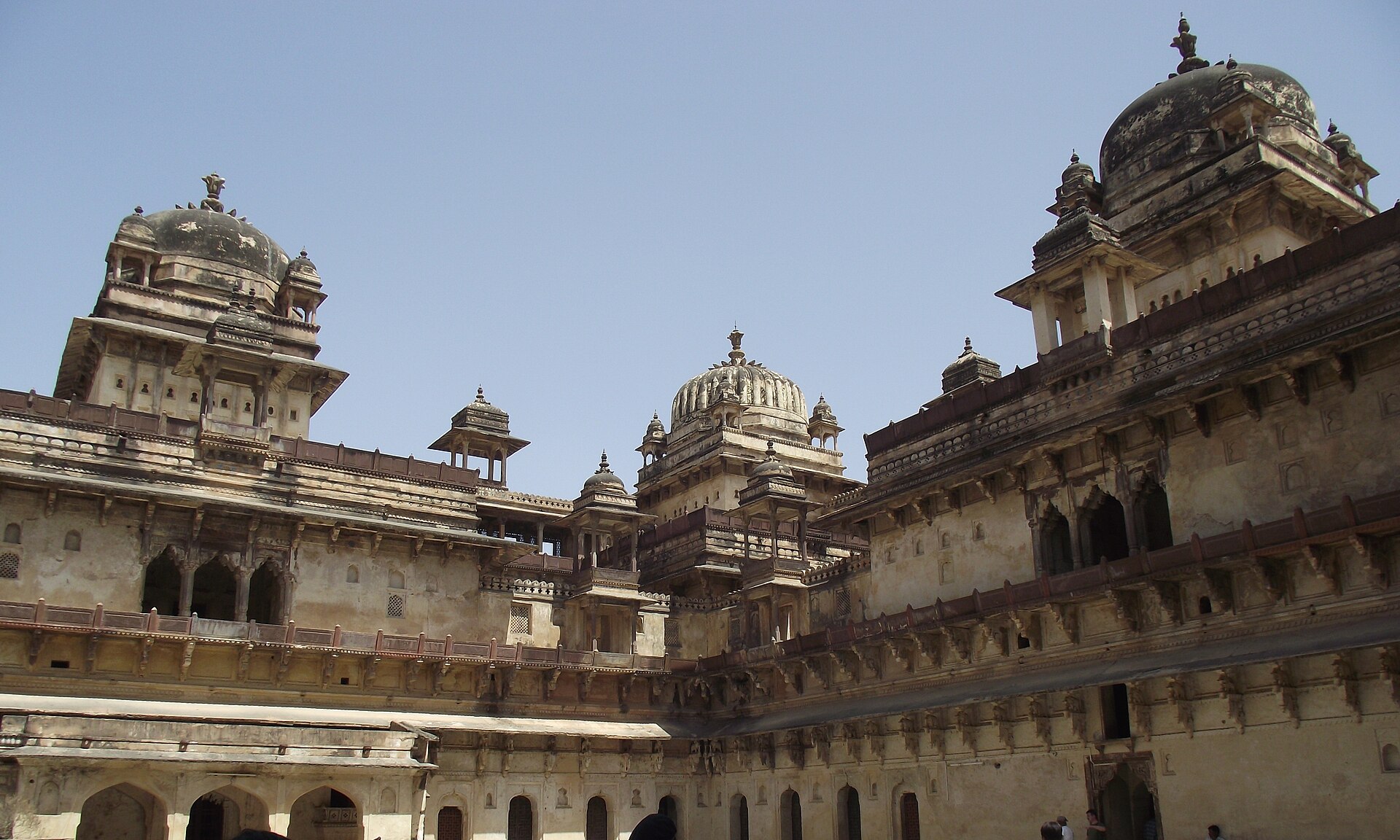
In gratitude and honor, Bir Singh built the Jahangir Mahal, the grandest of the Orchha palaces, to receive the emperor as an honored guest. The palace stands as a monument to that royal friendship, a Rajput king’s tribute to a Mughal emperor, and its very existence tells the story of the alliance at the heart of Bir Singh’s reign.
Beyond the palace, Bir Singh is credited with a vast number of works across his kingdom, temples, forts, gardens, and other buildings, that made his reign a golden age of Bundela architecture. The scale of his patronage reshaped the landscape of Bundelkhand and left an artistic legacy of the first importance.
In Bir Singh Deo, Orchha found its great creative king, the ruler whose ambition and whose imperial connections gave the capital its finest monuments. His works, above all the Jahangir Mahal, define the image of Orchha that has come down to the present, and his reign remains the high point of the Bundela story.
The friendship that made Bir Singh’s fortune had a dark side that history does not hide. To please the rebel prince Salim, Bir Singh is said to have ambushed and killed one of the emperor Akbar’s most trusted advisers, an act that made him a hunted man until his friend came to the throne. The splendor of Orchha thus rests, in part, on a bloody bargain, a reminder that the beauty of such places often grew from the hard and violent politics of their age.
Gates, Bridge, and the Citadel
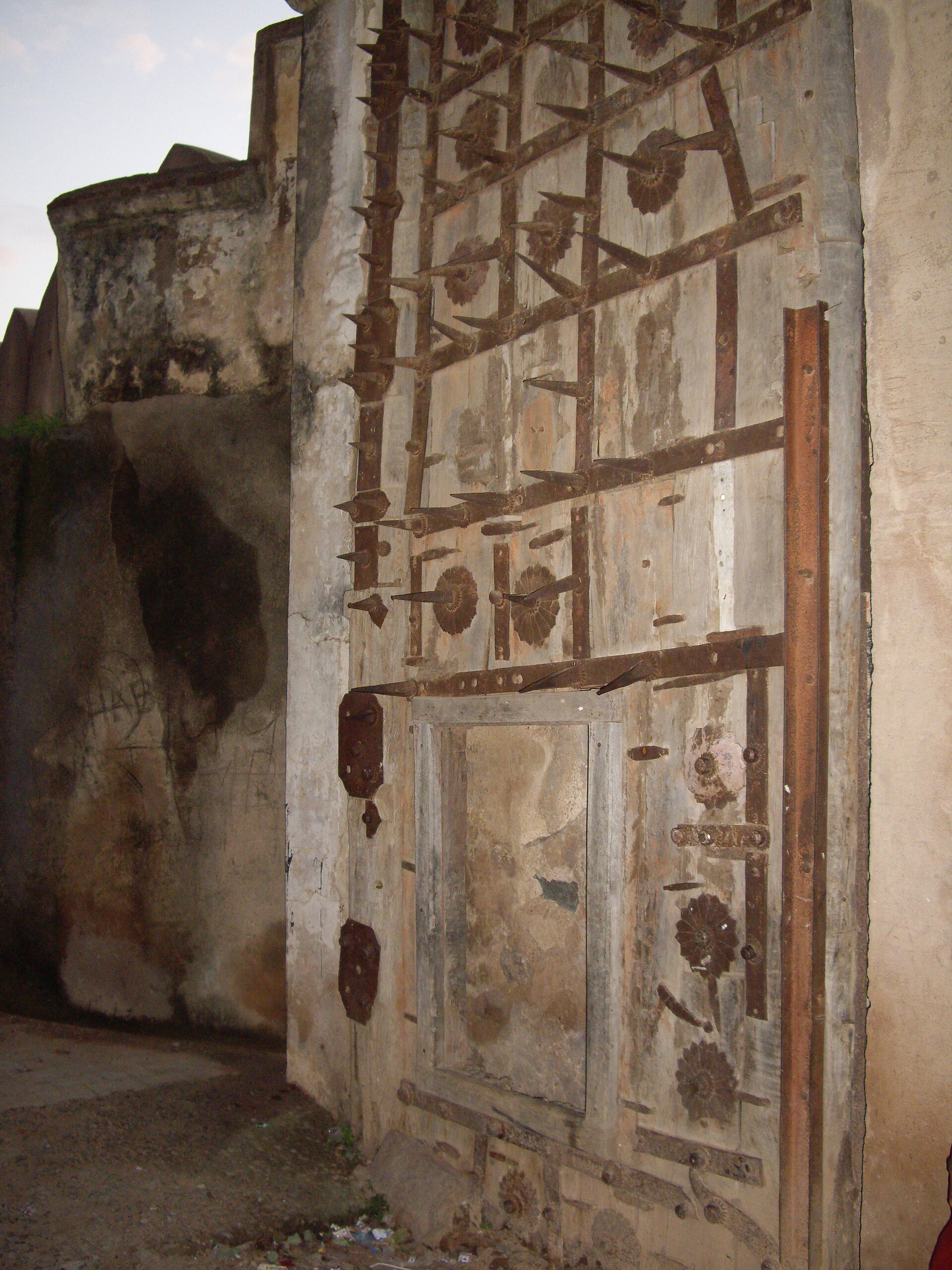
The palace complex of Orchha is approached across an old arched bridge that carries the visitor over the Betwa onto the fortified island, and entered through great gateways that guard the citadel. The bridge and gates form a dignified processional approach, staging the arrival at the royal seat much as at the hill forts of the region.
The citadel is enclosed by walls and entered through monumental gates, high enough to admit elephants and strong enough for defense, their scale announcing the power of the Bundela kings. Passing through them, the visitor leaves the ordinary world of the town and enters the enclosed precinct of the palaces.
Within the walls, besides the great palaces, stand lesser structures that served the life of the court, among them a building traditionally identified with the housing of camels and other quarters for the practical needs of the royal establishment. The citadel was a working seat of government as well as a stage for grandeur.
The layout of the citadel, with its palaces grouped within the walls and its gates controlling access, follows the logic of the fortified capitals of the region, combining defense with display. The island setting added a further layer of protection, the river itself serving as a moat around the royal heart of the kingdom.
To cross the bridge and pass through the gates into the citadel is to enter Orchha as its builders intended, arriving at a fortified island crowned with palaces. The approach, over the water and beneath the great gateways, remains one of the pleasures of a visit, framing the first sight of the domed palaces within.
The Jahangir Mahal
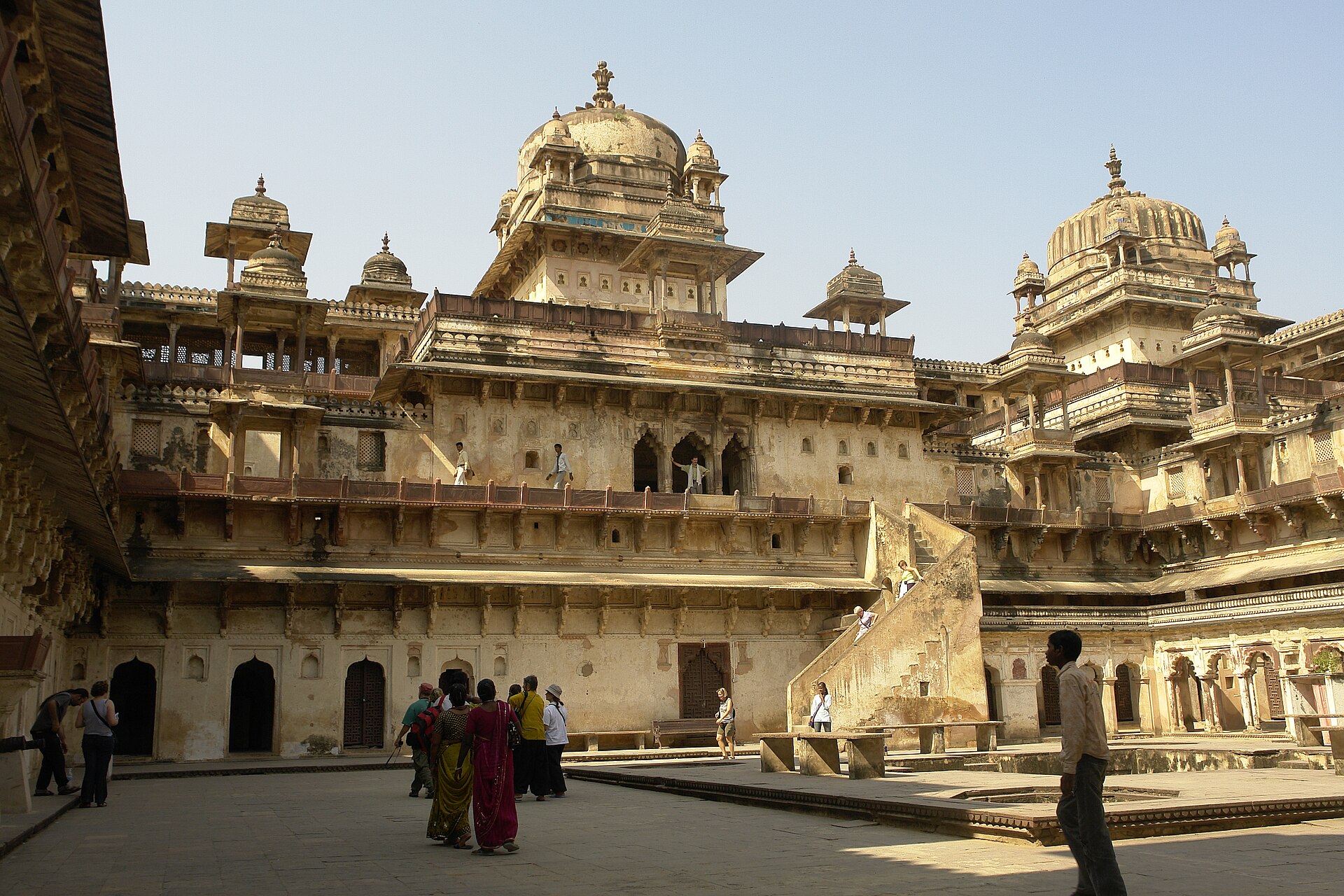
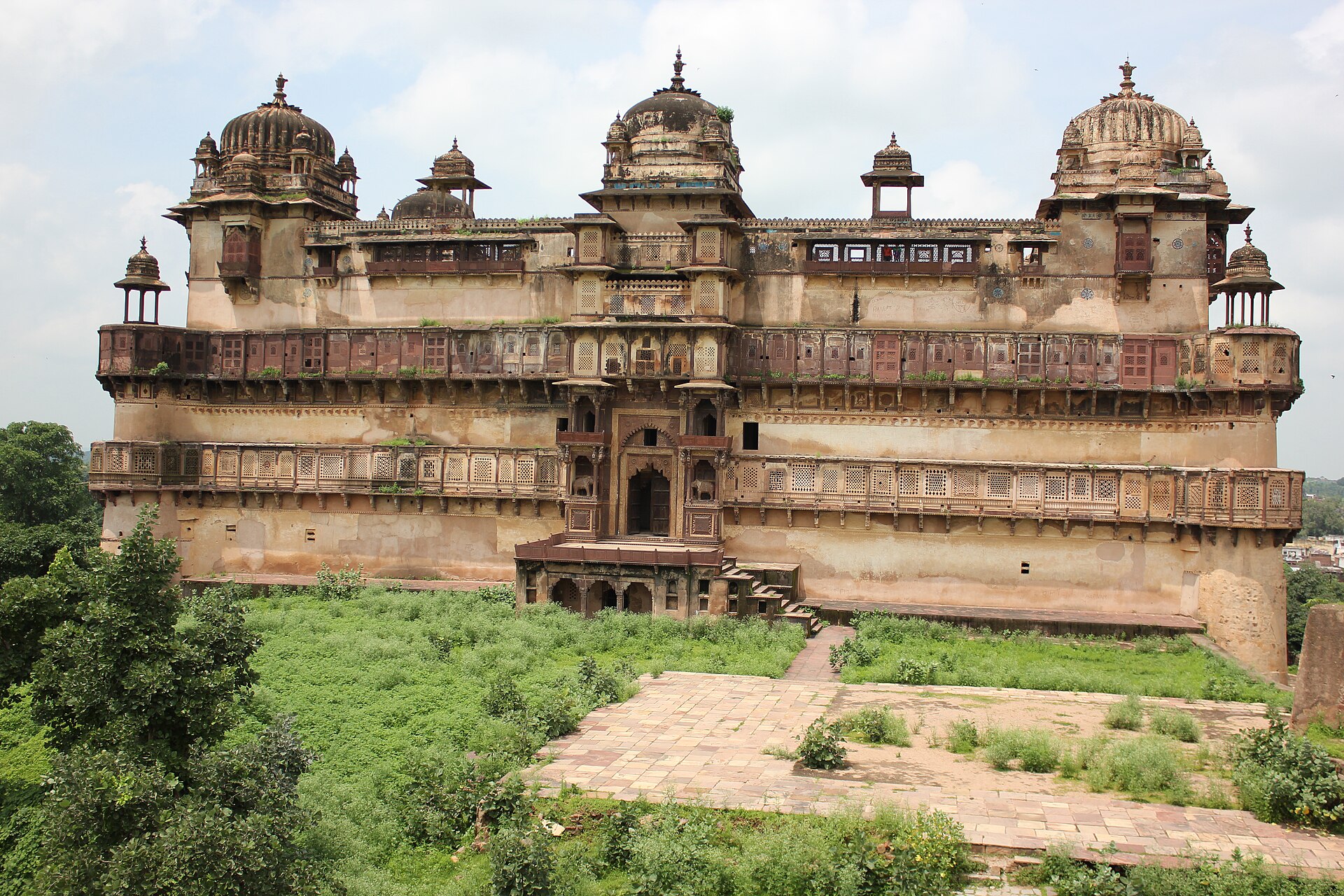
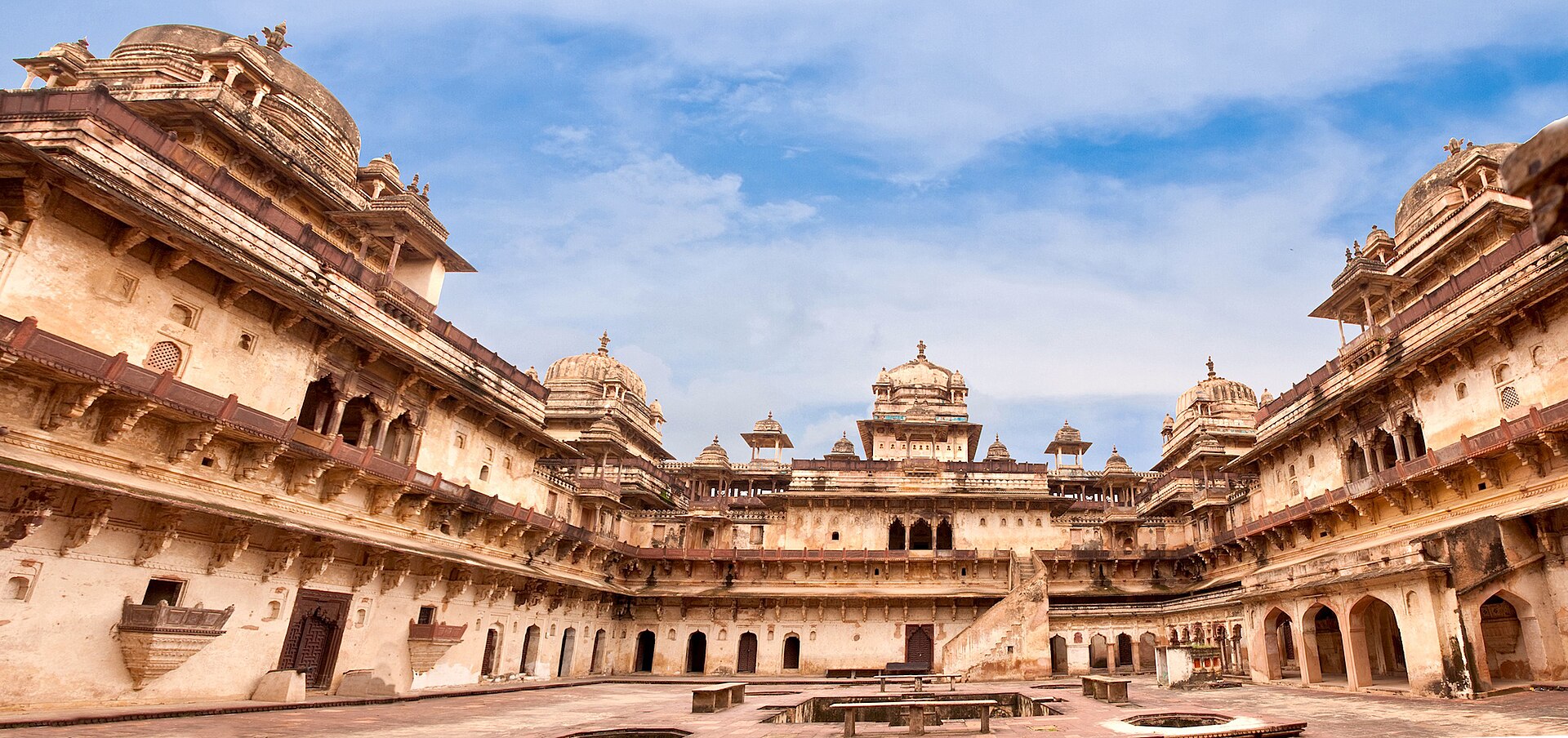
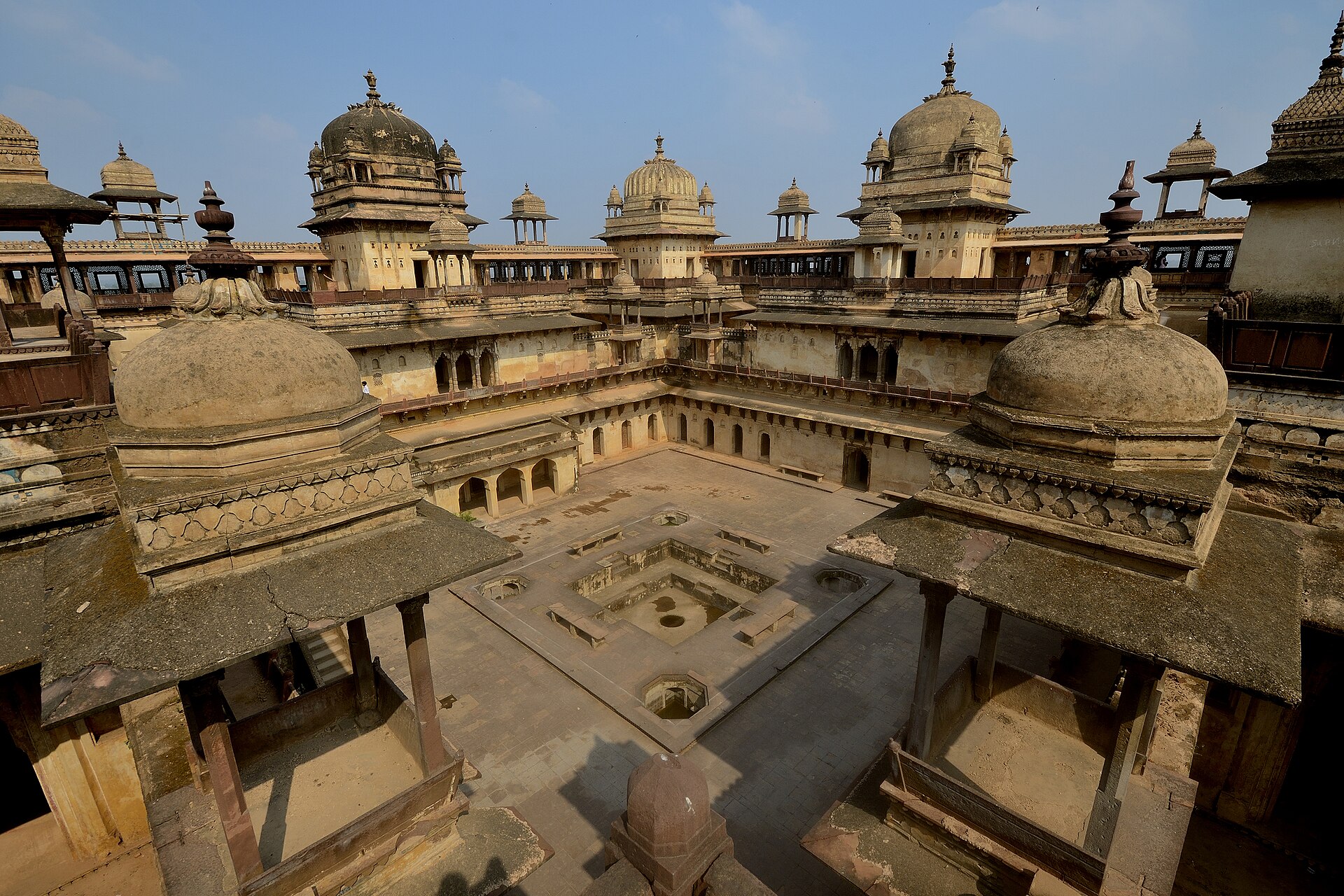
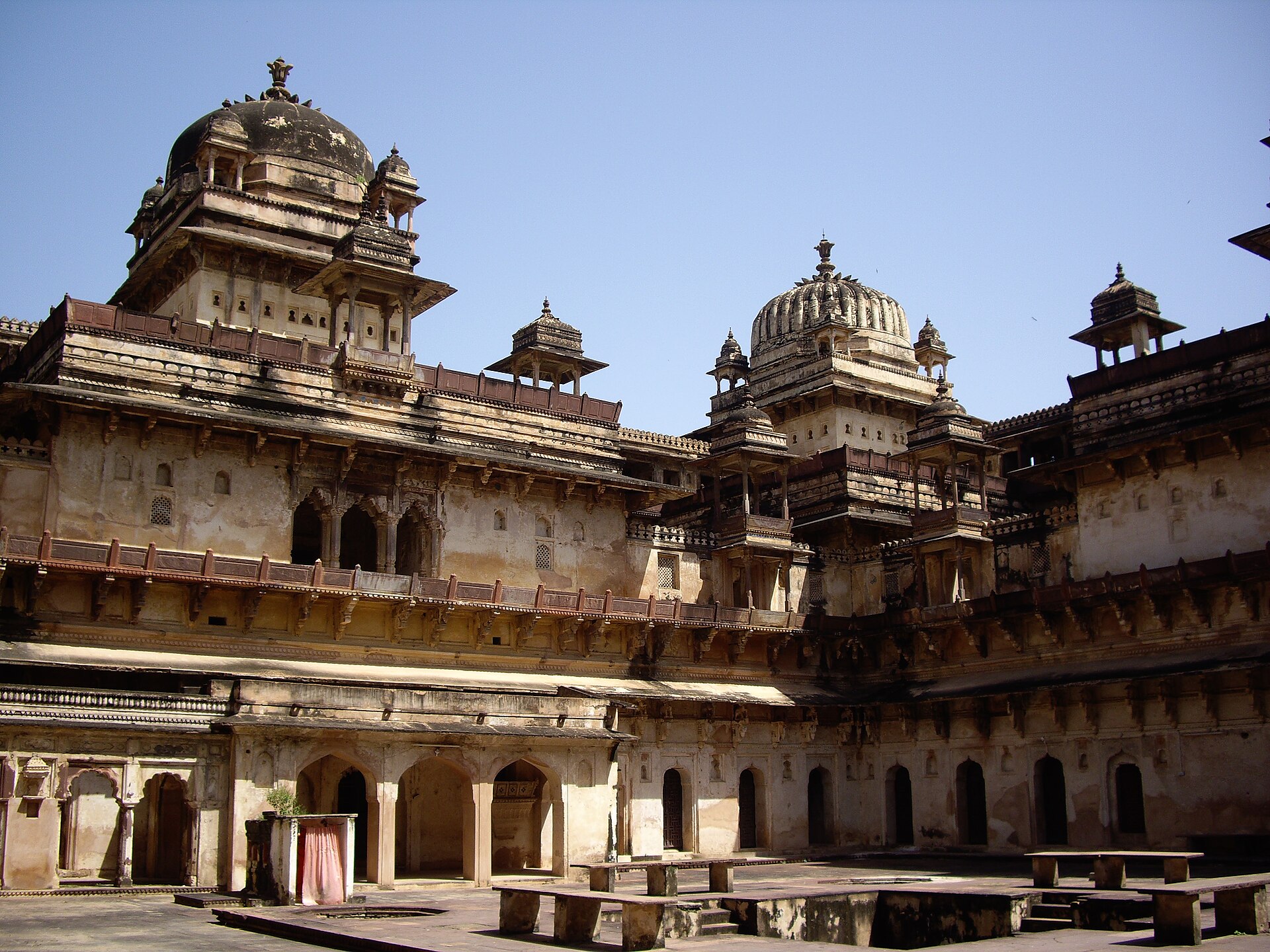
The Jahangir Mahal is the masterpiece of Orchha, a great square palace built around a central courtyard and crowned with a profusion of domes and chhatris that give it one of the most memorable silhouettes in India. Raised by Bir Singh Deo to honor the emperor Jahangir, it fuses Rajput and Mughal architecture into a single harmonious design.
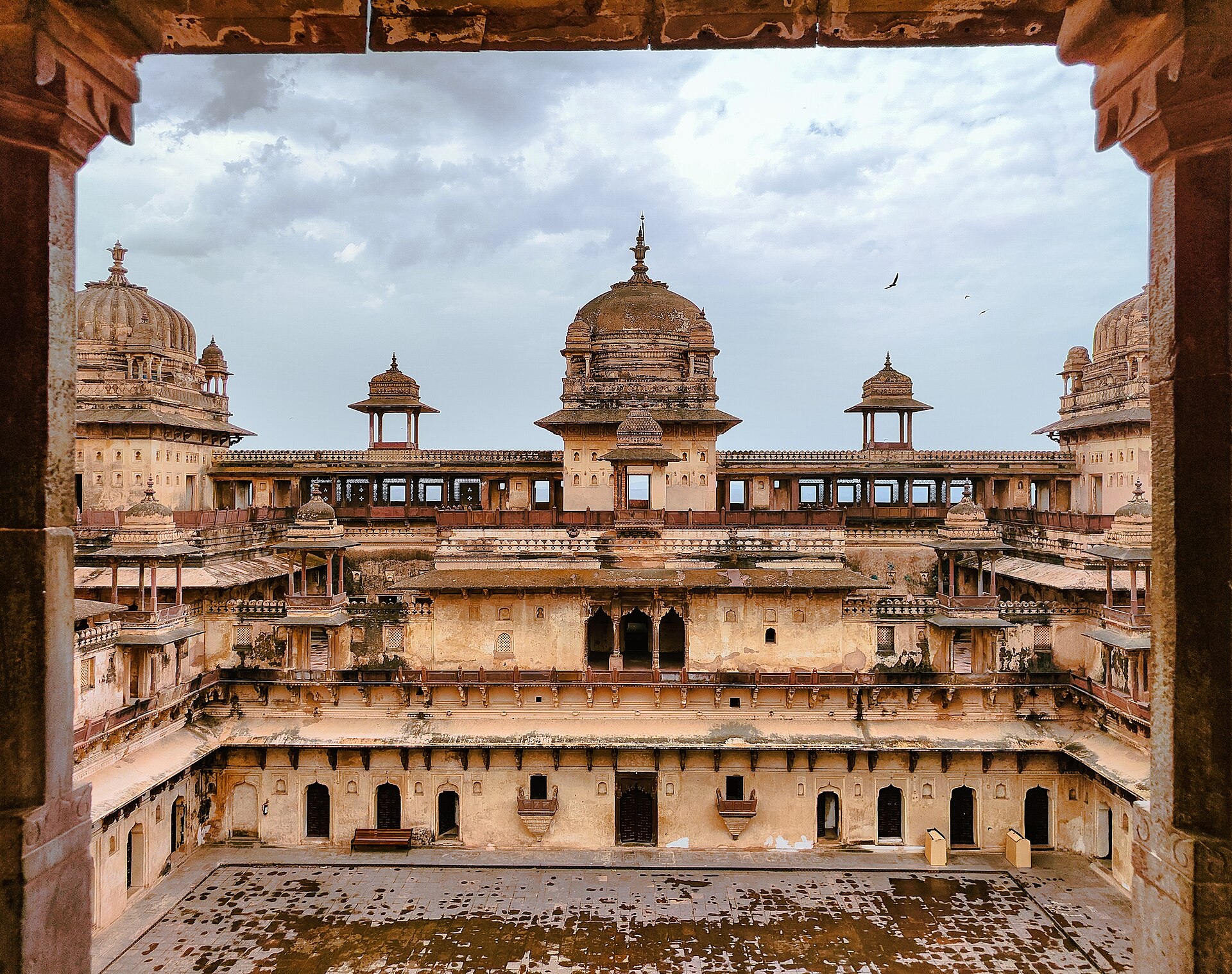
The palace is built on a symmetrical plan, its rooms and galleries rising through several storeys around the central court, with screened balconies, hanging galleries, and pavilions layered up its facades. The many domes that crown it, rising in a rhythmic cluster, are its signature, and they lend the massive building a lightness and grace.
The blending of styles is the palace’s great theme. Rajput elements, the chhatris, the bracketed balconies, the ornament, meet Mughal features of proportion and arrangement, so that the building embodies in stone the cultural meeting of the two traditions, just as it was built to honor the bond between a Rajput king and a Mughal emperor.
Tradition holds that the palace was built specifically to house Jahangir during a visit, and though the emperor is said to have stayed only briefly, the monument raised for him endures as the grandest expression of Bundela architecture. It was a gesture of honor on a royal scale, a whole palace built as an act of hospitality and gratitude.
From the upper galleries of the Jahangir Mahal the views open over the river, the town, and the plains beyond, and the play of light through its screens and across its courtyards is one of the delights of a visit. The palace is the heart of Orchha, the building that draws visitors and the enduring symbol of the Bundela capital.
There is a gentle irony in the palace’s origin worth savoring. A Rajput king built this vast and beautiful monument to house a Mughal emperor who, by most accounts, barely stayed in it, so that the grandest building in Orchha was raised for a guest who came and went. Yet the gesture outlasted the visit by four centuries, and the palace built as an act of courtesy became the enduring emblem of the Bundela capital.
The Raj Mahal and Its Murals
Older than the Jahangir Mahal, and standing beside it within the citadel, is the Raj Mahal, the original royal palace of Orchha, begun in the sixteenth century by earlier Bundela kings. Less flamboyant on the outside than its famous neighbor, it holds a treasure that the Jahangir Mahal lacks, a series of vivid wall paintings.
The Raj Mahal was the principal residence of the Bundela rulers before the building of the Jahangir Mahal, and its halls and chambers, arranged around courtyards, served the domestic and ceremonial life of the court. Its plainer exterior conceals interiors rich in the painted decoration that is one of the glories of Orchha.
The murals that cover the walls and ceilings of the Raj Mahal are among the finest surviving examples of Bundela painting. Executed in brilliant colors, they depict religious subjects, scenes from the great Hindu epics, and images of courtly and everyday life, filling the rooms with a vivid pictorial world.
These paintings are a precious record of the art and beliefs of the Bundela court. Their religious scenes reflect the deep devotion of the dynasty, especially to the god Rama, while their courtly images give a glimpse of the life, dress, and pastimes of the rulers and their household, preserved in color on the palace walls.
To move from the domed grandeur of the Jahangir Mahal to the painted halls of the Raj Mahal is to see two complementary faces of Orchha, the one architectural and the other pictorial. Together they show the full artistic achievement of the Bundela kings, masters of building and of painting alike, whose capital was a treasury of both.
It is worth seeking out a local guide or caretaker to point out the finest of the murals, for the light in the painted chambers is dim and the best scenes are easily missed. Once your eye adjusts and you begin to read the crowded walls, a whole world opens up, gods and kings, battles and festivals, painted with a directness and energy that five centuries have not dimmed, and the plain-faced Raj Mahal reveals itself as the richest interior in Orchha.
Courtyards, Galleries, and Screens
The interiors of the Orchha palaces unfold through courtyards ringed by galleries and screened balconies, a layered architecture that gave the court both grandeur and privacy. Moving through them, the visitor passes from open sunlit courts into shaded halls and up narrow stairs to high galleries with sweeping views.

The central courtyard of the Jahangir Mahal is the organizing heart of the palace, onto which the surrounding storeys open in tier upon tier of arches and balconies. This vertical, inward-facing arrangement created a sheltered world within the massive walls, cool and ordered, at the center of the great domed building.
Screened windows and hanging balconies, worked in stone, allowed light and air to enter while giving privacy to those within, and permitted the women of the court to observe the life of the palace unseen. This interplay of openness and seclusion, common to the palaces of the region, shaped the whole design of the buildings.
The galleries and terraces of the upper storeys were places to catch the breeze and the views, and from them the whole setting of Orchha, river, town, temples, and plain, spreads out before the visitor. The palaces were designed to command their landscape, and their high vantage points were part of the pleasure of royal life here.
Wandering these courts and galleries today, often nearly alone, is one of the great pleasures of Orchha. The play of light and shadow, the succession of framed views, and the sense of a vast building given over to silence make the exploration of the palaces a uniquely atmospheric experience among the monuments of India.
The Painted World of Bundela Art
The murals of Orchha, preserved above all in the Raj Mahal and in the town’s temples, represent a distinctive school of Indian painting, the Bundela style, which flourished under the patronage of the dynasty. Rich in color and lively in detail, these wall paintings are among the finest of their kind in central India.
The subjects of the murals range widely. Religious themes predominate, with scenes from the epics of Rama and Krishna and images of the gods rendered in glowing color, reflecting the intense devotion of the Bundela court. Alongside these appear courtly scenes, processions, hunts, and images of daily life that document the world of the kingdom.
The style is marked by bold color, flat decorative patterning, and a vivid narrative energy, filling walls and ceilings with crowded, animated compositions. The painters covered large surfaces with these scenes, turning the halls of the palaces and the interiors of the temples into immersive pictorial environments.
These murals are a precious historical source as well as works of art. In their depictions of dress, ornament, weapons, music, and ceremony, they preserve a detailed record of Bundela court life, allowing the modern visitor to reconstruct the texture of a world that has otherwise vanished, seen through the eyes of its own artists.
The survival of so much painting at Orchha, in a climate and over a span that has erased murals in many other places, is part of what makes the site so valuable. To stand in a painted hall of the Raj Mahal, surrounded by the bright, crowded scenes of the Bundela imagination, is to enter the visual world of the dynasty directly.
Because these paintings were made to cover architecture rather than to hang in frames, they have a scale and an immersive quality that easel painting cannot match. To stand in a painted chamber is to be surrounded on every side and overhead by the imagined world of the Bundela court, its gods and battles and festivals wrapping around you, an experience closer to entering a story than to viewing a picture.
The Rai Praveen Mahal
Near the fort stands a smaller and more intimate palace, the Rai Praveen Mahal, associated with one of the most romantic legends of Orchha. It is said to have been built for Rai Praveen, a celebrated poetess and musician, the beloved of a Bundela king, and it stands amid a garden as a monument to her memory.
The story holds that Rai Praveen was a woman of extraordinary beauty and talent, a gifted poet and singer whose fame reached the Mughal court. According to legend, the emperor summoned her to Delhi, but so moved was he by her devotion to her Bundela lord that he sent her back, and the palace and garden commemorate this celebrated tale.
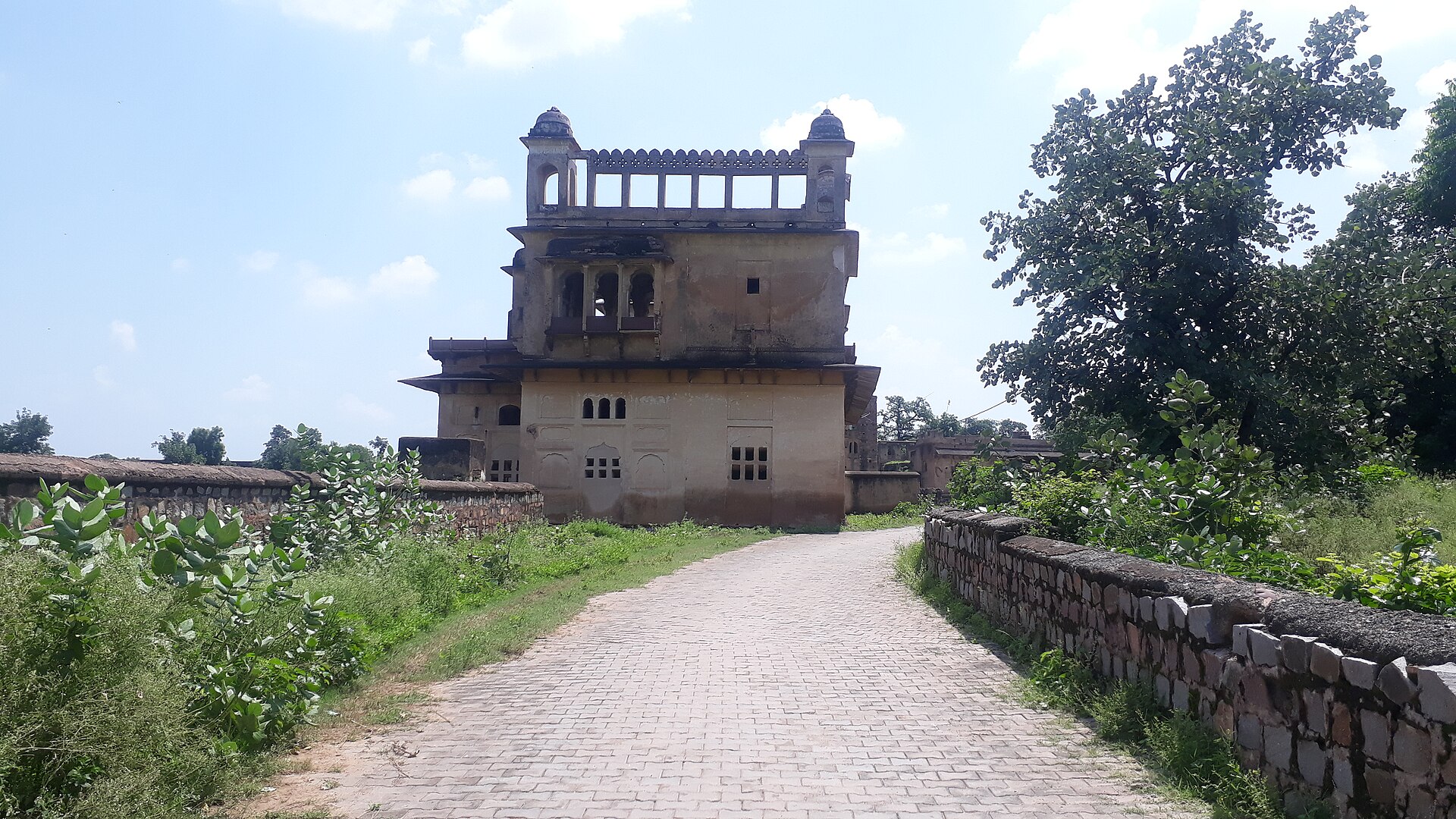
The building itself is modest in scale compared with the great palaces of the fort, a low structure of a few storeys set within a formal garden, designed for pleasure and repose rather than for grandeur. Its intimacy suits its associations, a private world of art and love rather than a stage for royal power.
Around the palace lies the garden known as the Anand Mahal, laid out with the geometric order of the Indian garden tradition, its beds and water features creating a green setting for the pavilion. Together the palace and garden form a designed landscape devoted to the arts and pleasures of the court.
Whatever the exact truth behind the legend of Rai Praveen, the palace that bears her name adds a note of romance and refinement to the monuments of Orchha. It reminds the visitor that the Bundela court valued poetry and music as well as arms and architecture, and it preserves the memory of one of the most celebrated artists of its age.
Temples of the Devout Kingdom
Orchha is as famous for its temples as for its palaces, for the Bundela kings were deeply devout, above all in their worship of the god Rama, and they filled their capital with great religious buildings. The most beloved of these is the Ram Raja Temple, unique in India as a place where Rama is worshipped as a king.
The story of the Ram Raja Temple is one of the treasures of Orchha’s lore. According to tradition, a queen brought an image of Rama to the town intending to install it in a grand new temple, but the image, once set down in the palace, could not be moved, and so the palace itself became the temple where Rama reigns as king.
The great temple built to receive the image, the soaring Chaturbhuj Temple, stands instead as a magnificent empty shrine, its lofty tower rising above the town. Its architecture, blending temple, fort, and palace forms, is among the most striking in central India, and its height dominates the skyline of Orchha.
These temples reflect the intense religious life of the Bundela kingdom, in which devotion to Rama was bound up with the identity and legitimacy of the dynasty. The kings were not only warriors and builders but patrons of a fervent devotional culture, and their temples were as central to their capital as their palaces.
For the visitor, the temples complete the picture of Orchha as a whole sacred and royal townscape. The Ram Raja Temple remains a living place of worship, drawing pilgrims to the town, so that amid the silent palaces and cenotaphs the religious heart of the Bundela capital still beats, as it has for centuries.
The Cenotaphs on the River
Along the bank of the Betwa River, a short walk from the palaces, stands one of the most beautiful sights of Orchha, a row of great domed cenotaphs, or chhatris, raised in memory of the Bundela rulers. Reflected in the still water of the river, these tall, elegant monuments form an unforgettable ensemble.
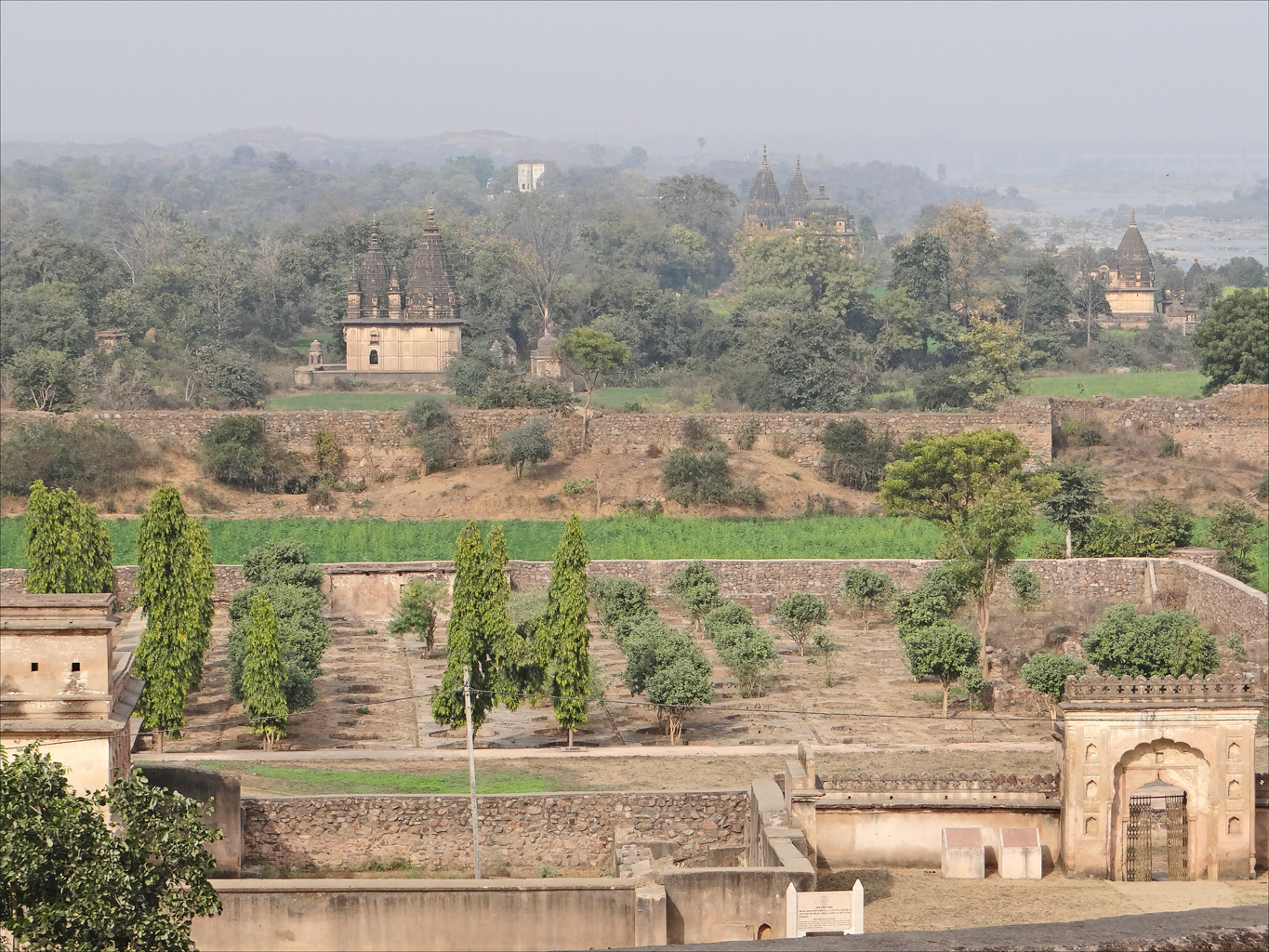
The chhatris are memorials rather than tombs in the strict sense, cenotaphs honoring the memory of the kings, built in the form of towering domed pavilions on high platforms. Their soaring silhouettes, crowned with the curved domes of the region, rise dramatically above the river and the surrounding greenery.
Grouped together on the riverbank, the cenotaphs form a kind of royal necropolis, a gathering of the memorials of the dynasty in a single serene setting. The choice of the riverside for these monuments reflects the sacred associations of flowing water in Indian tradition and the desire to honor the dead in a place of beauty.
Seen at sunrise or sunset, when the low light gilds their domes and the river holds their reflection, the chhatris of Orchha are among the most photographed and admired sights in central India. They have become, along with the Jahangir Mahal, one of the defining images of the town and its Bundela past.
The cenotaphs complete the monumental landscape of Orchha, adding to the palaces and temples a memorial to the kings who built them. Standing among them on the riverbank, with the domes rising against the sky and the Betwa flowing past, the visitor feels the full romance and melancholy of this beautifully preserved capital of a vanished kingdom.
There is a particular magic to the chhatris at the blue hour, just after the sun has gone, when their domes hold the last light and the river turns to pewter below them. Birds wheel around the high finials, the town falls quiet, and the memorials of the Bundela kings stand reflected in the water as they have for centuries. It is the image most visitors carry away from Orchha, and it distills the town’s blend of grandeur, serenity, and gentle melancholy.
Orchha Today: A Preserved Capital
In the seventeenth century the Bundela capital was eventually moved from Orchha, and the town gradually declined from a royal seat into a quiet provincial place. Yet this very decline preserved it, for spared the pressures of a growing city, Orchha kept its monuments and its atmosphere largely intact into the modern age.
View the exact location on Google Maps
Today the palaces, temples, and cenotaphs of Orchha are protected monuments and a major heritage destination, celebrated for the completeness of their preservation. The town offers the visitor a rare experience, a whole medieval Indian capital surviving as an ensemble, rather than a single monument isolated amid modern development.
The outstanding value of the site has been recognized internationally, and Orchha has been placed on the tentative list of sites proposed for World Heritage status, a step toward the fuller recognition its monuments deserve. Its combination of architecture, painting, and setting makes it one of the treasures of central India.
For modern travelers Orchha has become increasingly known as one of the most rewarding and atmospheric destinations in the region, its palaces, temples, and riverside cenotaphs drawing those who seek the beauty of a preserved past away from the busier tourist circuits. Its quiet charm is its great attraction.
To stand in the courtyard of the Jahangir Mahal, or on the riverbank among the cenotaphs at evening, is to feel the enduring spell of Orchha. The Bundela kingdom is long gone, its power a memory, but the capital its kings built on the Betwa endures, one of the loveliest and best-preserved royal landscapes in all of India.
Come, if you can, in the soft light of early morning or late afternoon, and give Orchha a full unhurried day. Wander from the palaces to the temples and out along the river to the cenotaphs, and let the quiet of the place work on you. Few sites in India reward slow, aimless exploration as richly, and few leave so strong an impression of having stepped, for a few hours, entirely out of the modern world.
Palaces Nearby
Orchha completes a trio of great palaces from the heart of India. Travel on to the hilltop fort of the Kachhwaha Rajputs near Jaipur, or to the painted palace of a musical king on the rock of Gwalior, to continue the journey through the courtly world of the subcontinent.
You May Like
The Man Mandir of Gwalior: The Painted Palace of a Musical King


One thought on “The Palaces of Orchha: A Bundela Capital on the Betwa”