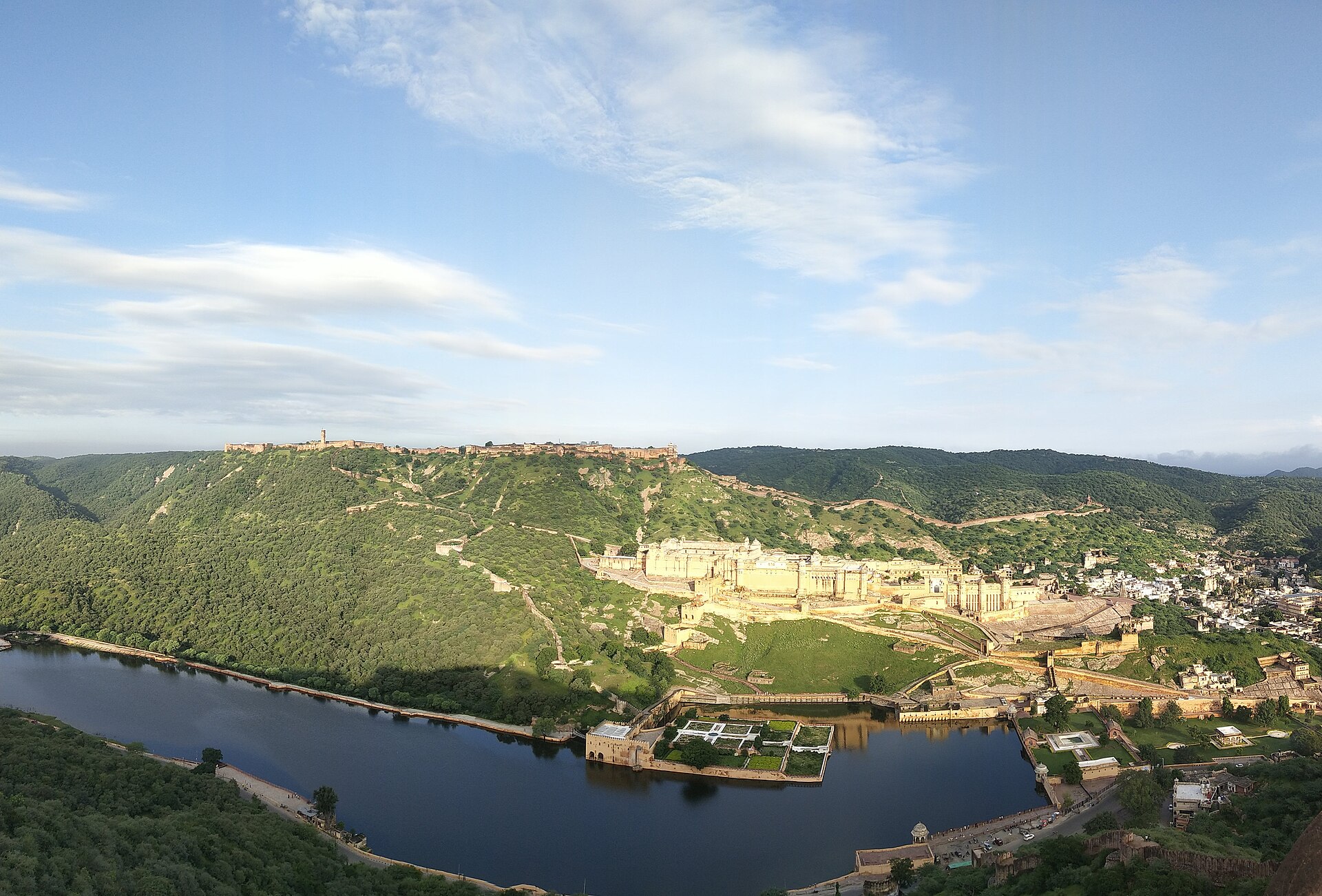
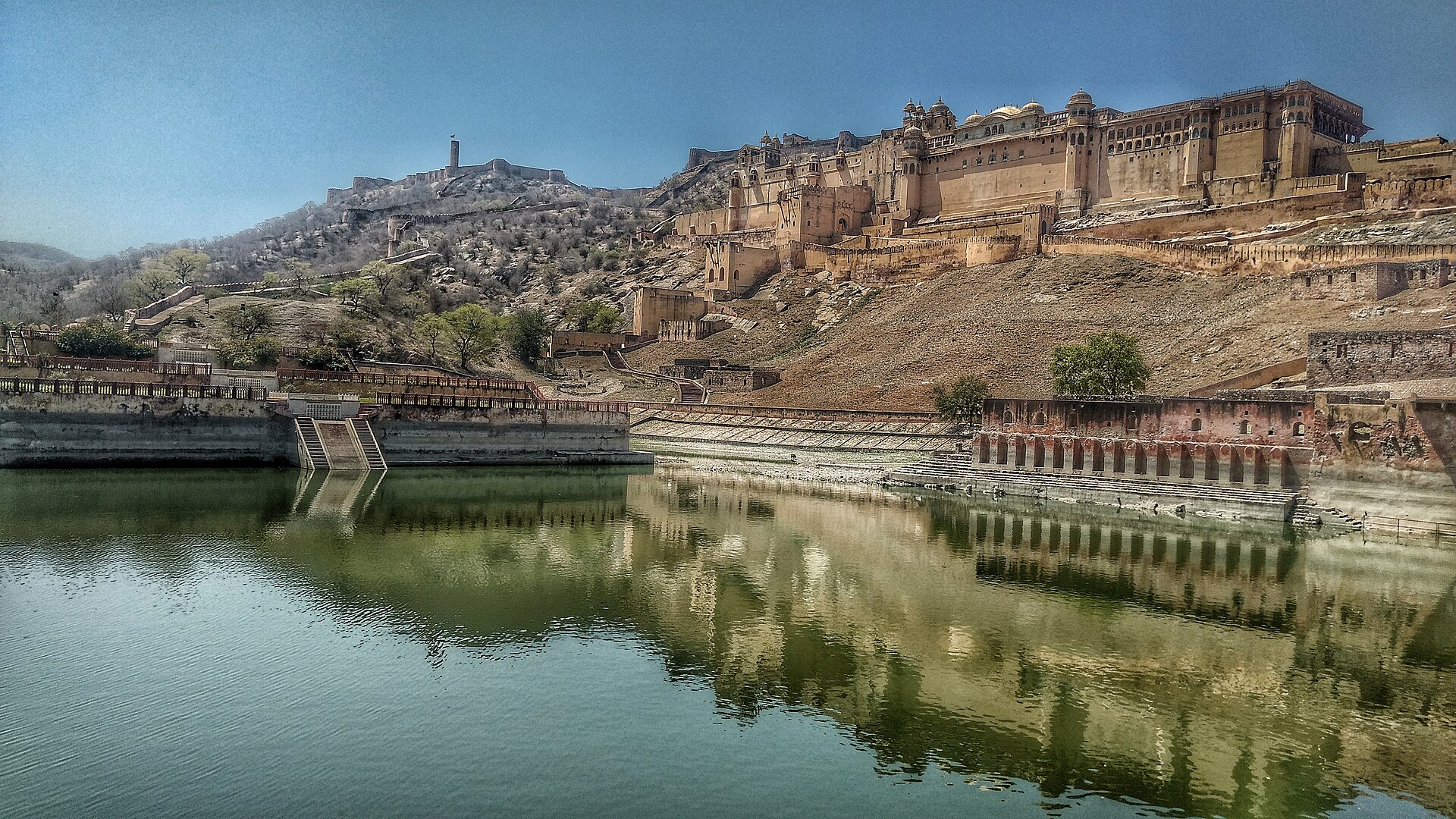
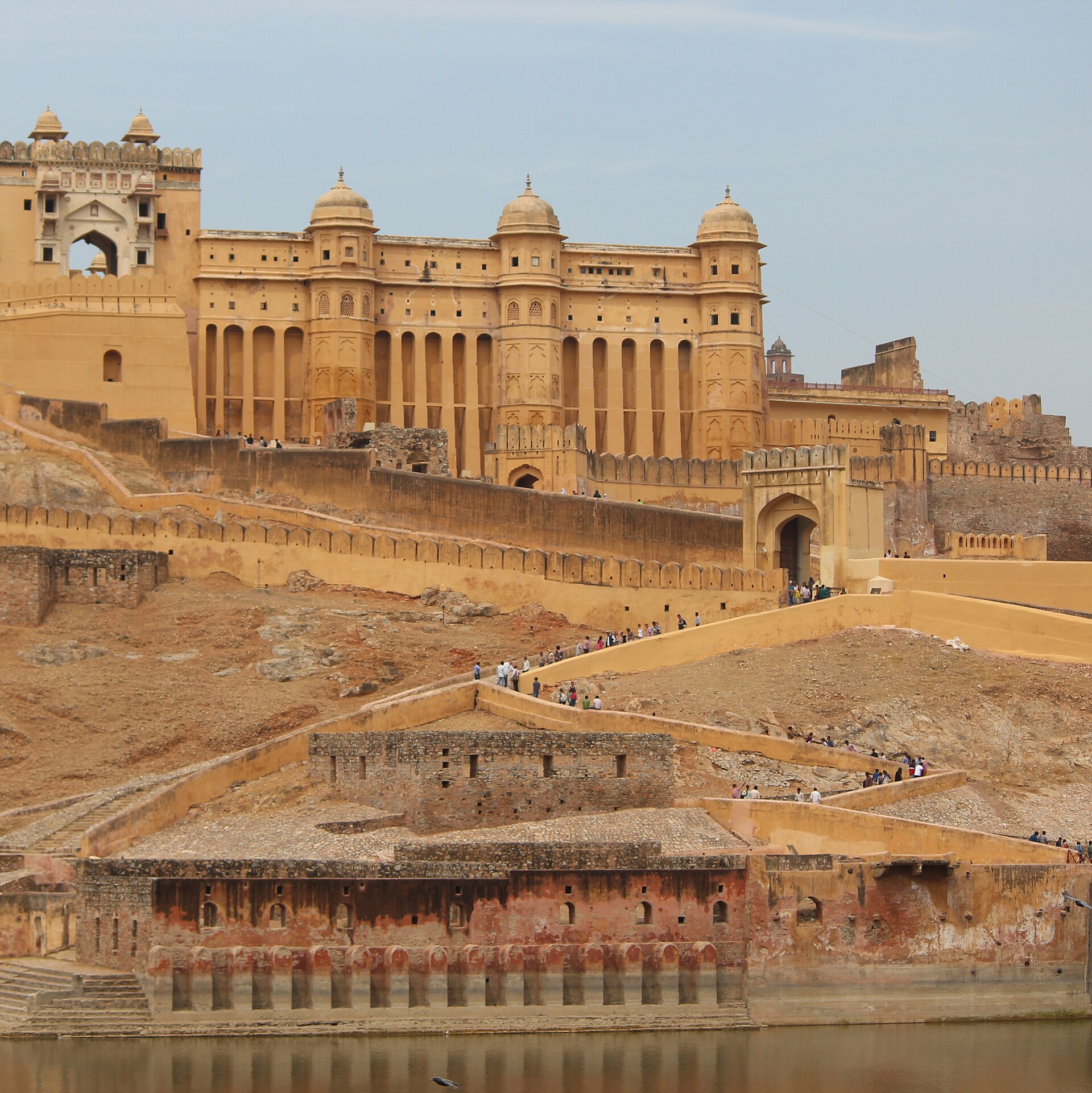
Rise early in Jaipur and drive a few kilometers north into the Aravalli hills, and you come upon one of the great sights of India. Above a still lake, on a rugged ridge of tawny stone, the honey-colored ramparts of Amer Fort climb the hillside, their walls and towers merging with the rock so completely that fort and mountain seem to be a single thing. Reflected in the water below, the whole vast palace-fortress hangs between the hills and their mirror image, and you understand at once why this was the seat of kings.
Amer, also spelled Amber, was the ancient capital of the Kachhwaha Rajputs, the warrior dynasty that ruled this corner of Rajasthan for centuries before they founded the pink city of Jaipur on the plain below. The fort that crowns the ridge is not a single building but a layered palace-city, raised and expanded over generations, where the martial strength of a hilltop stronghold meets the delicate luxury of a royal court.
Step through its gates and the fortress opens into a sequence of courtyards, each more richly worked than the last, culminating in halls of mirror and marble that count among the most beautiful interiors in India. This marriage of Rajput and Mughal art, of muscular fortification and jewel-like ornament, is the signature of Amer, and it makes the palace a study in how two great traditions met and enriched one another.
Today Amer Fort is one of the hill forts of Rajasthan inscribed together on the UNESCO World Heritage List, and one of the most visited monuments in the country. To walk its ramps and courtyards is to move through the world of the Rajput maharajas, a world of war and diplomacy, of alliance with distant emperors, and of a refined court life lived high above the Rajasthan plain. This is the story of that hilltop palace and the kings who built it.
In This Article
- A Palace-Fortress in the Hills
- The Kachhwaha Rajputs
- Raja Man Singh and the Builders
- The Lake and the Approach
- Gates and the First Courtyard
- The Hall of Public Audience
- The Ganesh Pol
- The Sheesh Mahal: Palace of Mirrors
- The Sukh Niwas and the Cooling Arts
- Courtyards of the Household
- Gardens of the Fort and Lake
- The Temple of the Goddess
- Amer Today: A World Heritage Hill Fort
A Palace-Fortress in the Hills
Amer Fort is best understood as a palace-city rather than a single palace, a walled complex spread across the hillside and organized into a series of courtyards on different levels. Built of the pale yellow and pink sandstone of the region, with marble reserved for its finest interiors, it blends into the rock from which it rises, an effect that is one of the great pleasures of approaching it.
The complex grew over many generations, each ruler adding courts, halls, and gates, so that the fort is really the accumulated work of a dynasty rather than the vision of a single builder. This layering gives Amer its richness and its slight irregularity, the sense of a place shaped by centuries of royal life rather than laid out all at once to a single plan.
The setting was chosen for defense as much as for beauty. Perched on a ridge above a narrow valley, guarded by the mightier fort of Jaigarh on the heights behind it and linked to it by walls and a passage, Amer could be defended against attack, while its position gave the rulers command of the surrounding country and the routes through the hills.
Yet for all its strength, Amer is remembered above all for its beauty. Behind the martial walls lie courtyards of extraordinary refinement, halls inlaid with mirror and marble, gardens laid out in geometric order, and gates painted and carved with the finest artistry. The fort holds war and delicacy in a single embrace.
Water, too, is part of its character. The Maota Lake at the foot of the ridge supplied the palace and set off its reflection, and within the fort ingenious channels and cascades cooled the royal apartments. In a dry land, this command of water was itself a mark of kingship, and it lent the fortress an unexpected freshness.
There is a useful contrast to be drawn with the desert palaces of Central Asia elsewhere in this series. Where the khans of Bukhara and Khiva built on the flat and had to manufacture their defenses and their water, the Kachhwahas were handed both by the land itself, a defensible ridge and a valley that could hold a lake. Amer works with its landscape rather than against it, and much of its beauty comes from that easy marriage of architecture and terrain.
The Kachhwaha Rajputs
The fort was the seat of the Kachhwaha Rajputs, one of the great warrior clans of Rajasthan, who traced their descent from ancient royal lineage and ruled the region around Amer for many centuries. Rajput society was built around martial honor, dynastic pride, and a fierce attachment to independence, and the Kachhwahas were among its leading houses.
Amer became their capital, and from this hilltop they governed their kingdom, a realm of hills, valleys, and desert margins in eastern Rajasthan. The rise of the dynasty is bound up with the history of the fort, which grew in grandeur as the fortunes of the family rose, reflecting their increasing wealth and standing among the Rajput states.
What set the Kachhwahas apart was the path they chose in dealing with the Mughal empire, the great Muslim power that came to dominate northern India. Rather than resist to the end as some Rajput houses did, they entered into alliance with the Mughals, giving daughters in marriage to the imperial family and serving the emperors as generals and governors.
This alliance brought the dynasty enormous rewards. Kachhwaha princes rose to the highest ranks of Mughal service, commanded imperial armies, and governed distant provinces, and the wealth and prestige they gained flowed back to Amer, funding the building of the very palace that visitors admire today. The fort is in large part a monument to that alliance.
It also shaped the art of the palace. Through their close ties to the Mughal court, the Kachhwahas absorbed its artistic tastes, and the fort became a place where Rajput and Mughal styles met and blended. The result is a distinctive synthesis, visible everywhere in the palace, that is one of the enduring legacies of this dynasty’s remarkable political choice.
The choice to ally with the Mughals rather than resist them was, in its day, a matter of fierce debate among the Rajput houses, and it is still argued over by historians. To some it was pragmatic statesmanship that preserved and enriched the dynasty; to others a compromise of Rajput honor. Whatever the verdict, its consequences are written plainly in the stones of Amer, a palace that could not have taken the form it did without the wealth and the artistic exchange that the alliance brought.
Raja Man Singh and the Builders
The greatest of the builder-kings of Amer was Raja Man Singh, a towering figure of the late sixteenth century who served the Mughal emperor Akbar as one of his most trusted generals. Commanding imperial armies across the length of India, he won vast wealth and honor, and he poured much of it into transforming his ancestral seat.
Man Singh began the construction of the grand palace complex that forms the heart of the fort as it stands today, raising courts and halls on a scale befitting his exalted position. His work set the pattern for the palace, and later rulers, above all Jai Singh, continued and refined it, adding the exquisite apartments that crown the upper courtyards.
As a leading noble of the Mughal empire, Man Singh moved between the world of the Rajput hills and the cosmopolitan imperial court, and he brought the artistic sophistication of the latter home to Amer. The palace reflects a patron of wide horizons, at ease with the finest craftsmanship the empire could offer and determined to display it in his own domain.
The building of the fort thus unfolded over generations of such rulers, each adding to the work of his predecessors. This continuity of purpose across a long line of kings gave Amer its coherence despite its gradual growth, for all the builders shared a common culture and a common ambition to make their seat magnificent.
In Raja Man Singh and his successors, Amer found patrons of the first rank, men whose service to the Mughals gave them both the means and the taste to create a palace of surpassing beauty. Their names are inseparable from the fort, and to walk its courts is to move through the ambition of a dynasty at the height of its power and prestige.
The Lake and the Approach
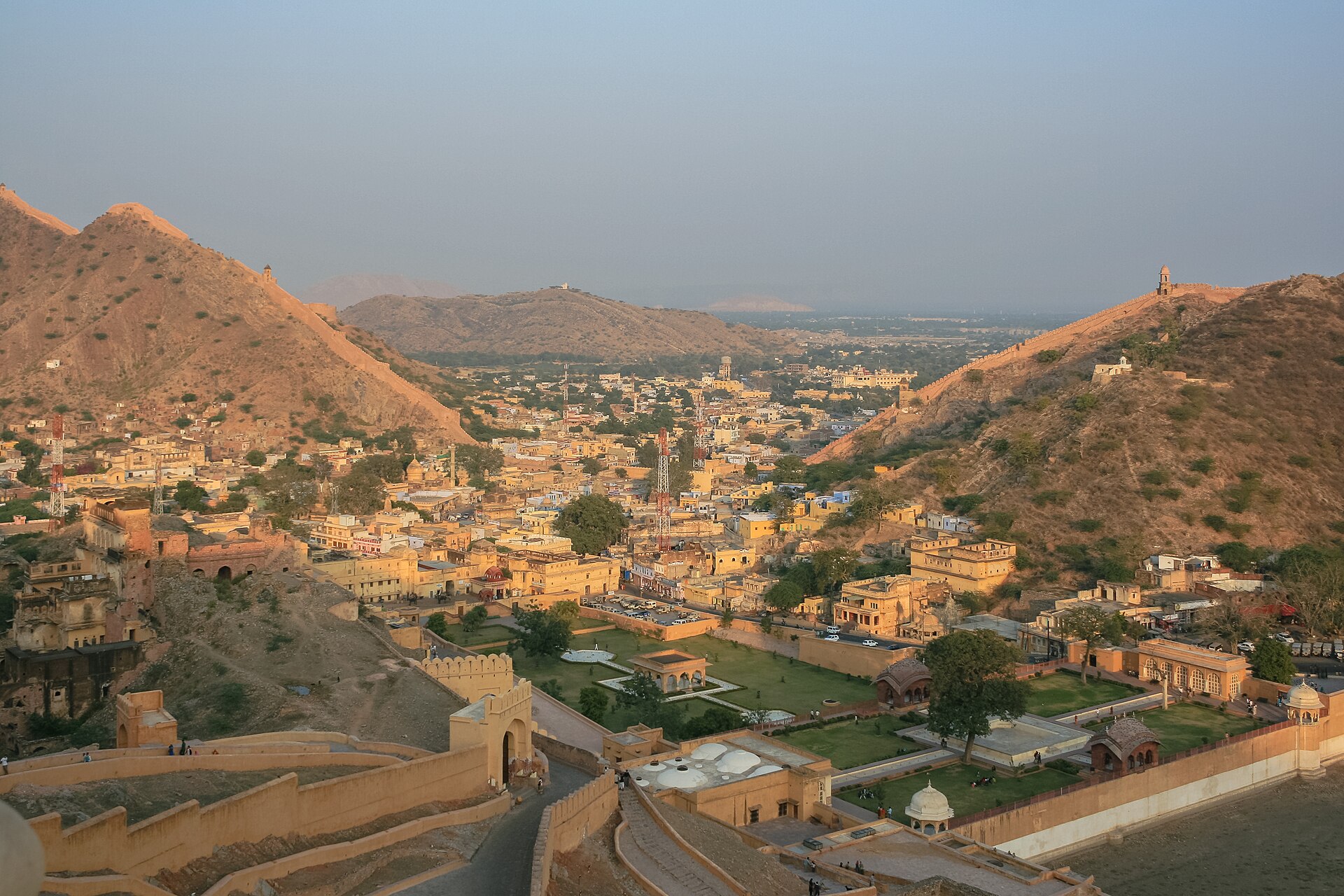
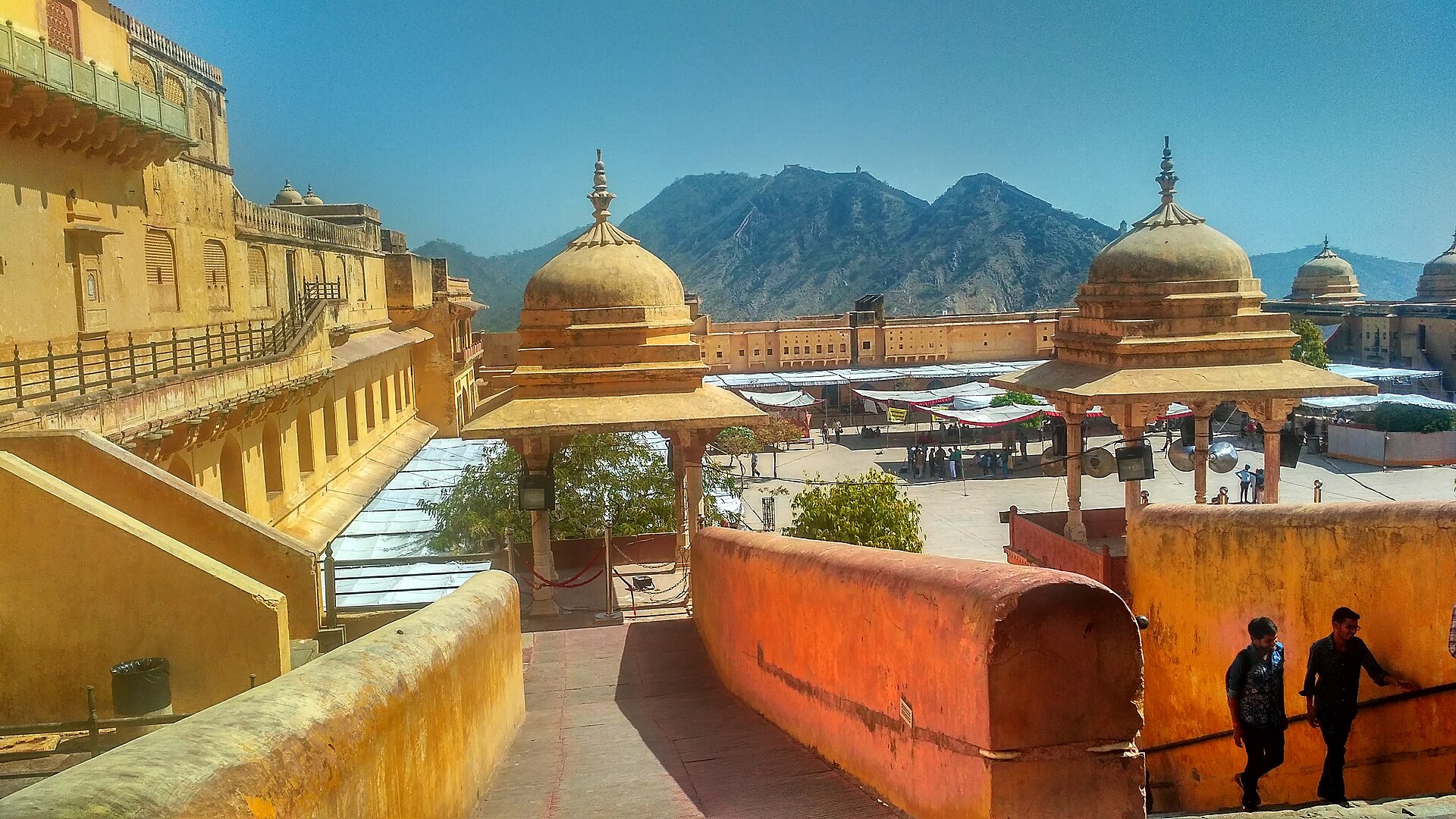
The approach to Amer is part of its magic. From the town below, the fort is reached by a climb up the ridge, and for centuries the grandest arrivals were made on elephant-back, swaying up the ramped path to the main gate in a slow procession that heightened the drama of entry. The view back over the lake and hills from the ascent is unforgettable.
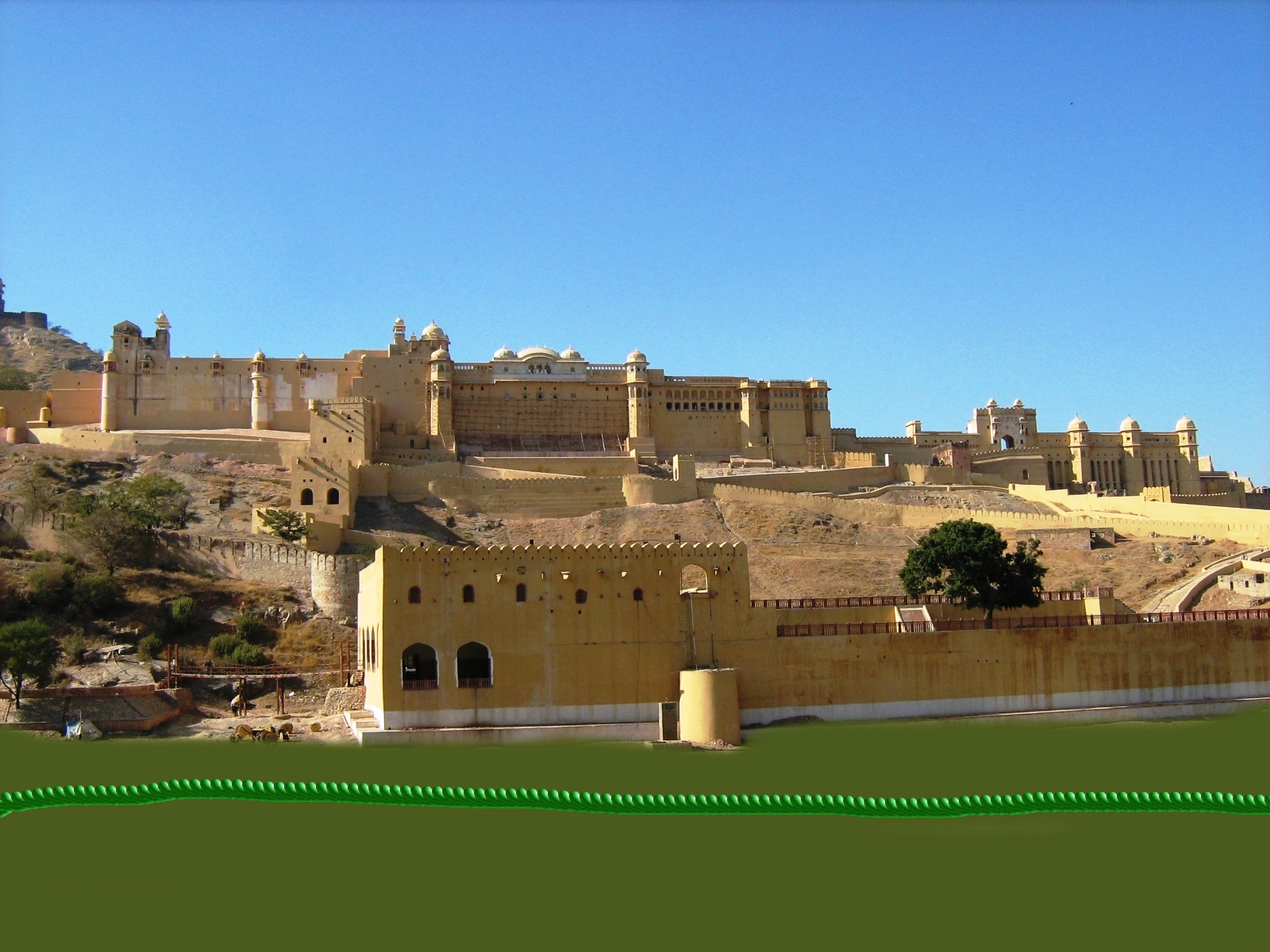
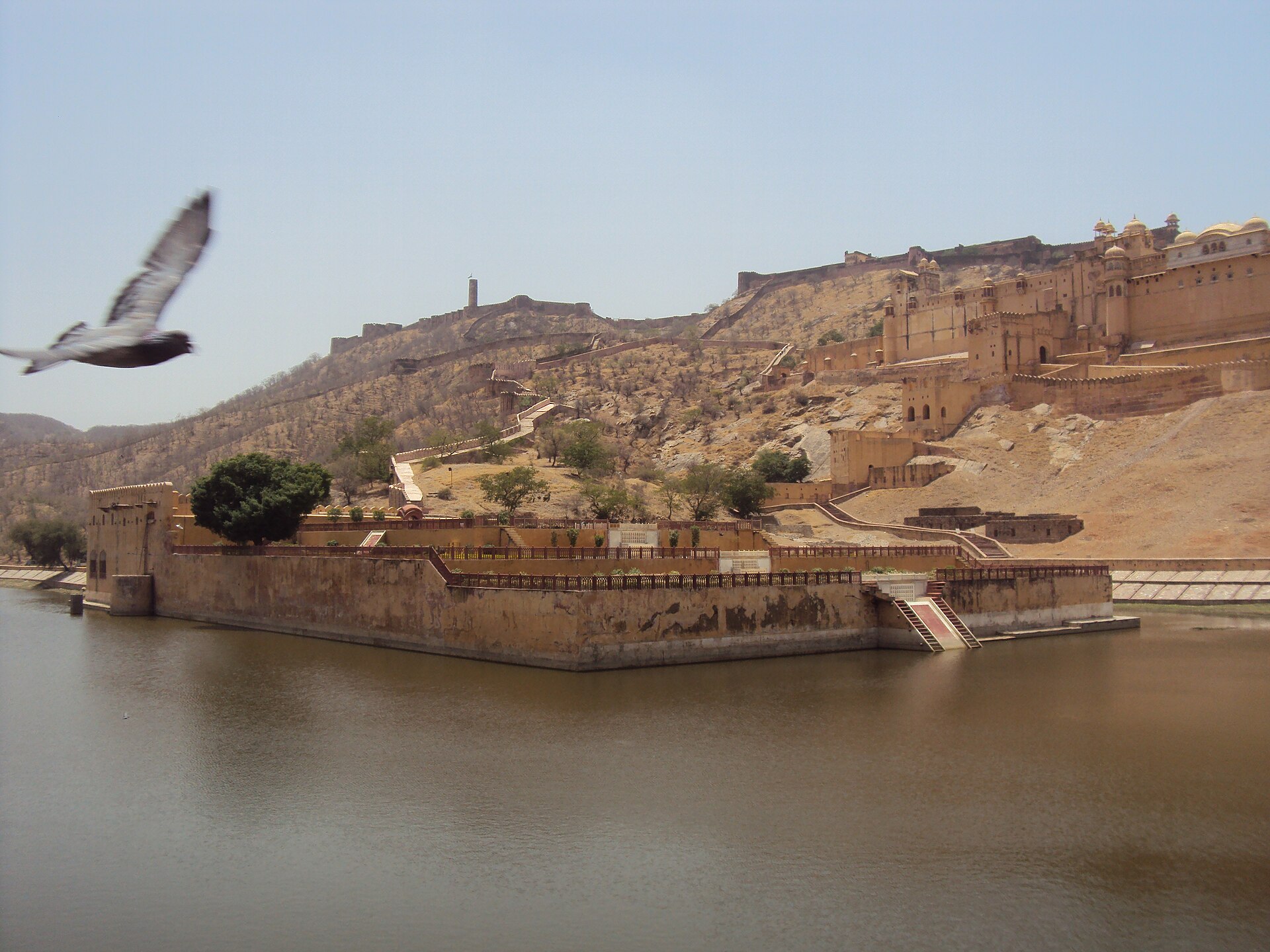
At the foot of the ridge lies the Maota Lake, whose waters supplied the palace and whose still surface holds the reflection of the fort. On an island and along the shore lie formal gardens, and the whole composition of lake, garden, and fortress rising behind was carefully contrived, a designed landscape meant to be seen as a single grand tableau.
The lake was more than ornament. In the dry climate of Rajasthan, a reliable source of water was essential to sustaining a palace-city on a hilltop, and the Maota Lake, fed by the monsoon and by channels from the hills, was the fort’s lifeline. Its practical necessity and its beauty were, as so often at Amer, two sides of the same thing.
Guarding the heights above and behind the palace stands the older, sterner fort of Jaigarh, linked to Amer by fortified walls and a passage. Jaigarh was the military stronghold and refuge, the hard fist behind the velvet glove of the palace, and together the two forts formed a single defensive system commanding the ridge and the valley.
Arriving at the fort today, whether on foot, by jeep, or in the elephant processions that still climb the ramp, the visitor repeats an experience shaped over centuries. The staged ascent, the widening views, the great gate at the summit, all were designed to build anticipation, so that entering Amer feels like a genuine arrival at a place of power.
The elephants that still carry visitors up the ramp are a subject of real debate today, with animal-welfare concerns weighed against long tradition and local livelihoods, and a thoughtful visitor is aware of the discussion. However one comes to feel about it, the staged ascent to the gate remains central to the experience of the fort, and even on foot the slow climb, with the lake falling away below, does its old work of building anticipation.
Gates and the First Courtyard
The main entrance leads through a great gate into the first and largest courtyard of the palace, a broad open space where armies once assembled and where returning victorious troops were welcomed. This was the public, martial heart of the fort, a parade ground and gathering place on a scale that speaks of the military life of the Rajput state.
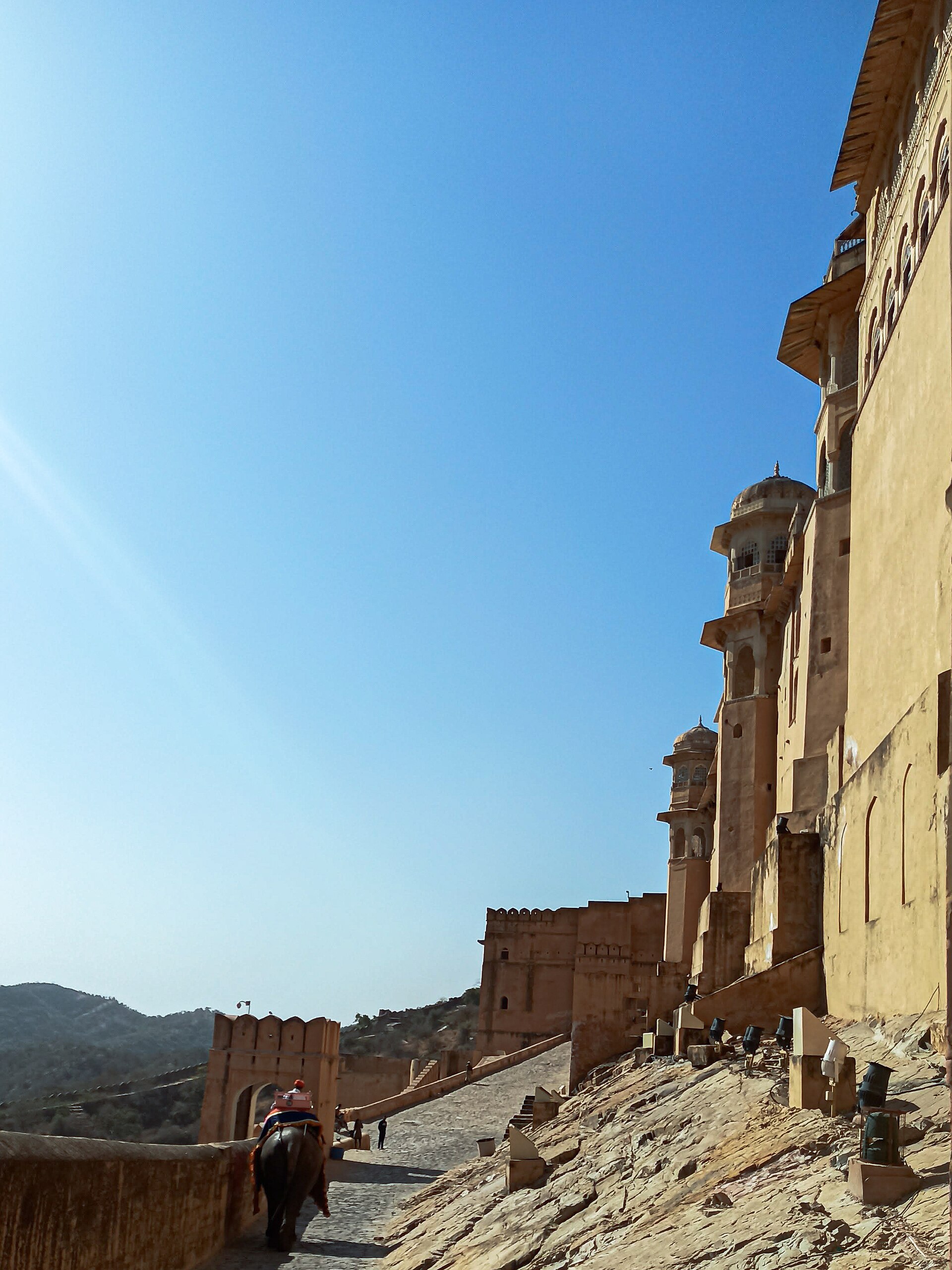
From this courtyard a monumental stairway climbs to the more private and ceremonial upper levels, marking the transition from the world of soldiers and horses to the world of the court. The change in level and the narrowing of the way reinforced the sense of moving inward and upward toward the presence of the ruler.
The gates of Amer are works of art in themselves, high and strong for defense yet richly decorated, their surfaces painted and carved with ornament. They embody the dual nature of the whole fort, at once fortifications built to withstand assault and thresholds designed to impress the visitor with the magnificence of the royal house.
The first courtyard also gave access to a temple that remains in active worship, a reminder that the fort was not only a residence and a stronghold but a religious center, the seat of the dynasty’s patron goddess. Faith and rule were intertwined here as in the great palaces across Asia.
Standing in this broad court, ringed by walls and gates with the upper palace rising beyond, the visitor gets the measure of Amer as a working fortress-capital. This was where the public life of the state played out, and from here the ascent begins toward the jewelled apartments that are the fort’s crowning glory.
The Hall of Public Audience
Climbing to the next level, the visitor reaches the Diwan-i-Aam, the Hall of Public Audience, where the ruler sat to receive the general public, hear petitions, and administer justice. An open pavilion of pillars, raised on a platform and cooled by the breeze, it was the place where the maharaja met his subjects.
The hall takes the form of a colonnaded pavilion, open on its sides so that a crowd could gather before the enthroned ruler and see him dispensing his authority. This openness was deliberate, for the public audience was meant to display the accessibility and justice of the ruler, a king visible to his people.
The design of such halls followed a pattern common to the palaces of Mughal India, adapted here to the Rajput setting. Rows of finely carved pillars support the roof, their capitals worked with ornament, and the whole pavilion combines dignity with the airy lightness suited to the climate.
Here the business of the kingdom was conducted in public view, disputes settled, petitions received, and the ruler’s judgments pronounced. The Diwan-i-Aam was the point where the machinery of government met the governed, and its position on the ascent through the palace, between the public court below and the private apartments above, marked its intermediate role.
From the hall the visitor looks out over the courtyards and walls to the hills beyond, a reminder that even in this ceremonial space the fort never forgot its setting. The Diwan-i-Aam belongs to the world of rule and display, and it prepares the visitor for the greater splendors that lie beyond the next, most famous gate of all.
It is easy, amid the glitter of the private apartments, to overlook a hall like this, and that would be a mistake. The Diwan-i-Aam is where the fort’s political purpose is clearest, where a king made himself visible to his people and justice was seen to be done. The mirror hall shows what the dynasty could afford; the audience hall shows what it was for, and the two together give the full measure of the place.
The Ganesh Pol
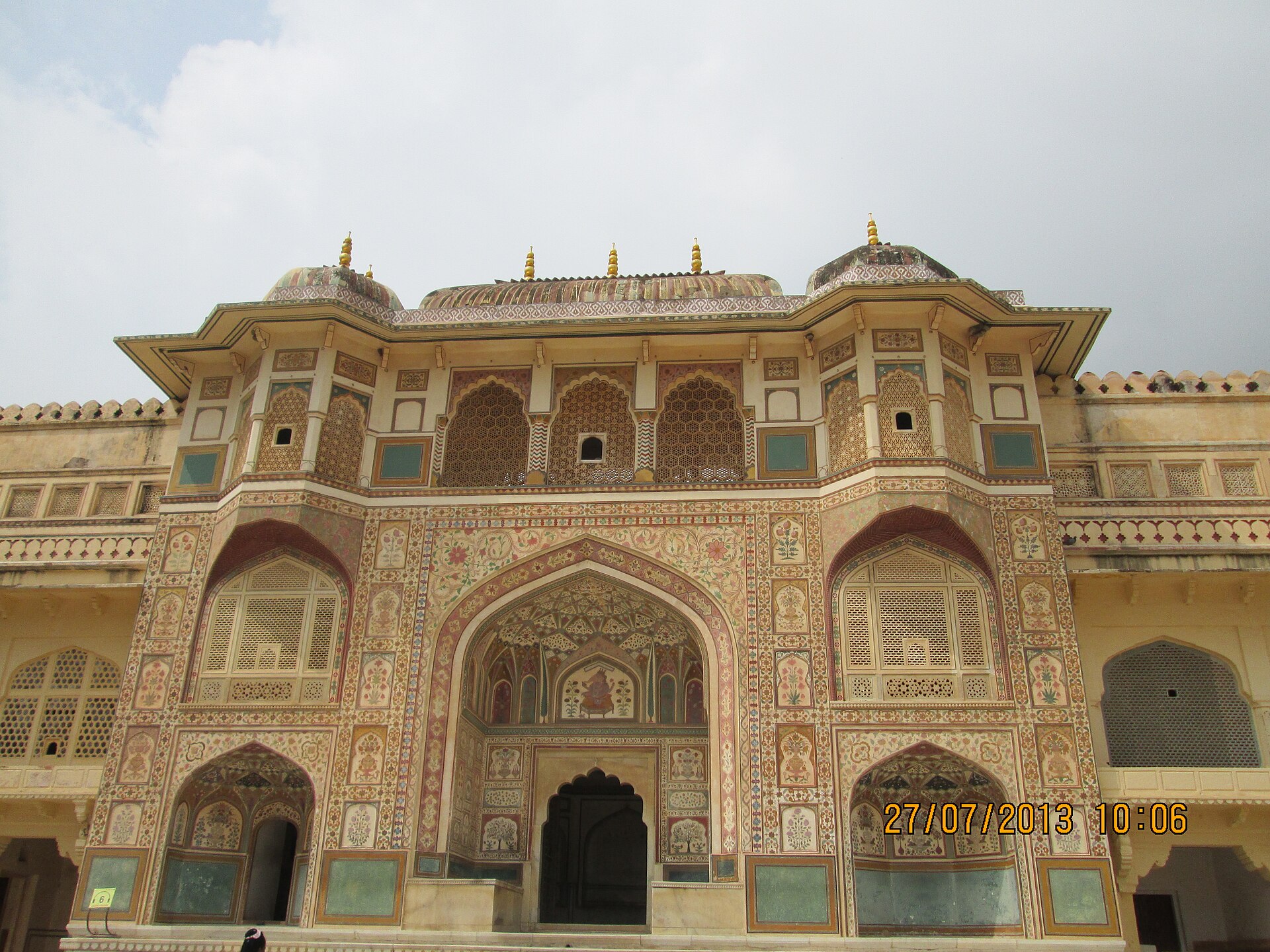
The threshold to the private heart of the palace is the Ganesh Pol, the Elephant Gate, and it is one of the most beautiful gateways in all of India. Named for the elephant-headed god Ganesha, whose image presides over its arch, this tall, richly painted gate separated the public courts from the private apartments of the ruler.
The gate is a riot of color and pattern. Its facade is covered with painted floral designs, delicate frescoes, and mosaic in glowing hues, worked with a finesse that turns the whole structure into a single vast composition. Above the archway, screened windows allowed the women of the palace to look down unseen on the court below.
Passing through the Ganesh Pol was a passage from the public to the intimate, from the world of audience and government to the private domain of the royal family. The magnificence of the gate marked the importance of that threshold, impressing on all who crossed it the splendor of the household they were entering.
The gate is a supreme example of the blended Rajput and Mughal art that defines Amer. Its floral motifs and refined technique owe much to Mughal taste, while its exuberant color and its place in a Rajput fort make it wholly of Amer. Few single structures better capture the artistic character of the palace.
To stand before the Ganesh Pol today, its colors still vivid after centuries, is to encounter one of the high points of the fort. Beyond it lie the mirror halls and marble pavilions of the private palace, and the gate itself, glowing above the courtyard, promises the delights that wait within.
Look up as you pass beneath the gate and you will see the latticed screens through which the palace women once watched the world below. That small detail says a great deal about the building, in which nothing is merely decorative and nearly every element served the intricate social life of the court, allowing some to see without being seen and marking, at every threshold, exactly who belonged on which side of it.
The Sheesh Mahal: Palace of Mirrors
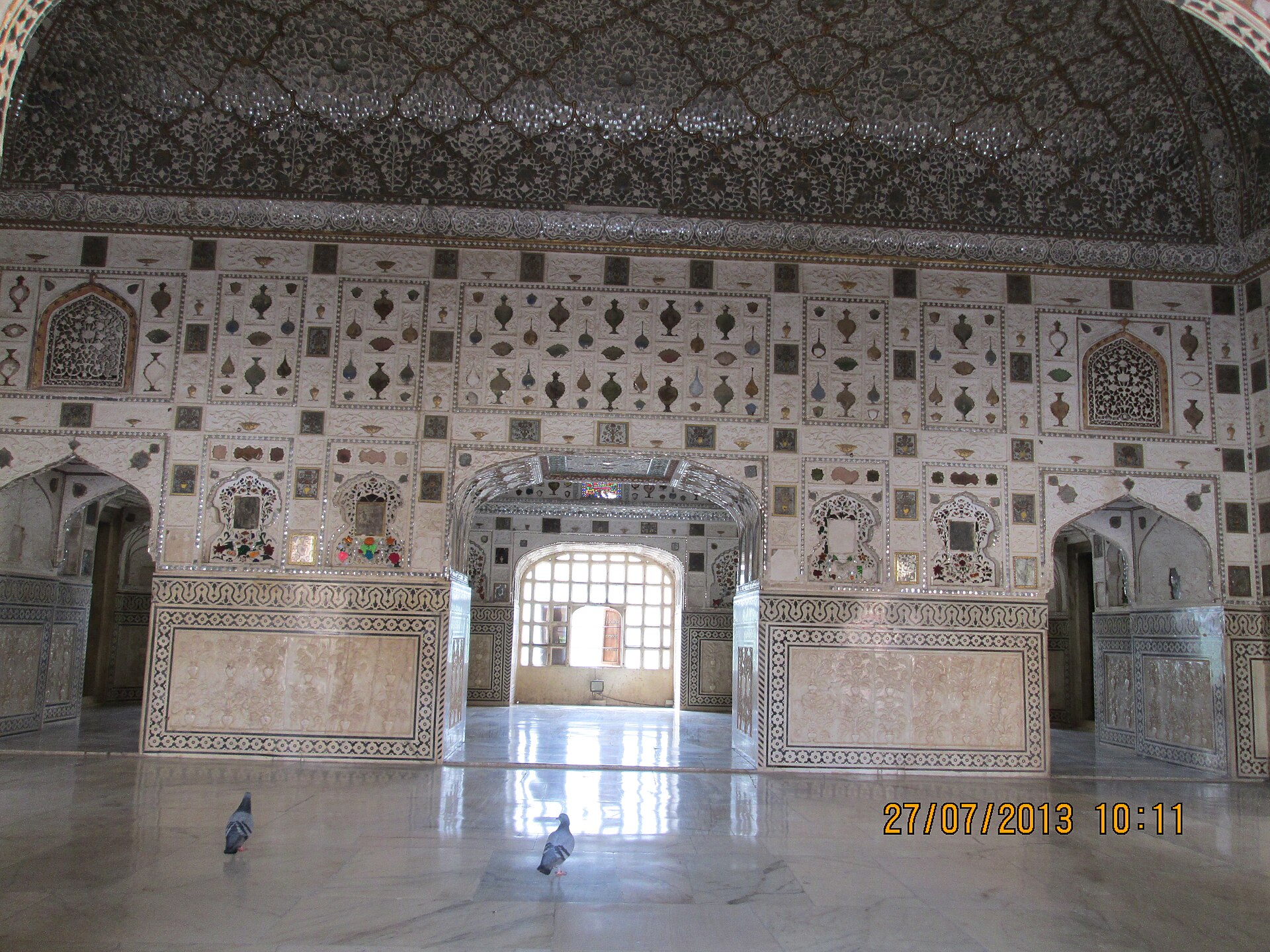
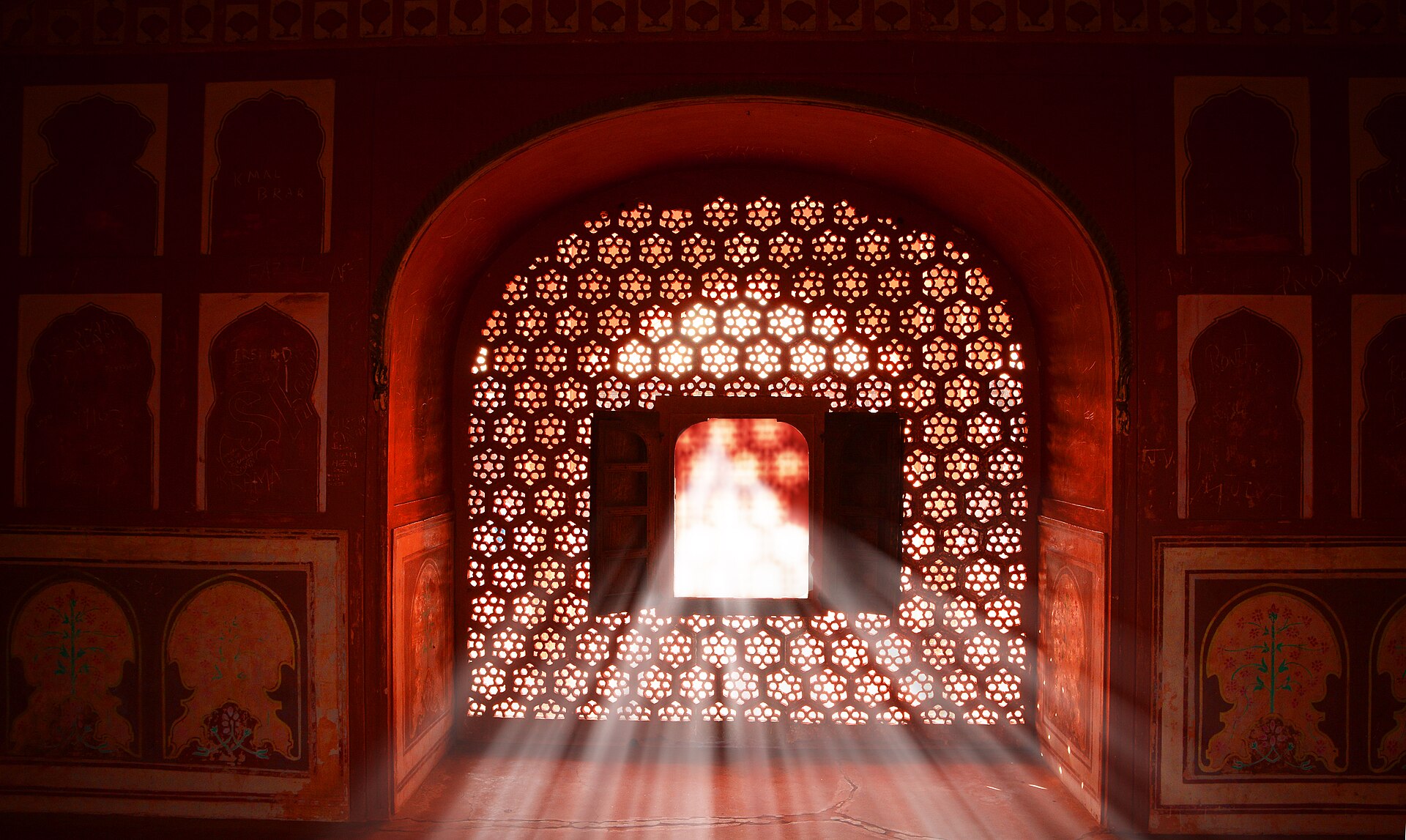
Beyond the Ganesh Pol lies the most celebrated interior of Amer, the Sheesh Mahal, the Palace of Mirrors. Its walls and ceilings are inlaid with countless tiny pieces of mirror and colored glass, set into intricate patterns so that the whole surface glitters and shifts as the light moves across it.
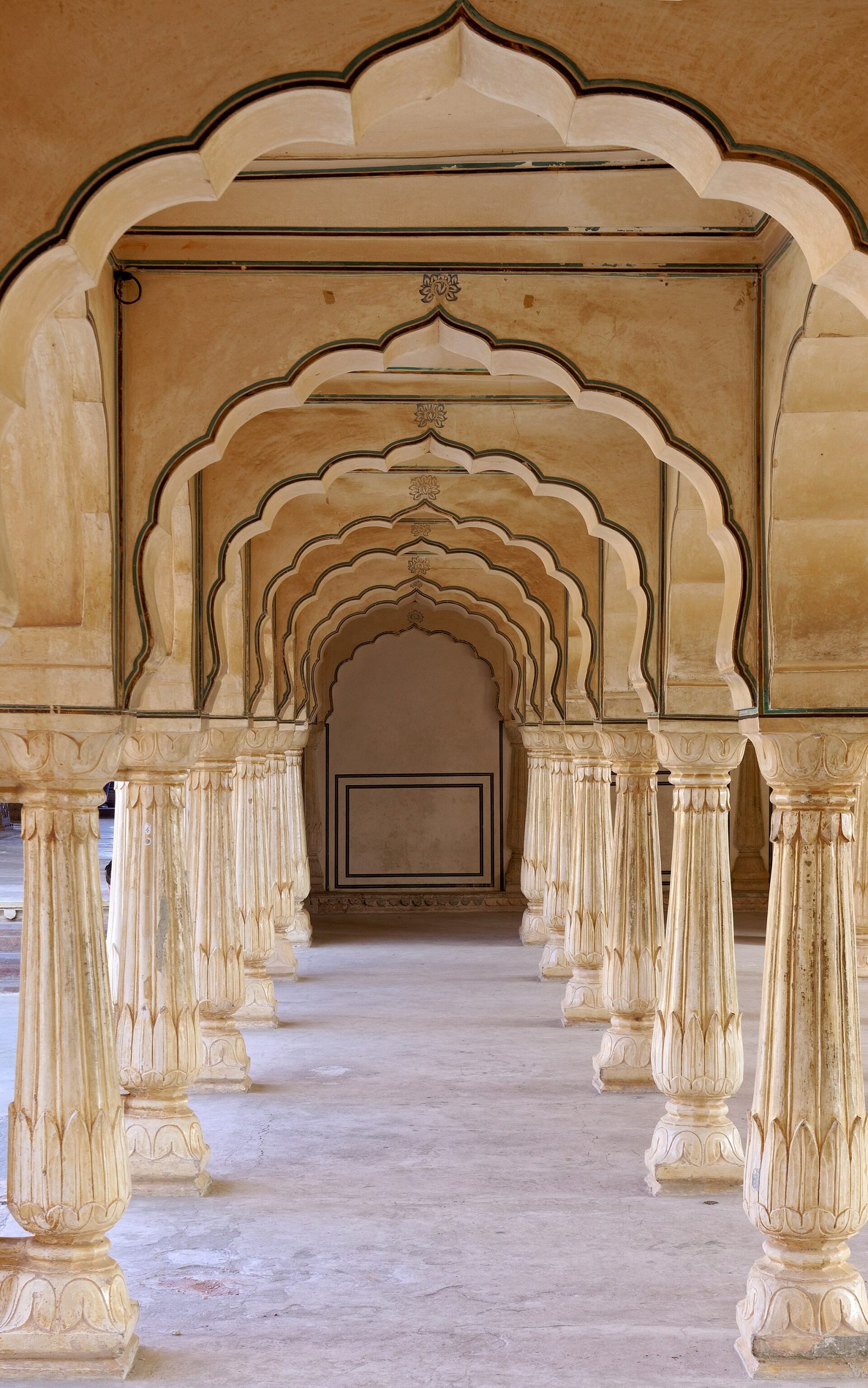
The famous quality of the hall is what happens in the dark. It is said that a single candle flame, reflected and multiplied across the thousands of mirror fragments, could fill the whole chamber with points of light like a sky full of stars. Whether or not the legend is exact, the effect of the mirror-work is undeniably magical.
The mirror inlay, a technique brought to a peak under Mughal-influenced craftsmen, covers the surfaces in a dense fabric of floral and geometric ornament. Convex mirrors, colored glass, and fine plasterwork combine to create an interior of extraordinary richness, a jewel box at the heart of the fortress.
Such a hall was a setting for the private pleasures of the court, for music, intimacy, and repose in an atmosphere of shimmering beauty. It represents the height of the luxury that the wealth of the Kachhwaha rulers could command, luxury made possible by their high standing in the Mughal empire.
The Sheesh Mahal is the image most visitors carry away from Amer, and rightly so. In its glittering walls the whole character of the palace is concentrated, the transformation of a hilltop fortress into a place of exquisite refinement, war turned into beauty by the art of the craftsmen who adorned it.
It is worth being a little skeptical of the more extravagant claims made about the mirror hall, the exact number of reflections, the precise trick with the candle, for such stories grow in the telling. What needs no exaggeration is the sheer craftsmanship of the inlay, the patience and precision with which thousands of fragments were set to make the walls come alive with light. The reality is marvel enough without embellishment.
The Sukh Niwas and the Cooling Arts
Facing the Sheesh Mahal across a garden courtyard stands the Sukh Niwas, the Hall of Pleasure, a pavilion designed for comfort in the fierce heat of the Rajasthan summer. Here the builders deployed an ingenious system of water channels and cascades to cool the air, an early and elegant form of air conditioning.
Water was piped through channels in the marble floors and made to fall in thin sheets over carved surfaces, so that the breeze passing across it was cooled before reaching the occupants. In a land of scorching summers, this command of water to create comfort was both a practical marvel and a display of the ruler’s resources.
The hall itself is finely decorated, with inlaid marble and delicate ornament, a place of retreat and repose. Together with the Sheesh Mahal across the garden, it formed the luxurious core of the private palace, the apartments where the royal family passed their days in comfort and beauty.
The garden between the two pavilions, laid out in the geometric Mughal manner, completed the composition. Its ordered beds and channels of water linked the two halls into a single designed space, a private paradise garden set high within the fortress walls, cool and green above the dry hills.
The Sukh Niwas shows the practical intelligence behind the beauty of Amer. The same builders who created the glittering mirror hall also engineered the flow of water to defeat the heat, and their mastery of both art and comfort is part of what makes the palace so remarkable an achievement.
Courtyards of the Household
The private life of the palace was divided between the public and ceremonial courts and the zenana, the quarters of the women of the household. As in the great palaces across the Islamic and Indian world, this domestic sphere was screened from outsiders, a private domain reserved for the royal family and their attendants.
The zenana courtyard is surrounded by apartments arranged, by tradition, so that the ruler could visit any of his queens without the others knowing, the passages and rooms contrived to preserve privacy within the shared enclosure. The architecture thus embodied the complex domestic order of a royal household.
Screened windows and galleries allowed the women of the palace to observe the ceremonies and audiences of the court below without being seen, participating in the life of the fort while remaining within their private world. This interplay of visibility and seclusion shaped much of the palace’s design.
Life in these courtyards followed its own rhythms, structured by custom, rank, and the seasons. The apartments, though private, shared in the luxury of the palace, decorated with ornament and cooled by the same ingenious arts that served the grand halls, so that the household lived amid considerable comfort and beauty.
The zenana reminds the visitor that Amer was a home as well as a fortress and a seat of government. Behind the public magnificence lay the private world of the royal family, and the courtyards of the household, quieter and more intimate than the ceremonial courts, preserve the memory of that domestic life.
The screened, inward-looking world of the zenana can be read in more than one way, and honesty asks us to hold the readings together. It was a place of seclusion and constraint, but also one of considerable comfort, status, and its own forms of power and influence, for the women of a ruling house were rarely mere onlookers. The architecture that hid them from view also gave them their own domain within the fort, and its quiet courtyards held a whole social world.
Gardens of the Fort and Lake
Gardens were as much a part of Amer as its walls and halls, for the Rajput and Mughal traditions alike prized the ordered garden as an image of paradise on earth. Within the palace and around the lake below, formal gardens softened the martial stone and brought greenery and geometry to the dry hillside.
On the Maota Lake lies a celebrated terraced garden, laid out in the geometric Mughal manner with beds arranged in symmetrical patterns and once planted, by tradition, with fragrant flowers whose form could be admired from the palace above. Seen from the ramparts, its ordered beds make a living carpet spread upon the water’s edge.
Within the palace, the garden courtyard between the Sheesh Mahal and the Sukh Niwas brought the same principles into the private heart of the fort. Its channels of water and ordered beds linked the two pleasure pavilions and created a cool green sanctuary high within the walls, a paradise garden in miniature.
These gardens depended, like everything at Amer, on the mastery of water. Channels carried water from the lake and the hills to feed the beds and fill the pools, and the whole system reflected the ingenuity that let the builders sustain greenery and coolness in an arid land, turning scarcity into luxury.
The gardens complete the picture of Amer as a place where beauty and practicality were one. Laid out for pleasure and for the display of order and abundance, they also served the real needs of comfort and sustenance, and their geometric forms, set against the wild hills, are among the quiet delights of the fort.
The Temple of the Goddess
Within the fort stands the temple of Shila Devi, the patron goddess of the ruling dynasty, a shrine that remains a place of active worship and devotion. The presence of this temple at the heart of the palace underlines the deep bond between the Kachhwaha rulers and the goddess they regarded as their protector.
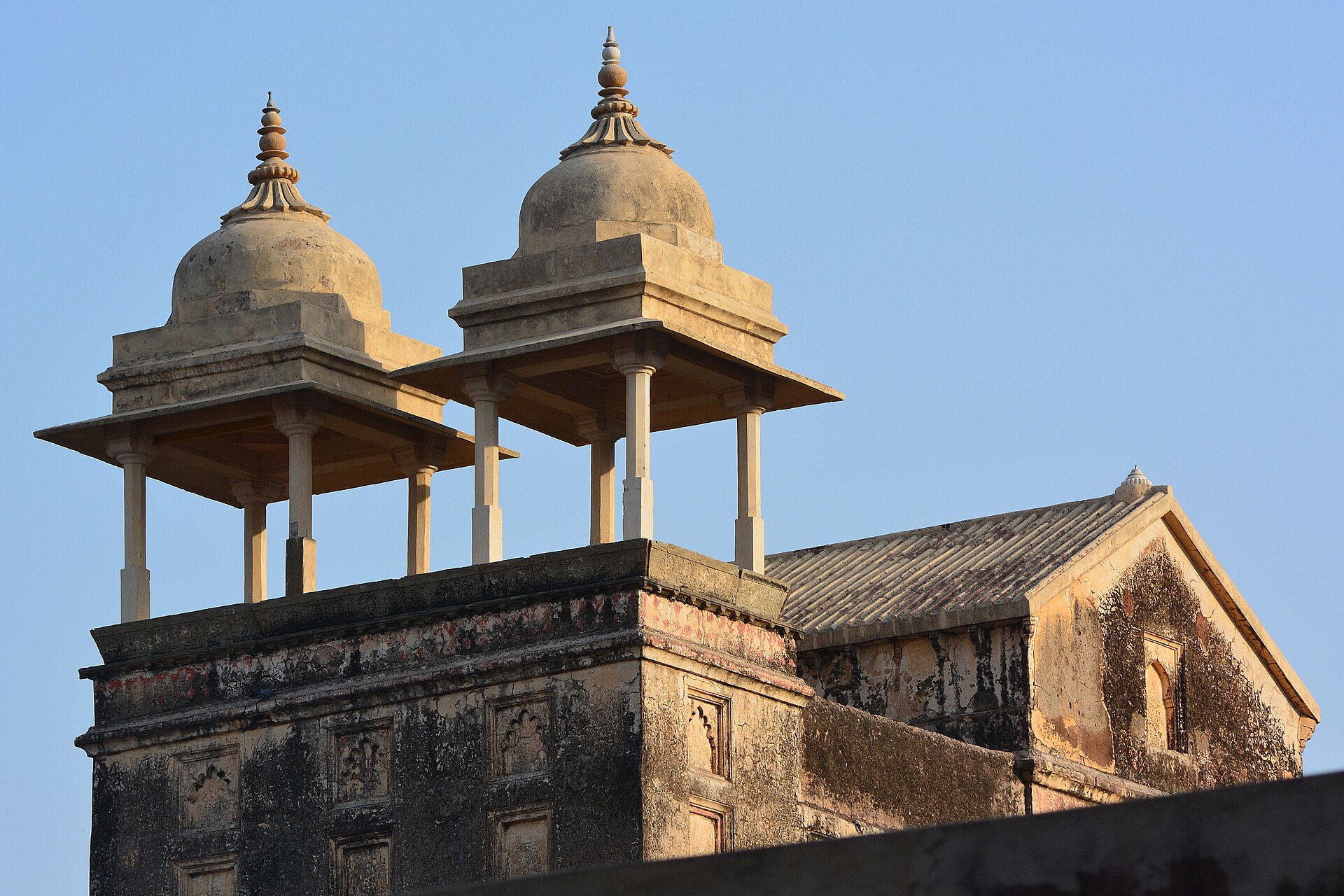
The image of the goddess, according to tradition, was brought to Amer by Raja Man Singh from a distant campaign, a trophy of his military service that became the spiritual anchor of the dynasty. The story ties the temple directly to the great builder-king and to the martial world in which the fort was raised.
The temple has finely worked doors and ornament, and it draws worshippers as well as sightseers, a living religious site within the historic monument. Its continuing use gives Amer a dimension that many palace-museums lack, connecting the visitor to the beliefs that animated the court that built the fort.
For the rulers, the favor of the goddess was inseparable from the fortunes of the dynasty. Victory in war, the security of the state, and the continuity of the line were all understood to depend on her protection, and the maintenance of her worship was among the ruler’s most important duties.
The temple thus adds a note of living faith to the fort’s blend of war and beauty. Amid the courtyards and mirror halls, it reminds the visitor that this was a sacred as well as a secular place, and that the kings who ruled from Amer saw their power as resting, in the end, on the favor of the divine.
Amer Today: A World Heritage Hill Fort
In the early eighteenth century the Kachhwaha rulers moved their capital from the cramped hilltop of Amer to a spacious new planned city on the plain below, the pink city of Jaipur, founded by Jai Singh. The court moved with them, and Amer, no longer the seat of the living state, gradually passed from capital to monument.
View the exact location on Google Maps
Yet the fort was never abandoned or ruined, and it survives today in remarkable completeness, its courtyards, halls, and gates preserved through the centuries. This preservation, together with its extraordinary architecture, has made Amer one of the treasures of Rajasthan and one of the most visited monuments in all of India.
In 2013 Amer Fort was inscribed on the UNESCO World Heritage List as one of the Hill Forts of Rajasthan, a group of six great fortresses recognized together for their outstanding testimony to the Rajput military architecture and courtly culture. The listing set a seal on Amer’s standing among the world’s heritage.
For modern India the fort is a source of pride and a magnet for travelers from around the world, who climb its ramp, wander its courtyards, and marvel at its mirror halls. Sound-and-light shows, elephant processions, and the great sweep of the fort reflected in its lake have made it one of the defining images of Rajasthan.
To stand in the Sheesh Mahal or before the Ganesh Pol today, high above the Maota Lake with the Aravalli hills stretching away, is to grasp what the Kachhwaha kings achieved on their ridge of stone. Their capital moved on, their kingdom is long gone, but the palace-fortress they built endures, a masterpiece of the meeting of two great traditions.
If you can, come at opening time, before the coaches arrive and the courtyards fill. In the early light the sandstone glows, the lake below is still, and for a little while you can have a corner of the mirror hall or the garden court almost to yourself. Amer is spectacular in any crowd, but it is in those quiet early moments that the fort most fully becomes what it once was, the serene high seat of a proud and cultivated dynasty.
Palaces Nearby
Amer is the first of a new group of great palaces of India that we will gather here, drawn from the rich courtly world of Rajasthan and beyond. More Indian royal residences will join it soon, to trace the varied splendor of the subcontinent’s kings and maharajas.
You May Like
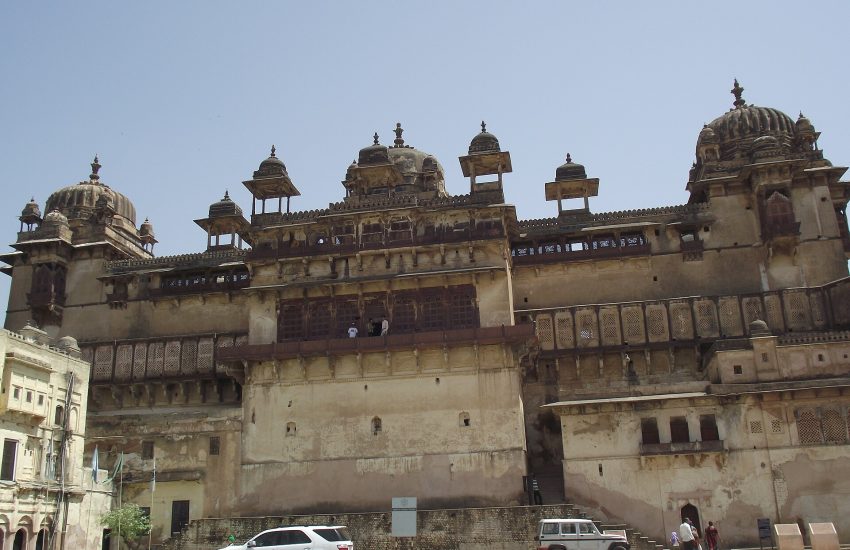
The Palaces of Orchha: A Bundela Capital on the Betwa


One thought on “Amer Fort: The Hilltop Palace of the Kachhwaha Rajputs”