Step out of the sunbaked lanes of Khiva and through a modest doorway in a high mud-brick wall, and you enter a world that seems to belong to a storybook. Inside the Tash Hauli Palace, deep courtyards open one after another, ringed by tall arched alcoves whose walls blaze with blue and white tilework from floor to ceiling. Slender carved wooden columns hold up painted balconies, and the noise of the town falls away. This is the great palace of the khans of Khiva, and it is one of the most dazzling interiors in all of Central Asia.
Khiva itself is a place out of time, a walled desert city on the edge of the Kyzylkum sands whose old center, the Ichan Kala, survives almost whole. Within that living museum of minarets, madrasas, and mausoleums, the Tash Hauli was the residence and seat of the rulers of the Khanate of Khiva in its final flourishing. Its name means stone courtyard or stone house, a proud claim in a land where most building was done in humble mud brick.
Where the Ark of Bukhara overwhelms with the weight of its ramparts, the Tash Hauli enchants with the richness of its decoration. This is a palace turned inward, presenting blank walls to the street and saving all its beauty for the courtyards within, where the khan and his household lived amid a riot of ornament that turned every surface into a field of color and pattern. It is intimacy and splendor rather than raw power that the place radiates.
Built in the first half of the nineteenth century, the palace is a late and glorious expression of a court tradition that was already living on borrowed time, for within a few decades the khanate would fall under Russian control and eventually vanish altogether. To walk through the Tash Hauli today is to step into the last great age of the Khivan khans, and to see, preserved in tile and timber, the world they made for themselves behind their desert walls.
In This Article
- A Palace of Hidden Courtyards
- Khiva and Its Khanate
- The Khan Who Built It
- The Harem Courtyard
- Walls of Blue and White
- Carved Wooden Columns
- Courts of Audience and Rule
- The Court of Justice
- The Khan’s Throne and Ceremony
- Life Within the Walls
- The Crafts of Khorezm
- The Palace as Museum
- The Tash Hauli Today
A Palace of Hidden Courtyards
The Tash Hauli is organized around a series of interior courtyards, each serving a different part of the ruler’s life, and the whole is enclosed within high walls that give nothing away from outside. The design turns its back on the street entirely, a common instinct in the architecture of this region, where privacy, shade, and defense all argued for looking inward rather than out.

There are three principal sections. One court was the harem, the private family quarters; another served for receptions and the business of rule; and a third was set aside for the ceremonies of justice and audience. Each is a self-contained world with its own character, linked by passages, so that moving through the palace is a sequence of arrivals into distinct enclosed spaces.
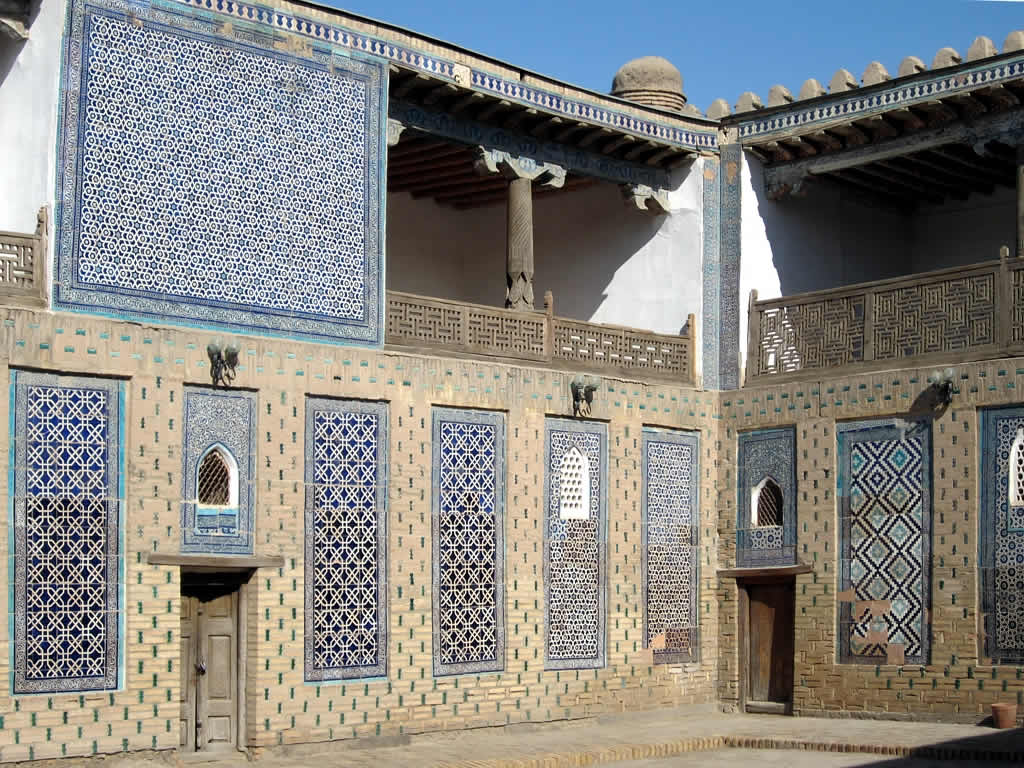
The dominant architectural element is the aivan, a tall open alcove or iwan facing into the courtyard, shaded and cool, where the occupants could sit out of the sun. These lofty niches, their ceilings borne on carved wooden columns, are the defining feature of the palace, and their brilliant tiled walls are what visitors remember most vividly.
For all its richness the palace was built quickly by the standards of such projects, reportedly under considerable pressure from an impatient ruler. The speed of construction is part of its legend, and the concentration of so many craftsmen on the work helps explain the astonishing density and consistency of its decoration, applied across vast surfaces in a single sustained campaign.
The result is a building that rewards slow exploration. There is no single grand facade to photograph and move on from; instead the palace unfolds courtyard by courtyard, alcove by alcove, each turn revealing another wall of tilework or another carved column, until the sheer accumulation of ornament becomes overwhelming in the best possible way.
It is natural to compare the Tash Hauli with the other palaces of the region, and the contrast with the Ark of Bukhara is especially instructive. Where Bukhara concentrated power in a towering fortress meant to be seen and feared from afar, Khiva hid its splendor behind unremarkable walls and poured everything into the interior. Two neighboring states, two rival khanates, arrived at almost opposite ideas of what a ruler’s residence should be, and seeing them together tells you a great deal about each.
Khiva and Its Khanate
To understand the palace you have to understand Khiva, the city and the state it ruled. The Khanate of Khiva was one of three great oasis states of Central Asia in the eighteenth and nineteenth centuries, alongside Bukhara and Kokand, each a Muslim monarchy controlling a stretch of the Silk Road and the lands watered by the region’s rivers.
Khiva lay in the historic region of Khorezm, an ancient center of civilization on the delta lands of the Amu Darya, the river the ancients called the Oxus. This was a place of deep history, of irrigation and trade reaching back thousands of years, and the khans who ruled it inherited a long tradition of desert kingship on the fertile margins of a harsh land.
The city of Khiva, and especially its inner walled town, the Ichan Kala, was the jewel of the khanate. Packed within its walls were the mosques, madrasas, minarets, mausoleums, and palaces of the ruling elite, an extraordinary concentration of monuments that survives today as one of the best-preserved medieval cities in the Islamic world.
Khiva also carried a darker reputation. For centuries it was a notorious center of the Central Asian slave trade, its markets supplied by raids on the surrounding peoples and on caravans, and the freeing of slaves here was one of the pretexts the Russian empire used as it pushed into the region in the nineteenth century.
Against this backdrop the Tash Hauli was built as the confident statement of a ruling house at the height of its wealth and self-assurance. It embodies the culture of the Khivan court in its last great period, a world of Islamic learning, desert trade, and lavish craftsmanship that would soon be transformed forever by the arrival of a European empire.
The Khan Who Built It
The palace was raised in the 1830s under Allah Quli Khan, one of the most vigorous rulers of the Khivan dynasty, whose reign marked a high point in the building and prosperity of the city. He wanted a grand new residence within the walls of the Ichan Kala, and the Tash Hauli was the result of that ambition.

Allah Quli Khan was a builder on a large scale. Beyond the palace he endowed madrasas, caravanserais, and a covered bazaar, reshaping the heart of Khiva with a burst of construction that reflected both his piety and his wish to leave a lasting mark. The Tash Hauli was the private and governmental centerpiece of this program.
Stories cluster around the palace’s construction. It is said that the khan demanded the whole complex be finished with impossible speed, and that at least one architect paid with his life for explaining that the work could not be done so fast. Such tales, true or embroidered, capture the character of a court where the ruler’s word was absolute.
The pressure showed in the organization of the work rather than in any shoddiness of result, for the palace is superbly made. Instead it meant gathering the finest craftsmen of Khorezm, the tile-makers, wood-carvers, and painters, and setting them to labor together on a single concentrated project, which is why its decoration is so unified in style.
In building the Tash Hauli, Allah Quli Khan gave his dynasty a setting worthy of its pretensions and gave posterity one of the treasures of Central Asian art. His name is inseparable from the palace, and to walk its courtyards is to move through the ambition of a single strong-willed ruler made permanent in tile and timber.
It is worth pausing on the human cost hidden behind such beauty. The grim legend of the executed architect, whether literally true or not, points to a real feature of these courts, where the will of the ruler was law and where the making of masterpieces could rest on coercion as much as on patronage. The palace is enchanting, but it was built within a system of absolute power, and an honest visitor holds both facts together.
The Harem Courtyard
The largest and in many ways the loveliest part of the palace is the harem, the private domestic quarter reserved for the khan, his wives, and their households. Here a long courtyard is lined on one side by a row of tall aivans, one for the khan and one for each of his principal wives, each a deep tiled alcove opening onto the shared court.

The word harem simply means the forbidden or private part of a household, the family space closed to outsiders, and it should not be reduced to the exotic fantasies of European imagination. This was where the domestic life of the ruling family was lived, a world of women, children, and servants organized by custom and rank behind the palace walls.
Each of the wives’ aivans is a self-contained apartment, and their arrangement along the courtyard reflects the ordered hierarchy of the household. The khan’s own aivan is the grandest, but all are lavishly decorated, and the symmetry of the row gives the courtyard a stately, rhythmic beauty as the eye travels from one glowing niche to the next.
The tall aivans were a practical response to the climate as much as a display of wealth. Open to the courtyard but deeply shaded, oriented to catch what breeze there was, they offered cool refuge from the ferocious desert summer, so that comfort and splendor were achieved by the same architectural means.
Standing in the harem court today, surrounded on every side by tilework and carved wood, you get the clearest sense of what daily life in the palace might have felt like. This was the heart of the household, and its blend of grandeur and enclosure, of beauty turned inward and away from the world, defines the whole spirit of the Tash Hauli.
There is a temptation, fed by centuries of outside fantasy, to romanticize or to sensationalize the harem, and it is worth resisting both. What these courts actually preserve is the domestic architecture of a wealthy nineteenth-century Muslim household, arranged according to the customs of its time and place. Seen plainly, without the distorting lens of exotic legend, it is more interesting, not less, a window onto how a real ruling family organized its private life.
Walls of Blue and White
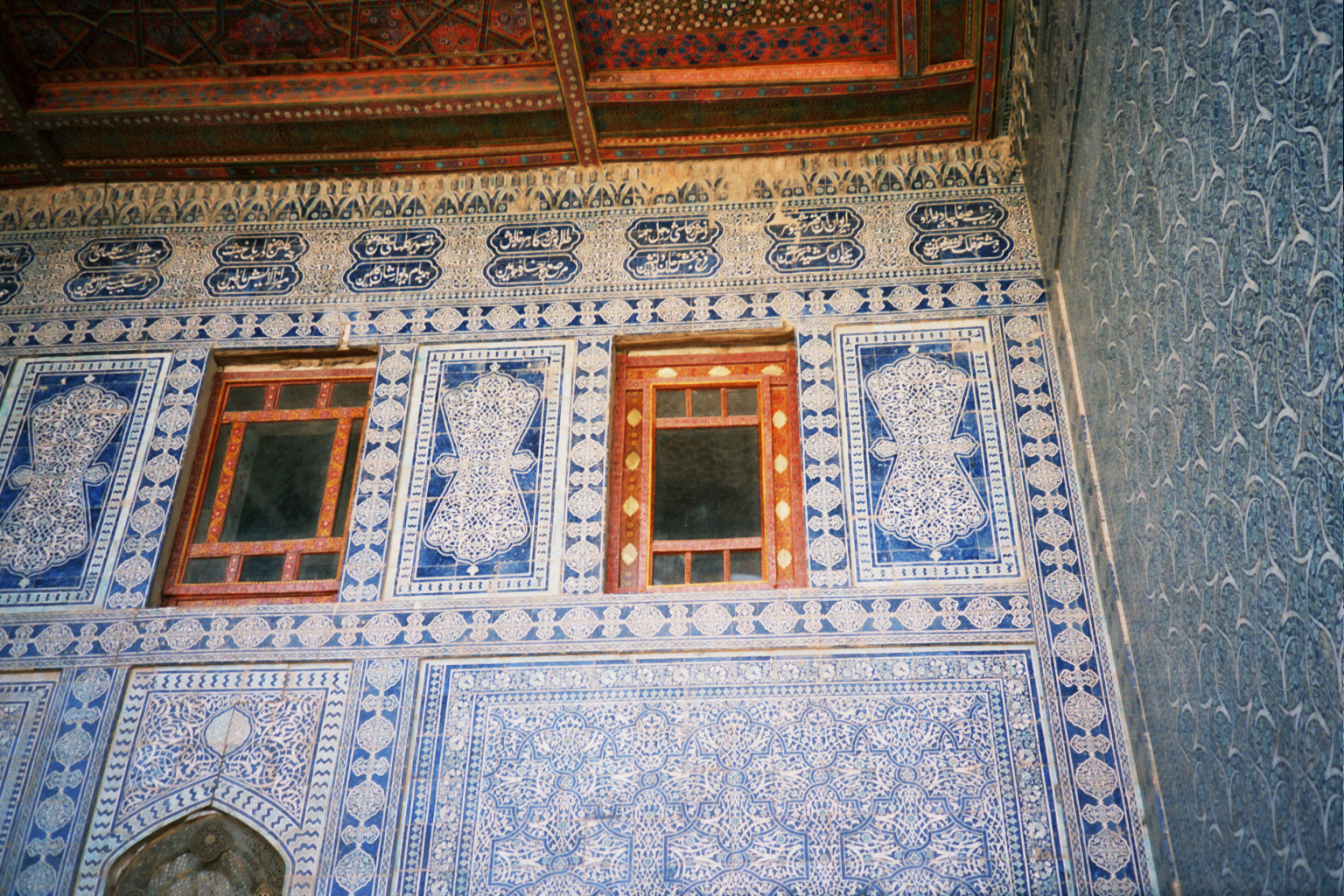
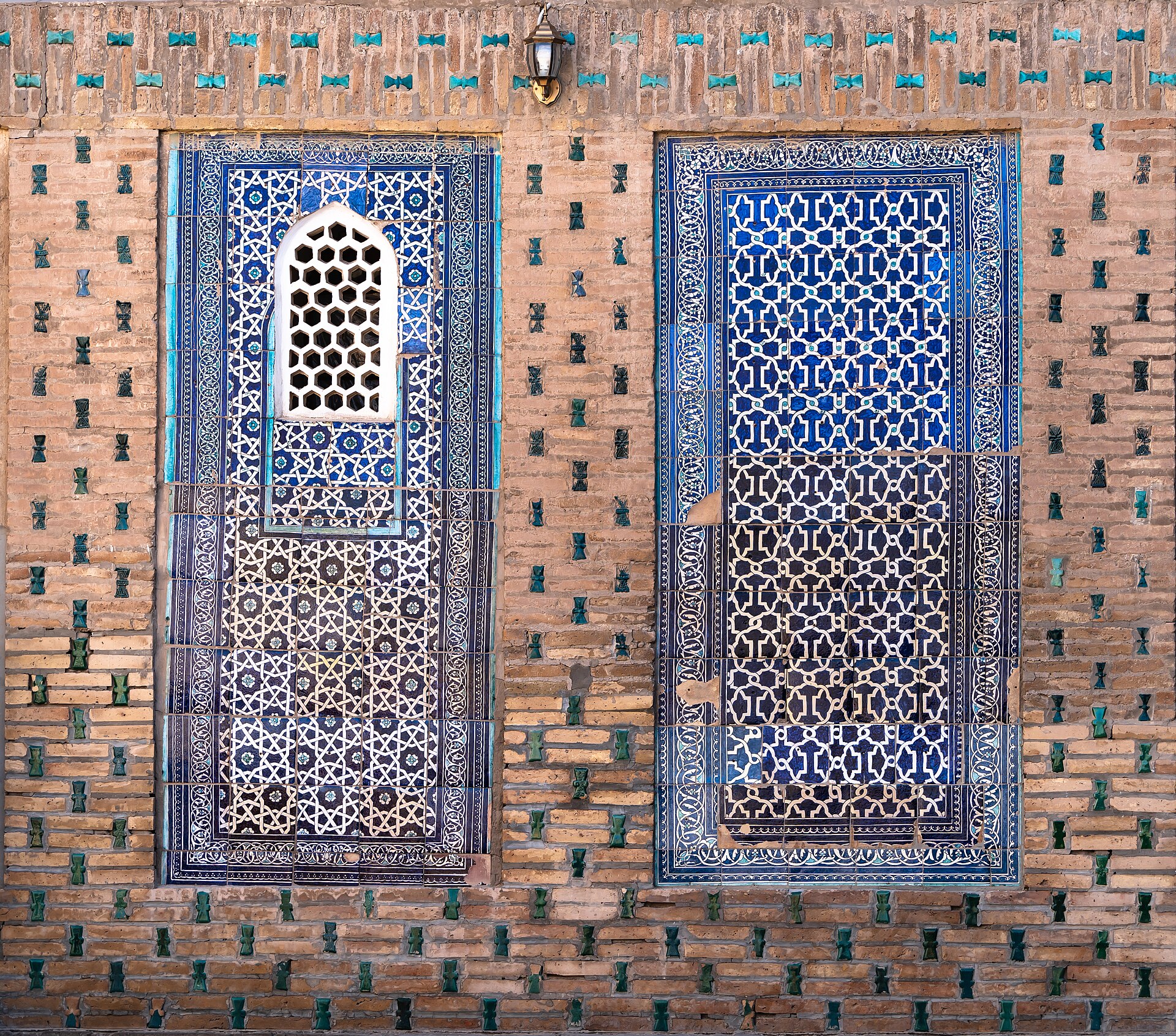
The glory of the Tash Hauli is its tilework, and no description quite prepares you for it. The walls of the aivans and courtyards are sheathed in glazed ceramic tiles in a palette dominated by deep blues and clean whites, worked into intricate floral and geometric patterns that cover every available surface.

This is the majolica tradition of Khorezm at its peak, a craft with deep roots in the region and across the Persian and Central Asian world. The tiles were made and glazed locally, and their designs, endlessly varied yet harmonious, draw on a vocabulary of stylized flowers, vines, medallions, and interlaced geometry refined over many centuries.
In keeping with Islamic tradition, the ornament contains no depictions of living beings, and yet it never feels austere. The craftsmen achieved extraordinary richness through pattern alone, layering motifs and framing them within borders and panels so that each wall becomes a composition in its own right, endlessly rewarding to the eye that lingers.
The blue and white scheme has a particular resonance in this desert setting. Against the tawny mud brick of the city and the brown of the surrounding sands, the cool blues of the tilework evoke water and sky, the most precious things in an arid land, turning the courtyards into refreshing oases of color as well as of shade.
Preserved remarkably well, this tilework is the reason the Tash Hauli ranks among the great decorated interiors of the Islamic world. It represents a high point of a regional craft that has since become emblematic of Uzbekistan, and it remains, nearly two centuries on, as vivid and precise as the day the khan’s artisans set it in place.
Try, if you can, to visit the tiled courts at different times of day. In the flat light of noon the blues read as cool and crisp, almost clinical in their precision, while in the golden hour before sunset the same walls warm and deepen until the whole courtyard seems to glow from within. The tilework was made for this shifting desert light, and a single visit at a single hour shows you only a fraction of what these walls can do.
Carved Wooden Columns
If the tilework draws the eye outward across the walls, the wooden columns draw it upward. The aivans are roofed by ceilings borne on tall, slender columns of carved wood, their shafts worked with fine ornament and their capitals swelling into the stalactite forms beloved of Islamic architecture.

Wood-carving is one of the signature crafts of Khiva, and the columns of the Tash Hauli are among its finest surviving examples. In a land poor in good timber, worked wood was precious, and the care lavished on these columns reflects both the value of the material and the skill of the Khorezmian carvers who shaped it.
Each column typically rises from a carved stone base, a practical detail that protected the vulnerable wood from ground damp, and tapers upward through bands of ornament to its elaborate capital. The combination of stone foot, carved shaft, and stalactite capital is a recurring signature of Khivan architecture found throughout the old city.
The columns do more than hold up roofs; they set the mood of the aivans. Their verticality lifts and lightens the deep tiled alcoves, and the play of light across their carved surfaces changes through the day, so that the same column can seem austere in the morning and richly textured in the raking light of late afternoon.
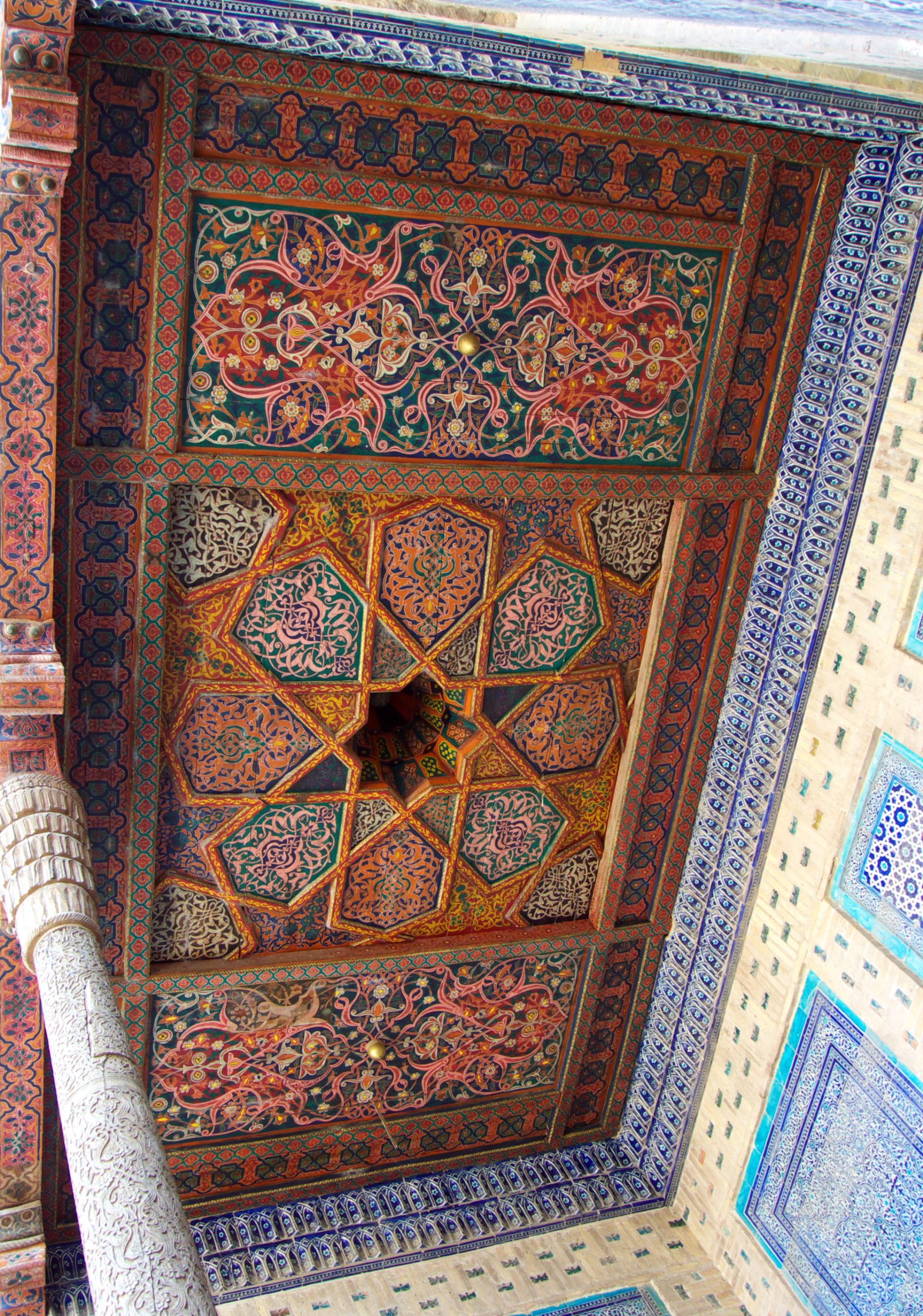
Together with the painted ceilings they support, these columns complete the decorative program of the palace. Between the tiled walls below and the painted timber above, the aivans surround the visitor with ornament on every plane, an immersive richness that is the essence of the Tash Hauli experience.
Run your eye down a single column and you can read the whole ethic of Khivan craft in miniature. Nothing is left plain that could be carved, yet nothing is merely busy; each band of ornament is disciplined, resolved, and in proportion to the whole. This is decoration as a form of intelligence, the patient working-out of pattern across a surface, and it is the same intelligence that governs the tilework and the painted ceilings around it.
Courts of Audience and Rule
Beyond the private harem lay the courtyards where the khan conducted the public business of his state, receiving officials and dignitaries and administering the affairs of the khanate. These reception areas were the working government quarters of the palace, distinct in function from the domestic world of the harem.
Here the khan met envoys and subjects amid decoration scarcely less rich than that of the private quarters, for the splendor of the setting was itself an instrument of rule. A ruler who received visitors in courtyards blazing with tilework impressed upon them the wealth and sophistication of his court and, by extension, his power.
The administration of the khanate, the collection of taxes, the command of its forces, and the dispensing of justice all flowed ultimately from the ruler, and these courts were where that authority became visible. The khan of Khiva held sweeping power over his subjects, and the palace was designed to express and reinforce it.
As at Bukhara, there was no separation between the religious and the political. The khan ruled a Muslim state in which religious law and scholarship carried great weight, and his legitimacy depended in part on his role as protector of the faith and patron of the city’s many madrasas and mosques.
These reception courts remind the visitor that the Tash Hauli was not only a beautiful home but the seat of a government. Behind the enchanting surfaces lay the hard machinery of a desert monarchy, and the same walls that sheltered the khan’s family also witnessed the exercise of his considerable and sometimes ruthless power.
The Court of Justice
One of the three main courtyards of the palace was devoted to the administration of justice, the arena where the khan sat in judgment over the disputes and crimes of his subjects. In a state where the ruler was the ultimate source of law, this was among the most consequential functions the palace housed.

Here the khan, or officials acting in his name, heard cases and pronounced verdicts, and his word carried the full and final weight of the state. Justice in the khanate could be swift and, by modern standards, harsh, blending religious law with the ruler’s personal authority in a manner typical of the region’s monarchies.
The courtyard set aside for these proceedings was, like the rest of the palace, richly decorated, its beauty forming a deliberate backdrop to the solemn business conducted there. The splendor of the setting lent an aura of majesty to the ruler’s judgments, reinforcing the idea that his authority was something grand and inescapable.
A raised platform within the court is traditionally identified as the place where the khan’s yurt could be pitched, a striking reminder of the dynasty’s nomadic heritage. Even in this most settled and ornate of palaces, the memory of the tent and the steppe was preserved, a link to the ruling house’s origins.
That detail captures something essential about the Tash Hauli and the khans who built it. They were heirs to a nomadic, steppe tradition who had become rulers of a settled oasis civilization, and their palace fused the two worlds, raising a place for the royal tent within courtyards sheathed in the tilework of an ancient urban art.
The Khan’s Throne and Ceremony
At the ceremonial heart of the palace stood the khan’s throne, the focus of the audiences and rituals through which the ruler displayed his majesty. The throne of Khiva was a famous object, richly worked and later carried off, and its setting within the tiled courts was arranged to concentrate all attention on the seated ruler.

Court ceremony in Khiva followed the patterns common to the Islamic monarchies of Central Asia, with the ruler enthroned amid a ranked and robed court, receiving the homage of his officials and the petitions of his subjects. The elaborate protocol served to place the khan at the symbolic center of his realm, the point from which order flowed.
The khan appeared on great occasions in the splendid dress of the Central Asian courts, heavy robes of patterned silk that signaled his rank and wealth. Such garments, like the palace itself, were tools of statecraft, meant to overawe and to make visible the gulf between the ruler and the ruled.
Ceremonial life was bound to the religious calendar as well as to the business of state, with festivals, receptions, and observances filling the year. The palace provided the stage for all of it, its courtyards and aivans serving now for private family life, now for the public rituals of monarchy.
The original throne no longer stands in the palace, having been taken as a trophy in the upheavals of the region’s history, but its former presence still shapes how one reads the ceremonial courts. This was where a desert monarchy performed its own grandeur, and the surviving setting lets the visitor imagine the vanished spectacle.
Life Within the Walls
The Tash Hauli housed a substantial community, not only the khan and his wives but their children, relatives, servants, guards, and attendants, a whole household living its days within the enclosed courtyards. The palace was a small world unto itself, largely sealed from the city beyond its walls.
Daily life followed the rhythms of the desert and the faith. The fierce heat of summer drove people into the shaded aivans and cool interiors during the day, while the milder hours of morning and evening brought the courtyards to life. The calls to prayer from the city’s minarets marked the passage of time.
For the women of the harem, life unfolded almost entirely within these walls, structured by custom, rank, and the domestic order of the household. Their world, though enclosed, was not empty of comfort or beauty; they lived amid some of the finest craftsmanship the khanate could produce, in apartments that were luxurious by any standard.
Servants and craftsmen kept the palace running, maintaining its fabric, preparing its food, and tending to the needs of the ruling family. The presence of workshops and service areas made the complex substantially self-sufficient, a characteristic it shared with the great fortress-palaces of the region.
This inward, enclosed life is written into the very architecture. The blank outer walls, the deep private courtyards, the shaded aivans all speak of a household that lived turned away from the street, finding its beauty and its social world within, in a manner that shaped the experience of everyone who dwelt there.
To sense this today, it helps to stand quietly in one of the courtyards and simply watch the light and shadow move across the tiles. In that stillness the palace stops being a museum and becomes, for a moment, a home again, and you can almost hear the hum of the household that once filled these silent, glowing courts.
The Crafts of Khorezm
The Tash Hauli is a showcase for the traditional crafts of Khorezm, the region around Khiva, and understanding those crafts deepens the appreciation of the palace. Tile-making, wood-carving, and decorative painting reached extraordinary heights here, sustained by generations of master artisans passing their skills down within families and workshops.

The tile-makers worked in the majolica technique, shaping and glazing ceramic to produce the brilliant blue and white surfaces that define the palace. Achieving consistent color and durable glaze across such vast areas demanded deep technical knowledge, and the survival of the tilework in such fine condition is a testament to their mastery.
The wood-carvers turned scarce timber into columns, doors, and screens of remarkable delicacy. Khiva is famous for its carved wooden doors and columns, and the craft continues in the city today, with artisans still producing work in the old manner for visitors who come to admire the tradition that built the palace.
Behind both crafts lay a shared design sensibility, a vocabulary of stylized plant forms, geometry, and calligraphic and abstract ornament that unified the decoration of the whole complex. This coherence is part of what makes the palace so satisfying; tile, wood, and paint all speak the same visual language.
These crafts were not confined to the palace but adorned the mosques, madrasas, and mausoleums throughout Khiva, making the whole city a museum of Khorezmian art. The Tash Hauli is the crown of that tradition, the place where the region’s finest makers were gathered to produce a single, concentrated masterpiece.
The Palace as Museum
Today the Tash Hauli is preserved as a museum within the larger open-air museum that is the Ichan Kala of Khiva. Its courtyards and aivans are open to visitors, and some of its rooms house displays that illuminate the history of the khanate and the life of its court.

The exhibits gather objects of Khivan court and daily life, from craftwork and costume to the tools of governance and trade, helping visitors reconstruct the vanished world of the khanate. Set within the very rooms where that world was lived, the collections gain an immediacy that a conventional museum could never match.
The palace forms part of a ticketed ensemble that includes many of Khiva’s monuments, and it is one of the highlights that draws travelers from around the world to this remote desert city. Its fame rests above all on its decoration, which photographs cannot fully convey and which rewards a visit in person.
Conservation of the tilework and timber is an ongoing responsibility, for these materials, however well made, require care to survive the extremes of the desert climate and the pressure of large numbers of visitors. The work of maintaining the palace continues the tradition of the craftsmen who first created it.
As a museum the Tash Hauli does more than display objects; it preserves an atmosphere. To walk its courts is to be immersed in the aesthetic world of the Khivan court, an experience that no case of artifacts alone could provide, and that makes the palace itself the greatest exhibit it contains.
Compared with the ruined interiors of so many royal residences elsewhere in the world, the state of preservation here is almost startling. Because Khiva was remote and its monuments were spared the worst of modern redevelopment, the Tash Hauli comes down to us with much of its decoration intact, giving the visitor something rare, a nineteenth-century Central Asian palace interior that can still be experienced more or less as its makers intended.
The Tash Hauli Today
The fall of the Khivan khanate came in stages. In 1873 the khanate was forced to submit to the Russian empire, becoming a protectorate that kept its khan but lost its independence, and in 1920, in the aftermath of the Russian Revolution, the monarchy was abolished altogether and the last khan deposed.

View the exact location on Google Maps
With the end of the khanate the Tash Hauli ceased to be a living seat of power and became a relic of a vanished state. The Soviet era brought its own upheavals to Khiva, but it also eventually brought recognition of the extraordinary heritage the city preserved, and steps to protect it as a monument.
In 1990 the Ichan Kala of Khiva was inscribed on the UNESCO World Heritage List, the first site in Uzbekistan to receive that honor, recognized as an outstandingly complete example of the Islamic architecture of Central Asia. The Tash Hauli stands among the treasures that earned the old town this distinction.
For modern Uzbekistan, Khiva and its palace are sources of pride and pillars of a growing tourism that brings the world to the edge of the Kyzylkum desert. The image of the walled city, with its minarets and tiled interiors, has become one of the defining pictures of the country’s rich past.
To stand in the harem courtyard of the Tash Hauli, surrounded by walls of blue and white beneath carved columns and a desert sky, is to grasp what the khans of Khiva achieved in their remote oasis. Their state is long gone, but the beauty they commanded endures, a jewel box of a palace preserved almost intact at the world’s edge.
If your travels bring you to Uzbekistan, the Tash Hauli deserves to be seen unhurried and, ideally, more than once, early and late, so that the changing light can show you its full range. Khiva is a small place and its monuments lie close together, which makes it easy to return to a favorite courtyard, and few travelers who give the palace that kind of time come away without counting it among the most beautiful interiors they have ever entered.
Palaces Nearby
The Tash Hauli belongs to a family of great Central Asian royal residences. Travel south to the towering citadel of a rival khanate, and watch this space for another palace of the region to join them soon.
You May Like
The Palaces of Orchha: A Bundela Capital on the Betwa