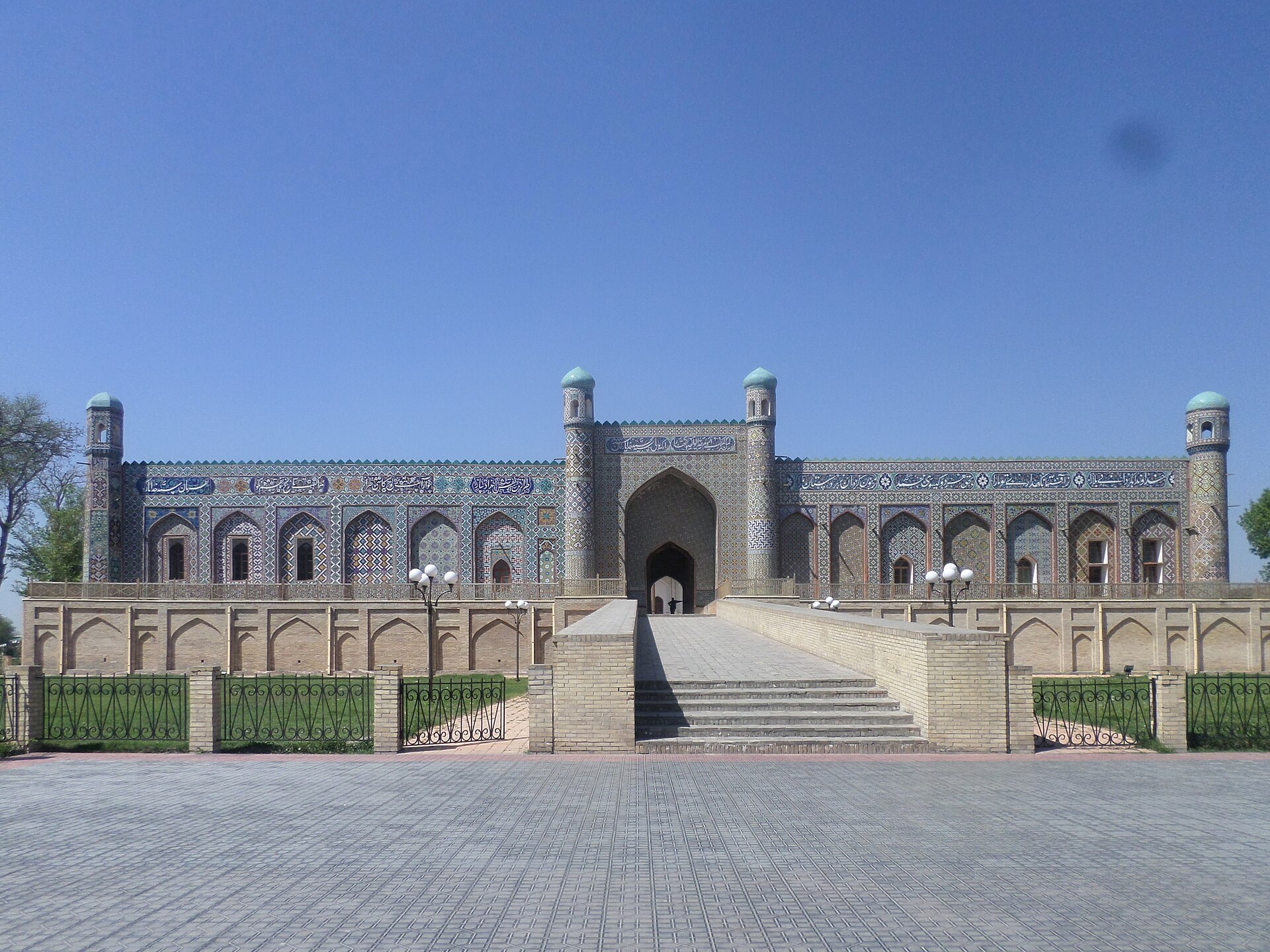
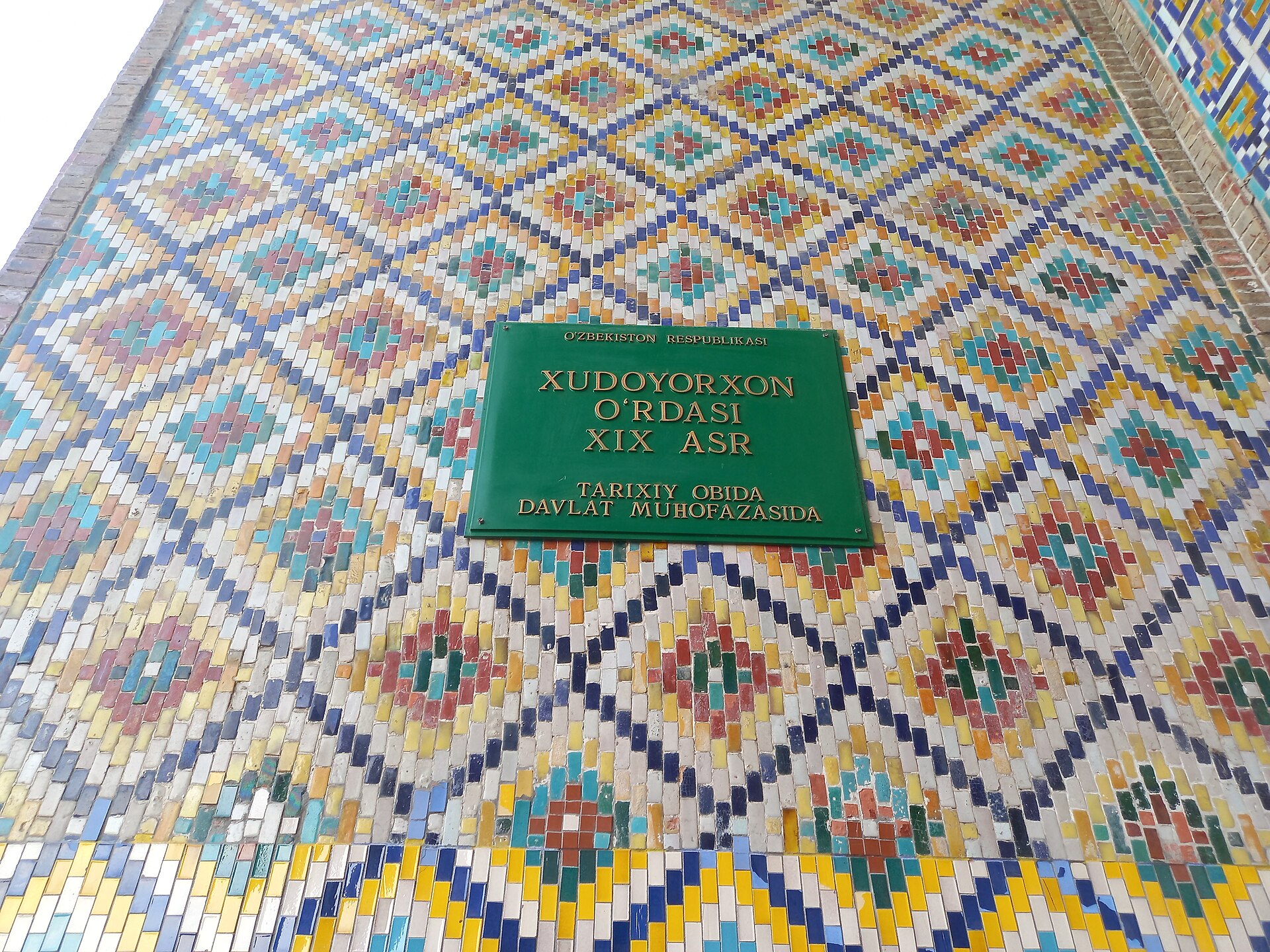
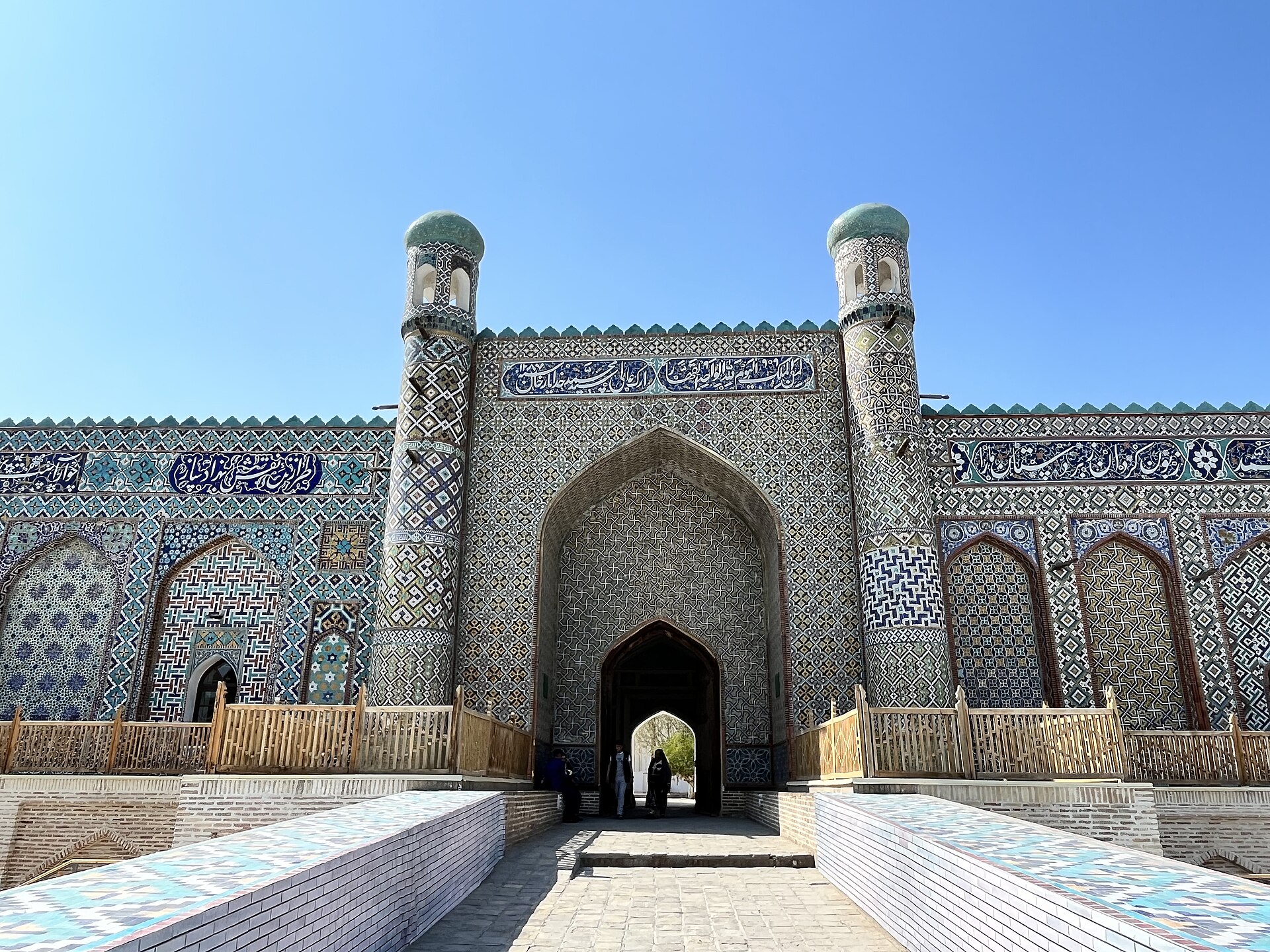
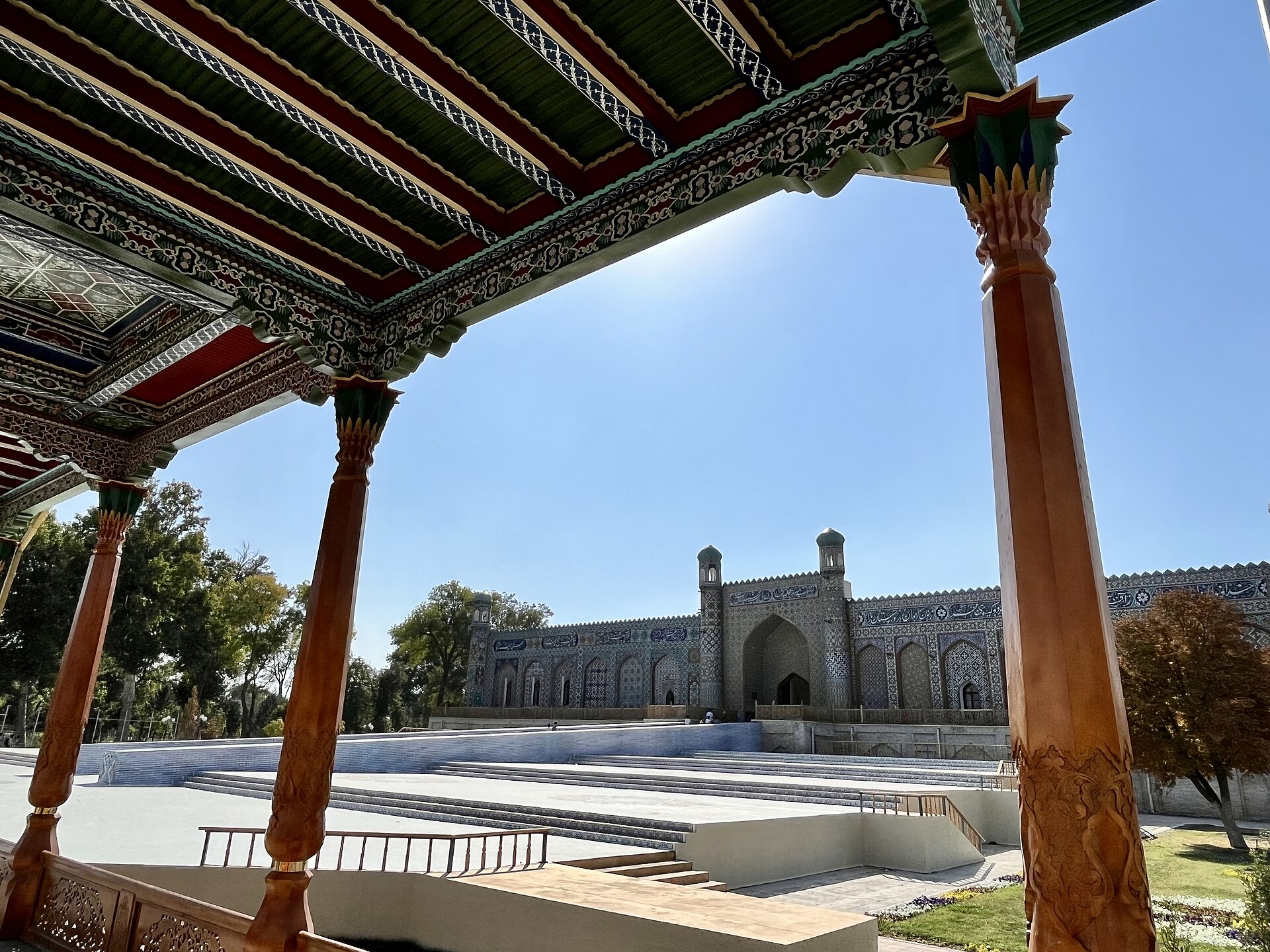
In the town of Kokand, in the fertile Fergana Valley of eastern Uzbekistan, a long tiled facade rises above a broad approach like a wall of jewelry. This is the Palace of Khudayar Khan, the last great residence of the rulers of the Khanate of Kokand, and its front is one of the most spectacular pieces of nineteenth-century decoration anywhere in Central Asia. A ramp leads up to a towering portal, and the whole face of the building glows with intricate ceramic ornament in blue, green, and gold.
The Fergana Valley is one of the garden regions of Central Asia, a densely populated bowl of irrigated land ringed by mountains, and Kokand was its capital in the age of the khans. Where Bukhara concentrated its power in a grim fortress and Khiva hid its splendor behind blank walls, Kokand chose to put its magnificence on open display, in a palace whose glittering facade announces the wealth and ambition of its builder to anyone who approaches.
The palace is the third of the great Central Asian royal residences in this series, alongside the Ark of Bukhara and the Tash Hauli of Khiva, and together the three tell the story of the last independent states of the region before the Russian conquest. Each was the seat of one of the three khanates that shared the land, rivals in politics and in the arts, and each expressed a different vision of what a ruler’s home should be.
Built in the 1860s and 1870s at the very end of Kokand’s independence, the palace is a monument to a state that was about to disappear. Its builder, Khudayar Khan, raised it as a proud statement of his power in the last years before the khanate fell to Russia, and the result is at once a triumph of Central Asian craftsmanship and an elegy for a world that was ending. To visit it is to see the final flowering of the Kokand court, preserved in tile and timber.
In This Article
- A Palace Built for Display
- The Khanate of Kokand
- Khudayar Khan
- The Great Tiled Facade
- The Ramped Approach and Portal
- Courtyards and Chambers
- The Hall of Audience
- The Private Quarters
- Painted Ceilings and Carved Wood
- The Artisans of the Fergana Valley
- Treasury, Mint, and Government
- The Palace as Museum
- The Palace Today: A Vanished Khanate Remembered
A Palace Built for Display
The Palace of Khudayar Khan, known locally as the Urda, was conceived on a grand scale, a walled complex that in its heyday contained a great many rooms and a series of courtyards, filling a substantial site in the heart of Kokand. It was the residence of the ruler and the seat of his government, the political center of the khanate.
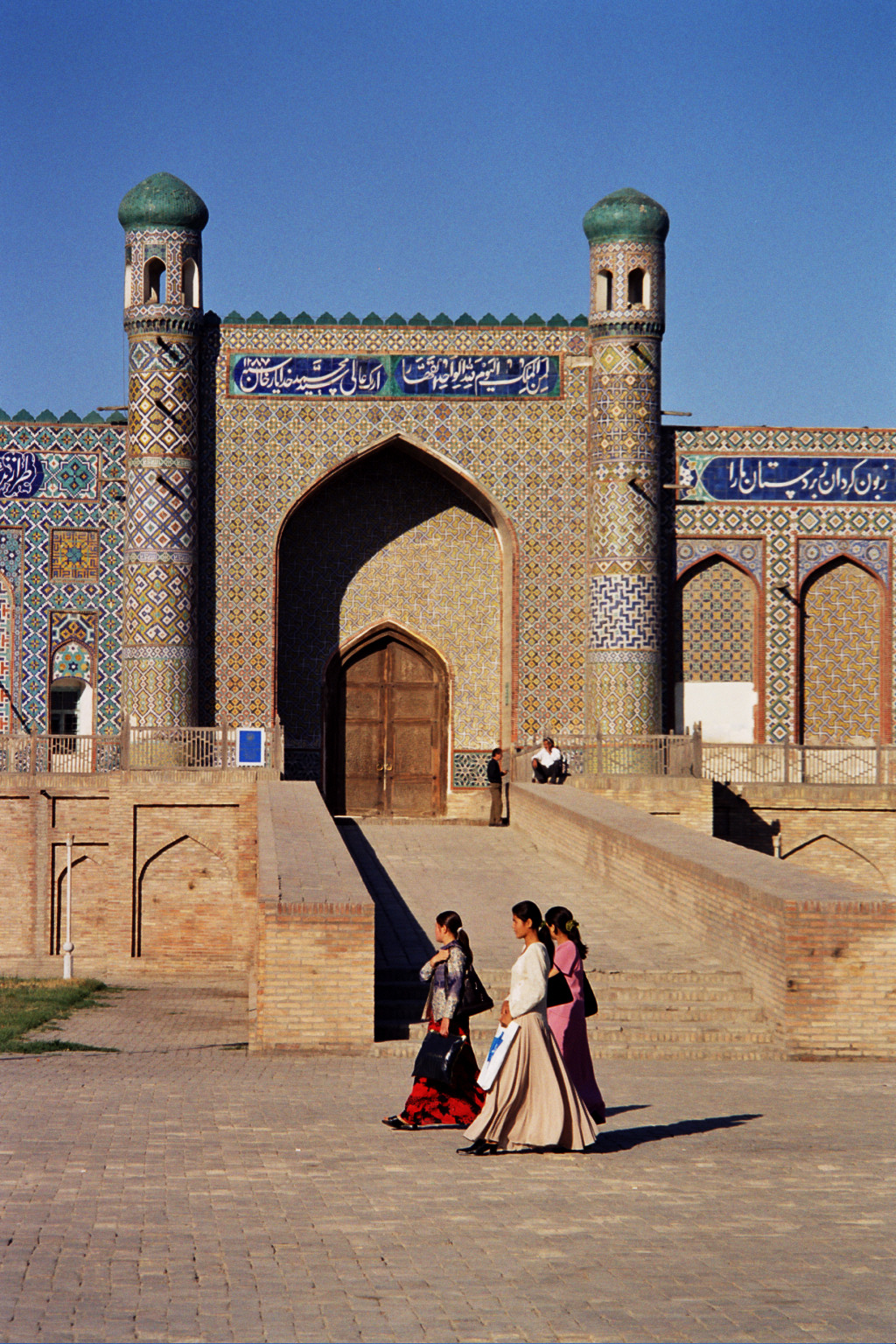
Unlike the inward-facing Tash Hauli, this palace makes a bold external statement. Its long facade, raised above a ramped approach, was designed to be seen and admired from the open ground before it, presenting a public face of dazzling richness to the world in a way that few residences of the region attempted.
Behind that facade the palace was organized around courtyards, with the ceremonial and public rooms toward the front and the private quarters set deeper within. The arrangement separated the world of state and audience from the domestic world of the household, a division common to the palaces of the region.
The original complex was larger than what survives today. Much was lost in the upheavals that followed the Russian conquest and in the changes of the century that followed, so that the palace now standing, impressive as it is, represents only a part of the sprawling residence that Khudayar Khan actually built.
What remains, above all the great facade and a series of restored rooms, is enough to convey the ambition of the whole. This was a palace meant to overawe, to proclaim the wealth and legitimacy of a ruler through the sheer splendor of his surroundings, and even in its reduced state it still performs that function for the modern visitor.
Setting the three great khanate palaces side by side, as this series does, turns each into a comment on the others. Bukhara’s Ark is all defensive mass, Khiva’s Tash Hauli all hidden interior richness, and Kokand’s Urda all outward, triumphal display. Three neighboring states, closely related in faith, language, and craft, each chose a strikingly different way to house and glorify its ruler, and the contrast is one of the pleasures of coming to know them together.
The Khanate of Kokand
The Khanate of Kokand was the third of the great Central Asian states of the eighteenth and nineteenth centuries, ruling the Fergana Valley and, at its height, a wide territory beyond it. Founded in the eighteenth century, it grew into a wealthy and populous power, its capital at Kokand a center of trade, craft, and Islamic learning.
The Fergana Valley gave the khanate a rich agricultural base, and its position astride trade routes brought further wealth. At its greatest extent Kokand controlled lands reaching toward the Tian Shan mountains and the steppes beyond, making it for a time a serious rival to its neighbors Bukhara and Khiva.
Like the other khanates, Kokand was a Muslim monarchy in which the ruler combined temporal power with the role of protector of the faith, and religious scholarship carried great weight. The capital was famous for its many mosques and madrasas, and the khanate prided itself on its piety and its learning.
The nineteenth century, however, brought the relentless advance of the Russian empire from the north. Kokand lay directly in the path of that expansion, and through a series of campaigns the Russians steadily reduced the khanate’s territory and independence, drawing it into the great imperial contest that gripped all of Central Asia.
By the 1870s the khanate was in crisis, torn by internal revolt and battered by Russian pressure, and its days were numbered. The palace of Khudayar Khan was built in these last years, a splendid assertion of sovereignty raised even as the state that produced it was sliding toward its end, which lends the whole building a poignant historical weight.
Khudayar Khan
The palace is named for Khudayar Khan, the ruler who built it and the last khan of Kokand to reign in its independent years. His was a turbulent career, marked by repeated risings to power and falls from it, as he was deposed and restored more than once amid the factional struggles that convulsed the khanate.

Khudayar Khan ruled a state under mounting strain, caught between internal rivals and the advancing Russians, and his reign was anything but secure. Yet in the midst of this instability he undertook the building of a magnificent palace, an act of confidence, or perhaps of defiance, in the face of the gathering storm.
The palace was intended to glorify his rule and to project an image of wealth, legitimacy, and permanence. In an age when the visible splendor of a court was a genuine instrument of politics, a residence of such dazzling richness was meant to impress subjects, rivals, and foreign envoys alike with the greatness of the khan.
His fortunes did not match his ambitions. Faced with revolt and Russian intervention, Khudayar Khan was finally driven from his throne in the mid-1870s, and the khanate itself was abolished shortly after, absorbed into the Russian empire. The ruler ended his life in exile, far from the palace he had raised.
That the palace outlived the ruler and the state it was built to serve gives it a particular resonance. Khudayar Khan vanished into exile and his khanate into empire, but the glittering facade he commissioned still stands, a more lasting monument to his reign than the crown he lost, and the enduring symbol of a vanished kingdom.
There is a melancholy symmetry in the story of Khudayar Khan and his palace. He poured the wealth of a threatened state into a building meant to proclaim its permanence, and within a few years both he and the state were gone. The palace stands as a lesson in the limits of splendor as a defense against history, and also as proof that beauty can outlast the power that produced it, becoming in the end its truest memorial.
The Great Tiled Facade
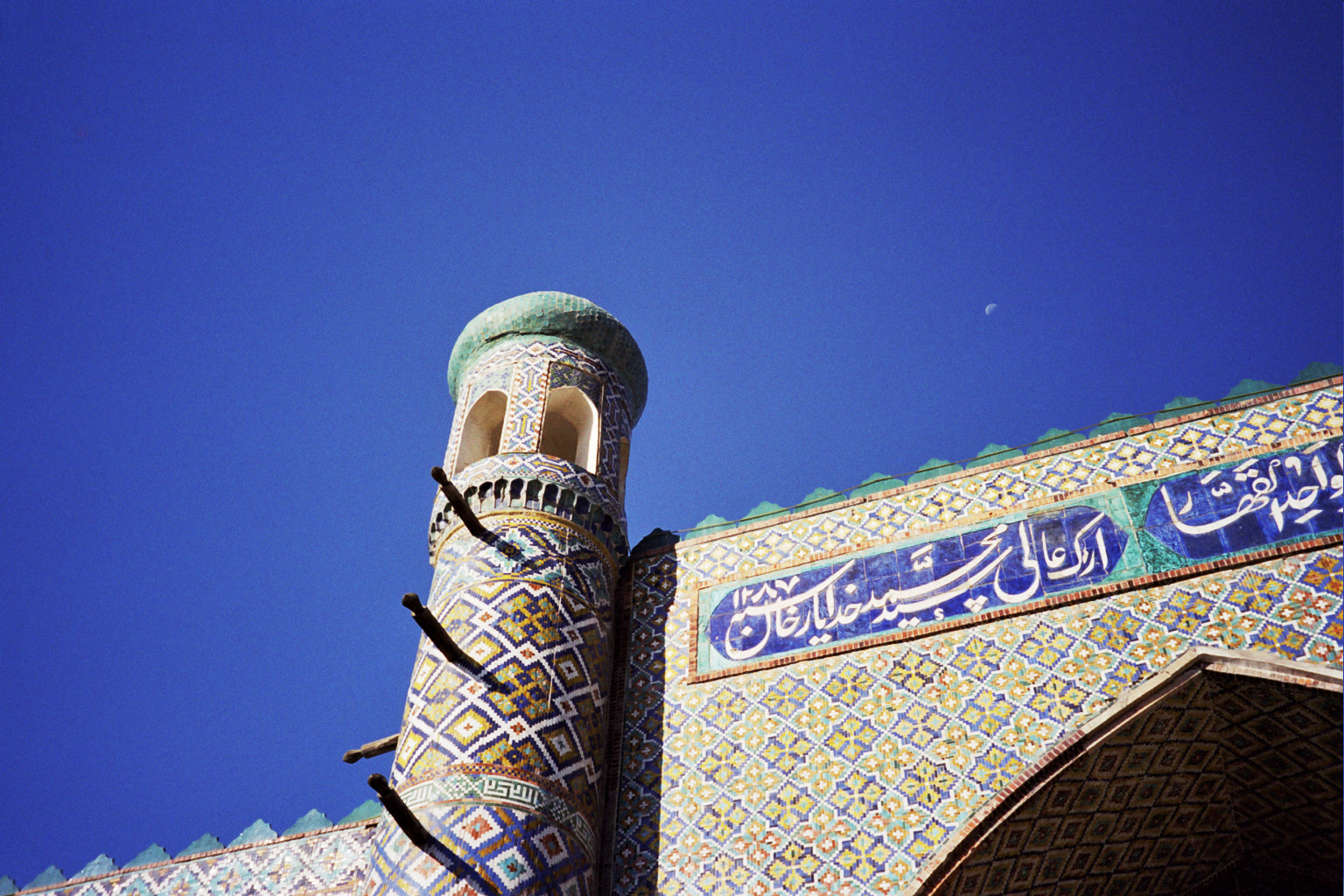
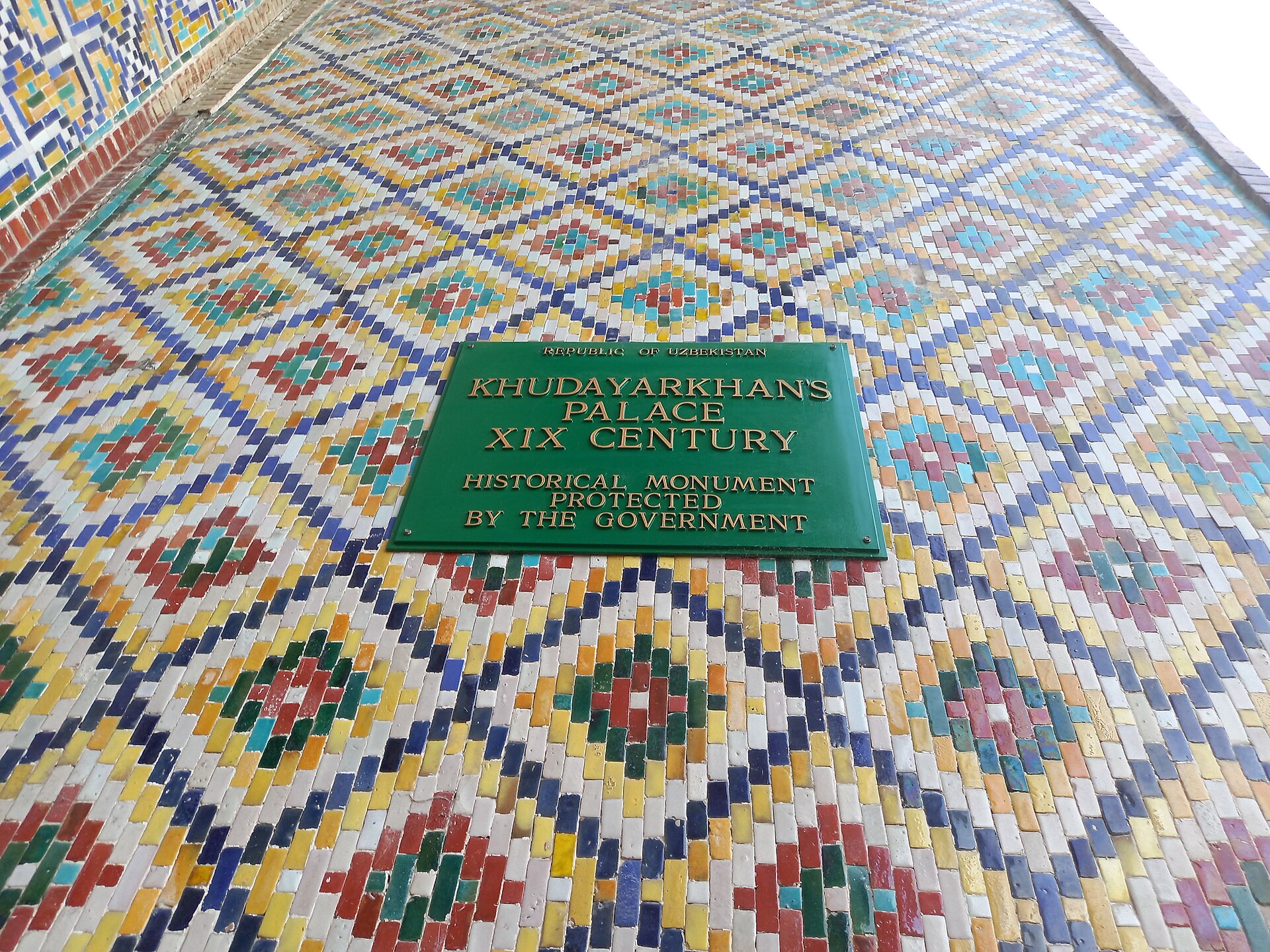
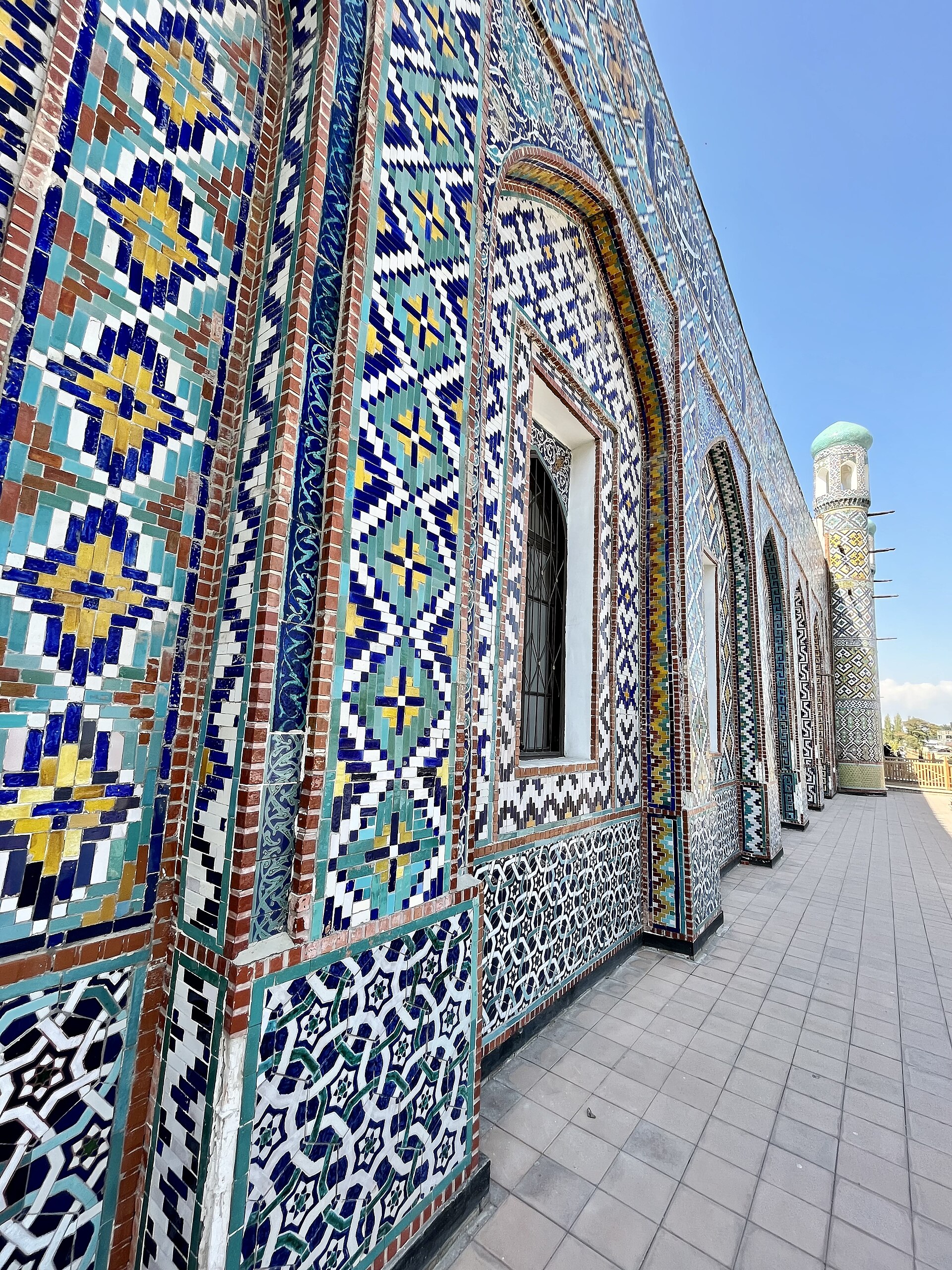
The glory of the palace is its facade, a long, high wall of ceramic decoration that ranks among the masterpieces of Central Asian architecture. Stretching for many meters and rising to a monumental central portal, it presents an almost unbroken field of glazed tile, its patterns worked in blue, green, white, and touches of gold.
The decoration combines the characteristic vocabulary of the region, stylized floral and vegetal motifs, geometric interlace, and bands of ornament, composed into a coherent and overwhelming whole. In keeping with tradition the ornament avoids the depiction of living creatures, achieving its richness entirely through pattern and color.
The central portal, or pishtaq, rises above the rest of the facade as the ceremonial focus of the whole composition. High and deeply recessed, framed by bands of tilework, it marks the main entrance and draws the eye and the visitor toward it, a monumental gateway into the world of the khan.
The scale of the tilework is what astonishes. To cover so vast a surface with ornament of such fineness and consistency required an army of skilled craftsmen and a huge investment of resources, and the achievement stands as a testament to the wealth of the khanate and the mastery of the Fergana Valley’s artisans.
Seen in the changing light of the day, the facade shifts in character, its glazes catching the sun and its patterns emerging and receding as the shadows move. It is the single most photographed and admired feature of the palace, and rightly so, for there are few more spectacular walls in all of Central Asia.
It is worth simply standing still before the facade for a while, letting the eye wander without trying to take in everything at once. The ornament is organized into panels and bands, and the longer you look, the more the underlying order emerges from what at first seems overwhelming profusion. This is the particular gift of the best Central Asian tilework, that it can read as sheer dazzle from a distance and as disciplined, legible composition up close.
The Ramped Approach and Portal
The palace is approached up a broad ramp that leads to the great portal, an arrangement that lifts the building above the surrounding ground and heightens the drama of arrival. Climbing toward that towering, tile-clad gateway, a visitor is made to feel the majesty of the ruler before ever setting foot inside.
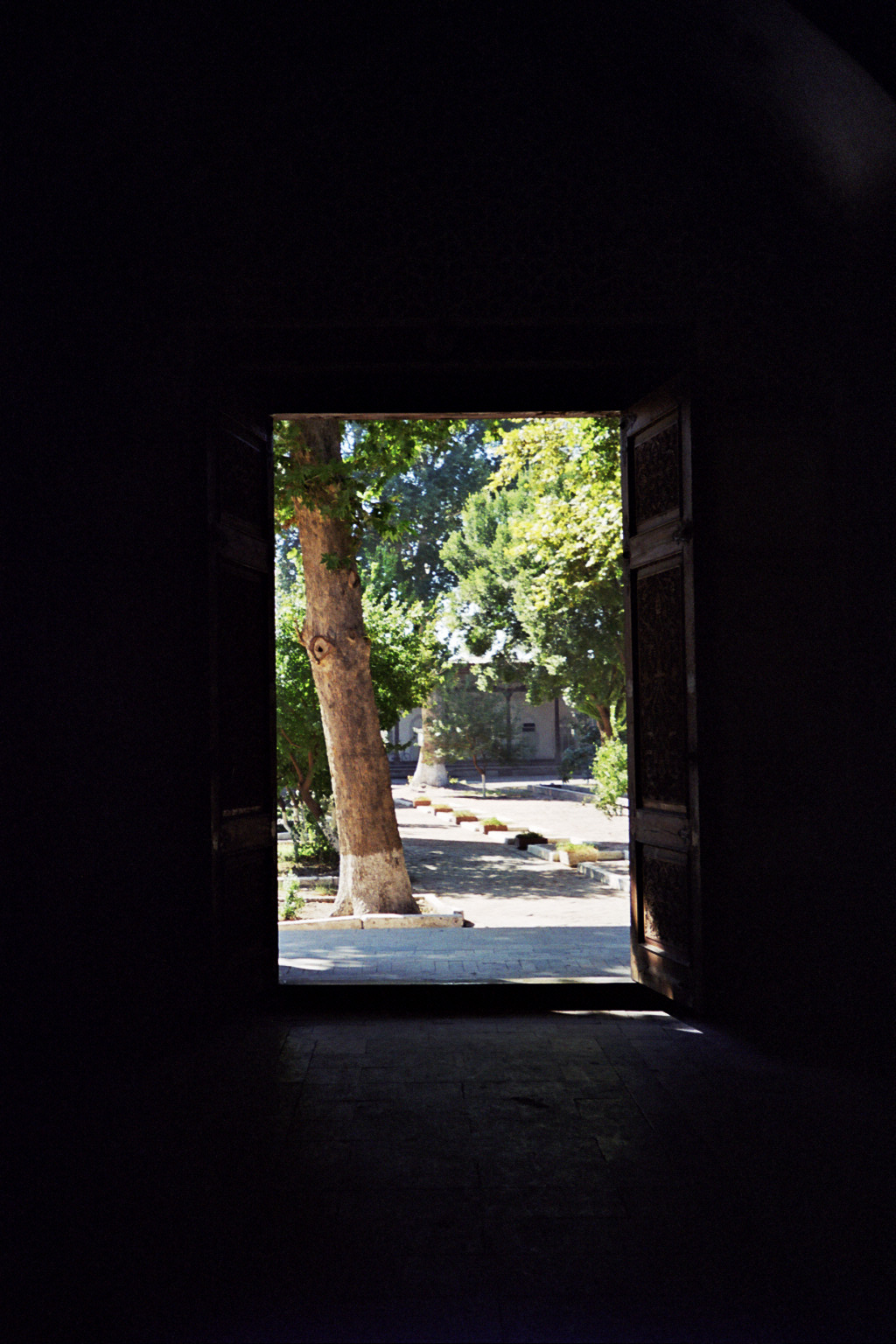
The ramp served both practical and symbolic ends. It gave access to a palace raised on a platform, and it staged the visitor’s approach as a deliberate ascent toward power, a common device in the architecture of monarchy, where the physical climb toward the ruler mirrors his elevation above ordinary people.
The portal at the top is the ceremonial threshold of the whole complex. Passing beneath its high arch, framed on every side by the brilliant tilework of the facade, the visitor crosses from the public space of the approach into the enclosed world of the palace courtyards, leaving the ordinary town behind.
This staged, ascending approach distinguishes the Kokand palace from its neighbors. Where the Ark of Bukhara channeled visitors up a dark defensive passage and the Tash Hauli drew them through modest doorways into hidden courts, Kokand made the approach itself a spectacle, an open and triumphal procession toward the shining facade.
The effect, even today, is considerable. To walk up the ramp toward the great portal, with the tiled facade filling your vision, is to experience the palace as its builder intended, as a monument designed to impress and to elevate, announcing the presence of the khan through the grandeur of his gate.
Notice, as you climb, how differently this palace treats the visitor from the fortress-citadels of the region. There is no dark tunnel, no sense of being funneled toward a guarded interior under watchful eyes. Instead the approach is broad, bright, and open, an invitation to admire rather than a warning to submit, and that openness tells you something about how Kokand wished to present its power, as magnificence to be witnessed rather than force to be feared.
Courtyards and Chambers
Beyond the portal the palace opens into a sequence of courtyards around which its many rooms were arranged. In its complete form the residence contained a large number of chambers grouped into courts, each with its own function, from public reception to private domestic life, linked into a single sprawling complex.
The courtyards organized the life of the palace, separating the ceremonial and governmental front from the private quarters behind. This progression from public to private, from the world of state to the world of the household, structured the visitor’s movement through the palace and reflected the ordered hierarchy of the court.
The rooms around the courts served every need of the ruler and his establishment, halls of audience and justice, offices of administration, the treasury and mint of the khanate, and the residential apartments of the khan and his family. The palace was a seat of government as much as a home.
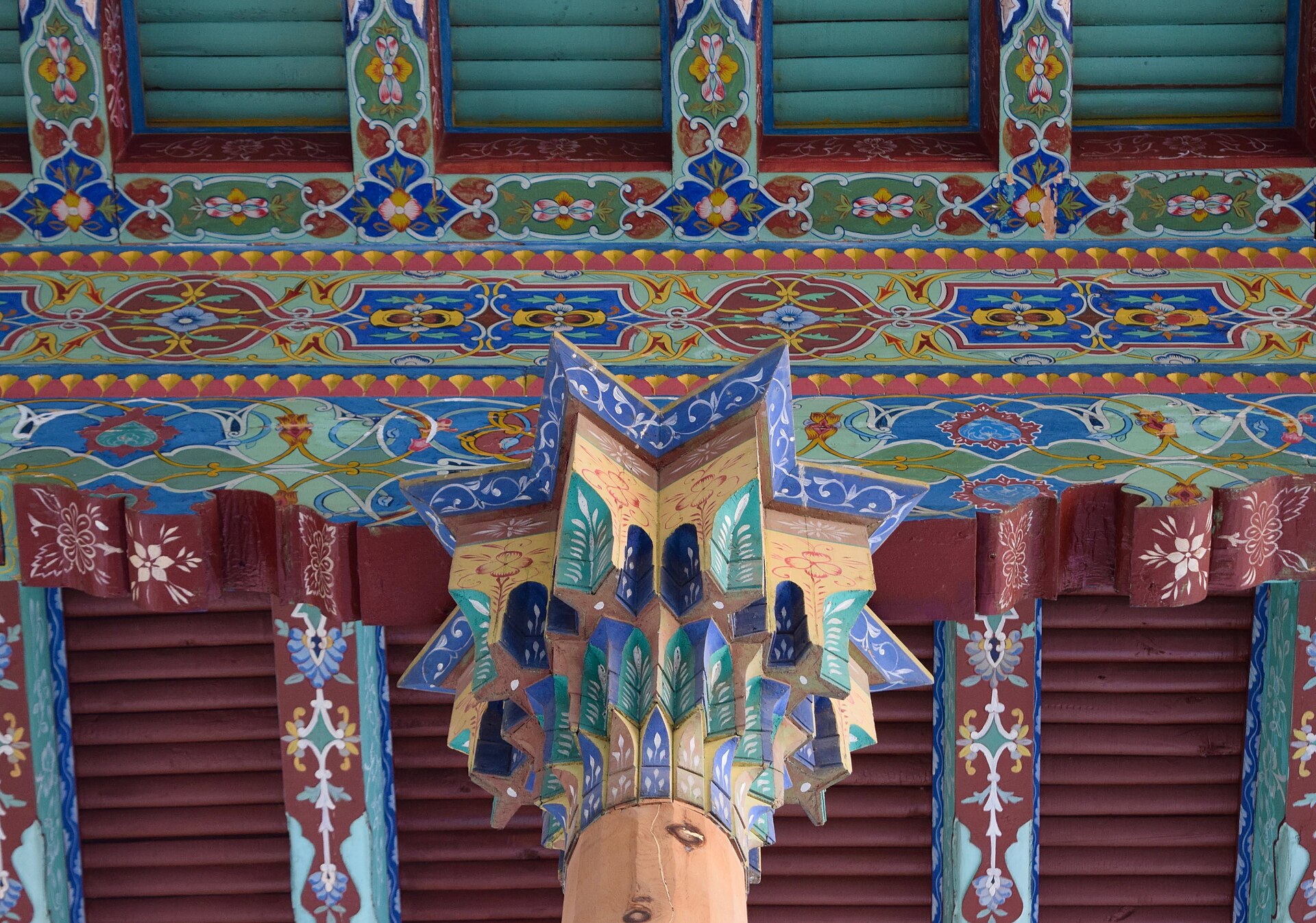
Many of the interiors were richly decorated, their walls and especially their ceilings worked with ornament that continued the splendor of the facade indoors. Carved and painted wood, glazed tile, and colored plaster combined to make the rooms as sumptuous within as the building was without.
Though only part of the original complex survives, the surviving courtyards and chambers still convey the character of the whole. Moving through them, the visitor can trace the outline of palace life, from the grand public spaces near the entrance to the more intimate rooms set deeper within the residence.
The loss of so much of the original complex is worth pausing over, because it shapes what a visit can and cannot show. The facade and the surviving rooms are magnificent, but they are fragments of a far larger whole, and the visitor must supply in imagination the vanished courts and chambers that once stretched behind them. Knowing this, the surviving splendor reads not only as a triumph but as a remnant, all the more precious for what has been lost around it.
The Hall of Audience
At the ceremonial heart of the palace lay the throne room and halls of audience, where Khudayar Khan received his officials, envoys, and subjects and conducted the business of rule. These were the grandest of the public rooms, staged to display the majesty of the ruler in the richest possible setting.

Here the khan sat enthroned amid decoration that continued the splendor of the facade, surrounded by a ranked and robed court. The elaborate ceremony of audience placed him at the symbolic center of the khanate, the source of authority and justice for the whole realm, and the setting was designed to reinforce that supremacy.
The administration of the khanate flowed from these rooms, the levying of taxes, the command of the army, the giving of judgment. In a state where the ruler’s power was near-absolute, the audience hall was where that power met the people it governed, and where the fate of subjects was decided.
As in the neighboring khanates, the ceremonial life of the court was bound up with the religious calendar and the customs of a Muslim monarchy. The khan appeared on great occasions in the sumptuous robes of the Central Asian courts, and the rituals of audience blended political and religious authority into a single display.
The audience halls, then, were where the true purpose of the palace was fulfilled, the exercise and display of royal power. Beautiful as the building is, it was above all an instrument of rule, and its most splendid rooms were the stage on which the drama of monarchy was performed for all who came before the khan.
One can only imagine the effect on a provincial official or a foreign envoy who, having climbed the ramp and passed beneath the glittering portal, was finally brought before the enthroned khan amid all this concentrated richness. Every element of the palace, from the facade to the audience hall, was arranged to build toward that moment and to make the ruler seem the natural and unquestionable center of the world it enclosed.
The Private Quarters
Set apart from the public rooms were the private quarters, the domestic world of the khan, his wives, and their household. As in the other palaces of the region, this harem, meaning simply the private and forbidden family space, was closed to outsiders and reserved for the intimate life of the ruling family.
Here the women of the household lived amid the comforts and luxuries the khanate could provide, in apartments decorated with the same care as the public rooms. The domestic quarter was a self-contained world, ordered by custom and rank, where the family life of the dynasty unfolded away from public view.
The separation of the private quarters from the ceremonial front reflected the deep concern for domestic privacy that shaped the architecture of the region. The household turned inward, its life sheltered behind walls and courtyards, in a pattern common to the great Muslim residences of Central Asia.
Servants, attendants, and guards supported the life of the household, and the private quarters, like the palace as a whole, functioned as a small community with its own routines and hierarchy. The domestic world was as structured and ordered as the world of state, if less visible to outsiders.
Much of the original private quarter has been lost, and it is the public splendor of the facade and the audience halls that dominates a modern visit. Yet the memory of this domestic world remains part of the palace’s story, a reminder that behind the glittering front lay the ordinary and extraordinary life of a royal family.
Painted Ceilings and Carved Wood
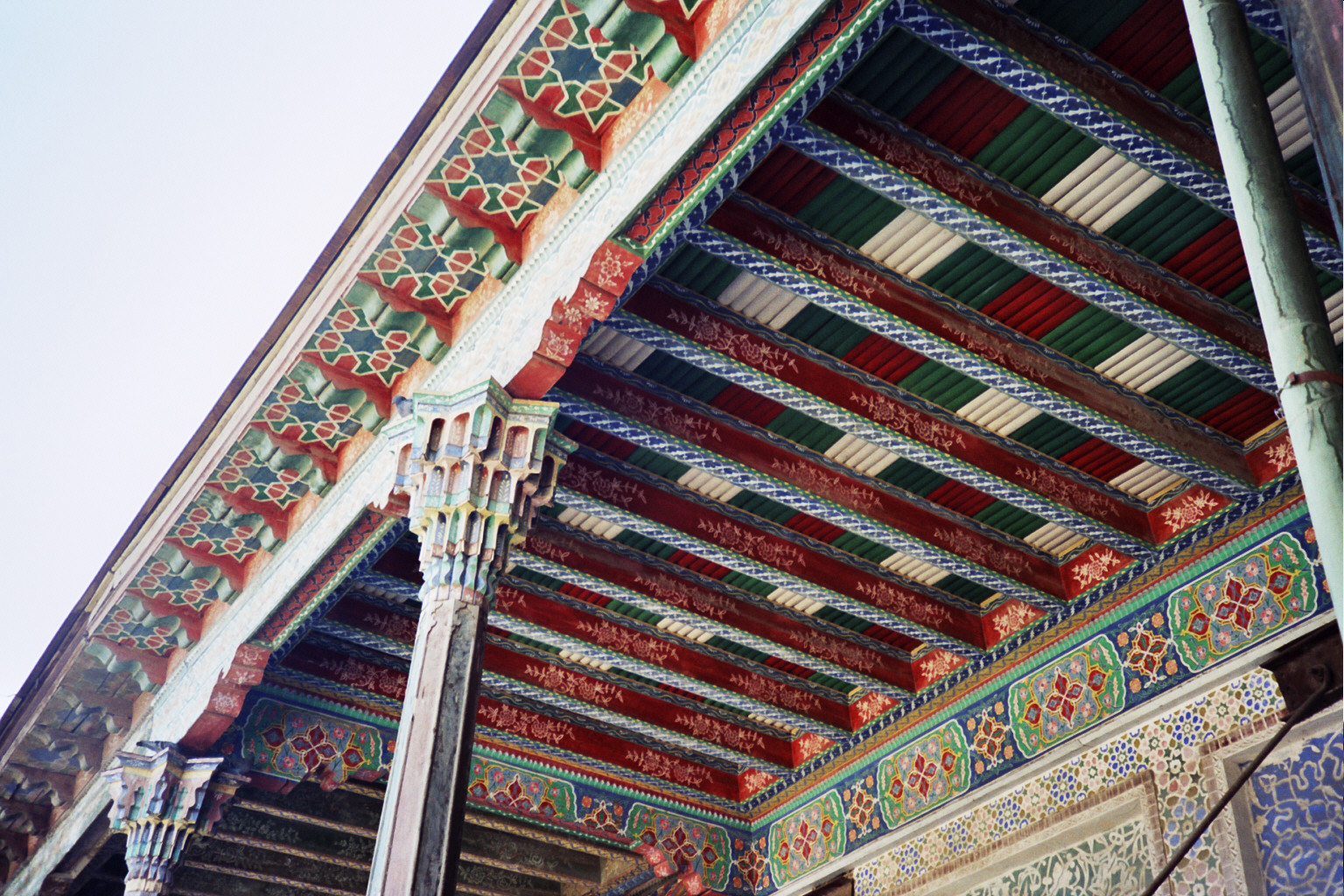
If the tiled facade is the palace’s greatest glory, the painted ceilings of its rooms are its most intimate one. Overhead, the interiors are covered with intricate ornament in rich colors, geometric and floral patterns painted onto carved and coffered wood, so that to look up is to see the same decorative genius that shaped the facade turned to the roof.
The ceilings represent a distinct craft tradition, the painting and carving of wood, which flourished across Central Asia and reached great heights in the Fergana Valley. Master craftsmen covered the timber with layered patterns in vivid pigments, framing panels and beams with borders of ornament in a controlled riot of color.
The palette of the ceilings, deep blues and greens set against reds and golds, complements the tilework of the facade and unifies the decoration of the whole building. Inside and out, the same visual language governs the ornament, giving the palace a coherence that ties its every surface into a single design.
Carved wooden columns, doors, and screens complete the interior decoration, their surfaces worked with fine ornament in the manner traditional to the region. As in Khiva, wood was a precious material carefully wrought, and the carpentry of the palace displays the same mastery as its ceramics and its painting.
Standing in one of the restored rooms and looking up at a painted ceiling, the visitor sees the palace at its most human scale. The vast facade impresses from without, but it is in these ornamented interiors, where color and pattern envelop the room, that the artistry of the Kokand court feels most immediate and alive.
The Artisans of the Fergana Valley
The palace is a monument to the craftsmen of the Fergana Valley as much as to the khan who commissioned it. To raise so richly decorated a building required the coordinated labor of many masters, tile-makers, wood-carvers, painters, and plasterers, drawn from a region long famous for the skill of its artisans.
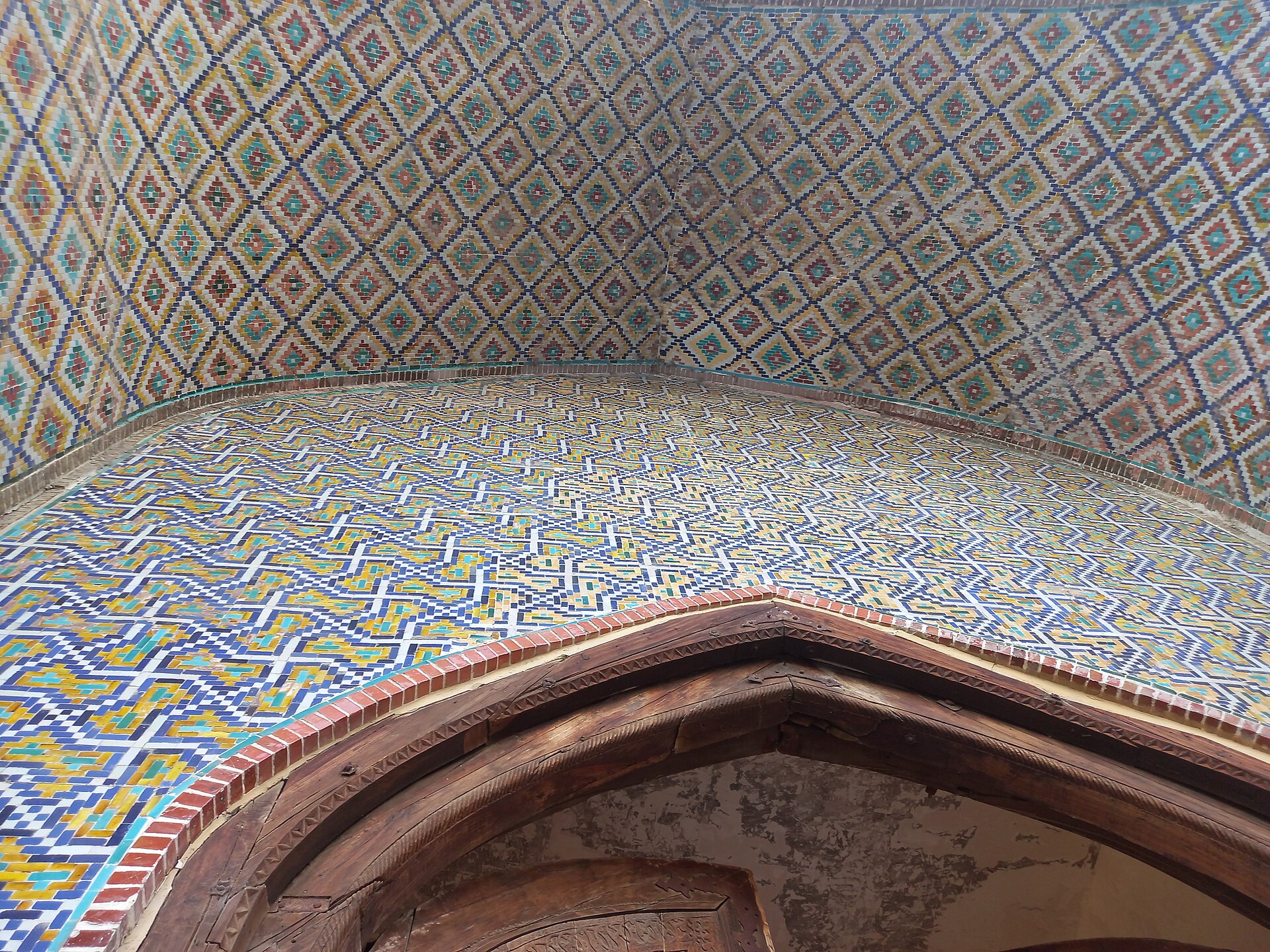
Ceramic craft was central to the achievement. The makers of the glazed tiles that sheathe the facade worked in a tradition refined over centuries, mixing and firing their glazes to produce durable, brilliant color, and cutting and assembling the tiles into the vast patterned surfaces that astonish visitors today.
The painters and wood-carvers who decorated the interiors worked in parallel traditions of equal depth. Their command of pattern, their disciplined use of a rich palette, and their ability to cover large surfaces with coherent ornament reflect generations of accumulated skill passed down within workshops and families.
These crafts did not exist only to serve the palace. They adorned the mosques, madrasas, and homes of the whole region, making the Fergana Valley a center of decorative art whose traditions continue to this day. The palace gathered the finest of these makers for a single concentrated masterpiece.
In admiring the palace, then, the visitor admires a whole artistic culture. The building is the crown of the Fergana Valley’s craft traditions, the place where its makers were given the resources and the occasion to work at the very limit of their art, and their achievement has outlasted the khanate that made it possible.
Treasury, Mint, and Government
The palace was not only a residence but the working seat of the khanate’s government, and among its rooms were the treasury and the mint where the coinage of Kokand was struck. Control of the currency was a mark of sovereignty, and its production within the palace underlined that this was the fiscal as well as the political heart of the state.
The treasury held the wealth of the khanate, gathered through taxation and the trade of the Fergana Valley, and its security was central to the ruler’s power. As in the other khanates, control of that treasure was control of the state, and it was guarded within the most secure part of the ruler’s residence.
From the palace the administration of the khanate was directed, its officials managing the collection of revenue, the command of the army, and the governance of the provinces. The building thus housed the machinery of a functioning state, the offices and records through which the khan’s authority was made effective across his lands.
The presence of the mint is a reminder of Kokand’s economic vitality in its independent years. The khanate was a wealthy state, and its coinage circulated through the markets of Central Asia, a tangible sign of the sovereignty that Khudayar Khan sought to proclaim through his magnificent palace.
When the khanate fell and its sovereignty was extinguished, the minting of its coinage ceased and the treasury passed to new masters. The rooms that had housed the fiscal heart of an independent state fell silent, their function ended along with the monarchy they had served, leaving the palace a monument to a vanished sovereignty.
The Palace as Museum
Today the surviving palace houses museums, and it serves as the principal monument and attraction of Kokand. Its restored rooms display collections that illuminate the history of the khanate, the life of its court, and the crafts of the Fergana Valley, set within the very halls where that history unfolded.
The exhibits gather objects of Kokand’s court and daily life, from craftwork and costume to the tools of governance, along with material on the natural and cultural history of the region. Together they help the visitor reconstruct the world of the khanate, giving context to the splendid architecture that surrounds them.
The palace forms the centerpiece of any visit to Kokand, a town that lies somewhat off the main tourist routes of Uzbekistan but rewards those who reach it with one of the country’s most spectacular monuments. The facade alone justifies the journey into the Fergana Valley.
Conservation of the tilework, painted ceilings, and carved wood is an ongoing task, for these materials require constant care to survive. The work of maintaining the palace continues the tradition of the craftsmen who created it, preserving their achievement for future generations of visitors.
As a museum the palace does more than display artifacts; it preserves the atmosphere of the Kokand court. To walk its courtyards and rooms, beneath painted ceilings and before the great tiled facade, is to be immersed in the world of the last khans, an experience no collection of objects alone could provide.
The town of Kokand around the palace repays a little exploration too, for it preserves other monuments of the khanate, mosques and madrasas and the tombs of the ruling house, that fill out the picture of the vanished state. Seen together with the palace, they let the visitor reconstruct something of the whole capital as it once was, a rich and pious city at the heart of the Fergana Valley.
The Palace Today: A Vanished Khanate Remembered
The Khanate of Kokand came to its end in 1876, when, after years of revolt and Russian pressure, it was abolished and its territory annexed to the Russian empire. Khudayar Khan had already been driven into exile, and with the fall of the khanate the palace ceased to be the seat of an independent state.
View the exact location on Google Maps
The Russian conquest and the upheavals of the following century took their toll on the palace, and much of the original complex was lost. Yet the great facade and a portion of the rooms survived, cared for in time as a monument, so that the masterpiece of the Kokand court came down to the modern age.
For independent Uzbekistan the Palace of Khudayar Khan is a source of national pride and a monument of the first rank, an emblem of the rich history of the Fergana Valley and of the artistic achievement of the vanished khanates. It stands on the country’s tentative list of sites proposed for World Heritage recognition.
The palace anchors the town of Kokand’s identity and draws visitors into a region less traveled than the famous cities of Samarkand and Bukhara, offering them one of the great sights of Central Asia. Its facade has become one of the defining images of the Fergana Valley and its history.
To stand before that shining wall of tile today, where a khan once climbed the ramp to his shimmering portal, is to see the last flowering of the Kokand court preserved against the odds. The khanate is long gone, swallowed by empire, but the palace endures, a glittering memorial to a kingdom that vanished at the moment of its greatest splendor.
If you make the journey into the Fergana Valley to see it, give yourself time to walk the whole facade slowly and to linger in the painted rooms, for Kokand sees fewer visitors than Samarkand or Bukhara and you may well have the place nearly to yourself. In that quiet the palace speaks most clearly, and the shining wall that a vanished khan raised at the end of his kingdom becomes one of the most moving sights in all of Central Asia.
Palaces Nearby
The Palace of Khudayar Khan completes a trio of great Central Asian royal residences, each the seat of one of the three khanates that shared the region. Visit its rivals to see how differently each chose to house its ruler.
You May Like
The Palaces of Orchha: A Bundela Capital on the Betwa