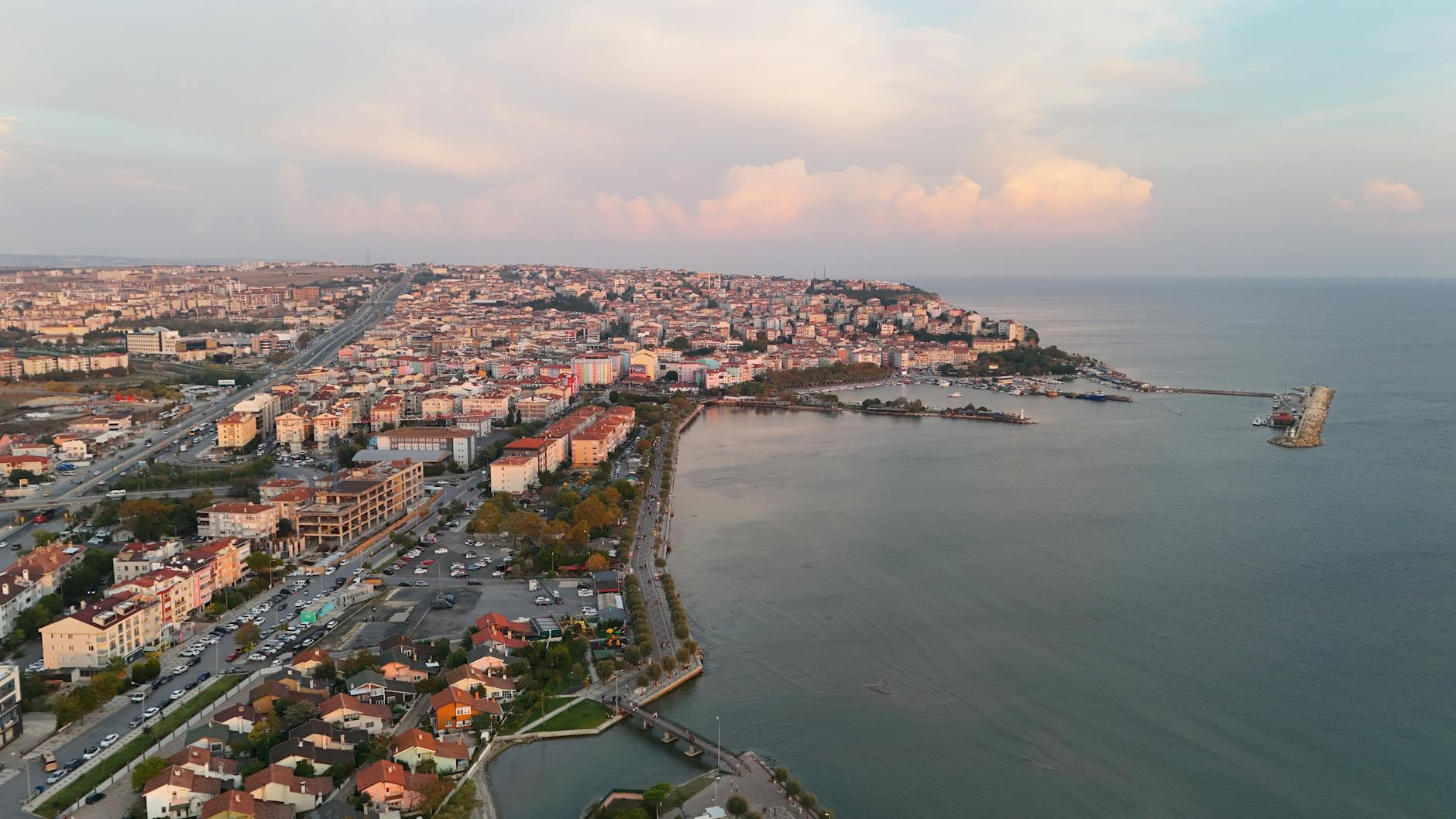
It is located in the southern part of the Çatalca Peninsula, at the intersection of the 41 degrees, 3 minutes north parallel and the 28 degrees, 20 minutes east meridians. There are Çorlu and Marmara Ereğlisi districts of Tekirdağ province in the west, Büyükçekmece district of Istanbul province in the east, Çatalca district of Istanbul province in the north, Çerkezköy district of Tekirdağ province in the northwest, and the Marmara Sea in the south. The length of the coasts of the Marmara Sea is approximately 45 km.
The surface area of the district is approximately 760 km² (860 km² including agricultural lands). The center of the district, which has 18 villages and 8 towns, is divided into 7 neighborhoods. The town municipalities are: Selimpaşa, Değirmenköy, Gümüşyaka, Çanta, Celaliye-Kamiloba, Ortaköy, Kavaklı and Büyük Çavuşlu.
The names of the villages are; Akören, Alipaşa (reduced to the neighborhood of Silivri with the Metropolitan Municipality Law No. 5216), Bekirli, Beyciler, Çayırdere, Çeltik, Danamandıra, Fener, Gazitepe (reduced to the neighborhood of Silivri with the Metropolitan Municipality Law No. 5216), Kadıköy, Küçük Kılıçlı (reduced to the neighborhood of Silivri with the Metropolitan Municipality Law No. 5216), They are Büyük Kılıçlı, Kurfallı, Sayalar, Seymen, Küçük Sinekli, Büyük Sinekli and Yolçatı.
District lands are generally low-sloping areas. The topography of the Silivri region is in the form of gently undulating plains and hills with a height not exceeding 60 meters. The topography in question; It starts from the seashore in the south and gradually rises towards the north. In the east, Keltepe and Araptepe in the Muratçeşme region constitute the main hills. There are no high mountains within the district.
There are no very important river beds within the district borders, but there are small streams and streams such as Çanta Creek, Gelevri Creek, Kova Creek, Tuzla Creek and Karılar Creek.
Silivri’s share in the total population of Istanbul is 1%. Among the 32 districts in Istanbul, it ranks 28th in terms of permanent resident population size, ahead of Şile, Çatalca, Eminönü and Adalar districts. However, during the summer months, it becomes one of the districts of Istanbul with a high population density.
According to 2000 data, the population of the district center is 44,530 and 108,155 throughout the district (44,530 people in the district center, 41,699 people in town centers and 21,886 people in villages). While the number of people per square kilometer was 90 in 1990, it increased to 126 in 2000. While the population of Silivri was 38,932 according to data in 1997, it increased to 44,530 in 2000. As of 2007, it is estimated to be close to 72 thousand. The most crowded town is Selimpaşa.
In the 2000 census, 9,151 people were recorded in Selimpaşa. The smallest village is Küçüksinekli with 270 people. It is followed by Büyüksinekli with 402 people. The most populous village is Fener District, which is the closest village to Silivri, with a population of 2,700. The village population is gradually decreasing and migration from rural areas to urban areas is intensifying.
Although “Silivri Yogurt” comes to mind when Silivri is mentioned, there is no trace left of that “Silivri Yogurt” of the 1950s-1960s. It is thought that the feature of yoghurt, which became famous throughout the country at the time, comes from the botanical structure of the pastures where animals graze and the regional fermentation / yoghurt making technique. The yoghurt tradition continues with the international yoghurt festival held in Silivri for 4 years.
Silivri is the place where the best yoghurt is made in Türkiye, especially Silivri yoghurt is known for its Arslanlı yoghurt.
More wheat is grown in the arable agricultural lands in Silivri, which are decreasing day by day. Then comes sunflower and barley. Although there were vineyards in many places in Silivri, where fruit cultivation was almost nonexistent, until the 1970s, grape cultivation is almost never done today. The reason for the disappearance of viticulture is that the Greeks in the district were forced to migrate.
In Silivri, where vegetable cultivation is seen to decrease day by day, there seems to be an obsession with growing watermelons. Although very little beekeeping is practiced, cattle breeding is also decreasing day by day. Generally, cattle, cows and sheep are raised, and buffalo breeding is rare in Danamandıra Village.
It has temperate climate zone characteristics. According to the long-term average, precipitation in Silivri begins in autumn and is especially intense during the winter months. Characteristics of the Thracian climate are seen in the region. Winters are generally cold and rainy, and summers are warm. The average annual rainfall is 600-700 mm. The effects of the continental climate increase as you move north and west. The annual average temperature is 13.7 C.
The hottest month (35.4 C) is August, and the coldest month is February (average 2.0 C). The annual average humidity is 77 percent and the average rainfall is 691.4 mm.
Silivri essentially has a treeless vegetation and the dominant appearance is steppe. A cover that changes little and appears in a single line covers the area. As you go up to the mountain villages in the north, there are forested areas due to more favorable altitude and humidity conditions. The shape seen today generally consists of trees with trunks and sometimes bushes.
Among the trees that make up this community, there are more varieties with shed leaves. We can count hornbeam, maple, oak and beech among the most common trees. Evergreen varieties include juniper and especially dwarf oak. The greater presence of dwarf oaks in the dominant community better explains the Mediterranean climate of the region. Thyme, wild mint and reeds are seen next to this community.
The characteristic plant of the mountain village area is the heather tree (erica arborea). Broom broom can be seen occasionally in the form of islands in forest areas.
According to data from the early 1990s, the forest area in Silivri is 27,453 hectares. In the forest areas of the Silivri region, oak and hornbeam varieties, juniper, linden, cranberry, hazelnut, willow, forest poplar, medlar, wild apple and pear are naturally found; Black pine, maritime pine, stone pine, acacia, walnut and cypress are grown in planted form.
Pigs, rabbits, wolves, jackals, foxes, weasels, martens, skunks, badgers, moles, mice, squirrels, snakes, quails, woodcocks, ducks, geese, pigeons, falcons, hawks, hawks and a small number of roe deer can be seen in the forest areas in the Silivri region.
Places to Visit
Silivri, which is easy to reach for Istanbulites and has a lot of summer houses, is located in the southwest of the main city and only 67 km away.
18 villages, a coastal city with 8 towns, E-5 and TEM highway by land, railway connection, easy and quick transportation by sea, especially to Avşa Island and Istanbul, increase the interest in Silivri… The parks and natural areas created on the 45 km long coastline of the district offer convenient environments for rest, entertainment and sports for travel lovers looking for a daily change as well as for a holiday. Those coming from Istanbul or Tekirdağ direction can take the land route. They turn towards Silivri and come to the beach in line with the signs indicating the Port.
With the latest arrangements made along the beach, walking areas have become available. Well-groomed parks with flowers, various plants, tropical trees
decorated. Tea gardens, which run parallel to the coastline, intertwined with parks, welcome guests with their open and closed sections. Guests cool off with the breeze from the sea, watch the sea view during their rest and sip their drinks with great pleasure. The busiest hours of the port are between 15.00 and 16.00 in the afternoon, which coincides with the arrival and departure of the ferry operating between Avşa and Silivri every day.
Both passengers and vehicle owners see the arrival of the ferry from a distance and start making preparations. They hurriedly fill the ferry, which becomes empty after the arrivals get off, to go to Avşa. The harbor is surrounded by rental boats where you can take excursions, fishing shelters, a floating fish restaurant and a breakwater on which you can walk and fish.
> In Silivri, which has different features on both sides of the port, we first visit the Bosnakbahçe Cape on the left. Silivri, which is built on a 56-meter high hill overlooking the Marmara Sea, is more visible when viewed from the sea. Some sections of the city walls provide information about the history of Silivri.
Although it is not known who built the first walls of Silivri, it is known that they were repaired by Emperor Justinian in the 6th century and were last repaired by the same sultan after the great earthquake called “Kıyamet_i Suğra” (little apocalypse) during the reign of Bayezid II (1481-1512).
Silivri Historical Park, located in Bosnakbahçe, attracts attention with its naturally flowing spring water and rock structure carved as if by a sculptor. Those who come with their vehicles fish here, swim in the sea, and even use the wooded area as a camping area. In Selimpaşa, located further along the coastline, there are some workshops that manufacture boats.
In the workshops that make custom-made boats, the infantry model boat type, which is suitable for rowing and sailing and consumes economical fuel, is very popular. Another type, called Hookhead, is preferred for boats that sail well even in waters 4-5 fingers deep due to their thin and water-repellent head. These boats, which can swim in shallow bays and go up to the shore, are 7 meters long and are divided into 2 pairs and 5 pairs of oars.
Fishing in SilivriSilivri is on the passageway for Marmara fish, which is more delicious and expensive than Mediterranean fish. Especially during the September raid season, oiled bluefish and bonito fish species coming from the Black Sea, as well as mullet, red mullet, red snapper, horse mackerel, sardines, sea bass, herring (shad is best fried in plenty of oil), kikla (seaweed meat is a type of fish that is delicious steamed and stewed).
Fish species, which are even more enriched with local fish, nest off the coast of Silivri and wander around the fault line called Silivri Pit, which is also located in this location. In addition to the purr or whiting fish nests between the fault rifts, bug-eye coral fish, orphaned red snapper, large fish, and even sharks with a length of around 50 cm, which are exported, are caught here.
Usually, fishermen cast their nets in the area called Karaburun, which is 20 miles away from the mainland, and white whitings come to eat the white whiting caught in the net. While the fronts of Silivri Bosnakbahçe remain secluded even in strong winds, large boats take shelter here.
Zafer Pala, a fisherman of 40 years, nicknamed “Cango”, who states that it is suitable for catching fish with an underwater harpoon, states that the undersea ground is rocky, mossy noodles, some areas are covered with brown branchy trandil grasses, and the fish are hidden among these lettuce and spinach-like grasses.
“If the weather is southwest, the sea becomes cloudy and the clarity of the shores is impaired. Hunters choose north-eastern weather and follow the side sections at the foot of the rocks.” He says. Experienced fishermen add that it is necessary to scratch the fish with a knife before cooking it, because the small bones in the hot oil will burn and melt under the effect of the heat and prevent it from sinking into the mouth while eating.
Mussel Type Pheasant: Since the sea bottom is sandy in Silivri, shellfish such as shrimps and mussels are also frequently encountered. One of these is a type of mussel called “pheasant” that lives under the sand. These mussels, which are an acceptable bait for every fish, are not visible on the sand at all, there are only two small holes, about 8 in number. Mussels are collected by inserting a special skewer into this hole. Some people roast and eat mussels, and some use them as fish bait.
In particular, the bottom of the tin is removed and glass is placed with paste, thus providing a clear view of the seabed without being affected by the waves on the surface. Mussels are hunting on the sandy surface, which is viewed like a lens.
Places to Visit: You can visit the Silivri coast from one end to the other with rented boats from the harbour. Since the coastline is sandy and extremely shallow, it is necessary to pay attention to the sand dunes in the water in order not to run aground. On the Bosnakbahçe side, you can see the high hills camping area with some caves in the interesting rock structure under some ruins of the castle walls.
On the other side of the port, the coast, the historical 32-eyed Mimar Sinan Bridge, beaches and the coastal strip with summer houses can be seen.
Those traveling by land may have the opportunity to take a closer look at the old historical monuments of Silivri such as the Walls, Gates (market gate, middle gate, country gate), inscriptions, brick stamps, cistern, Grand Vizier Piri Mehmet Pasha Mosque dated 1517 AD, Mimar Sinan bridge and statue. The shallow beaches along the coast, where children can swim comfortably, are free of charge and have fine sand that does not stick to the body.
The entire coastline, decorated with resting benches, is closed to vehicle traffic, except for the train that operates symbolically to carry passengers, and is suitable for strolling. In addition to the opportunity to do sea sports, there are routes between villages and rural areas suitable for automobile, motorcycle and bicycle trips. The Bolluca stream, with its polite name, flowing under the Hızır Hılkın bridge in the middle of the district, is waiting for improvement works.
The people of Silivri call this weather strong weather because the humidity rate decreases in northeastern weather. The southwest weather causes trouble and fatigue is felt.
Silivri Yoghurt Since the district’s livelihoods are based on agriculture, animal husbandry, fishing, tourism and industry, yoghurts made with the milk of cows carefully fed in pastures have become famous all over Turkey for years. When you think of Silivri, you think of full-fat tray yoghurts whose cream is scooped out with a shovel.
Silivri, which organizes festivals in its name today, has reserved the traditional dates between 6 and 16 July for the “Silivri Culture and Yogurt Festival”. Concerts, games, folklore shows were performed, yoghurts and ayran were distributed. Although the number of yoghurt factories has decreased, those who come to Silivri do not leave without stopping by the Arslan concentrator, located next to the historical plane tree in the bazaar. When they leave, they buy yoghurt as a gift.
Arslan Yoğurtçusu, operating at Ali Çetinkaya Street No.18, offers its additive-free yoghurts, with the experience it has gained since 1940, in trays, casseroles and plastic packages, in full-fat, half-fat and diet varieties. They say that the deliciousness of yoghurt is hidden in the milk of animals living in plains and rural areas.
You can find pictures of Silivri on this page.
You May Like
Amasya Hotel Pension Accommodations