Just a short drive from Heidelberg and Mannheim, the small town of Schwetzingen is home to one of the most enchanting palace gardens in Europe. Schwetzingen Palace was the summer residence of the Electors Palatine, and around it they created a garden of extraordinary variety, with a perfect circular parterre, temples, fountains, a bathhouse, a rococo theatre and even a mosque.
The palace itself is a gracious country residence rather than a vast state palace, but its gardens make it one of the great sights of southwest Germany. Wandering through them is like walking through a catalogue of eighteenth century dreams, from French formality to English romanticism and fantasies of the Orient.
In this article we will explore Schwetzingen from its medieval origins to the golden age of Elector Carl Theodor, through its palace, its garden buildings and its musical history, and we will finish with practical tips for your visit.
In This Article
- A Summer Palace Between Heidelberg and Mannheim
- From Moated Castle to Electoral Residence
- Elector Carl Theodor and His Court
- The Palace and Its Courtyard
- The Famous Circular Parterre
- A Garden of Many Styles
- Gates, Arms and the Entrance to the Garden
- The Garden Mosque
- The Elector Bathhouse
- Statues, Temples and Fountains
- The Rococo Theatre and Mozart
- Schwetzingen on Video
- Visiting Schwetzingen Today
A Summer Palace Between Heidelberg and Mannheim

Schwetzingen lies on the plain of the Rhine, between the old university town of Heidelberg and the former electoral capital of Mannheim. The palace stands at the end of the main street, its pale facade facing a long courtyard framed by low wings.
At first glance the palace looks modest, a pleasant country house with a central block and side buildings. But step through to the garden side and an astonishing landscape opens up, stretching far into the distance with lawns, avenues, fountains and pavilions.
The town itself is lively and friendly, known across Germany as the capital of white asparagus. In spring, when the asparagus season begins, restaurants around the palace square fill with people enjoying the local speciality.
What makes Schwetzingen special is the combination of a relaxed summer residence with one of the richest and most imaginative gardens of the eighteenth century. It is a place to stroll, to discover and to be surprised.
Many visitors come for a few hours and end up staying all day, drawn deeper into the garden by the promise of another temple, another fountain or another view.
The palace garden covers more than seventy hectares, so it is worth planning your route in advance or simply accepting that you will not see everything in one visit. Benches, shady avenues and lawns invite you to pause along the way.
The scale of the garden becomes clear only when you walk into it. Long avenues stretch toward the horizon, and every few minutes a new building, fountain or sculpture appears among the trees.
From Moated Castle to Electoral Residence

The origins of the palace lie in a medieval moated castle, first mentioned in the fourteenth century, which belonged to the Counts Palatine of the Rhine. Over the centuries it was used as a hunting lodge and occasional residence by the rulers of the Palatinate.
The castle suffered badly in the wars of the seventeenth century, including the Thirty Years War and the War of the Palatine Succession, when French troops devastated much of the region. In the early eighteenth century the electors rebuilt and enlarged it as a baroque summer residence.
The court moved from Heidelberg to Mannheim in 1720, and Schwetzingen, conveniently located between the two, became the preferred summer retreat of the electors and their court.
Traces of the older castle survive within the present building, but its character today is largely shaped by the eighteenth century, when the electors transformed both the palace and its surroundings.
The rebuilding in the early eighteenth century was carried out under Elector Johann Wilhelm and his successors, who added wings and transformed the old castle into a comfortable residence suited to court life.
In the nineteenth century, after the Palatinate on the right bank of the Rhine passed to Baden, the palace became a residence of the grand dukes of Baden, who used it as a summer retreat and preserved much of its eighteenth century character.
The moat that once surrounded the medieval castle has disappeared, but the core of the old building still forms the heart of the palace, hidden behind the later facades.
Elector Carl Theodor and His Court
The golden age of Schwetzingen came under Carl Theodor, Elector Palatine from 1742 and later also Elector of Bavaria. He was one of the most cultivated princes of his age, a patron of music, theatre, science and the arts, who made Mannheim and Schwetzingen famous throughout Europe.
Every summer the court moved to Schwetzingen, bringing musicians, actors, scholars and guests. Concerts, operas and plays were performed, and the gardens became a stage for festivities and promenades.
Carl Theodor’s court orchestra, the Mannheim orchestra, was considered the best in Europe, and its musicians developed a new style of orchestral playing that influenced composers such as Mozart.
In 1778 Carl Theodor inherited Bavaria and moved his court to Munich, but he continued to care for Schwetzingen and its gardens, which remained one of his favourite creations.
His legacy can be seen everywhere in the garden, from the grand parterre to the exotic buildings that reflect his curiosity about the wider world.
Carl Theodor also founded academies of science and art in Mannheim, supported botanical research and built up rich collections of paintings, coins and natural history specimens.
Voltaire visited Schwetzingen as the elector’s guest in 1753 and was impressed by the cultivated atmosphere of the court, describing it in admiring terms in his letters.
Under his rule, Schwetzingen became one of the most admired summer residences in Germany, visited by princes, artists and travellers who wrote enthusiastically about its gardens and entertainments.
The Palace and Its Courtyard

The palace is approached through a long courtyard, the Ehrenhof, framed by circular buildings and low wings. At its end stands the main building, with its central entrance leading through to the garden.
The interiors of the palace preserve apartments from the eighteenth and nineteenth centuries, including rooms used by Carl Theodor and later by members of the grand ducal family of Baden, who inherited the palace in the nineteenth century.
Guided tours show the electoral and grand ducal apartments, with period furniture, paintings, tapestries and decorative objects that bring the life of the court to life.
The courtyard itself is a pleasant space, often used for concerts and festivals, and it provides a dignified prelude to the wonders of the garden beyond.
The circular buildings framing the courtyard once housed court officials and services, and their curved form echoes the great circle of the garden behind the palace.
Among the most charming rooms inside the palace are those furnished in the style of the early nineteenth century for the grand duchess Stephanie, an adopted daughter of Napoleon who married into the house of Baden.
From the palace windows, the view across the circular parterre toward the distant avenues reveals the full scale of the garden design, and it is easy to see why the electors loved spending their summers here.
The Famous Circular Parterre

Behind the palace lies the heart of the garden, a vast circular parterre that is unique in European garden design. Two curving wings of trellis and arbour enclose a circle of lawns, flower beds and fountains, creating a perfectly balanced composition.
The circular layout was designed in the mid eighteenth century by the court gardener Johann Ludwig Petri, and later developed by the architect Nicolas de Pigage. At its centre lies the Arion fountain, surrounded by beds of flowers and gravel paths.
From the palace terrace, the main axis leads through the circle and out into the wider garden, drawing the eye toward distant views. The effect is one of grand order and harmony.
In spring and summer, the parterre is planted with colourful flowers, and the lawns and fountains create an atmosphere of serene elegance that captures the spirit of the baroque garden.
The arbours along the edge of the circle, covered with climbing plants, offer shady walks and a feeling of intimacy within the grand design.
Seasonal plantings change the colours of the parterre throughout the year, and the gardeners follow historic planting plans to recreate the appearance of the eighteenth century garden as closely as possible.
The fountains in the parterre are fed by an ingenious water system, and on warm days their spray adds a refreshing coolness to the air.
In the early morning, before the crowds arrive, the circle is wonderfully quiet, and the low sun casts long shadows across the lawns and through the arbours.
A Garden of Many Styles
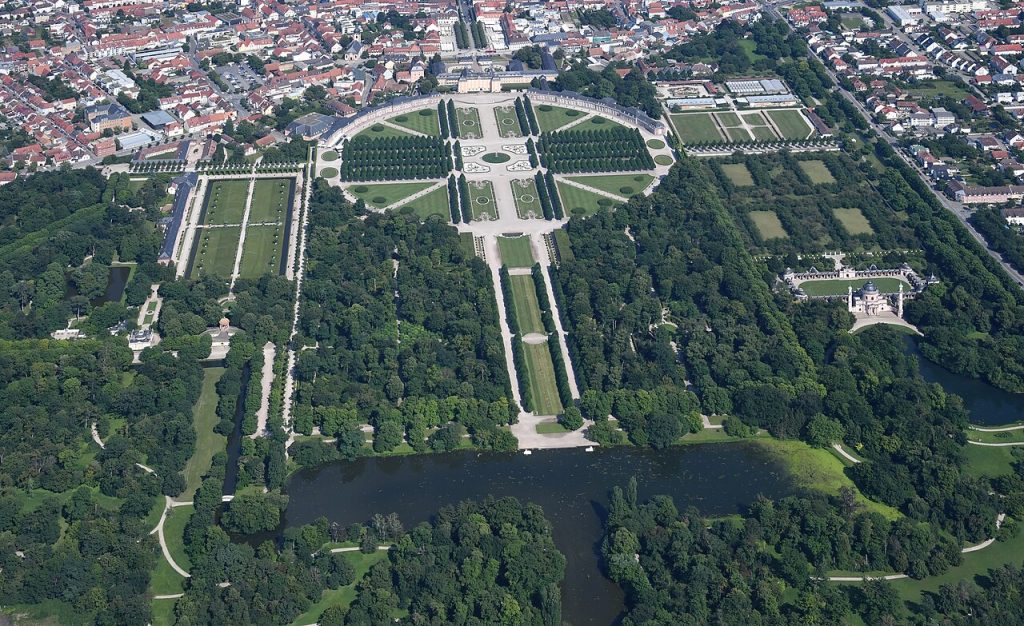
Seen from above, the Schwetzingen garden reveals its remarkable variety. The formal French style parterre and avenues near the palace give way to an English landscape garden further out, with winding paths, lakes and groups of trees.
This combination reflects changing tastes in the second half of the eighteenth century, when the strict geometry of baroque gardens gave way to a more natural, romantic approach. At Schwetzingen both styles coexist, creating a garden that is both ordered and surprising.
The landscape garden was developed by Friedrich Ludwig von Sckell, one of the leading garden designers in Germany, who later created the English Garden in Munich.
Scattered throughout the garden are temples, ruins, fountains and pavilions, each placed to create a particular view or mood. Exploring them is like following a carefully planned journey through the imagination of the eighteenth century.
The large lake in the landscape garden, with its reed beds and views toward the distant hills, is one of the most peaceful parts of the park and a favourite spot for birdwatchers.
Sckell’s work at Schwetzingen marked an important step in the spread of the English landscape style in Germany, and garden historians regard the park as a key monument of this transition.
Small bridges, islands and secluded paths make the landscape garden ideal for exploration, and children enjoy discovering its hidden corners.
The garden also contains rare trees planted in the eighteenth and nineteenth centuries, some of which have grown to impressive sizes.
Gates, Arms and the Entrance to the Garden

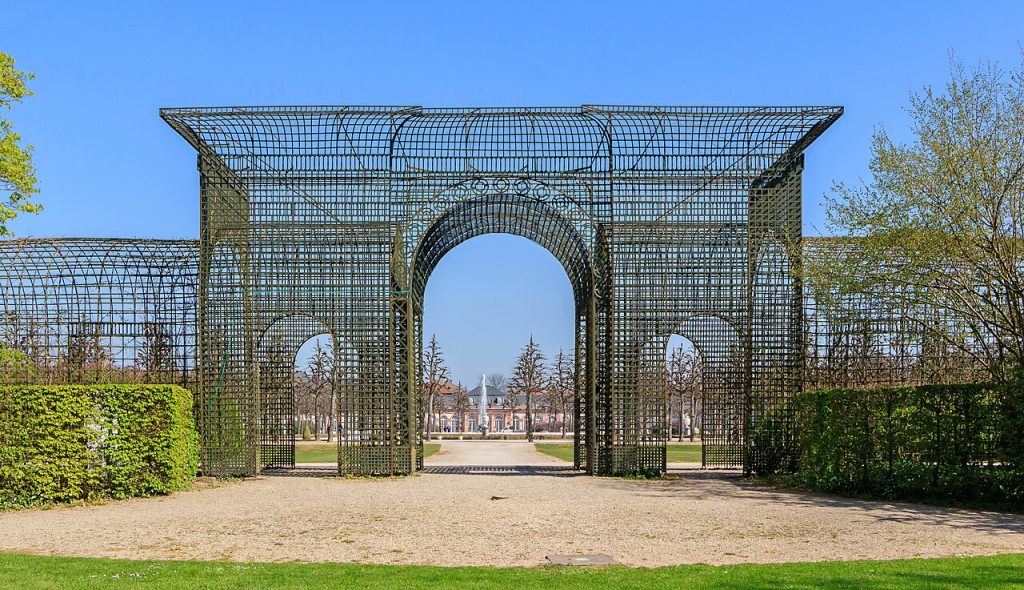
The entrances to the palace and garden are marked by gates decorated with the coats of arms of the Palatinate and the electoral family. These heraldic symbols proclaimed the identity and power of the rulers to everyone who passed through.
The arms include the lion of the Palatinate and the lozenges of Bavaria, reflecting the dynastic connections of the house of Wittelsbach, to which the electors belonged.
Passing through the gates, visitors leave the bustle of the town behind and enter a world of calm and beauty, just as the electors and their guests once did.
The gates and their sculpture have been carefully restored, and they offer a fine introduction to the artistry that awaits inside the garden.
Look for the details in the ironwork and stone carving, which show the skill of the craftsmen who worked for the electoral court.
From the gates, straight avenues lead into the garden, framing views of fountains and buildings that draw visitors onward.
The Garden Mosque
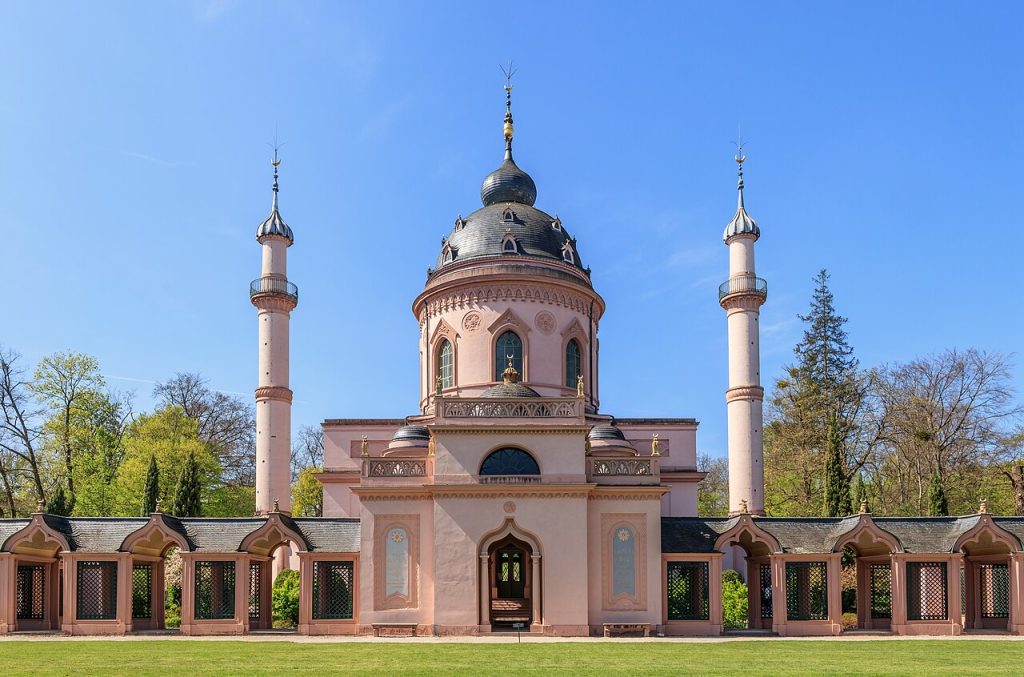
One of the most surprising sights at Schwetzingen is the Garden Mosque, built between 1779 and 1795 to designs by Nicolas de Pigage. With its domed central building, slender minarets and cloistered courtyard, it is one of the earliest buildings in Germany inspired by Islamic architecture.
The mosque was never intended for religious use by the court. It was a garden folly, expressing the eighteenth century fascination with the Orient and the ideals of tolerance and wisdom associated with the Enlightenment. Inscriptions in Arabic and German celebrate moderation and virtue.
The cloister around the mosque, with its arcades and pavilions, creates a peaceful enclosed space, while the minarets rise above the trees as landmarks visible from many parts of the garden.
Today the building is a symbol of cultural encounter and is admired as a unique monument of its kind. Climbing into its courtyard and looking up at the dome is one of the highlights of any visit.
Inside, the domed hall is decorated with painted ornament and inscriptions, creating a calm and luminous space that invites quiet reflection.
The mosque was carefully restored in recent decades, and its colours and decoration once again shine as they did in Carl Theodor’s time.
In the twentieth century the building was occasionally used for prayer by Muslim soldiers and visitors, a moving reminder of how a garden folly came to take on real spiritual meaning.
The mosque’s cloister also contains small pavilions and inscriptions that encourage visitors to reflect on wisdom, patience and the brotherhood of humankind, ideas that were dear to the thinkers of the Enlightenment.
The Elector Bathhouse

Hidden in a quiet corner of the garden lies the Bathhouse, a small pavilion built for Carl Theodor between 1768 and 1775. It was his private retreat, a place where he could escape the formality of the court and enjoy solitude, reading and bathing.
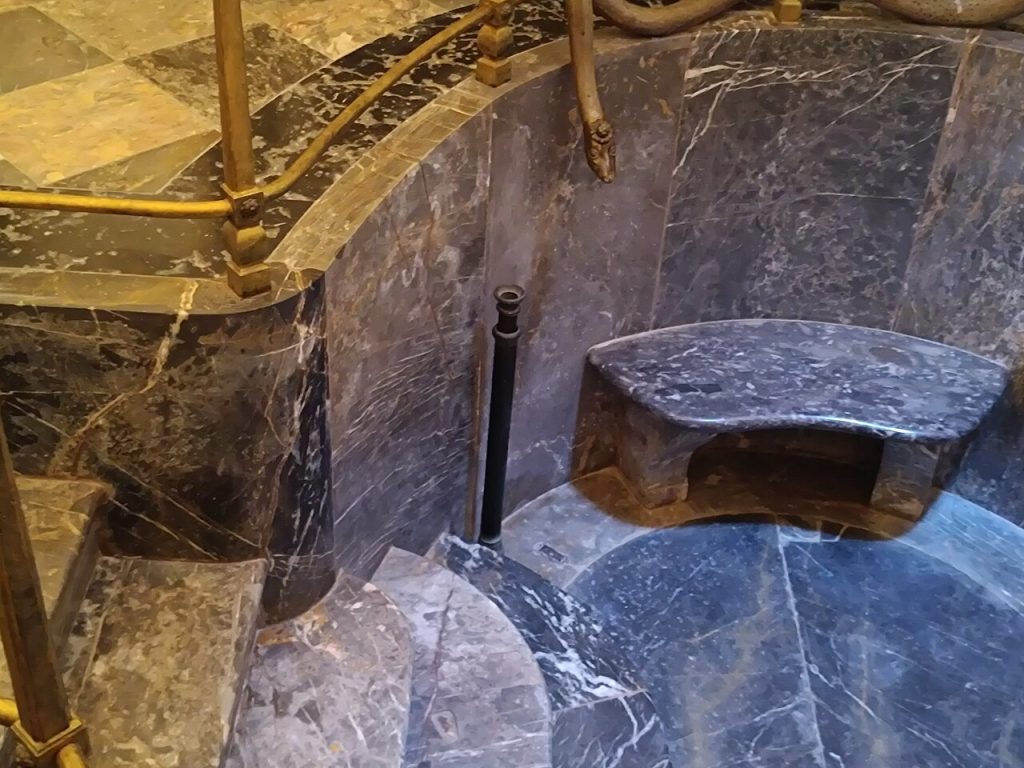
Inside, a sequence of exquisite rooms includes an oval hall with a painted ceiling, small cabinets decorated with Chinese wallpaper and fine furniture, and a bath room with a sunken basin lined with marble and decorated with shells.
The Bathhouse is one of the most intimate and refined buildings of the period, and it reveals the private taste of a prince who loved beauty and comfort.
Around the Bathhouse, a small garden with fountains and sculptures creates a world of its own, including the famous perspective view known as the end of the world, a painted illusion seen through a tunnel of greenery.
The bath room itself is a jewel. A marble basin, surrounded by shells and decorative details, was filled with warm water for the elector’s use, and the room was designed to feel like a cool, private grotto.
Water flowed through hidden pipes and was heated by a system that was advanced for its time, showing how the electoral court combined luxury with technical ingenuity.
The adjoining rooms, with their delicate decoration and fine views of the garden, made the Bathhouse a perfect place to rest and enjoy the company of a few close friends.
Seeing the bath today, after careful restoration, gives a rare insight into the private pleasures of an eighteenth century prince.
The perspective view known as the end of the world is one of the most famous illusions in any German garden. Looking through a dark, leafy tunnel, you see a painted landscape at the end that seems to stretch into infinity.
Because the Bathhouse is small and delicate, visits are usually limited to guided tours in small groups, which makes the experience feel even more exclusive and intimate.
Statues, Temples and Fountains

The garden is filled with sculpture, from mythological figures and allegories to animals and fountains. Among the most famous are the Arion fountain at the centre of the circle and the stag fountains, where water pours from the mouths of sculpted deer.
Temples dedicated to Apollo, Minerva, Mercury and Botany stand in carefully chosen spots, each creating a different atmosphere. The Temple of Apollo, set on an artificial hill above a cascade, is one of the most romantic places in the garden.
There is also an artificial Roman water castle and a ruin, evoking the fashionable taste for classical antiquity and the melancholy of the past.
Every walk through the garden reveals new sculptures and buildings, and many visitors enjoy simply wandering without a plan, discovering the garden’s surprises as they go.
Many of the sculptures were created by artists working for the electoral court, including Peter Anton von Verschaffelt, whose works can also be seen in Mannheim.
The Temple of Botany, dedicated to the study of plants, reflects the scientific interests of the Enlightenment and the elector’s support for natural history.
The stag fountains, with their naturalistic animals and splashing water, are favourites with children and photographers alike.
The Rococo Theatre and Mozart
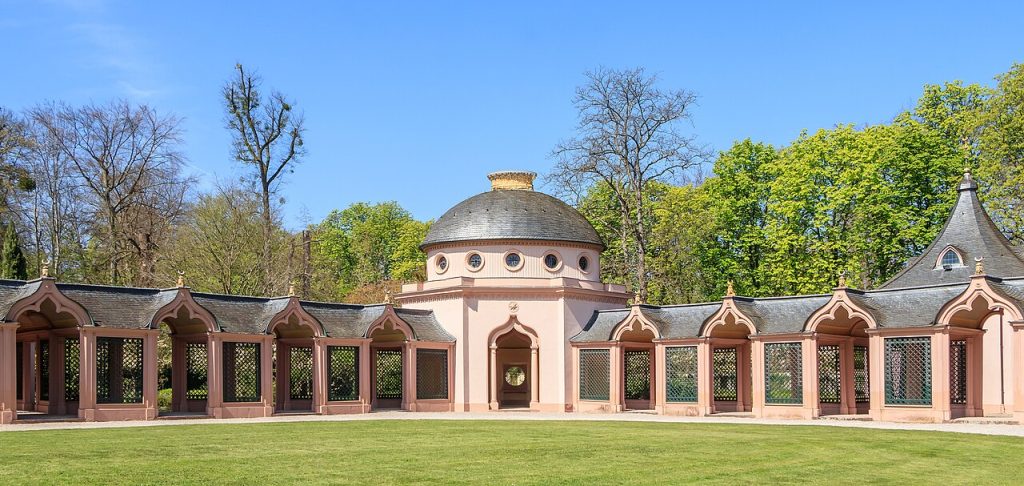
Next to the palace stands the Rococo Theatre, built in 1752 by Nicolas de Pigage for Carl Theodor’s court. It is one of the oldest surviving court theatres in Germany, and its elegant auditorium still hosts performances today.
Music was central to life at Schwetzingen. In 1763 the young Wolfgang Amadeus Mozart, then just seven years old, performed for the elector during his family’s tour of Europe, and the Mannheim musicians impressed him deeply.
Today the Schwetzingen Festival, held each spring, continues this tradition with concerts, operas and recitals in the theatre and other historic spaces of the palace.
Attending a performance in the Rococo Theatre is a wonderful way to experience the palace as it was intended, as a place of music, art and celebration.
The theatre’s auditorium, with its tiers of boxes and elegant decoration, was designed for the court and its guests, creating an intimate setting where every seat had a good view of the stage.
The theatre was restored in the twentieth century, and its stage machinery and decoration recall the glittering performances of the electoral era.
Mozart later returned to the region and spent several months in Mannheim, where he composed music and formed close friendships with the court musicians.
Schwetzingen on Video
For an overview of the palace and its gardens, the video below takes you through Schwetzingen, from the circular parterre to the mosque and the bathhouse.
Watch for the sweeping views of the garden and the many buildings scattered across it.
The video also shows the garden in different seasons, giving you an idea of the best time to visit.
If the video inspires you, read on for practical tips.
Visiting Schwetzingen Today

Schwetzingen Palace and its garden are managed by the State Palaces and Gardens of Baden Wurttemberg. The garden is open all year, while the palace interiors and the Bathhouse can be visited on guided tours, mainly in the warmer months.
Schwetzingen is easy to reach by train or tram from Heidelberg and Mannheim. From the station, a short walk brings you to the palace square.
Plan at least half a day for the garden alone, and a full day if you want to see the palace interiors, the theatre and the town. Comfortable shoes are essential, as the garden is large.
In spring, combine your visit with the cherry blossoms in the garden and the asparagus season in the town, when Schwetzingen is at its most delightful.
There are cafes in the garden and many restaurants around the palace square, so you can easily combine your visit with a relaxed meal.
Whenever you come, Schwetzingen offers a delightful journey through the garden art and culture of the eighteenth century, and it is one of the most rewarding day trips from Heidelberg.
Guided tours of the garden are also available, and they are a good way to learn about the stories behind the buildings and sculptures.
View the location on Google Maps
Palaces Nearby
If Schwetzingen has enchanted you, Baden Wurttemberg holds more remarkable palaces. Here are two more well worth adding to your journey:
- Bruchsal Palace – the residence of the prince bishops of Speyer, famous for its staircase by Balthasar Neumann.
- Karlsruhe Palace – the heart of the fan shaped city founded by the margraves of Baden.
You May Like
Karlsruhe Palace and the Fan Shaped City of the Margraves of Baden


