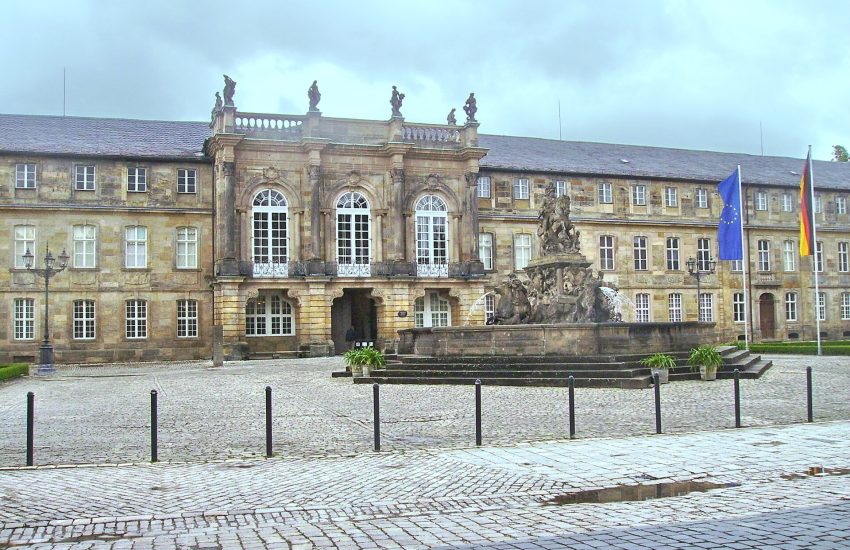
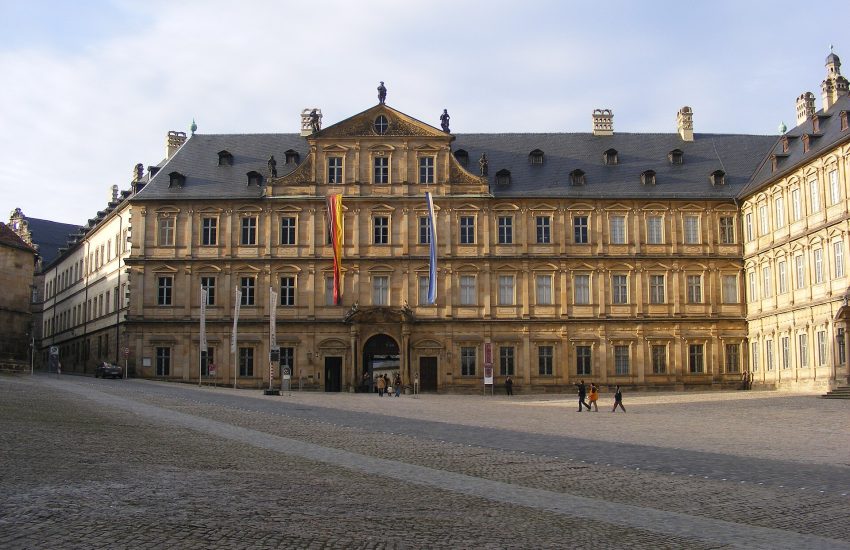
In the heart of the Franconian town of Ansbach stands a palace that many travellers pass by on their way to Rothenburg or Nuremberg without realising what lies inside. The Residence of Ansbach was the seat of the margraves of Brandenburg Ansbach, a branch of the Hohenzollern dynasty, and it contains some of the most beautiful early rococo interiors in Germany.
Behind its sober facades lie a magnificent festive hall with a recently restored ceiling fresco, more than twenty state rooms, a hall lined with thousands of painted faience tiles and a cabinet of mirrors and porcelain. Across the street, a court garden with a long orangery offers a peaceful retreat.
In this article we will explore the Ansbach Residence from the margraves who built it to its rooms, its tiles and its gardens, and we will finish with practical tips for your visit.
In This Article
- A Hidden Rococo Treasure in Franconia
- The Margraves of Brandenburg Ansbach
- Gabrieli, Zocha and Retti
- Facades and the Inner Courtyard
- The Festive Hall
- Carlo Carlone and the Painted Ceiling
- Stucco and Ornament
- The State Apartments
- The Tile Hall and Ansbach Faience
- The Mirror Cabinet and Porcelain
- The Court Garden and Orangery
- The Ansbach Residence on Video
- Visiting the Ansbach Residence Today
A Hidden Rococo Treasure in Franconia
Ansbach is a quiet, elegant town in the west of Franconia, with baroque streets, churches and squares that still reflect its past as a princely capital. At its centre stands the Residence, a large, dignified building that dominates the old town.
From the outside, the palace looks restrained, with long facades, regular windows and a central projection. Its quiet appearance gives little hint of the splendour within, which makes the discovery of its interiors all the more delightful.
The palace is surrounded by the streets of the old town, and across the road lies the court garden with its orangery and lime tree avenues, a green oasis in the heart of the town.
What makes the Ansbach Residence special is the quality and authenticity of its interiors. Many rooms survive with their original decoration and furnishings, offering a rare glimpse into the world of a small but cultivated German court.
Because it is less famous than the great residences of Wurzburg or Munich, the palace is often peaceful, allowing you to enjoy its rooms at a leisurely pace.
The town also celebrates its princely past with events such as the Rococo Festival, when residents and visitors dress in eighteenth century costume and the streets around the palace come alive with music and dancing.
Ansbach’s churches, including St Gumbertus with its knights chapel, add further interest to a visit and show the long history of the town before the margraves built their residence.
The palace’s location right in the centre of town makes it easy to combine with a walk through Ansbach’s charming streets, where many houses still bear the marks of the margravial era.
Arriving by train, you can walk from the station to the palace in a few minutes, passing through streets lined with handsome baroque houses that once belonged to court officials and wealthy citizens.
The Margraves of Brandenburg Ansbach
The margraves of Brandenburg Ansbach belonged to the Franconian branch of the Hohenzollern family, the same dynasty that ruled Prussia and later the German Empire. From the fifteenth century, they governed a principality in western Franconia with Ansbach as its capital.
Like many German princes of the baroque age, the margraves wanted a residence that reflected their status and their connection to the great house of Hohenzollern. They invested heavily in building and decoration, creating a court that was small but refined.
The last margrave, Karl Alexander, ruled in the late eighteenth century. In 1791 he sold his principality to his Prussian relatives and moved to England with Lady Elizabeth Craven, whom he later married, a romantic episode that brought the history of the independent principality to an end.
In 1806 Ansbach became part of Bavaria, and the Residence passed to the Bavarian state, which still cares for it today.
The Hohenzollern connection gave the margraves prestige and close links with the Prussian court in Berlin. Several margraves married princesses from other German houses, and their marriages brought new tastes and artistic influences to Ansbach.
Margrave Karl Wilhelm Friedrich, known as the Wild Margrave for his passion for hunting, ruled in the mid eighteenth century and oversaw much of the decoration of the state rooms.
The court of Ansbach also supported music and theatre, and composers and performers were employed to entertain the margraves and their guests in the palace and the orangery.
The Hohenzollerns of Ansbach were closely related to the margraves of Bayreuth, another Franconian branch of the family, and the two courts often competed in splendour, building ever more elaborate palaces and gardens.
Margravine Christiane Charlotte, who ruled as regent for her young son in the early eighteenth century, played an important part in the rebuilding of the Residence and in shaping the cultural life of the court.
Gabrieli, Zocha and Retti
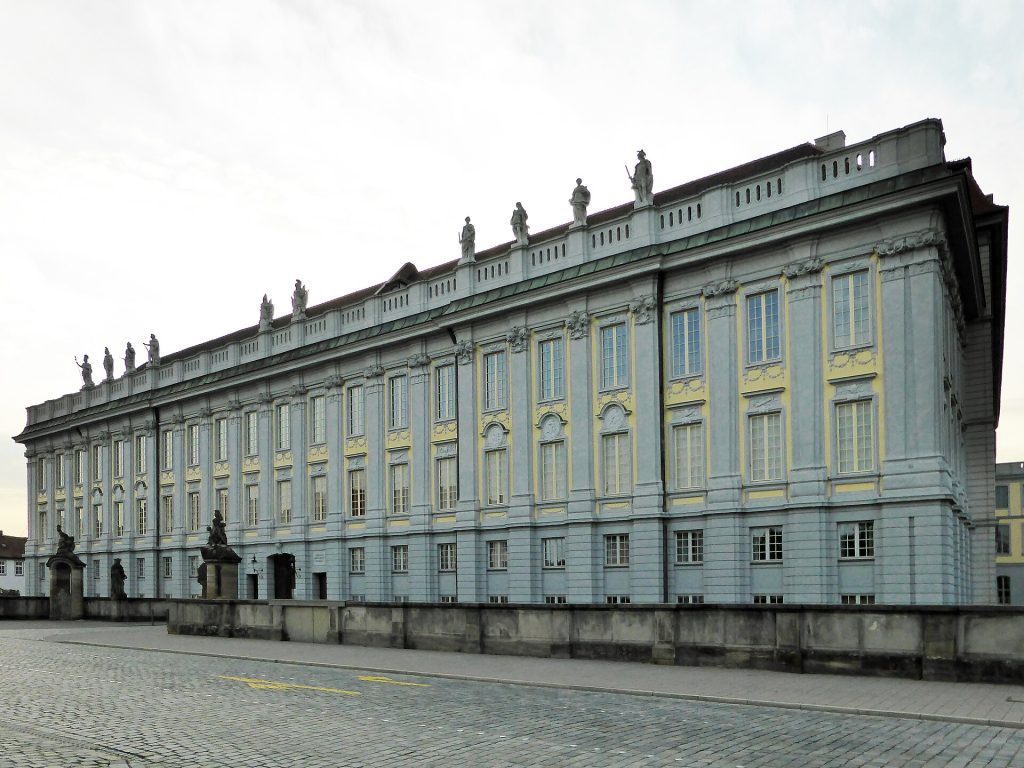
The present palace grew out of an older Renaissance castle, which was rebuilt and expanded in the first half of the eighteenth century. The main architect at the beginning was Gabriel de Gabrieli, an Italian Swiss master builder who later worked in Eichstatt.
After Gabrieli, the work was continued by Karl Friedrich von Zocha and then by Leopoldo Retti, an Italian architect who also worked in Ludwigsburg and Stuttgart. Each left his mark on the building and its interiors.
The result is a palace that combines baroque grandeur in its overall plan with the lighter, more playful style of early rococo in its decoration. The transition between the two styles can be traced as you move through the rooms.
The building is arranged around an inner courtyard, with the state rooms on the main floor and service areas below, following the typical pattern of German princely residences.
Retti’s work at Ansbach shows his talent for elegant, balanced design, and he later became one of the leading architects at the court of Wurttemberg.
The palace was completed in stages over several decades, and the changing tastes of the period can be seen as you move from the earlier baroque rooms to the later rococo apartments.
Each architect brought his own experience and ideas, but the overall plan of the palace remained coherent, thanks to the strong vision of the margraves who commissioned it.
Visitors with an eye for architecture will enjoy comparing the different staircases, doorways and ceilings, which reveal the gradual evolution of style over several decades.
Facades and the Inner Courtyard
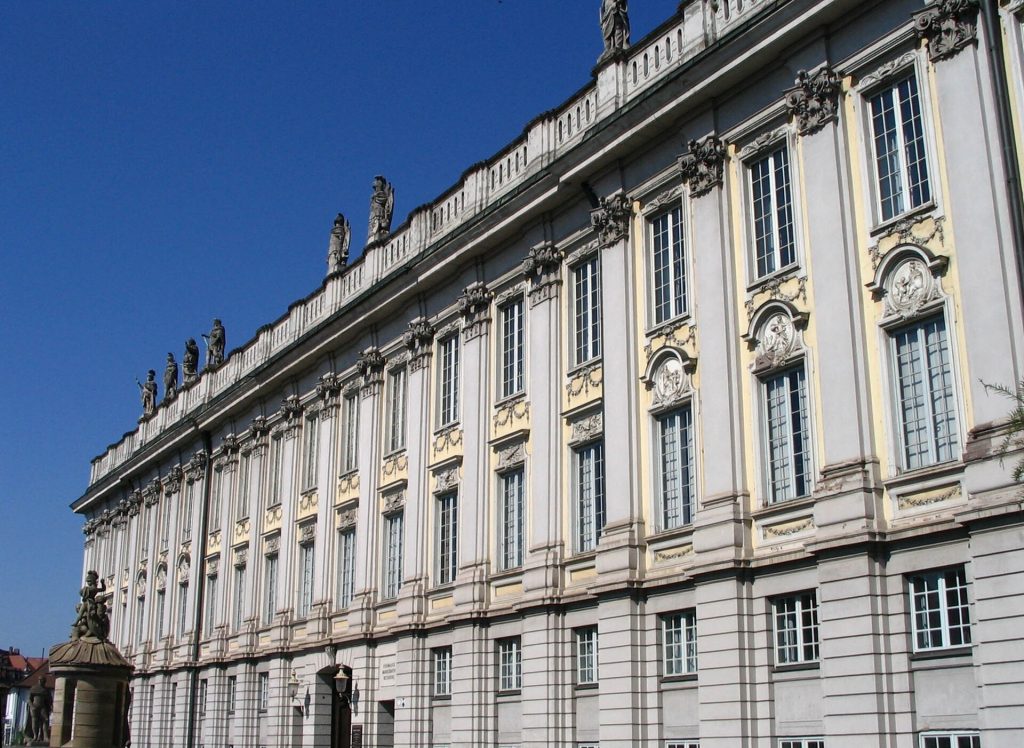
The facades of the Residence are long and harmonious, with pilasters, window frames and cornices that give them a sense of order. The central projections mark the main entrances and are decorated with more elaborate details.
Inside, the courtyard is surrounded by arcades and wings that connect the different parts of the palace. It is a quiet space, and from here you can appreciate the size of the building and the care taken over its proportions.
The pale stone of the facades glows in sunlight, and in the evening the palace is often softly illuminated, giving it an elegant presence in the centre of the town.
Walking around the palace, you can see traces of the older castle in some parts of the building, reminders of the long history of the site.
The large square in front of the palace was designed to show off the building to its best advantage, and it remains a focal point of the town.
From the Hofgarten across the street, there is a fine view of the palace, framed by trees and the long orangery, which shows how the residence and its garden were conceived as a single ensemble.
The palace square was once the setting for parades and court ceremonies, when the margrave and his guards would appear before the townspeople.
The Festive Hall
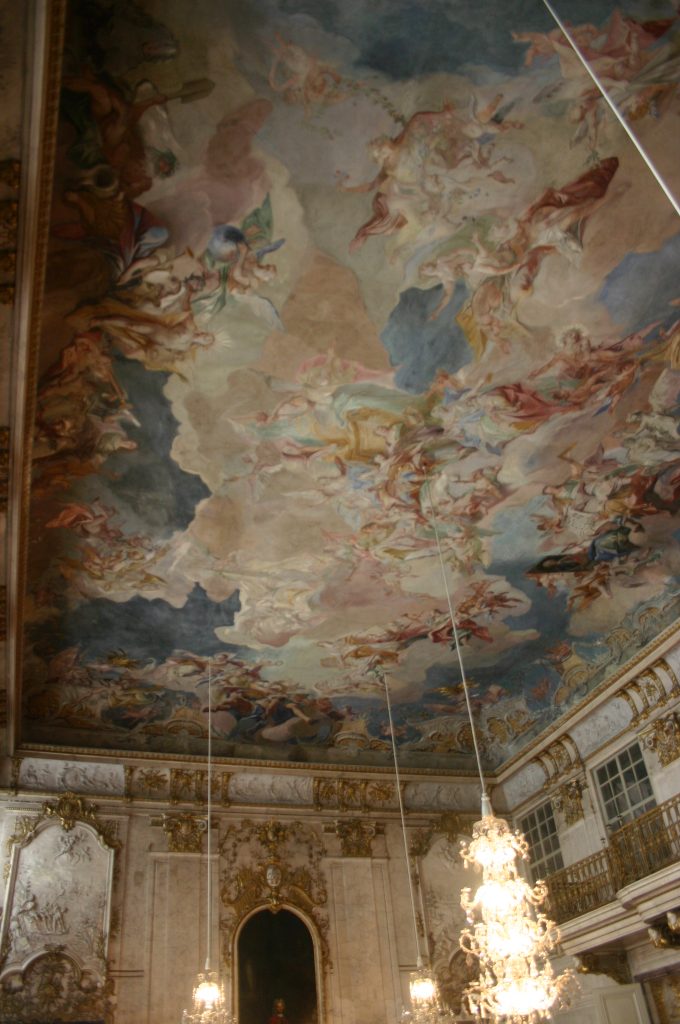
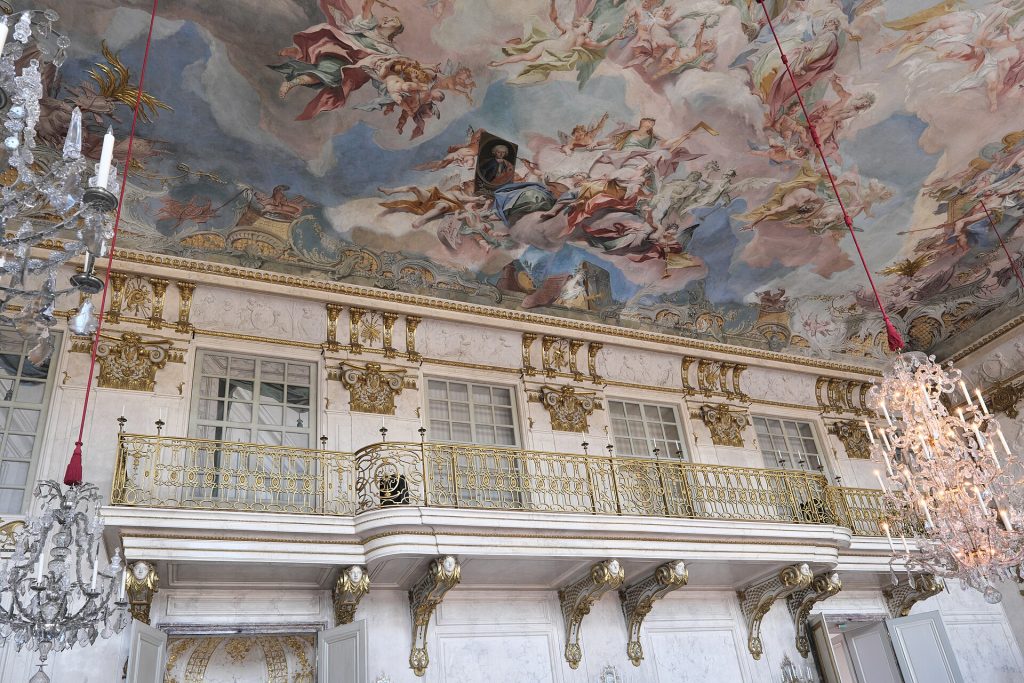
The heart of the Residence is the Festive Hall, a large and luminous room that rises through two storeys. Its walls are decorated with elegant stucco and its windows fill the space with light, creating a perfect setting for court celebrations.
The hall was designed for balls, banquets and receptions, and it was the stage for the most important events in the life of the margravial court. Musicians played from a gallery while guests danced beneath the painted ceiling.
After a long restoration lasting several years, the Festive Hall reopened recently with its decoration and fresco restored to their original brilliance. It is once again one of the most impressive rooms in Franconia.
Standing in the middle of the hall, you can appreciate the harmony of its proportions and the way the architecture, stucco and painting work together to create a festive atmosphere.
The restoration project involved specialists in stucco, painting and gilding, who worked carefully to preserve as much of the original material as possible.
The hall’s acoustics make it an excellent venue for concerts, and since the restoration it has once again hosted music, receptions and special events.
Large crystal chandeliers hang from the ceiling, and when they are lit the stucco and gilding sparkle, recreating the festive atmosphere of the margravial court.
Carlo Carlone and the Painted Ceiling
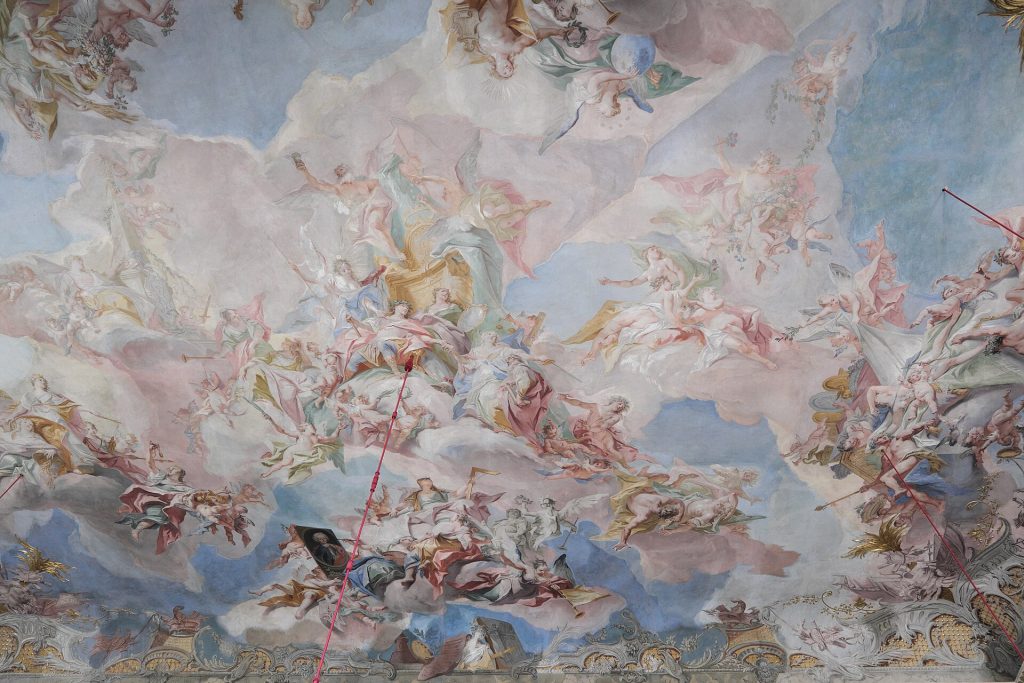
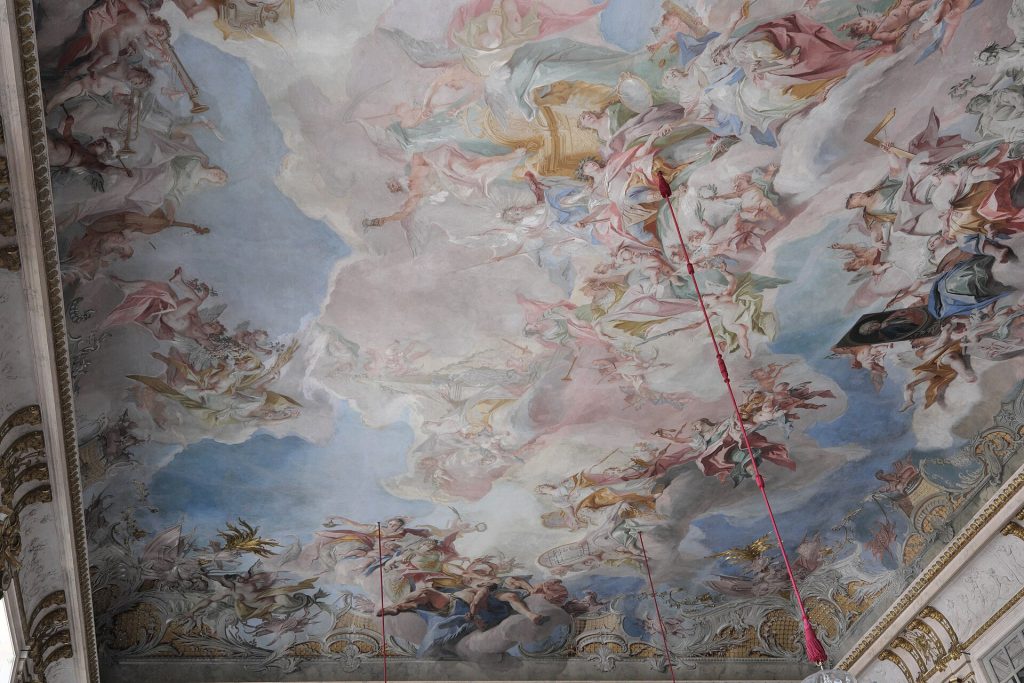
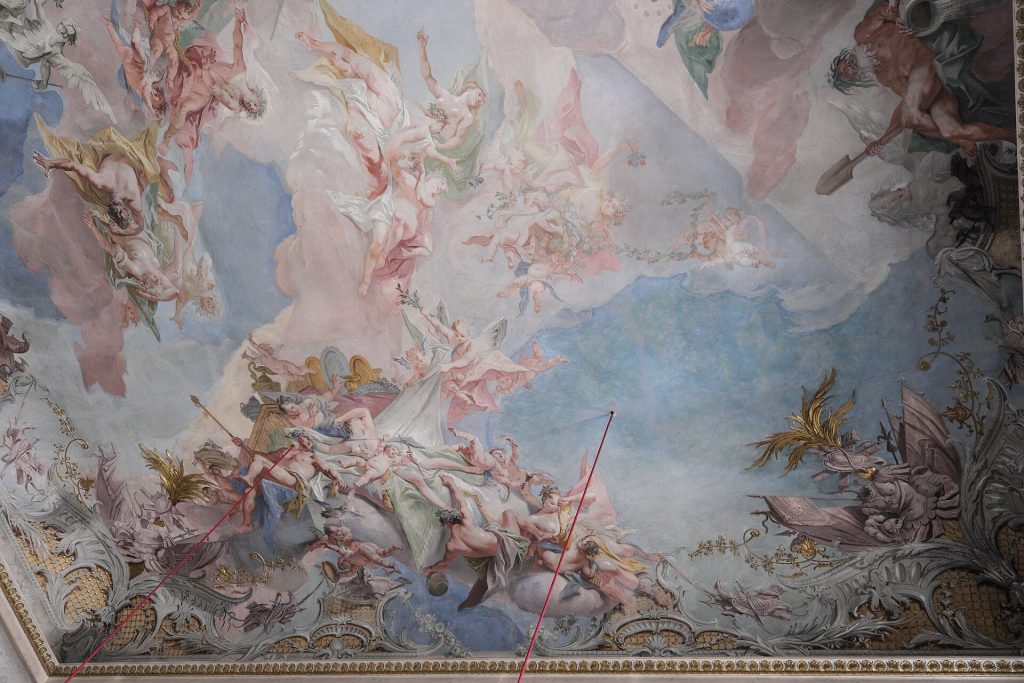
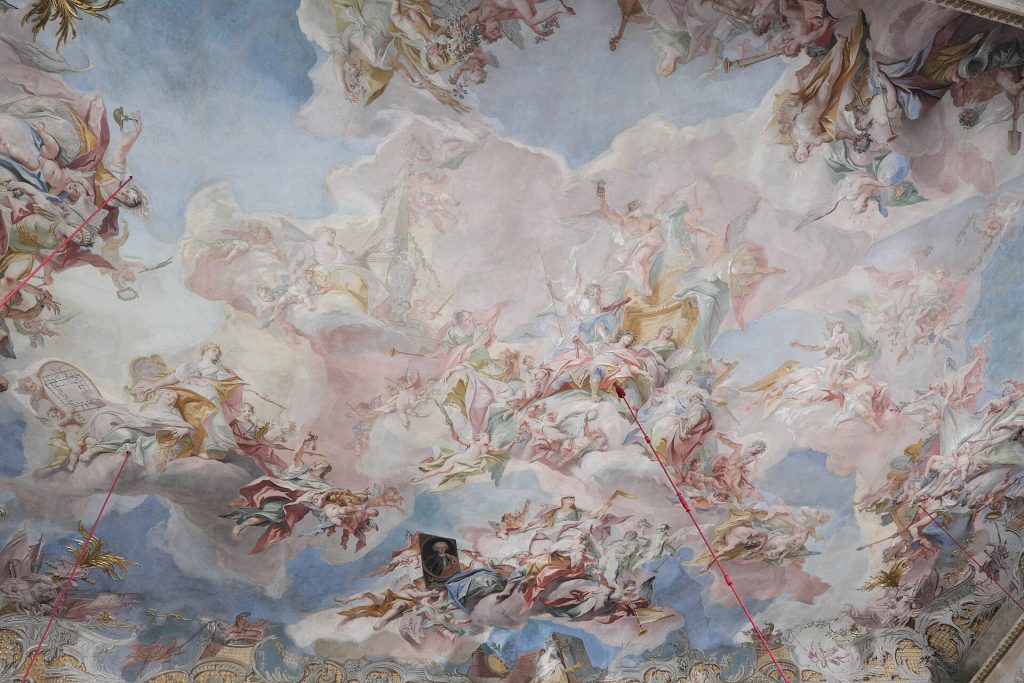
The ceiling of the Festive Hall is decorated with a large fresco by Carlo Carlone, an Italian painter from the region of Lake Lugano who was one of the most sought after fresco artists in central Europe in the eighteenth century.
Painted in the 1730s, the fresco presents an allegorical scene celebrating the virtues and glory of the margrave and his house, with gods and figures floating among clouds in a bright sky.
Carlone’s style is light, colourful and elegant, with graceful figures and soft tones that suit the early rococo spirit of the hall. His work can also be seen in palaces and churches in Austria, Germany and Italy.
The recent restoration removed layers of dirt and earlier retouching, revealing the original colours and the delicacy of Carlone’s painting. Looking up at the ceiling today, you see it much as the margraves did.
Carlone often worked with stuccoists and architects as part of a team, and his frescoes at Ansbach were designed to harmonise perfectly with the surrounding stucco decoration.
Seen from the centre of the hall, the fresco seems to open the ceiling to the sky, a classic baroque illusion that delighted the margrave’s guests.
The restorers discovered that some areas of the fresco had been overpainted in later centuries, and careful work revealed Carlone’s original brushwork beneath, a discovery that delighted art historians.
Stucco and Ornament
The stucco decoration of the Festive Hall and the state rooms is among the finest in Franconia. Delicate garlands, shells, scrolls and figures cover the walls and ceilings, created by skilled stuccoists who worked for many German courts.
The ornament is light and playful, with asymmetrical forms that are characteristic of the rococo style. White and gold dominate, creating an atmosphere of refined elegance.
In some rooms, stucco frames surround paintings or mirrors, while in others it forms entire decorative schemes on the ceilings, turning them into works of art in their own right.
Taking the time to look closely at these details reveals the extraordinary skill of the craftsmen and the attention to beauty that defined the court of Ansbach.
Several rooms feature stucco ceilings with motifs from mythology and nature, such as birds, flowers and putti, which give the apartments a light and joyful character.
The stucco work was created in close collaboration between architects and craftsmen, and many of the artists also worked in other Franconian palaces, spreading the same refined style across the region.
Gilding was applied by hand using thin sheets of gold leaf, a painstaking process that gives the decoration its warm, glowing quality.
The State Apartments
The Residence contains more than twenty state rooms, decorated and furnished in the style of the early eighteenth century. Many of them have survived almost unchanged, making Ansbach one of the best places in Germany to experience the atmosphere of an early rococo court.
The apartments include audience rooms, bedrooms, cabinets and galleries, each with its own decoration and character. Silk wall coverings, fine furniture, paintings and tiled stoves create a sense of luxury and comfort.
Portraits of the margraves and their families hang throughout the rooms, introducing you to the people who lived here and their connections with other European courts.
Guided tours lead you through the apartments, and the guides explain the history and significance of each room, as well as the daily life of the court.
Among the rooms are the margrave’s audience chamber, the bedchamber of the margravine and a series of cabinets used for private conversations and the display of treasures.
The furniture includes pieces by German cabinetmakers, as well as French and Italian works, reflecting the international taste of the court.
The authenticity of the interiors is one of Ansbach’s great strengths. Unlike many palaces that lost their furnishings, Ansbach preserves a large part of its original decoration and contents.
Many rooms still have their original silk and damask wall coverings, some of them rewoven to historic patterns, which give each space a distinct colour and mood.
The private apartments of the margravine are particularly elegant, with delicate furniture and decoration reflecting the taste of the women of the court.
The Tile Hall and Ansbach Faience
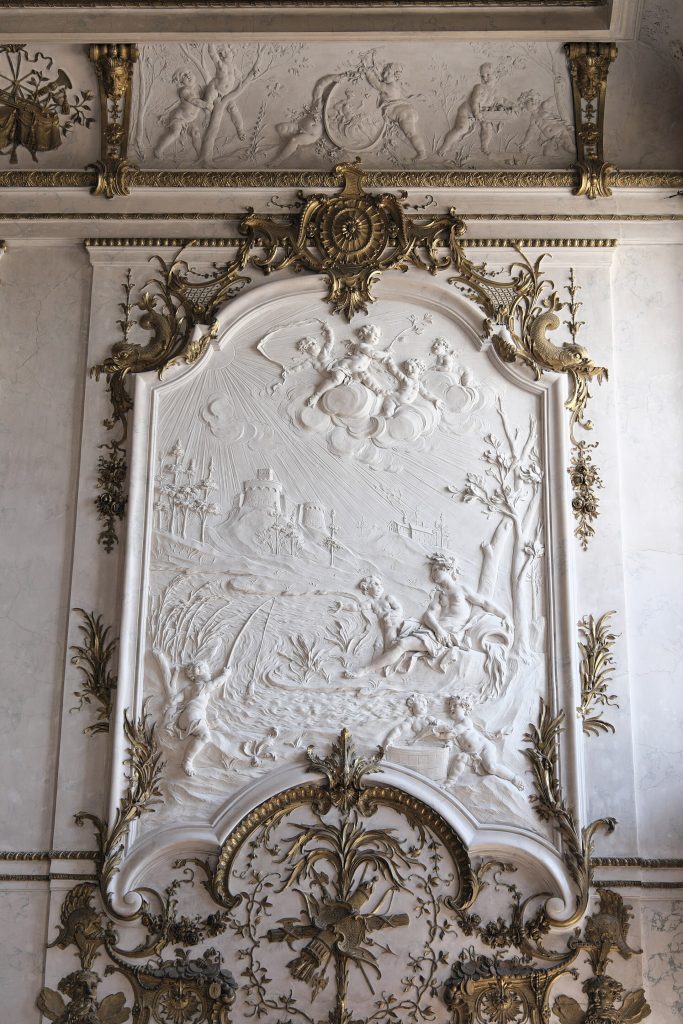
One of the most unusual rooms in the Residence is the Tile Hall, whose walls are covered with around 2800 painted faience tiles made in Ansbach. The tiles depict scenes of animals, plants and landscapes in blue and other colours, creating a cool, shimmering surface.
Ansbach was home to an important faience manufactory in the eighteenth century, and its products were prized for their quality and decoration. The Tile Hall is a showcase of this local craft.
The room was used as a dining room, and its tiled walls were both decorative and practical, easy to clean and cool in summer.
Looking closely at the tiles, you can discover a whole world of little scenes and motifs, each painted by hand.
The Ansbach faience manufactory produced not only tiles but also vases, plates and figures, and examples of its work can be found in museums across Germany.
The Tile Hall is a reminder that baroque courts combined luxury with practicality, choosing materials that were beautiful as well as durable.
Visitors often linger in the Tile Hall to look for favourite motifs, from birds and flowers to small landscapes, and children enjoy turning it into a game of discovery.
The tiles were produced locally, so the room is also a celebration of Ansbach’s own craftsmen and their contribution to the court’s splendour.
The Mirror Cabinet and Porcelain
Another highlight is the Mirror Cabinet, a small room lined with mirrors and decorated with porcelain from the Meissen manufactory and other European factories. The mirrors reflect the porcelain and the gilded ornament endlessly, creating a dazzling effect.
Mirror and porcelain cabinets were fashionable in the early eighteenth century, and they reflected the passion of German princes for the precious white gold of porcelain, which had only recently begun to be produced in Europe.
At Ansbach, the cabinet displays porcelain figures, vases and plates arranged on gilded brackets, turning the whole room into a jewel box.
It is one of the most photographed rooms in the palace, and it captures the playful elegance of rococo taste perfectly.
The effect of light reflected endlessly in the mirrors is particularly beautiful on sunny days, when the room seems to sparkle from every angle.
The porcelain on display includes pieces from Meissen as well as from other manufactories, showing the wide network of trade and gifts that linked the German courts.
Rooms like this were meant to astonish visitors and show off the wealth of the court, and even today they have lost none of their power to surprise.
The Court Garden and Orangery
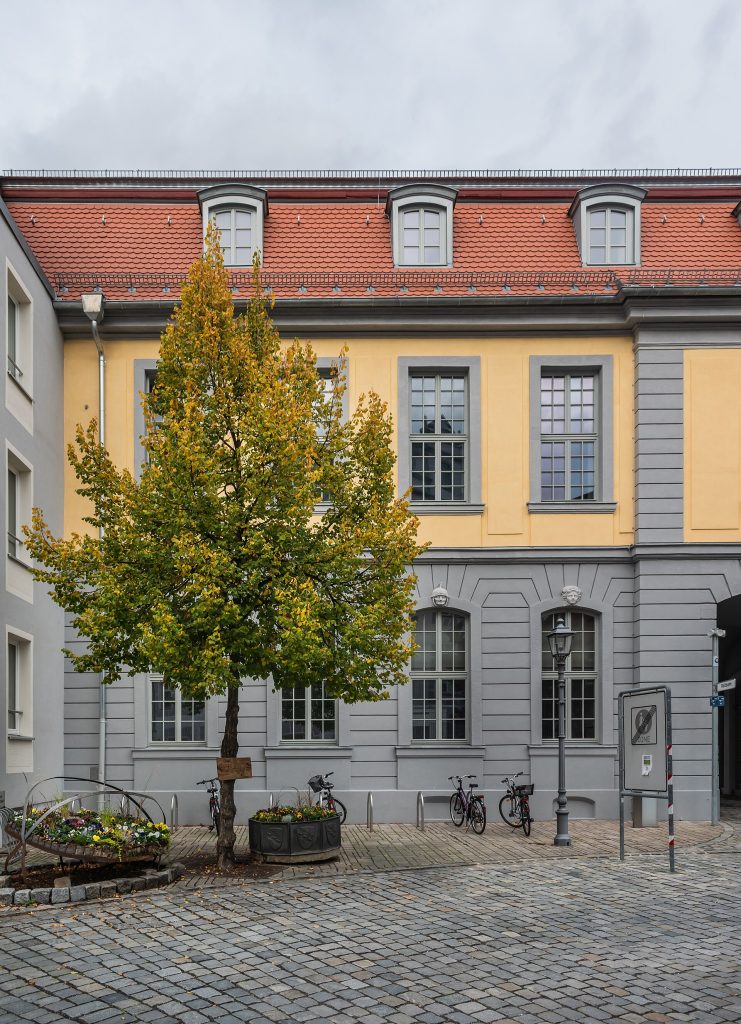
Across the street from the Residence lies the Hofgarten, the court garden of the margraves. Laid out in the eighteenth century, it combines formal elements with shady avenues of lime trees and open lawns.
At its centre stands the Orangery, a long and elegant building constructed between 1726 and 1743, where citrus trees and exotic plants were kept during the winter. Today it is used for concerts, events and exhibitions.
The garden also contains a memorial to Kaspar Hauser, the mysterious foundling who appeared in Nuremberg in 1828 and was fatally wounded in the Hofgarten in 1833. His story still fascinates people today, and Ansbach is closely associated with his legend.
The garden is a pleasant place to stroll after your visit to the palace, with benches, flower beds and the elegant facade of the orangery providing a lovely backdrop.
In summer the orangery terrace is a lovely place to sit, and the garden often hosts open air concerts and festivals that draw visitors from across the region.
The lime tree avenues are especially lovely in early summer, when the trees are in blossom and fill the air with their sweet scent.
A memorial stone marks the place where Kaspar Hauser was attacked, and many visitors pause there to reflect on one of the most mysterious stories of nineteenth century Germany.
The Ansbach Residence on Video
For an impression of the palace before your visit, the video below presents the Residence and its rooms.
Watch for the Festive Hall, the state apartments and the courtyard.
The video also gives a sense of the palace’s setting in the town and the scale of its main rooms.
If the video inspires you, read on for practical tips on visiting.
Visiting the Ansbach Residence Today
The Ansbach Residence is managed by the Bavarian Palace Administration, and its state rooms can be visited on guided tours throughout the year, except on certain holidays.
Ansbach lies in western Franconia, about forty minutes by train from Nuremberg and close to the famous medieval town of Rothenburg ob der Tauber. It makes an easy stop on a tour of the region.
Plan at least two hours for the palace tour and a stroll in the Hofgarten, and more if you want to explore the old town with its churches and baroque streets.
The Residence pairs well with other Franconian palaces such as the Wurzburg Residence, the New Residence in Bamberg and the New Palace in Bayreuth, which together form a rich trail of baroque and rococo art.
The old town of Ansbach has cafes and restaurants where you can try Franconian dishes such as bratwurst and local beers after your visit.
Whenever you visit, the Ansbach Residence offers a rewarding and peaceful encounter with the elegance of early rococo Germany, far from the crowds of better known palaces.
If you are travelling by car, Ansbach is conveniently located near the motorways linking Nuremberg, Wurzburg and Stuttgart, making it easy to include in a wider itinerary.
Guided tours are offered in German, with printed information in other languages, and the staff are friendly and helpful to international visitors.
View the location on Google Maps
Palaces Nearby
If the Ansbach Residence has charmed you, Franconia holds more remarkable palaces. Here are two more well worth adding to your journey:
- The New Residence of Bamberg – the baroque palace of the prince bishops on the cathedral hill of Bamberg.
- The New Palace of Bayreuth – the rococo residence of Margravine Wilhelmine, with its Palm Room and glittering grottoes.
You May Like