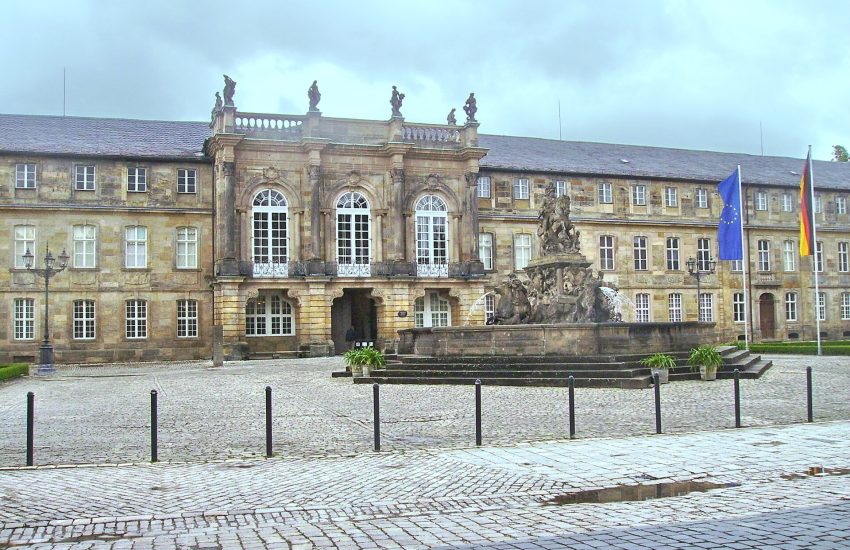
High on a ridge above the little town of Rudolstadt in Thuringia, a long, pale palace looks out over the valley of the Saale. Heidecksburg was for centuries the seat of the counts and later princes of Schwarzburg Rudolstadt, and today it is one of the most beautiful baroque and rococo residences in central Germany, little known abroad but treasured by those who discover it.
Rebuilt after a great fire in the eighteenth century, the palace contains a magnificent festive hall, a sequence of elegant rococo state rooms, a famous collection of historic weapons and a charming miniature rococo world created in modern times. From its terraces you can see far across the Thuringian countryside.
In this article we will explore Heidecksburg from its medieval origins to its rococo splendour, through its halls, its collections and its setting, and we will finish with practical tips for planning your visit.
In This Article
- A Palace on the Ridge Above Rudolstadt
- The Counts and Princes of Schwarzburg
- From Medieval Castle to Baroque Palace
- Facades, Courtyards and Views
- The Festive Hall, Jewel of Thuringian Rococo
- Rococo State Apartments
- Private Rooms and Princely Life
- Floors, Stoves and Fine Craftsmanship
- Weapons, Natural History and Porcelain
- A Rococo World in Miniature
- The Beautiful Fountain and the Courtyard
- Heidecksburg on Video
- Visiting Heidecksburg Today
A Palace on the Ridge Above Rudolstadt
As you approach Rudolstadt, Heidecksburg dominates the town from its hilltop, its long facades and roofs stretching along the ridge. It is an impressive sight, especially when the late afternoon sun lights up the pale walls against the green hills.
A steep path and stairs lead up from the old town to the palace, and the climb rewards you with ever widening views. At the top you enter a large courtyard framed by three wings, open on one side toward the valley.
The palace is home to the Thuringian State Museum Heidecksburg, and its rooms and collections give a rich picture of court life in one of the many small principalities that made up the old German empire.
What makes Heidecksburg special is the combination of grand architecture, refined interiors and a peaceful setting far from the crowds of better known palaces.
Rudolstadt itself is a charming small town with historic streets, a lively cultural scene and a famous folk music festival each summer, and the palace is the crown of its skyline.
The approach on foot is part of the pleasure. As you climb, glimpses of the palace appear between houses and trees, and each turn of the path reveals a new view of the town and the valley below. By the time you reach the courtyard, you feel you have truly arrived somewhere special.
Many visitors come for the palace and stay for the atmosphere, lingering on the terraces or in the town cafes long after their tour has ended.
In every season the palace has its own charm. Spring brings fresh green to the hillsides, summer long evenings on the terraces, autumn golden woods along the Saale, and winter a quiet beauty when snow dusts the roofs and the valley below.
Inside the palace, the museum guides are friendly and knowledgeable, and they are happy to share stories about the princes and the history of the building. Even if you do not speak German, many displays include information in English.
The palace is never crowded in the way that famous royal residences can be, so you can explore at a relaxed pace and enjoy the rooms almost to yourself.
The Counts and Princes of Schwarzburg
The Schwarzburg family was one of the oldest noble houses in Thuringia, with roots reaching back to the Middle Ages. Over time the family divided into several lines, and the branch based at Rudolstadt became one of the most important.
The counts of Schwarzburg Rudolstadt held their lands as part of the Holy Roman Empire, and in 1710 they were raised to the rank of princes. With their new status came the desire for a residence that matched the courts of their more powerful neighbours.
The family ruled their small principality until the end of the German monarchies in 1918, when the last prince abdicated. Throughout these centuries Heidecksburg was the centre of their court and government.
Like many small German courts, Rudolstadt was a place of culture and learning. The princes supported music, theatre and science, and the poet Friedrich Schiller met his future wife here, a connection still celebrated in the town.
The family took its name from Schwarzburg Castle, a dramatic fortress in the Schwarza valley not far from Rudolstadt, which remained an important symbol of the dynasty even after the court moved to Heidecksburg.
The princes maintained close ties with other German courts through marriage and diplomacy, and their small state was part of the rich patchwork of territories that defined central Germany before unification.
In the twentieth century, the last reigning prince, Gunther Victor, also inherited the neighbouring principality of Schwarzburg Sondershausen, briefly uniting the two lines before the monarchy ended in 1918.
The court at Rudolstadt also had a lively musical life, with a court orchestra that performed in the palace and in the town. Composers and musicians were employed by the princes, and music remained an important part of the cultural identity of Rudolstadt.
Schiller’s connection with Rudolstadt is especially cherished. It was here that he met the von Lengefeld sisters, one of whom, Charlotte, became his wife, and here too that he first met Goethe in 1788, a meeting that would shape the history of German literature.
The principality was small, but its rulers took their responsibilities seriously, building schools, supporting churches and encouraging trade and crafts in their towns and villages.
Today descendants of the family still take an interest in the history of the palace, and the museum works to preserve the memory of the Schwarzburg princes and their contribution to Thuringian culture.
From Medieval Castle to Baroque Palace
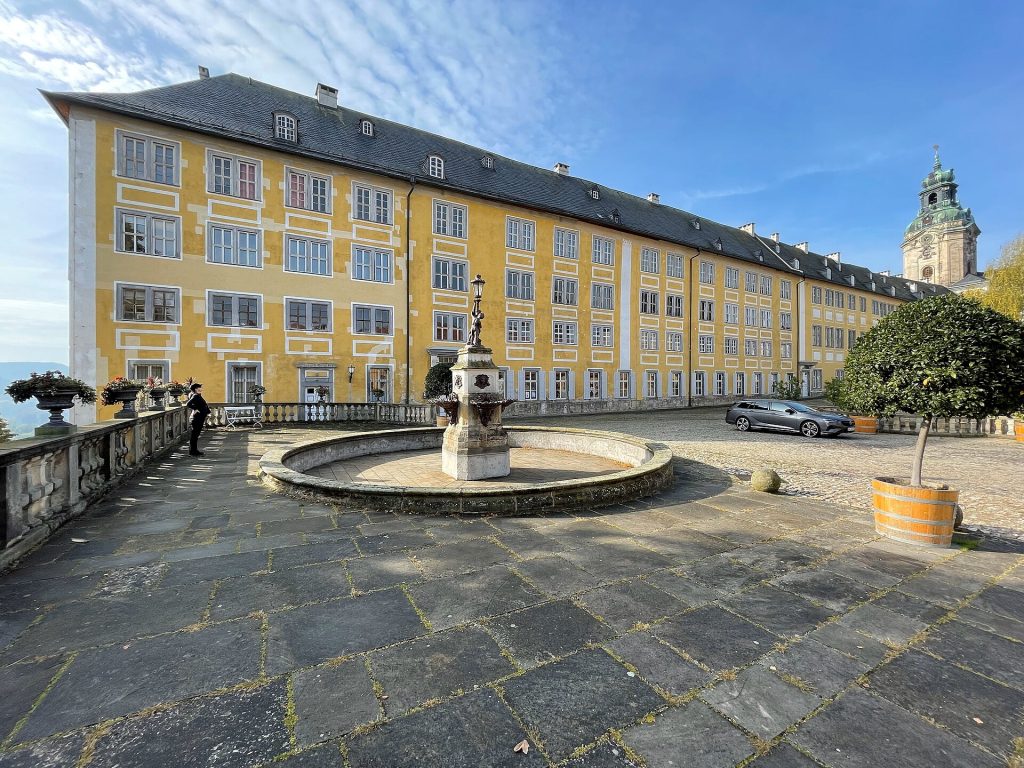
The origins of Heidecksburg lie in a medieval castle built on the ridge to control the Saale valley. Over the centuries it was enlarged into a Renaissance residence with three wings around a courtyard.
In 1735 a devastating fire destroyed much of the west wing, including many of the most important rooms. Rather than simply repairing the damage, the princes decided to rebuild in the latest baroque style, creating a residence worthy of their new princely rank.
The reconstruction lasted several decades and involved leading architects of the time. Johann Christoph Knoffel, who worked for the Saxon court in Dresden, produced plans for the new building, and Gottfried Heinrich Krohne directed much of the later work and the design of the interiors.
The result was a palace that combines the older structure of the three wings with a magnificent new west wing filled with some of the finest rococo rooms in Thuringia.
The fire of 1735 was a disaster for the court, but it also created an opportunity. The new west wing allowed the princes to express their status in the latest fashion, and it gave Thuringia one of its most splendid interiors.
Krohne in particular left his mark on many buildings in Thuringia, and his work at Heidecksburg is considered among his finest. His sense of elegance and decoration defines the character of the palace today.
Some parts of the older palace survived the fire and were incorporated into the new building, so the palace today is a fascinating mixture of periods and styles.
The rebuilding took so long that tastes changed during the work, which is why the decoration moves from late baroque forms to the lighter, more playful rococo.
Visitors can still see traces of the older building in some parts of the palace, such as thick walls, vaulted cellars and irregular rooms that predate the baroque reconstruction.
The rebuilding also included new staircases and corridors that improved circulation within the palace and made it more suitable for the ceremonial life of a princely court.
Facades, Courtyards and Views
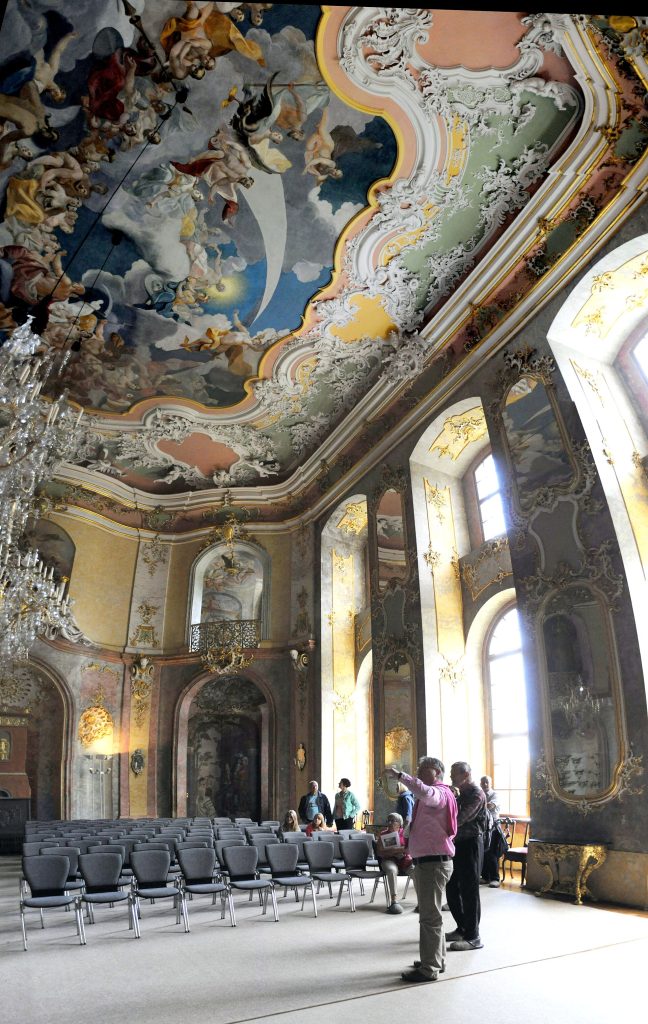
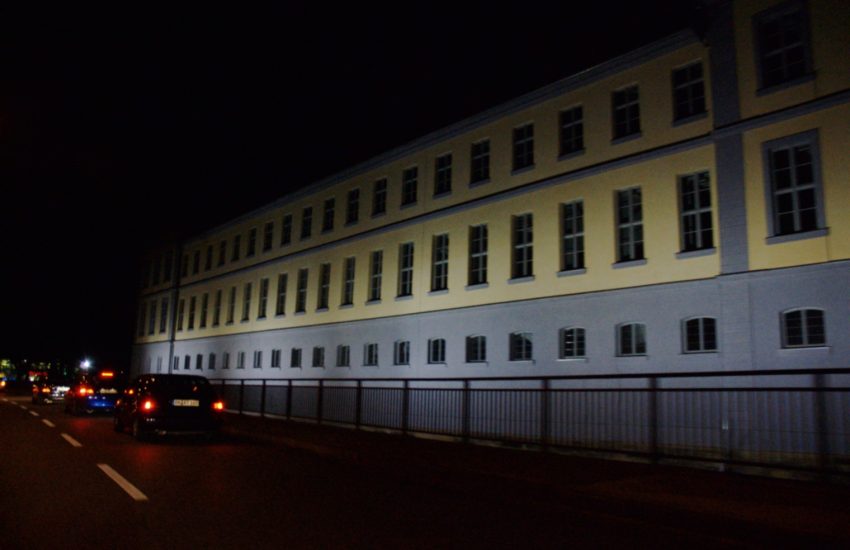
The facades of Heidecksburg are long and dignified, with regular rows of windows and a central projection marking the main entrance. Their restrained elegance reflects the influence of Dresden baroque.
The courtyard is spacious and calm, and from its open side you enjoy wide views over the Saale valley and the rooftops of Rudolstadt. A fountain adds a pleasant touch to the space.
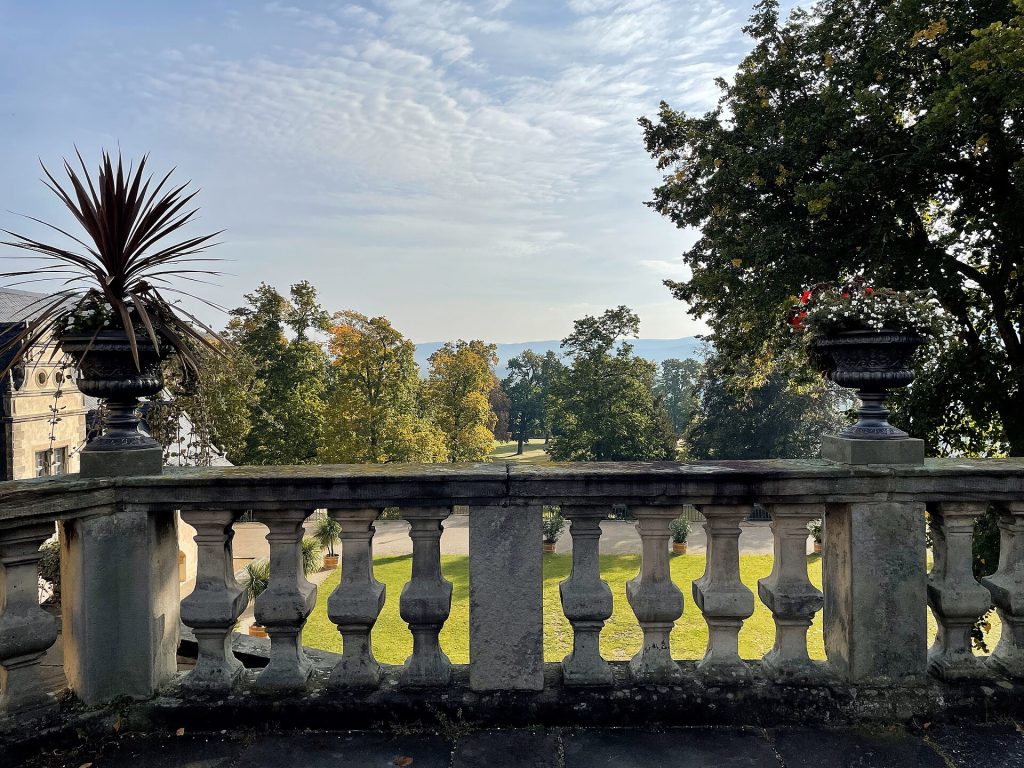
Behind the palace, terraces and a small garden offer further views, and on clear days you can see far across the hills of the Thuringian Forest.
Walking around the palace, you can trace the different building phases, from the older Renaissance parts to the baroque west wing with its more elaborate decoration.
The size of the palace is impressive for such a small principality, and it reflects the ambition of the Schwarzburg princes to stand alongside the great dynasties of the empire.
At sunset, the facades take on warm tones of gold and pink, and the view of the palace from the valley is one of the loveliest sights in Thuringia.
The north and south wings retain more of their earlier character, while the west wing displays the full splendour of the eighteenth century rebuilding.
From the valley, the palace appears as a single long horizontal line along the ridge, a striking silhouette that has become the symbol of Rudolstadt.
The palace is surrounded by a small park and gardens on the slopes of the ridge, with paths that offer different perspectives on the building and the town below.
Look closely at the window frames and cornices, where subtle decorative details soften the long facades and give them rhythm and elegance.
The Festive Hall, Jewel of Thuringian Rococo
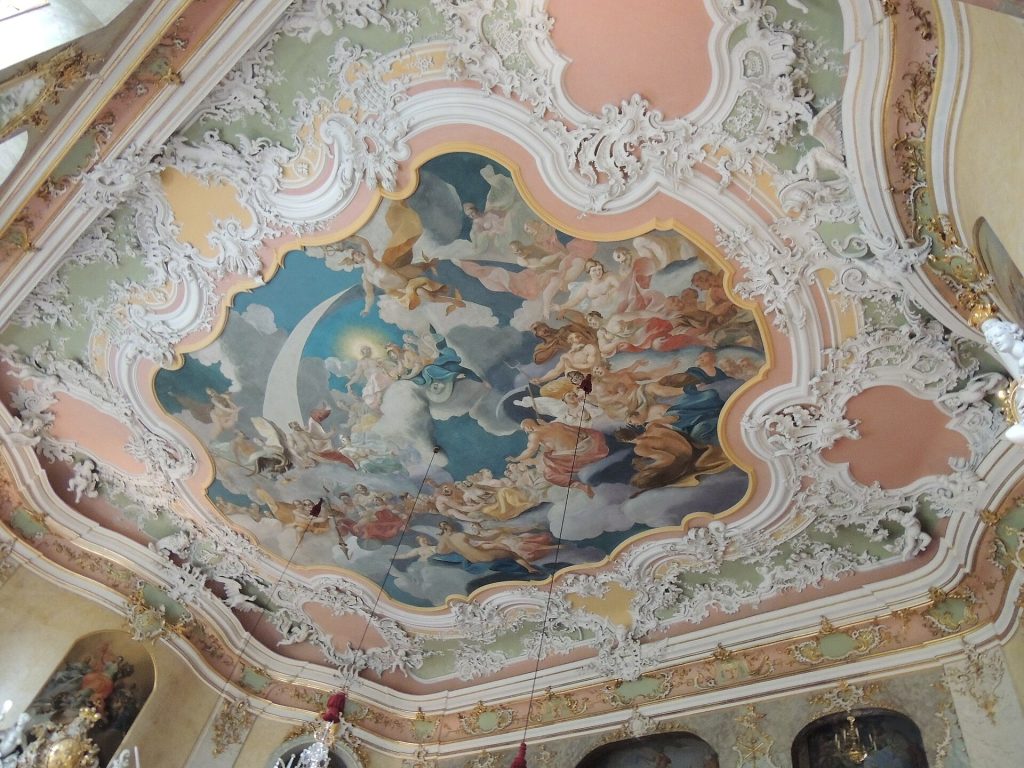
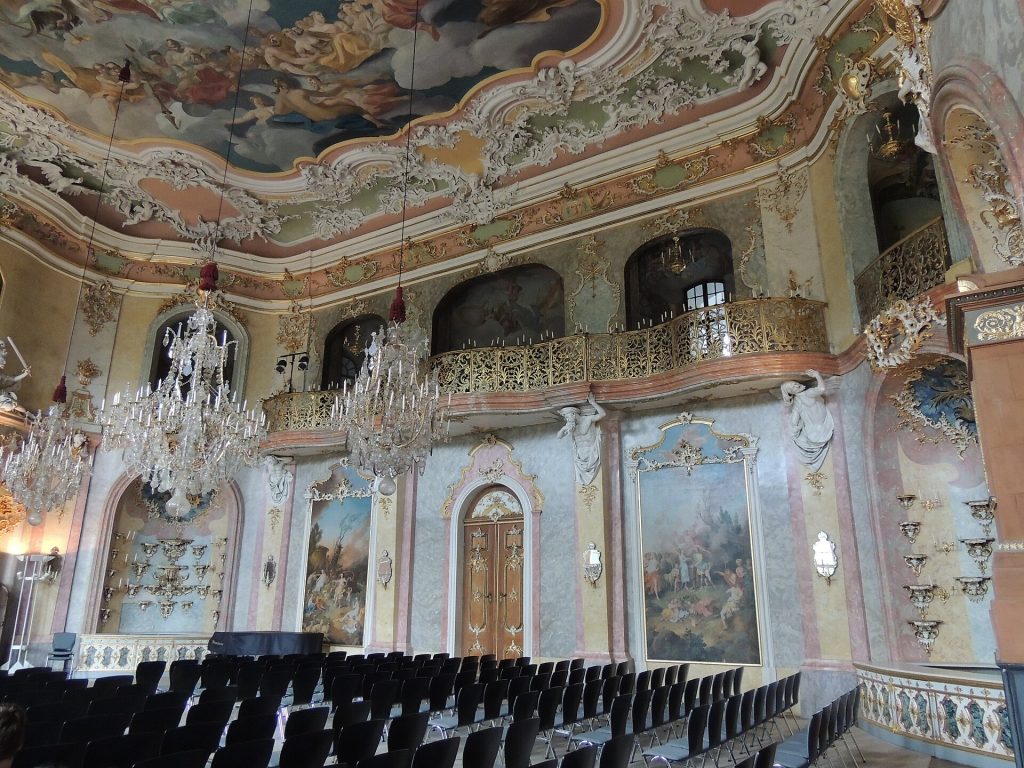
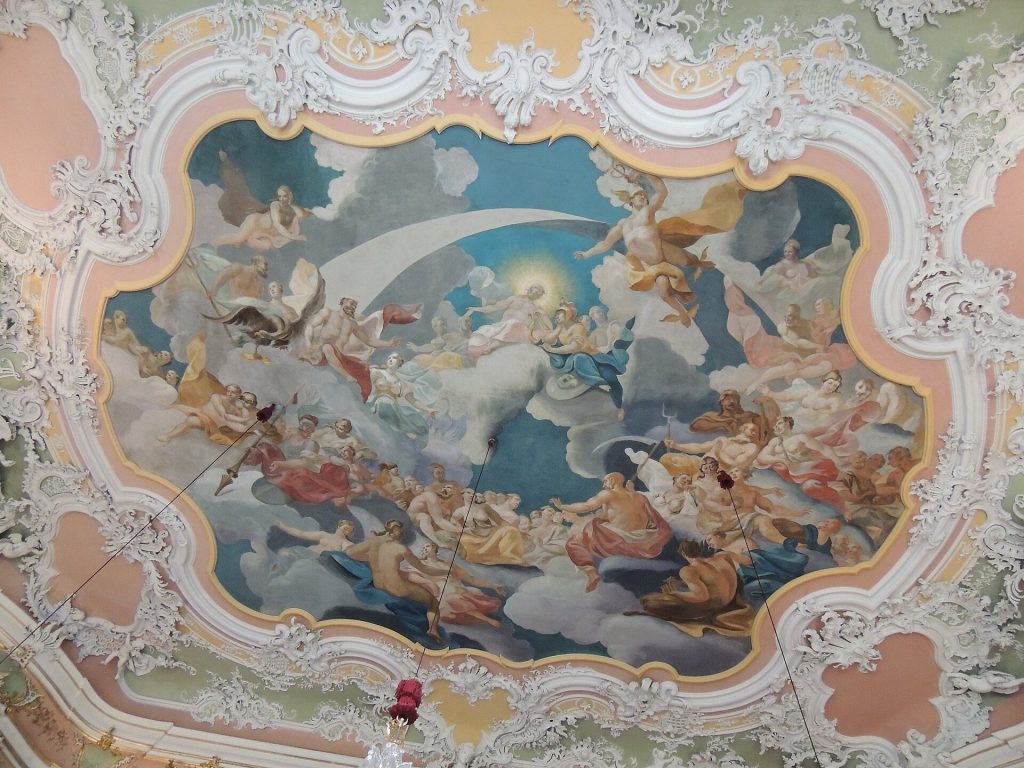
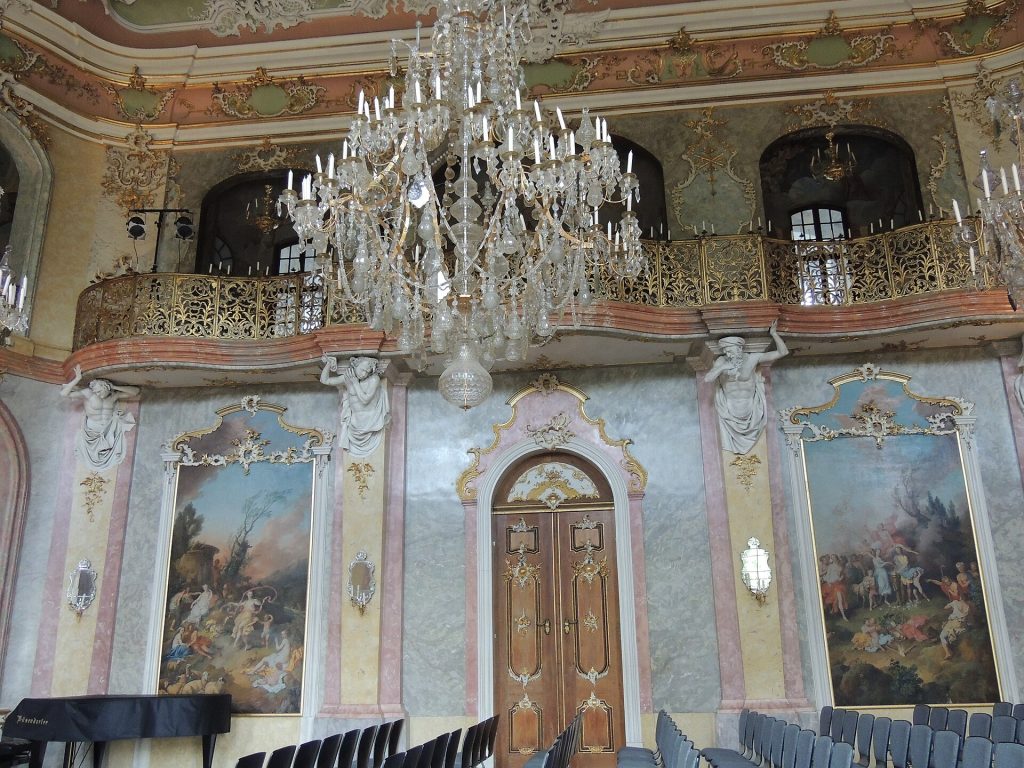
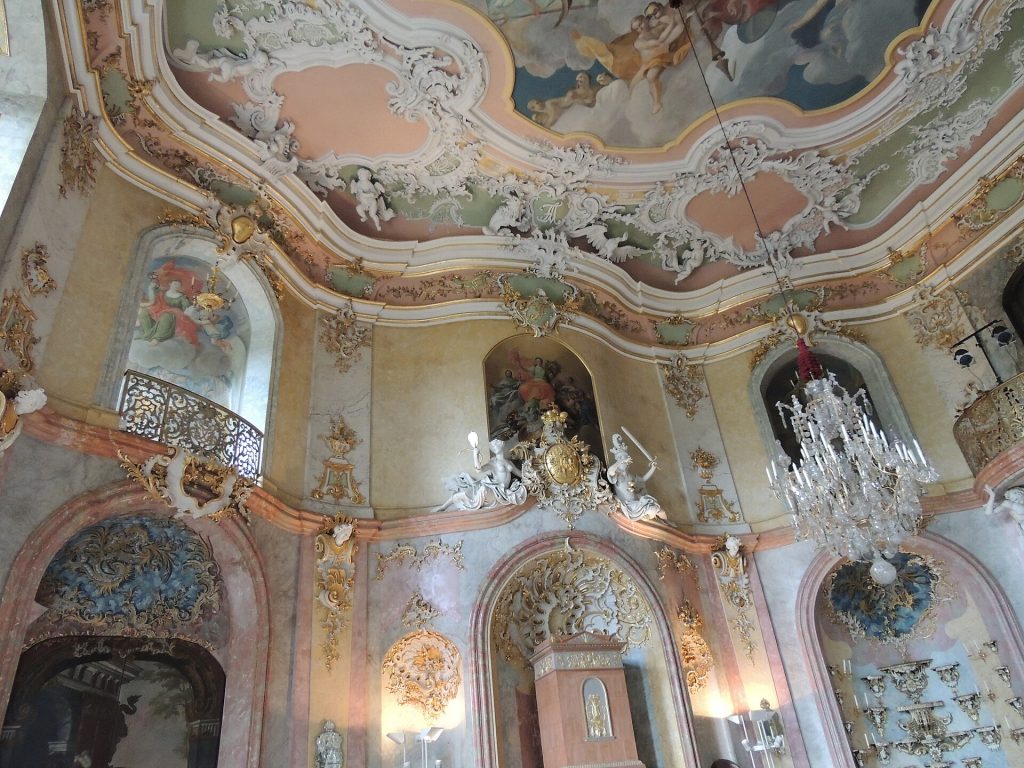
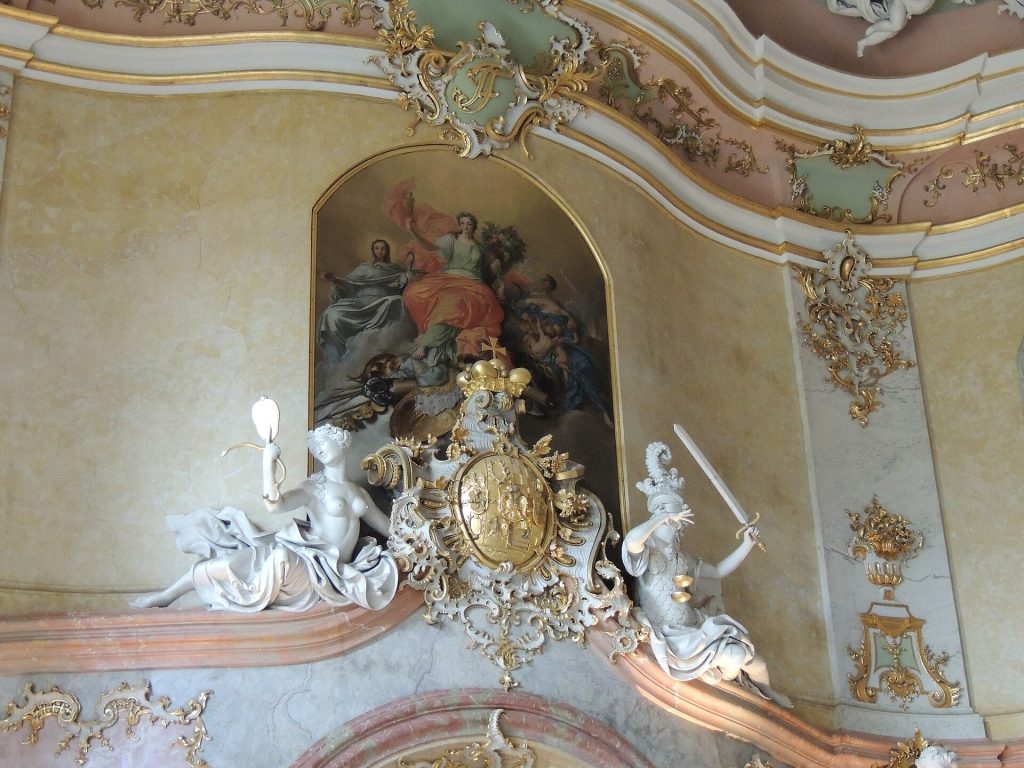
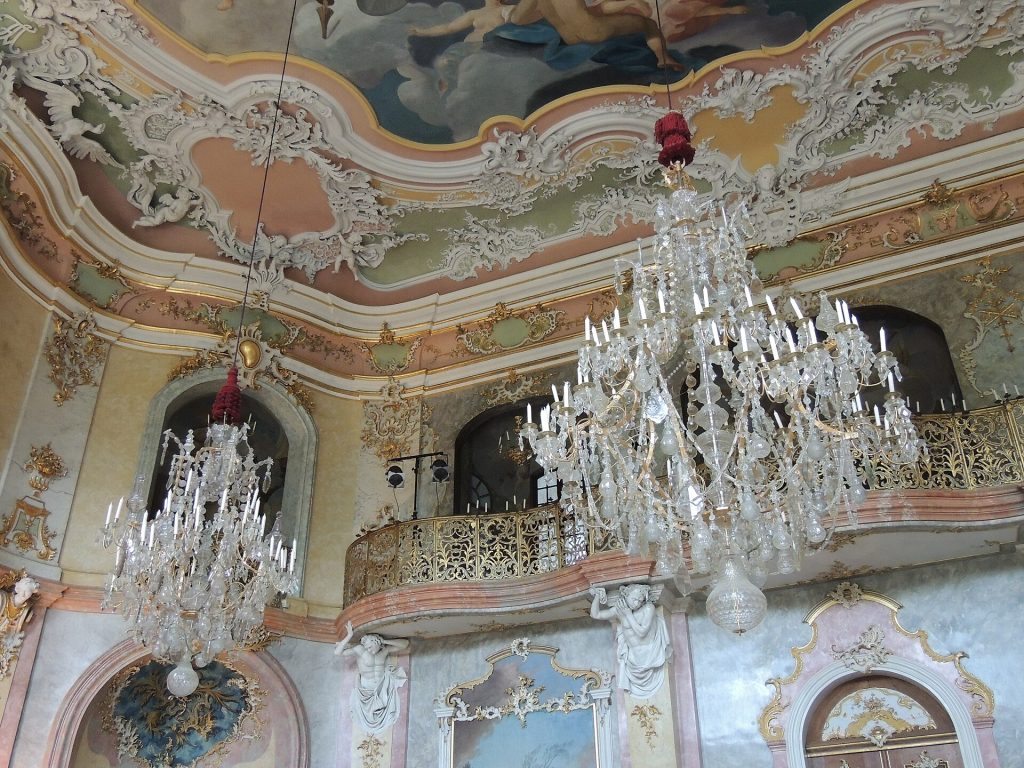
The highlight of any visit is the Festive Hall, a large and brilliant room at the heart of the west wing. Its walls are decorated with delicate stucco in the rococo style, with shell motifs, garlands and playful ornament in white and gold.
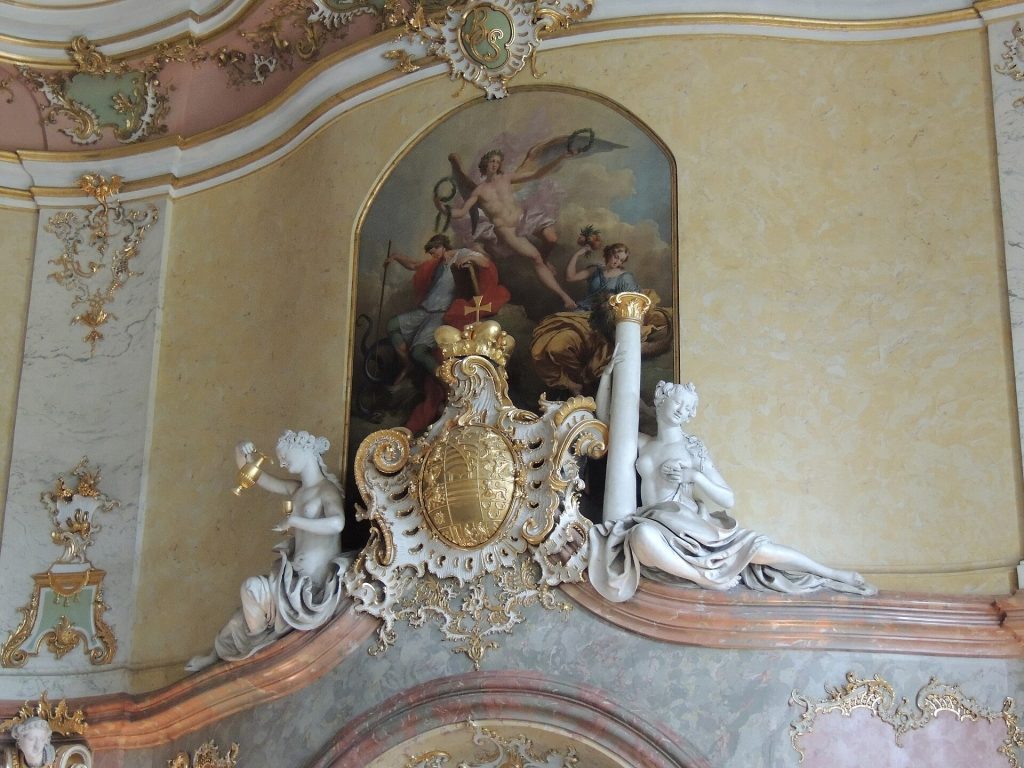
A large ceiling painting crowns the hall, depicting an allegorical scene in which gods and figures float among clouds. The combination of painting, stucco and light creates an atmosphere of joyful elegance.
The hall was used for balls, banquets and court celebrations, and it remains one of the finest rococo interiors in Germany. Concerts are still held here, bringing the room back to life with music.
Standing in the middle of the hall and looking up, you can understand why the princes of Schwarzburg Rudolstadt spared no expense in creating this showpiece of their court.
The stucco work in the hall is especially fine, with flowing curves and naturalistic details such as flowers, leaves and shells that seem almost to grow from the walls. It is a perfect example of the light, playful spirit of rococo design.
Large windows on both sides fill the room with light, and on sunny days the white and gold decoration sparkles. In the evening, with candles and chandeliers lit, the effect must have been magical.
The ceiling painting shows a celestial gathering in which figures from mythology celebrate the glory of the princely house, a common theme in baroque and rococo palaces.
Restoration in recent decades brought back the original colours and gilding, and the hall now looks much as it did when the princes held their first great celebrations there.
The proportions of the hall are carefully balanced, with a gallery for musicians and a sequence of doors leading to the adjoining apartments, so that guests could move easily between dancing, dining and conversation.
Many visitors consider the Festive Hall at Heidecksburg one of the most beautiful rococo rooms north of the Alps, comparable to the celebrated interiors of Bavaria and Franconia.
If you have the chance to attend a concert in the hall, take it. Hearing music in this setting is the best way to understand what the room was created for.
Rococo State Apartments
Around the Festive Hall lies a sequence of state apartments, each decorated in the rococo style with rich colours, stucco ceilings, mirrors and fine furniture. Some rooms are painted in soft greens and blues, others in warm reds and golds.
These apartments were designed for the prince and princess and for important guests, and they combine comfort with display. Tiled stoves, chandeliers and porcelain add to the sense of refinement.
Many of the furnishings are original or come from the princely collections, giving the rooms a strong sense of authenticity.
Walking from room to room, you experience the rococo ideal of a sequence of varied and surprising spaces, each with its own mood and character.
Several rooms feature painted silk or fabric wall coverings, carefully restored to their original colours, which give each space a distinct character.
The so called Green Cabinet and other smaller rooms are particularly charming, offering intimate spaces for conversation, cards or private audiences away from the formal halls.
Furniture in the apartments includes pieces made by German cabinetmakers in the rococo style, with curving legs, inlaid surfaces and gilded mounts, reflecting the refined taste of the court.
Porcelain figures and vases decorate many of the rooms, showing the love of the princes for this precious material, which was produced in several Thuringian manufactories.
Mirrors placed opposite windows were a favourite rococo trick, doubling the light and making the rooms seem larger and more brilliant. You will see this effect throughout the apartments.
The careful sequence of rooms, from public reception rooms to more private chambers, reflects the strict etiquette of court life, where access to the prince depended on rank and favour.
Private Rooms and Princely Life
Beyond the state apartments, visitors can see more private rooms where the princely family lived day to day. These spaces are smaller and more intimate, with writing desks, cabinets, family portraits and personal objects.
They reveal the routines of court life, from morning dressing and correspondence to quiet evenings of reading and music. Even in a small principality, the rhythms of aristocratic life followed the patterns of the great European courts.
Portraits of the princes and princesses of Schwarzburg Rudolstadt introduce you to the family, some of whom were notable patrons of art, music and science.
The careful restoration of these rooms allows you to imagine the people who once lived here and the small world of the Rudolstadt court.
The princes of Schwarzburg Rudolstadt were also known for their interest in botany and natural science, and some rooms contain objects that reflect these scholarly pursuits.
Family portraits show how fashions changed over the centuries, from the elaborate wigs of the baroque era to the simpler styles of the nineteenth century.
Some private rooms contain musical instruments, books and games, giving a sense of how the family passed their leisure time in the long evenings.
A visit to these rooms offers a more personal perspective on the princely family, showing them not only as rulers but as people with their own tastes, interests and daily routines.
The museum has gradually acquired furniture and objects that once belonged to the palace, returning them to their original setting and making the rooms ever more complete.
Floors, Stoves and Fine Craftsmanship
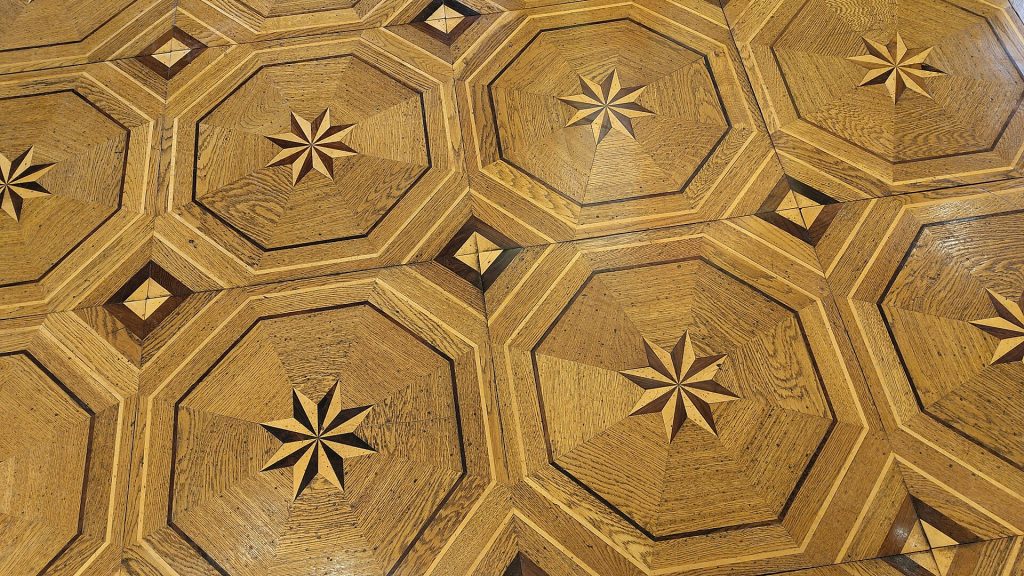
One of the pleasures of Heidecksburg is the quality of its details. The parquet floors are made of different woods arranged in elegant patterns, each room with its own design.
Tiled stoves, carved doors, gilded frames and delicate stucco show the skill of the craftsmen who worked on the palace. Many came from Dresden, Saxony and other parts of Germany, bringing the latest fashions to Rudolstadt.
Mirrors and chandeliers multiply the light, and the furniture combines practicality with ornament, from chests of drawers to card tables and cabinets.
Taking the time to notice these details makes a visit much richer, and you will find yourself discovering new treasures in every room.
The parquet floors were laid by skilled joiners who combined woods such as oak, walnut and maple to create geometric and floral designs. Some patterns are so complex that they seem almost like carpets made of wood.
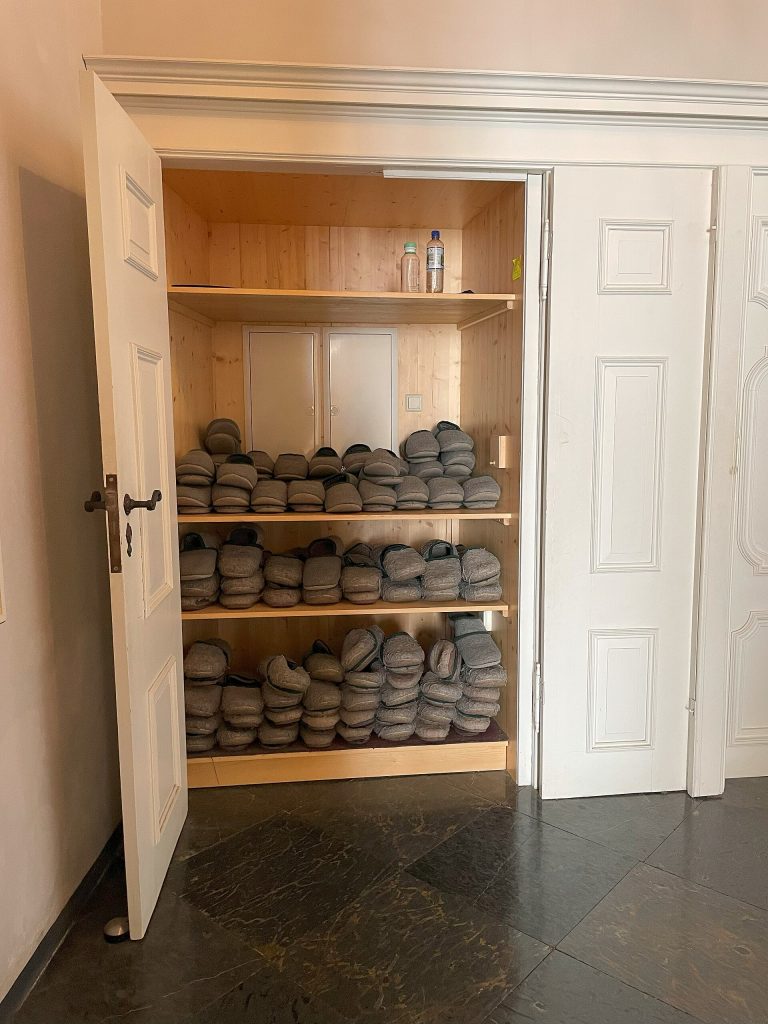
Restorers have worked carefully to preserve these floors, which are fragile and easily damaged, so visitors are sometimes asked to wear protective overshoes.
Door handles, window catches and other small fittings were often gilded or finely worked, showing that no detail was too small for the attention of the princely craftsmen.
The care taken over these details shows that even in a small principality, the court aspired to the highest standards of European taste and craftsmanship.
Weapons, Natural History and Porcelain
Heidecksburg houses several important collections. The Schwarzburg Armoury, one of the oldest and most important weapons collections in Germany, includes swords, firearms, armour and hunting weapons collected by the family over centuries.
There is also a natural history collection gathered by the princes, reflecting the scientific interests of the eighteenth and nineteenth centuries, as well as collections of porcelain, paintings and decorative arts.
The museum also presents the history of the region and of the Schwarzburg family, helping visitors understand the place of this small principality in German history.
Together these collections make Heidecksburg one of the most varied museums in Thuringia, with something to interest almost every visitor.
The armoury includes rare pieces from the Renaissance and baroque periods, as well as weapons used in hunting, which was a central pastime of the princely court.
Porcelain from Thuringian manufactories, including pieces made in nearby Volkstedt, shows the importance of the regional porcelain industry, which flourished under princely patronage.
The natural history collection includes shells, minerals, birds and insects, collected by members of the family and arranged according to the scientific ideas of their time.
Temporary exhibitions are held regularly in the museum, exploring different aspects of Thuringian history, art and culture.
The armoury also contains ceremonial weapons used in court festivities and parades, beautifully decorated with gold, silver and engraving, showing that weapons could be works of art as well as tools of war.
The collections also include paintings by German and Dutch artists, some of them acquired by the princes on their travels, which add a further layer of interest to the visit.
A Rococo World in Miniature
One of the most charming attractions at Heidecksburg is the exhibition known as Rococo en miniature. It is a miniature world of an imaginary rococo principality, complete with palaces, gardens, figures and scenes of court life, created in modern times by dedicated craftsmen.
Thousands of tiny figures, buildings and objects recreate the atmosphere of the eighteenth century, from festive balls to hunting parties and market scenes. The detail is astonishing, and children and adults alike can spend a long time discovering the stories hidden in the scenes.
The miniature world complements the real rococo rooms of the palace, helping visitors imagine how life looked and felt in a small court of the eighteenth century.
It is a delightful and unexpected highlight, and many visitors say it is their favourite part of the museum.
The project took years to complete, and new scenes are occasionally added. Each figure is hand painted, and the buildings are made with remarkable attention to architectural detail.
Visitors often find themselves bending close to the cases to discover small surprises, from tiny musicians and servants to animals and carriages.
The exhibition also explains the techniques used to create the miniatures, offering insight into the patience and skill needed for such a project.
It is a perfect way to end a visit with children, who often love searching for tiny details and inventing their own stories about the inhabitants of the miniature kingdom.
The Beautiful Fountain and the Courtyard
In the courtyard of the palace stands an elegant fountain, a focal point that adds life and movement to the space. It is a pleasant place to pause and enjoy the atmosphere before or after visiting the interiors.
The courtyard is also used for events, from concerts to markets, and in summer it fills with visitors enjoying the views and the sunshine.
From here you can look down over Rudolstadt and the Saale valley, a view that shows how the palace was designed to dominate and protect the town.
On quiet days, the courtyard has a peaceful, almost timeless quality, and it is easy to imagine the comings and goings of the court in centuries past.
The fountain, sometimes called the Beautiful Fountain, was carefully restored and once again forms a graceful centrepiece in the courtyard.
At night, the courtyard is softly lit, and the fountain and facades take on a romantic glow that makes an evening visit especially atmospheric.
Benches around the courtyard invite you to sit and enjoy the scene, and it is a pleasant spot to rest between the different parts of the museum.
Heidecksburg on Video
For a look at the palace before your visit, the video below takes you around Heidecksburg, its courtyard and its rooms.
Watch for the Festive Hall and the views over the valley.
The video also gives a sense of the palace’s setting above the town, which is one of its most memorable features.
Seeing the palace from the air and in motion helps you appreciate its scale and setting, which are hard to capture in photographs.
If the video inspires you, read on for practical tips.
Visiting Heidecksburg Today
Rudolstadt lies in the Saale valley in Thuringia, easily reached by train from Erfurt, Jena or Saalfeld. From the station, a walk through the old town and up the hill brings you to the palace in about twenty minutes.
The museum is open throughout the year, with different opening hours in summer and winter. Guided tours of the state rooms are available, and the collections can be visited individually.
Plan at least half a day to see the state rooms, the armoury, the miniature world and the other collections, and allow time to enjoy the views and the old town below.
Heidecksburg pairs well with other Thuringian residences such as Friedenstein in Gotha and the castles of Weimar, making it an excellent stop on a tour of central Germany.
There are cafes in the palace and in the old town, as well as restaurants serving Thuringian specialities. The nearby Saale river offers pleasant walks along its banks.
Whenever you visit, Heidecksburg offers a rewarding and peaceful experience, far from the crowds, and a vivid glimpse into the world of a small German princely court.
The palace is also a popular venue for weddings, concerts and cultural events, so check the programme before your visit to see if anything special is happening.
If you have more time, combine your visit with a trip to the nearby Schwarzburg Castle and the beautiful Schwarza valley, where the story of the Schwarzburg family began.
View the location on Google Maps
Palaces Nearby
If Heidecksburg has charmed you, central Germany holds more remarkable residences. Here are two more well worth adding to your journey:
- Friedenstein Palace – the vast early baroque palace above Gotha, home of the Ekhof Theatre and its working stage machinery.
- Pillnitz Palace – the Chinese style summer palace of the Saxon kings on the Elbe near Dresden.
You May Like