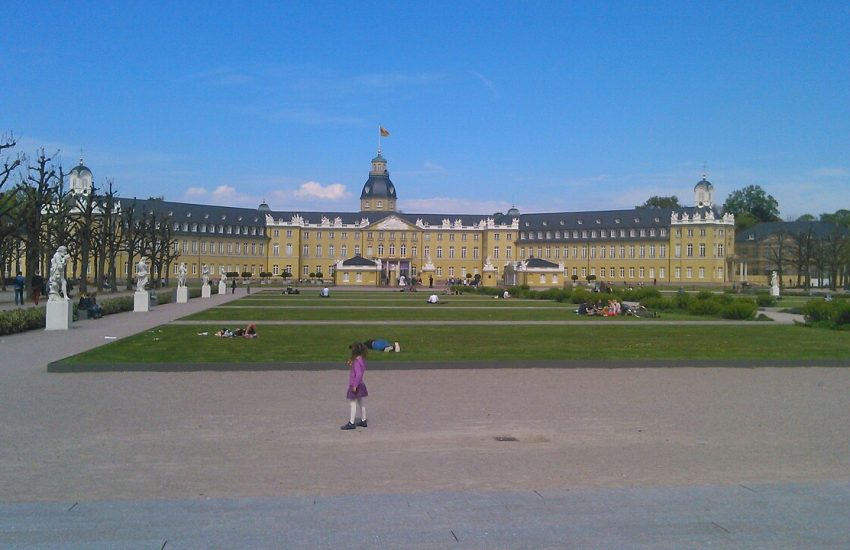
In the town of Bruchsal, between Karlsruhe and Heidelberg, stands one of the most spectacular baroque residences in Germany. Bruchsal Palace was built for the prince bishops of Speyer, and at its heart lies a staircase by Balthasar Neumann so beautiful that it is counted among the masterpieces of European architecture.
The palace has a dramatic history. Almost completely destroyed by bombing in the last weeks of the Second World War, it was painstakingly rebuilt over decades, and its great halls and painted ceilings were recreated with astonishing skill. Today it is also home to a delightful museum of mechanical musical instruments.
In this article we will explore Bruchsal from the prince bishop who founded it to Neumann’s staircase, the painted halls, the destruction and rebirth of the palace, and we will finish with practical tips for your visit.
In This Article
- A Baroque Residence in Bruchsal
- Damian Hugo von Schonborn and the Prince Bishops of Speyer
- A Town Within a Town
- Gatehouses and Courtyards
- The Staircase by Balthasar Neumann
- Neumann Genius in Detail
- The Grotto Beneath the Stairs
- The Princes Hall and Johannes Zick
- The Marble Hall
- Destruction and Rebirth
- The Museum of Mechanical Musical Instruments
- Bruchsal Palace on Video
- Visiting Bruchsal Palace Today
A Baroque Residence in Bruchsal
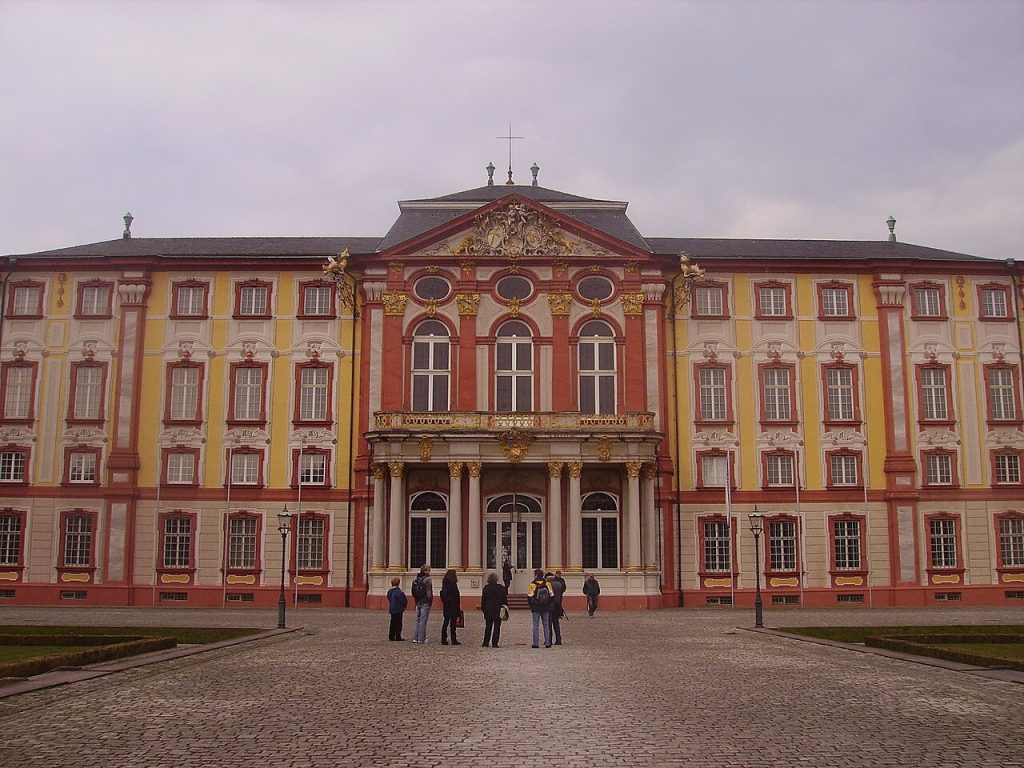
Arriving in Bruchsal, you find the palace spread across a wide area at the edge of the town, its buildings arranged around courtyards and gardens. The main building, with its elegant facades painted in soft tones, is surrounded by more than fifty smaller buildings that once served the court.
The ensemble is one of the largest baroque residence complexes in southwest Germany, and walking through it gives you a sense of the scale of a prince bishop’s court in the eighteenth century.
Painted architecture on some facades adds a playful touch, creating illusions of windows and ornament where there are none, a reminder of the theatrical spirit of the baroque.
What makes Bruchsal special is the combination of grand architecture, a staircase of international fame and the remarkable story of its rebirth after near total destruction.
The palace garden, with its avenues and fountains, provides a peaceful setting and a fine view back toward the main building.
Bruchsal itself is a pleasant town with a long history, and the palace district forms its most distinguished quarter. Cafes and restaurants nearby make it easy to combine sightseeing with a relaxed meal.
Even before you enter the main building, the scale of the complex and the harmony of its layout give a strong impression of the wealth and ambition of the prince bishops.
In spring and summer, the gardens and courtyards come alive with flowers and visitors, while in winter the quiet courtyards have a calm, almost meditative atmosphere.
Damian Hugo von Schonborn and the Prince Bishops of Speyer

The palace was founded in 1720 by Damian Hugo von Schonborn, prince bishop of Speyer and a member of the famous Schonborn family, renowned for their passion for building. The Schonborns also created the Wurzburg Residence, the New Residence in Bamberg and Weissenstein at Pommersfelden.
The prince bishops of Speyer had long had difficult relations with the citizens of their cathedral city, and Damian Hugo decided to move his residence to Bruchsal, where he could build freely and govern without interference.
He commissioned a large new palace with numerous outbuildings, creating a complete residential town for his court, administration and household.
His successors continued the work, adding decoration and furnishings, and the palace remained the seat of the prince bishops until the secularisation of 1803, when it passed to Baden.
The Schonborn arms and those of later prince bishops can still be seen on the buildings, recalling the churchmen who ruled here.
Damian Hugo was a capable administrator and a passionate builder, and he took a close personal interest in the design of the palace, discussing plans with architects and craftsmen.
His nephew and successors continued the family tradition of patronage, and the Schonborn network of palaces across southern Germany remains one of the great achievements of baroque architecture.
The bishopric of Speyer was one of the older ecclesiastical principalities of the empire, and its rulers combined spiritual leadership with the management of lands, finances and justice.
Moving the residence to Bruchsal allowed the prince bishops to create a court that reflected the latest fashions, free from the constraints of the medieval city of Speyer.
A Town Within a Town

Seen from above, the Bruchsal residence reveals its remarkable layout. The main palace stands at the centre, with wings, pavilions and service buildings arranged symmetrically around it, while the garden extends behind.
The outbuildings housed offices, stables, kitchens, guards, officials and craftsmen, making the residence a self contained world. Many of these buildings survive and are used today for offices, schools and cultural institutions.
The overall plan was carefully designed to express order and hierarchy, with the prince bishop’s palace at the centre and the various functions of the court arranged around it.
Walking through the complex, you can still sense how the court must have functioned, with people and goods moving between the buildings throughout the day.
Some of the outbuildings have painted facades that imitate architectural details, a clever and economical way of creating a grand effect, and these illusions have been restored with care.
The church of St Peter, built by Neumann as the burial church of the prince bishops, stands nearby and is well worth a visit as part of the wider ensemble.
The long rows of outbuildings create harmonious streetscapes that are a pleasure to walk through, and many details such as doorways and window frames survive from the eighteenth century.
Gatehouses and Courtyards

Entrances to the residence are marked by gatehouses and guardhouses, which controlled access to the inner courtyards. Their architecture is dignified and decorated with sculpture and coats of arms.
Passing through these gates, visitors entered a world of ceremony and order, where every step brought them closer to the presence of the prince bishop.
The courtyards themselves are spacious and calm, framed by the facades of the main palace and its wings, and they make a fine setting for photographs.
Today these spaces are used for events and festivals, bringing life back to the historic heart of the residence.
The guardhouses at the entrances once housed soldiers who protected the residence and controlled the flow of visitors, a reminder that a prince bishop’s court was also a seat of political power.
Look up at the sculpted coats of arms above the gates, which record the identities of the prince bishops who built and expanded the residence.
The view from the gates toward the main palace is one of the classic images of Bruchsal.
The Staircase by Balthasar Neumann

The greatest treasure of Bruchsal Palace is its staircase, designed by Balthasar Neumann in the 1730s. Neumann, the architect of the Wurzburg Residence, created here one of the most original and beautiful staircases in the world.
The staircase is oval in plan, with two curving flights that rise around a central platform. Visitors climb in a gentle spiral, with light falling from above, and arrive at a landing that opens into the great halls on the upper floor.
The effect is one of movement and lightness, as if the architecture itself were turning in a graceful dance. Neumann solved a difficult problem, linking existing parts of the building, with a design of pure genius.
Above the staircase, a painted dome creates the illusion of an open sky, completing the sense of ascent toward a heavenly realm.
Many visitors come to Bruchsal specifically to see the staircase, and few leave disappointed.
The staircase is often compared with Neumann’s other famous staircases at Wurzburg and Bruhl, and many experts consider Bruchsal the most poetic of the three because of its unusual oval form.
Light plays a key role in the design. Windows placed around the upper level fill the space with brightness, which changes throughout the day and gives the staircase a constantly shifting atmosphere.
Walking up the stairs slowly, you notice how the view changes at every step, revealing new perspectives of the balustrades, the dome and the halls beyond.
Neumann Genius in Detail
Balthasar Neumann was one of the greatest architects of the German baroque. Trained as a military engineer, he brought technical brilliance and artistic imagination to his buildings, and his staircases are among his most celebrated achievements.
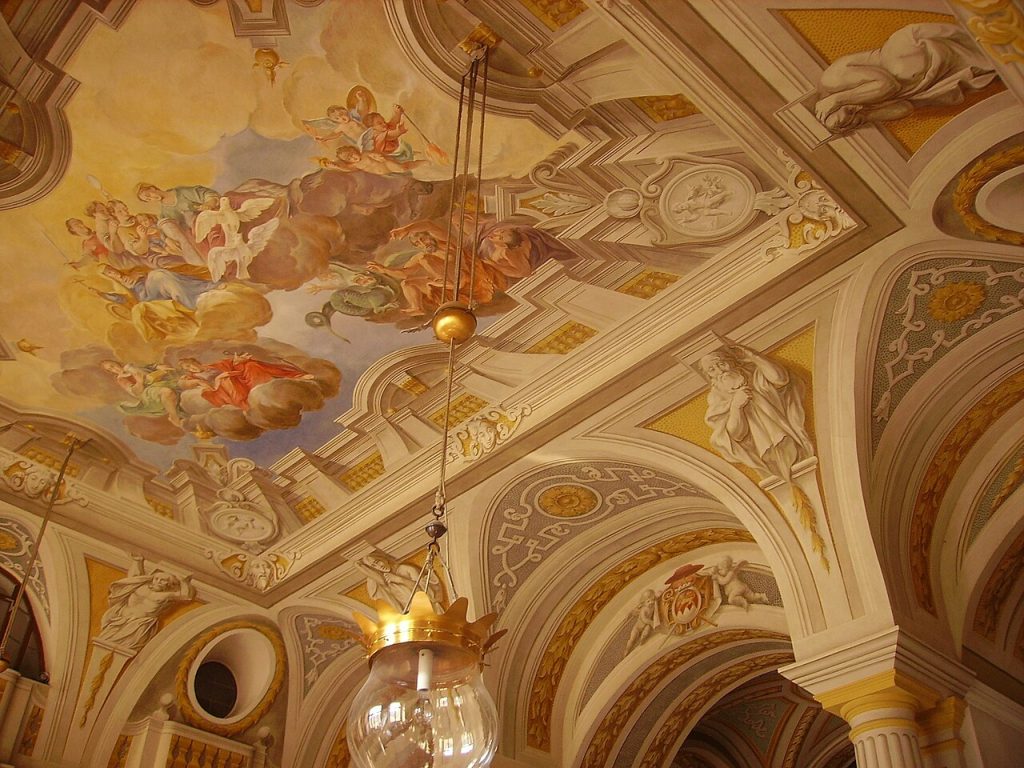
At Bruchsal, the balustrades, stucco and painted decoration work together with the architecture to create a seamless whole. Every curve and line contributes to the sense of flowing movement.
The staircase also reflects the ceremonial needs of the court, providing a grand approach to the state rooms where the prince bishop received his guests.
Standing on the central platform and looking up and around, you can appreciate the complexity and harmony of the design, a true masterpiece of baroque space.
Neumann worked on many buildings for the Schonborn family and other patrons, and his legacy includes churches such as Vierzehnheiligen and Neresheim, as well as numerous palaces.
His portrait appeared on the old fifty mark banknote of Germany, a sign of the high esteem in which he is held as one of the country’s greatest architects.
Architects and students from around the world come to study the staircase, and it features in many books on the history of European architecture.
The Grotto Beneath the Stairs
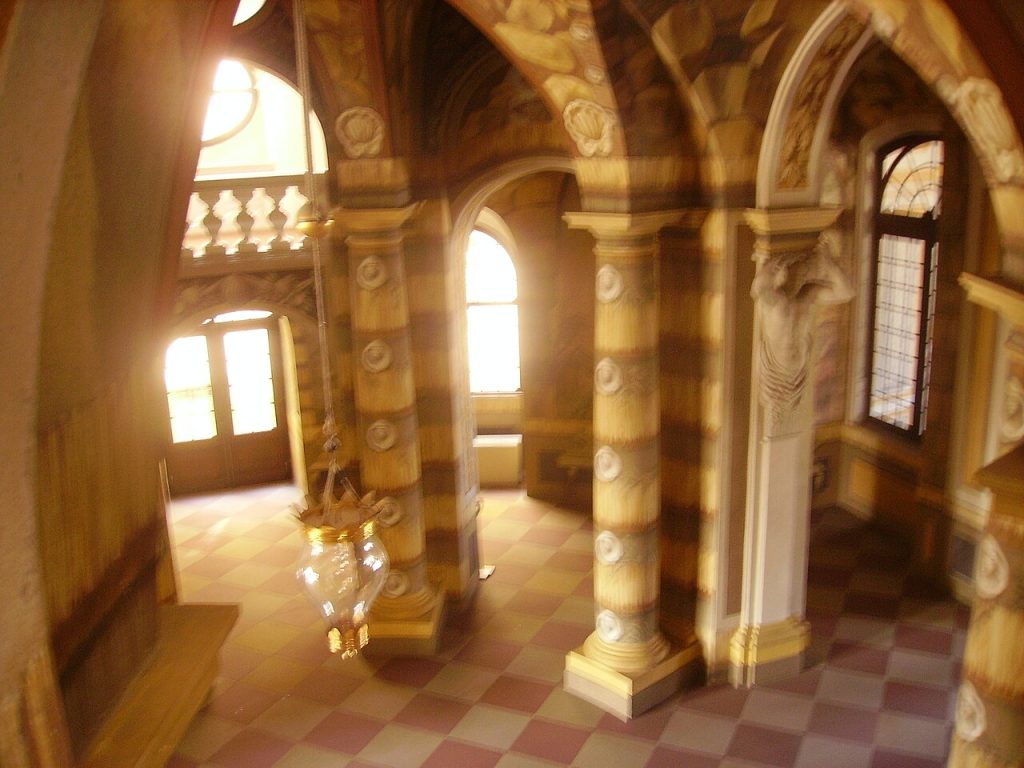
Beneath the great staircase lies a grotto like space, a cool, dimly lit room decorated in the manner of a cave. Grottoes were fashionable features of baroque palaces, offering a contrast to the bright and splendid rooms above.
At Bruchsal, the grotto creates a dramatic transition, as visitors pass from shadow into the light of the staircase, a theatrical effect that Neumann and his patrons clearly enjoyed.
Its decoration evokes the natural world, with rough textures and shell motifs, reminding visitors of the mysteries of nature hidden beneath the elegance of the court.
Today the grotto is part of the visitor route, and it adds an unexpected and atmospheric touch to the experience of the palace.
The grotto also served a practical purpose, providing a cool space on the ground floor that connected different parts of the palace.
Its subdued light makes the brilliance of the staircase above all the more striking, an effect carefully calculated by the designers.
The Princes Hall and Johannes Zick

At the top of the staircase lie the two great halls of the palace, the Princes Hall and the Marble Hall. Their ceilings were painted in the 1750s by Johannes Zick, a leading fresco painter of southern Germany.
Zick’s frescoes celebrate the virtues and history of the prince bishops, with allegorical figures, historical scenes and views of the bishopric set within painted architecture.
The halls were used for receptions, banquets and ceremonies, and their splendour was designed to impress visitors with the power and dignity of the prince bishop.
After their destruction in 1945, the frescoes were reconstructed from photographs and colour slides taken during the war, a remarkable achievement of modern restoration.
Johannes Zick worked for several courts in southern Germany, and his son Januarius Zick also became a famous painter, continuing the family’s artistic tradition.
The reconstructed frescoes are so faithful to the originals that many visitors are surprised to learn they were painted in the twentieth century.
The Princes Hall also displays portraits of prince bishops, linking the painted allegories on the ceiling with the real rulers who once stood beneath them.
The Marble Hall
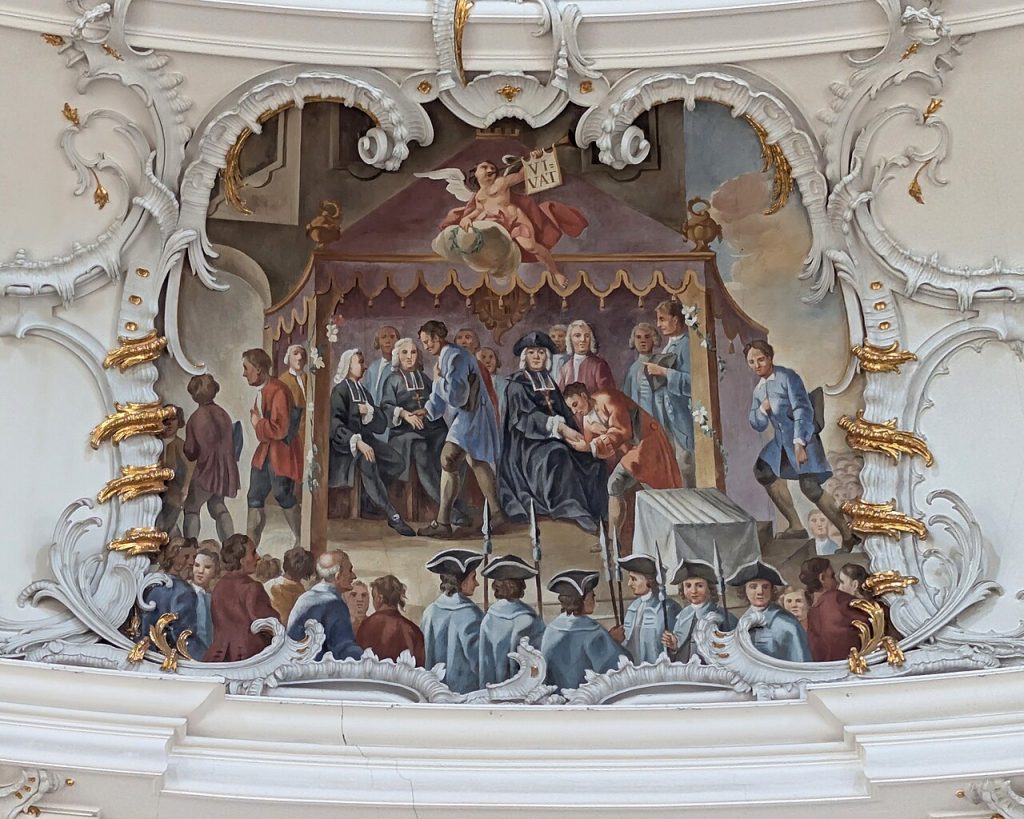
The Marble Hall is one of the most elegant spaces in the palace, with walls clad in imitation marble and decorated with stucco and gilding. Its painted ceiling continues the themes of the Princes Hall, creating a sequence of magnificent rooms.
Light from tall windows fills the hall, bringing out the colours of the marble and the brilliance of the gilding. It is a perfect example of the late baroque taste for luxury and harmony.
Concerts and events are held in the hall, and hearing music beneath its painted ceiling is a memorable experience.
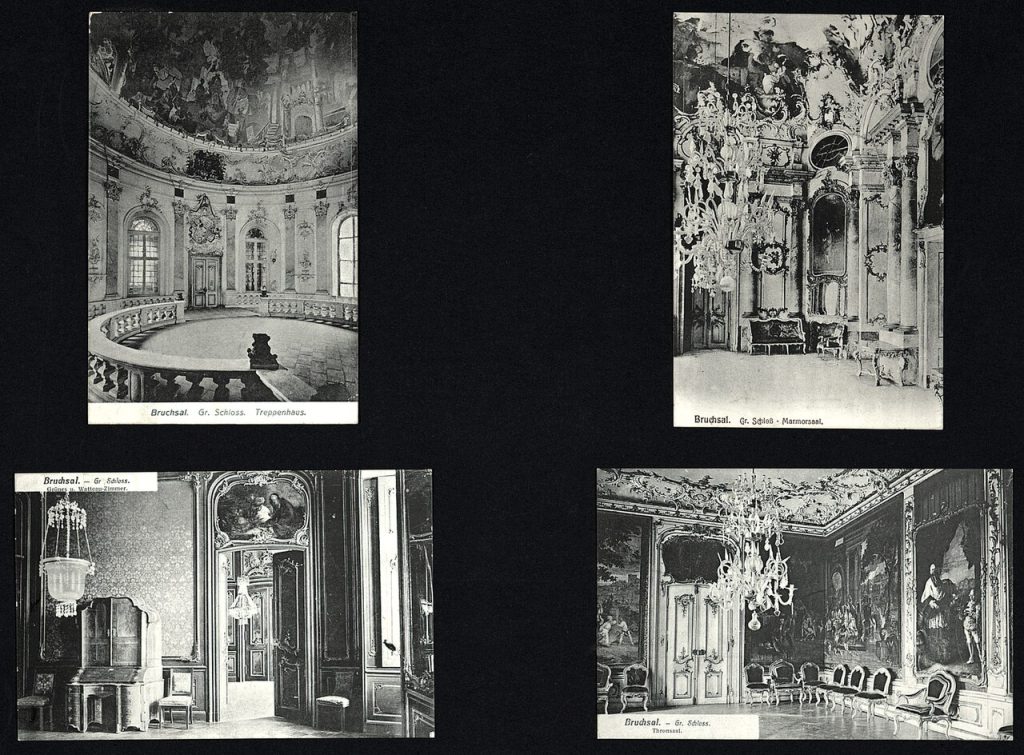
Standing in the Marble Hall, it is hard to believe that it was once a burnt out ruin, a testament to the dedication of the craftsmen who rebuilt it.
Fine furniture, mirrors and chandeliers complete the decoration of the hall, recreating the atmosphere of a princely reception room.
The hall’s acoustics are excellent, and it has become one of the most sought after concert venues in the region.
Doors from the Marble Hall lead to further state rooms, furnished with period pieces that show how the prince bishops lived.
Destruction and Rebirth

On 1 March 1945, just weeks before the end of the Second World War, Bruchsal was heavily bombed. The palace was almost completely destroyed by fire, and only the outer walls of many buildings remained standing.
For years the ruins stood as a reminder of the war, but the people of Bruchsal and the state of Baden Wurttemberg were determined to rebuild. Reconstruction began in the following decades and continued until the late twentieth century.
Craftsmen recreated the stucco, gilding and painted ceilings using historic photographs, drawings and colour slides made during the war as part of a programme to document important interiors.
Neumann’s staircase was carefully rebuilt, and today it once again rises in its elegant spiral, a symbol of resilience and renewal.
The story of the palace’s destruction and rebirth is told in exhibitions within the building, adding a moving dimension to the visit.
Original fragments that survived the fire were incorporated into the reconstruction wherever possible, so the rebuilt palace contains real traces of its eighteenth century past.
The reconstruction of Bruchsal is now regarded as one of the most successful restorations of a war damaged palace in Germany, and it served as a model for other projects.
Photographs displayed in the palace show the ruins after the bombing, making the contrast with today’s splendour all the more striking.
The Museum of Mechanical Musical Instruments
Bruchsal Palace is home to the German Museum of Mechanical Musical Instruments, a delightful collection of music boxes, automata, barrel organs, orchestrions and self playing pianos from the eighteenth to the twentieth centuries.
Many of the instruments are still in working order, and guided tours include demonstrations that fill the rooms with music. Hearing a great orchestrion play is a joyful experience that appeals to visitors of all ages.
The collection shows how people enjoyed music before recorded sound, and it includes beautifully crafted objects that combine engineering, art and entertainment.
The museum is one of the most popular attractions in Bruchsal, and it makes a lively contrast with the grand state rooms of the palace.
Among the highlights are large orchestrions that imitate entire orchestras, as well as delicate singing bird automata and elegant music boxes that once entertained aristocratic and middle class families.
Children love the demonstrations, but adults are just as enchanted by the ingenuity and charm of these remarkable machines.
The museum also explains the technology behind the instruments, from pinned cylinders to punched paper rolls, revealing the clever mechanics that made music without musicians.
Bruchsal Palace on Video

For a look at the palace and its staircase before your visit, the video below presents Bruchsal and its highlights.
Watch for Neumann’s staircase and the great halls with their painted ceilings.
The video also shows the scale of the residence and its setting in the town.
If the video inspires you, read on for practical tips.
Visiting Bruchsal Palace Today

Bruchsal Palace is managed by the State Palaces and Gardens of Baden Wurttemberg and is open throughout the year, except on Mondays. Guided tours and audio guides help you explore the state rooms and the staircase.
Bruchsal is easy to reach by train from Karlsruhe, Heidelberg and Mannheim, and the palace is a short walk from the station.
Plan at least half a day to see the state rooms, the staircase, the museum of musical instruments and the garden.
Bruchsal pairs well with Schwetzingen and Karlsruhe, making it easy to visit several palaces in a single trip through the region.
There is a cafe in the palace complex, and the garden is a lovely place to relax after your tour.
Whenever you visit, Bruchsal offers a moving story of beauty lost and regained, and the chance to see one of the most extraordinary staircases ever built.
Combined tickets for the palace and the museum are available, and special events such as concerts and festivals take place throughout the year.
View the location on Google Maps
Palaces Nearby
If Bruchsal has impressed you, Baden holds more remarkable palaces. Here are two more well worth adding to your journey:
- Schwetzingen Palace – the summer residence of the Electors Palatine with its enchanted gardens and garden mosque.
- Karlsruhe Palace – the heart of the fan shaped city founded by the margraves of Baden.
You May Like