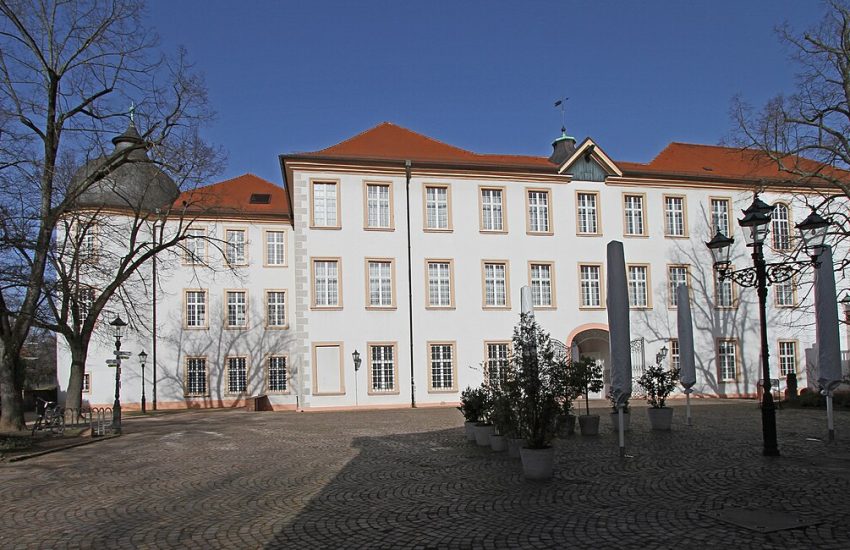
On a wooded hill west of Stuttgart, far above the city, stands a palace that seems to float above the landscape. Solitude Palace was built in the 1760s for Duke Carl Eugen of Wurttemberg as a pleasure and hunting retreat, and its graceful oval hall, sweeping terraces and endless views make it one of the most beautiful rococo palaces in southern Germany.
Solitude is also tied to remarkable stories. A perfectly straight avenue thirteen kilometres long links it with Ludwigsburg Palace, and the military academy founded here by the duke counted the young Friedrich Schiller among its students. Today the palace and its surroundings host an international academy for artists.
In this article we will explore Solitude from the duke who dreamed it into being to its architecture, its White Hall, its avenue and its later history, and we will finish with practical tips for your visit.
In This Article
- A Palace Above the Clouds of Stuttgart
- Duke Carl Eugen and His Passion for Building
- La Guepiere and the Architecture of Solitude
- Terraces and Curving Stairs
- Solitude From Above
- The Cavalier Houses
- The Solitude Allee
- Passages and Hidden Corners
- The White Hall
- Views Over Swabia
- The Palace Chapel and the Karlsschule
- Solitude Palace on Video
- Visiting Solitude Palace Today
A Palace Above the Clouds of Stuttgart

The approach to Solitude takes you up through forests above Stuttgart, until suddenly the trees open and the palace appears on the crest of a hill. Its pale facade, crowned by a central dome, stands against the sky, surrounded by lawns and low buildings.
The palace is compact and elegant, raised on a terrace above the surrounding landscape, so that from its windows and balconies you look out over forests, fields and distant hills. On clear days you can see far across Swabia.
Around the main building stand the cavalier houses, a ring of smaller buildings that once housed courtiers, guests and servants, and that today accommodate artists and a restaurant.
What makes Solitude special is the combination of rococo elegance, a dramatic hilltop setting and a rich cultural history that continues today.
Visitors from Stuttgart often come here for walks in the surrounding forest, and the palace makes a perfect destination for an excursion into the countryside around the city.
The sense of height and openness is what most visitors remember about Solitude. After the dense forest of the approach, the open plateau around the palace feels like a stage set above the world.
In autumn the surrounding woods glow with colour, and in winter, when snow covers the terraces, the palace looks like a scene from a fairy tale.
Despite its closeness to a major city, Solitude feels remote and peaceful, and many visitors are surprised to find such a tranquil place so near Stuttgart.
Duke Carl Eugen and His Passion for Building
Duke Carl Eugen of Wurttemberg, who ruled from 1744 to 1793, was one of the most colourful princes of eighteenth century Germany. Ambitious, extravagant and passionate about the arts, he built palaces, theatres and gardens throughout his duchy.
His court at Stuttgart and Ludwigsburg was famous for its operas, ballets and festivals, which cost enormous sums and brought him into conflict with the estates of Wurttemberg.
In 1763 he began building Solitude as a retreat where he could escape the formality of court life, hunt in the surrounding forests and entertain his guests in a more intimate setting.
The name Solitude, meaning solitude in French, reflects this desire for retreat, though in practice the palace was often the scene of lavish festivities.
Later in life Carl Eugen became more serious and devoted himself to education, founding the famous academy that bore his name.
His long reign saw Wurttemberg transformed by new buildings, roads and institutions, and many of the landmarks of Stuttgart and Ludwigsburg owe their existence to him.
His relationship with Franziska von Hohenheim, whom he later married, softened his character, and she encouraged his interest in education and charitable works.
Carl Eugen was also a passionate hunter, and the forests around Solitude were rich in game. Hunting parties set out from the palace, and the duke’s guests enjoyed both the sport and the festivities that followed.
La Guepiere and the Architecture of Solitude
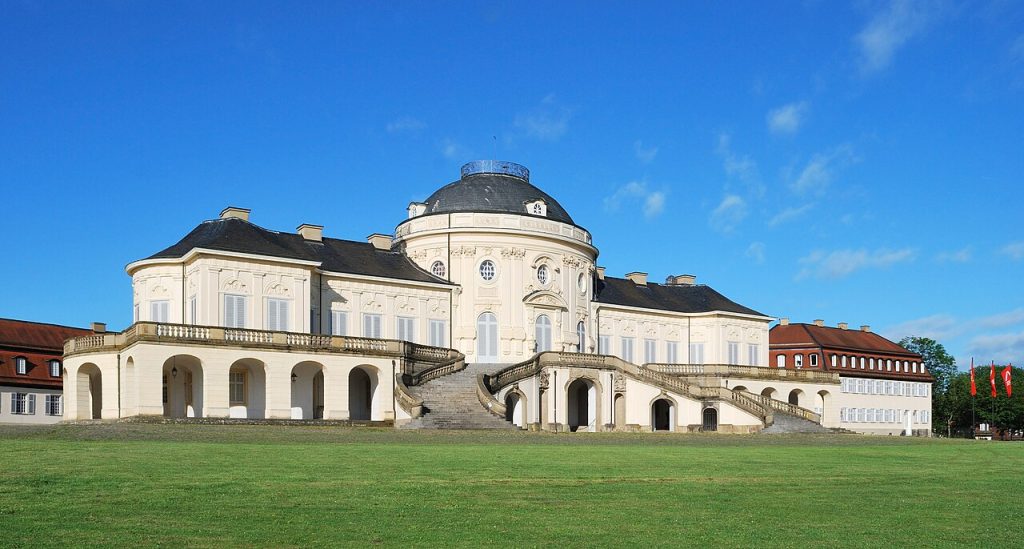
The palace was designed by Johann Friedrich Weyhing and completed under the direction of Philippe de La Guepiere, a French architect who served as court architect in Wurttemberg and designed several of the duke’s buildings.
La Guepiere brought French elegance to Wurttemberg, and Solitude reflects the transition from late rococo to early classicism, with graceful curves combined with clear, ordered forms.
The main building is raised on a high terrace and crowned by a dome over the central oval hall. Curving staircases lead up to the entrance, giving the palace a sense of lightness and movement.
Construction lasted from 1763 to 1769, and the result was one of the finest pleasure palaces of its time, admired by visitors from across Europe.
The surrounding buildings and gardens were planned as part of a unified ensemble, with the palace at the centre of a carefully designed landscape.
La Guepiere also designed the New Palace in Stuttgart and Monrepos near Ludwigsburg, so Solitude belongs to a family of buildings that share his refined style.
The dome over the central hall is a distinctive feature, visible from far away and giving the palace its recognisable silhouette.
The interior decoration was carried out by skilled stuccoists, painters and carvers, many of whom also worked on the duke’s other palaces.
Terraces and Curving Stairs

The south side of the palace faces a broad terrace with curving flights of stairs leading down to the gardens. From here the views over the landscape are breathtaking, especially at sunset.
The north side, facing the approach, has a more formal character, with the entrance and the central projection crowned by the dome.
The pale facades are decorated with pilasters, window frames and delicate ornament, giving the palace an air of lightness and grace.
Walking around the terrace, you can appreciate how the architect used the hilltop setting to create a building that seems to command the entire landscape.
The balustrades along the terrace are decorated with vases and ornament, and the stone steps have been worn smooth by centuries of visitors.
From the bottom of the stairs, the view up to the palace and its dome is especially impressive, emphasising the building’s elevated position.
The terrace was designed for promenading, and in the duke’s time courtiers would stroll here in the evening, enjoying the cool air and the views.
Solitude From Above

From the air, Solitude reveals its careful planning. The main palace stands at the centre, with the curved ring of cavalier houses enclosing an oval space around it, and the gardens and forest extending beyond.
The famous Solitude Allee can be seen running straight as an arrow toward the northeast, linking the palace with Ludwigsburg across the landscape.
The ensemble shows how eighteenth century princes shaped entire landscapes around their residences, creating axes, views and avenues that still define the region today.
Aerial images also show the dense forest that surrounds the palace, emphasising its sense of seclusion from the city below.
The oval plan of the ensemble is unusual, and it gives Solitude a harmonious, almost theatrical character when seen from above.
The surrounding meadows and woods remain largely undeveloped, preserving the sense of isolation that gave the palace its name.
The Cavalier Houses
Around the palace stands a semicircle of low buildings known as the cavalier houses. They once housed members of the court, guests, officers and servants, and their modest architecture frames the main building without competing with it.
Today the cavalier houses are home to the Akademie Schloss Solitude, an international artists residency founded in 1990. Artists, writers, composers and scholars from around the world live and work here for months at a time.
The presence of the academy gives Solitude a lively, creative atmosphere, and exhibitions, readings and concerts are held regularly.
One of the cavalier houses also contains a restaurant, where visitors can enjoy a meal with views over the palace and the landscape.
The academy has hosted thousands of artists since its founding, making Solitude an important centre of contemporary culture as well as a historic monument.
The modest architecture of the cavalier houses, with their simple facades and low roofs, emphasises the elegance of the main palace at the centre.
Walking around the oval, you pass the doors and windows of the artists studios, where new works are created in the historic setting.
The Solitude Allee
One of the most remarkable features of Solitude is the Solitude Allee, a perfectly straight road thirteen kilometres long that runs from the palace to Ludwigsburg Palace. It was laid out at the duke’s command so that he could travel quickly between his residences.
The avenue is so straight that in the early nineteenth century it was used as a baseline for the land survey of Wurttemberg, an important step in creating accurate maps of the kingdom.
Today parts of the avenue are still in use as roads and paths, and walking or cycling along it gives a vivid sense of the scale of Carl Eugen’s ambitions.
From the palace terrace, you can look along the line of the avenue toward Ludwigsburg, imagining the duke’s carriage racing across the landscape.
Along the avenue, small markers and information boards explain its history and its role in surveying, making it an interesting route for walkers and cyclists.
The avenue was also a statement of power, demonstrating the duke’s ability to reshape the landscape according to his will, cutting straight through forests, fields and valleys.
Passages and Hidden Corners
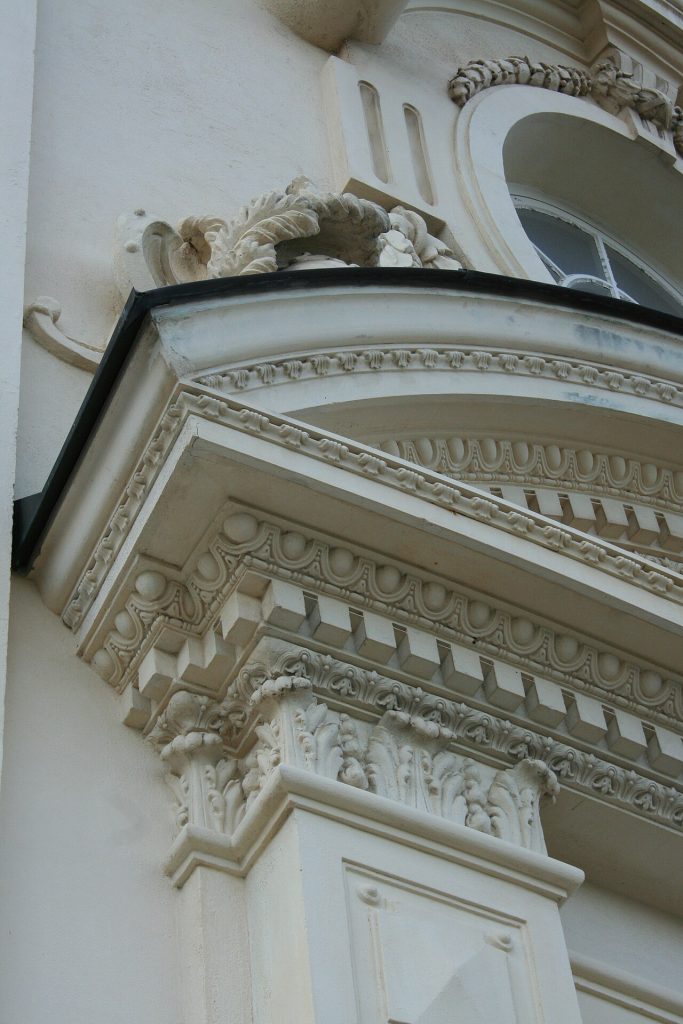
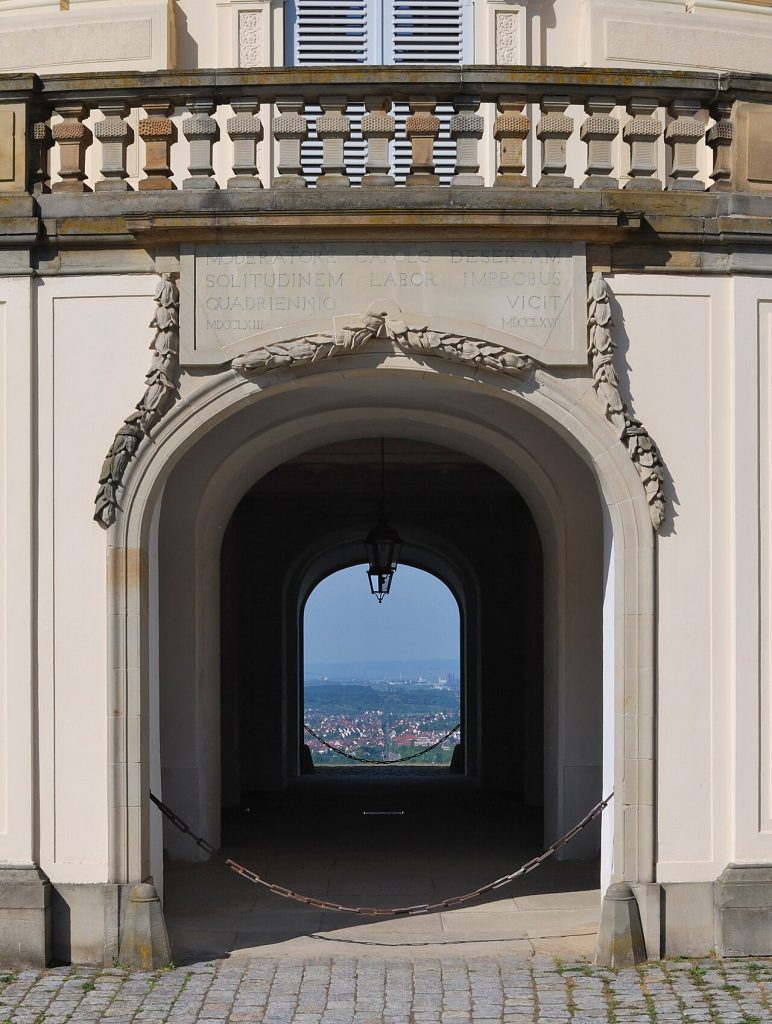
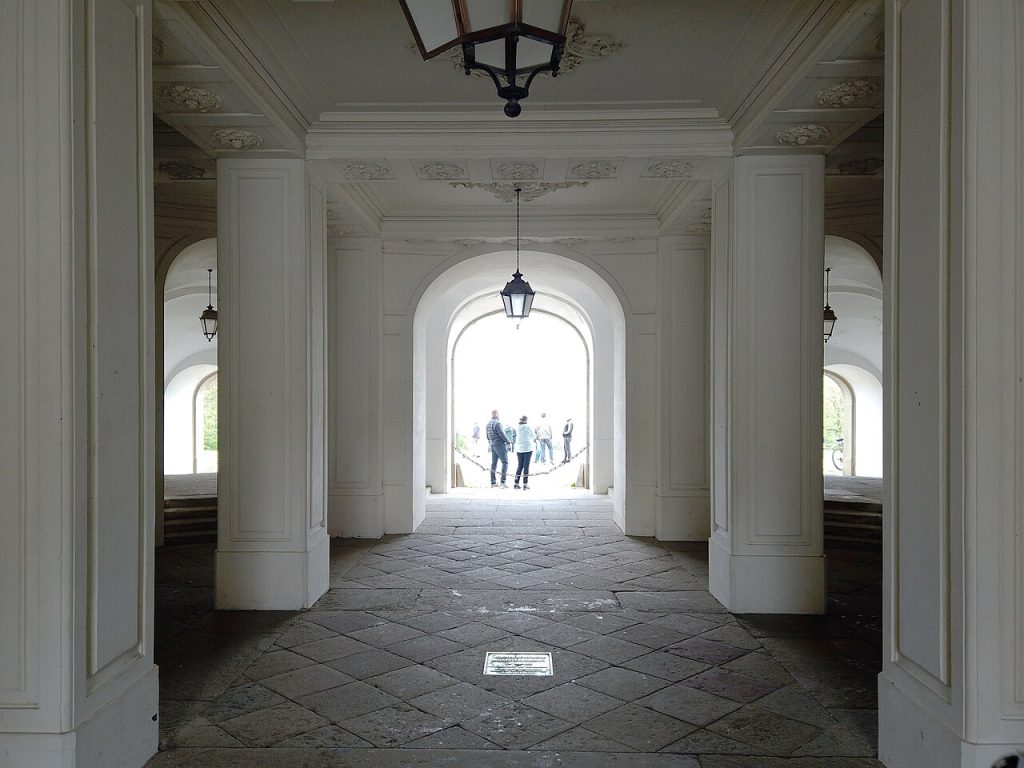
Between the cavalier houses, passages and gateways lead from the outer grounds into the oval around the palace. These transitions create a sense of arrival and enclosure.
Exploring the grounds, you discover quiet courtyards, old trees and views back toward the dome, each offering a different perspective on the ensemble.
Some passages frame views of the forest or the distant landscape, a typical device of eighteenth century design that links architecture and nature.
These quieter corners are perfect for a peaceful walk after visiting the palace interiors.
Some of the old trees around the palace were planted in the eighteenth century and have grown to impressive size, adding to the dignified atmosphere of the grounds.
In spring, wildflowers bloom in the meadows around the palace, adding colour to the grounds and attracting butterflies and bees.
The White Hall

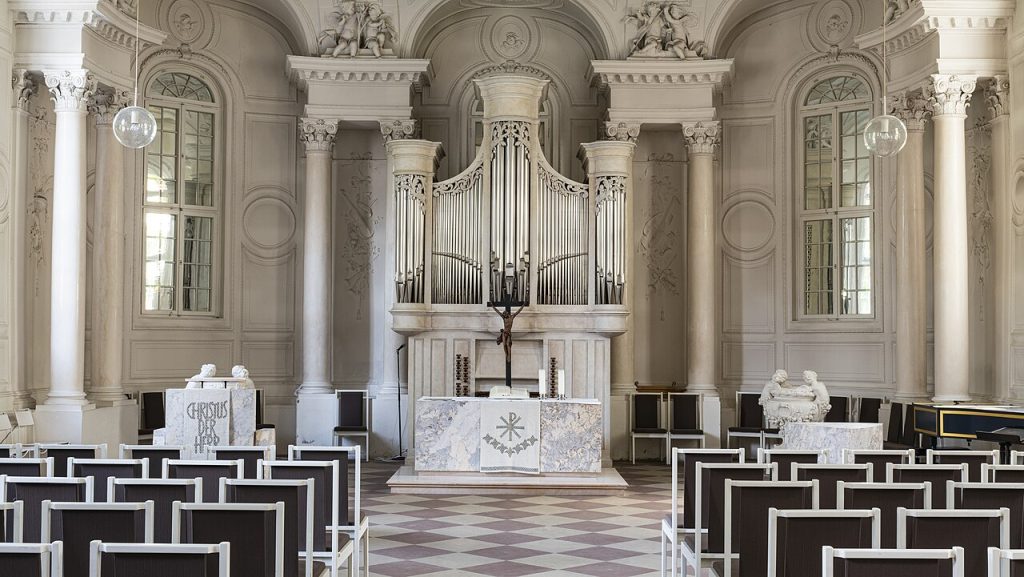
The heart of the palace is the White Hall, an oval domed hall at the centre of the main building. Its walls are decorated with white and gold stucco, and its dome rises above, flooding the room with light.
The hall was used for receptions, concerts and festivities, and its elegant proportions and acoustics made it ideal for music. Carl Eugen loved music and theatre, and the hall echoed with the sound of his court musicians.
The decoration combines rococo playfulness with classical restraint, reflecting the changing tastes of the 1760s.
Standing in the centre of the White Hall and looking up at the dome is one of the highlights of a visit to Solitude.
Around the hall lie smaller rooms, including apartments, cabinets and galleries, each with its own decoration.
The hall’s acoustics are still appreciated today, and concerts are occasionally held here, bringing the music of the eighteenth century back to life.
Mirrors and windows multiply the light, and on sunny days the white and gold decoration seems to glow.
The adjoining rooms include the duke’s apartments, decorated with painted panels, stucco and fine furniture, giving a sense of the comfort he enjoyed in his hilltop retreat.
Views Over Swabia
From the palace terrace and windows, the views over the surrounding landscape are among the finest in the Stuttgart region. On clear days you can see the hills of the Swabian Alb on the horizon.
The duke chose this site deliberately, placing his palace where it could command the landscape and offer views in every direction.
At sunset, the light over the forests and fields is particularly beautiful, and many visitors linger on the terrace to watch the sky change colour.
The views remind you that Solitude was designed as much for enjoying nature as for display, a palace of pleasure in every sense.
Benches on the terrace invite you to sit and enjoy the panorama, and it is easy to spend a long time simply watching the light change over the landscape.
The view to the northeast along the avenue toward Ludwigsburg is one of the most famous, linking two of Carl Eugen’s great creations in a single sightline.
The Palace Chapel and the Karlsschule

Near the palace stands a chapel built for the court, a calm and dignified space decorated in the style of the period. It served the religious needs of the household and the students of the academy.
In 1770 Carl Eugen founded a military academy at Solitude, which later moved to Stuttgart and became the Hohe Karlsschule, one of the most important educational institutions of its time in Germany.
Among its students was the young Friedrich Schiller, who studied medicine here under the strict discipline of the duke. His experiences at the academy inspired his first play, The Robbers, and his longing for freedom.
The connection with Schiller adds a literary dimension to a visit, reminding us that Solitude was a place of learning as well as pleasure.
Schiller later fled Wurttemberg to escape the duke’s control, and his conflict with Carl Eugen became one of the most famous episodes in German literary history.
A small exhibition in the palace tells the story of the academy and Schiller’s years there, bringing this chapter of history to life.
Solitude Palace on Video
For a look at the palace and its setting, the video below takes you to Solitude above Stuttgart.
Watch for the dome, the terraces and the views over the landscape.
The video also captures the atmosphere of the hilltop and the surrounding forest, which are hard to convey in photographs.
If the video inspires you, read on for practical tips.
Visiting Solitude Palace Today

Solitude Palace is managed by the State Palaces and Gardens of Baden Wurttemberg. The interiors can be visited on guided tours, while the grounds and terraces are freely accessible.
The palace lies on the western edge of Stuttgart and can be reached by bus or car. Many visitors combine a visit with a walk in the surrounding forest.
Plan at least two hours for the palace and grounds, and consider a meal at the restaurant in the cavalier houses.
Solitude pairs well with Ludwigsburg Palace and Monrepos, which together form a remarkable ensemble of ducal residences in Wurttemberg.
There are walking trails through the surrounding forest, and the area is popular with hikers and cyclists at weekends.
Whenever you visit, Solitude offers a rare combination of rococo elegance, sweeping views and cultural history, all just a short trip from Stuttgart.
Guided tours are offered at set times, and it is a good idea to check the schedule in advance, especially outside the summer season.
View the location on Google Maps
Palaces Nearby
If Solitude has fascinated you, Wurttemberg holds more remarkable palaces. Here are two more well worth adding to your journey:
- Ludwigsburg Palace – the grand baroque seat of the dukes of Wurttemberg with its famous gardens.
- Monrepos Lake Palace – the rococo lakeside retreat of the dukes of Wurttemberg near Ludwigsburg.
You May Like

Monrepos Lake Palace and the Rococo Retreat of Ludwigsburg