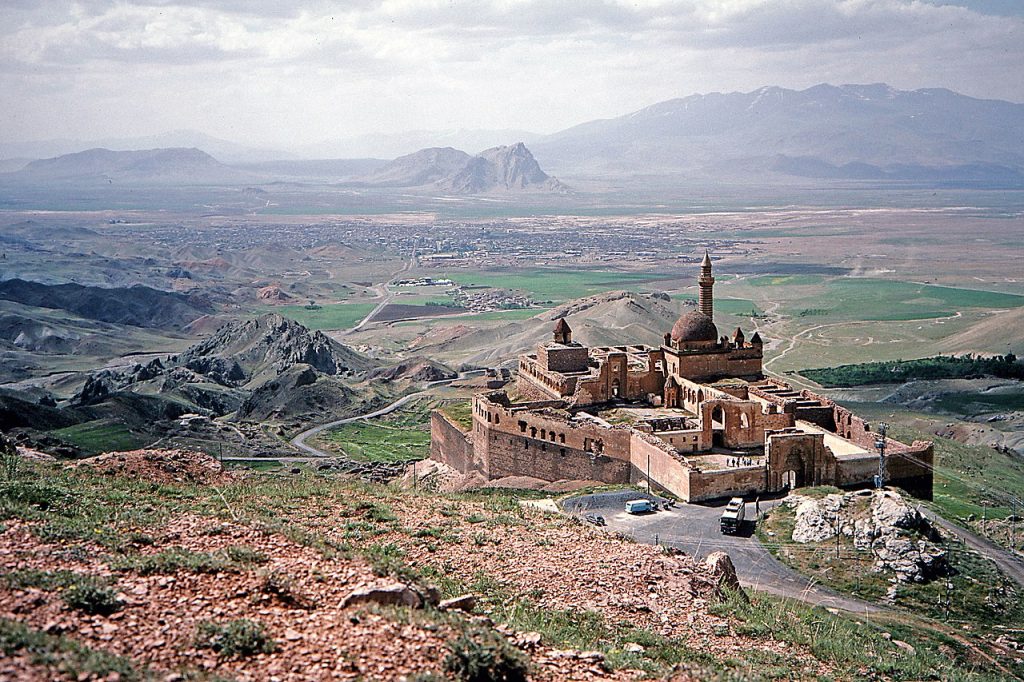
High on a windswept plateau near Turkey’s far‑eastern border stands Ishak Pasha Palace, one of the country’s most remarkable surviving examples of Ottoman frontier architecture. Part fortress, part administrative centre and part residence, the palace blends Seljuk, Persian, Armenian and Georgian styles, reflecting the diverse influences that once met along the Silk Road. This guide explores the palace’s history, architecture, climate and the practicalities of visiting Doğubayazıt and its surroundings.
Historical background
Construction of Ishak Pasha Palace began around 1685 under Çolak Abdi Pasha, governor of the Beyazit province, and continued through several generations of the Çıldıroğlu (Ishak Pasha) family before completion in 1784. The nearly 99‑year building process produced a complex that fused Ottoman, Persian and Anatolian elements, symbolising both wealth and strategic power on this remote frontier. During its heyday the palace served as a residence, military outpost and administrative centre for the region. It was abandoned in the 19th century during the Russo‑Turkish wars and later damaged by earthquakes, but much of its stonework survives.
Architecture & layout
The palace occupies roughly 7,600 m² on a rocky promontory overlooking the plain of Doğubayazıt. Its irregular plan measures about 115 × 50 m and incorporates two courtyards, a harem, reception halls, barracks, a mosque with a single minaret, kitchens, stables and a small mausoleum. The main portal features elaborate muqarnas (stalactite) carvings inspired by Seljuk architecture. Inside the harem, finely carved stone screens filter the light, while the mosque’s dome retains traces of painted decoration. The palace originally contained 366 rooms across its two levels. An early under‑floor central heating system circulated warm air beneath the floors—an unusual feature for its time.The building
materials include six types of local stone, from soft yellow limestone to hard basalt, giving the complex subtle colour variations. Floral, geometric and arabesque motifs decorate doorways and window frames. Although wood once formed some structural elements, little remains due to decay. A mausoleum adjacent to the mosque houses the tombs of the Pasha’s family, constructed in a Seljuk tomb style
You May Like
Aspendos Ancient Theater Travel Guide