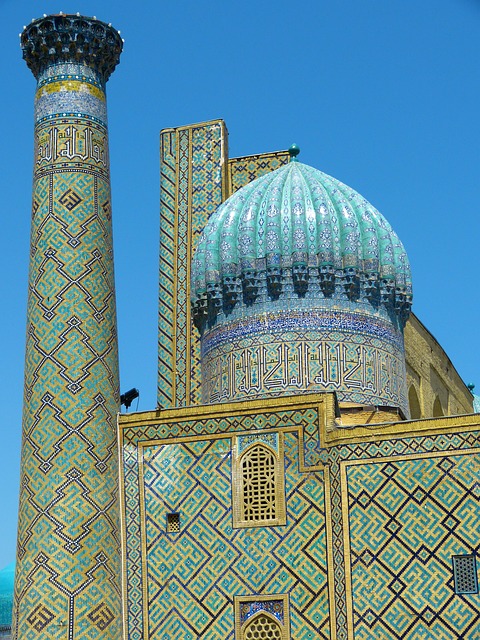
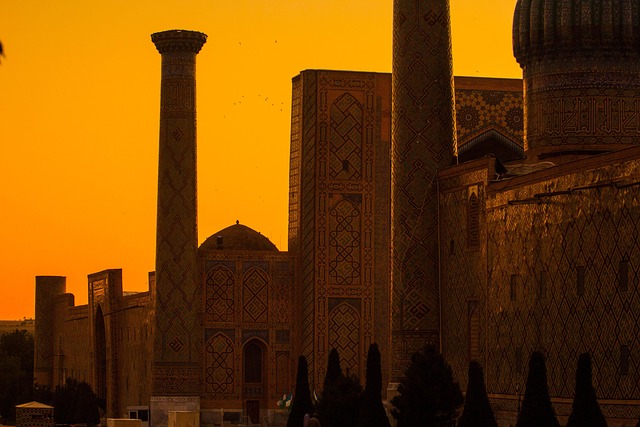
For many travellers, the Registan in Samarkand is the single most spectacular sight in all of Central Asia. Three vast theological colleges, their facades sheathed in turquoise and gold tilework, face one another across a wide public square. To stand at its centre at dusk, as the tiles catch the last light, is to understand why this Silk Road city was once called the jewel of the Islamic east.
The Heart of Timur’s Capital
Samarkand rose to its greatest glory under Timur and his descendants in the fourteenth and fifteenth centuries, when it became the capital of a powerful empire. The Registan, whose name means “sandy place,” served as the city’s ceremonial and commercial heart, a place where royal proclamations were read and crowds gathered. The grand madrasas that frame it were centres of learning where students studied theology, astronomy and mathematics.
Three Magnificent Madrasas
The oldest of the three buildings is the Ulugh Beg Madrasa, named for Timur’s grandson, an astronomer-king who turned Samarkand into a centre of science. Facing it stands the later Sher-Dor Madrasa, famous for the unusual roaring lions and rising suns above its portal. Between them, the Tilla-Kari Madrasa dazzles visitors with a prayer hall lined in gold leaf. Together they form one of the finest ensembles of Islamic architecture anywhere in the world.
A UNESCO Treasure
Samarkand and its monuments are inscribed on the UNESCO World Heritage list, recognised as a crossroads of cultures along the Silk Road. Careful restoration over the past century has brought back much of the brilliance of the tilework, and the Registan today is the proud symbol of modern Uzbekistan.


One thought on “The Registan of Samarkand: Jewel of the Silk Road”