Caral rises from the desert of Peru’s Supe Valley, roughly 180 kilometers north of Lima, and carries a claim no other site in the Americas can match: it is the oldest known city in the entire hemisphere, with monumental construction beginning around 2600 BCE.
That date places Caral’s earliest pyramids as contemporaries of Egypt’s Old Kingdom pyramid builders and the first cities of Sumer, built by a society that had no contact whatsoever with either civilization, developing urban life, monumental architecture, and social complexity entirely on its own along the Peruvian coast.
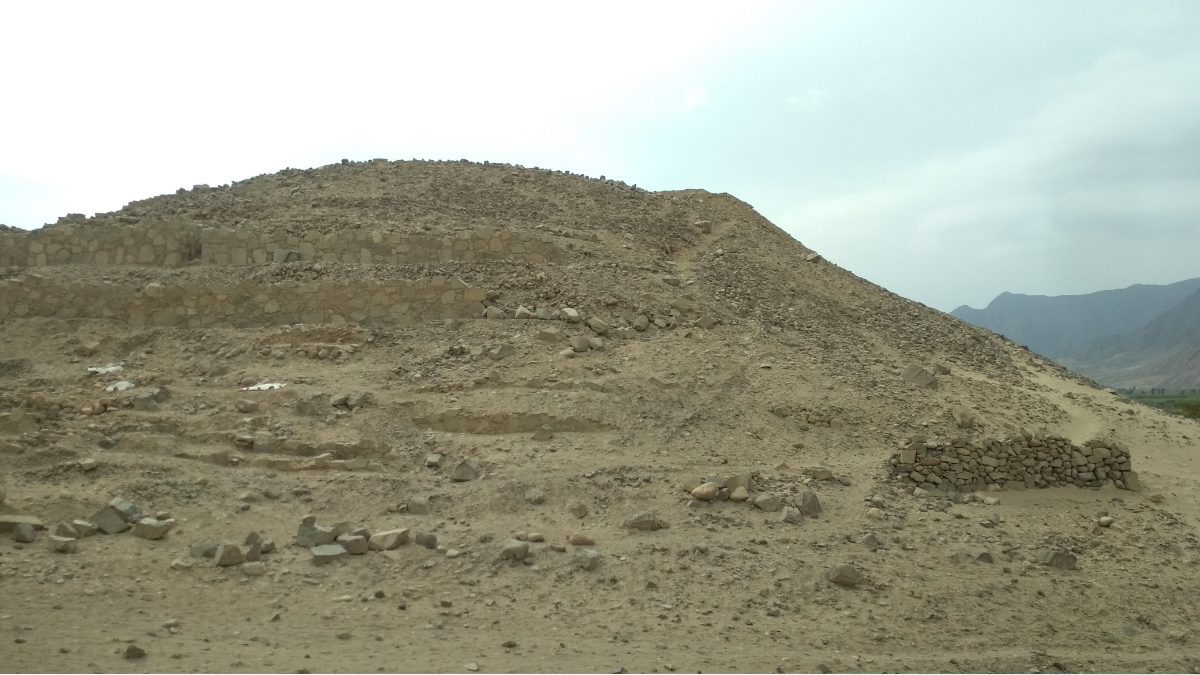
Table of Contents
- The Oldest City in the Americas
- Inside the Sacred City: Layout and Architecture
- Pyramids, Plazas, and Sunken Circles
- Shicra Bags and the Engineering of the Pyramids
- Ruth Shady and the Rediscovery of Caral
- What Language Did the People of Caral Speak?
- Religion, Ritual, and a City Without War
- Flutes, Cornets, and the Sounds of Caral
- Cotton, Fish, and the Economy of the Supe Valley
- Caral’s Legacy and the Question of Civilization’s Origins
- Nearby Places to Explore
The Oldest City in the Americas
For most of the twentieth century, the accepted timeline of Andean civilization began with cultures like Chavin, dated to roughly 900 BCE. Caral, along with a cluster of related sites collectively known as the Norte Chico or Caral-Supe civilization, pushed that timeline back more than fifteen centuries once radiocarbon dating confirmed the age of its earliest platform mounds in the early 2000s.
Norte Chico encompasses roughly thirty settlements spread across several river valleys along Peru’s arid north-central coast, but Caral stands out as the largest and most thoroughly excavated, covering about 60 hectares of monumental and residential architecture.
Unlike almost every other early civilization archaeologists have studied, Caral developed without pottery, without a recognizable system of writing, and, remarkably, without any clear evidence of warfare. No defensive walls ring the city, no weapons caches have turned up in its residential quarters, and no mass graves or burned buildings point to violent conflict during its centuries of activity.
The wider Norte Chico region includes other major sites such as Aspero, closer to the coast, and Vichama further south, each sharing Caral’s combination of monumental platform mounds, sunken circular plazas, and an economy built on irrigated cotton farming paired with maritime trade, suggesting a shared cultural sphere rather than a single isolated city.
Prior to the confirmation of Caral’s age, the oldest widely accepted urban centers in the Americas were associated with the Olmec of Mexico’s Gulf Coast, dated to roughly 1200 BCE, meaning Caral’s construction predates even those celebrated Mesoamerican beginnings by well over a thousand years.
Norte Chico’s thirty-odd settlements were not evenly sized or equally important. Caral, along with a handful of other large centers, appears to have functioned as a primary hub within a loosely connected regional network, rather than as the capital of anything resembling a centralized state comparable to later Wari or Inca administration.
Environmental studies of the Supe Valley suggest that during Caral’s heyday the local climate was somewhat wetter and more predictable than it is today, allowing the kind of stable irrigated agriculture needed to free up labor for monumental construction rather than leaving the entire population occupied full time with basic subsistence farming.
Comparisons with early Mesopotamian and Egyptian urbanism inevitably arise given the shared timeframe, but scholars are careful to stress that Caral developed its monumental architecture, social hierarchy, and regional trade networks through an entirely independent process, one of very few known instances anywhere in the world of a so-called pristine civilization arising without inherited influence from an already established urban tradition.
Inside the Sacred City: Layout and Architecture
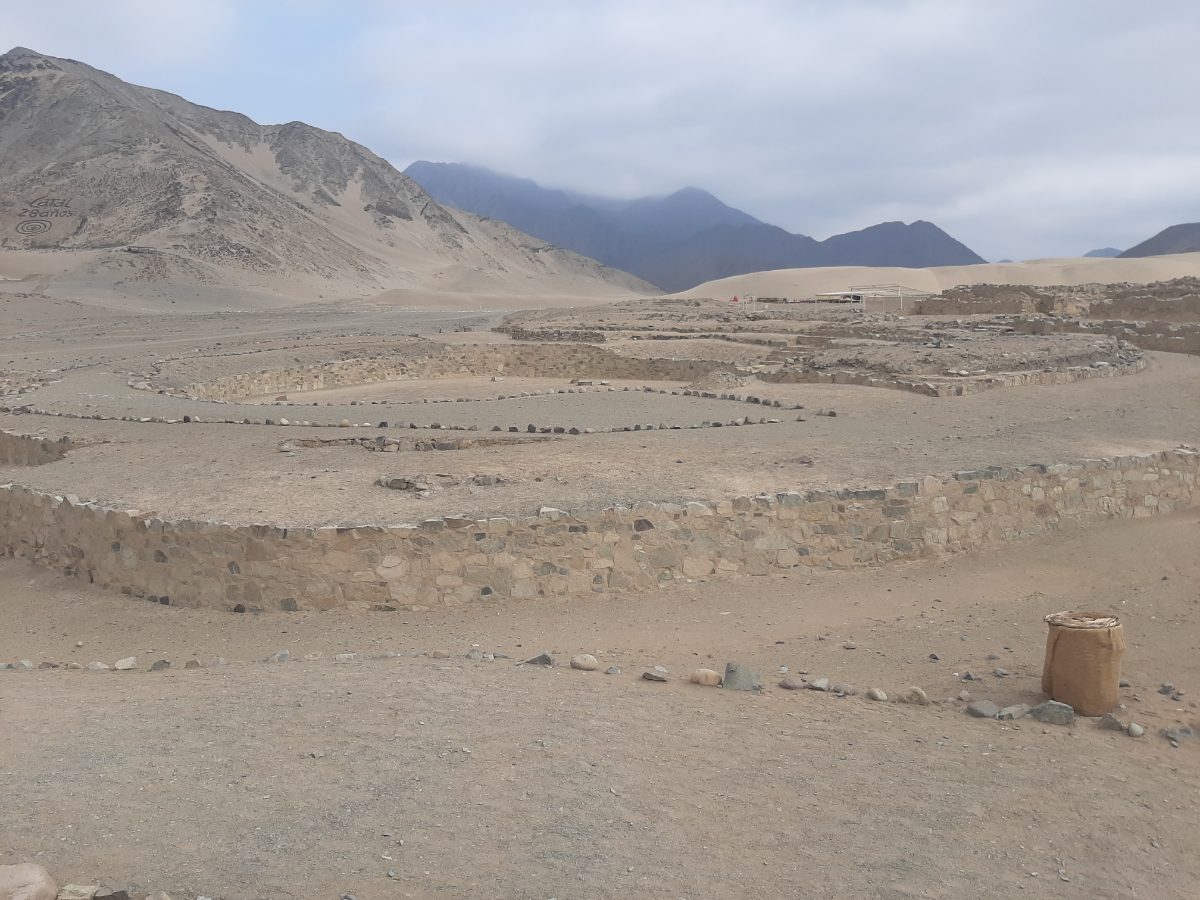
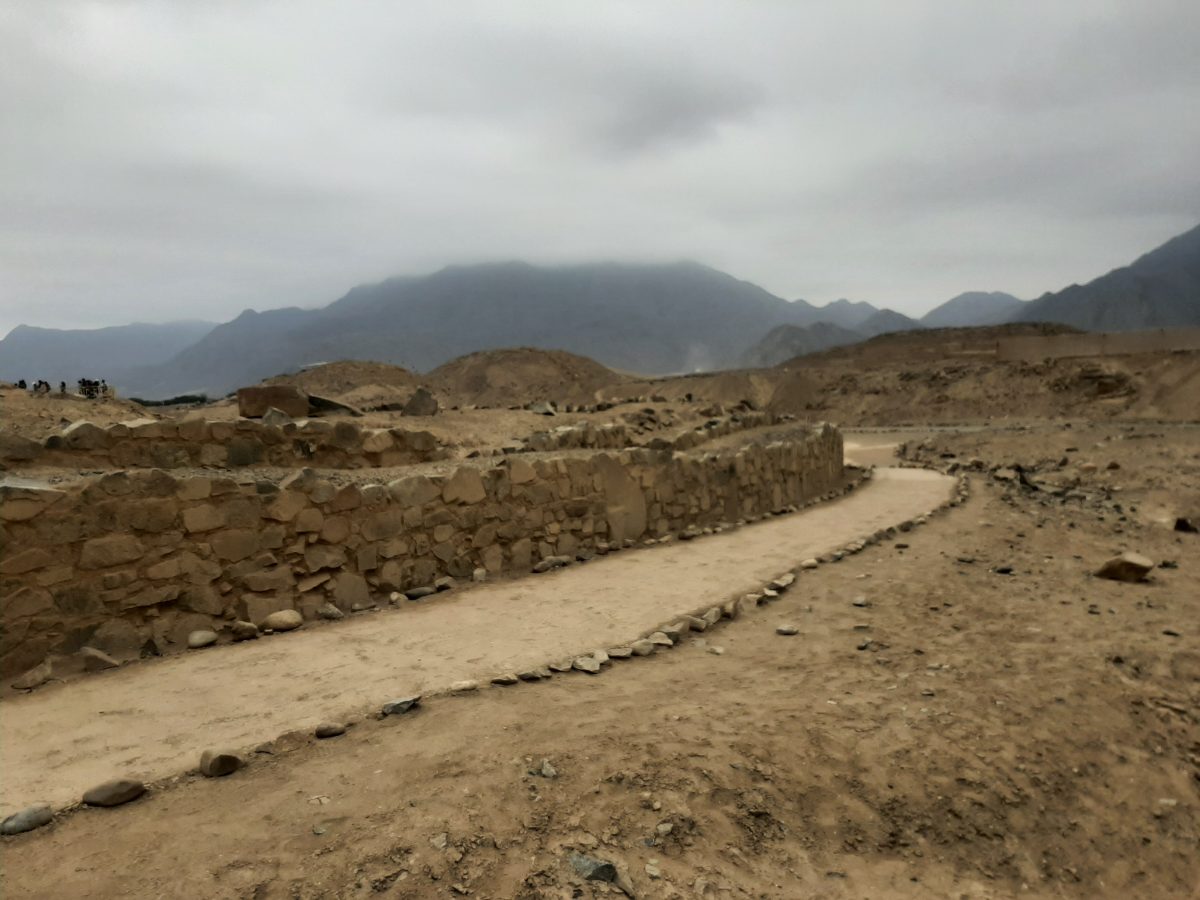
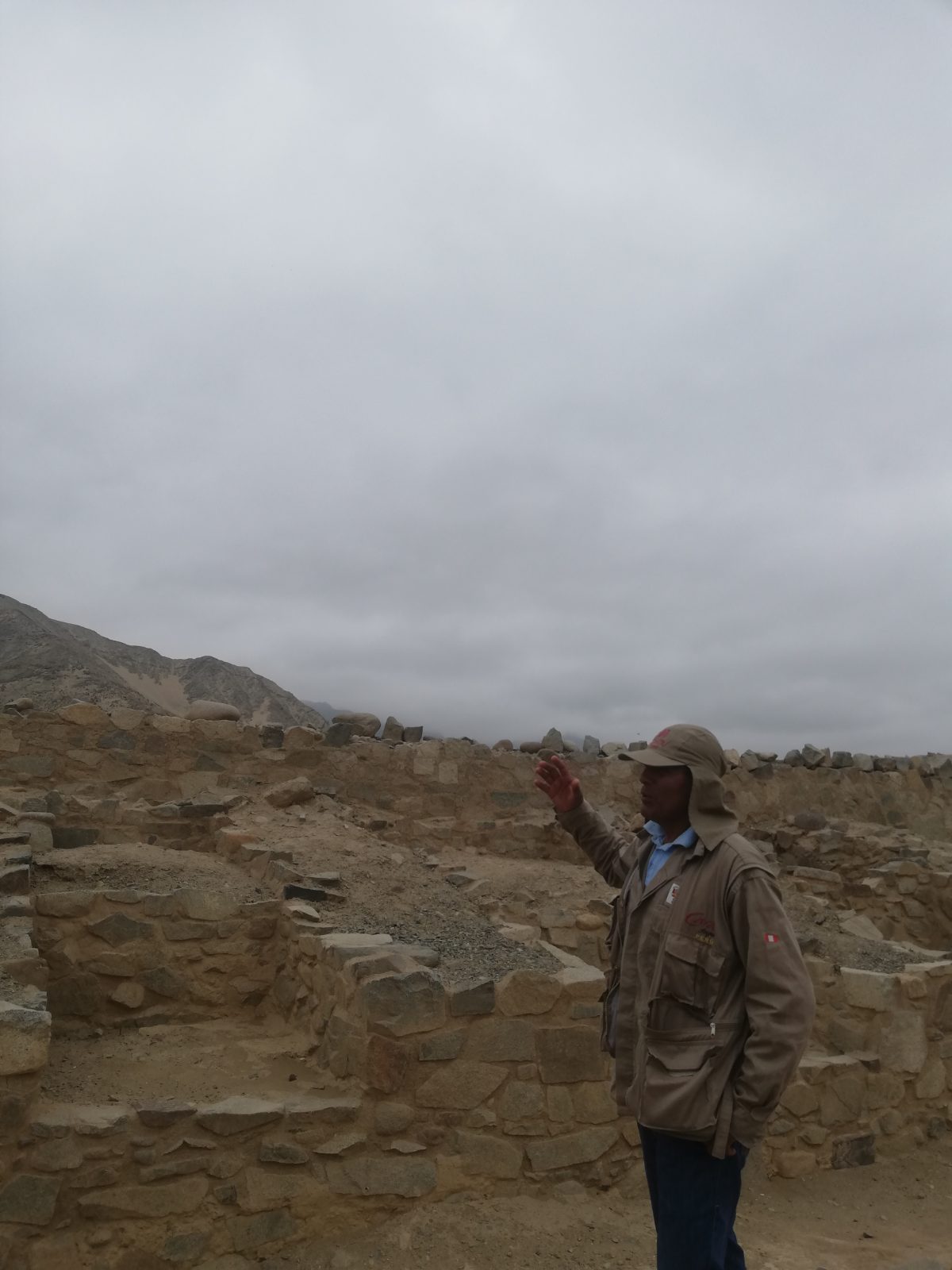
The city’s monumental core consists of six major stone and earthen platform mounds, arranged around a large central plaza, along with two sunken circular plazas set into the ground rather than raised above it. Residential architecture spreads outward from this ceremonial core, with distinct quarters that appear to reflect status differences between elite and common households.
The largest structure, known today as the Piramide Mayor or Great Pyramid, rises about 18 meters and covers a base larger than several modern city blocks. A grand staircase leads visitors up through multiple terraced levels to a summit platform that likely once held ceremonial structures, long since eroded or dismantled.
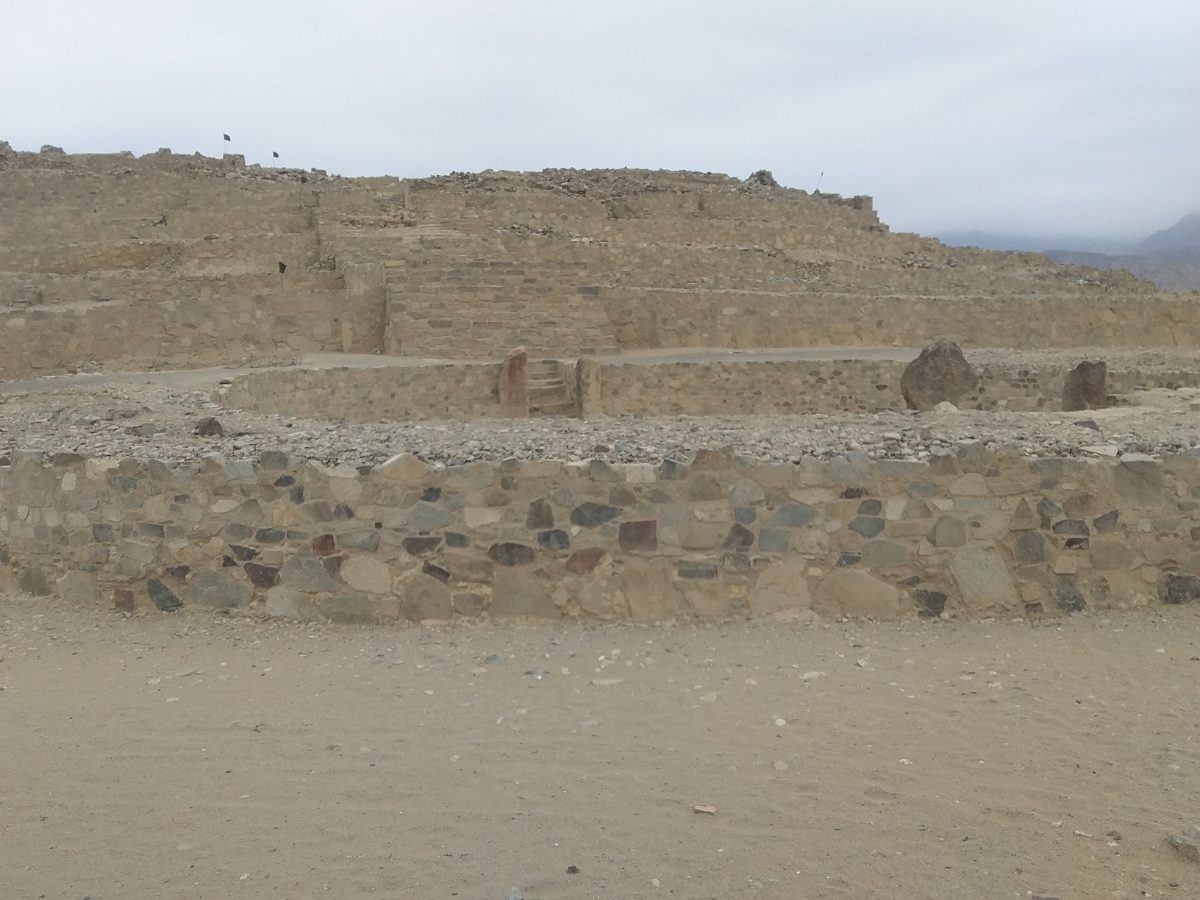
Excavators have identified distinct construction phases at several of Caral’s pyramids, showing that structures were periodically buried under new construction and rebuilt larger, a pattern of renewal also seen at other early ceremonial centers across the ancient world, suggesting a recurring ritual cycle of burial and rebirth built into the very architecture of the city.
Archaeologists have mapped at least seven distinct pyramid complexes at Caral beyond the Great Pyramid, each apparently associated with a different residential quarter or kin group, hinting at a federated internal structure in which multiple elite lineages each maintained their own ceremonial architecture within a single unified urban plan.
Access to the upper platforms of Caral’s pyramids appears to have been restricted, with narrow staircases and controlled entry points suggesting that only a limited number of priests or elite individuals could reach the summit spaces during ceremonies, while larger crowds gathered instead in the open plazas below.
The residential quarters closest to the monumental core show evidence of finer construction and more elaborate burials than those further out, a spatial gradient of wealth and status that mirrors patterns archaeologists would later observe at much larger and more thoroughly documented Andean cities, suggesting Caral already contained the basic social hierarchy that would characterize Andean urbanism for millennia to come.
Pyramids, Plazas, and Sunken Circles
Caral’s two sunken circular plazas, carved directly into the ground beside its largest pyramids, are among the site’s most striking features. Similar sunken circular courts appear at other early Andean ceremonial centers for the next several thousand years, making Caral’s examples among the very earliest known instances of an architectural form that would remain central to Andean religious life for millennia.
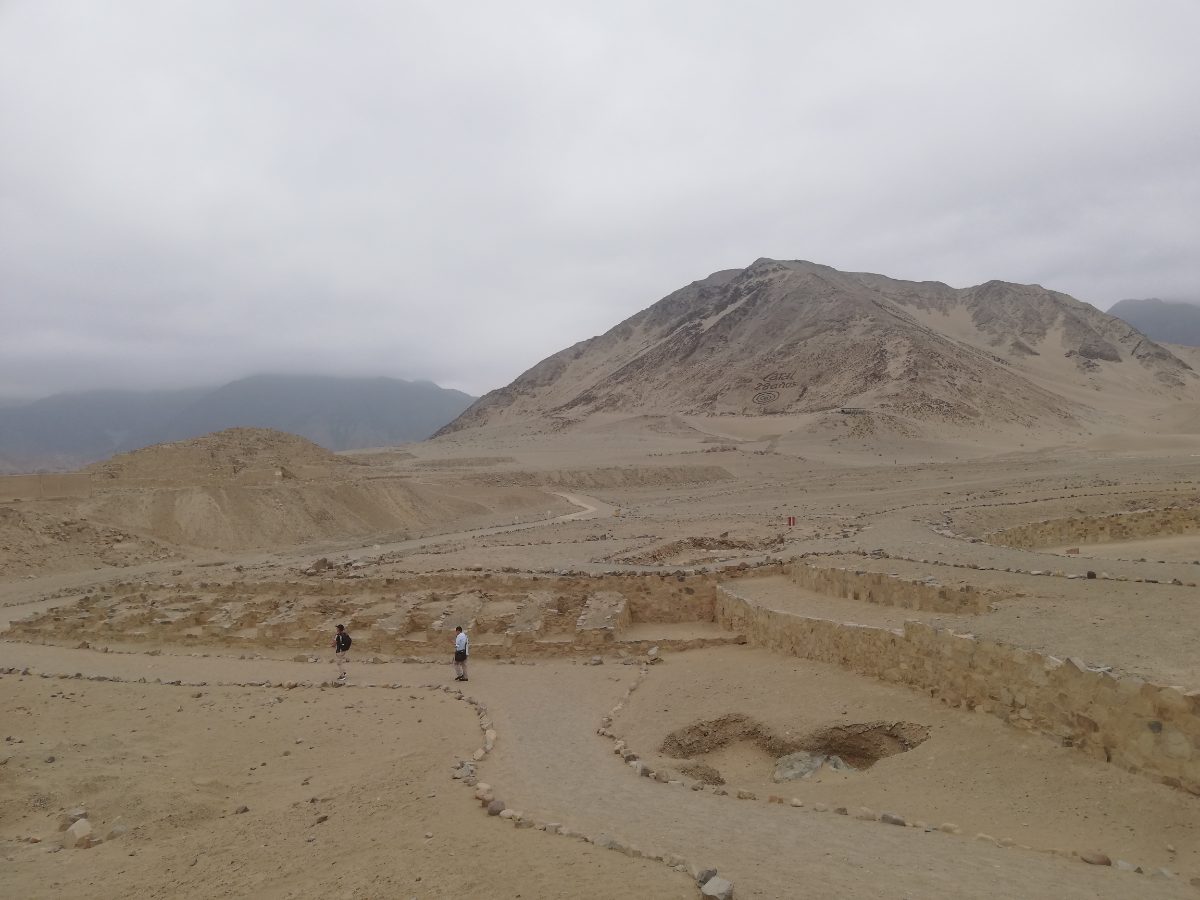
The plaza beside the Great Pyramid, in particular, appears to have hosted gatherings that brought together far more people than lived at Caral itself, suggesting the city functioned as a ceremonial magnet drawing pilgrims and traders from smaller settlements throughout the Supe Valley and beyond.
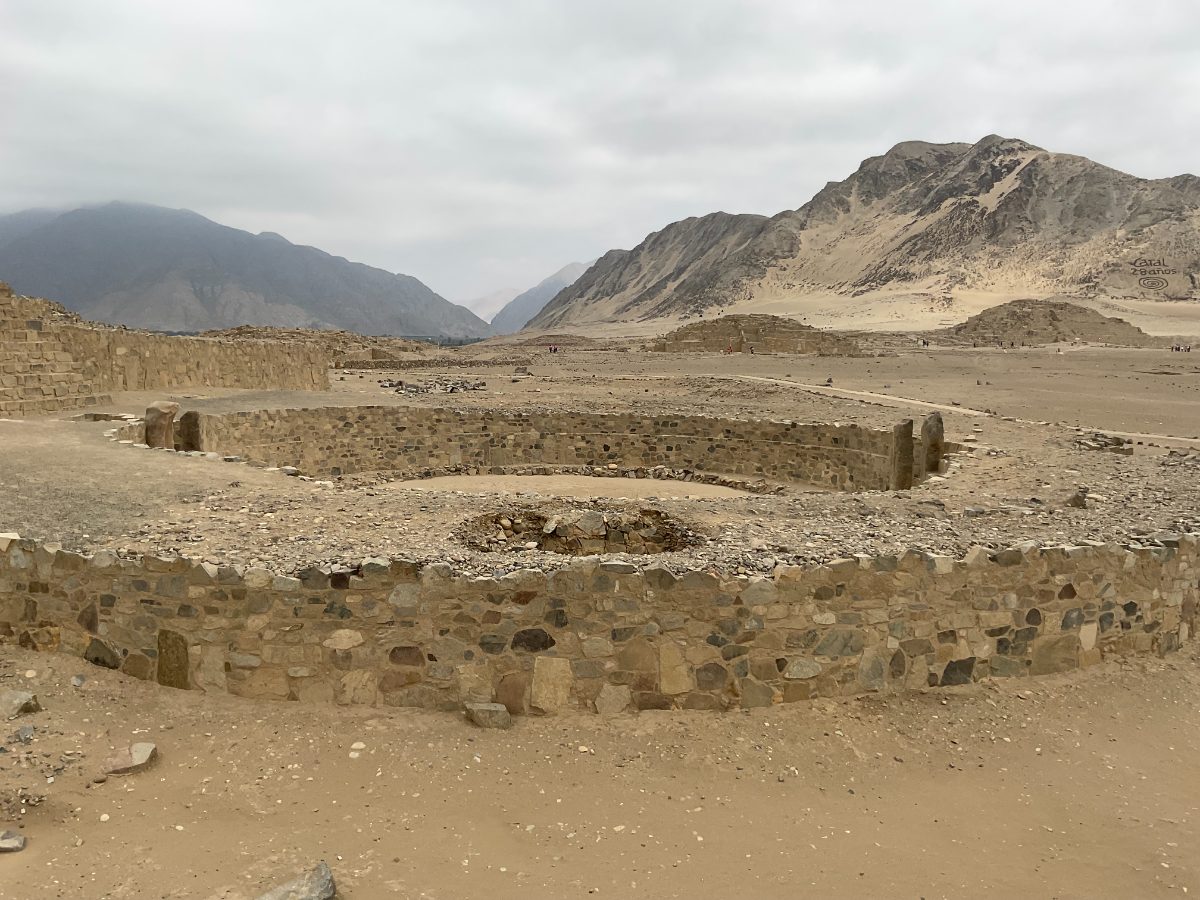
Smaller residential compounds cluster around these monumental precincts, built from fieldstone and cane, with hearths, storage pits, and burials found beneath house floors, indicating that daily domestic life continued in close, constant proximity to the sacred architecture rather than being segregated into a purely secular district.
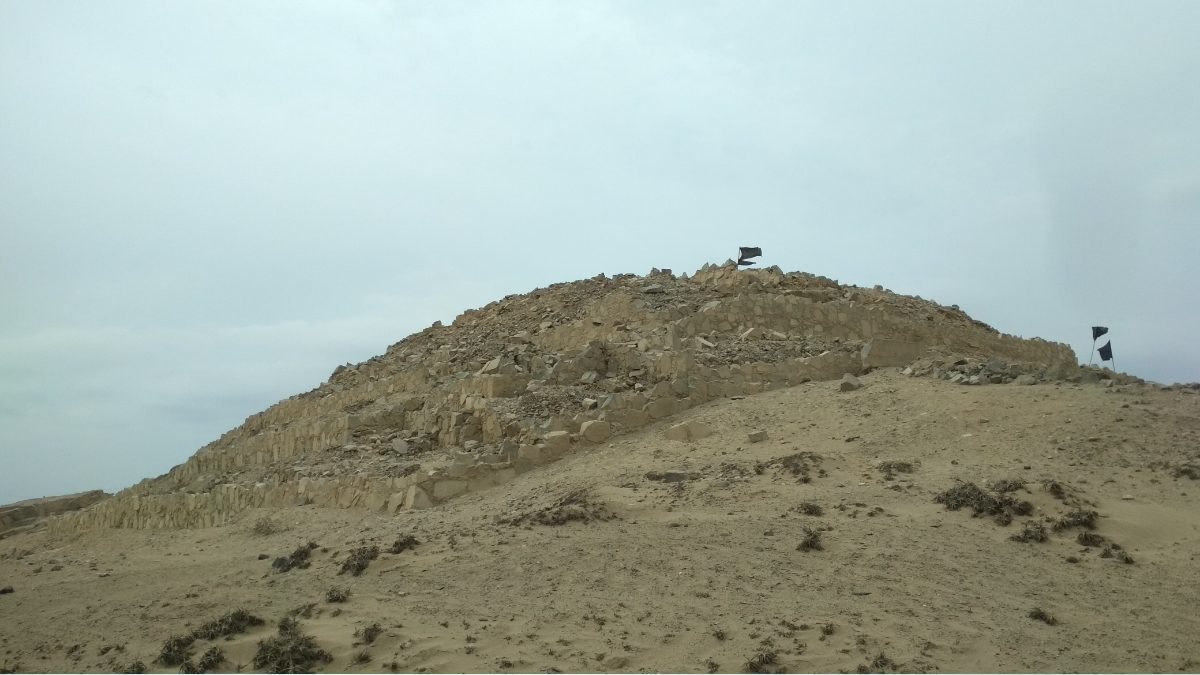
Excavation of the Great Pyramid’s summit uncovered a small enclosed room containing an offering of a bird figurine wrapped in fiber, alongside charcoal deposits, suggesting the uppermost spaces served highly specific ritual functions rather than general public gathering, a role reserved instead for the sunken plazas at ground level.
Shicra Bags and the Engineering of the Pyramids
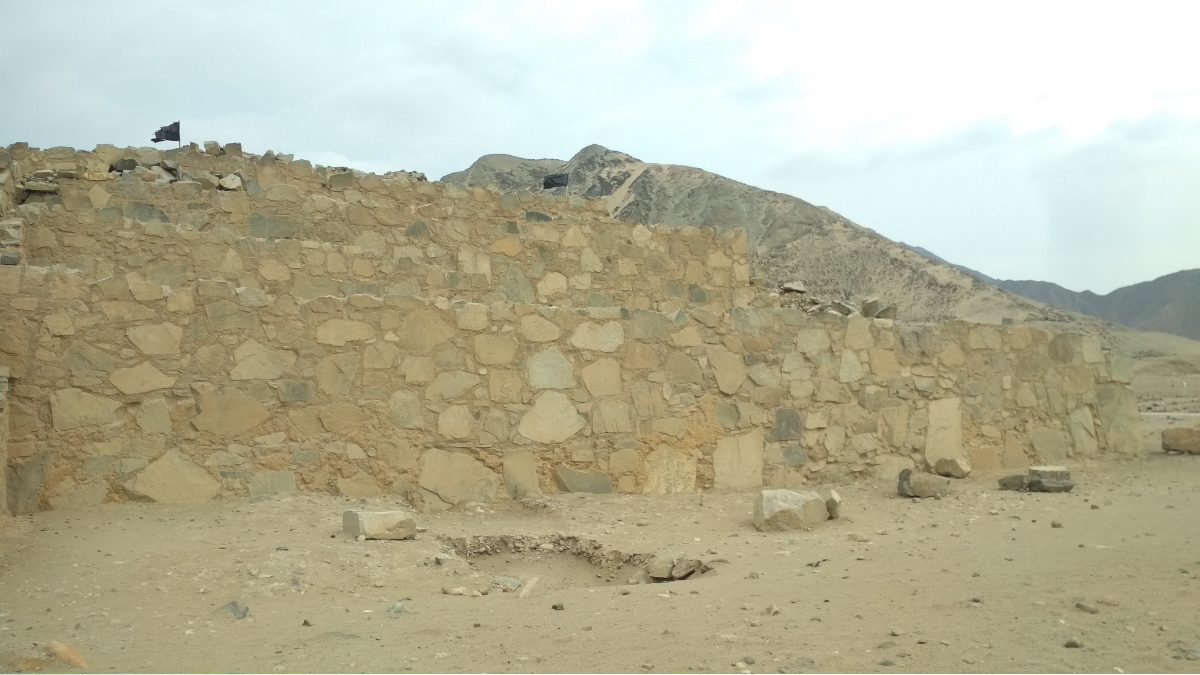
Caral’s builders solved a basic engineering problem, how to construct tall, stable platform mounds on an earthquake-prone coast, with an ingenious technique now called shicra. Workers wove reed and rush fiber into net-like bags, filled them with fist-sized stones, and stacked thousands of these bags inside retaining walls to form the core of each pyramid.
The flexible, bag-filled core allowed each mound to absorb seismic shock far better than a solid rubble or masonry fill would, a design solution so effective that many of Caral’s pyramids have survived more than four thousand years of Pacific coast earthquakes largely intact. Modern engineers studying the technique have noted its similarity to contemporary soil-reinforcement methods used in earthquake engineering today.
Producing the sheer volume of shicra bags needed for a single pyramid required organized, large-scale labor: harvesting reeds, weaving nets, quarrying and hauling stone, then stacking and fitting thousands of completed bags into place under some form of centralized direction, evidence in itself of a functioning authority capable of mobilizing and coordinating a substantial workforce.
Comparable shicra-filled platform construction has since been identified at other Norte Chico sites throughout the Supe, Fortaleza, and Pativilca valleys, showing that this engineering solution was a shared regional technology rather than a one-off invention unique to Caral itself.
Because shicra bags were woven from plant fiber that eventually decays, exposed sections of pyramid fill at Caral have provided archaeologists with an unusually direct, hands-on view of ancient construction technique, allowing researchers to examine the actual bags and stones rather than reconstructing methods purely from indirect evidence.
Later Andean builders, including those at Wari and eventually the Inca, would rely on more conventional dressed-stone and rubble-core construction for their major monuments, making Caral’s shicra-bag technique something of a regional specialty rather than a universal Andean building method, tied specifically to the seismic conditions and available plant materials of the north-central coast.
Ruth Shady and the Rediscovery of Caral
Caral was known to local farmers for generations before archaeologists took serious interest, its low mounds long dismissed as natural hills rather than buried monuments. Peruvian archaeologist Ruth Shady began systematic excavations at the site in 1994, working with a small team and modest funding in the years before Caral’s true age was confirmed.
Shady’s radiocarbon dating results, published in the journal Science in 2001, placing Caral’s earliest construction at roughly 2600 BCE, stunned the archaeological community and forced a wholesale revision of the accepted chronology for civilization in the Americas. Her continued excavation and advocacy work helped secure Caral’s inscription as a UNESCO World Heritage Site in 2009.
Shady’s excavation team faced considerable skepticism from parts of the international archaeological community when her dates were first announced, given how radically they rewrote the accepted sequence of New World civilization, but subsequent independent radiocarbon testing at multiple Norte Chico sites has consistently confirmed her original chronology.
Shady’s ongoing work at Caral, continued through Peru’s Zona Arqueologica Caral project, has expanded excavation to include residential sectors and outlying settlements, gradually filling out a picture of daily life that complements the more visible monumental architecture that first drew scholarly attention to the site.
What Language Did the People of Caral Speak?
No language spoken at Caral can be identified with any confidence. The city predates every documented Andean language by well over two thousand years, and it left behind no writing system, no inscriptions, and no artistic convention clearly encoding phonetic or symbolic language the way later Maya glyphs or Wari iconography arguably did.
Quechua and Aymara, the language families that would eventually dominate the Andes, likely did not yet exist in anything like their historical form when Caral was thriving, meaning any attempt to name Caral’s spoken language would be pure speculation dressed up as scholarship. Linguists generally treat the languages of Norte Chico as belonging to an unknown, unclassified, and now entirely vanished linguistic stratum, one of many such lost languages that once filled the Americas before later expansions overwrote them.
This uncertainty is itself worth stating plainly rather than glossing over: unlike Wari, where competing Quechua and Aymara theories at least give scholars a real debate to have, Caral offers no serious linguistic candidate at all. Whatever words its priests and builders used to organize the labor behind those pyramids are gone beyond any hope of recovery.
Some linguists have speculated about possible deep connections between Norte Chico speech and the isolate languages still spoken in scattered pockets of the Peruvian Amazon and northern coast, such as Mochica, but these proposals remain highly speculative and are not widely accepted, underscoring just how thin the evidence trail becomes once one reaches back this far into Andean prehistory.
The absence of any securely identified language for Caral stands in useful contrast to better-documented later cultures, and serves as a reminder that the deeper one looks into the American past, the more the historical record thins out into genuine, irreducible silence rather than merely undiscovered detail.
Religion, Ritual, and a City Without War
The absence of weapons, fortifications, or destruction layers at Caral has led many archaeologists to characterize it as an unusually peaceful society, one that may have organized itself around shared ceremonial obligation and religious authority rather than military coercion or conquest.
Fire pits found atop several platform mounds, filled with ash and burned offerings, point to fire-based rituals performed at the summits of the pyramids, likely tied to agricultural cycles, astronomical observation, or ancestor veneration, though the precise content of Caral’s belief system remains far less understood than that of later, better-documented Andean cultures.
Some researchers have proposed that Caral’s religious authority rested on control of ceremonial knowledge itself, perhaps the timing of rituals tied to solstices or flood cycles, giving priestly elites a form of power that did not require standing armies to enforce, a hypothesis that would help explain the conspicuous lack of martial imagery or defensive architecture across the entire Norte Chico region.
Caral’s summit fire pits often contain the remains of quinoa, beans, and other food offerings alongside ash, suggesting rituals combined feasting with fire, a pattern of ceremonial hospitality that would echo, in modified form, through the chicha-feasting political culture practiced millennia later at Wari outposts like Cerro Baul.
The lack of a single dominant iconographic deity, of the kind later seen in Wari and Tiwanaku’s Staff God imagery, has led some researchers to suggest Caral’s religious system may have centered more on place, ancestry, and natural forces like water and fire than on a codified pantheon of named gods, though this remains an area of active interpretation rather than settled consensus.
Some of the fire-pit offerings recovered from pyramid summits include unusually rare or exotic materials, including marine shell species not native to the immediate area, hinting that these rituals drew on long-distance exchange networks to acquire symbolically important objects for ceremonial use, further evidence of Caral’s connections beyond its own valley.
Flutes, Cornets, and the Sounds of Caral
Among Caral’s most evocative discoveries are 32 flutes carved from the wing bones of pelicans and condors, found together in a cache and likely played as an ensemble during ceremonial occasions. Cornets made from deer and llama bone have also been recovered, suggesting an active musical tradition tied closely to the city’s ceremonial life.
Textile fragments, twisted cord, and a knotted-string object identified by some researchers as a possible early quipu, the knot-based recording device later refined by the Inca, have also turned up at Norte Chico sites, hinting that some system of record-keeping using knotted cords may have far deeper roots in Andean history than previously assumed.
Musical instruments found broken and deliberately buried near ceremonial architecture suggest, much like the smashed offering pottery found centuries later at Wari, that ritual destruction of meaningful objects was already part of Andean religious practice at this remarkably early date.
Analysis of the pelican-bone flutes found at Caral shows they were tuned to produce a consistent set of notes, and experimental archaeologists who have reconstructed playable replicas report that the instruments were capable of surprisingly complex melodic sequences, challenging any assumption that early Andean music was purely rhythmic or ceremonial noise rather than deliberately composed sound.
The deliberate pairing of wind instruments from different animal species, pelican, condor, deer, and llama bone, may have carried symbolic meaning tied to the different habitats and qualities each creature represented, air, height, land, and domesticated labor, though such interpretations necessarily remain speculative given the absence of any text explaining Caral’s own symbolic logic.
Cotton, Fish, and the Economy of the Supe Valley
Caral sits inland, away from the Pacific shoreline, yet its economy depended heavily on the sea. Excavators have found enormous quantities of fish bone and shell at the site, alongside almost no evidence that Caral’s residents themselves fished, pointing instead to a trade relationship with coastal fishing communities.
Cotton was Caral’s side of that exchange. The inland valley’s irrigated fields produced cotton in quantity, which was woven into the netting that coastal communities needed to make fishing nets, a mutually dependent relationship binding inland farmers and coastal fishers into a single regional economy long before any Inca road connected them politically.
This division of labor across ecological zones, coast supplying protein, valley supplying cotton and irrigated crops like squash, beans, and guava, anticipates the vertical economic strategies that would define Andean civilization for the next four thousand years, all the way through Wari and into the Inca empire.
Anchovy and sardine remains dominate the fish bone assemblages recovered from Caral’s residential middens, both species that were, and still are, extraordinarily abundant along the cold, nutrient-rich Humboldt Current offshore, a marine bounty that likely made the coastal side of this inland-coastal partnership relatively easy to sustain over the long term.
Squash, beans, guava, and pacay were cultivated in irrigated fields along the Supe River, supplementing the cotton crop and providing the plant-based portion of a diet otherwise built around traded coastal seafood, a combination that supported a surprisingly stable food supply without any grain staple like maize playing a major role this early.
Because cotton does not preserve as reliably as stone or bone, much of what is known about Caral’s textile production comes from impressions left in mud, fragments preserved in unusually dry conditions, and the sheer number of spindle whorls recovered from residential areas, indirect evidence that nonetheless paints a picture of an economy substantially organized around fiber production.
Caral’s Legacy and the Question of Civilization’s Origins
Caral’s decline, around 1800 BCE, remains less studied than its rise, though prolonged drought and shifting river courses in the Supe Valley are the leading suspects. The city was gradually abandoned rather than destroyed, its pyramids left standing to be buried slowly under windblown sand for the next three and a half millennia.
What Caral demonstrates, more than any single artifact or structure, is that monumental civilization did not require the specific ingredients long assumed necessary elsewhere: it arose without pottery, without writing, and seemingly without warfare, built instead on cotton, fish, shared ceremony, and an engineering solution as simple as a woven bag full of stones.
UNESCO’s 2009 decision to inscribe Caral as a World Heritage Site specifically credited the city with demonstrating that the rise of civilization does not follow a single universal template, noting its combination of features found nowhere else among the world’s earliest urban centers.
Contemporary Peruvian scholarship has increasingly framed Caral not merely as an archaeological curiosity but as a foundational chapter of national identity, a status reflected in its prominent place in Peruvian school curricula and its promotion as a heritage tourism destination distinct from the more famous Inca sites further south and east.
Ongoing excavation continues at Caral and related Norte Chico sites today, and researchers caution that much of the site remains unexcavated, meaning the picture presented by current scholarship, however already surprising, may still be substantially revised as further work uncovers additional structures, burials, and artifacts in the coming decades.
For visitors today, reaching Caral requires a multi-hour drive north from Lima followed by travel into the Supe Valley itself, a journey that keeps the site considerably less crowded than better-known destinations further south, offering a quieter, more contemplative encounter with the oldest urban ruins the Americas have yet produced.
Nearby Places to Explore
Caral connects directly to other early Andean sites already covered on InKend.
- Wari: The Andean Empire That Came Before the Inca
- Chan Chan: The Largest Adobe City in the World
- Cerro Sechin: The 3,600-Year-Old Peruvian Temple Carved With Warriors and Their Victims
closing
Long before Caral was recognized as the oldest city in the Americas, its low sandy mounds sat quietly above the Supe Valley, mistaken for hills by generations of farmers who had no idea an entire civilization’s beginning lay buried beneath their feet.
Walking among its pyramids and sunken plazas today, with the desert wind sweeping the same dry hillsides its builders once climbed, offers a rare chance to stand at the literal starting point of urban life in an entire hemisphere.
You May Like
Mafra, the Palace a King Built From a Vow


3 thoughts on “Caral Is the Oldest City Ever Built in the Americas”