There are castles that hide and castles that announce themselves, and then there is Hochosterwitz, which does something stranger: it performs. Rising on a lone dolomite crag from the flat green floor of a Carinthian valley, it spirals up its rock in a slow theatrical climb, and the road to its summit passes through no fewer than fourteen separate fortified gates, each one a small fortress in itself. Long before you reach the top, the castle has told you its whole story, which is that no one was ever meant to take it by force.
It is one of the most instantly recognizable castles in Austria, a silhouette so perfect that it looks invented, and generations of artists and, some say, the makers of fairy-tale films have drawn on its dramatic outline. But Hochosterwitz is entirely real, a working fortress refined into its present spectacular form in the sixteenth century, at the height of the fear of Ottoman invasion, and still owned by the same noble family that shaped it more than four hundred years ago.
So let us make the climb together, up the winding ramp and through those fourteen gates one by one, and discover the family, the legends and the sheer defensive genius behind a castle that turned the simple act of approaching it into an ordeal. This is a place where the journey to the door is the whole point, and every twist of the path was designed to make an attacker wish he had stayed home.

In This Article
- A Rock That Rules Its Valley
- The Gauntlet of Fourteen Gates
- Walking the Spiralling Road
- Arriving at the Inner Castle
- The Little Church at the Summit
- Built in the Shadow of the Ottoman Threat
- A Spiral of Stone Seen From Above
- Living High Above the World
- The Castle That Was Never Taken
- The Khevenhüller Family and Four Centuries of Ownership
- Drawbridges, Ditches and the Art of Delay
- The Legend of the Last Ox
- Armour, Relics and the Castle Today
A Rock That Rules Its Valley
The first thing that strikes you about Hochosterwitz is how alone it stands. This is not a castle folded into a range of hills or hidden in a forest. It sits atop a single isolated crag of dolomite limestone that erupts abruptly from the flat floor of a Carinthian valley, rising some one hundred and sixty meters above the surrounding fields, so that from every direction it commands the landscape utterly. On a clear day you can see it from a great distance, a stone crown floating over the green plain.
That solitary rock is the whole reason the castle exists. Whoever controlled this crag controlled the valley routes of central Carinthia, in the south of modern Austria, and a fortress here could watch and dominate the countryside for miles in every direction. The site was in use in ancient times, and a stronghold is recorded here from the early Middle Ages, because the strategic logic of the place was obvious to anyone who looked at it.
Nature gave the builders almost everything they needed. The crag is steep on all sides, its approaches difficult, its summit defensible, and its height turns any attacker into a slow, exposed target long before they reach the walls. All the human ingenuity that went into Hochosterwitz was really just an elaboration of this one natural gift, a rock that seemed designed by geology itself to carry a fortress.
If you want to find this remarkable outcrop before you visit, here are the coordinates for the crag in the Carinthian valley. Drop a pin and you will see how it sits apart from everything, a lone height with the fortress spiralling up its flanks.
Geologists note that this kind of isolated dolomite tower is itself a relative rarity, a hard remnant left standing while softer rock around it wore away, which is why the castle seems to sit on a pedestal made for it. The fortress simply completed what erosion had begun, crowning a natural monument with a man-made one.
The Gauntlet of Fourteen Gates
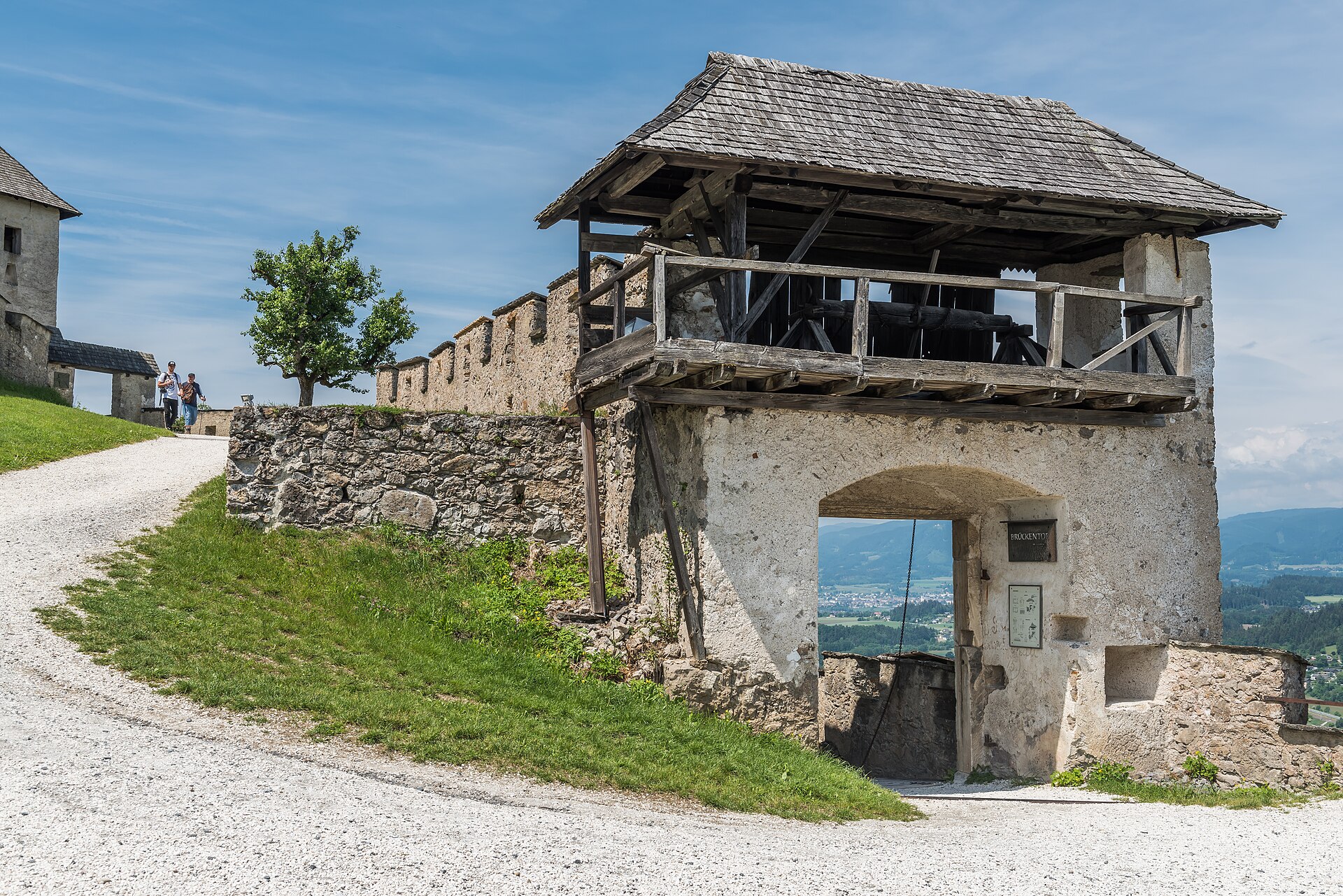
Most castles have a gate. Hochosterwitz has fourteen. This is the feature that sets it apart from almost every other fortress in Europe, and it is the key to understanding the whole place. To reach the inner castle at the summit, you must pass through fourteen separate fortified gates, spaced along the winding ramp that climbs the rock, each one a defensive strongpoint in its own right, complete with its own devices, obstacles and lines of fire.
The idea behind this was brutally simple. An attacker who breached the first gate did not break into the castle; he merely earned the right to be shot at while attacking the second gate, and then the third, and so on, all the way up the exposed spiralling path. Each gate could be defended independently, so that even if the outer ones fell, the defenders could fall back and hold the higher ones, making the cost of every step upward almost unbearable.
The gates were not identical. Each was designed with its own particular defensive character, some with drawbridges over rock-cut ditches, some with portcullises, some positioned so that attackers had to expose their unshielded side to the walls above, and at least one, by tradition, rigged so that a section of the path could be dropped away entirely. Climbing through them today, you can still read the deadly cleverness built into each one.
It is worth savouring the psychology of it, too. By the time an attacking commander had studied this ascent, fourteen gates rising one above another up a sheer crag, the sensible conclusion was obvious: do not attack at all. The gauntlet of gates was as much a deterrent as a defence, a visible promise of ruin to anyone who tried to force the road to the top.

No two visitors count the ordeal quite the same way, but everyone arrives at the top with the same realization: that they have just walked, in perfect safety, a route engineered to destroy an army. It is one of the few places where the abstract idea of medieval defence becomes a physical, breathless experience you carry in your own legs.
Walking the Spiralling Road
To visit Hochosterwitz properly is to walk the old defensive road on foot, climbing the spiralling ramp through the gates just as friend and foe would have done for centuries. The path is long, some six hundred meters of ascent winding around and up the rock, and every stretch of it was engineered to funnel movement exactly where the defenders wanted it, always climbing, always overlooked, never offering cover.
Each of the fourteen gates carries its own name and history, a roll-call that reads like a story in itself, from the first gate at the bottom to the final gate that admits you to the inner castle at the summit. Some are named for their function, some for the families or events associated with them, and together they form a graduated sequence of defence, each a little higher and a little harder than the last.
As you climb, you feel the design working on your own body. The road never lets you forget the walls above you, the way it curves so that you are constantly presenting a flank, the narrow points where a handful of defenders could have stopped an army. It is one thing to read that a castle was impregnable; it is another to toil up its approach and understand, in your legs and lungs, exactly why.
And then, punctuating the effort, come the views. At each turn of the path the Carinthian countryside opens out further below, the valley floor receding, the far mountains rising, until by the upper gates you are looking out over a vast sweep of southern Austria. The climb that was meant to exhaust and expose an enemy now rewards the peaceful visitor with one of the finest approaches to any castle in Europe.

Guides like to point out particular gates as you climb, each with its own small story, so that the ascent becomes a kind of unfolding narrative rather than a mere slog. By the time you pass the last of them, you feel you have not just climbed a hill but travelled through the whole defensive imagination of an age.
Arriving at the Inner Castle
Pass through the final gate and the character of the place changes at once. The tension of the climb releases, and you step into the inner castle at the summit, an altogether more domestic and welcoming world of arcaded courtyards, residential wings and quiet corners. After the martial severity of the ascent, this is where the fortress reveals its softer face, the place where people actually lived rather than merely fought.
The buildings around the summit courtyard date largely from the great sixteenth-century rebuilding, and they have an elegant, almost graceful quality, with covered arcades and handsome facades. Here were the living quarters, the halls, the kitchens and storerooms, everything needed to sustain a household and a garrison high on their rock, self-contained and secure above the world.
It is a striking contrast, and a deliberate one. The whole point of the fourteen gates and the punishing road was to protect exactly this, a comfortable, defensible living space at the very top where the lords of the castle could dwell in safety. The violence was all on the approach; the summit itself was meant to be a refuge, and it still feels like one, a calm eyrie perched above the Carinthian plain.
Standing in the courtyard, with the buildings enclosing you and the sky open above, it is easy to forget how high and how isolated you are, until you step to a parapet and the ground drops away below. That combination, intimate enclosure and dizzying height, is the particular magic of the summit of Hochosterwitz, and it explains why the castle has always been as much a home as a stronghold.

The Little Church at the Summit
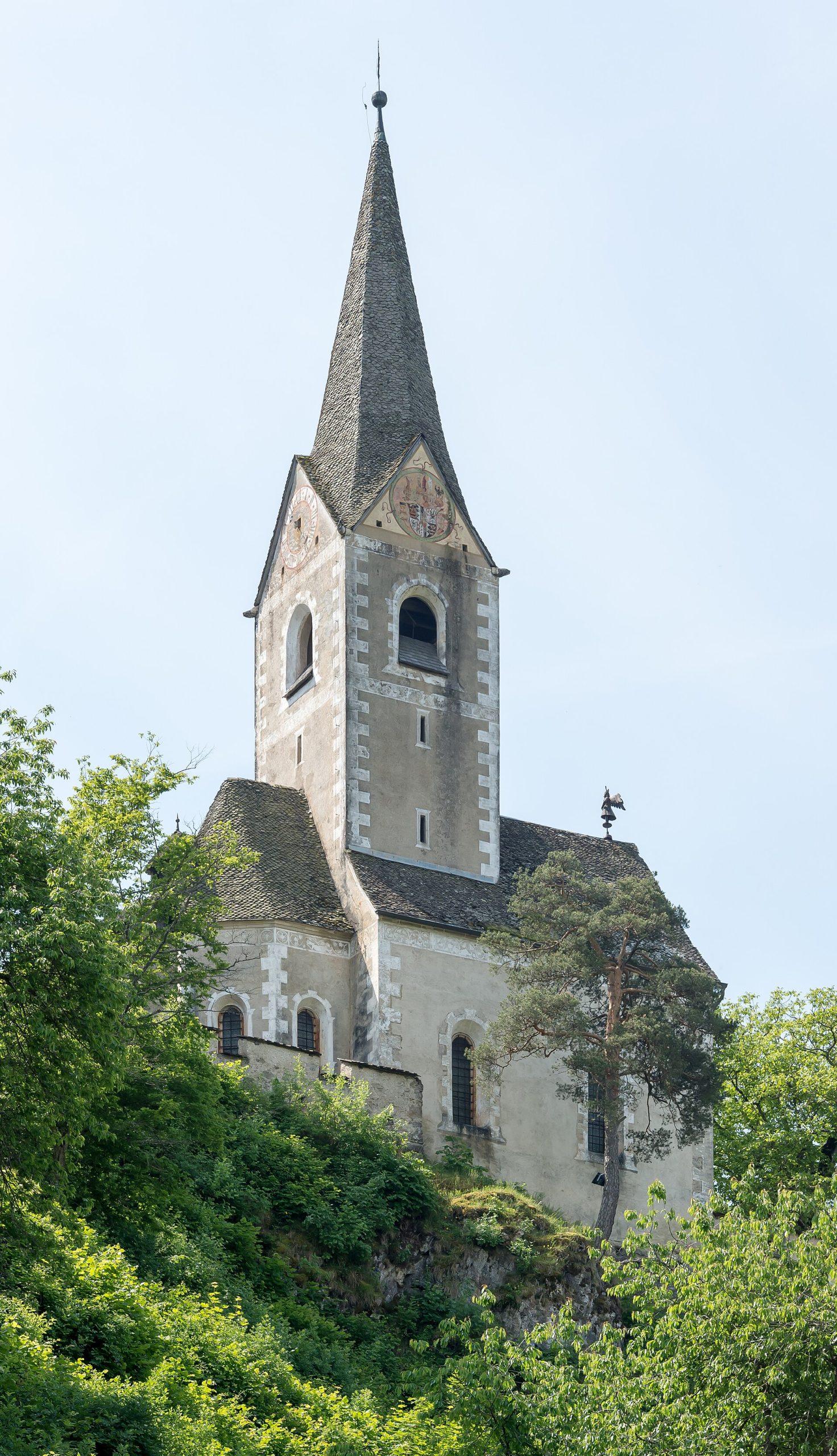
No medieval fortress was complete without a place of worship, and Hochosterwitz has a lovely castle church near its summit, a reminder that the hard men who built and held this rock also needed somewhere to pray. The chapel served the spiritual needs of the household and garrison, and it remains one of the most atmospheric spaces in the whole complex, a pocket of calm and colour at the top of the climb.
The church is richly decorated, its interior adorned with frescoes and an altar that lift it well above the merely functional. In a fortress otherwise devoted to the grim business of defence, the chapel was where beauty and devotion were allowed their due, and the care lavished on it shows how seriously the castle’s owners took the religious life alongside the military one.
There is something moving about a place of prayer set at the summit of so warlike a fortress. The same walls that were built to rain death on attackers also sheltered this quiet space of faith, and the two impulses, to defend and to worship, sat side by side at the top of the rock, as they did throughout the Christian Middle Ages.
Today the castle church is a popular and romantic setting for weddings, and it is easy to see why. To be married in a chapel at the summit of a fabled castle, having climbed through fourteen gates to reach it, with the whole of Carinthia spread out below, is the kind of storybook occasion that Hochosterwitz seems almost to have been designed to provide.
Built in the Shadow of the Ottoman Threat
The Hochosterwitz we see today, with its fourteen gates and its theatrical spiralling defences, is not a relic of the high Middle Ages but very largely the creation of one man in the sixteenth century: Georg von Khevenhüller. Between roughly 1570 and 1586 he transformed an older stronghold on the rock into the elaborate fortress that survives, and he did so in direct response to a very specific and terrifying danger, the threat of Ottoman invasion.
In those decades the Ottoman Empire was pressing hard into central Europe, and raids and incursions reached deep into the Habsburg lands, spreading fear across the countryside of Carinthia and beyond. A powerful noble like Khevenhüller needed a refuge that could withstand not just local feuds but the shock of a serious military assault, and he poured resources into making Hochosterwitz exactly that, a fortress that could shelter him, his family and his people against the worst.
This is why the castle feels so systematic and so martial in its design. It was not built up piecemeal over centuries of small conflicts but conceived, in large part, as a coherent defensive scheme at a moment of real existential dread, when the possibility of an Ottoman army in Carinthia was frighteningly plausible. The fourteen gates are the physical expression of that fear, an all-out attempt to make the castle unassailable.
As it happened, the great Ottoman assault on this part of Austria never came, and Hochosterwitz was never actually tested against the enemy it was rebuilt to resist. But the fortress remains a vivid monument to that anxious age, a reminder of how the long struggle between the Habsburgs and the Ottomans shaped not just great battles but the very stones of castles far behind the front.

Georg von Khevenhuller was not merely a frightened man throwing up walls, but a sophisticated soldier and statesman who understood the new realities of gunpowder warfare, and the fortress reflects that knowledge, blending the older logic of gates and bridges with an awareness of what artillery could and could not do to a position as high and steep as this one.
A Spiral of Stone Seen From Above
To really understand the genius of Hochosterwitz, it helps to rise above it and look down, and from that vantage the whole design snaps into focus. The fortified road does not climb the rock in a straight line but coils around it in a great spiral, so that the fourteen gates are strung out along a serpentine path that wraps the entire crag. It is less a wall with a gate than a single continuous defensive ribbon winding up to the summit.
This spiral arrangement was fiendishly effective. It meant that attackers could never simply rush a wall, but had to follow the long curving road, always overlooked, always turning, always climbing, past gate after gate. The defenders, meanwhile, could move quickly along the summit and inner ways to concentrate wherever they were needed, holding the high ground while the enemy toiled around the outside.
Seen from the air, the castle also reveals how completely it fits its rock, the buildings and walls following every contour of the crag, exploiting each ledge and cliff. There was no wasted effort and no weak flank; the fortress and the mountain became a single thing, which is exactly why no attacker ever thought the summit worth the terrible price of the climb.
The best way to appreciate all this short of flying over it yourself is to watch the castle in motion, the road unspooling gate by gate toward the top. This tour follows that spectacular ascent and shows, far better than any diagram, how the whole spiral of stone was meant to work as one great machine for stopping an army.

Living High Above the World
A fortress meant to withstand a determined siege had to be more than a set of walls; it had to be able to keep its people alive, sometimes for a long time, cut off from the world below. Hochosterwitz was designed with exactly this in mind, and its summit held the storerooms, cisterns and open ground needed to sustain a household and garrison through weeks or months of blockade without ever having to open the gates.
Water, as always on a dry hilltop, was the critical problem, and the castle made provision to collect and store it, so that thirst could never quickly force a surrender. Alongside water came space for provisions and, in the more settled centuries, terraces and gardens where the household could take the air and enjoy the extraordinary position, high above the Carinthian plain.
This capacity for self-sufficiency was the quiet foundation of the castle’s reputation for impregnability. The fourteen gates and the spiralling road might stop an assault, but it was the stores of food and water at the top that would defeat a siege, allowing the defenders to simply outlast an enemy who had no such comforts camped on the plain below.
To stand on the summit today, among these high open spaces with the wind moving across them and the view running to the mountains, is to feel the strange doubleness of a great fortress. It was a place braced for horror, siege and assault and desperate defence, and yet also a place of remarkable peace and beauty, a home in the sky that its owners clearly loved as well as trusted.

The Castle That Was Never Taken
For all the effort poured into its defences, the ultimate proof of a fortress lies in its record, and Hochosterwitz has one of the best imaginable: in its long history it was never taken by an enemy in open assault. The fourteen gates and the spiralling road did their work not by being stormed and holding, but by being so obviously unstormable that few ever seriously tried, and none succeeded.
This unbroken record is not a matter of luck but of design. A castle can be beaten in many ways, by treachery, by starvation, by overwhelming force, but Hochosterwitz was built to close off every one of those paths. Its gates defeated direct assault, its stores defeated siege, and its commanding position and loyal owners left little room for surprise. It presented an attacker with no good options at all.
The castle did change hands over the centuries, but through inheritance, purchase and the ordinary transactions of noble life, never through the breach of its walls. In an age when so many great fortresses were stormed, sacked and rebuilt, sometimes repeatedly, Hochosterwitz simply stood, its defences never overcome, a quiet standing rebuke to anyone who imagined they could take the rock by force.
There is a lesson in that serene record. The most successful fortress is often the one that never has to fight, the one whose strength is so evident that the battle is won before it begins. Hochosterwitz achieved exactly that, deterring rather than defeating its enemies, and its perfect, unblemished history is the truest measure of just how formidable those fourteen gates really were.

Military historians sometimes point to Hochosterwitz precisely because it complicates the romantic image of the endlessly besieged castle. Here was a fortress whose whole success lay in the sieges that never happened, the assaults that were never launched, the enemies who took one look at the rock and its gates and quietly decided to find easier prey elsewhere.
The Khevenhüller Family and Four Centuries of Ownership
Behind every great castle stands a family, and Hochosterwitz belongs, to an unusual degree, to one: the Khevenhüllers, a noble Carinthian house who acquired the castle in the sixteenth century and, remarkably, still own it today, more than four hundred years later. In an age when most historic castles have long since passed to states, trusts or strangers, this unbroken family ownership is genuinely rare and gives the place a rare continuity.
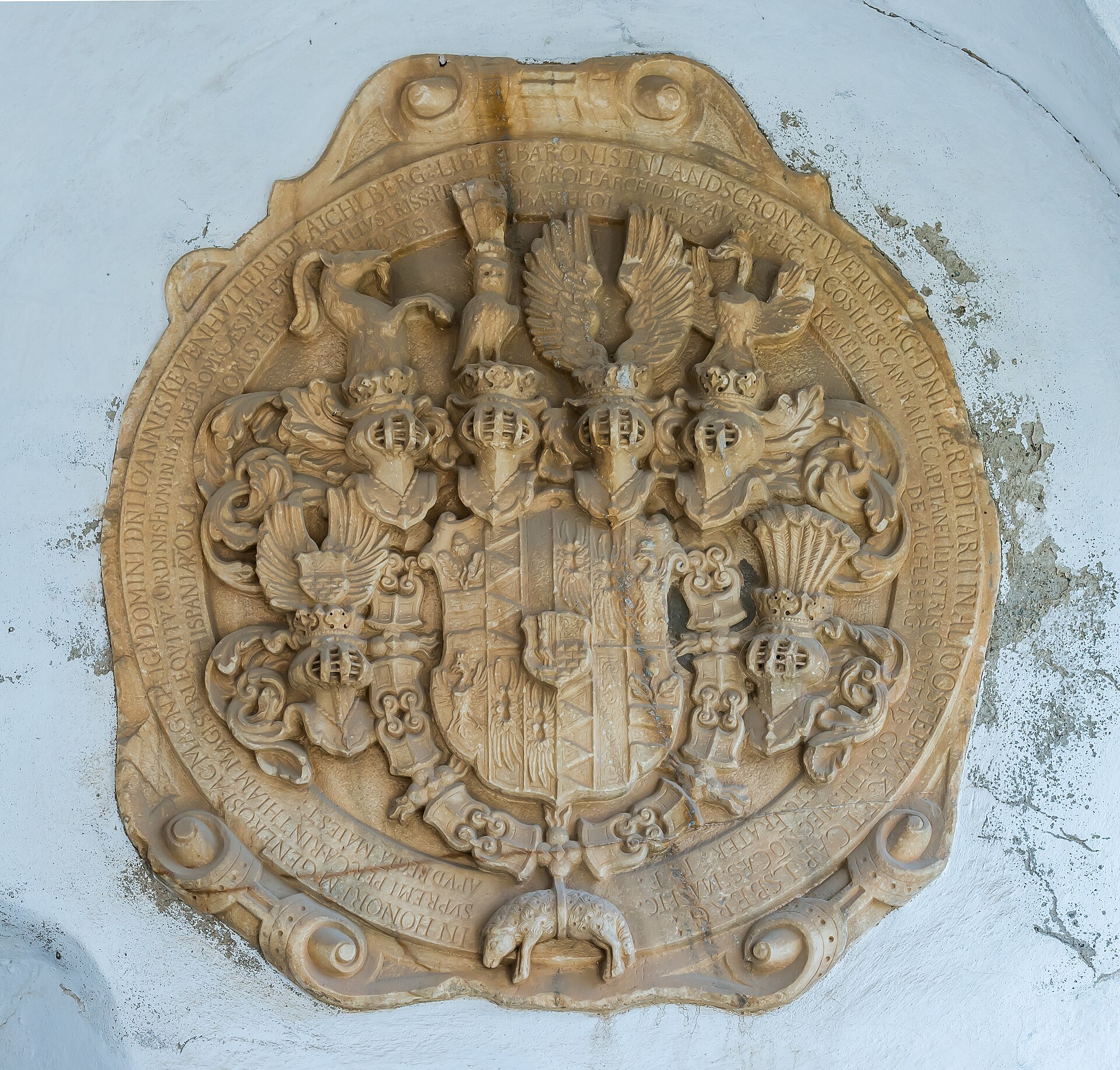
It was Georg von Khevenhüller, as we have seen, who rebuilt the castle into its present spectacular form during the years of the Ottoman scare, and he made sure his achievement would endure. A famous inscription he left records his wish that the castle remain with his family forever, and against all the odds of the intervening centuries, wars, upheavals and the fall of empires, that wish has essentially been honoured.
The Khevenhüllers rose to great prominence in the service of the Habsburgs, holding high offices and titles, and their fortunes carried the castle through the dangerous early modern centuries. Even when the family’s main residences lay elsewhere, Hochosterwitz was preserved as an ancestral treasure, maintained rather than modernised away, which is a large part of why it survives so vividly today.
That long stewardship is something you feel as you walk the castle. This is not a sterile monument frozen by a bureaucracy but a place that has been continuously cared for by a family with a personal stake in its story, its coats of arms and portraits and heirlooms speaking of an unbroken line. Few castles anywhere can claim so intimate and enduring a bond between a fortress and the people who have always held it.
Drawbridges, Ditches and the Art of Delay
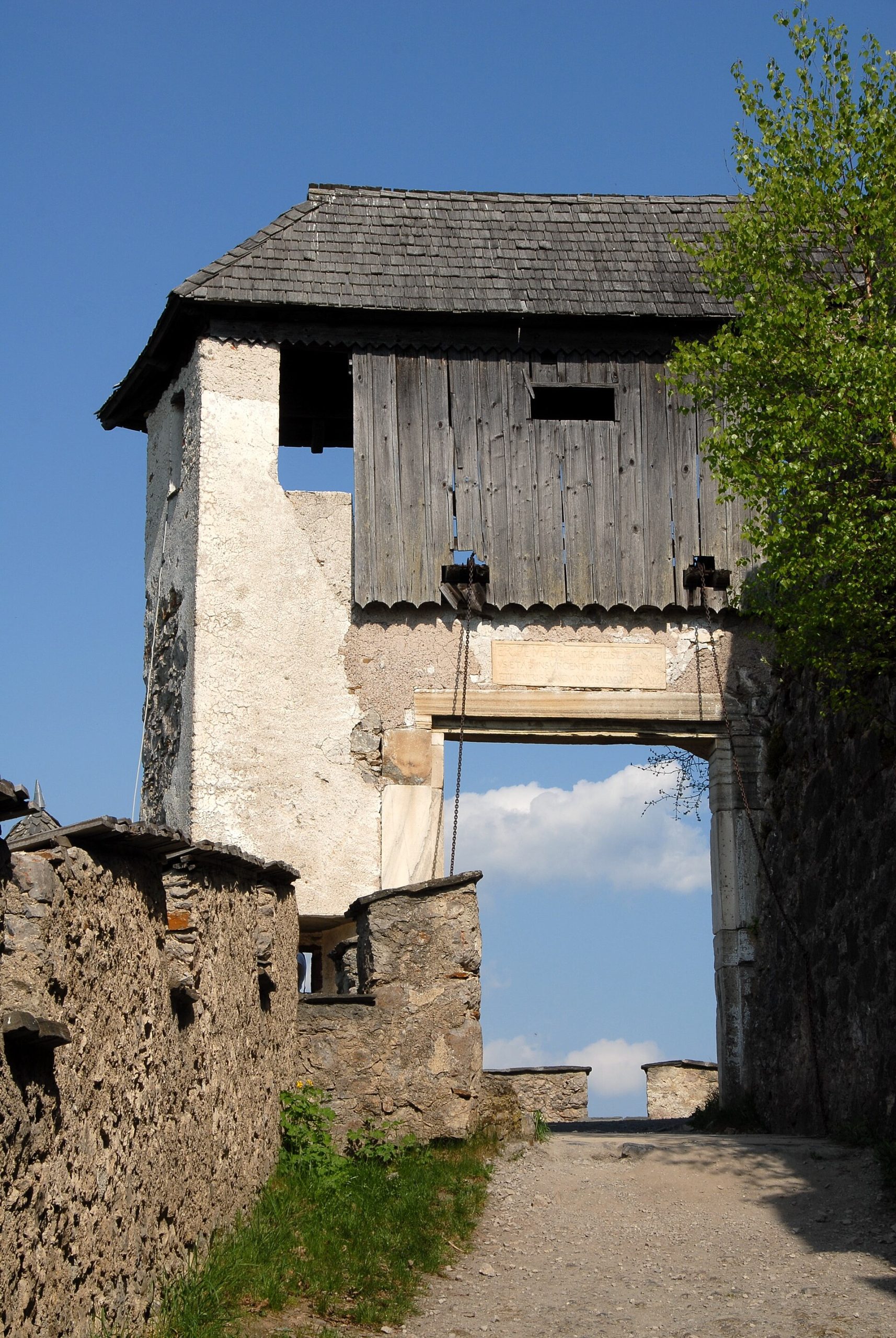
Walk the road slowly and you begin to appreciate the sheer craft of the individual gates, because no two solve the problem of defence in quite the same way. Several are approached across drawbridges spanning ditches cut into the living rock, so that with the bridge raised, a gate became an island, cut off and unassailable. An attacker who reached it found not a door to batter but a gap he could not cross.
Other gates rely on different tricks. Some are set at angles that force attackers to turn and expose their unshielded right side, the side not covered by a shield, to the defenders above. Some are overlooked by galleries and openings from which stones, missiles or worse could be dropped on anyone crowded below. Each gate, in other words, was a small tailored trap, designed to punish assault in its own particular way.
The genius of the scheme was that these strongpoints were independent. Because each gate could be held on its own, the loss of one did not doom the rest; defenders could yield the lower gates and still fight on from the higher ones, extracting a fresh price at every level. The road to the summit was less a single barrier than fourteen barriers in series, and an enemy had to defeat them one after another.
This is medieval and early modern military engineering at its most inventive, the art not of the single mighty wall but of layered, cumulative delay. Every gate bought time, and time, for a well-provisioned garrison, was the surest weapon of all. Standing on one of the little drawbridges today, looking down into its rock-cut ditch, you can still feel the cold logic of a design meant to make each step upward a separate ordeal.
The Legend of the Last Ox
Every great castle attracts legends, and Hochosterwitz has a particularly delicious one, often attached to the fourteenth-century figure of Margaretha, a countess remembered in folklore by the unkind nickname Maultasch. In the tale, her forces laid siege to the castle, and the defenders on the rock were slowly starving, down at last to almost nothing, their situation apparently hopeless as the besiegers waited confidently below for surrender.
The garrison commander, so the story goes, hit upon a desperate bluff. The defenders had just one animal left, a single ox, and a last small quantity of grain. Instead of eating them, the commander had the ox slaughtered, its belly stuffed with the remaining grain, and the carcass hurled contemptuously down the rock into the enemy camp, as if to say that the castle was so well stocked it could afford to throw away food.
The trick, the legend claims, worked perfectly. The besiegers, seeing this apparent proof that the garrison had provisions to spare, concluded that they could never starve the castle into submission, and gave up the siege and marched away, just as the defenders were on the very brink of collapse. It is a wonderful story of nerve and cunning triumphing over brute force, exactly the kind of tale a proud castle loves to tell about itself.
Whether any of it is literally true hardly matters; the legend has become part of the identity of Hochosterwitz, and it captures a real truth about the place. This was a castle that won its battles as much by wit and reputation as by walls, a fortress whose greatest weapon was often the simple conviction, in the minds of its enemies, that it could never be taken at all.

Similar stories are told of other besieged towns across Europe, which suggests the tale is a travelling legend that attached itself to Hochosterwitz because the castle seemed so perfectly suited to it. That it stuck here, of all places, is itself a kind of tribute to the fortress’s reputation for cunning survival against the odds.
Armour, Relics and the Castle Today
Reach the summit and the fortress opens itself to you as a museum of its own long life. The castle houses an armoury and collections that display weapons, armour and relics gathered over the centuries, an evocative array of the tools of the very warfare the fourteen gates were built to withstand. Suits of armour, halberds, swords and firearms line the rooms, bringing the martial history of the place vividly to life.
Among the treasures are pieces connected to the Khevenhüller family and to the dramatic events of the castle’s past, including memorabilia of the age of Ottoman fear that shaped its rebuilding. To walk these rooms is to see, gathered in one place, the physical evidence of the world the castle was made for, a world of mounted knights, pike and shot, siege and defence, all preserved on the rock where it might have played out.
Today Hochosterwitz is one of the most popular castle attractions in Austria, drawing visitors from all over the world who come to climb its gates, tour its collections, eat in its restaurant and drink in its incomparable views. For those who would rather not walk the whole road, a lift rises through the rock to the summit, but the true experience is still the climb on foot through the fourteen gates.
That the castle can be enjoyed so freely, while remaining in the hands of the family that built it, is a happy ending to its long story. The fortress that was raised in fear of invasion, and that never had to fire a shot in the great war it was built for, now welcomes rather than repels, its terrible gates opening not onto armies but onto delighted visitors climbing up to admire the most theatrical castle in Austria.

Castles Nearby
Why Fourteen Gates Still Guard an Empty Road
Some castles impress you with their beauty, others with their history, but Hochosterwitz impresses you above all with its sheer, single-minded cleverness. Everything about it, the lone rock, the spiralling road, the fourteen gates rising one above another, serves one relentless idea: that the way to win a fight is to make it unthinkable to start. It is less a building than an argument, laid out in stone, that this hill simply cannot be taken.
And the argument worked. Never stormed, never sacked, held by the same family for over four hundred years, the castle stands today essentially as its sixteenth-century builder left it, a perfect and unspoiled expression of the fortress-maker’s art at the very moment when medieval defence met early modern fear. Few places let you read the logic of a stronghold so clearly, gate by gate, all the way to the top.
So when you find yourself in southern Austria, set aside a day for the climb. Walk the spiralling road, pass through all fourteen gates, stand in the little church and the armoury and the high courtyards, and look out over the Carinthian plain from a rock that no enemy ever conquered. Hochosterwitz turns the simple act of reaching a castle door into an unforgettable journey, and that, in the end, is exactly what its builders intended.
You May Like
Buda Castle: The Crown of Budapest Above the Danube


One thought on “Hochosterwitz Castle: The Fortress of Fourteen Gates”