In the mountains of northern Ethiopia stands a group of churches unlike any others in the world. Rather than being built up from the ground, they were carved downward into the solid volcanic rock, each hewn as a single piece complete with roofs, doors, windows and columns. This is Lalibela, one of the holiest places in Ethiopian Christianity.
Created some eight centuries ago as a new Jerusalem in the highlands, Lalibela’s eleven rock-hewn churches remain living places of worship, thronged with pilgrims and priests. They are among the most astonishing feats of architecture and faith on earth.

Table of Contents
- Churches Carved Downward into the Rock
- King Lalibela and a New Jerusalem
- Bete Giyorgis: The Church of Saint George
- Bete Medhane Alem and the Northern Group
- Carved from a Single Block of Stone
- Trenches, Tunnels, and Hidden Passages
- A Living Place of Worship
- Priests, Crosses, and Sacred Art
- Legends and Construction Mysteries
- Conservation and UNESCO
- Nearby Places
- Closing Thoughts
Churches Carved Downward into the Rock
The churches of Lalibela were not constructed but excavated. Workers cut down into the rock, first freeing a great block by digging trenches around it, then hollowing out the interior to leave a complete church standing in a pit.
This means each church is a single piece of stone, with no joints or added masonry. The technique demanded extraordinary planning, for a single mistake could not be undone by adding new material.

King Lalibela and a New Jerusalem
The churches are traditionally credited to King Lalibela, who ruled around the late twelfth and early thirteenth centuries and gave the place its name. According to tradition, he set out to create a new Jerusalem in Ethiopia.
After the holy city of Jerusalem fell to Muslim rule, pilgrimage there became difficult for Ethiopian Christians. Lalibela offered them a sacred destination closer to home, its very layout echoing the holy places of Jerusalem, including a river named the Jordan.
Bete Giyorgis: The Church of Saint George
The most famous and perfect of the churches is Bete Giyorgis, the Church of Saint George. Carved in the shape of a Greek cross, it stands in a deep pit, its roof at ground level so that visitors first see it from above.
Seen from the surrounding rim, its cruciform roof is one of the most iconic images of Ethiopia. Reached by a hidden trench, it appears almost to have risen whole from the rock itself.

Bete Medhane Alem and the Northern Group
The largest of the churches is Bete Medhane Alem, the House of the Saviour of the World, surrounded by rows of great rectangular columns. It is often described as the largest rock-hewn church in the world.
It belongs to a northern cluster of churches, linked to others by passages and courtyards. Together they form a complex sacred landscape rather than a set of isolated buildings.

Carved from a Single Block of Stone
Stepping inside a Lalibela church, one enters a space entirely carved from the rock: columns, arches, ceilings and decorative details all cut from the same mass of stone as the walls around them.
The interiors are cool and dim, lit by carved windows, and adorned with crosses, reliefs and paintings. The sheer skill of shaping a whole architectural interior by removal, rather than construction, is difficult to overstate.

Trenches, Tunnels, and Hidden Passages
The churches are connected by a network of trenches, tunnels and passages cut through the rock, some dark and narrow. Pilgrims move between the churches through this underground maze.
One tunnel is traditionally walked in darkness as a symbolic passage through hell before emerging into the light. The whole site is designed to be experienced as a spiritual journey, not merely a collection of monuments.

A Living Place of Worship
Unlike many ancient sites, Lalibela is not a ruin but a thriving centre of faith. Its churches have been in continuous use for some eight hundred years, and services, chanting and prayer fill them daily.
At major festivals, especially the celebration of Ethiopian Christmas, tens of thousands of white-robed pilgrims gather at Lalibela, turning the ancient churches into a sea of worshippers.
Priests, Crosses, and Sacred Art
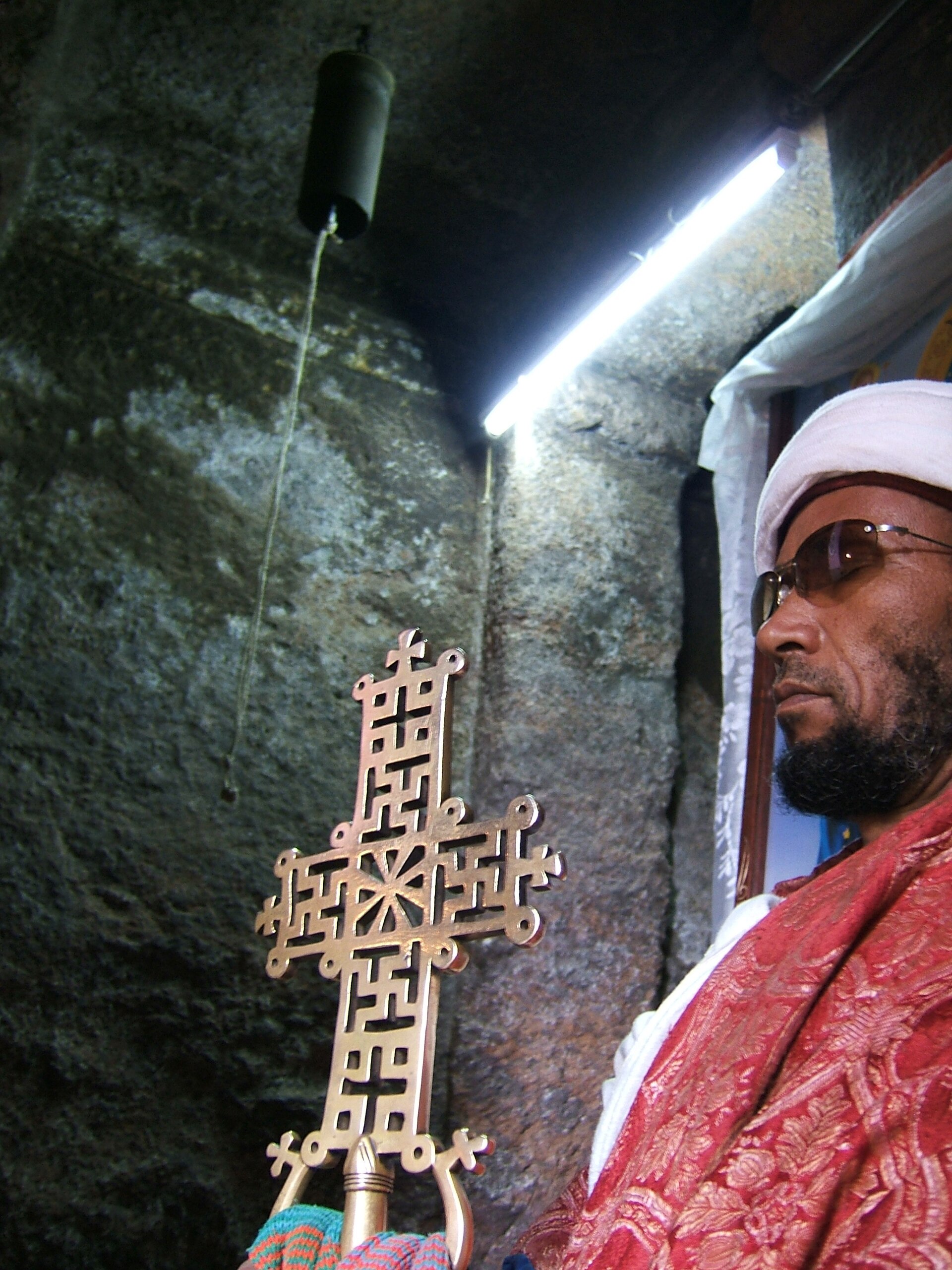
The churches are tended by priests of the Ethiopian Orthodox Church, who guard their treasures, including ornate processional crosses, illuminated manuscripts on parchment and ancient religious paintings.
Each church has its own guardians and relics, and the priests, in their robes and with their crosses, are as much a part of Lalibela as the stone itself. They maintain traditions of chanting and ritual reaching back centuries.

Legends and Construction Mysteries
So remarkable are the churches that legends grew up around their creation, telling how angels worked alongside the labourers to complete them in a miraculously short time. Such stories reflect the awe they have always inspired.
Exactly how, and over how long, the churches were carved is still studied by scholars. Some may reuse earlier structures, and the work likely spanned generations, but the achievement remains extraordinary by any measure.
Conservation and UNESCO
The rock-hewn churches of Lalibela were inscribed on the UNESCO World Heritage List in 1978, among the very first sites so honoured. Protecting them from erosion, water damage and the pressure of visitors is an ongoing challenge.
Great protective shelters have been built over some churches, a practical if controversial measure. Yet Lalibela endures as both a world monument and a living heart of Ethiopian Christianity.
Nearby Places
- Aksum — the earlier Ethiopian kingdom that first brought Christianity to the highlands where Lalibela later rose.
- Petra — another astonishing city carved directly into rock, though hewn into cliffs rather than down into the ground.
- Great Zimbabwe — another masterpiece of African architecture, built in stone by a powerful medieval kingdom.
Closing Thoughts
Lalibela turns the very idea of building on its head: here, to make a church, one carves a mountain away. The result is a sacred landscape of monolithic churches, tunnels and courtyards unlike anywhere else on earth.
Still filled with the chanting of priests and the prayers of pilgrims after eight centuries, Lalibela is not a relic but a living wonder, a new Jerusalem carved from the rock of the Ethiopian highlands.
You May Like

Mafra, the Palace a King Built From a Vow