In the Oaxaca valley of southern Mexico, a short distance from the better-known ruins of Monte Alban, stands a city unlike any other built by the ancient Zapotec people. Mitla was not designed primarily as a center of population or royal power but as a sanctuary for the dead and the priests who tended them, its very name deriving from a Nahuatl term meaning place of the dead, itself a translation of the original Zapotec name Lyobaa, meaning place of rest or burial.
What sets Mitla apart from every other ancient Mesoamerican site is not its size or its pyramids, both comparatively modest, but the extraordinary geometric stone mosaic work covering its major buildings, an intricate fretwork technique found nowhere else in the ancient Americas at anything close to the same scale or precision, produced by fitting thousands of individually cut stone pieces together across entire facades without mortar.
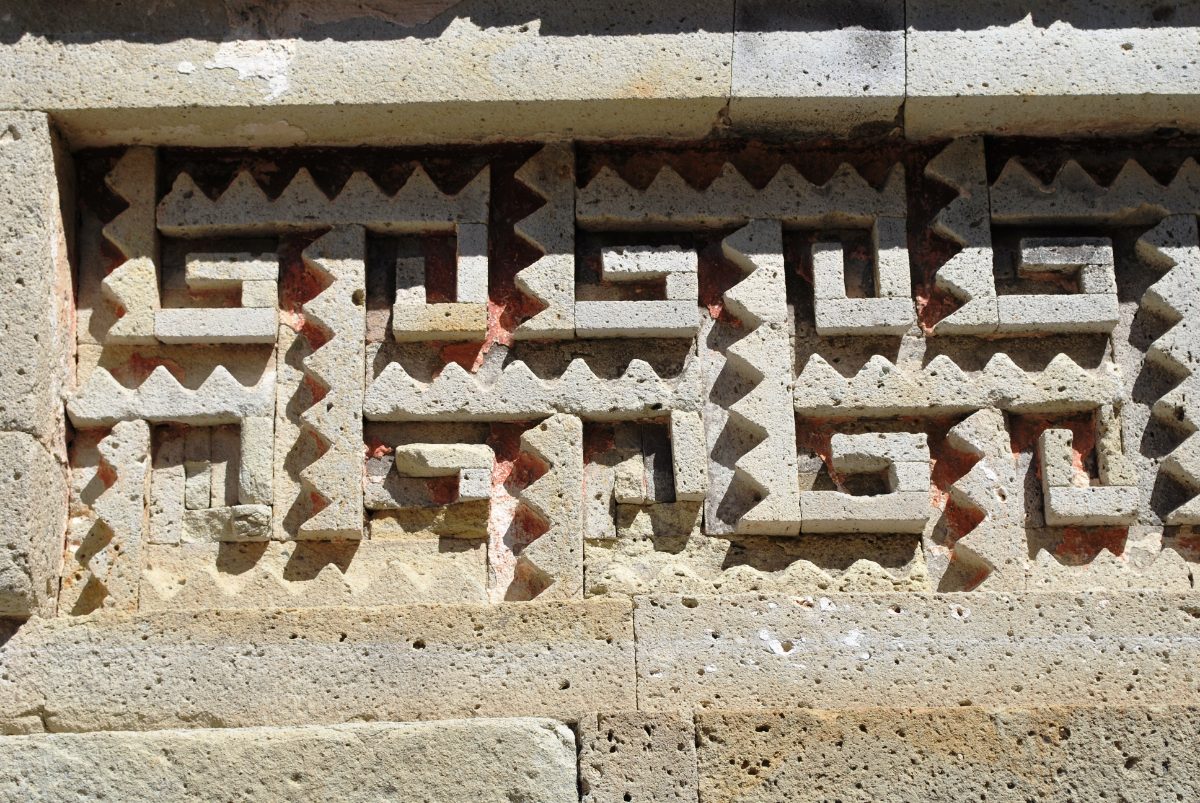
Table of Contents
- Arriving at the City of the Dead
- Five Groups of Stone: Mapping Ancient Mitla
- The Mosaic Fretwork That Has No Equal
- The Hall of the Columns and the Palace Group
- What Language Did the People of Mitla Speak?
- The Uija-tao: Priests Greater Than Kings
- Tombs, Ancestors, and the Zapotec Underworld
- A Church Built Atop the Ruins
- From Zapotec Capital’s Shadow to Mixtec Sanctuary
- Rediscovery and Visiting Mitla Today
- Nearby Places to Explore
- Closing Thoughts
Arriving at the City of the Dead
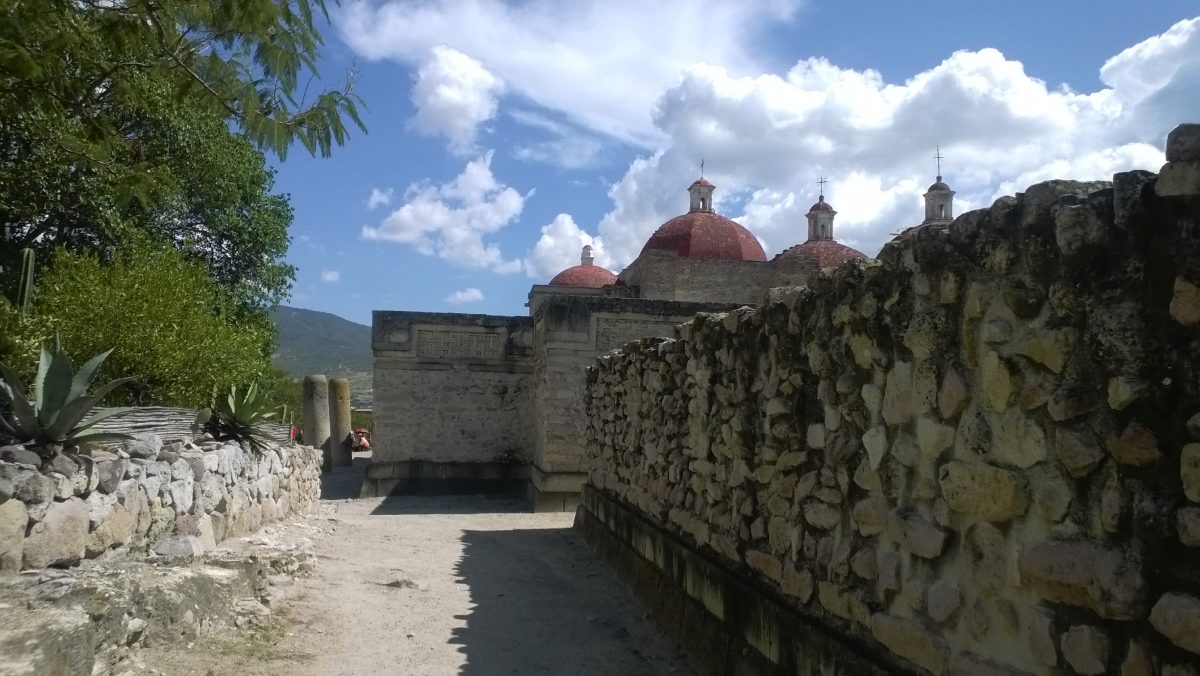
Visitors approaching Mitla today first encounter a jarring juxtaposition: a colonial Catholic church, still in active use, standing directly beside and partly atop one of the site’s ancient quadrangles, a physical reminder of how thoroughly Spanish colonization layered itself over existing indigenous sacred geography rather than simply replacing it elsewhere.
Beyond the church, the ancient structures spread across several distinct architectural groups connected by open plazas, each displaying the site’s signature mosaic stonework to different degrees, with the best-preserved and most elaborate examples concentrated in the Group of the Columns, the complex most visitors focus their time on.
Unlike the hilltop defensive positioning of Xochicalco or the towering pyramids of central Mexico, Mitla sits in relatively open valley terrain, its importance rooted not in defensibility or sheer monumental height but in its specific religious function as a place where the Zapotec dead, particularly high-status rulers and priests, were believed to pass into the afterlife.
The modern town surrounding the ruins still bears the name Mitla, a rare case among major Mesoamerican sites where the ancient place, its Spanish-derived name, and a living contemporary community all occupy exactly the same physical location without significant displacement, unlike many ruins that sit abandoned at a distance from the nearest modern settlement.
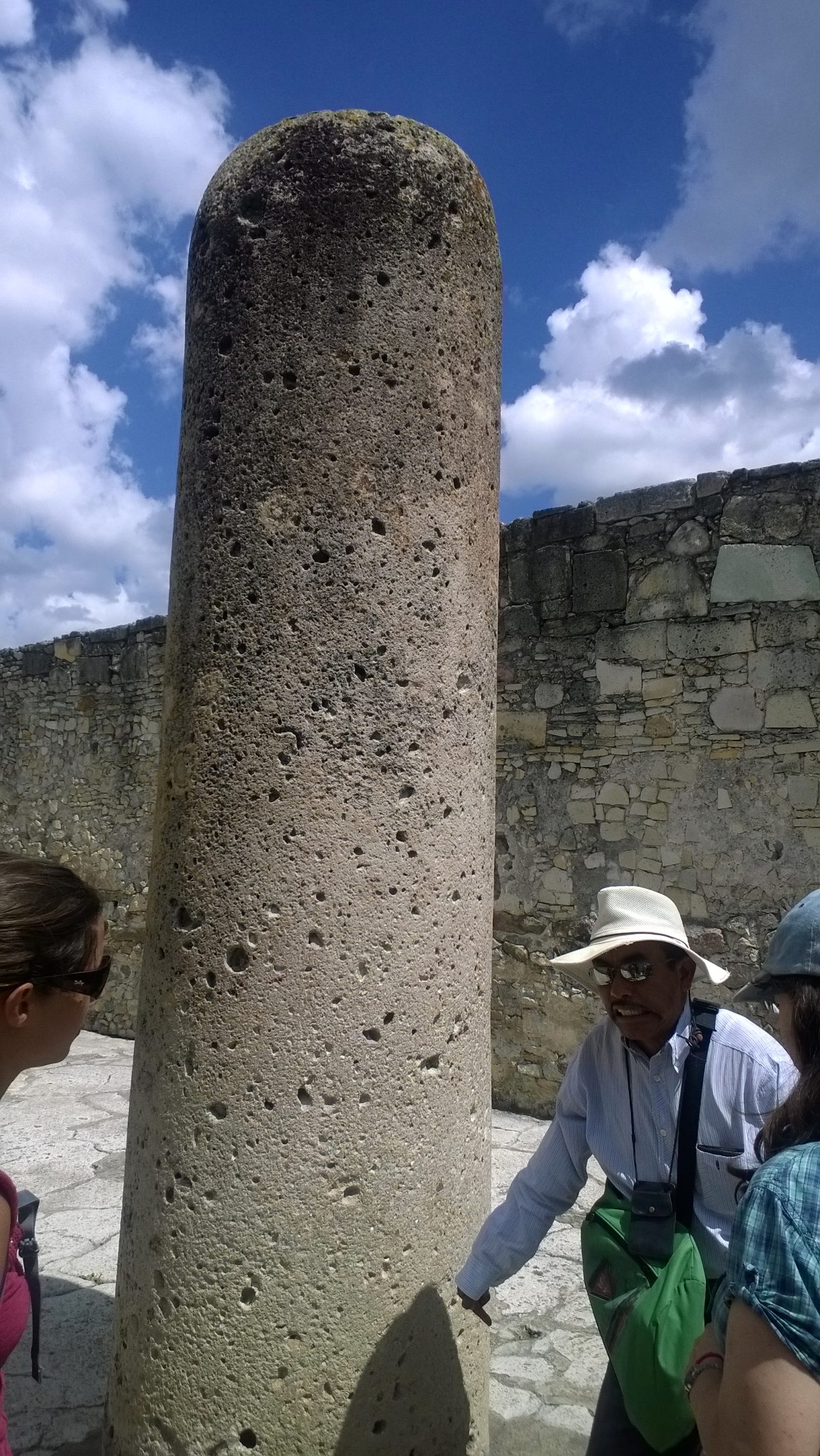
Local guides in Mitla, many of Zapotec descent themselves, often draw directly on family and community oral tradition when explaining the site’s history to visitors, adding a layer of living cultural interpretation that goes beyond what purely academic archaeological reports typically convey about the site’s continued meaning to people whose ancestors built and used it.
Five Groups of Stone: Mapping Ancient Mitla
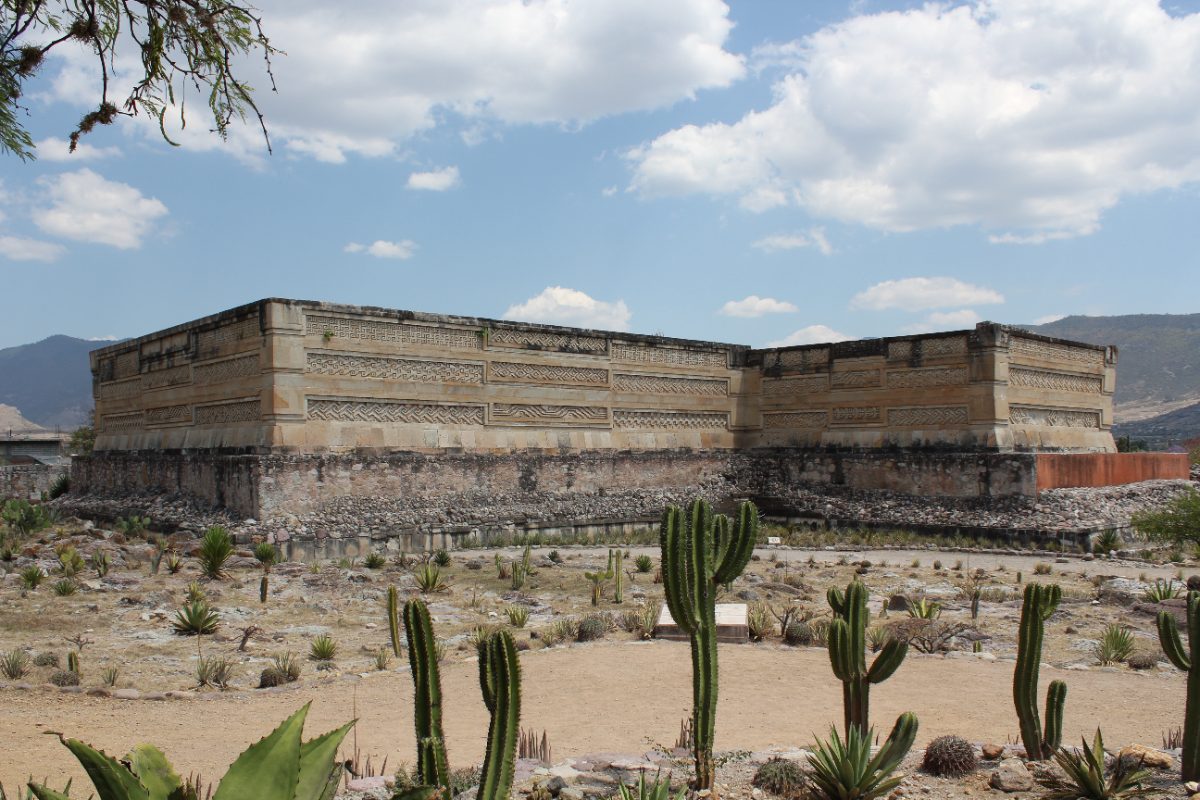
Archaeologists divide Mitla’s ruins into five principal architectural groups. The Church Group, now partly overlaid by the colonial-era church mentioned above, the Group of the Columns, generally considered the site’s finest and best-preserved complex, the Group of the Adobes, the South Group, and the Arroyo Group, each representing a distinct cluster of plazas, tombs, and residential or ceremonial structures built and rebuilt across centuries of occupation.
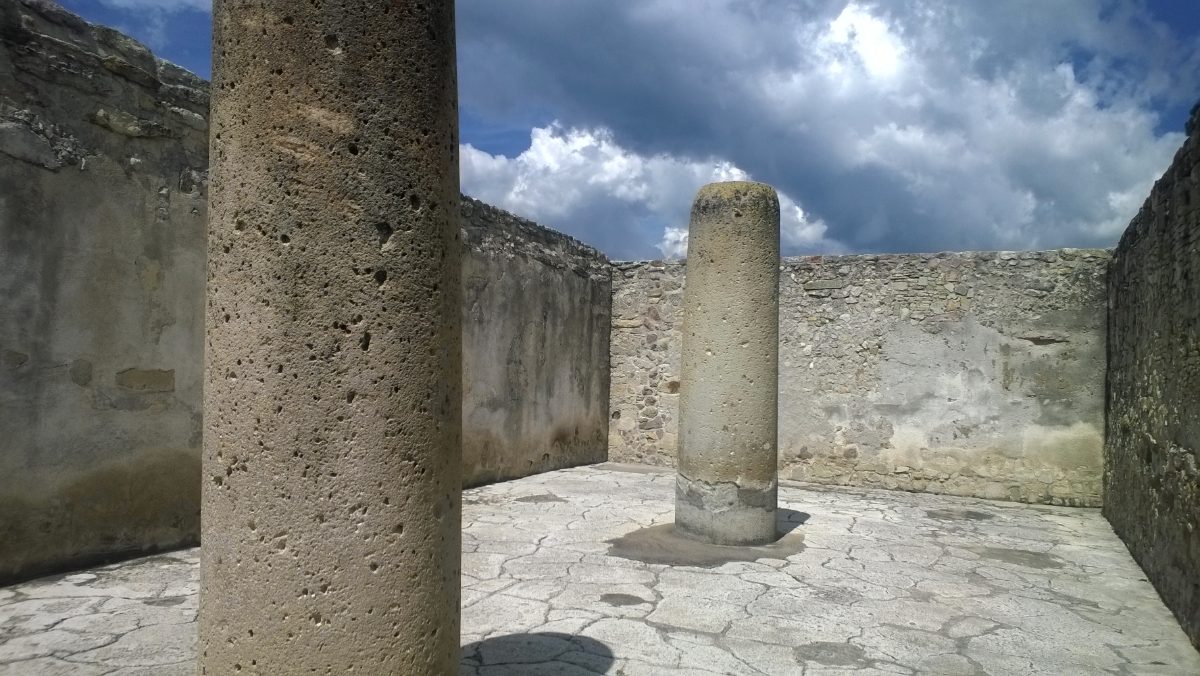
The Group of the Columns takes its name from six massive monolithic stone columns, each carved from a single piece of volcanic stone and originally supporting a roof over what was likely an important ceremonial hall, a construction technique and scale that required considerable engineering skill and labor organization to quarry, transport, and raise into position.
Beneath and around these above-ground structures, archaeologists have documented an extensive network of subterranean tombs and chambers, some accessible via narrow stone passages, reinforcing the interpretation of Mitla as fundamentally a mortuary and religious complex built around the veneration and physical interment of the Zapotec elite dead.
Excavation across the five groups has proceeded unevenly, with the Group of the Columns receiving by far the most restoration and scholarly attention, while portions of the Arroyo Group and South Group remain comparatively understudied, leaving open questions about how the full site functioned as an integrated religious complex during its centuries of active use.
Access between the different groups likely involved processional routes used during specific religious observances, though the precise ceremonial choreography connecting the Church Group, Group of the Columns, and the other complexes remains only partially understood given how much of the site’s original surrounding infrastructure has been lost to later agricultural and urban development in the immediate vicinity.
The Mosaic Fretwork That Has No Equal
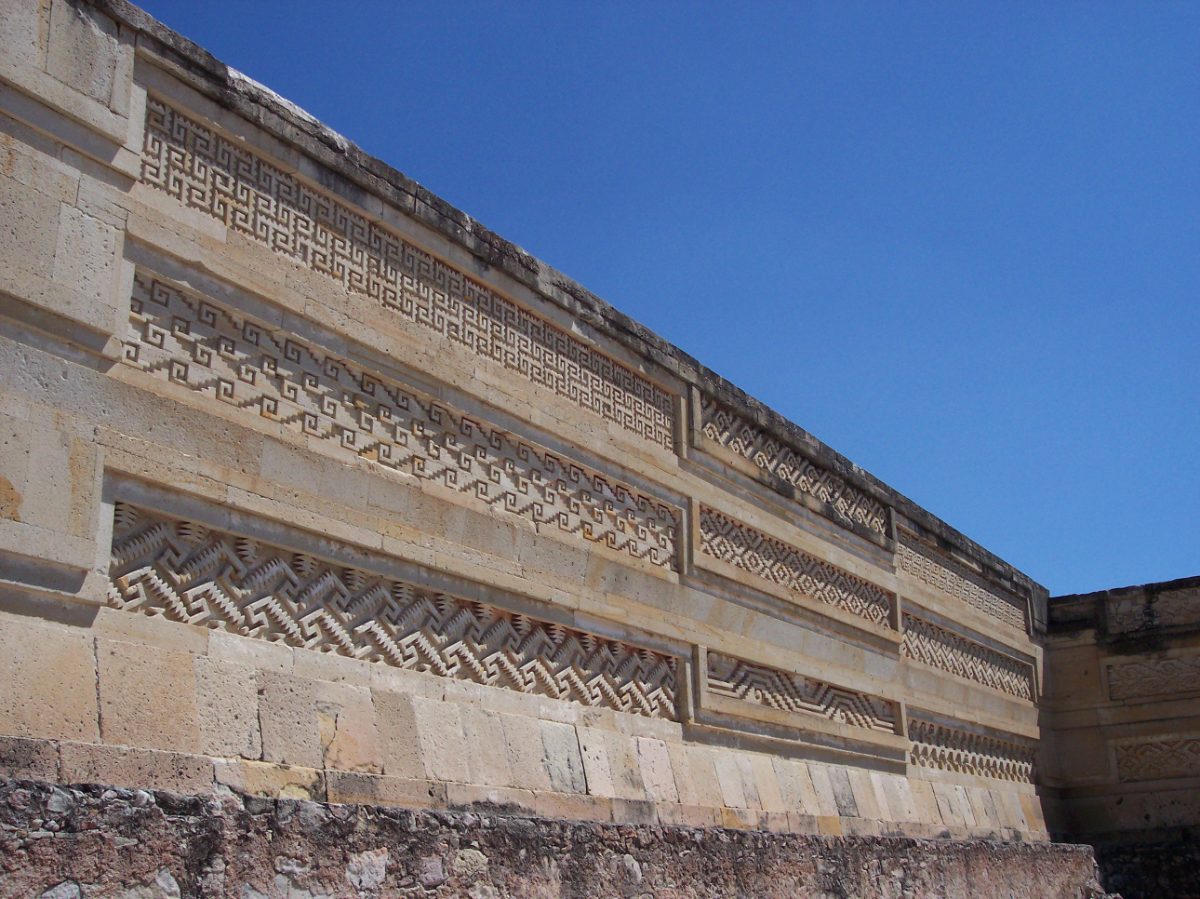
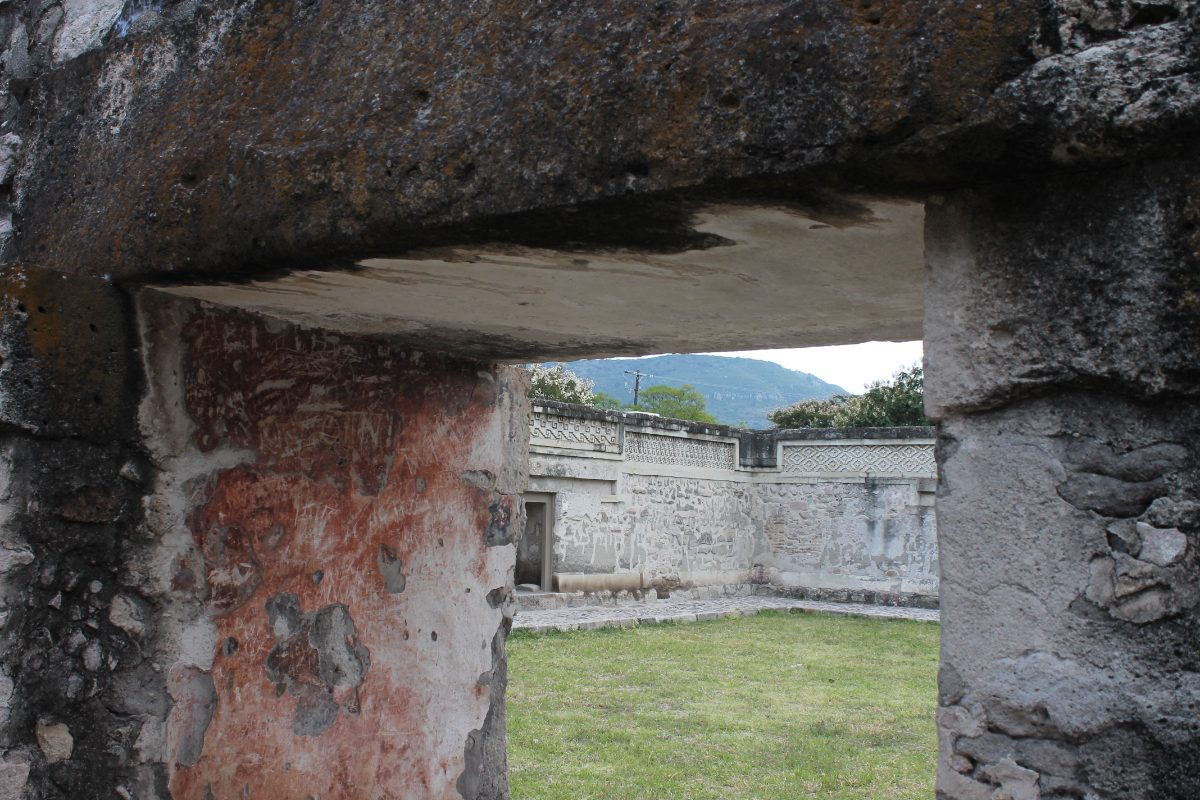
Mitla’s defining architectural feature is its geometric mosaic fretwork, known in Spanish as grecas, covering the upper facades of its major buildings in continuous, interlocking step-fret patterns assembled from thousands of individually cut and polished stone pieces, fitted together with a precision that has impressed architects and archaeologists alike since the site’s earliest documented descriptions.
Unlike carved relief sculpture, where a single artisan cuts a scene directly into a stone surface, Mitla’s mosaics required an entirely different production process: cutting many small, precisely shaped stone tesserae to exact specifications, then assembling them into repeating geometric patterns across an entire wall, a technique demanding both mathematical precision in the underlying design and painstaking manual execution across thousands of individual pieces.
No other confirmed Mesoamerican site produced mosaic stonework at this scale and complexity, making Mitla’s fretwork facades genuinely unique within the broader tradition of ancient American architecture, a distinction that has led some architectural historians to compare the technique, at least in spirit, to mosaic traditions found in entirely unrelated ancient civilizations elsewhere in the world.
Some researchers have proposed that the specific geometric patterns used across different buildings at Mitla carried distinct symbolic meanings tied to particular deities, calendar concepts, or lineage identities, though without surviving textual explanation directly from the Zapotec builders themselves, such interpretations remain informed speculation rather than settled fact.
Restoration work on the mosaic panels requires specialists trained specifically in this technique, since replacing a damaged or missing stone tessera without disrupting the surrounding pattern demands a level of precision matching, as closely as modern conservation allows, the original ancient craftsmanship the ruins are famous for.
Comparative studies of stoneworking traditions across ancient civilizations note that few other cultures worldwide invested comparable labor into purely geometric, non-figurative stone mosaic decoration at architectural scale, making Mitla a frequently cited example in broader discussions of how different societies chose to express monumental artistic ambition through radically different visual vocabularies.
The Hall of the Columns and the Palace Group
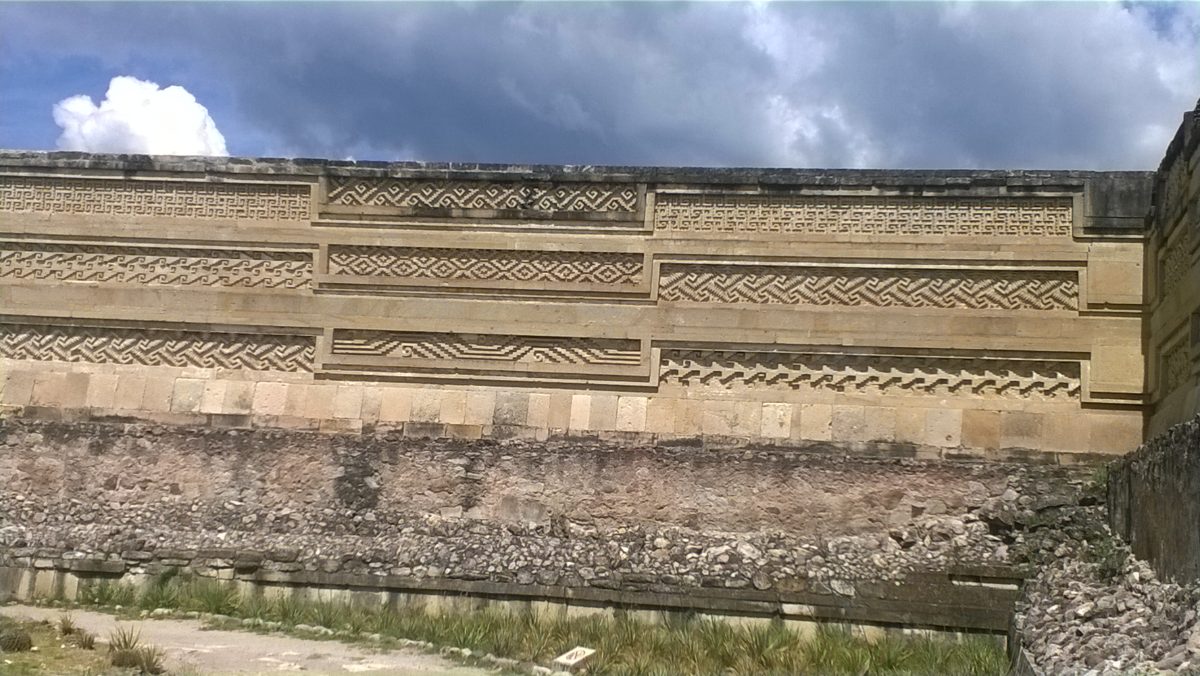
The Hall of the Columns, the most photographed structure in the Group of the Columns, consists of a long rectangular chamber whose roof was once supported by the six monolithic columns that give the building its name, opening onto a courtyard whose surrounding walls are covered almost entirely in mosaic fretwork panels, each composed of a distinct geometric design repeated with careful symmetry.
Passageways beneath and behind the Hall of the Columns lead to a series of cruciform tomb chambers, cross-shaped underground rooms that archaeologists believe served as burial places for high-status individuals, quite possibly including the powerful religious leaders discussed in the following section, their walls in some cases bearing traces of the same mosaic decoration found above ground.
The Palace Group’s overall design, arranging rooms and passages around enclosed courtyards rather than open public plazas, suggests a level of restricted access appropriate to a complex used primarily by religious elites and their attendants rather than a space intended for large public gatherings, reinforcing Mitla’s specialized function within the broader Zapotec religious landscape.
Quarrying and transporting six monolithic stone columns of this size would have required substantial coordinated labor, likely organized under direct priestly or royal authority, reflecting the same kind of centralized labor mobilization documented at other major Mesoamerican monumental construction projects, even though Mitla’s overall settlement was comparatively modest in population terms.
The absence of any surviving roof over the Hall of the Columns today, likely made of perishable wood and thatch supported by the stone columns and walls, means visitors currently see the space open to the sky, a common state for ancient Mesoamerican structures whose original wooden roofing elements rarely survive centuries of exposure the way stone walls do.
What Language Did the People of Mitla Speak?
Mitla’s population, both in antiquity and today in the surrounding modern town that shares its name, has long spoken Zapotec, specifically a variant belonging to the broader Zapotecan branch of the Oto-Manguean language family, the same linguistic family associated with nearby Monte Alban and the wider Oaxaca valley region.
Unlike some Mesoamerican sites where the spoken language of the ancient builders remains genuinely uncertain, Mitla offers a relatively strong case for linguistic continuity, since Zapotec has been spoken continuously in this specific valley from the Classic period through Spanish colonization and into the present day, with the modern town of Mitla itself remaining a significant center of Zapotec language and cultural identity in Oaxaca.
That said, Mitla’s Postclassic period saw increasing cultural and artistic influence from Mixtec-speaking populations migrating into the Oaxaca valley from the west, and some scholars debate how much this later Mixtec influence extended to language use among Mitla’s religious elite specifically, versus remaining primarily a matter of shared artistic conventions and religious practice layered onto a continuously Zapotec-speaking population.
Linguists studying modern Zapotec varieties spoken in and around Mitla note considerable dialectal diversity across the wider Oaxaca valley region, a reflection of the mountainous terrain that historically limited communication between neighboring Zapotec-speaking communities, even those separated by relatively short distances.
The Uija-tao: Priests Greater Than Kings
Perhaps Mitla’s most distinctive social feature was the extraordinary religious authority granted to its highest priest, known in Zapotec as the Uija-tao, sometimes translated as Great Seer, a figure whose spiritual authority colonial-era Spanish chroniclers described as rivaling or even exceeding that of secular Zapotec rulers, an unusual arrangement compared to many other Mesoamerican societies where king and high priest, while both powerful, rarely achieved such close parity.
According to colonial accounts drawing on earlier Zapotec tradition, the Uija-tao lived in near-total ritual seclusion at Mitla, communicating with subordinates through intermediaries and rarely appearing before ordinary people directly, a practice intended to preserve the sense of sacred distance appropriate to someone believed to communicate directly with ancestral and divine forces on behalf of the entire Zapotec people.
This concentration of supreme religious authority at Mitla, physically separate from the main political capital, first at Monte Alban and later at other Zapotec centers, helps explain why the site developed such a specialized architectural character focused so heavily on mortuary ritual and priestly residence rather than the broader mix of markets, residential neighborhoods, and civic administration found at typical Mesoamerican capitals.
Colonial Spanish chroniclers, drawing on testimony from Zapotec informants, compared the Uija-tao’s status to that of the Pope in Catholic Christendom, an analogy meant to convey the extraordinary degree of reverence and ritual authority the position commanded, even if the comparison inevitably simplifies a religious office rooted in an entirely different cosmological framework.
Succession to the office of Uija-tao likely followed specific hereditary or ritually determined criteria, though the precise mechanism recorded in surviving colonial accounts remains incomplete, another area where the loss of pre-Hispanic Zapotec textual sources leaves modern researchers dependent on necessarily imperfect secondhand colonial description.
Tombs, Ancestors, and the Zapotec Underworld
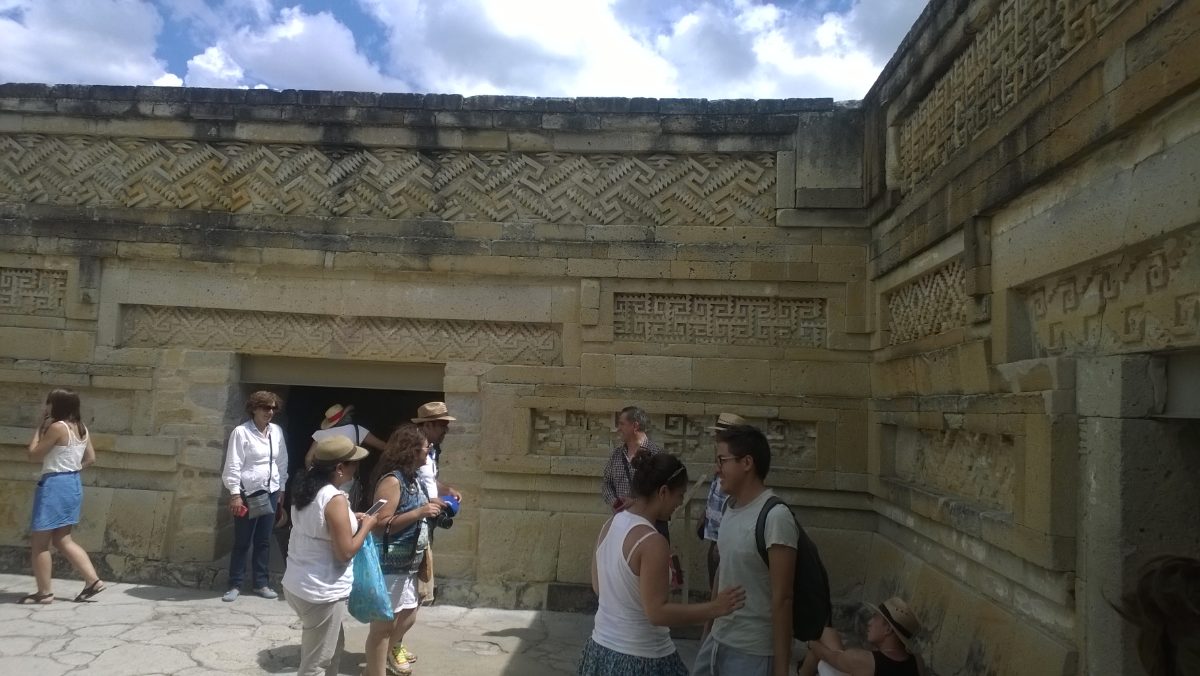
Zapotec religious belief held that Mitla functioned as a gateway between the world of the living and the underworld, a belief reflected directly in the site’s name and reinforced by its extensive network of tombs built specifically to house the remains of rulers and high priests who, in death, were thought to pass through Mitla on their journey to the afterlife.
Some colonial-era accounts describe a specific underworld deity associated with Mitla, sometimes identified with the Zapotec lord of the dead, though direct pre-Hispanic textual confirmation of specific deity names tied unambiguously to the site remains limited, another area where researchers must rely heavily on colonial-era ethnographic accounts filtered through Spanish missionary interpretation rather than uncontested indigenous sources.
Funerary offerings recovered from Mitla’s tombs, though many were looted long before systematic archaeological documentation began, include ceramic vessels, jade and shell ornaments, and other elite grave goods consistent with the broader Oaxaca valley tradition of elaborate ancestor veneration also documented extensively at Monte Alban’s own royal tombs.
Later Mixtec religious traditions, which increasingly influenced the Oaxaca valley during Mitla’s Postclassic peak, shared broadly similar concerns with death, ancestor veneration, and elaborate tomb construction, making it difficult in some cases to cleanly separate specifically Zapotec religious practice at Mitla from overlapping Mixtec influence during the site’s later centuries of use.
Looting of Mitla’s tombs began soon after Spanish conquest and continued intermittently for centuries afterward, meaning much of what modern archaeologists know about the original contents of these burial chambers relies on the comparatively small number of tombs that escaped disturbance long enough to be documented under controlled archaeological conditions.
A Church Built Atop the Ruins
Spanish missionaries arriving in the Oaxaca valley during the sixteenth century recognized Mitla’s continuing religious significance to local Zapotec communities and responded in a pattern common across colonial Mexico: building a Catholic church directly on or immediately beside the most important pre-Hispanic religious structure, in this case within the Church Group complex, deliberately asserting Christian authority over a site indigenous communities still regarded as sacred.
The result, still visible today, is one of Mexico’s most visually striking examples of colonial religious superimposition: an active Catholic church with mosaic-covered ancient Zapotec walls forming part of its own courtyard, a physical layering of two religious traditions that neither fully erased the other nor achieved simple coexistence, but instead created a genuinely hybrid sacred space still used and visited today.
This superimposition also inadvertently helped preserve some of the ancient mosaic stonework, since the church’s continued religious use protected the adjacent ancient walls from the kind of stone-robbing and agricultural clearance that damaged or destroyed less protected structures elsewhere at the site during the intervening centuries.
Similar patterns of colonial churches built directly atop pre-Hispanic religious structures appear at numerous sites across Mexico, a deliberate missionary strategy intended to physically and symbolically supplant indigenous sacred geography, though the degree of success in actually replacing local religious meaning varied considerably from community to community.
Visitors today can walk directly from the active church courtyard into the adjoining ancient mosaic-covered rooms, a transition that captures, in a single short walk, five centuries of layered religious history compressed into one continuously used sacred complex.
From Zapotec Capital’s Shadow to Mixtec Sanctuary
Mitla’s occupation and religious importance actually increased during the Postclassic period, precisely the era when Monte Alban, the dominant Zapotec political capital for centuries, was declining as a major population and administrative center, suggesting Mitla’s specialized religious function allowed it to maintain relevance even as the broader Zapotec political landscape shifted around it.
This period also saw growing Mixtec cultural influence throughout the Oaxaca valley, visible in artistic styles, ceramic types, and quite possibly changes in Mitla’s own ruling elite, as Mixtec-speaking groups expanded their political and cultural reach eastward from their traditional highland territories, sometimes through conquest and sometimes through more gradual cultural exchange and intermarriage with existing Zapotec populations.
By the time Spanish conquistadors arrived in the sixteenth century, Mitla functioned as an important religious center serving a population with both Zapotec and Mixtec cultural elements, its Uija-tao priesthood still commanding significant local authority even as the broader political structures that had once supported Monte Alban’s imperial reach had long since fragmented into smaller, competing Oaxaca valley polities.
Ceramic styles recovered from Mitla’s later occupation phases show a blending of Zapotec and Mixtec decorative conventions, a pattern of gradual cultural mixing rather than abrupt replacement, consistent with a scenario of intermarriage, trade, and shared religious practice between the two populations rather than one group simply displacing the other by force.
Some archaeologists have proposed that the Uija-tao priesthood itself may have continued functioning, in modified form, well into the period of increased Mixtec influence, suggesting a degree of religious institutional continuity that persisted even as broader political and artistic influences shifted considerably across the surrounding Oaxaca valley.
Rediscovery and Visiting Mitla Today
European scholarly interest in Mitla dates back centuries, with detailed descriptions and illustrations appearing in Spanish colonial accounts almost immediately after conquest, given how visually striking the mosaic facades were even to observers with no particular interest in preserving indigenous heritage for its own sake.
Systematic archaeological documentation intensified through the nineteenth and twentieth centuries, with researchers including Swiss-American anthropologist Adolph Bandelier producing detailed studies of the site’s architecture and tomb structures, work that helped establish Mitla’s place in the broader academic understanding of Zapotec and Oaxaca valley civilization alongside Monte Alban.
Today Mitla remains an easy day trip from the city of Oaxaca, and the adjacent modern town retains a strong Zapotec cultural identity, with local markets, textile traditions, and mezcal production connecting the ancient site to a living community rather than presenting Mitla purely as an isolated archaeological curiosity disconnected from the people who still consider this valley their home.
Bandelier’s late nineteenth-century survey work at Mitla was part of a broader wave of scientific interest in Mexican antiquities during that period, and his detailed measurements and drawings of the tomb chambers and mosaic facades remain useful reference material for archaeologists still studying the site’s construction sequence and preservation today.
Nearby Places to Explore
Mitla’s Zapotec religious role connects it closely to other major Oaxaca valley and central Mexican sites covered elsewhere on this site, each offering useful comparison points for understanding the broader arc of ancient Mexican civilization.
- Monte Alban: The Zapotec Capital Carved Into a Mountain
- Xochicalco: The Fortified Hilltop City of Feathered Serpents
- Teotihuacán: The Pyramid of the Sun and the Lost City of the Gods
Closing Thoughts
Mitla occupies a distinctive place among ancient Mexican cities precisely because it was never really designed to be a city in the conventional sense. Its purpose was narrower and, in some ways, more intense: a sanctuary for the Zapotec dead, governed by priests whose authority rivaled kings, decorated with a mosaic technique so labor-intensive and precise that no other Mesoamerican site ever matched it at comparable scale.
The colonial church still standing amid Mitla’s ancient walls captures something important about the site’s long afterlife, a place that has never stopped being sacred to the people living around it, even as the specific religious traditions layered onto that sacredness have changed dramatically across the centuries since the last Uija-tao presided over its courtyards.
You May Like
Mafra, the Palace a King Built From a Vow