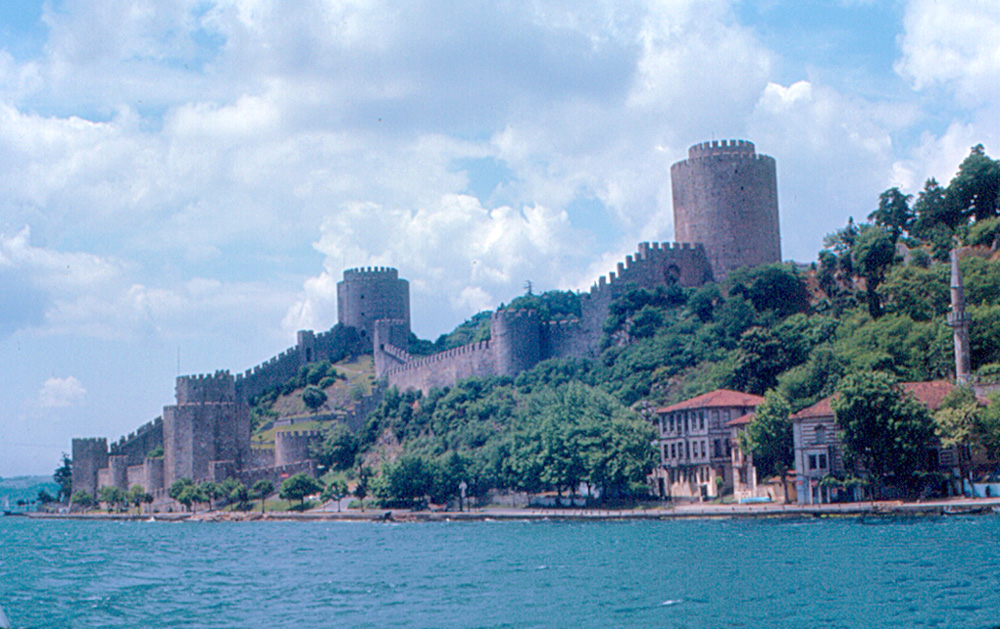
On the European shore of the Bosphorus, at the very point where that famous strait narrows to its slenderest width, there rises one of the most magnificent and historically momentous fortresses in the whole of the Ottoman world. Rumeli Hisarı, the Fortress of Rumelia, was built by the young Sultan Mehmed the Second, soon to be known to history as Mehmed the Conqueror, for a single overwhelming purpose, to cut the throat of the great city of Constantinople and to make possible its conquest by the armies of Islam.
In this article you are invited to explore the history and the architecture of this mighty stronghold, from its astonishingly rapid construction in the year 1452, through its decisive role in the fall of Constantinople and the end of the Roman empire, down to its later life as a customs post, a prison, and finally a beloved museum and concert venue. Rumeli Hisarı is a fortress that changed the course of world history, and its great towers still stand guard over the waters of the Bosphorus as they have done for more than five centuries.

In This Article
- The Strait-Cutter on the Bosphorus
- Mehmed the Conqueror’s Design
- Built in a Matter of Months
- Facing Anadolu Hisarı
- The Three Great Towers
- The Tower of Halil Pasha
- The Curtain Walls and Watchtowers
- Cannon over the Strait
- The Fall of Constantinople
- Customs Point and Prison
- The Mosque and the Garrison
- Fire, Earthquake, and Restoration
- Rumeli Hisarı Today
- Castles Nearby
- The Fortress that Conquered a City
The Strait-Cutter on the Bosphorus
The fortress of Rumeli Hisarı occupies one of the most strategically vital positions in the entire world, upon the European shore of the Bosphorus, the narrow strait that divides Europe from Asia and joins the Black Sea to the Sea of Marmara and the Mediterranean beyond. At the very point where the fortress stands, the strait narrows to a mere six hundred and sixty meters in width, and it was here, at this natural choke point, that Mehmed the Conqueror chose to build his great stronghold.
The Turkish name by which the fortress was originally known, Boğazkesen, captures its deadly purpose perfectly, for it means the strait-cutter, and the word carries also the sinister secondary sense of the throat-cutter. From this commanding position the fortress could dominate all traffic passing through the Bosphorus, cutting off the great city of Constantinople from the grain and supplies of the Black Sea, and severing the throat of the empire that Mehmed was determined to conquer. Rarely has a fortress been so precisely and so ruthlessly placed.
The Bosphorus has always been one of the most strategically important waterways in the world, the narrow hinge upon which the trade and the power of empires have turned for thousands of years. To control it is to hold the key to the passage between the Black Sea and the Mediterranean, between the grain lands of the north and the great cities of the south. Mehmed understood this perfectly, and in planting his fortress at the very narrowest point of the strait he seized that key with a decisiveness that would seal the fate of Constantinople.
Mehmed the Conqueror’s Design
The fortress was the creation of Sultan Mehmed the Second, a young man of extraordinary ambition, energy, and intelligence who had come to the Ottoman throne determined to accomplish what generations of his forebears had failed to achieve, the capture of Constantinople, the ancient capital of the Roman empire of the East. The building of Rumeli Hisarı in the year 1452 was the first great move in this campaign, a deliberate and unmistakable declaration of his intent to take the city.
Mehmed is said to have taken a personal hand in the design of the fortress, sketching out its plan and driving forward its construction with relentless energy. The stronghold he created was not merely a fortress but a strategic masterpiece, precisely engineered to serve the single purpose of the conquest. In its conception and its execution, Rumeli Hisarı reveals the mind of one of the greatest commanders and statesmen of the age, a ruler who would earn, by the taking of Constantinople, the immortal title of the Conqueror.
Mehmed the Second was only about twenty years old when he ordered the building of Rumeli Hisarı, yet he already possessed a strategic vision and a force of will that would have done credit to a far older and more experienced ruler. His determination to take Constantinople, a goal that had eluded the Ottomans and their predecessors for centuries, bordered on obsession, and the fortress was the first concrete expression of that iron resolve. In it we see the mind of a young man who would reshape the map of the world and bring an age of history to a close.

Built in a Matter of Months
One of the most astonishing things about Rumeli Hisarı is the sheer speed with which it was built. Construction began on the fifteenth of April in the year 1452, and the great fortress, with its mighty towers and its long curtain walls, was raised in a matter of only a few months, a feat of organization and labor that amazed contemporaries and still amazes us today. Thousands of workers and craftsmen were assembled for the task, and the whole resources of the Ottoman state were thrown into the effort.
This breathtaking speed of construction was itself a demonstration of Ottoman power, a message to the beleaguered defenders of Constantinople that the might of the sultan was overwhelming and his determination absolute. The three great viziers of the empire were each given charge of one of the main towers, and they competed to complete their sections first, driving the work forward at a furious pace. That so vast and so solid a fortress could be raised so quickly was a marvel of the age, and a chilling omen for the doomed city across the water.
The competition between the three viziers to complete their towers first was more than a mere spur to speed; it was a characteristically shrewd stroke of management by the young sultan, who understood how to harness the ambition and rivalry of his great men to serve his purposes. By dividing the work and setting his viziers against one another, Mehmed ensured that no effort would be spared and no time wasted. The result was one of the most rapid feats of major construction in the whole history of fortification, a fortress raised in a single building season.
Contemporary accounts of the building of Rumeli Hisarı speak with wonder of the scale of the effort, of the thousands of masons and laborers gathered from across the empire, and of the stone and timber and lime brought together in vast quantities to feed the work. The whole apparatus of the Ottoman state was bent to the single task, and the result was a fortress of the first rank completed in a single building season. Nothing could have proclaimed more clearly the resolve of the young sultan or the might of the empire he commanded.

Facing Anadolu Hisarı
The position of Rumeli Hisarı was chosen with great care, for it stood directly opposite an older Ottoman fortress on the Asian shore, the Anadolu Hisarı, which had been built some sixty years earlier by Sultan Bayezid the First. With the completion of Rumeli Hisarı, the two fortresses faced one another across the narrowest point of the strait, and between them they could seal the Bosphorus completely, closing it to any ship that did not have the sultan’s leave to pass.
This coordinated system of two fortresses, one on each shore, gave the Ottomans absolute control over the vital waterway. No vessel could now pass up or down the Bosphorus without coming under the guns of one or both strongholds, and the great city of Constantinople, which depended upon the Black Sea trade, was thus cut off from a vital source of its strength. The building of Rumeli Hisarı to complement the older Anadolu Hisarı completed the strangulation of the imperial city and set the stage for the final assault.
The older fortress of Anadolu Hisarı, built by Mehmed’s great-grandfather Bayezid the Thunderbolt, had long given the Ottomans a foothold on the Asian shore of the strait, but alone it was not enough to close the Bosphorus completely. It was the addition of Rumeli Hisarı on the European side, directly opposite, that transformed the situation, creating a crossfire that no ship could hope to run. The pairing of the new fortress with the old was a masterstroke of strategic planning, completing a work of encirclement begun generations before.
From the water, the sight of the two fortresses facing one another across the narrow strait must have been deeply intimidating to any sailor, a visible gate of stone and cannon barring the way through the Bosphorus. The narrowness of the channel at this point meant that no ship could pass out of range of the guns, and the crossfire of the two fortresses turned the strait into a deadly funnel. It was a system of control as elegant as it was ruthless, and it achieved its purpose completely, sealing the fate of the city that depended upon the open passage of the strait.

The Three Great Towers
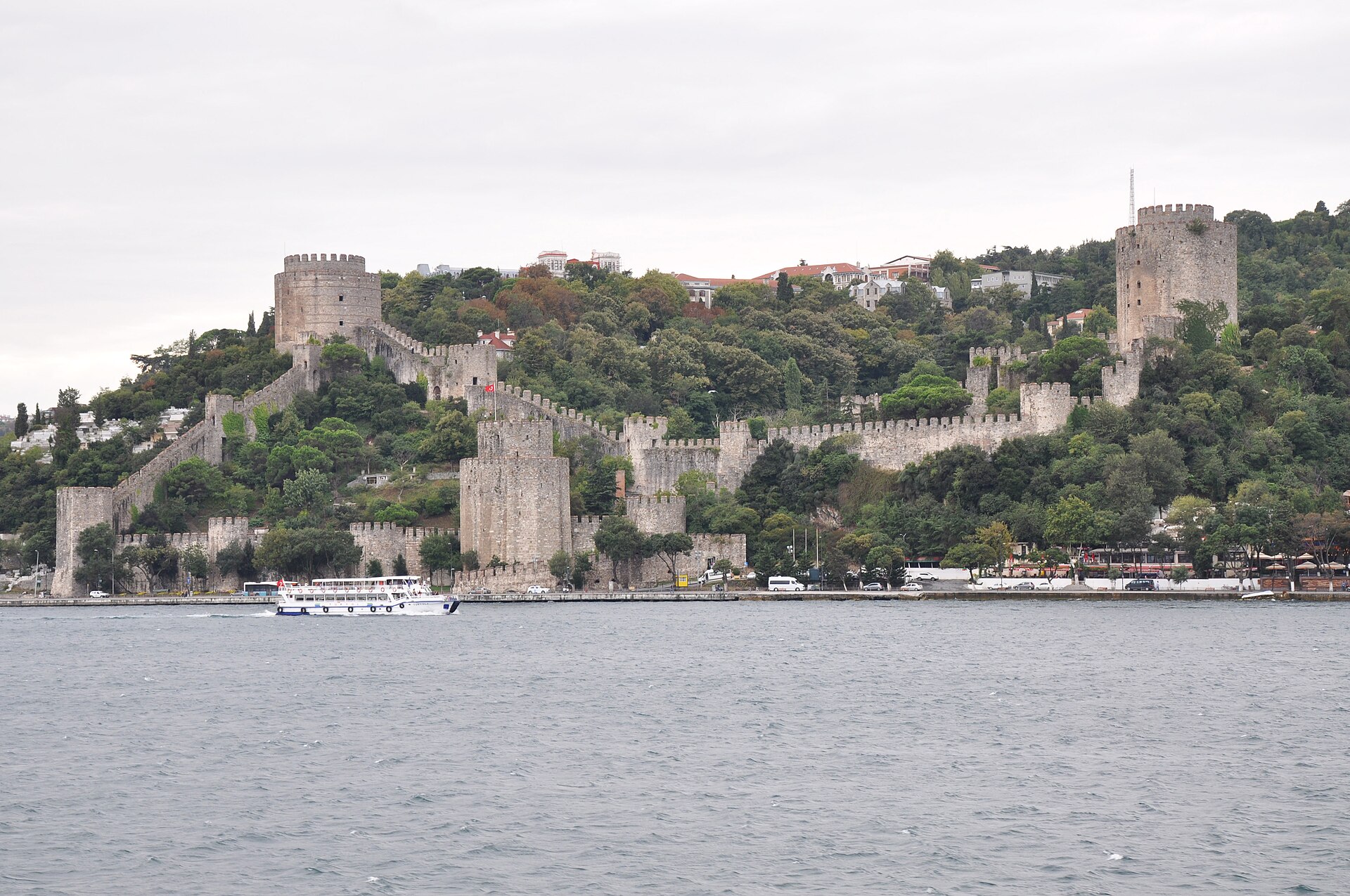
The most imposing features of Rumeli Hisarı are its three great main towers, massive cylindrical and polygonal structures that anchor the corners of the fortress and dominate the whole complex. Each of the three was named after one of the great viziers of the empire who was charged with its construction, and their competition to finish first drove the astonishing speed of the building. The towers are named for Halil Pasha, Saruca Pasha, and Zaganos Pasha, the leading men of Mehmed’s court.
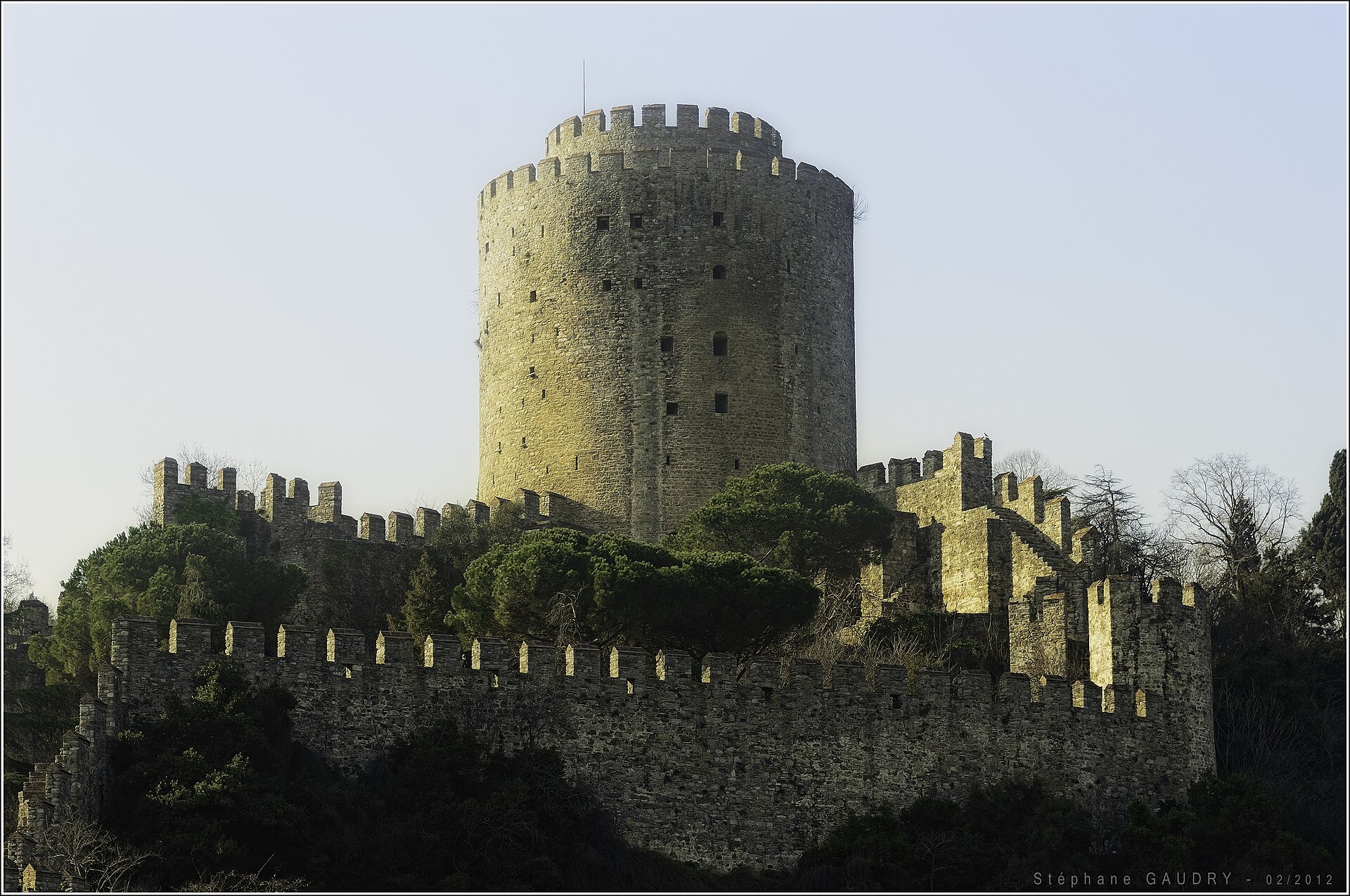
These towers are structures of tremendous size and strength, rising more than twenty meters in height, with walls in places more than six meters thick, and containing many stories within their great drums of masonry. Their conical roofs, originally covered in lead, once gave them an even more striking silhouette against the sky. Standing at the corners of the fortress, linked by the curtain walls, the three great towers form one of the most impressive groupings of military architecture anywhere in the Ottoman world, a monument to the power and the ambition of the young conqueror.
The naming of the three great towers after the viziers who built them has preserved the memory of these powerful men into our own day, and it reflects the collaborative yet competitive nature of the great enterprise. Halil Pasha, the grand vizier, was the most senior of the three, an experienced statesman who had served Mehmed’s father; Saruca and Zaganos were rising men of the new sultan’s own circle. In the towers that bear their names, the personalities and rivalries of Mehmed’s court are, in a sense, frozen in stone, a lasting record of the men who made the conquest possible.
The differing shapes of the towers, some cylindrical and one polygonal, and their varying dimensions, reflect the individual approaches of the three viziers who built them and the specific defensive roles each was intended to play. The largest of them measures more than twenty-six meters across, a colossal drum of masonry that could withstand any assault the age could bring against it. To walk among these giants, craning the neck to take in their full height, is to feel the awesome scale of the ambition that raised them, and the vast power of the empire that Mehmed commanded.

The Tower of Halil Pasha
Of the three great towers, it was the Tower of Halil Pasha, standing at the water’s edge, that played the most directly deadly role in the fortress’s purpose. This massive polygonal tower, rising some twenty-two meters with walls more than six meters thick, was positioned to command the strait itself, and it was here that the great cannon were mounted that could fire upon any ship attempting to pass through the narrows below. From this tower the fortress projected its lethal power out over the water.
The great guns of Rumeli Hisarı represented the cutting edge of the military technology of the age, for Mehmed the Conqueror was a pioneer in the use of heavy artillery, and it was his massive cannon that would ultimately breach the ancient walls of Constantinople itself. Mounted in the Tower of Halil Pasha, these guns turned the fortress into an instrument of blockade of terrifying effectiveness, able to sink any vessel that dared to defy the sultan’s control of the strait. The tower was the sharp edge of the strait-cutter’s blade.
The revolution in siege warfare brought about by heavy artillery, of which Mehmed was one of the great pioneers, is central to the story of Rumeli Hisarı and of the conquest it made possible. The same mastery of the new gunpowder technology that allowed the fortress to sink ships in the strait would soon be turned, on a far greater scale, against the ancient land walls of Constantinople, which had defied every attacker for a thousand years. In the guns of the strait-cutter we glimpse the dawn of a new age of warfare, in which stone walls, however mighty, could no longer guarantee safety.
It is worth noting the tragic footnote that the grand vizier Halil Pasha, whose name is borne by the waterfront tower, did not long survive the conquest he had helped to make possible, for he was executed by Mehmed shortly after the fall of the city, having fallen under suspicion of being too cautious and too friendly to the Byzantines. The tower that bears his name thus commemorates a man whose fate was bound up, in the most personal way, with the great events in which the fortress played so central a part.

The Curtain Walls and Watchtowers
The three great towers of Rumeli Hisarı were linked together by long curtain walls, forming a great enclosure that climbed the steep slope from the water’s edge up the hillside behind. These walls were studded with a number of smaller towers and watchtowers, thirteen in all, from which sentries could keep watch and defenders could bring their fire to bear. The whole formed a complete and formidable defensive system, enclosing an area of more than thirty thousand square meters.
The outer walls of the fortress extended some two hundred and fifty meters from north to south, and varied in width from fifty to a hundred and twenty-five meters as they climbed the slope. Within this great enceinte were housed the garrison, the mosque, and the various buildings needed to support the fortress in its work. The scale and the solidity of the walls, like those of the towers, reflected the vast resources that Mehmed poured into the project, determined that his strait-cutter should be utterly impregnable and utterly dominant over the vital waterway it guarded.
The way in which the fortress climbs the steep hillside from the water’s edge, its walls and towers stepping up the slope, adds greatly to its dramatic and picturesque effect, and it also served a practical defensive purpose, giving the upper works a commanding position over the lower. The engineers who laid out the fortress made skillful use of the terrain, adapting their design to the contours of the ground so as to maximize both the strength and the imposing appearance of the whole. The result is a stronghold that is as impressive to behold as it was formidable to attack.

Cannon over the Strait
The deadly effectiveness of Rumeli Hisarı as an instrument of blockade was demonstrated dramatically soon after its completion, in an incident that became famous throughout the Christian world. A Venetian ship, commanded by a captain named Antonio Rizzo, attempted to sail through the strait without stopping in defiance of the sultan’s orders, trusting perhaps that the fortress would not dare to fire upon the flag of Venice. It was a fatal miscalculation.
The great cannon of the fortress opened fire, and with a single well-aimed shot the Venetian ship was sunk in the waters of the Bosphorus. The survivors who reached the shore were put to death, and the unfortunate captain, Antonio Rizzo, was impaled and his body set up as a grim warning to any other mariner who might think to defy the guns of the strait-cutter. The message was unmistakable, and it was heard across Europe, that the sultan now controlled the Bosphorus absolutely, and that the days of Constantinople were numbered.
The fate of Antonio Rizzo and his ship sent a wave of alarm through the maritime states of Europe, and above all through Venice and Genoa, whose trade depended upon free passage through the Bosphorus. It demonstrated beyond any doubt that the balance of power in the region had shifted decisively, and that the Ottomans were now the undisputed masters of the strait. The incident was a grim overture to the tragedy of the following year, a clear signal that Mehmed would stop at nothing in his determination to bring down the ancient city of Constantinople.
The episode of the Venetian ship also revealed the character of Mehmed himself, a ruler capable of both brilliant strategy and ruthless cruelty, who understood the value of a terrible example. By making a public spectacle of the fate of those who defied him, he ensured that his control of the strait would be respected without the need to fire another shot. It was a lesson in the psychology of power, delivered with chilling effectiveness, and it left no doubt in any mind that the strait now belonged to the sultan alone.

The Fall of Constantinople
With the Bosphorus sealed by his two fortresses and the great city cut off from the Black Sea, Mehmed the Conqueror was ready for the final assault. In the spring of the year 1453 he brought his great army, his fleet, and his enormous cannon against the ancient walls of Constantinople, and after a siege of some seven weeks, on the twenty-ninth of May, the city fell to the Ottoman assault. The thousand-year Roman empire of the East, the last living link to the classical world, came to its end.
The role of Rumeli Hisarı in this world-changing event had been decisive, for it was the fortress that had made the blockade possible and had prevented the city from being relieved or supplied by sea from the north. The fall of Constantinople sent a shock through the whole of Christendom and marked, for many historians, the very end of the Middle Ages and the dawn of a new age. And at the heart of that momentous event stood the strait-cutter, the fortress that Mehmed had raised in a matter of months to cut the throat of the imperial city.
The fall of Constantinople in 1453 is one of the great turning points of world history, an event whose reverberations were felt across the whole of Europe and the Near East, and which is often taken to mark the boundary between the medieval and the modern ages. The city that had been the capital of the Roman world for more than a thousand years became the capital of the Ottoman empire, and the young Mehmed, at the age of just twenty-one, earned forever the title of the Conqueror. And the fortress that had made it all possible stood in silent triumph upon the shore of the strait it had sealed.
For the defenders of Constantinople, watching the great fortress rise across the water in the summer of 1452, the message was one of doom, for they understood that it could have only one purpose. The Byzantine emperor protested, but he was powerless to prevent the building, and the completion of the strait-cutter left his city isolated and all but doomed. The story of Rumeli Hisarı is thus inseparable from the tragedy of Constantinople, the two bound together as cause and effect in one of the great dramas of history.
Customs Point and Prison
Once Constantinople had fallen and become the new capital of the Ottoman empire, the great fortress of Rumeli Hisarı lost its original purpose, for there was no longer a hostile city to blockade. But its commanding position on the strait ensured that it continued to serve the empire in new ways. For a time it functioned as a customs checkpoint, controlling and taxing the shipping that passed up and down the Bosphorus, a peaceful continuation of its old role as master of the strait.
Later the fortress was put to a grimmer use, serving as a prison, particularly for foreign prisoners of war and for prisoners of state. Its massive towers, so hard to escape from, made it well suited to this purpose, and many an unfortunate captive languished within its walls over the centuries. The fortress that had been built to bring down an empire thus settled into a long and quieter afterlife as a customs post and a prison, its great guns silent, its walls now guarding prisoners rather than commanding the strait.
There is a certain irony in the peaceful afterlife of a fortress built for so violent and momentous a purpose, but it is the common fate of great strongholds to outlive the wars that called them into being. Rumeli Hisarı, having accomplished the one great task for which it was created, found itself, like so many fortresses, gradually reduced to more mundane duties as the world moved on around it. Yet even in its role as customs house and prison, the fortress remained a potent symbol of the conquest and of the might of the empire that Mehmed had raised to greatness.

The Mosque and the Garrison
Like any great Ottoman fortress, Rumeli Hisarı was not merely a collection of walls and towers but a complete military community, with everything its garrison required for daily life. Within the walls the sultan endowed a mosque, so that the soldiers might perform their prayers, and there were wooden quarters to house the men of the garrison. The fortress was defended by a battalion of some four hundred janissaries, the elite infantry of the Ottoman army, under the command of the fortress’s governor.
The janissaries who garrisoned the fortress were among the finest soldiers of their age, a disciplined and formidable corps that formed the backbone of Ottoman military power. Stationed in the strait-cutter, they manned the walls and the towers, tended the great guns, and enforced the sultan’s absolute control over the passage of the Bosphorus. The mosque at the heart of the fortress reminded them, amid their martial duties, of the faith in whose name the great conquest was undertaken, and gave the stronghold the character of a religious as well as a military community.
The janissaries who formed the garrison of Rumeli Hisarı belonged to one of the most remarkable military institutions in all of history, a corps of professional soldiers recruited and trained from boyhood who owed their loyalty directly to the sultan. For centuries the janissaries were the terror of the empire’s enemies and the backbone of its armies, and their presence in the strait-cutter reflects the importance that Mehmed attached to the fortress. To be posted here, at the very hinge of the great campaign against Constantinople, was to stand at the cutting edge of Ottoman ambition.
The little mosque within the walls, endowed by the sultan himself, still survives in part today, and its minaret rises among the towers as a reminder of the religious dimension of the great enterprise. For Mehmed and his soldiers, the conquest of Constantinople was not merely a matter of empire but of faith, the fulfillment of a long-cherished ambition of the Islamic world, and the mosque at the heart of the strait-cutter gave expression to that spiritual purpose amid all the martial business of the fortress.
Fire, Earthquake, and Restoration
Over the long centuries of its existence, Rumeli Hisarı suffered its share of damage from the natural disasters that periodically strike the region. A great earthquake in the year 1509 inflicted substantial harm upon the fortress, though it was afterward repaired, and in 1746 a fire destroyed the wooden components of two of the great towers. Later sultans, including Selim the Third, undertook repairs to keep the ancient fortress in good order, even as its military importance faded away.
The most important modern chapter in the fortress’s history came in the 1950s, when the Turkish state undertook a major program of restoration. In 1953 the people who had come to live within the walls were relocated, and between 1955 and 1958 the fortress was extensively restored to something approaching its original condition. This great work of conservation rescued the strait-cutter from decay and prepared it for its new role as one of the treasured historic monuments of the city of Istanbul.
The careful restoration of the fortress in the twentieth century reflects the deep place that Rumeli Hisarı holds in the national memory of Turkey, as the very symbol of the conquest that founded Ottoman Istanbul. To the Turkish people the fortress is not merely an old building but a monument to one of the defining moments of their history, and its preservation was a matter of national pride. The work of the 1950s rescued this precious monument from the neglect of centuries and ensured that it would stand for generations to come as a witness to the age of the Conqueror.
Today the visitor to Rumeli Hisarı benefits from that great work of restoration, walking among towers and walls that have been carefully consolidated and preserved, able to climb the ramparts and to appreciate the scale and the ingenuity of the fortress much as it appeared in the days of the Conqueror. The restoration struck a careful balance between preserving the authentic historic fabric and making the fortress safe and accessible, and it stands as a model of the sensitive conservation of a great historic monument.

Rumeli Hisarı Today
Since the year 1960, the great fortress of Rumeli Hisarı has served as a museum, its towers and walls open to the many visitors who come to explore this remarkable monument of Ottoman history. Within its walls, an open-air setting of extraordinary atmosphere, concerts, art festivals, and cultural events are held during the warmer months, so that the fortress that was built to destroy a city has become a place of music and celebration, one of the beloved cultural venues of modern Istanbul.
The setting of the fortress, upon the shore of the Bosphorus at its narrowest point, is one of the most beautiful in all of Istanbul, and today the great Fatih Sultan Mehmet Bridge, named after the conqueror himself, soars across the strait just to the north, linking the two continents that the fortress once divided. So iconic is Rumeli Hisarı that it appeared for many years upon the banknotes of the Turkish Republic, a fitting honor for a fortress so bound up with the history of the nation.
To stand within the walls of Rumeli Hisarı today, with the blue waters of the Bosphorus sparkling below and the great bridge soaring overhead, is to feel the full drama of the history that unfolded here, when a young sultan raised a fortress in a matter of months to bring down the greatest city of the age. The strait-cutter has long since laid aside its deadly purpose, but it has lost none of its power to stir the imagination, and it remains one of the most evocative and magnificent monuments of the whole Ottoman achievement.
The transformation of Rumeli Hisarı from an instrument of war into a place of music and culture is a fitting and hopeful conclusion to its long story, and it reflects the way in which the monuments of a violent past can find new meaning in more peaceful times. Where once the great guns thundered over the strait, now the strains of concerts drift out over the water on summer evenings, and where janissaries once stood watch, visitors from all over the world now wander in wonder. The strait-cutter has become a place of beauty and delight, without losing any of its power to evoke the drama of its past.
If you would like to see exactly where this famous fortress stands upon the map, you can find it here:
View on Google Maps: 41.085, 29.0556
From its commanding position at the narrowest point of the Bosphorus, Rumeli Hisarı has watched over the strait it was built to master for more than five hundred years, and it watches over it still.

Castles Nearby
If Rumeli Hisarı has drawn you into the age of the Ottomans and the great fortresses of the East, you may enjoy these other remarkable strongholds:
- Van Fortress: The Ancient Citadel of Urartu
- Belgrade Fortress: The Kalemegdan Stronghold at the Confluence
The Fortress that Conquered a City
Rumeli Hisarı is one of the great fortresses of the world, a stronghold whose construction was a decisive act in one of the most momentous events in all of history, the fall of Constantinople and the end of the thousand-year Roman empire of the East. Its mighty towers and curtain walls, raised in a matter of months by the will of a young sultan, still stand upon the shore of the Bosphorus as an enduring monument to the ambition and the genius of Mehmed the Conqueror.
If you should visit Istanbul, the fortress of Rumeli Hisarı is one of the great sights of the city, a place where the drama of the conquest comes vividly to life amid the towers and walls that made it possible. From the ramparts the view over the sparkling waters of the Bosphorus, with the great bridge soaring overhead and the ships passing far below, is unforgettable. Rumeli Hisarı is a fortress that conquered a city and changed the world, and it deserves a place among the most famous strongholds in all of history.
Whether you come for the epic history of the conquest, for the magnificent architecture of the towers and walls, or simply for the incomparable views over the Bosphorus, Rumeli Hisarı will reward your visit, and you will carry away the memory of this mighty fortress, standing guard over the strait it was built to master, as one of the great experiences of any journey to the enchanting city of Istanbul.
You May Like
Fort San Pedro: The Oldest Fort in the Philippines