Northeast of modern Mexico City, in a high mountain valley, lie the ruins of one of the greatest cities the ancient world ever produced. At its height around the middle of the first millennium, Teotihuacan covered some twenty square kilometres and housed perhaps a hundred thousand people or more, making it one of the largest cities anywhere on earth at the time. Down its central avenue march colossal pyramids, and around them once spread a planned grid of apartment compounds, workshops, and painted temples.
The most haunting thing about Teotihuacan is how much remains unknown. We do not know what its builders called themselves, what language they spoke, or how they governed. The very name is not their own but a later Aztec word meaning, roughly, the place where the gods were created. Centuries after the city fell, the Aztecs came upon its ruins and, awed, believed the present age of the world had begun there. Its true history is still being pieced together from stone, paint, and bone.

Table of Contents
- A City of the Gods
- The Avenue of the Dead
- The Pyramid of the Sun
- The Pyramid of the Moon
- The Feathered Serpent
- Carved Facades
- Painted Walls
- Life in the Apartment City
- Collapse and Legacy
- Getting There
- Nearby Places
- Closing Thoughts
A City of the Gods
Teotihuacan arose in the Valley of Mexico around the beginning of the common era and grew explosively over the following centuries. By around 400 to 500 it was a true metropolis, its influence radiating across Mesoamerica, its goods and art reaching as far as the Maya cities of the south.
The scale of the place is staggering even in ruin. A great ceremonial avenue runs for kilometres, flanked by monumental architecture, while beyond it once stretched a dense urban fabric. This was not a mere ceremonial centre but a functioning city of craftsmen, traders, farmers, and priests.

The Avenue of the Dead
The spine of the city is the great thoroughfare the Aztecs later called the Avenue of the Dead, mistaking the platforms along it for tombs. Running roughly north to south, slightly off the cardinal points in a deliberate orientation, it organized the entire urban plan around a sacred axis.
Along its length stand temples, platforms, and plazas, culminating at each significant point in a major monument. To walk it is to move through a landscape designed to overwhelm, a processional way built on a superhuman scale.

The Pyramid of the Sun
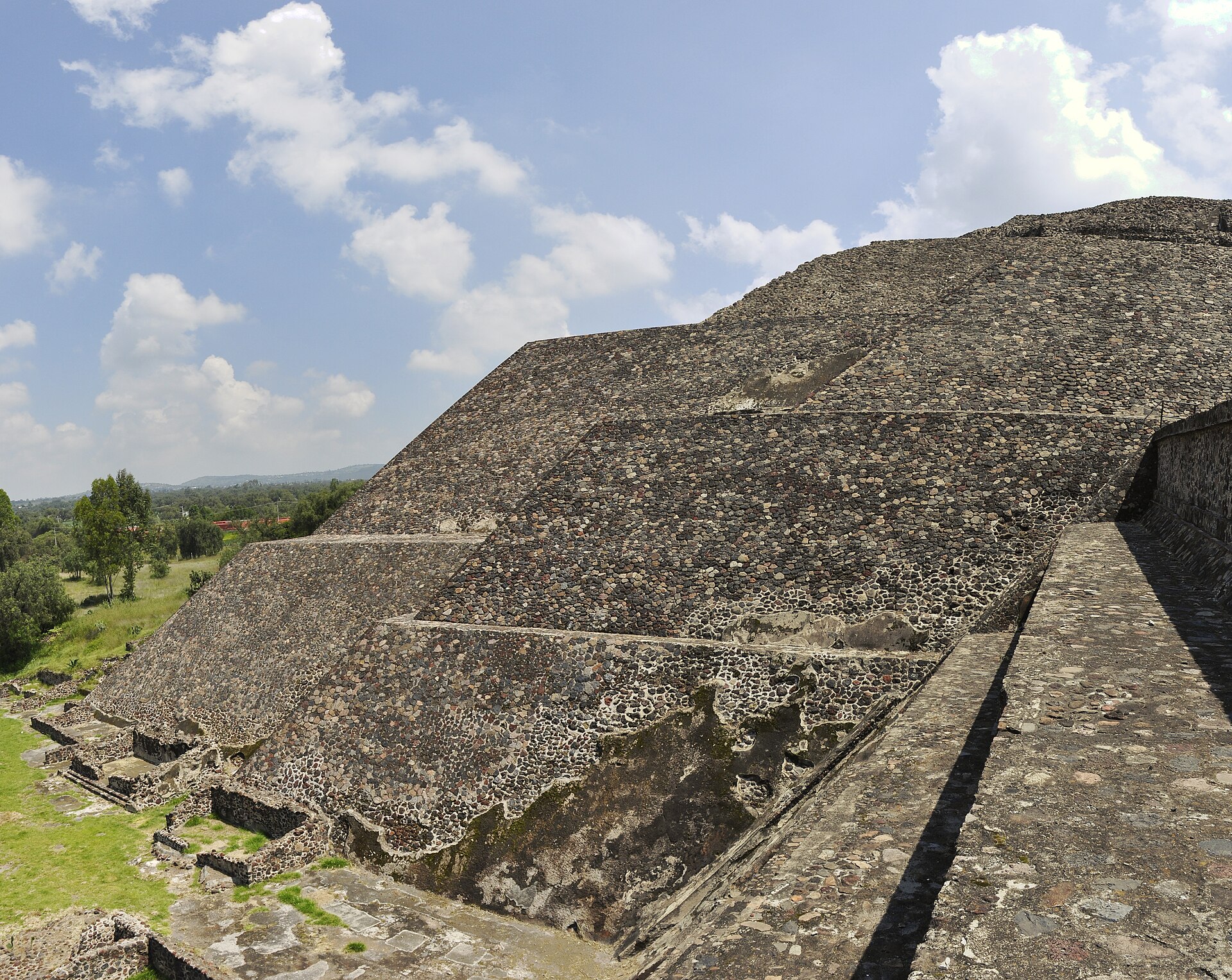
Dominating the eastern side of the avenue is the Pyramid of the Sun, one of the largest structures in the pre-Columbian Americas and among the biggest pyramids anywhere. Rising in stepped tiers to over sixty metres, it was built largely in a single great campaign early in the city’s history.
Beneath it, archaeologists discovered a cave and tunnel that may have held profound religious meaning, perhaps as a place of origin or emergence. The pyramid was the ritual heart of the city, its bulk still commanding the valley today.
The Pyramid of the Moon
At the northern end of the avenue stands the Pyramid of the Moon, smaller than the Sun but no less important, framed by the mountain behind it in a deliberate echo of the natural landscape. Its plaza was a focus of ceremony, and excavations within it have revealed successive stages of construction.
Buried inside and around the pyramid, archaeologists found the remains of sacrificial victims, human and animal, along with rich offerings. These discoveries have shed grim but valuable light on the rituals that accompanied the building of the monument.
The Feathered Serpent
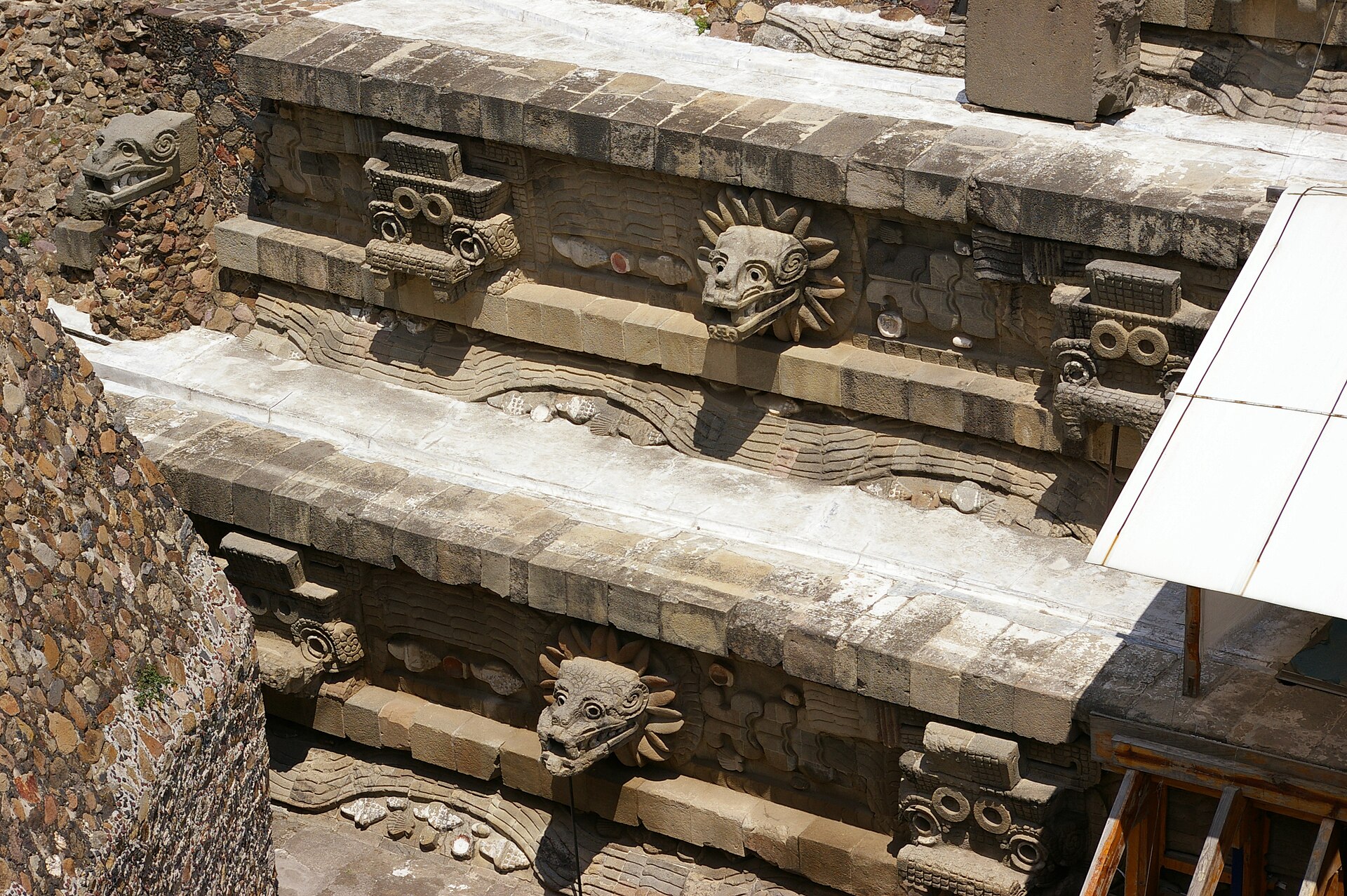
South along the avenue lies the Ciudadela, a vast sunken plaza enclosing the Temple of the Feathered Serpent. Its facades are carved with alternating heads of the plumed serpent and another emblem often linked to storms or war, projecting from the stone in one of the great sculptural programs of Mesoamerica.
Beneath and around this temple, excavators uncovered the remains of many sacrificed individuals, apparently warriors, buried when it was built. The Feathered Serpent, later known to the Aztecs as Quetzalcoatl, was among the most enduring deities of the region.
Carved Facades
The sculpture of the Feathered Serpent temple is among the finest surviving from Teotihuacan. The great tenoned heads, once brightly painted, thrust out from a stepped facade decorated with marine imagery, creating an effect both fearsome and sacred.
Such carving shows the sophistication of Teotihuacan’s artists and the theological ambition of its rulers. The building fused political and religious authority in stone, a statement of power at the ceremonial core of the city.

Painted Walls
Away from the great pyramids, Teotihuacan was a city of colour. Its many residential compounds and temples were covered in murals painted in vivid reds, greens, and yellows, depicting deities, priests, animals, and paradisiacal scenes. These paintings are among the most important bodies of ancient American art.
The murals give a rare glimpse into the beliefs and imagination of a people who left no readable texts. Processions of figures, mythical creatures, and ritual imagery speak of a rich cosmology, even if its precise meanings remain debated.

Life in the Apartment City
Most of Teotihuacan’s population lived in large walled compounds, each housing many families around shared courtyards. These apartment complexes, laid out on the city’s grid, provided a remarkable degree of urban planning, with drainage and defined neighbourhoods.
Some districts were home to people from other regions of Mesoamerica, including Oaxaca and the Maya area, making Teotihuacan a genuinely cosmopolitan city. Workshops producing obsidian tools and pottery underpinned an economy that traded across the ancient world of Mexico.

Collapse and Legacy
Sometime in the sixth or seventh century, Teotihuacan suffered a violent upheaval. The central monuments were burned, and the city’s power collapsed, whether through internal revolt, environmental stress, or some combination. Its population dwindled and dispersed.
Yet its influence long outlived it. Later peoples, above all the Aztecs, revered the ruins as sacred and drew on Teotihuacan’s imagery and prestige. Its greenstone masks and its gods echoed through Mesoamerican civilization for centuries after the city itself lay silent.

Getting There
Teotihuacan lies about fifty kilometres northeast of central Mexico City, an easy day trip by bus or car. The site is extensive, with the pyramids, the avenue, the Ciudadela, and several mural-bearing compounds open to visitors, along with an on-site museum.
The site stands at approximately 19.6925, -98.8438. You can open the exact location on Google Maps for directions to the pyramids of Teotihuacan.
Nearby Places
Closing Thoughts
Teotihuacan confronts us with a paradox: a city so vast, so planned, and so influential, yet whose builders remain in many ways anonymous. Its pyramids are among the largest ever raised, its art among the richest of the ancient Americas, and its reach spanned a continent.
That the Aztecs, coming upon its ruins centuries later, took it for the birthplace of the gods is a fitting tribute. Teotihuacan stands as one of humanity’s great urban achievements, a monument to a civilization we are still learning to understand.
You May Like
Mafra, the Palace a King Built From a Vow


2 thoughts on “Teotihuacan: The City of the Gods and Its Colossal Pyramids”